
You launch two ads. One pulls more clicks, the other pulls more purchases, and a week later you’re staring at Ads Manager trying to decide which one deserves the budget. Most people go with their gut. That’s a guess, and guesses get expensive.
Facebook ads A/B testing takes the guesswork out by running two versions against each other under controlled conditions, so any gap in results comes from the thing you changed and not from luck. It matters more now than it used to. Marketing Brew’s October 2026 report on Meta’s earnings notes that the average price per ad on Meta rose 12% year over year in both Q1 and Q2. When every impression costs more, a wrong call costs more too.
This guide covers what to test, how to set up an experiment in Meta Ads Manager, how long to run it, which metrics deserve your trust, and where the method falls short. You’ll finish it knowing how to run tests that give you answers you can act on.
Table of Contents
What Is Facebook Ads A/B Testing?
Facebook ads A/B testing is a controlled experiment where you change one variable between two or more ad versions and let Meta split your audience between them, so you can see which version performs better against a goal you picked in advance. Because Meta keeps the groups separate, nobody sees more than one version.
You’ll also hear it called Facebook ads split testing. Same idea, different label.
Understanding the Basics of A/B Testing
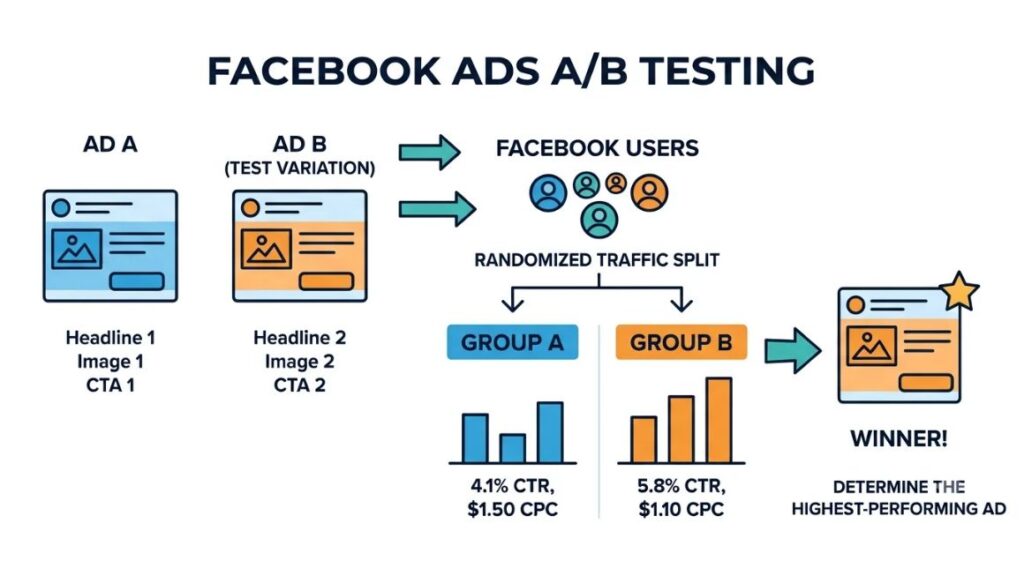
The logic is older than online ads. Version A goes up against version B, everything else stays the same, and the better performer wins.
Take an online clothing store. Version A uses a clean product photo of a jacket. Version B shows someone wearing that jacket on a busy street. Both ads go to the same audience, run on the same budget and share the same objective, which is purchases. The goal is to find out which image generates more purchases at a cost the store can live with.
That’s a hypothetical, and real tests get messier. The shape never changes, though.
How A/B Testing Works in Facebook Advertising
Inside Ads Manager, the A/B test tool sits with Meta’s other experiment tools. You choose what to compare, such as two creatives, two audiences or two placements, and Meta divides your target audience into random groups that don’t overlap. Each person sees one version only.
Then you pick a winning metric and a schedule. When the test ends, Meta reports a result along with a confidence level, which is its estimate of how likely you’d see the same winner if you ran the test again.
The Difference Between A/B Testing and Regular Ad Testing
Regular testing usually means two ad sets side by side and a lot of dashboard watching. It feels scientific. It isn’t. Both ad sets can chase the same people in the same auction, so they end up competing with each other, and whichever one Meta’s delivery system favours early tends to look better for reasons that have nothing to do with the ad itself.
A/B testing Facebook ads through the built-in tool removes that overlap by design. Think of it as the difference between a fair race and two runners sharing one lane.
Facebook ads A/B testing compares two or more ad versions by changing a single variable and splitting the audience into non-overlapping groups. Because each person sees only one version, the result reflects the change you made rather than audience overlap. Regular side-by-side ad sets don’t offer that protection.
Why Is Testing Important for Facebook Advertising Campaigns?
Testing matters because audiences rarely behave the way marketers expect, and every wrong assumption gets paid for in ad spend. A controlled test swaps opinion for evidence. That cuts waste and gives you decisions you can defend.
The money side is getting hard to ignore. Meta says its own analysis of more than one million campaigns found advertisers earned $4.13 in revenue for every dollar spent, up 25% since 2022, according to Marketing Brew’s October 2026 report. But that’s an average. Plenty of accounts sit below it, and Facebook ads A/B testing is one of the more reliable ways to find out why.
Understand What Your Audience Responds To
Your team might love the polished brand video. Your customers might scroll straight past it and stop on a shaky phone clip. You won’t know until you test.
Reduce Wasted Advertising Spend
Every rupee behind a weaker ad is a rupee that could have backed a stronger one. A short test on a small budget catches the weaker version before the real money lands on it.
Improve Conversions and Return on Investment
Small gains stack. A better headline lifts click-through rate, a better landing page lifts conversion rate, and the two multiply. That’s most of what Facebook ad optimization really is: a steady run of small, proven improvements, not one dramatic redesign.
Make Decisions Using Actual Campaign Data
Without tests, creative reviews turn into arguments about taste. With Facebook ads A/B testing, the question becomes “what did the data show?” That’s a much shorter meeting.
What Elements Can You Test in a Facebook Ad?
Six variables do most of the work: creative, copy, audience, placement, call-to-action button and landing page. Facebook ads A/B testing can cover all of them, but only one at a time, with everything else held identical.
Ad Creatives: Images and Videos
Start here. Creative is usually the biggest lever, and Facebook ad creative testing is where most accounts find their first real win. Change the image or video and nothing else, because the creative is what stops the scroll. A good experiment: a still product photo against a 15-second video of the product in use.
Ad Copy and Headlines
Change the headline or the first line of the primary text. Plenty of people read only those few words before deciding. Try a benefit-led headline such as “Shoes that survive monsoon commutes” against an offer-led one like “Flat 20% off this week.”
Also Read: How to write Facebook ad copy that drives clicks
Target Audience and Demographics
Here you change who sees the ad, not the ad. The same message can land very differently with different groups. Compare a broad audience against a lookalike audience built from past buyers, or two age brackets against each other.
Also Read: Target High-Intent Users on Facebook Ads for Better Conversions
Ad Placements
Different placements carry different costs and behaviours. A fair test pits automatic placements against Facebook and Instagram feeds only. Just remember that the creative may need reformatting for each placement, which can sneak in a second variable.
Call-to-Action Buttons
The button is where someone decides to click or leave. Swap “Shop Now” for “Learn More” on a product people usually research before buying, and watch click-through rate and conversion rate.
Landing Pages and Conversion Experiences
The ad earns the click. The page earns the sale. Test a short page with one product and a buy button against a longer one with reviews and an FAQ. Since the change lives on your website, you’ll usually run two ads pointing to two URLs and treat it as a creative test.
| Test variable | Example variation | Main metric to watch |
| Creative | Product photo vs lifestyle photo; static image vs short video | CTR, cost per purchase |
| Copy and headline | Benefit-led headline vs offer-led headline | CTR, cost per click |
| Audience | Broad vs lookalike; two age brackets | Cost per result |
| Placement | Automatic placements vs Facebook and Instagram feeds only | Cost per result |
| Call-to-action button | Shop Now vs Learn More | CTR, conversion rate |
| Landing page | Short page vs long page with reviews | Conversion rate, cost per purchase |
How to Set Up an A/B Test in Meta Ads Manager: Step-by-Step
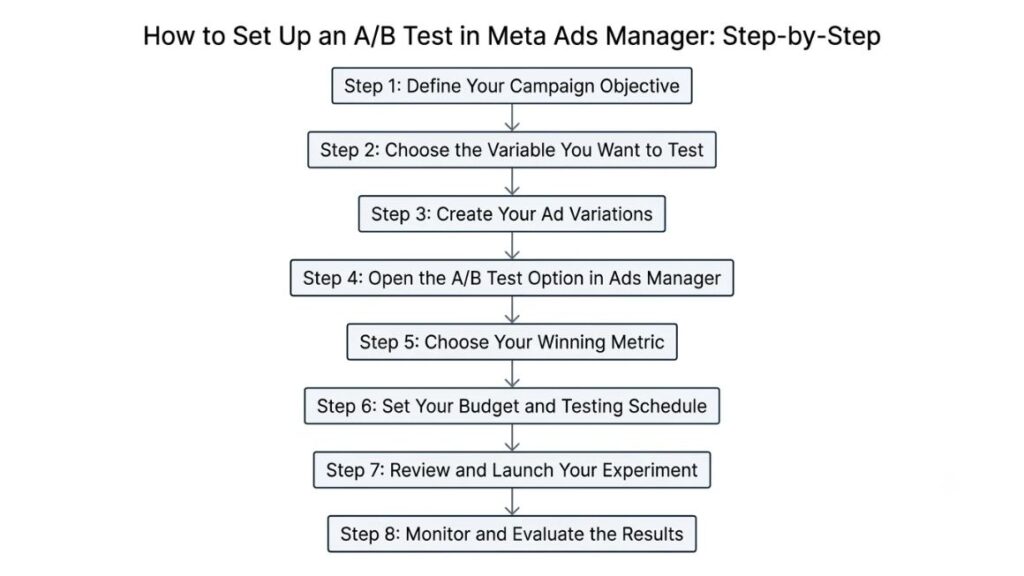
To set up Facebook ads A/B testing, pick one objective and one variable, build the versions, open Meta’s A/B test option, choose a winning metric, set an equal budget and a schedule of at least seven days, then launch and leave it alone. Menu names shift now and then, so check the layout in your own account.
There are two common ways in. The first is creating a copy: you duplicate an existing campaign or ad set, change one variable on the copy, and Meta runs the original against it. The second is comparing existing campaigns or ad sets you’ve already built. That second route saves time, but it needs more checking, because any small difference you forgot about muddies the result. For most people the copy route is cleaner.
Step 1: Define Your Campaign Objective
Pick the one outcome the whole test serves, such as purchases, leads or traffic. The objective decides which metric can crown a winner. A test built around purchases shouldn’t be judged on clicks.
Step 2: Choose the Variable You Want to Test
Write down exactly one thing you’ll change. Creative, audience, placement or optimization event are the usual candidates. If you can’t say the variable in a short phrase, you’re probably testing two things.
Step 3: Create Your Ad Variations
Build the versions so they match in every way except that one variable. Name them clearly, for example “Jacket_Product_Image” and “Jacket_Lifestyle_Image”, so you’re not guessing later. The tool supports more than two variations, but two or three is plenty while you’re learning.
Step 4: Open the A/B Test Option in Ads Manager
Go to the tools menu under Analyze and Report, where you’ll find Meta Ads Manager experiments, or switch on the A/B test option while duplicating a campaign or ad set. Then choose whether you’re duplicating or comparing existing campaigns or ad sets.
Step 5: Choose Your Winning Metric
Pick one key metric to decide the winner, such as cost per result or cost per purchase. Meta lets you track extra metrics for context, but those don’t pick the winner. Choose before launch, never after you’ve seen the numbers.
Step 6: Set Your Budget and Testing Schedule
Meta splits the budget evenly between versions. Set a schedule of at least seven days and a daily budget big enough for each version to collect meaningful results. The next section covers how to size it.
Step 7: Review and Launch Your Experiment
Check the summary once more. Is the variable the only difference? Are the budgets equal? Think twice about letting Meta end the test early when it spots a winner, because an early lead can vanish by day seven. Then launch.
Step 8: Monitor and Evaluate the Results
Check delivery, not verdicts. Make sure both versions are actually spending. Don’t touch budgets, audiences or creative mid-test, since edits can reset learning and spoil the comparison. When the schedule ends, read the winning metric and the confidence level together.
Also Read: A/B Testing vs Multivariate Testing: What are they and how to use them

How Much Budget and Time Do You Need for an A/B Test?
Meta recommends running A/B tests for at least seven days, and its scheduling tool accepts tests between one and 30 days. For budget, aim to give each version enough money to produce around 50 optimization events a week. One caveat: seven days is a recommendation, not a guarantee of statistical reliability.
How to Decide Your Testing Budget
Work backwards from your cost per result. Say your cost per purchase is ₹400 and you want about 50 purchases per version in a week, which is roughly what Meta’s learning phase looks for. That’s about ₹20,000 per version, or ₹40,000 for a two-way test. Split it equally, because uneven budgets bias the result before the ads even run. And check that your audience is big enough to divide into groups without running out of people.
How Long Should an Experiment Run?
Long enough to cover a full week, since Tuesday shoppers aren’t Saturday shoppers. If your customers usually take more than a week to buy after seeing an ad, stretch the test to ten days or more. Stopping at day three because one ad is ahead is how people crown the wrong winner. Early numbers swing wildly, and the learning phase hasn’t settled yet.
Testing Facebook Ads With a Small Budget
Facebook ads A/B testing on a small budget still works, just differently. Change something big enough to matter, like the offer or the format, rather than a button colour. Judge the test on a metric that piles up fast, such as cost per click or cost per lead, and run one test at a time. The result will be a direction, not proof.
Meta recommends running A/B tests for at least seven days, and its scheduling tool allows tests of one to 30 days. Seven days is a minimum worth respecting, not proof of statistical reliability. Budget, audience size, conversion volume and sales cycle length decide whether a test has run long enough.
Which Metrics Should You Track When Comparing Ads?
Track the metric tied to your objective, not the one that looks best on a slide. In Facebook ads A/B testing, that choice decides who wins. Facebook ad performance metrics fall into three loose camps: attention (CTR), cost (CPC, CPA, CPL) and outcome (conversion rate, ROAS). Pick from the camp that matches what you’re actually paying for.
Click-Through Rate (CTR)
CTR is the percentage of people who saw your ad and clicked it. It tells you whether the creative and copy earn attention. It doesn’t tell you whether those clicks turn into customers.
Cost Per Click (CPC)
CPC is the average amount you pay for each click. It’s handy for traffic campaigns. A cheap click from the wrong person is still a waste, though.
Cost Per Acquisition (CPA)
CPA is total ad spend divided by the number of acquisitions, such as purchases or sign-ups. On most conversion campaigns, this is the number that settles arguments.
Conversion Rate
Conversion rate is the share of clicks or visitors who complete the action you wanted. It exposes problems an ad can’t fix, like a slow page or a confusing checkout.
Return on Ad Spend (ROAS)
ROAS is revenue divided by ad spend, so a ROAS of 4 means ₹4 of revenue for every ₹1 spent. It ignores your margins, which means a healthy-looking ROAS on a thin-margin product can still lose money.
Also Read: Marketing Efficiency Ratio (MER): The Metric Smart Marketers Use to Scale Revenue
Cost Per Lead (CPL)
CPL is ad spend divided by the leads you collected. Cheap leads can be junk. For lead generation, pair it with a quality check such as cost per qualified lead.
| Campaign objective | Important metric |
| Website traffic | Landing page views |
| Lead generation | Cost per qualified lead |
| E-commerce sales | Cost per purchase and ROAS |
| Brand awareness | Reach and ad recall |
| Engagement | Relevant engagement actions |
How to Analyze A/B Testing Results and Identify the Winning Ad?
In Facebook ads A/B testing, the winning ad is the one that beats the other on the metric you chose before launch, by a margin big enough to trust. More clicks don’t make a winner. Profit does.
Compare the Primary Performance Metric
Say Ad A earns 500 clicks and 10 purchases on ₹10,000 of spend, while Ad B earns 300 clicks and 20 purchases on the same spend. Ad A looks livelier. Ad B costs ₹500 per purchase against ₹1,000. Those numbers are made up, but the pattern is real: clicks flatter, purchases pay.
Understand Statistical Confidence
Meta’s confidence percentage estimates how likely the same result would repeat. Higher is safer. Plenty of practitioners wait for something near 95% before scaling, though small budgets often have to settle for less and treat the result as a lean, not a verdict.
Sample size matters just as much. GrowthSpree’s 2026 guide to Meta A/B testing points to roughly 100 conversions per variant as the benchmark consumer advertisers use. Below that, percentages wobble.
One more limit. A 2025 Journal of Marketing paper by Michael Braun of Southern Methodist University and Eric Schwartz of the University of Michigan found that ad platforms can show each version to different mixes of people, which they call divergent delivery. A winner tells you what worked on that platform with that audience. It may not travel.
What Happens When Both Ads Perform Similarly?
Then you’ve learned something: that variable doesn’t move much for this audience. Don’t force a winner. Keep the cheaper or easier-to-produce version and test a bolder change next.
When Should You Declare a Winner?
After the scheduled end, with enough conversions, acceptable confidence, and a lead that shows up in a business metric like cost per purchase or qualified leads, not only in clicks. If any of those is missing, call it inconclusive and move on.
Facebook Ad Testing Best Practices You Should Follow
A good Facebook ads testing strategy is less about clever ideas and more about discipline. The advertisers who learn fastest tend to share the same few habits.
Test One Major Variable at a Time
Change the image and the headline together, and the ad wins? You won’t know which one did it. Facebook ads A/B testing answers one question per test, so ask a single question.
Use a Clear Testing Hypothesis
Write it as a sentence with a reason inside. For example: if the first line leads with customer reviews instead of a discount, cost per purchase will fall for first-time buyers, because trust is a bigger barrier than price. Now the test can prove you wrong, which is the whole point.
Keep Other Campaign Settings Consistent
Same objective, same bid approach, same schedule, same budget. Anything that differs becomes a suspect when results come in, and then you’re back to guessing.
Also Read: Campaign Optimization Strategies: How to Cut Cost Per Result Without Increasing Budget
Avoid Making Frequent Changes During Experiments
Hands off. Every edit risks resetting learning and blurring the comparison, and that urge to tweak a “slow” ad on day three is exactly how tests get ruined.
Maintain a Testing Record
Don’t count on Ads Manager to keep a tidy history for you. A simple sheet with the hypothesis, variable, dates, result and takeaway beats memory every time.
Turn Successful Findings Into Your Next Experiment
Good Facebook ad testing works like a loop. A winning hook becomes the new baseline, and the next test changes something else, like the offer or the format.
Also Read: Meta Ads Optimization Checklist: The Complete Guide for Andromeda-Era Campaigns (2026)
Common Mistakes to Avoid When Testing Facebook Ads
Most Facebook advertising best practices get ignored the moment a deadline shows up. Each mistake below leads to the same place: a confident decision built on weak evidence.
Testing Too Many Variables at Once
New image, new headline, new audience. When it wins, nobody knows why, so nothing gets repeated. Facebook ads A/B testing can only credit one change. Give it two and the credit gets split between them, with no way to tell who earned it.
Ending Experiments Too Early
Day-two results are noise with good lighting. One ad pulls ahead, someone gets excited, and the test gets shut down before the data has settled. Let the schedule finish.
Using the Wrong Success Metric
Judging a sales campaign on clicks rewards ads that attract browsers. Pick the metric that matches the money, and fix it before launch so nobody can shop for a flattering number afterwards.
Ignoring Audience Overlap
Two ad sets aimed at the same people compete in the same auction. Meta’s A/B tool separates the groups. Manual tests don’t.
Making Decisions With Insufficient Data
Three leads against one isn’t a result. It’s a coin flip with a spreadsheet.
Assuming One Winning Ad Will Always Perform Well
Winners wear out. People see the same ad again and again, and results slide. A win is a snapshot, so keep testing fresh ideas against it.
Real-World Examples of Successful Ad Experiments
The three scenarios below are illustrative. They show Facebook ads A/B testing in action, how a test gets designed and read, but they’re not results from real brands.
Example 1: Testing Two Ad Creatives for an E-commerce Brand
Picture a D2C skincare brand testing a studio product shot against a customer-style phone video. Same audience, same offer, same budget, purchases as the objective and cost per purchase as the winning metric. If the video wins, the team shouldn’t just keep it. They should ask why: a faster hook, a real face, a visible result? The answer feeds the next test, and that’s where the compounding starts.
Example 2: Testing Different Headlines for a Lead Generation Campaign
A coaching institute compares “Book a free career counselling call” with “Get your personalised study plan.” The winning metric is cost per qualified lead, not raw leads, because the cheaper headline might attract people who never pick up the phone. A test that rewards volume would crown the wrong ad.
Example 3: Comparing Two Audience Strategies
A fitness app compares a broad audience, where Meta finds the buyers, with a lookalike built from existing subscribers. Broad sometimes wins on cost. The lookalike may bring better subscribers. So the test should judge both cost per install and how many trials turn into paid plans.
Latest Facebook Advertising Testing Trends in 2026
Meta leans harder on AI every quarter. That changes what’s worth testing in Facebook ads A/B testing, not whether testing is worth doing.
AI-Assisted Creative Production and Testing
Advantage+ tools can produce creative variations in bulk, and Meta said Advantage+ solutions reached an annual revenue run rate above $75 billion in Q2 2026, per Marketing Brew’s October 2026 report. Speed has a catch, though. Marketing Brew reported in April 2026 that some brands, including Snag Tights, found AI edits that misrepresented their products. Check everything the AI makes.
Also Read: How to create AI prompts for A/B testing strategies
Creative Diversification and Faster Experimentation
With Meta’s Andromeda system and broad targeting, creative does much of the targeting work. Ankit Jadav, associate director of paid social at the agency Rain, told Marketing Brew that creative is the new targeting. So test genuinely different ideas, not five copies of one ad with a recoloured button.
First-Party Data and Better Conversion Measurement
Meta’s April 2026 announcement said advertisers using the Conversions API for web events saw an average 17.8% lower cost per result than those without it, and it added a one-click setup. Meta ads conversion tracking is only as good as the events reaching Meta. A test judged on missing purchases picks the wrong winner.
Combining A/B Tests With Conversion Lift Studies
An A/B test tells you which ad beats which. A conversion lift study holds back a control group that doesn’t see your ads, so it shows whether the ads caused extra sales at all. Given the divergent delivery issue, lift studies make a useful second check on bigger budgets. AI can draft the variations. Only a controlled test tells you which one performs.
In 2026, Meta’s AI tools make creative variations cheap to produce, but controlled experiments still decide which variation performs. Accurate conversion data, such as Pixel plus Conversions API, keeps tests honest. Conversion lift studies add a check on whether ads caused sales at all.
Conclusion
A good test is a small, fair fight. One variable changes, the budgets match, the metric is chosen before launch, and the test runs long enough to mean something. Do that, and even a loss teaches you what your audience doesn’t care about. That’s worth money too.
So start small. Pick one ad you already run, write one hypothesis and set up one test this week. Write down what you learn, then use it to design the next one. Facebook ads A/B testing pays off through repetition, not through one lucky win.
If you’d like to build these skills properly, have a look at Young Urban Project’s digital marketing training and practical learning resources. They’re made for people who’d rather practise than just read about it.
Frequently Asked Questions
What is the best way to test Facebook ads?
For Facebook ads A/B testing, use Meta’s built-in A/B test tool, change one variable, keep budgets equal, and judge the result on one metric chosen before launch. Run it for at least seven days so weekday and weekend behaviour both show up.
How many variations should I test at once?
Two or three is plenty for most advertisers. Each extra variation splits budget and audience further, which slows down how fast you collect enough results. Add more only when your budget can feed every version.
How long should a Facebook ad experiment run?
At least seven days, and no more than 30. Stretch to ten days or longer if customers take a while to buy after seeing an ad. Seven days is a minimum worth respecting, not a guarantee of reliable results.
What is a good budget for testing Facebook ads?
Enough for each version to produce around 50 conversions a week. Multiply your cost per result by 50, then by the number of versions. If that’s out of reach, test on a cheaper metric such as cost per click.
Can I test multiple audiences simultaneously?
Yes, if you use the A/B test tool so the groups don’t overlap. Without it, audiences share the same auction and contaminate each other. Keep the creative identical across every audience in the test.
What should I do if neither ad wins?
Treat it as a finding: the variable didn’t matter much. Keep the cheaper or easier-to-produce version and test something bolder next, like a different offer or format instead of another headline tweak.
Is A/B testing better than running multiple ads in one ad set?
For clean answers, yes. Multiple ads in one ad set let Meta pick favourites early, so exposure isn’t even. That works fine for everyday rotation but poorly for deciding what actually works.
Can AI help with Facebook ad testing?
Yes, for producing creative variations, headlines and copy faster. It can’t tell you which one performs. Use AI for the drafts, a controlled test for the verdict, and check every AI-edited image for accuracy.