
Most media buyers don’t have a creative problem. They have a decision-making problem. Spend hits a flat CPA on day three, and the call becomes “let’s give it one more day” instead of a clear yes or no. That single habit is why so many accounts plateau at the same monthly spend for years – not because the creative ran out, but because nobody built rules for what to do when a test comes back unclear.
A Meta Ads creative decision framework is a set of pre-defined rules that tell you exactly when to kill, keep, iterate, or scale a creative, based on specific metric thresholds set before the campaign launches. The point isn’t to remove judgment from media buying. It’s to remove judgment from the moments when you’re most likely to get it wrong – three days into a test, staring at a CPA that’s “almost there.”
This article walks through how to build that framework step by step: which metrics to track, how to diagnose why a creative is underperforming, how to set kill and keep thresholds, and how to document results so every test makes your next one sharper.
Table of Contents
Why Creative Decisions Without Rules Don’t Scale
A Meta Ads creative decision framework is a pre-defined set of rules that determines whether a creative gets killed, kept, iterated, or scaled, based on metric thresholds set before launch. It removes emotional decision-making from the moments where media buyers are most prone to bias, such as day three of a flat-performing test.
Here’s the pattern in almost every account that’s stuck at the same spend level month after month: someone looks at an underperforming ad and says “let’s give it another day,” or “I have a good feeling about this one,” or “maybe the algorithm just needs more time.” None of those are decisions. They’re delays dressed up as patience.
The cost isn’t just wasted spend. It’s wasted learning. Every day an ad runs without a clear hypothesis attached to its outcome is a day you’re not testing the next concept. Agencies and in-house teams that manage to scale past six and seven figures in monthly spend almost always have one thing in common: they know the answer to “should we kill this?” before they open Ads Manager. The rule was set before the ad ever launched.
This isn’t about being rigid. It’s about separating two different jobs that often get blurred together – running the test, and judging the test. If you judge while you’re still emotionally invested in a concept you spent two days briefing, you’ll find a reason to keep it alive. A framework takes that judgment call and moves it earlier, to a moment when you’re thinking clearly about thresholds instead of staring at a graph that’s almost, but not quite, working.
The Metrics You Need to Review Before Making Any Call
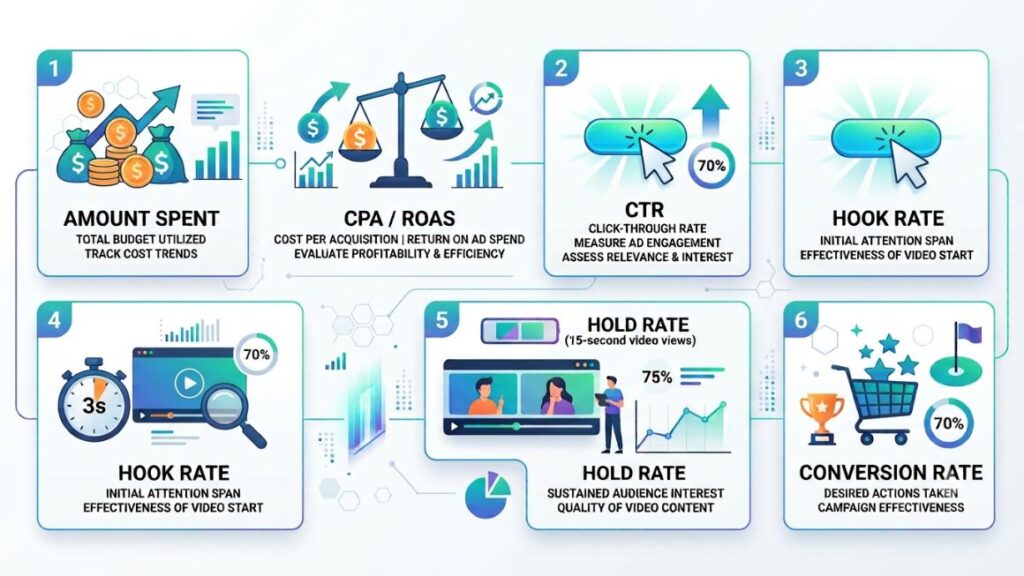
You can’t build kill or keep rules on vibes, and you can’t build them on a single metric either. CPA alone tells you whether something worked. It doesn’t tell you why. To diagnose a creative correctly, you need to look at metrics in a specific order – each one rules something in or out before you move to the next.
Here’s the actual sequence to check, in order:
- Amount Spent – this is Meta’s confidence signal. If the algorithm hasn’t allocated meaningful spend to a creative, you don’t have a real test yet.
- CPA / ROAS – your bottom-line check. Is the ad profitable at your target?
- CTR (Click-Through Rate) – tells you whether the angle or hook is relevant to the audience you’re showing it to.
- Hook Rate (3-second video views) – tells you whether the first three seconds actually stopped the scroll.
- Hold Rate (15-second video views) – tells you whether the middle of the ad kept people watching, or lost them.
- Conversion Rate – tells you whether the problem sits with the creative at all, or with what happens after the click.
Amount Spent: Meta’s Confidence Signal
Before you read any other number, check spend. Meta’s delivery system allocates budget toward creatives it predicts will perform. A creative that’s barely spending isn’t necessarily bad – it might just be a creative Meta hasn’t found an audience match for yet. Judging CPA on an ad that’s only spent ₹400 of a ₹2,000 daily budget is judging noise, not signal.
Action step: Set a minimum spend threshold before launch, typically 2–3x your target CPA per creative, before you allow yourself to make a kill or keep call.
CPA and ROAS: The Bottom-Line Check
Once spend clears your threshold, look at cost per acquisition or return on ad spend against your target. This number tells you whether the ad is working. It doesn’t tell you what to fix if it isn’t, which is exactly why the next three metrics matter.
CTR, Hook Rate, and Hold Rate: Where the Creative Is Breaking
These three metrics, read together, show you precisely where a creative is losing people. CTR shows relevance at a glance. Hook rate shows whether the opening three seconds earned attention. Hold rate shows whether the middle section kept that attention or lost it. A creative can have a strong CTR and still fail on CPA, which means the problem likely isn’t the ad at all.
Hook rate measures the percentage of viewers who watch at least three seconds of a video ad, while hold rate measures the percentage who watch at least fifteen seconds. Together with CTR, these three metrics diagnose exactly where in the creative people are dropping off, before you ever look at conversion data.
How to Diagnose a Losing Ad Before You Kill It
Diagnosis comes before the kill decision, not after. Pulling an ad without knowing why it failed means you’ll repeat the same mistake in your next concept, just with a different visual.
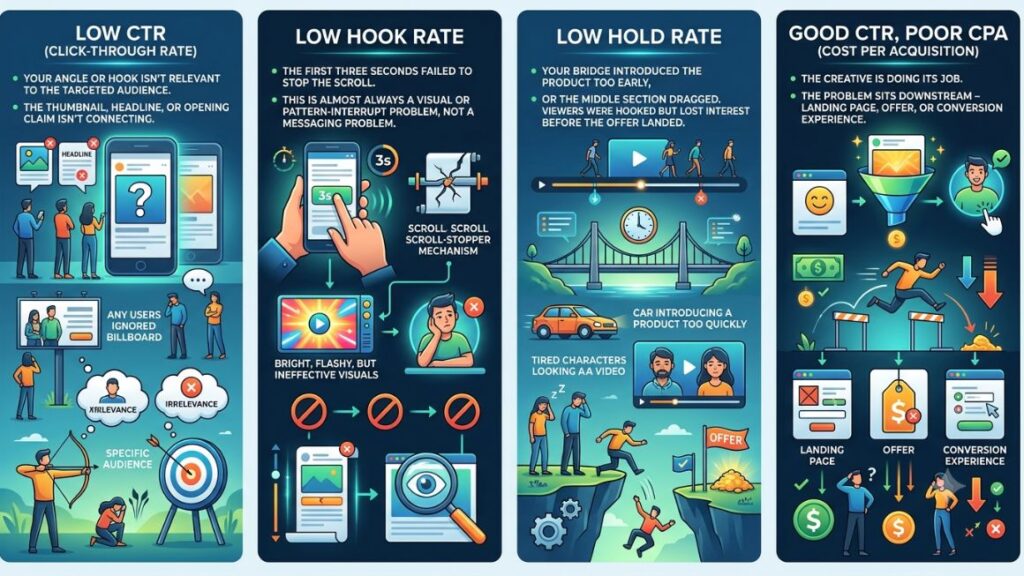
Here’s how to map each metric failure to its likely cause:
- Low CTR → Your angle or hook isn’t relevant to the audience you’re targeting. The thumbnail, headline, or opening claim isn’t connecting.
- Low Hook Rate → The first three seconds failed to stop the scroll. This is almost always a visual or pattern-interrupt problem, not a messaging problem.
- Low Hold Rate → Your bridge introduced the product too early, or the middle section dragged. Viewers were hooked but lost interest before the offer landed.
- Good CTR, Poor CPA → The creative is doing its job. The problem sits downstream – landing page, offer, or conversion experience.
This is the step most media buyers skip. They see a flat CPA and pause the ad without checking whether the issue was the hook, the bridge, the offer, or the page it sent people to. A boAt campaign that gets clicks but no conversions has a different fix than one that never gets clicked at all – and that distinction only shows up if you check CTR and hold rate before you pull the plug.
Action step: Before killing any ad, write down which of the four diagnoses applies. If you can’t name one, you don’t have enough data yet – extend the test instead of guessing.
How to Set Kill Criteria Before You Launch
Kill criteria only work if they’re written down before the campaign goes live. Writing them after you’ve already seen the early numbers defeats the purpose – you’ll unconsciously set the threshold to match whatever result you’re hoping for.
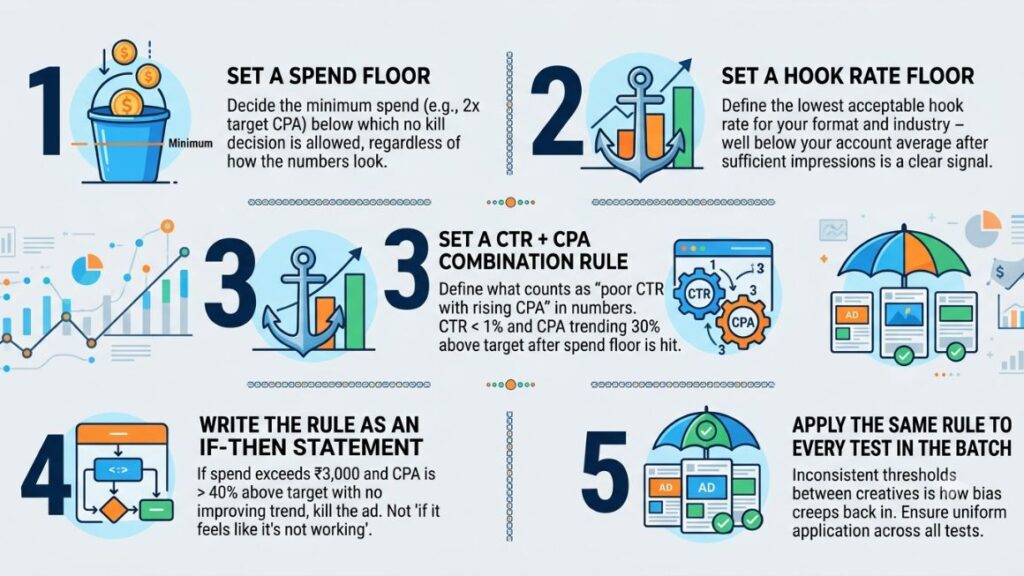
Follow these steps to build your kill rules:
- Set a spend floor. Decide the minimum spend (e.g., 2x target CPA) below which no kill decision is allowed, regardless of how the numbers look.
- Set a hook rate floor. Define the lowest acceptable hook rate for your format and industry – this varies, but a hook rate well below your account average after sufficient impressions is a clear signal.
- Set a CTR + CPA combination rule. Define what counts as “poor CTR with rising CPA” in numbers, not impressions. For example: CTR below 1% and CPA trending 30% above target after the spend floor is hit.
- Write the rule as an if-then statement. “If spend exceeds ₹3,000 and CPA is more than 40% above target with no improving trend, kill the ad.” Not “if it feels like it’s not working.”
- Apply the same rule to every test in the batch. Inconsistent thresholds between creatives is how bias creeps back in.
Example kill criteria:
- Kill concepts Meta refuses to allocate spend to after 48 hours.
- Kill ads with a hook rate more than 25% below account average after sufficient impressions.
- Kill creatives showing poor CTR combined with rising CPA past your spend floor.
How to Set Keep and Scale Criteria
Kill rules get most of the attention, but keep rules matter just as much – mostly because media buyers tend to pause winning ads too early. Internal teams see the same creative every day in Ads Manager and assume the audience is just as tired of it. They usually aren’t.
A creative is ready to scale when it shows:
- Strong spend allocation from Meta, meaning the algorithm is actively pushing budget toward it
- CPA within your defined target range, with a stable or improving trend
- CTR at or above account average for the format
- Hook rate at or above account average
- Hold rate showing the message is landing through the middle section, not just the opening
Action step: Build a simple scorecard with these five checks. A creative that passes four or five graduates to a higher budget tier. One that passes two or three stays at current spend. Below two, it moves toward iteration or kill.
Don’t pause winners because your team has seen them too many times. Your audience almost certainly hasn’t.
Why Every Winning and Losing Ad Needs to Be Documented
A decision framework without documentation just resets every month. You’ll rediscover the same winning angle in March that you found in January, because nobody wrote down what actually made the January ad work.
For every winning ad, document these six elements:
- Persona – who specifically responded
- Angle – the core argument or promise
- Offer – what was being sold and how
- Hook – the specific opening that earned attention
- Format – UGC, static, carousel, talking head, and so on
- Why people watched – your best read on the psychological reason it landed
Writing “UGC worked” tells you nothing reusable. Writing “a founder-style UGC video using a problem-agitation hook, targeting first-time buyers aged 25–34, outperformed because it addressed a specific objection in the first three seconds” gives you a blueprint you can brief against again.
For every losing ad, document these four elements:
- Which hypothesis failed
- Where viewers dropped off, based on hook rate and hold rate
- Which metric failed first in the sequence
- Whether the root cause was the hook, the bridge, the angle, or the offer
A failed test without documentation gets repeated. That’s not a guess – it’s the most common reason creative testing budgets stall without producing fresh, reliable winners.
Building a Creative Testing Portfolio, Not a Single Winner
The goal of a creative decision framework isn’t to find one winning ad and ride it until it dies. It’s to build a portfolio that keeps producing winners, because no single creative survives audience fatigue forever.
Split your testing budget roughly like this:
- 50–60% on iterating proven winners – new hooks or formats built on a validated angle
- 20–30% on improving underperformers that showed partial signal, such as strong hook rate but weak hold rate
- 20–30% on testing entirely new concepts, personas, or angles
This split matters because teams that only iterate winners eventually run out of fresh angles, and teams that only test new concepts never build on what’s already working. Every test, win or lose, should leave the portfolio stronger than it was before the test ran – that’s the actual measure of whether your framework is working.
Conclusion
A creative decision framework doesn’t make your ads better on its own. What it does is make sure every test, win or lose, teaches you something you can actually use again. The teams that scale past flat CPAs aren’t running fundamentally different creative – they’re running the same kind of testing everyone else does, but with rules that turn each result into a documented pattern instead of a forgotten campaign.
Start small: pick your spend floor, write down your kill criteria for the next batch of creatives, and commit to documenting both winners and losers before you launch. The framework gets sharper every cycle you run it.
If you want to go deeper into building testing systems like this one for your own Meta Ads account, YUP’s Performance Marketing course walks through creative testing, budget allocation, and scaling frameworks used by working media buyers – not theory, the actual systems.
FAQ
What is a Meta Ads creative decision framework?
A Meta Ads creative decision framework is a documented set of rules that determines when a creative should be killed, kept, iterated, or scaled, based on specific metric thresholds defined before the campaign launches. It replaces subjective, in-the-moment judgment calls with pre-agreed criteria.
Why do most advertisers fail to scale Meta Ads?
Most advertisers make creative decisions based on feeling rather than rules, which leads to delaying kill decisions on underperforming ads and pausing winning ads too early due to internal fatigue. Without a framework, every test produces a result but rarely a reusable lesson.
How do I know if my hook rate is good or bad?
Compare your hook rate against your own account average for the same format, not against a generic industry benchmark. A hook rate significantly below your account average after sufficient impressions usually signals the first three seconds aren’t earning attention.
Is hook rate the same as CTR?
No. CTR measures how many people clicked the ad, while hook rate measures how many people watched at least three seconds of a video. A creative can have a strong CTR with a weak hook rate if it’s a static image, or the reverse if a video grabs attention but the link or CTA isn’t compelling enough to click.
How much should I spend before judging a creative?
A common rule is 2–3x your target CPA per creative before making any kill or keep decision. Judging performance before hitting this spend floor usually means you’re reading noise instead of a real signal.
What do I do if CTR is good but CPA is still poor?
This combination usually points to a problem downstream of the creative – the landing page, the offer, or the overall conversion experience – rather than the ad itself. Check page load speed, offer clarity, and checkout friction before touching the creative.
Do I need to document ads that failed, or only the winners?
Both. Documenting failed tests, including which hypothesis broke and at what stage, prevents the same losing angle from being re-tested under a different format. Most teams only document winners, which is why losing patterns repeat.
What percentage of my budget should go toward testing new concepts?
A reasonable starting split is 50–60% on iterating proven winners, 20–30% on improving underperformers, and 20–30% on testing entirely new concepts. This keeps the portfolio growing instead of relying on a single ad indefinitely.
Should I pause an ad just because my team is tired of seeing it?
No. Internal teams see their own ads far more often than the actual audience does, and creative fatigue is frequently overestimated. Use performance metrics like hook rate, hold rate, and CPA trend to decide, not how many times your team has seen it in Ads Manager.