

Somebody opens Ads Manager on a shared screen and says, “This campaign is stuck. Walk me through it.” That’s the moment Meta Ads interview questions stop being theory.
Meta reported $160.6 billion in advertising revenue for 2024, so it’s no surprise that nearly every performance team hires for this skill. Interviewers know the platform inside out, too. They aren’t hunting for recited definitions. They want to hear how you read a dashboard, what you check first when ROAS drops, and whether you can explain a decision without hiding behind jargon.
Theory gets you through round one. Campaign experience, or a believable stand-in for it, carries the rest.
This guide has 74 numbered Meta Ads interview questions, plus an FAQ at the end. It’s written for freshers, mid-level marketers and experienced buyers alike. Read it in order or jump to your level. Either way, say the answers out loud. It’s a very different skill from nodding along on a screen.
Table of Contents
How to Prepare for an Upcoming Meta Ads Interview?
Preparing for Meta Ads interview questions works best when you mix reading with doing. Reading alone makes answers sound borrowed. Here’s what to cover:
- Revise the fundamentals and campaign structure.
- Practise performance metric calculations until they’re automatic.
- Understand Pixel and CAPI implementation, including deduplication.
- Learn to explain real campaign results, or a small test you ran.
- Prepare a small portfolio or campaign case study.
- Practise answering scenario-based questions out loud.
- Explore Meta Blueprint learning resources. The training courses are free, though the official certification exam is a separate paid booking.
Also Read: 50 Marketing Interview Questions and Answers (With Tips to Actually Get Hired)
| Day | Preparation |
| Day 1 | Fundamentals and campaign structure |
| Day 2 | Campaign setup, objectives, and budgeting |
| Day 3 | Audiences and targeting |
| Day 4 | Metrics and calculations |
| Day 5 | Pixel, CAPI, and tracking |
| Day 6 | Scenario-based questions and case studies |
| Day 7 | Mock interview and revision |
Basic Meta Ads Interview Questions Every Candidate Should Know
If you’re hunting for Meta Ads interview questions for freshers, start here. Panels open with these to check whether your foundations are solid before they spend time on anything harder. Keep each answer short, then offer an example if they want more.
1. What are Meta Ads?
Meta Ads are paid ads shown across Meta’s apps, mainly Facebook, Instagram, Messenger and WhatsApp. You choose a goal, an audience, a budget and a creative. Meta runs an auction and shows your ad to people likely to act.
2. What is Meta Ads Manager?
It’s the free tool where you build, edit and report on paid campaigns. Audiences, placements, bids, breakdowns, all of it lives there. Both Meta’s native tools are free, and you only pay for ad spend.
3. What is the difference between Facebook Ads and Meta Ads?
Nothing meaningful. Facebook ads management is the same activity under the platform’s older name. That’s why some job posts still say Facebook Ads interview questions. In your answer, say “Meta Ads” and mention Facebook once.
4. What are the main platforms where Meta ads can appear?
Meta’s advertising surface spans Facebook, Instagram, Messenger, Threads, WhatsApp and the Audience Network. Threads availability can vary by account, so check Placements in your own Ads Manager.
5. What are the different campaign objectives?
Meta’s six current objectives are awareness, traffic, engagement, leads, app promotion and sales. Pick by the business outcome you want, not by whichever click looks cheapest.
6. What is the structure of a Meta advertising campaign?
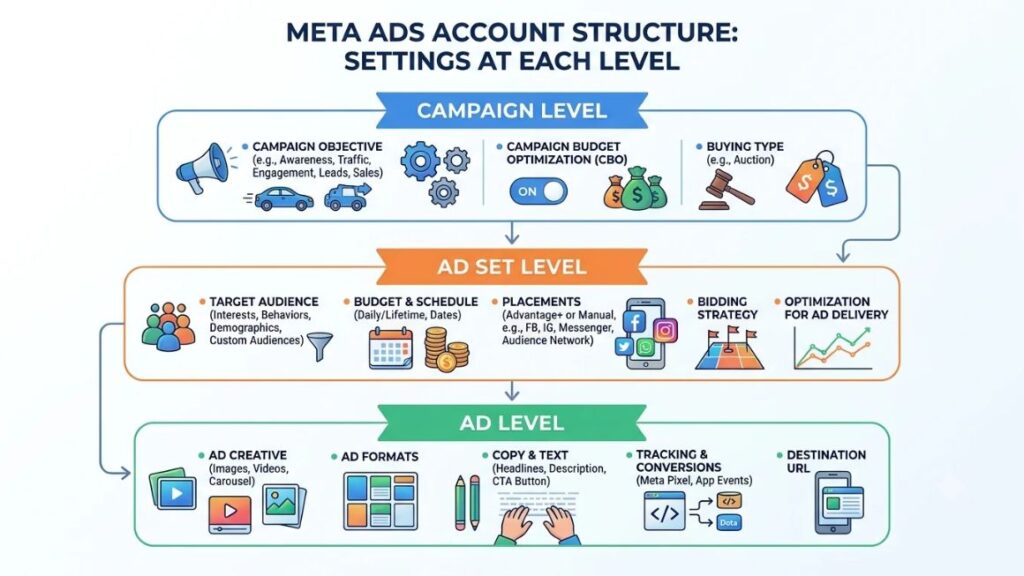
Three levels. The campaign holds the objective. The ad set holds audience, budget, schedule, placements and the optimisation event. The ad holds the creative and destination.
7. What is the difference between a campaign, ad set, and ad?
Think about what you’d change. New goal? New campaign. New audience or budget? Ad set. New image or headline? Ad. It matters because edits at higher levels can reset delivery.
8. What is the difference between organic reach and paid reach?
Organic reach is how many people see your content without you paying. Paid reach comes from ads. Organic depends on followers and engagement, while paid lets you reach strangers. Neither replaces the other.
9. What is the Meta Business Suite?
It’s the free hub for day-to-day work: posting, inbox, insights and simple boosts. Ads Manager is where you go for detailed campaign control. Business Suite suits small teams, and Ads Manager suits performance marketers running complex campaigns.
10. What are the different types of advertisements available on Meta?
Image, video, carousel, collection, Stories and Reels ads, lead ads with instant forms, and catalogue-based dynamic ads. Say which format you’d pick for which goal. That’s the part they’re listening for.
Campaign Setup and Management Questions
Most Meta Ads interview questions and answers in this round come down to one thing: do you know what each setting actually changes? Reciting menu names won’t help. Explain the consequence.
11. How do you create a campaign in Ads Manager?
Click Create, choose an objective, name the campaign, then set budget, audience, placements and the optimisation event at ad set level. Upload creative, add the destination, publish. Since early 2026, new Sales, Leads and App Promotion campaigns default to the automated Advantage+ path. You can still adjust controls.
12. What is the difference between ABO and CBO?
ABO (ad set budget optimisation) sets a budget on each ad set. CBO sets one budget at campaign level and lets Meta split it. Meta has since rebranded CBO as Advantage+ campaign budget. Use ABO for clean tests and CBO for scaling winners. Expect this one in nearly every round of Meta Ads Manager questions.
13. What is the learning phase?
It’s the stretch where Meta’s system explores who responds best to your ad. An ad set generally needs about 50 optimisation events within seven days of its last significant edit to exit it. Delivery and costs are less stable until then.
14. What is the learning limited status?
It appears when an ad set is unlikely to reach 50 events in seven days. It’s not a penalty. Usual causes: budget too low, audience too small, or an optimisation event that fires too rarely. Fix it by consolidating ad sets, raising budget or optimising for an earlier event.
15. What is the difference between daily and lifetime budgets?
A daily budget is an average spend per day, so Meta may spend a bit more on strong days and less on weak ones. A lifetime budget is a total for the whole run, which Meta paces across your dates.
16. What is campaign scheduling?
It’s choosing when your ads run: start and end dates, and, with a lifetime budget, specific hours. Useful for lead businesses that can only answer calls during office hours.
17. What is the difference between automatic and manual placements?
Automatic (Advantage+ placements) lets Meta choose across surfaces. Manual lets you restrict them. Start automatic. Switch to manual only when creative can’t fit a surface or a brand-safety rule demands it.
18. What is Advantage+ and how does it work?
It’s Meta’s suite of AI automation. A campaign counts as Advantage+ when it uses Advantage+ campaign budget, audience and placements. The trade-off is less manual control, so creative becomes your main lever.
19. What factors should you consider before launching a campaign?
Goal, margins and break-even CPA, working tracking, landing page speed, creative readiness, and whether the budget can realistically produce 50 events a week. Skipping any one of these is how good campaigns fail quietly.
20. How do you structure an advertising campaign for an e-commerce business?
Keep it lean. One prospecting campaign (Advantage+ Sales or broad audience), one retargeting campaign for cart and site visitors, and a small testing campaign for new creative. Exclude purchasers from prospecting. More campaigns rarely mean more results.
The learning phase is Meta’s exploration period, and an ad set generally needs about 50 optimisation events in seven days to leave it. Significant edits restart it, which is why frequent tweaking often does more harm than a patient wait. Structure for enough events per ad set, not for the neatest-looking account.
Audience Targeting and Retargeting Questions
Targeting changed more than almost anything else on the platform in the last few years. A candidate who still describes 2019 interest stacking gets noticed, and not kindly. So answer with how the system works now.
21. What are the different types of audiences available in Meta Ads?
Core audiences (location, age, interests, behaviours), custom audiences (built from your own data), lookalike audiences (people similar to a source), and Advantage+ audience, where your inputs act as suggestions rather than hard limits.
22. What is a Custom Audience?
It’s an audience built from people who already know you: website visitors through the Pixel, customer lists, app users, or people who engaged with your Instagram or Facebook content.
23. What is a Lookalike Audience?
Meta finds new people who resemble a source audience, with a size from 1% to 10% of a country’s population. Source quality matters more than size. Purchasers make a far better seed than page likers.
24. What is the difference between Custom and Lookalike Audiences?
Custom reaches people who’ve already met your brand. Lookalike reaches strangers who look like your best customers. One is mostly for retargeting, the other for prospecting.
25. What is broad targeting?
Setting only basics like country and age, and letting the creative and the optimisation event do the targeting. It works best with healthy conversion data. For a brand-new account with little signal, it can wander.
26. What is audience overlap, and how can you manage it?
Overlap means two ad sets chase the same people, so you end up competing against yourself in the auction. Consolidate similar ad sets, and use exclusions, such as keeping purchasers out of prospecting.
27. What is retargeting, and why is it important?
Showing ads to people who’ve already interacted: visited, viewed a product, added to cart, watched a video. Most buyers don’t convert on a first visit, so retargeting brings them back. Watch frequency, because warm pools are small and tire fast.
28. How would you target a new audience for a recently launched product?
Start broad, or with two or three hypotheses from any customer list you have. Test creative angles first, since there’s no purchase data yet. Build retargeting pools as visitors accumulate.
Also Read: How to Do Audience Research for Facebook Advertising (Step-by-Step Guide)

Budgeting, Bidding, and Performance Metrics
Plenty of performance marketing interview questions sound like maths homework, and that’s deliberate. Anyone can define ROAS. Fewer people can calculate it live while someone watches. Here’s one set of numbers to use for every metric below. It’s an illustrative example, not a real account.
| Input | Value | Metric | Result |
| Spend | ₹20,000 | CPM | ₹50 |
| Impressions | 400,000 | CTR | 1.5% |
| Clicks | 6,000 | CPC | ₹3.33 |
| Purchases | 60 | CPA | ₹333 |
| Revenue | ₹90,000 | ROAS | 4.5x |
29. What is CPM in Meta Ads?
Cost per mille: what you pay per 1,000 impressions. Spend ÷ impressions × 1,000. Here, ₹20,000 ÷ 400,000 × 1,000 = ₹50.
30. What is CPC?
Cost per click: spend ÷ clicks. ₹20,000 ÷ 6,000 = ₹3.33. Say which click you mean, because Meta reports all clicks and link clicks separately.
31. What is CTR?
Click-through rate: clicks ÷ impressions × 100. Here, 6,000 ÷ 400,000 = 1.5%. It tells you whether the creative earns attention.
32. What is CPA?
Cost per acquisition: spend ÷ conversions. ₹20,000 ÷ 60 = ₹333 per purchase. Judge it against break-even, never in isolation.
33. What is ROAS?
Return on ad spend: revenue ÷ ad spend. ₹90,000 ÷ ₹20,000 = 4.5x. It’s a revenue ratio, so it says nothing about profit on its own.
34. What is the difference between CTR and conversion rate?
CTR measures how many people who saw the ad clicked. Conversion rate measures how many clickers completed the action: 60 ÷ 6,000 = 1%. Strong CTR with weak conversion points at the landing page or offer, not the ad.
35. What is the difference between CPC and CPM?
CPM prices attention, CPC prices clicks. They connect: CPC = CPM ÷ (1,000 × CTR). ₹50 ÷ (1,000 × 0.015) = ₹3.33. A high CPM isn’t automatically bad if CTR is strong.
36. What is frequency, and why should advertisers monitor it?
Frequency is impressions ÷ reach, the average number of times one person saw your ad. When it climbs while CTR falls, the audience is tiring. There’s no universal threshold, so watch the trend.
37. What are the different bidding strategies?
Lowest cost (highest volume), cost cap, bid cap and ROAS goal. Meta has renamed some of these over the years, so know both names. Start with lowest cost and add caps only when volume is stable.
38. How do you calculate the break-even ROAS for a business?
Break-even ROAS = 1 ÷ profit margin. At a 40% margin, that’s 2.5x. Use margin after shipping, payment fees and returns, or you’ll fool yourself. Our 4.5x example clears 2.5x comfortably.
ROAS is revenue divided by ad spend, and it is not profit. Break-even ROAS equals one divided by your margin, so a 40% margin needs at least 2.5x just to cover costs. Always judge ROAS against margin, never against a generic benchmark.
Tracking, Pixel, and Conversion API Questions
Technical Meta Ads interview questions separate people who run ads from people who understand why the numbers move. Tracking is where most real-world disasters start. Get comfortable explaining it plainly, ideally with a story from an account you’ve touched.
39. What is Meta Pixel?
A JavaScript snippet on your website that sends browser events, such as PageView, AddToCart and Purchase, to Meta. It powers optimisation, reporting and retargeting audiences.
40. How do you install Meta Pixel on a website?
Three routes: paste the base code in the site header, add it through Google Tag Manager, or use a partner integration like Shopify. Then verify with Test Events in Events Manager or the Meta Pixel Helper extension.
41. What is Conversions API (CAPI)?
It sends events straight from your server, CRM or platform to Meta, without depending on the visitor’s browser. It can carry web, app and physical store events through a single endpoint. Handy when ad blockers or browser limits stop the Pixel firing.
42. What is the difference between Pixel and CAPI?
Pixel sends from the browser. CAPI sends from your server. It isn’t either/or. The recommended setup runs both and deduplicates them.
43. What are standard events in Meta Ads?
Predefined actions Meta recognises: PageView, ViewContent, Search, AddToCart, InitiateCheckout, AddPaymentInfo, Purchase, Lead and CompleteRegistration. Use custom events only when no standard one fits.
44. What is event deduplication?
It stops one conversion being counted twice when the browser and server both report it. Meta treats events as identical when the Pixel’s eventID matches the server’s event_id and the event names match, within 48 hours.
45. How do you check whether conversion tracking is working correctly?
Fire a test event in Test Events, check Event Match Quality and the deduplication view in Events Manager, then compare Meta’s purchase count with your backend orders. A small gap is normal. A large one means something’s broken.
46. How would you troubleshoot missing or duplicate purchase events?
Missing: check the thank-you page fires the event, consent banners aren’t blocking it, and a payment gateway redirect isn’t skipping the page. Duplicate: look for two Pixels installed, a reloading confirmation page, or Pixel and CAPI sending without a shared event ID.
A simple example of Pixel and CAPI working together. A customer pays ₹2,000 for an order. Their browser fires a Purchase event with eventID “order_10452”. A few seconds later, your server confirms payment and sends a Purchase event with the same event_id. Meta keeps one. If the customer’s browser had blocked the Pixel, the server event would still arrive, so the sale isn’t lost.
Pixel and Conversions API send the same conversions from two places, the browser and your server. Meta deduplicates them when the event name and event ID match within 48 hours. Running both with matching IDs protects tracking accuracy without double-counting sales.
Advanced Questions for Experienced Candidates
The Meta Ads interview questions for experienced buyers aren’t harder in vocabulary. They’re harder in judgement. Nobody expects a script. They want to see what you do when the textbook answer doesn’t fit the account in front of you.
47. How do you scale a successful campaign?
Raise budget gradually, a rule of thumb being 10 to 20% every few days, since bigger jumps can restart learning. Add fresh creative alongside. Scaling spend without scaling creative is the usual reason winners stall.
48. What is the difference between horizontal and vertical scaling?
Vertical means more budget on what already works. Horizontal means widening the net: new audiences, placements, geographies, products or creative concepts. Mature accounts need both.
49. How do you approach creative testing?
Test one variable at a time (hook, format, offer), give each variant enough budget to gather real events, and judge on cost per result, not CTR alone. Test concepts before polishing. A beautiful ad built on the wrong angle is still the wrong angle.
Also Read: How to create AI prompts for A/B testing strategies
50. What is creative fatigue, and how do you identify it?
It’s when an audience has seen the ad too often. Frequency rises, CTR drops, then CPA climbs, all without targeting changes. Refresh the hook and concept, not just the colours.
51. How do you reduce customer acquisition costs?
Fix the funnel before touching bids: sharper creative, a clearer offer, faster landing pages, better tracking signal, purchasers excluded from prospecting. Then raise average order value or retention so each customer is worth more.
52. How do you optimise a campaign with a high CPM?
Check festive-season auction pressure, audience overlap, narrow targeting and weak creative, since low engagement raises costs. Then ask whether the CPM even matters. If CTR and conversion rate are strong, a high CPM can be perfectly fine.
53. How do you improve conversion rates without increasing the advertising budget?
Work on the page, not the ad. Speed up mobile load, match the page to the ad’s promise, cut checkout steps, add UPI and COD where relevant, and put proof near the buy button.
54. How do you decide whether to pause or continue an underperforming ad?
Don’t judge in the first day or two. A common rule of thumb is to consider pausing once spend passes two to three times your target CPA with no conversions, while checking earlier signals like CTR and add-to-carts first.
55. How do you measure campaign performance beyond platform-reported ROAS?
Use MER (marketing efficiency ratio: total revenue ÷ total ad spend), blended CAC and backend data from Shopify or GA4. Add incrementality tests where budget allows. Platform numbers can shift without sales moving. Meta permanently removed the 7-day and 28-day view attribution windows in January 2026.
56. How do you allocate advertising budgets across different stages of the marketing funnel?
A common starting point is roughly 70% prospecting and 30% retargeting and retention. It’s a starting rule, not a law. Let the size of your warm audiences and your margins push it up or down.
Also Read: 50 Performance Marketing Interview Questions and Answers (India, 2026)
Scenario-Based Questions That Test Practical Knowledge
Scenario-based Meta Ads interview questions are where interviews are won. There’s rarely one correct answer. What matters is the order you check things in, and whether you diagnose before you change anything.
57. Your campaign is spending money but not generating leads. What would you do?
First confirm leads are being recorded: test the form, check the Pixel or CAPI event. Then look at the landing page or form friction. Then audience and offer fit. Only after that touch creative or bids.
58. Your ROAS suddenly drops from 4x to 1.5x. How would you investigate?
Sudden drops usually mean something broke. Compare Meta’s numbers with backend revenue. Check site outages, stock, price changes, tracking, attribution settings and any recent edits that reset learning. Gradual drops point to fatigue or seasonality instead.
59. Your ads are receiving clicks but no purchases. What could be wrong?
Compare link clicks with landing page views. A big gap means slow pages or accidental clicks. If visitors arrive, test the checkout end to end, check the Purchase event, then look at price shock and message mismatch.
60. Your cost per lead has increased significantly. How would you reduce it?
Check frequency and creative age first, then CPM for auction pressure, then form changes. Refresh creative, add one qualifying question to the form, and make sure you’re optimising for the right lead event.
61. Your ad account is spending less than its allocated budget. What would you check?
Delivery status first: ads in review or rejected, learning limited, or a bid or cost cap set too tight. Then audience size, schedule, payment method and any account spending limit.
62. An advertisement has been rejected by Meta. What steps would you take?
Read the exact reason in Account Quality, fix that specific issue (a claim, an image, a landing page), and resubmit or request a review. Don’t spam near-identical ads. Repeated violations can restrict the account.
63. A client wants more leads but has a very limited budget. How would you plan the campaign?
Narrow everything: one offer, one audience, one or two ad sets, a lead-focused objective. Do the budget maths against the CPL target. If the budget can’t support enough events, say so, and suggest a higher-funnel event or a bigger budget.
64. A campaign performs well initially but starts declining after two weeks. How would you approach the problem?
Suspect saturation and fatigue. Check frequency, audience size and creative age. Rule out seasonality and learning resets. Then add fresh concepts, widen the audience, and set a regular creative refresh rhythm.
Practical and Case Study-Based Interview Questions
Meta Ads practical interview questions ask you to plan, not recall. Short, structured answers beat long speeches. Start with the goal, the math, then the plan.
65. How would you plan a Meta advertising campaign for a new e-commerce brand?
Set break-even CPA first, confirm tracking, launch with a few creative angles on broad targeting, then add retargeting as data builds.
66. How would you generate leads for a coaching institute?
Lead ads or a landing page with a qualifying question, fast follow-up by call or WhatsApp, and a free demo class as the offer.
67. How would you promote a local business using a limited monthly budget?
Tight radius targeting, one clear offer, Click-to-WhatsApp or call objectives, and maybe two creatives, not ten.
68. How would you create a campaign strategy for a product priced at ₹2,000?
Work backwards from margin to break-even CPA, then pick the optimisation event your budget can feed. The example below shows the thinking.
69. How would you present campaign results to a client or marketing manager?
Lead with the business result, then the metrics behind it, one learning, and the next action. Skip the dashboard tour.
Illustrative example (hypothetical, not a real brand’s results). A new skincare brand sells a ₹2,000 kit at a 40% margin, so break-even CPA is ₹800 and break-even ROAS is 2.5x.
Plan: one Sales campaign, broad audience, three creative angles, ₹1,500 a day. At that spend, purchases alone won’t reach 50 a week, so start by optimising for Add to Cart.
Launch: confirm Pixel and CAPI before spending a rupee.
Monitor: for seven days, watch cost per add-to-cart, CTR and landing page views per click, without touching budget.
Optimise: pause clear losers, back the strongest hook, add two fresh variations of it, and open retargeting once there’s enough visitor data.
HR and Behavioural Questions
Broader digital marketing interview questions in HR rounds test whether you can think, own mistakes and talk like a colleague. Technical strength helps. Sounding like someone people want on their team helps more.
70. Tell me about yourself and your experience with paid advertising.
Use present, past, future. What you do now, one campaign with real numbers, what you want next. Freshers can use Blueprint learning and a practice account.
71. Why do you want to work in performance marketing?
Be specific. Fast feedback, measurable outcomes, and the mix of creative judgement and analysis. “I love digital” says nothing.
72. What would you do if a campaign failed to meet its target?
Diagnose before defending: tracking, offer, creative, audience. Then explain what you changed and learned. Owning it calmly scores well.
73. How do you keep yourself updated with advertising platform changes?
Name real sources: Meta Business Help Center, Meta for Developers documentation, Meta Blueprint, and small tests in your own account.
74. Why should we hire you as a Meta Ads specialist?
Tie it to the job. One relevant skill, one piece of proof, and a clear appetite to learn their account.
Common Mistakes to Avoid During an Interview
Good candidates still lose offers over small things. Watch for these:
- Memorising answers without understanding them.
- Giving incorrect or outdated information. Plenty of people still answer Facebook advertising interview questions with 2020 playbooks.
- Quoting campaign results without context.
- Confusing ROAS with profit.
- Ignoring tracking and attribution.
- Making claims about campaign experience that you can’t explain.
- Suggesting changes without analysing the underlying problem.
Conclusion
Memorised answers to Meta Ads interview questions fall apart at the first follow-up. What holds up is understanding why a campaign behaves the way it does: strategy, tracking, metrics and optimisation, all connected. Practise explaining your decisions with examples, even small ones from a test account. Then go build something hands-on. Even ₹500 on a practice campaign teaches you more than another night of flashcards.
If you want that hands-on practice guided, YUP’s Performance Marketing course walks through live Meta campaigns step by step. And if you’d rather keep learning in small doses, the Crystal Clear Newsletter covers what’s changing in paid media.
FAQs
What are the most commonly asked Meta Ads interview questions?
Campaign structure, ABO vs CBO, the learning phase, core metrics like CPA and ROAS, Pixel and CAPI, and scenarios like falling ROAS. Those cover most Meta Ads interview questions at every level.
Is Meta Ads difficult to learn for beginners?
The basics are quick to pick up. The hard part is judgement, which comes only from running real campaigns. A small personal test account teaches more than any course.
Can I get a Meta Ads job without prior work experience?
Yes, for junior roles. Show a practice campaign, Blueprint learning and clear reasoning. Employers hire fresher candidates who can explain their thinking.
What should I learn before attending an interview?
Campaign structure, objectives, budgeting, audiences, metrics maths, and tracking. Add one story about a campaign problem you diagnosed.
Are Facebook Ads and Meta Ads the same?
Yes. Facebook Ads is the older name, so searching for Facebook Ads interview questions and answers leads to the same material as Meta Ads.
Is certification necessary for a Meta Ads job?
No. It helps freshers show commitment, but practical skill outweighs a badge. Fees and validity change, so check Meta Blueprint directly.
What practical skills do employers expect from a Meta Ads specialist?
Reading data, diagnosing problems, doing quick maths, testing creative and explaining decisions to non-experts. Tracking knowledge is a growing differentiator.
How long does it take to prepare for an interview?
A focused week covers the essentials, as in the plan above. Add more time if you’re new to the platform or have no live campaign experience.