
Most Meta ads checklists you’ll find right now are built for a system that stopped running the platform. They tell you to layer interests, build three lookalike tiers, and test dozens of ad variations against a fixed audience. None of that reflects how Meta actually decides who sees your ads today.
Meta introduced a new algorithm called Andromeda in late 2024, and it replaced the targeting systems advertisers had relied on for years. Instead of you picking an audience and Meta showing your ad to it, the system now reads your creative first and decides who should see it. This Meta ads optimization checklist is built around that reality. It covers what to check at every stage, from beginner account setup to advanced incrementality testing, and none of it assumes the old playbook still works.
Table of Contents
What Changed With Meta’s Andromeda Algorithm
Andromeda is Meta’s retrieval system. It scans every active ad on the platform and narrows the field down to a small set of candidates that might be relevant to a specific person, before any auction happens. Once that shortlist exists, a second model called GEM, the Generative Ads Recommendation Model, takes over and decides which single ad actually gets shown, based on the likelihood that this person will click, watch, visit, or buy. Andromeda is the gatekeeper. GEM is the decision maker.
That two-step split matters because it changes what you’re actually optimizing when you build a campaign. You’re no longer setting parameters for a system that searches within them. You’re feeding two models that build their own understanding of your audience from your creative and your conversion data.
Here’s what tripped up a lot of advertisers through 2025 and into 2026. The old approach of creating dozens of small variations of one idea and letting the algorithm pick a winner now works against you. Andromeda doesn’t see fifty near-identical ads. It sees three, sometimes one, because each genuinely distinct creative gets its own entity ID and its own shot at the auction, while near-duplicate versions of the same concept get treated as a single entry.
Meta’s Andromeda algorithm is a retrieval system that reads ad creative to predict audience fit, replacing the manual targeting model advertisers used through 2024. A second model, GEM, then ranks the shortlisted ads and decides which one a specific person sees. Together they mean creative diversity now drives targeting more than interest or lookalike selection does.
Your interest targeting hasn’t disappeared. It’s just become a soft suggestion the system can override the moment your creative signals point to a better match elsewhere. That’s the mental shift this entire checklist is built around: your targeting settings guide the algorithm. Your creative drives it.
Get this layer right before you touch anything else. Bad foundations poison every optimization decision above them, no matter how sophisticated your bidding strategy looks.
- Business Manager is set up with clear roles: one owner, named admins, no personal ad accounts mixed into agency or team structures
- Ad account is linked to a verified Business Manager, not a personal profile
- Events Manager shows one connected data source per business, not fragmented pixels across old campaigns
- Meta Pixel is installed on every page that matters: product pages, cart, checkout, thank-you page
- Conversions API is installed alongside the Pixel, not instead of it
- Domain is verified in Business Manager (required for iOS 14+ event configuration and catalog ads)
- Product catalog is connected and synced correctly if you’re running ecommerce campaigns
- Standard events (Purchase, Lead, AddToCart, InitiateCheckout) are named consistently, not customized per campaign
Why Pixel and CAPI together, not either/or: the Pixel captures browser-side signals. CAPI sends the same events from your server, which catches conversions the browser misses due to ad blockers or iOS restrictions. Running both together enables event deduplication, redundancy, and full coverage across browser and server-side environments. Skip CAPI and you’re optimizing on a partial data set without knowing how partial it is.
Campaign Structure Checklist for the Andromeda Era (Beginner to Intermediate)
Structure used to be a control mechanism. You built tightly segmented ad sets to protect budget and force the algorithm into specific audiences. That instinct now costs you.
Advertisers still building campaigns with stacked lookalike tiers, layered interests, and age or gender exclusions are the ones struggling most, because that structure was designed to control a system that no longer needs it and it slows Andromeda down instead.
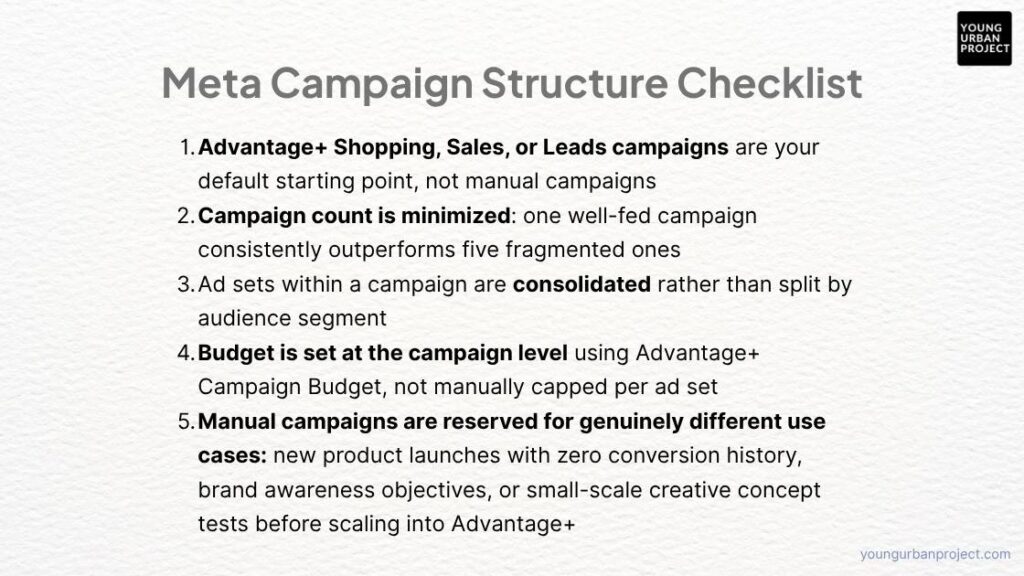
- Advantage+ Shopping, Sales, or Leads campaigns are your default starting point, not manual campaigns
- Campaign count is minimized: one well-fed campaign consistently outperforms five fragmented ones
- Ad sets within a campaign are consolidated rather than split by audience segment
- Budget is set at the campaign level using Advantage+ Campaign Budget, not manually capped per ad set
- Manual campaigns are reserved for genuinely different use cases: new product launches with zero conversion history, brand awareness objectives, or small-scale creative concept tests before scaling into Advantage+
There’s a real structural debate worth running as a test rather than assuming. Meta’s typically recommended structure is one campaign, one ad set, ten to twenty or more creatives, giving the algorithm maximum freedom, but there’s no single correct structure and the right one is whichever performs on your specific account. If you’re unsure, run two ad sets with identical creatives, one fully broad and one with interest targeting applied, same budget, same window, and compare CPA after seven to fourteen days.
When manual structure still earns its place: brand-new accounts with no conversion history, where Advantage+ has nothing to learn from yet. Small daily budgets under what your objective needs to exit the learning phase. And genuinely experimental creative concepts you want to isolate before feeding them into a consolidated campaign.
Creative Checklist: Building for Creative-as-Targeting (Intermediate)
This is the section that actually moves performance in 2026. Meta’s own data science team has said creative quality now accounts for 56% of campaign performance outcomes, more than targeting, budget, placement, and timing combined. If your account is underperforming and your settings look fine, your creative decision framework is almost always the real problem.
Structural diversity beats surface diversity. Swapping a headline on the same image doesn’t count as a new creative to Andromeda. Meta’s visual recognition models can treat an image with slightly different text overlays as essentially the same asset, and a perceived lack of diversity can push your CPMs higher.
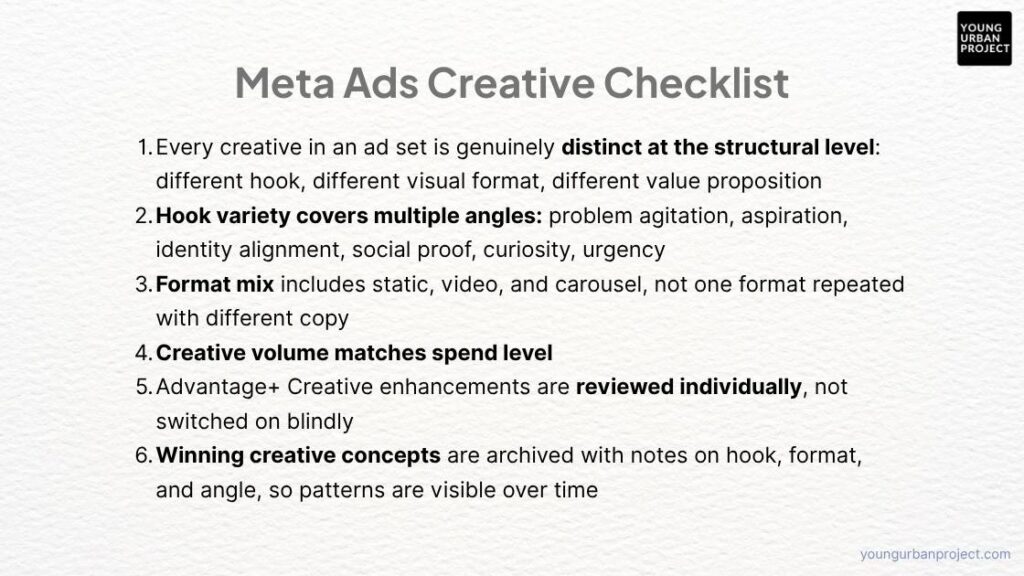
- Every creative in an ad set is genuinely distinct at the structural level: different hook, different visual format, different value proposition
- Hook variety covers multiple angles: problem agitation, aspiration, identity alignment, social proof, curiosity, urgency
- Format mix includes static, video, and carousel, not one format repeated with different copy
- Creative volume matches spend level (see benchmarks below)
- Advantage+ Creative enhancements are reviewed individually, not switched on blindly
- Winning creative concepts are archived with notes on hook, format, and angle, so patterns are visible over time
Minimum creative volume by spend: accounts spending $5,000 or more per month typically need five to fifteen new creatives per week to keep Andromeda supplied with fresh signal. March 2026 guidance from Meta partners puts the broader benchmark at fifteen to fifty or more active creatives across an account for the algorithm to optimize properly, roughly double what was considered sufficient two years earlier.
On Advantage+ Creative specifically: since February 2026, every new Sales, Leads, and App Promotion campaign launches with all Advantage+ Creative enhancements turned on by default. Don’t leave them all running blind. Pull up the preview panel weekly and check what the system is generating from your source assets, especially auto-cropping, text overlays, and music additions on video. Advantage+ Creative can now generate video from static images and produce multiple variations automatically, and Meta reports this cuts creative production costs by up to 40%. Useful for volume. Not a replacement for reviewing what actually ships.
Creative quality drives 56% of Meta ad performance outcomes as of 2026, more than targeting, budget, or placement. Genuine diversity means varying hook, format, and value proposition, not swapping headlines on the same visual. Accounts spending $5,000 or more monthly typically need 5-15 new creatives weekly to keep the algorithm supplied.
Targeting and Audience Checklist in the Post-Interest Era (Intermediate)
Interest-based targeting and custom lookalikes are underperforming broad targeting in most accounts right now, and industry analysis from Search Engine Land in January 2026 confirmed that broad targeting began outperforming interest stacks across hundreds of advertiser accounts. That doesn’t mean delete every audience you’ve built. It means test before you assume.
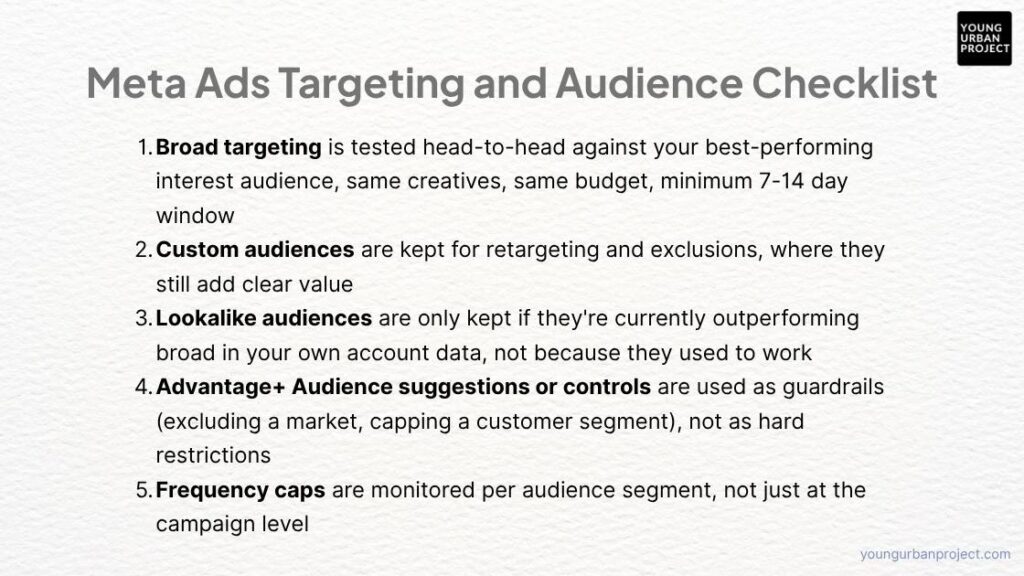
- Broad targeting is tested head-to-head against your best-performing interest audience, same creatives, same budget, minimum 7-14 day window
- Custom audiences are kept for retargeting and exclusions, where they still add clear value
- Lookalike audiences are only kept if they’re currently outperforming broad in your own account data, not because they used to work
- Advantage+ Audience suggestions or controls are used as guardrails (excluding a market, capping a customer segment), not as hard restrictions
- Frequency caps are monitored per audience segment, not just at the campaign level
Where audiences still matter: exclusions. Andromeda is good at finding new people. It’s not automatically good at avoiding people who already converted last week, unless you exclude them or your Advantage+ Audience settings account for it. Existing customer exclusion or budget caps inside Advantage+ Shopping campaigns remain one of the highest-leverage manual controls you still have.
Budget and Bidding Checklist for Advantage+ Campaigns (Intermediate to Advanced)
Budget mistakes in 2026 usually come from applying old learning phase rules to a system whose thresholds have moved.
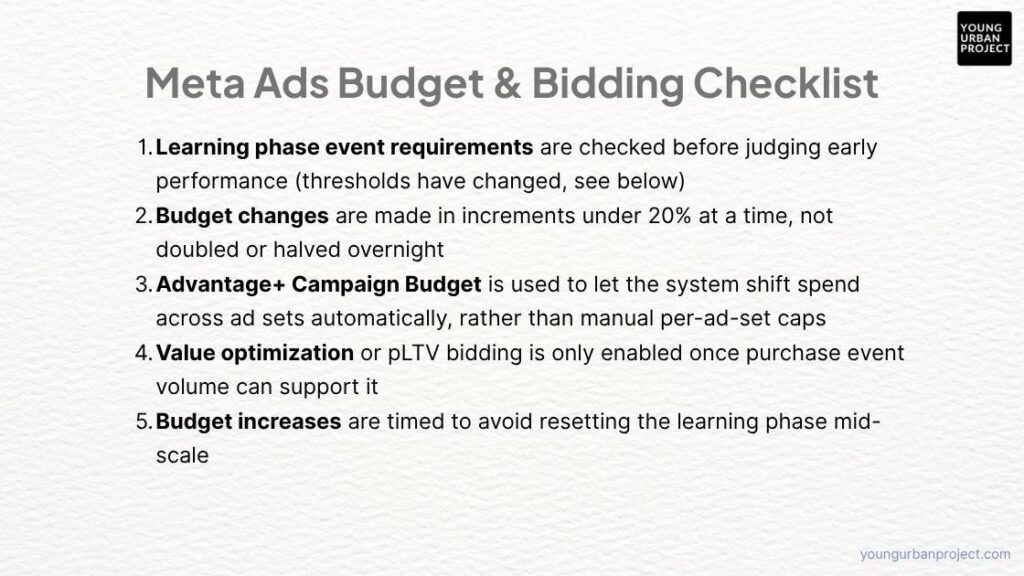
- Learning phase event requirements are checked before judging early performance (thresholds have changed, see below)
- Budget changes are made in increments under 20% at a time, not doubled or halved overnight
- Advantage+ Campaign Budget is used to let the system shift spend across ad sets automatically, rather than manual per-ad-set caps
- Value optimization or pLTV (predicted Lifetime Value) bidding is only enabled once purchase event volume can support it
- Budget increases are timed to avoid resetting the learning phase mid-scale
Meta’s March 2026 Advantage+ updates changed the learning phase requirement to 50 optimization events per week, up from the varied thresholds advertisers worked with before. If your ad set isn’t clearing that volume, expect instability, not a broken campaign.
Value optimization and pLTV bidding inside Advantage+ Sales campaigns can now stabilize with as few as 30 to 50 high-value purchase events per week, a lower bar than the standard learning phase threshold requires. That’s a meaningful shift for mid-sized advertisers who previously assumed value-based bidding was out of reach.
Predictive Budget Allocation, rolled into Advantage+ in 2026, automatically shifts spend toward high-performing segments in real time and delivered 8-15% better ROAS in early tests. Worth testing on any account with enough volume to feed it, but confirm it’s actually reallocating meaningfully before crediting it for a lift you’d have gotten anyway.
Also Read: 100+ Performance Marketing Tools – Ultimate List
Signal Quality Checklist: Conversions API and Event Match Quality (Advanced)
Everything above assumes Andromeda and GEM are learning from clean, complete data. If 30 to 40% of your purchase events never reach Meta, blocked by ad blockers, lost to iOS restrictions, or suppressed by consent settings, the algorithm is learning from an incomplete and potentially biased sample of your actual buyers. That directly limits how well it can retrieve and rank the right people for you, no matter how good your creative is.
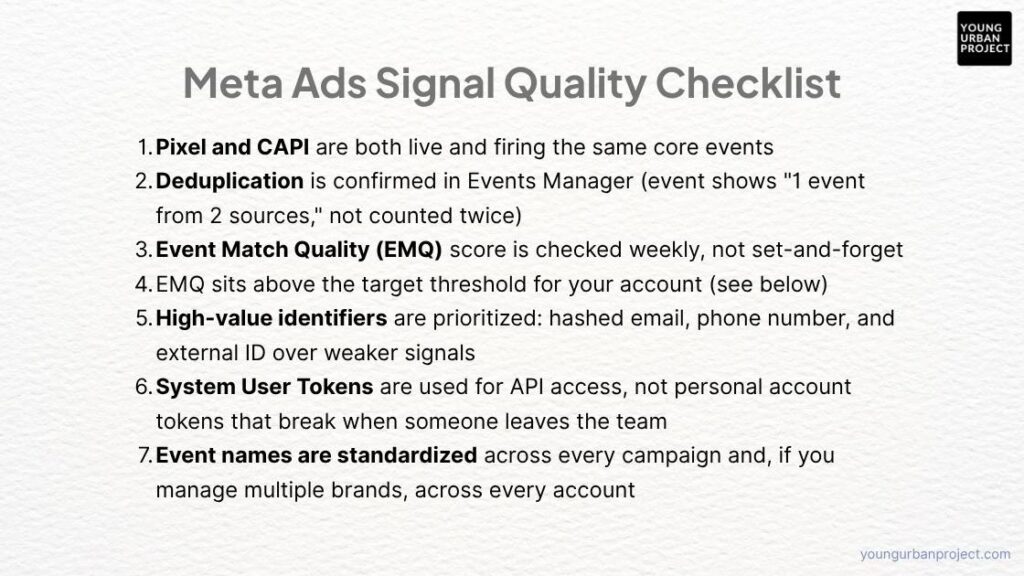
- Pixel and CAPI are both live and firing the same core events
- Deduplication is confirmed in Events Manager (event shows “1 event from 2 sources,” not counted twice)
- Event Match Quality (EMQ) score is checked weekly, not set-and-forget
- EMQ sits above the target threshold for your account (see below)
- High-value identifiers are prioritized: hashed email, phone number, and external ID over weaker signals
- System User Tokens are used for API access, not personal account tokens that break when someone leaves the team
- Event names are standardized across every campaign and, if you manage multiple brands, across every account
Event Match Quality benchmarks: Meta requires a match rate above 70% for reliable attribution, and advertisers who implement Conversions API correctly typically see roughly 20% more attributed conversions on Purchase events than Pixel data alone would show. Inside Events Manager, aim to keep EMQ above 7.0 for optimal delivery, and treat anything under 6.0 as a signal something in your event parameters needs fixing.
On integration method: the Conversions API Gateway is a self-serve option inside Events Manager that lets you set up server-side tracking without dedicated developer resources, cutting integration time from weeks down to hours or minutes. If you’re on Shopify, WooCommerce, or a similar platform with a native integration, use that first. Reach for the Gateway or a custom GTM Server-Side setup only when you have requirements the native integration can’t handle.
Meta requires an Event Match Quality score above 70% for reliable attribution, and advertisers implementing Conversions API correctly typically see about 20% more attributed Purchase conversions than Pixel-only tracking captures. Below an EMQ of 6.0, the algorithm is learning from a degraded signal regardless of how strong the creative or targeting is.
Incrementality Testing Checklist: Is Your ROAS Even Real (Advanced)
This is the step most Meta advertisers skip, and it’s the one that separates accounts that are actually growing from accounts that are just reallocating spend to sales that would have happened anyway.
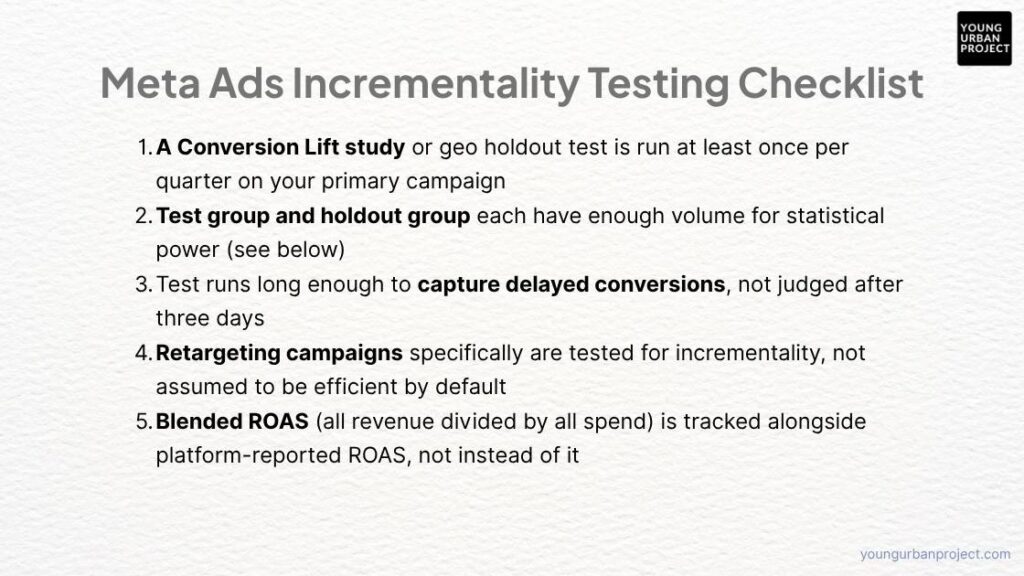
- A Conversion Lift study or geo holdout test is run at least once per quarter on your primary campaign
- Test group and holdout group each have enough volume for statistical power (see below)
- Test runs long enough to capture delayed conversions, not judged after three days
- Retargeting campaigns specifically are tested for incrementality, not assumed to be efficient by default
- Blended ROAS (all revenue divided by all spend) is tracked alongside platform-reported ROAS, not instead of it
Most Conversion Lift tests need at least 200,000 users in each group and should run two to four weeks minimum to capture delayed conversions and produce a meaningful result. Smaller accounts without that volume should lean on geo holdout tests instead, comparing performance across matched regions rather than at the user level.
The reason this matters more in 2026 than it used to: post-iOS 14 tracking gaps mean Meta’s reported ROAS commonly underestimates true performance by 20 to 40%, which is exactly why blended ROAS deserves more trust than any single platform’s dashboard number.
But automation cuts both ways on this. Research from Haus found 58% of brands saw higher incremental ROI on manual campaigns than on Advantage+, with Advantage+ over-reporting results by roughly 12 percentage points compared to its actual incremental delivery. And retargeting deserves specific scrutiny: in documented lift tests, roughly 60% of retargeting conversions turned out to be non-incremental, meaning those shoppers were already coming back regardless of the ad.
None of this means abandon Advantage+ or stop retargeting. It means don’t take the reported number at face value for either.
Creative Fatigue and Ongoing Monitoring Checklist (Advanced)
Fatigue windows have compressed to two to three weeks in the Andromeda era, down from what advertisers were used to previously. Waiting a full month to check creative health means you’ve already lost performance you can’t get back.
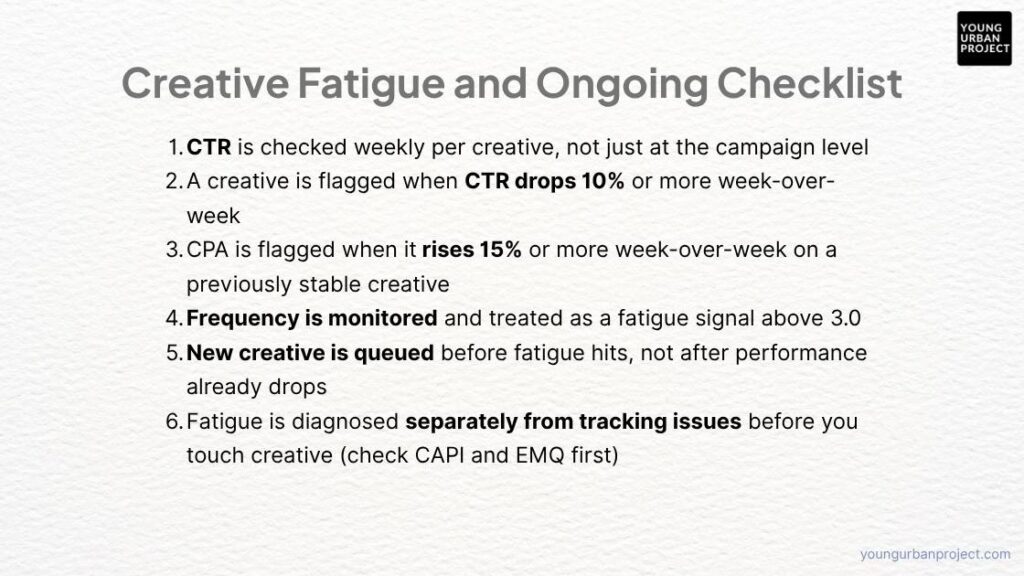
- CTR is checked weekly per creative, not just at the campaign level
- A creative is flagged when CTR drops 10% or more week-over-week
- CPA is flagged when it rises 15% or more week-over-week on a previously stable creative
- Frequency is monitored and treated as a fatigue signal above 3.0
- New creative is queued before fatigue hits, not after performance already drops
- Fatigue is diagnosed separately from tracking issues before you touch creative (check CAPI and EMQ first)
When signals flatten, don’t wait for a fixed schedule to react, and verify your Conversions API setup before assuming the algorithm broke. A CPA spike that looks like creative fatigue is sometimes a tracking gap wearing a creative costume. Rule out the signal problem first.
Honestly, this is the checklist item most accounts skip because it requires a weekly habit, not a one-time setup. It shows.
Getting This Right Takes a Different Skill Set Than It Did Two Years Ago
The through-line across every section here is the same. Andromeda and GEM reward advertisers who feed them clean signal and genuine creative variety, and they punish the habits that used to be considered best practice: narrow targeting, repetitive creative, and blind trust in platform-reported numbers.
Start with the foundations. Pixel and CAPI both live, EMQ above threshold, campaign structure consolidated instead of fragmented. Then build creative volume with real structural diversity, and don’t skip the incrementality check just because your dashboard ROAS looks healthy.
If you want to go deeper on running paid campaigns that actually hold up under this kind of scrutiny, our Performance Marketing course walks through Meta and Google Ads optimization from the ground up, built around exactly this kind of current, practitioner-level detail. If you’d rather get one sharp read every week without committing to a course, the Crystal Clear Newsletter’s Friday Marketing Edition covers exactly this kind of platform-level shift as it happens.
Also Read: How to Automate Meta Ads Reporting with Claude Code
Frequently Asked Questions about Meta Ads Optimisation Checklist
What is the Meta Andromeda algorithm?
Andromeda is Meta’s AI-driven retrieval system that decides which ads are eligible to be shown to a specific person, based primarily on the ad’s creative content rather than the advertiser’s targeting settings. It replaced the older audience-based targeting model that had run Meta’s ad platform for roughly a decade.
Is Andromeda the same as Advantage+?
No. Andromeda is the underlying delivery and retrieval system running across all campaign types. Advantage+ is a campaign type that gives Andromeda maximum targeting flexibility by removing manual restrictions. They work together. Andromeda benefits from the flexibility Advantage+ campaigns provide, but one doesn’t replace the other.
How do I know if my creatives are diverse enough for Andromeda?
Check whether your ads differ structurally, not just cosmetically. Different hooks, different formats, and different value propositions count as real diversity. Different headlines on the same image, or the same video with a new caption, generally don’t. If most of your ad set is variations of one concept, treat that as a single creative in Andromeda’s eyes.
Who should use Advantage+ campaigns instead of manual campaigns?
Most advertisers with existing conversion history should default to Advantage+. Manual campaigns still make sense for brand-new accounts with no data yet, small test budgets that can’t clear learning phase thresholds, and isolated creative concept tests you want to evaluate before folding into a broader campaign.
Is Meta’s reported ROAS accurate in 2026?
Not fully, and you shouldn’t treat it as the final word. iOS tracking restrictions mean reported ROAS commonly underestimates true performance, while Advantage+ automation has been shown to overstate incremental impact in independent research. Track blended ROAS and run periodic incrementality tests rather than relying on the dashboard number alone.
How many creatives do I need per ad set in 2026?
Accounts spending $5,000 or more monthly generally need five to fifteen new creatives weekly to stay ahead of fatigue. Broader account-level benchmarks suggest fifteen to fifty or more active creatives for the algorithm to optimize effectively, roughly double what was sufficient a couple of years ago.
Why is my Advantage+ campaign stuck in the learning phase?
Check your weekly optimization event volume against the current threshold, which sits around 50 events per week under 2026 guidance. If your ad set isn’t clearing that, the campaign will look unstable regardless of how good your creative or bidding strategy is. Value optimization campaigns have a slightly lower bar, closer to 30-50 high-value purchase events weekly.
Do I still need interest targeting in 2026?
Not by default. Broad targeting is outperforming interest stacks in most accounts under Andromeda. Test it directly against your best interest audience before assuming either approach is right for you. Interest targeting and lookalikes still earn their keep in specific cases, particularly exclusions and retargeting.
What is Event Match Quality and why does it matter?
Event Match Quality, or EMQ, measures how reliably Meta can match the conversion events you send back to a real person on the platform. A low EMQ score means the algorithm is learning from a degraded signal, which limits how well it can find the right people for your ads no matter how strong your creative or targeting is. Aim to keep it above 7.0.
Is incrementality testing worth it for a small budget?
If you can’t hit the 200,000-user-per-group volume a Conversion Lift study needs, a geo holdout test is a more realistic option. Even a quarterly geo test on your top campaign gives you a far clearer read on real impact than trusting platform-reported ROAS alone, and it doesn’t require the same scale.