

Most performance marketers “optimize” the same way every week. They nudge a bid, swap an audience, pause the weakest ad and then call it a day. Meanwhile the two levers that actually decide whether a campaign wins, creative and budget structure, sit untouched for months.
That gap is why cost per acquisition keeps creeping up even when the team is clearly putting in the hours. Real campaign optimization strategies work differently. They treat the account as a system with five interacting levers instead of a dashboard to poke at until a number moves. This guide walks through what changed in 2026 and why most accounts plateau. Learn exactly how to rebuild the habit of optimizing so it actually lowers cost per result.
Table of Contents
What Campaign Optimization Strategies Actually Mean in 2026
Campaign optimization strategies are the ongoing set of decisions across budget, bidding, audience, creative and placement that lower your cost per result over time. Not a one time launch checklist. That’s a loop you run every week for as long as the campaign is live.
That difference matters more than it sounds. Most teams treat optimization as something you do once, right after launch, then leave alone unless performance drops. The five levers, including budget structure, bidding or optimization event, audience, creative and placement all interact. Change one and the others shift too. A tighter audience changes what your bid strategy needs to learn. A new creative angle can outperform a broader audience with worse targeting.
Here’s the part that’s changed since 2023 or so: creative now outweighs targeting as the primary lever, and it isn’t close. Meta’s Andromeda update, which rolled out through 2025, pushed the platform’s ad retrieval system to read creative content directly rather than relying mainly on audience signals. According to a 2025 analysis by paid social agency Chatter Buzz, brands testing more than 20 new ads a month saw 65% higher ROAS than accounts testing fewer than 10, and ad fatigue windows compressed from six-plus weeks down to two or three. That’s not a Meta-only story either. Google’s Performance Max and Advantage+ Shopping campaigns lean the same direction: give the algorithm variety, and it finds the audience for you.
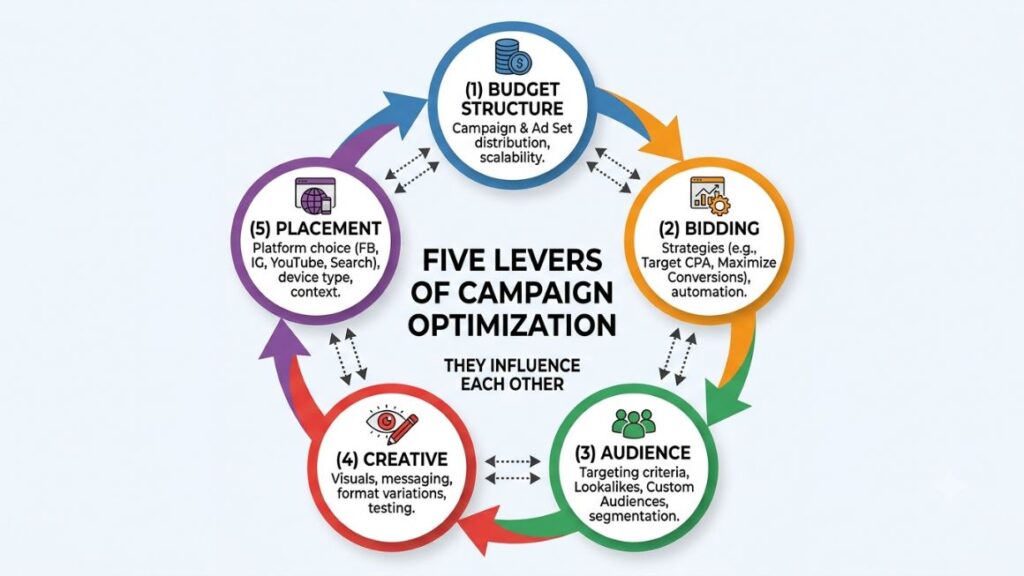
Campaign optimization strategies cover five interacting levers: budget structure, bidding and optimization event, audience, creative, and placement. Since Meta’s 2025 Andromeda update and the rise of Performance Max on Google, creative has overtaken audience targeting as the highest-leverage lever, because ad platforms now use creative content itself to determine who sees an ad.
Read More: Plan Facebook Ad Campaigns That Convert (Step-by-Step Framework)
Why Most Campaigns Plateau: The Real Reasons Behind Wasted Spend
Ask most marketers why a campaign stalled. You’ll get “the algorithm changed” or “the market’s saturated.” But usually it’s something far more fixable.
Stale creative is the biggest culprit. Ad fatigue windows have shrunk hard. What used to hold up for six weeks now wears out in two or three, particularly on Meta after Andromeda started rewarding genuine creative variety over small edits to the same ad. Teams still running the same three creatives from launch day are paying an invisible tax on every impression.
Budget spread too thin is the second problem, and it’s sneaky because it looks like diligence. Splitting spend across eight ad sets to “test everything at once” starves every ad set of the conversion volume it needs to exit the learning phase. Bid algorithms need data. Thin budgets across too many variables mean none of them ever get enough.
Then there’s the vanity metric trap. Click-through rate and impressions feel good to report, but they don’t pay the bills. A campaign with a strong CTR and a weak CPA is not a good campaign. It’s a campaign generating cheap attention that doesn’t convert, and teams keep it running because the top-line number looks healthy.
Finally: tracking gaps. If your pixel, server-side event, or Conversions API setup has holes, your bid strategy is optimizing against partial or delayed data. No amount of creative or budget discipline fixes a campaign that’s essentially bidding blind.
Read More: Meta Ads Optimization Checklist: The Complete Guide for Andromeda-Era Campaigns (2026)
Building the Right Budget Structure Before You Touch Anything Else
Before you write a single new ad or adjust a single bid, get the budget structure right. Everything downstream depends on it.
Campaign-Level vs Ad-Set-Level Budgets (Advantage+ / CBO vs ABO)
Campaign Budget Optimization, or CBO, lets Meta’s algorithm decide how to split spend across ad sets in real time depending on where it’s finding conversions. Ad Set Budget Optimization, or ABO, means you set the budget manually per ad set. And it stays fixed regardless of performance. Algorithm-controlled budgets outperform manual splits for most accounts running under Andromeda-era Meta or Google’s Performance Max. That is simply because the system has more real time signal than a human checking the dashboard twice a day.
ABO still earns its place in one scenario: when you deliberately want to protect spend on a smaller, strategically important segment (a new market, a specific product line) that the algorithm would otherwise starve in favor of an easier win elsewhere.

How Much to Set Aside for Testing vs Scaling Proven Winners?
A workable split for most mid-size accounts is 70-80% of budget on proven and scaling campaigns. It’s 20 to 30% on active testing. Below 15% for testing and you stop finding new winners before the current ones fatigue. Above 35% and you’re starving your scaling campaigns of the volume they need to stay in a healthy learning phase.
Real example: A D2C skincare brand running festive campaigns typically restructures budget in three phases during the Diwali season. Two to three weeks out, they shift 30% of spend into a dedicated testing campaign to find which festive specific creative angles (gifting versus self-care versus family) perform before the peak window opens. That creative gets folded into the main scaling campaign once a winner emerges. Testing budget drops back to 15% for the remainder of the season. This mirrors how brands like Mamaearth structure festive spend and front-loading creative testing before the highest competition days when CPMs spike.
A workable budget split for most performance accounts is 70-80% on scaling campaigns and 20-30% on active testing. Algorithm-controlled budgets (CBO on Meta, standard shopping campaigns on Google) generally outperform manually fixed ad-set budgets because platform algorithms now have more real-time conversion signal than manual daily adjustments can match.
Read More: Meta Andromeda Update: Run Winning Campaigns – Full Strategy
Creative Testing: The Highest-Leverage Lever Right Now
Here’s the uncomfortable truth for teams that have spent years perfecting audience segmentation: your creative is probably the reason your CPA hasn’t moved, not your targeting.
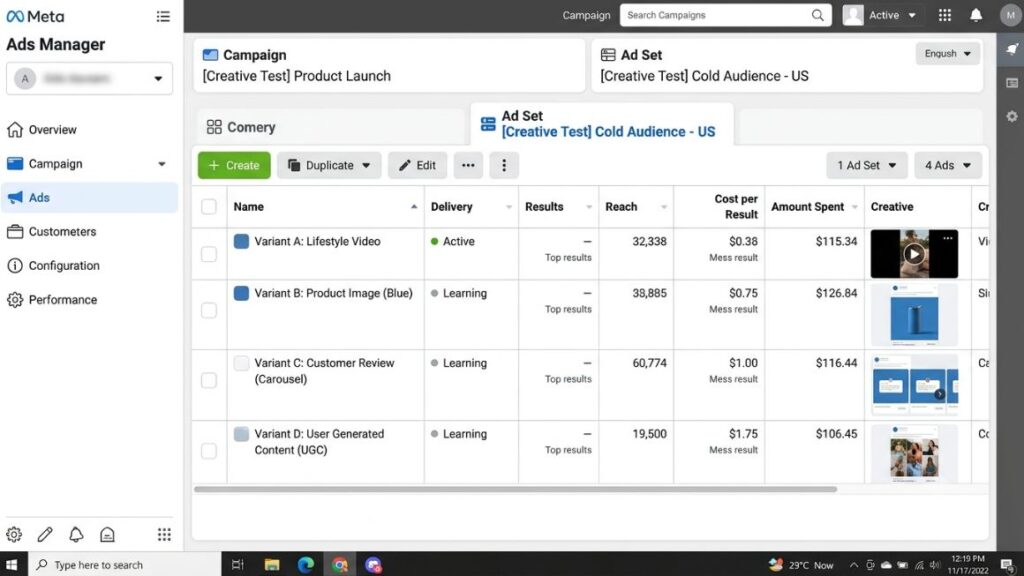
How Many Variants to Test and Why 3-5 Per Test Is the Sweet Spot
Three to five genuinely distinct creative variants per A/B test gives you enough signal to find a winner without splitting your budget so thin. This isn’t about volume for its own sake. According to the same Chatter Buzz 2025 analysis, a single ad set running 25 diverse creatives generated 17% more conversions at 16% lower cost than five separate ad sets running five creatives each. That is because consolidating creative variety into fewer and larger ad sets gives the algorithm more data per audience segment to learn from.
Isolating Variables: New-vs-New, One Change at a Time
Testing a new hook against your current best-performing ad, rather than against another untested variant, is how most teams accidentally waste a test cycle. You learn whether the new hook beats your old winner, not whether the new hook itself is any good relative to other new ideas. Run new-vs-new tests instead: pit fresh variants against each other, then bring the winner forward to challenge your existing top performer separately.
One more thing worth knowing: Meta’s system now actively penalizes cosmetic variation. Ads it judges too similar to each other get collapsed into a single entity for delivery purposes, according to Chatter Buzz’s account testing, with a Creative Similarity Score above roughly 60% triggering that suppression. Changing a thumbnail or swapping one word in the headline doesn’t count as a real test variant anymore.
Reading Results Without Falling for Early Noise
Wait for at least 50 conversions per variant before making a kill-or-scale decision, and longer for high-ticket products with naturally lower conversion volume. Early CTR spikes are the classic trap. An ad can post an excellent click-through rate in the first 48 hours purely from novelty and still convert worse than your existing creative once the algorithm has real conversion data to work with.
Example: boAt’s creative team is known for running high-frequency refresh cycles on Meta and rotating hook-first UGC style ads (customer testimonials, unboxing clips and influencer reaction content). This happens every two to three weeks rather than waiting for a formal fatigue signal to show up in the metrics. That cadence lines up almost exactly with how fast ad fatigue now sets in under Andromeda.
Audience and Targeting: What Still Matters When Algorithms Do the Work
If creative now does most of the targeting work, does audience selection even matter anymore? Mostly, yes, but the job has changed from precision-targeting to signal-feeding.
Broad vs Segmented Targeting in an Automation-First Environment
Broad targeting lets Meta or Google’s algorithm find the right person rather than constraining it with narrow interest layers. It now consistently outperforms tightly segmented audiences in accounts with healthy conversion volume and clean tracking. The algorithm has more data than any manual segmentation strategy can replicate. Segmentation still earns its place when you’re deliberately testing message market fit across genuinely different customer groups instead of a default targeting approach.
Retargeting and Lookalike Audiences: Where They Still Earn Their Place
Retargeting is still one of the highest ROAS tactics in almost any account. That is precisely because it’s targeting people who’ve already shown intent. Lookalike audiences built from high-value customers (not just any converter) still give broad campaigns a useful starting seed even under automation heavy bidding.
First-Party Data and Signal Quality
This is where the real leverage sits now. Conversions API integration and enhanced conversions on Google Ads feed the algorithm cleaner, faster signal than pixel tracking alone, which is increasingly degraded by browser privacy restrictions and ad blockers. An account with strong first-party data infrastructure can consistently out-optimize a competitor spending the same budget with weaker signal quality. That’s the case regardless of how sophisticated either team’s manual targeting looks.
Read More: Facebook Marketing Strategy Guide for Business Growth 2026
Bidding Strategy and Choosing the Right Optimization Event
Get the optimization event wrong and every other lever you pull is fighting against a bid algorithm that’s chasing the wrong outcome.
Matching Bid Strategy to Campaign Objective
Target CPA works well once you have stable, consistent conversion volume and know roughly what a customer is worth. Maximize Conversions suits earlier-stage campaigns still building that data, before you’re confident enough in unit economics to set a hard CPA ceiling. Target ROAS is available on both Meta and Google. It is the right call once you’re tracking revenue per conversion accurately and want the algorithm optimizing for value, not just volume.
Common Mistakes: Wrong Event, Switching Too Often
The most common bidding mistake isn’t picking the wrong strategy. It’s optimizing for “Add to Cart” or “Landing Page View” as a permanent event long after the campaign has enough purchase data to optimize for the event that actually matters. Optimizing for a shallow funnel event brings in cheap, low-intent traffic that never converts downstream.
The second mistake is switching bid strategy every time performance dips for a few days. Every switch resets the learning phase, and a campaign stuck perpetually re-learning never reaches stable performance. Give a bid strategy at least a full learning cycle, generally 50 conversions or one to two weeks, before deciding it isn’t working.
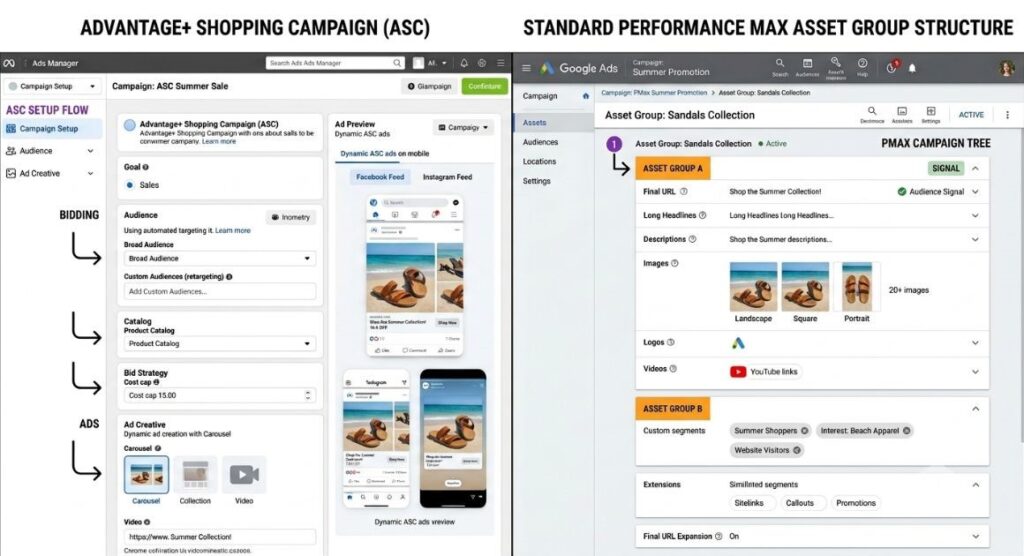
Performance Max Structuring: Single Campaign vs Segmented Approach
Google’s Performance Max campaigns perform best structured as fewer, broader campaigns rather than many narrow ones split by product category. A single PMax campaign with strong, diverse asset groups generally outperforms five smaller campaigns competing against each other for the same auction, since fragmenting spend across campaigns just means each one has less conversion data to learn from. Segment PMax campaigns only when you genuinely need separate budgets or ROAS targets for distinct product lines, not as a default organizational habit.
Read More: Performance Marketing Strategy: Complete Guide for 2026
Channel-Specific Optimization Tactics
The five levers stay the same across channels. How you apply them doesn’t.
Meta and Instagram: Andromeda-Era Creative Diversity, Advantage+ Shopping
Andromeda rewards genuine creative diversity over volume for its own sake. Advantage+ Shopping Campaigns, Meta’s fully automated e-commerce campaign type, now handle placement, budget, and audience decisions almost entirely, which means your entire job as the marketer shifts to feeding the system a steady stream of distinct creative concepts, not managing bid adjustments.
Google Ads and Performance Max
Google Ads rewards tight keyword-to-ad relevance in Search campaigns beyond PMax structuring. It increasingly favors advertisers who’ve connected offline conversion data (store visits, call tracking) back into the platform for smarter bidding decisions.
Email and Lifecycle Campaigns
Segmentation still matters far more in email than in paid social, since you’re working with a known list rather than an algorithm finding new prospects. Deliverability has become its own optimization lever: sender reputation and inbox placement now meaningfully affect whether your “optimized” campaign even reaches the inbox.
Social and Organic-Paid Crossover Content
Content that performs organically first (a Reel or a carousel post) often makes the strongest paid creative. That is because it’s already been validated by real engagement before a rupee of media budget touches it. Feeding your best organic performers into paid campaigns is one of the simplest and lowest cost creative testing shortcuts available.
The Weekly Campaign Optimization Cadence You Can Actually Run
Optimization fails most often not from bad decisions but from no consistent rhythm at all. Here’s a cadence that actually holds up week over week.
Daily: Check spend pacing and flag any ad set spending more than 20% off its expected daily budget. Nothing else needs daily attention. Checking every metric daily just invites premature and noise-driven decisions.
Weekly: Review creative fatigue signals like rising frequency and declining CTR on previously strong ads. Audit CPA and ROAS by campaign against target and refresh at least one creative test.
Monthly: Run a full campaign audit and review budget allocation across the testing-versus-scaling split. Reassess bid strategy against updated conversion data.
A Simple Campaign Audit Checklist
- Confirm tracking accuracy (pixel, Conversions API, offline conversions all firing correctly)
- Compare CPA and ROAS by campaign against the previous 30-day period
- Flag any ad running longer than three weeks without a fresh variant test
- Review budget split between testing and scaling campaigns
- Check bid strategy still matches current conversion volume and data maturity
- Identify the single highest-CPA campaign and diagnose which lever is failing it
When to Pause, Scale, or Kill an Ad Set?
Scale an ad set once it’s hit target CPA or ROAS consistently for at least a week with sufficient conversion volume. Increase budget in increments of 20 to 30% rather than doubling it. This can reset learning. Pause, don’t kill, an ad set that’s underperforming but still within a reasonable range. Seasonal or platform shifts sometimes explain a temporary dip. Kill an ad set only after it’s had a full learning cycle and clearly missed target with no improving trend.
Measuring What Matters: Metrics That Actually Drive Decisions
CPA, ROAS, and MER (marketing efficiency ratio) all answer slightly different questions, and using the wrong one for the decision in front of you leads to bad calls even with perfect data.
CPA is the right lens for lead-generation and subscription businesses where a fixed acquisition cost matters more than variable order value. ROAS works best per-channel, per-campaign, showing revenue return on that specific spend. MER is total revenue divided by total marketing spend across every channel combined. That is the metric that matters most to the business overall, because it isn’t dependent on any single platform’s attribution model. MER above 3x is generally considered healthy for most D2C brands. But the right benchmark depends heavily on margin structure and growth stage.
Attribution Windows and Why Last-Click Still Misleads Teams
Last-click attribution credits whichever touchpoint happened right before conversion. That systematically undervalues upper-funnel awareness and retargeting campaigns that set up the eventual sale. A seven-day click and one-day view attribution window on Meta (or its Google Ads equivalent) gives a more realistic picture for most e-commerce purchase cycles. But longer consideration-cycle products (real estate, B2B software and high-ticket electronics) need wider windows to capture the full path to conversion.
Statistical Significance Basics
Don’t call a creative test until each variant has at least 50 conversions as a working rule. And treat anything under 100 total conversions across a comparison as directional rather than conclusive. A 20% difference in CPA between two ads with 15 conversions each is noise, not signal. That same 20% gap across 200 conversions each is a real result worth acting on.
MER, revenue divided by total marketing spend across all channels, gives the clearest single view of overall marketing efficiency because it doesn’t depend on any one platform’s attribution model. A MER above 3x is generally healthy for D2C brands, though the right benchmark varies with margin and growth stage. MER is unlike ROAS as it requires no attribution model at all, just total revenue and total spend.
Campaign Optimization Strategies for the Indian Market
Optimization tactics that work globally still need Indian-market context layered on top. That especially matters around timing, language and platform mix.
Festive-Season Spend Patterns and Planning Around Them
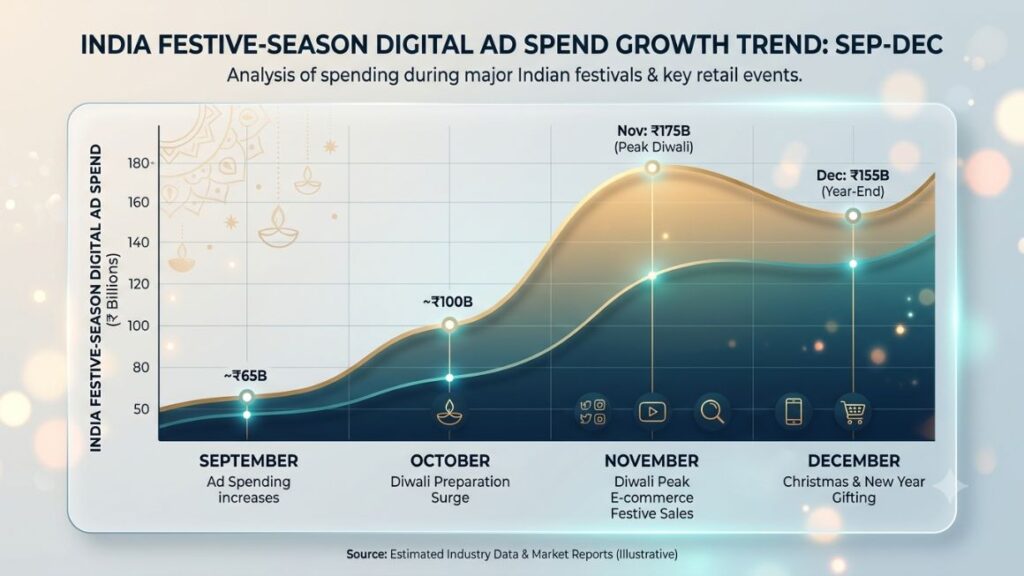
The festive advertising window in India (roughly September through Diwali) sees digital ad spend surge disproportionately relative to the rest of the year. Industry estimates for the 2025 festive season pointed to digital ad expenditure rising 20 to 25% year-on-year. That is nearly double the pace of traditional media and notably faster than comparable growth in the US or Western Europe. Total festive-season ad spend across all media in 2025 reached an estimated ₹48,000 to ₹51,000 crore. That surge means CPMs climb sharply in the two to three weeks before Diwali. This is exactly why the budget-phasing approach covered earlier (front-loading creative testing before the peak window) matters more in India than in flatter, less seasonal markets.
Regional-Language Creative and Tier-2/3 Targeting
Hindi and regional-language creative variants consistently outperform English-only ads once you move targeting beyond metro audiences. Tier-2/3 cities now represent a growing share of D2C order volume for brands like Nykaa and Zepto. Treat regional language creative as its own test variant. It is not a translated afterthought of your English language winner.
Platform Mix Shift: JioCinema, ShareChat, WhatsApp Commerce
Video and connected TV inventory through platforms like JioCinema and Disney+ Hotstar have become a meaningful part of the festive media mix. That is particularly true for brands with a brand-awareness component to their funnel, not just direct-response goals. WhatsApp has become its own performance channel entirely. India’s WhatsApp user base sits above 500 million. Click-to-WhatsApp ads have grown fast enough that Meta-linked commerce reporting put year-on-year click-to-WhatsApp ad revenue growth at 60% for Q3 2025. WhatsApp ads deserve their own budget line for categories like real estate, education and high-consideration D2C where a conversation closes the sale better than a landing page.
Read More: The 15 Best WhatsApp Marketing Software Tools for 2026
AI-Powered Campaign Optimization: How Much to Automate
Every platform now pitches its AI layer as the thing that entirely replaces manual optimization. It doesn’t, though it does genuinely change where your time should go.
Where Automation Genuinely Helps
Bid and budget routing across ad sets and creative generation at scale for initial variant testing. Automated placement decisions are all areas where the platform’s algorithm now outperforms manual management. That is simply because it’s processing far more real-time signal than any human checking a dashboard twice daily can. AI-generated creative variants are genuinely useful for the early and high volume testing phase. They are generating enough distinct concepts fast enough to find a winning angle before manually briefing every single one.
Where Human Judgment Still Has to Stay in the Loop
Strategic decisions, which audience segments to prioritize, what the brand’s creative angle should even be, when to enter or exit a market, still need a human making the call. AI-generated creative also tends to plateau in quality once you’re past the initial broad concept testing stage. The ads that actually break through and drive the highest ROAS still tend to come from genuine customer insight instead of generative output alone. From what we’ve seen with YUP learners running their own accounts, the strongest performers are the ones using AI to generate testing volume while keeping strategic creative direction firmly in human hands.
Realistic Expectations, Not Hype
Automation compresses the time it takes to find a winning creative or audience combination. It does not remove the need for someone who understands the five levers well enough to know when the algorithm is optimizing toward the wrong goal. Treat AI-powered optimization as a force multiplier on a sound strategy. It is not a replacement for having one.
Read More: How to Create AI-Driven Marketing Campaigns
Conclusion
Cutting cost per result without touching the budget line comes down to getting the fundamentals right in the order that actually matters. Budget structure first, creative testing second, audience and bidding refined around both. Skipping straight to bid tweaks without fixing a thin and over segmented budget or stale creative. You’re optimizing the smallest lever while the two biggest ones sit untouched.
The teams seeing real CPA improvements in 2026 aren’t the ones with the most sophisticated targeting. They’re the ones running a disciplined weekly cadence and feeding their campaigns genuine creative variety instead of cosmetic tweaks. Trusting platform algorithms with the decisions they’re now genuinely better at making.
If you want to build this into a repeatable system rather than relearning it every quarter, YUP’s Performance Marketing course walks through budget structuring, creative testing frameworks, and bidding strategy in far more depth than a single article can cover, with live campaign audits from working marketers. If a full course isn’t the right next step yet, the Crystal Clear Newsletter breaks down one performance marketing tactic like this every week, free.
FAQ
What are campaign optimization strategies?
Campaign optimization strategies are the ongoing set of decisions across budget structure, bidding, audience, creative, and placement that lower cost per result over time. They’re not a one-time setup task; they’re a continuous weekly loop you run for as long as a campaign stays live.
Is campaign optimization the same as A/B testing?
No. A/B testing is one tactic within campaign optimization, specifically for comparing creative or landing page variants. Full campaign optimization also covers budget allocation, bid strategy, audience structure and platform specific tactics that A/B testing alone doesn’t touch.
How often should I optimize my campaigns?
Check spend pacing daily, review creative fatigue and CPA against target weekly. Run a full campaign audit monthly. Checking every metric every day usually leads to premature decisions based on noise rather than real signal.
CPA vs ROAS: which should I optimize for?
CPA suits lead-generation or subscription businesses where a fixed acquisition cost matters most. ROAS works better for e-commerce, where order value varies and you need to see revenue return per rupee spent. For an overall efficiency view across every channel, MER is the more reliable metric since it doesn’t depend on any single platform’s attribution.
How many creative variants should I test at once?
Three to five genuinely distinct variants per test round is the sweet spot. Fewer than that and you’re not covering enough creative angles. More than that and you split conversion volume too thin for any single variant to reach statistical significance quickly.
Who should be running formal campaign optimization, and when does it matter?
Any account spending enough to generate at least 50 conversions a month per campaign benefits from a structured optimization cadence. Below that volume, focus first on getting enough conversion data before investing heavily in formal testing cycles, since small-sample tests just produce noise.
Is AI-powered campaign optimization actually worth it?
For creative generation at scale and bid or budget routing, yes, the platform algorithms now process more real-time signal than manual management can match. Human judgment still consistently outperforms automation alone for strategic decisions like which audience segments to prioritize or what the core creative angle should be.
Why isn’t my campaign optimization working even though I’m testing regularly?
The most common cause is testing cosmetic variations like a new headline or a swapped thumbnail. That is better than genuinely distinct creative concepts. These platforms like Meta now treat them as duplicates and suppress them. The second most common cause is thin tracking data from incomplete Conversions API or pixel setup. This means your bid algorithm is optimizing against partial information regardless of how good your creative testing is.
What’s the biggest mistake teams make in campaign optimization?
Switching bid strategy or budget structure every time performance dips for a few days. Every change resets the learning phase, so a campaign that never gets left alone long enough to stabilize never actually reaches its potential performance.
Do Indian festive-season campaigns need a different optimization approach?
Yes. CPMs rise sharply in the two to three weeks before Diwali as competition for the same inventory spikes. So shifting a larger share of budget into creative testing before that window (rather than during it) tends to produce stronger festive-period performance than testing on the fly.
How much budget should go toward testing new creative versus scaling proven ads?
A workable default is 70 to 80% on scaling campaigns that are already hitting target CPA or ROAS, and 20-30% on active testing. Going much below 15% on testing means you stop finding new winners before your current ones fatigue.
What’s a Performance Max campaign and how is it different from regular Search or Shopping campaigns?
Performance Max is Google’s automated campaign type that runs across Search, Display, YouTube, Gmail, and Maps from a single campaign. The algorithm handles most targeting and placement decisions. It is unlike standard Search or Shopping campaigns where you control keywords and placements more directly. PMax asks you to feed it creative assets and conversion goals, then trusts the algorithm to find the right combination.