
Most marketing dashboards look… impressive.
ROAS is strong.
CPA is stable.
Conversion rates look healthy.
On paper, everything is working.
And yet revenue isn’t scaling the way it should.
You push budgets. You test creatives. You tweak targeting. Maybe even rebuild funnels.
Still… something feels off.
If you’ve been in that situation, you’re not alone. And honestly, it’s not because your team is underperforming.
It’s because you’re optimizing parts of a system… without measuring the system itself.
That’s where Marketing Efficiency Ratio (MER) comes in.
It’s not a new metric. It’s just… strangely underused.
And once you start using it properly, it’s hard to go back.
Table of Contents
What Is Marketing Efficiency Ratio (MER)?
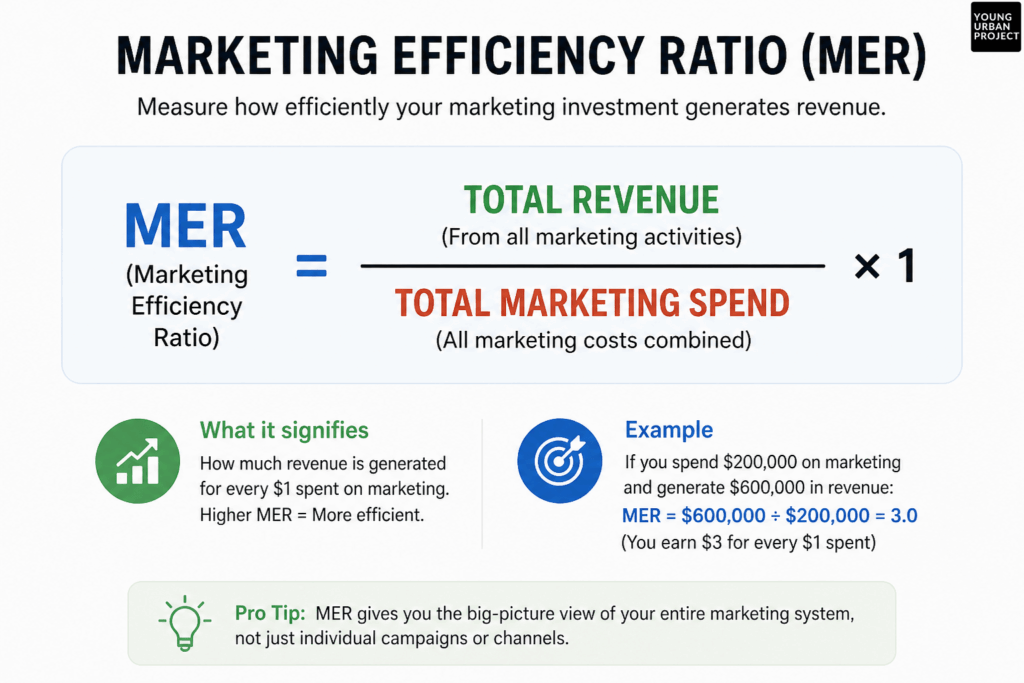
At its simplest, Marketing Efficiency Ratio (MER) measures how efficiently your entire marketing system generates revenue.
The Formula
MER = Total Revenue ÷ Total Marketing Spend
That’s it.
But what makes it powerful isn’t the formula.
It’s what you include in it.
What Counts as “Marketing Spend”?
This is where most teams get it wrong.
MER is not just about ad spend. It includes everything that contributes to demand generation:
- Paid ads (Meta, Google, TikTok, etc.)
- Agency or freelancer costs
- Content production (videos, blogs, creatives)
- Influencer or creator partnerships
- Marketing tools and software
If money is being spent to drive awareness, interest, or conversions, it belongs in MER.
That’s what makes it different from traditional metrics.
Also Read: Best Marketing Analytics Tools
MER vs ROAS: The Difference Most Teams Miss
Let’s address the obvious comparison.
Most marketers live inside ROAS dashboards, especially on platforms like Meta Ads and Google Ads.
And to be fair, ROAS is useful.
But it answers a very specific question.
ROAS Asks:
“Is this campaign efficient?”
MER Asks:
“Is our entire marketing system efficient?”
That’s a fundamentally different lens.
ROAS is a channel-level metric.
MER is a business-level metric.
And when you scale, that difference becomes everything.
Also Read: What is Return On Marketing Investment (ROMI)
A Simple MER Example (That Explains a Lot)
Let’s say you’re running a D2C brand (like MamaEarth, or BoAt).
Here’s your monthly spend:
- $100,000 on Meta ads
- $50,000 on Google ads
- $50,000 on influencers + content
Total Marketing Spend = $200,000
Revenue generated that month?
$600,000
MER Calculation:
MER = 600,000 ÷ 200,000 = 3.0
So for every $1 spent, the business generates $3.
Sounds solid, right?
Now here’s where it gets interesting.
Inside That Performance:
- Meta shows 4.5x ROAS
- Google shows 3.2x ROAS
Naturally, the team thinks:
“Let’s cut influencer spend. It’s hard to measure anyway.”
They shift budget into Meta.
ROAS improves. Everyone celebrates.
But a month later… Revenue stagnates.
Why This Happens (And Why MER Matters)
Because not all marketing works the same way.
Some channels:
- Capture demand (search, retargeting, bottom funnel ads)
- Convert existing intent
Others:
- Create demand (content, influencers, YouTube, brand campaigns)
- Build awareness and interest
When you cut demand creation, you don’t see the impact immediately.
You see it later.
And often… in another channel.
This is something even platforms like Shopify have highlighted in their ecosystem discussions around attribution challenges in D2C brands.
What Happened in Our Example?
Influencers were creating demand.
Meta was capturing it.
By cutting influencers:
- ROAS improved (on paper)
- MER declined (in reality)
- Revenue plateaued
MER reveals what ROAS hides.
What MER Actually Tells You
MER forces you to confront something uncomfortable:
Not all marketing activities convert directly.
And that’s okay.
Because marketing isn’t just about conversion.
It’s about:
- Awareness
- Consideration
- Trust
- Intent
These don’t always show up in last-click attribution models.
But they absolutely show up in revenue.
Another Way to Think About It
ROAS optimizes for efficiency.
MER optimizes for efficiency + scale together.
And those two goals often conflict.
The Hidden Trade-Off: Efficiency vs Growth
If you only chase high ROAS:
- You stay in bottom-of-funnel traffic
- You optimize for people already ready to buy
- You hit audience saturation quickly
- Growth plateaus
If you monitor MER:
- You invest in upper-funnel channels
- You understand total contribution
- You scale more sustainably
This is something brands like Nike have mastered over decades balancing brand and performance marketing.
They don’t just optimize for immediate conversions.
They invest in long-term demand.
What Is a Good MER?
This depends heavily on your business model.
There’s no universal benchmark, but we can think in ranges.
Based on Gross Margins:
- Low-margin businesses (electronics, retail): Need higher MER
- High-margin businesses (SaaS, digital products): Can sustain lower MER
Rough Benchmark
If your gross margin is around 60%:
You typically need MER above 2.5 to 3.0 to scale sustainably.
Below that, growth starts eating into profitability.
Where Most Teams Get MER Wrong
Even when teams adopt MER, they often misuse it.
Let’s break down the common mistakes.
1. Not Including Full Marketing Costs
If you only count ad spend, your MER is inflated.
It gives a false sense of efficiency.
And leads to bad scaling decisions.
2. Tracking MER Too Frequently
Daily MER is noisy.
Attribution delays, conversion lags, and campaign cycles distort the picture.
Better approach:
- Weekly tracking for tactical insights
- Monthly tracking for strategic decisions
3. Treating MER as a Reporting Metric
This one’s subtle, but important.
Most teams report MER…
…but don’t use it to make decisions.
That defeats the purpose.
MER should influence:
- Budget allocation
- Channel mix
- Scaling decisions
- Experimentation strategy
Why MER Matters More in 2026 Than Ever Before
Marketing has changed.
- Attribution is less reliable (thanks to privacy changes)
- Customer journeys are more fragmented
- Platforms operate in silos
Even companies like Apple have reshaped tracking with privacy updates, making it harder to rely purely on platform-reported metrics.
Which means:
If you rely only on channel-level data like ROAS…
You’re making decisions on incomplete information.
MER gives you a macro view.
And in a fragmented ecosystem, that’s not optional anymore.
What MER Enables You To Do (That ROAS Doesn’t)
This is probably the most practical part.
MER gives you permission to invest in things that ROAS usually punishes.
Like:
- YouTube campaigns
- Creator partnerships
- Brand storytelling
- Content ecosystems
Because instead of asking:
“Did this campaign convert?”
You ask:
“Did this contribute to overall revenue growth?”
That’s a more honest question.
And honestly, a more strategic one.
A Simple MER Thought Experiment
Try this.
If you paused all your top-of-funnel marketing for 30 days:
- Would your MER improve short-term? Probably yes.
- Would your revenue shrink 30–60 days later? Also yes.
Most teams never test this.
But it reveals a lot about how your system actually works.
How to Start Using MER in Your Business
You don’t need complex tools.
Start simple.
Step 1: Calculate Total Marketing Spend
Include everything:
- Ads
- Salaries or agency fees
- Content costs
- Tools
Step 2: Track Total Revenue
Use actual revenue, not attributed revenue from platforms.
Step 3: Calculate MER Weekly and Monthly
Look for trends, not daily fluctuations.
Step 4: Use MER to Guide Decisions
Ask:
- Should we scale this channel?
- Should we invest more in awareness?
- Are we over-optimizing for short-term ROAS?
The Bigger Shift: From Channel Thinking to System Thinking
This is really what MER represents.
A mindset shift.
From:
- Campaign-level optimization
- Channel-level reporting
To:
- System-level thinking
- Business-level performance
And maybe that’s why it feels uncomfortable at first.
Because it removes the illusion of control that ROAS dashboards give you.
Final Thought: MER Is Not a Replacement. It’s a Reality Check.
You don’t have to stop using ROAS.
It’s still useful.
But if you rely on it alone, you’ll eventually hit a ceiling.
MER doesn’t replace your metrics. It grounds them.
It connects your marketing efforts to actual business outcomes.
And in a world where attribution is messy and growth is harder…
That’s not just useful. It’s necessary.
Frequently Asked Questions on Marketing Efficiency Ratio (MER)
What is Marketing Efficiency Ratio (MER)?
Marketing Efficiency Ratio (MER) is a metric that measures the overall efficiency of a company’s marketing by dividing total revenue by total marketing spend. It provides a complete view of how effectively all marketing efforts combined generate revenue, rather than evaluating individual channels in isolation.
How do you calculate MER?
MER is calculated using the formula:
MER = Total Revenue ÷ Total Marketing Spend
Total marketing spend should include all costs related to demand generation, such as paid ads, agency fees, content production, influencer marketing, and marketing tools.
What is the difference between MER and ROAS?
The key difference is scope. Return on Ad Spend (ROAS) measures the efficiency of a specific advertising channel or campaign, while Marketing Efficiency Ratio (MER) measures the efficiency of the entire marketing system across all channels and activities. MER provides a more accurate view of overall business performance.
Why is MER important in marketing?
MER is important because it reflects the true impact of marketing on revenue. Unlike channel-specific metrics, it captures both demand creation and demand capture, helping businesses make better decisions about budget allocation, scaling, and long-term growth.
What is a good MER benchmark?
A good MER depends on the business model and profit margins. Generally, businesses with lower margins require a higher MER to remain profitable, while high-margin businesses can sustain a lower MER. For many companies, a MER between 2.5 and 4 is considered healthy, but this varies by industry.
Does MER include only paid advertising costs?
No, MER includes all marketing-related costs, not just paid advertising. This includes expenses such as content creation, influencer partnerships, agency fees, marketing software, and any other investment that contributes to generating demand.
How often should MER be measured?
MER should be measured on a weekly and monthly basis rather than daily. Daily MER can be volatile due to attribution delays and short-term fluctuations, while longer timeframes provide a more accurate picture of marketing performance.
Can MER help improve marketing strategy?
Yes, MER helps improve marketing strategy by providing a holistic view of performance. It allows marketers to identify whether their overall marketing system is efficient, adjust channel mix, justify upper-funnel investments, and scale campaigns more effectively.
Why can ROAS be misleading without MER?
ROAS can be misleading because it only measures direct, trackable conversions within a specific channel. It often ignores the impact of brand marketing, content, and other activities that influence customer decisions but are not directly attributed. MER captures this broader impact.
What does a declining MER indicate?
A declining MER indicates that marketing efficiency is decreasing, meaning the business is spending more to generate the same or less revenue. This can signal issues such as rising customer acquisition costs, ineffective campaigns, or reduced contribution from certain channels.
How does MER help with scaling marketing?
MER helps with scaling by showing whether increasing marketing spend leads to proportional revenue growth. If MER remains stable or improves as spend increases, it indicates that the marketing system can scale efficiently.
Should MER replace other marketing metrics?
No, MER should not replace other metrics like ROAS or CPA. Instead, it should be used alongside them. While ROAS helps optimize individual campaigns, MER ensures that the overall marketing strategy is effective and aligned with business growth.
What types of businesses benefit most from MER?
MER is especially useful for businesses with multiple marketing channels, such as eCommerce brands, SaaS companies, and D2C businesses. It is particularly valuable in environments where attribution is complex or fragmented.
How does MER account for brand marketing?
MER indirectly accounts for brand marketing by including all marketing spend and total revenue. Even if brand campaigns do not generate immediate conversions, their impact on awareness and future sales is reflected in the overall revenue captured by MER.
What is the biggest mistake when using MER?
The biggest mistake is not including all marketing costs in the calculation. Excluding expenses like content, influencers, or tools leads to an inflated MER and can result in poor strategic decisions.