

A company can have a sharp product, a clean website and a social feed that posts daily, and still have no idea what customers say about it when nobody from the team is listening. That gap is where brands quietly lose ground. Leads slow down. A competitor’s name keeps showing up in reviews. The team argues about whether the logo, the pricing or the tone is to blame.
A brand audit settles that argument with evidence, and the right brand audit tools let you run one without a six-month research project. Some track what people say online. Some show how you stack up in search. A few ask customers directly.
This guide covers 15 of them: what each does, what it costs, where it falls short and who should bother. You’ll also get a way to choose, a seven-step workflow and the metrics worth watching. Most businesses need three or four of these tools. Not fifteen.
Table of Contents
What Is a Brand Audit and Why Does It Matter?
A brand audit is a structured review of how a brand looks, sounds and performs, measured against how customers actually see it. It exposes inconsistencies, perception gaps, weak positioning and missed opportunities before they show up as lost revenue.
Understanding the purpose of a brand audit
The point isn’t to admire your logo. It’s to find the distance between what you say you are and what people believe. A founder might call the brand premium while reviews keep saying overpriced. That gap is the finding.
Internal vs. external brand evaluation
Internal evaluation checks your own house: guidelines, messaging, design files, and how sales and support describe the company. External evaluation looks outward at search behaviour, social conversation, competitors and survey responses. You need both, because teams are usually the worst judges of their own brand.
When should a business conduct an audit?
Once a year is a sensible default. Run one sooner after a rebrand, a funding round, a new market launch, a sudden drop in leads, or a public complaint that won’t go away.
Also Read: Brand Management Framework: Building Strong Brand Strategy, Identity & Equity
A brand audit compares how a company presents itself with how customers perceive it. The output is a ranked list of gaps in messaging, visual identity, positioning and reputation. Most businesses should repeat it about once a year and after any major change.
15 Best Brand Audit Tools in 2026
No single product covers a full audit. Some tools listen to conversations, some measure search and traffic, some survey customers, and a few keep your own brand assets in order. The 15 brand audit tools below run roughly in that order. Prices were checked in early November 2026, and vendors change them often, so treat every figure as a starting point and confirm it on the pricing page.
Brandwatch
Brandwatch is a social listening and consumer intelligence platform built for analysts. Its Iris AI layer includes Ask Iris, which answers questions in plain language instead of Boolean queries, and the platform reads images as well as text. In an audit, that shows which topics, communities and visuals attach to your brand. It suits large brands and agencies. Pricing is custom and annual, with no public price list, and third-party estimates run to five figures a year. Expect a steep learning curve.
Brand24
Brand24 tracks mentions across social media and the web, scores sentiment and sends alerts when conversation spikes. That makes it a fair pick for small teams that want daily monitoring without enterprise contracts. There’s no free plan, only a 14-day trial, and paid plans have started around $199 a month in 2026 pricing trackers. The price has moved several times this year, so check the page. It tells you what people say, not what to fix.
Mentionlytics
Mentionlytics monitors social and web mentions with AI-assisted sentiment analysis, and it sells an optional managed service if nobody on your team has time to run it. Plans start at $69 a month, or $49 on yearly billing, according to its help centre, and six tiers follow. A free trial exists, a free plan doesn’t. Startups, SMEs and agencies are the natural fit. Don’t expect Brandwatch-level depth.
Meltwater
Meltwater started as a media monitoring tool and now covers news, print, broadcast, podcasts and social conversation in one suite. Its GenAI Lens feature tracks how AI platforms describe your brand. PR and communications teams get the most out of it. Pricing is custom, annual and sold through sales, and Vendr’s contract data puts the median near $26,000 a year. That’s a lot if all you need is social mentions.
Sprout Social
Sprout Social is a social management platform with a strong analytics layer. Professional-tier plans add competitive reports, which help when you’re benchmarking rivals. Plans run $79 (Essentials) to $399 (Advanced) per seat each month on annual billing, with a 30-day trial. Here’s the catch: listening is a separate add-on with no published price, and per-seat costs add up fast. Best for teams whose brand lives on social.
Semrush
Semrush is an SEO suite with competitor traffic data, keyword tracking and a content toolkit that includes brand monitoring. Its AI Visibility Toolkit costs $99 a month per domain and tracks mentions in ChatGPT, Perplexity, Gemini and Google’s AI Overviews. The Pro plan starts at $139.95 a month, and a 7-day trial is on offer. SEO and content teams will feel at home. Social conversation isn’t its strength.
Ahrefs
Ahrefs is known for backlink and search data, and its Brand Radar add-on (from $199 a month) tracks brand visibility across AI search engines such as ChatGPT, Gemini and Perplexity. Plans run from $29 (Starter) to $1,499 (Enterprise) a month. There’s a free tier, Ahrefs Free, but only for sites you can verify as your own. Credit limits can bite heavy users, and it won’t show you social sentiment.
Similarweb
Similarweb estimates competitor traffic, engagement and branded versus non-branded keywords, and it tracks share of search. That’s useful for seeing whether rivals are growing faster than you. A limited free tier exists; paid plans start in the low hundreds of dollars a month, with custom pricing at enterprise level. The structure has changed several times in 2026. Remember that the numbers are modelled estimates, so small gaps mean little.
Google Trends
Google Trends is free and shows relative search interest for any term, by region and over time. Type in your brand and two rivals, and you’ll see who people look for most. It’s a blunt but honest awareness check. The catch is that values run on a 0 to 100 index relative to peak interest, not as raw search counts, and low-volume terms may return nothing.
YouGov BrandIndex
YouGov BrandIndex is a daily brand health tracker covering 16 metrics, with 15-plus years of history, and it lets you benchmark against competitors. Its Index score averages impression, quality, value, satisfaction, recommendation and reputation. It suits large consumer brands. YouGov publishes no price list that we could find, so you start with a conversation with its team. Check that your brand and category are covered first.
Qualtrics
Qualtrics is an experience management platform whose Strategy & Research suite includes brand tracking. The free account is small, with three active surveys and 30 questions per survey. A self-serve Strategic Research plan costs $420 a month billed annually, and enterprise products are quoted individually. It’s strong for proper research programmes. It’s also overkill for a quick pulse check.
SurveyMonkey
SurveyMonkey is the easy way to ask customers what they think. The free Basic plan allows 10 questions per survey and limits how many responses you can view. Paid plans start at roughly $30 to $40 a month on annual billing, depending on the plan. It works well for small and mid-size teams. Your results are only as good as the people you manage to reach.
Frontify
Frontify combines digital brand guidelines, asset management, editable templates and AI-based governance in one platform. For an audit, it shows whether teams actually follow the rules. Pricing is custom and sold through demos. It fits mid-size and multi-region brands. Setting up the guidelines and templates properly takes real effort, so budget time as well as money.
Canva
Canva isn’t an audit tool in the strict sense, but its Brand Kit is where visual fixes happen. The free plan includes one Brand Kit with your logo, colours and fonts. Paid team plans add shared brand controls, approvals and template locking, and the strictest enforcement sits at Enterprise level. Small teams get the most from it. Governance is lighter than Frontify’s.
Google Analytics 4
Google Analytics 4 (GA4) is free and shows how visitors reach your site, what they do and whether they convert. Link Search Console and you’ll see the queries behind organic visits. A paid 360 tier exists for enterprises. Any business with a website should use it. It only sees activity on your own properties, so it can’t tell you what people say elsewhere.

Quick Comparison of the Top Platforms
Free tools show demand, listening tools show conversation, and survey tools show opinion. A solid audit usually needs one of each. The table sorts all 15 platforms by what they do best, so you can shortlist two or three before rereading the full reviews. Eight of the 15 offer some free access, though the limits vary a lot. Where a vendor publishes no price, the table says so instead of guessing.
| Tool | Main purpose | Best use case | Free option | Pricing model | Suits |
| Brandwatch | Social listening, consumer intelligence | Deep audience and topic research | No (demo only) | Custom quote, annual | Enterprise, agencies |
| Brand24 | Mention tracking and alerts | Daily monitoring on a budget | Free trial only | Subscription, tiered | Small teams, SMEs |
| Mentionlytics | Social and web monitoring | Sentiment tracking for smaller brands | Free trial only | Subscription, six tiers | Startups, SMEs, agencies |
| Meltwater | Media and social intelligence | PR coverage and AI visibility checks | No | Custom quote, annual | Mid-size and large firms |
| Sprout Social | Social management and analytics | Engagement and competitor reports | 30-day trial | Per seat, listening extra | Social-led teams |
| Semrush | SEO and competitor data | Search presence and AI visibility | Limited free account | Subscription | SEO and content teams |
| Ahrefs | Search, backlink and AI mention data | Authority and AI search tracking | Ahrefs Free (own sites) | Subscription, add-ons | SEO-led teams |
| Similarweb | Traffic and share-of-search benchmarks | Competitor comparison | Limited free tier | Subscription, custom at top | SMEs, enterprise |
| Google Trends | Search interest over time | Checking brand name demand | Free | Free | Everyone |
| YouGov BrandIndex | Daily brand health tracking | Benchmarking against rivals | No public tier | Sold through sales | Large consumer brands |
| Qualtrics | Surveys and experience management | Brand tracking, customer research | Small free account | Self-serve plan, custom | Research teams, enterprise |
| SurveyMonkey | Surveys | Quick perception checks | Free Basic plan | Subscription | Small and mid-size teams |
| Frontify | Brand guidelines and assets | Consistency across teams | No public tier | Custom quote | Mid-size and large brands |
| Canva | Design with brand controls | Fixing visual inconsistency | Free plan | Subscription, team plans | Small teams |
| GA4 | Website behaviour analytics | Traffic, conversions, channel mix | Free | Free, paid 360 tier | Any site owner |
Brand audit tools fall into four groups: listening platforms for conversation, search and traffic tools for demand, survey platforms for opinion, and brand asset tools for consistency. Free options such as Google Trends and GA4 cover the demand side at no cost. Most audits combine three or four tools rather than relying on one.
How to Choose the Right Tool for Your Business?
Start with the question you need answered, then pick the cheapest tool that can answer it.
Identify your audit objectives
Write down the one question you care about. “What do people say about us?” points to listening. “Do people find us?” points to search data. “Do we look the same everywhere?” points to asset tools.
Consider your business size and budget
A five-person startup shouldn’t sign a five-figure contract. Free tiers plus one paid monitor go a long way. Enterprises can justify custom quotes, but only with a named owner for the data.
Check integrations and reporting
Look for exports to Looker Studio, spreadsheets or your CRM. A dashboard nobody opens is just an expensive screenshot. Ask for a sample report during the demo.
Evaluate data accuracy and limitations
Every tool samples the web differently. Run two on the same brand for a week before trusting either, and remember that Google Trends and Similarweb give estimates, not exact counts.
Prioritize ease of use and scalability
Brand audit software your team finds tedious simply won’t get used. Pick something you can grow into, like a plan with room for more keywords or seats.
- Startups: Google Trends, GA4, a free survey tool and one paid monitor.
- SMEs: Brand24 or Mentionlytics, plus Semrush or Ahrefs.
- Agencies: Sprout Social or Semrush for client reporting, Brandwatch for bigger accounts.
- Enterprise: Brandwatch or Meltwater, YouGov BrandIndex or Qualtrics, and Frontify.
Also Read: Brand Positioning Strategy: Complete Guide to Building a Strong Market Position
How to Conduct a Brand Audit Using These Tools?
Run the audit in seven steps, moving from what you intend to say to what people actually hear.
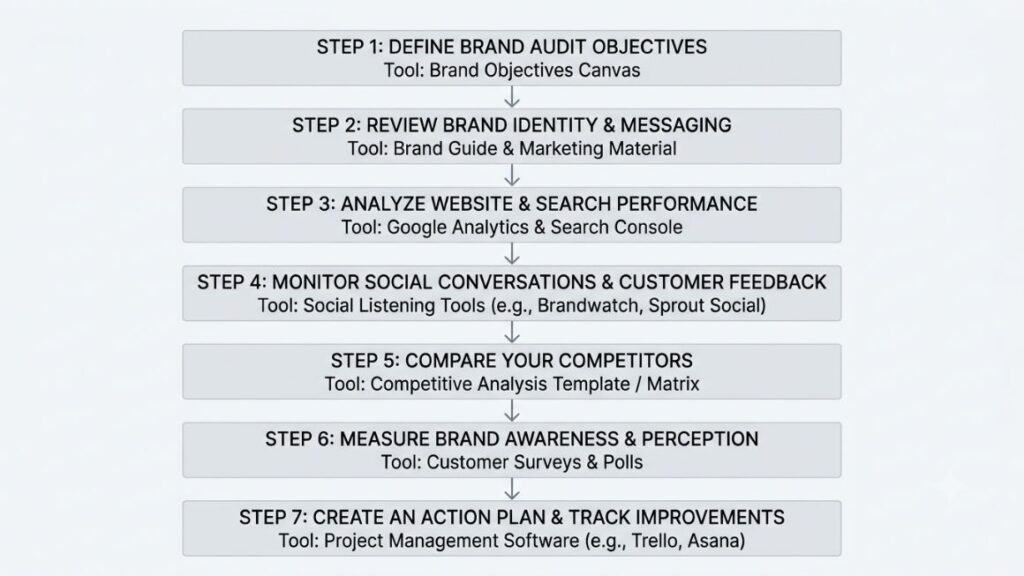
Step 1: Define your brand audit objectives
Pick one or two goals, such as finding out why lead quality dropped or checking a rebrand. A focused digital brand audit finishes in weeks. A vague one never ends.
Step 2: Review brand identity and messaging
Collect your logo files, decks, social profiles and ads. A brand identity audit means laying them side by side and spotting what doesn’t match. Frontify or Canva’s Brand Kit will show whether brand consistency is real or just claimed.
Step 3: Analyze website and search performance
Open GA4’s acquisition report and link Search Console. Then compare branded and non-branded traffic in Semrush, Ahrefs or Similarweb. These brand analytics tools show whether people look for you by name.
Step 4: Monitor social conversations and customer feedback
Set up Brand24 or Mentionlytics with your brand name, product names and common misspellings. Social listening tools surface the complaints and praise nobody emails you about. If press coverage matters, brand monitoring tools such as Meltwater cover news too.
Step 5: Compare your competitors
Pick three real rivals, not the giant you wish you competed with. Competitor analysis tools like Similarweb and Semrush show their traffic and keywords, and Sprout Social’s competitive reports compare social activity.
Step 6: Measure brand awareness and perception
Run a short SurveyMonkey or Qualtrics survey with customers and non-customers. Ask what they associate with you and whether they’d recommend you. Larger brands can add brand tracking software such as YouGov BrandIndex for daily readings.
Step 7: Create an action plan and track improvements
Turn findings into a ranked list with an owner and a date for each fix. Re-check the same numbers in three months. If branded traffic and survey recall haven’t moved, the fixes aren’t working. A lean starter combination: Google Trends, GA4, SurveyMonkey and Brand24.
Also Read: 15 Best Brand Monitoring Tools
Important Metrics to Track During a Brand Audit
Brand health metrics fall into six groups, and each answers a different question about how the brand is doing.
Brand awareness and branded search demand
Branded search shows how many people look for you by name. Track the trend in Google Trends or Search Console, and add a quick survey for brand awareness measurement, since search only counts people who already know you.
Customer sentiment and reputation
Sentiment shows whether mentions lean positive or negative. Brand sentiment analysis in Brandwatch or Brand24 turns thousands of posts into a score, and brand reputation management starts there. YouGov’s Index score, which averages six perception measures, gave Blinkit a 6.3-point rise to 19.4 in its 2026 India rankings.
Engagement and audience growth
Followers matter less than saves, shares and replies. Sprout Social and Similarweb show whether the audience is growing and whether it’s engaged.
Website traffic and conversions
GA4 shows which channels bring visitors and which ones convert. Rising traffic with flat conversions usually means the message attracts the wrong people.
Share of voice and competitor performance
Share of voice is your slice of all conversation in a category. Similarweb tracks share of search, and listening platforms can estimate it from mentions. Together they make brand performance analysis honest: are you gaining on rivals, or just riding the market?
Brand consistency and customer loyalty
Consistency shows up in template use and guideline compliance. Loyalty shows up in repeat purchases and recommendation scores. Ask the recommend question in every survey. It’s the cheapest loyalty signal you can collect.
Latest Trends Shaping Brand Audits in 2026
Five changes are already visible in shipping products, which is more useful than guessing what comes next.
AI-powered brand monitoring and sentiment analysis
Brandwatch’s Ask Iris and AI Query Writer let analysts build searches in plain language, and Sprout Social’s listening add-on sorts conversations with Smart Categories. Both cut setup time. A human still has to judge what the numbers mean.
Brand visibility in generative AI search results
Semrush’s AI Visibility Toolkit tracks mentions in ChatGPT, Perplexity, Gemini and Google’s AI Overviews. Ahrefs Brand Radar and Meltwater’s GenAI Lens do similar jobs. Treat the scores as directional, because AI answers shift from one prompt to the next.
Visual brand recognition across digital platforms
Brandwatch’s image recognition can pick up brand imagery in posts that never mention your name in text. That matters most in visual categories like fashion and food.
Real-time reputation monitoring
Brand24 and Sprout Social both send alerts when mentions spike. YouGov BrandIndex updates daily, so a team can see perception move within days of a campaign or a crisis.
Connecting customer experience with brand performance
Qualtrics runs brand tracking and customer experience programmes under one login, so NPS and brand perception can sit in the same analysis. GA4’s BigQuery export can bring web behaviour into the mix.
Common Mistakes to Avoid When Conducting a Brand Audit
Choosing tools without defining objectives
Buying brand audit tools first and asking questions later is how teams end up with three dashboards and no answers.
Relying on vanity metrics
Follower counts look great on a slide. They say little about whether anyone trusts you.
Ignoring customer feedback
Dashboards can’t replace talking to buyers. Read reviews and support tickets alongside the data.
Comparing unrelated competitors
Benchmarking a local D2C label against Amazon tells you nothing. Choose rivals your customers actually weigh you against.
Failing to act on audit findings
An audit nobody acts on is just a report. Assign owners and dates before the meeting ends.
Conclusion
The right brand audit tools won’t fix a weak brand. They show you where it’s weak, and that’s the part most teams skip. You don’t need all 15. Pick the one that answers your biggest brand question, run it for a month, and add a second tool only when the first leaves a gap. Google Trends and GA4 are free, so there’s no reason to wait.
Want more practical brand thinking in your inbox? Young Urban Project’s Crystal Clear Newsletter breaks down brand and marketing ideas in plain language, so you can apply them the same week. Subscribe and use one idea this week.
FYQs
What are the best tools for conducting a brand audit?
The best brand audit tools depend on your question. Brandwatch, Brand24 and Meltwater cover conversation, Semrush, Ahrefs and GA4 cover search and traffic, and Qualtrics or SurveyMonkey cover customer opinion.
Are there any free tools for brand auditing?
Yes. Google Trends and GA4 are free, Ahrefs Free works for your own verified site, and SurveyMonkey and Qualtrics offer limited free plans. Canva’s free plan includes one Brand Kit.
How often should a business conduct a brand audit?
Once a year suits most businesses. Do one sooner after a rebrand, a new market launch, a leadership change or a sudden drop in leads or sentiment.
Can small businesses conduct a brand audit themselves?
Yes. A small team can combine Google Trends, GA4, a free survey and one low-cost monitor. The hard part is honesty, so ask a few customers for blunt feedback.
What is the difference between brand monitoring and a brand audit?
Brand monitoring is ongoing tracking of mentions and sentiment. A brand audit is a periodic, structured review that compares your positioning, identity and reputation with what customers actually think.
Which metrics should businesses track during an audit?
Track branded search demand, sentiment, engagement, website conversions, share of voice and recommendation scores. Pick three at the start so the audit stays focused.
Can AI tools help with brand auditing?
Yes, mainly for speed. AI features in Brandwatch, Semrush, Ahrefs and Meltwater summarise conversations and track brand mentions inside AI answers, though a person should still review the findings.