

Leads pour in from your website, Instagram, WhatsApp and a dozen forms. Then they sit in a spreadsheet. Plenty of them never get a proper reply. That’s not a lead problem. It’s a handling problem.
Traditional CRM software stores contact details well. But it leaves your team doing the dull work by hand: logging calls, updating fields, chasing follow-ups. AI CRM marketing tools take over a good chunk of that. They score leads, group customers by behaviour, draft messages and flag who’s about to go cold.
This guide shows how they work, what 12 popular platforms offer in 2026, what they cost and how to pick one without overpaying. HubSpot’s 2026 State of Marketing report found that 86.4% of marketing teams now use AI somewhere in their work. So the real question isn’t whether to try it. It’s which tool deserves your budget.
Table of Contents
What Are AI CRM Marketing Tools?
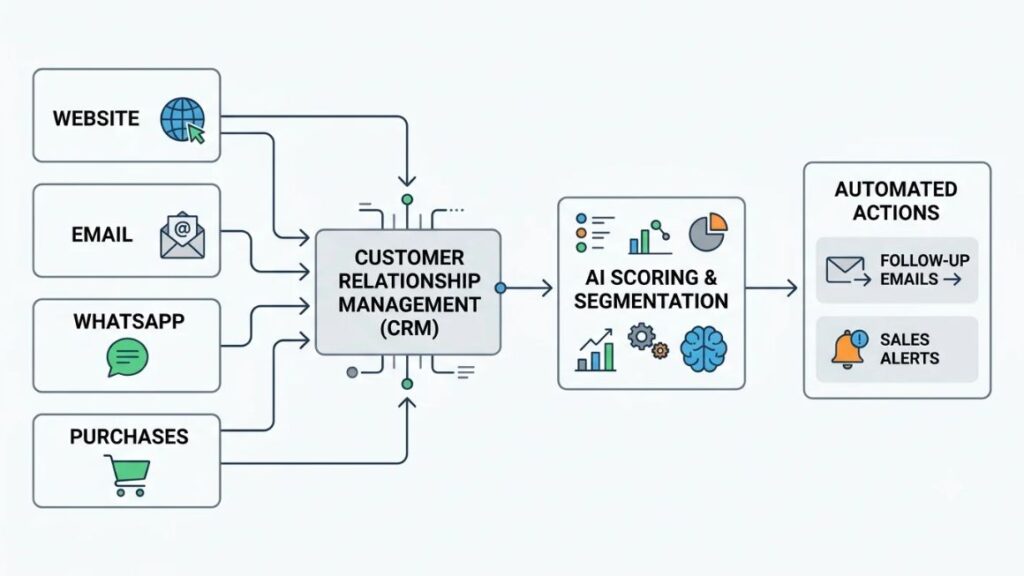
AI CRM marketing tools are CRM platforms with built-in artificial intelligence. They score leads, predict customer behaviour, personalize messages and automate follow-ups. And like any CRM, they store customer data, then use it to tell you what to do next.
Think of a neighbourhood kirana owner who remembers every regular: who buys milk daily, who only shows up before Diwali, who hasn’t visited in months. A traditional CRM is her notebook. An AI-powered CRM software platform is that same owner with a thousand customers, nudging you: “Call this one today.”
Customer relationship management (CRM) is the practice, and the software, of tracking every interaction a business has with leads and customers. The AI layer reads that history. It spots patterns in what people click, buy or ignore. And then turns them into scores and suggested actions.
Here’s a simple case. An online education company gets 400 enquiries a week. Without AI, a counsellor works through them in order of arrival. With AI, the CRM ranks leads by behaviour: who opened three emails, visited the fees page twice and downloaded the brochure. Those people get the first call.
AI CRM marketing tools combine customer data with machine learning to rank leads, predict behaviour and automate follow-ups. Unlike a basic CRM, which records what happened, they suggest or take the next action. Most platforms now bundle at least some of this into standard plans.
How AI Changes Traditional CRM Systems
| Area | Traditional CRM | AI-enabled CRM |
| Data entry | Typed in by hand | Captured and enriched automatically |
| Reporting | Basic dashboards of past activity | Predictions and suggested next steps |
| Campaigns | Same message to a big list | Messages tailored to behaviour |
| Follow-ups | Manual reminders | Triggered automatically, with drafts |
Why Businesses Are Adopting AI for Customer Management
Customers expect fast replies and messages that make sense for them. Meanwhile, teams are drowning in data nobody has time to read.
Salesforce’s 10th State of Marketing report, built on 4,450 marketers surveyed in late 2025. It found that 75% use at least one form of AI. Yet 84% still admit to running generic campaigns. Closing that gap is what AI CRM marketing tools are for.
Several pressures push businesses toward AI. Customer data keeps piling up across email, ads, chat and payments. Decisions need to be faster than a weekly report allows. And generative AI for marketing made writing cheap. So the bottleneck moved to knowing who to write to.
There’s also plain admin. Updating fields and sending reminders eats hours that could go to selling. And when marketing and sales share one record, they stop arguing about lead quality. Better sales and marketing automation means a lead handed to sales arrives with context, not just a name. A customer who asked about pricing yesterday shouldn’t get a cold intro email today.
12 Best AI CRM Marketing Tools to Consider in 2026
No single platform wins everywhere. HubSpot suits all-in-one marketing, Zoho suits tight budgets, Salesforce suits large enterprises and Klaviyo suits online stores. The right pick depends on team size, channels and budget. Prices below were checked in October and November 2026, and they change often.
One thing to know first: not all of these AI CRM marketing tools are the same kind of product. Ten are full CRMs. Brevo and Klaviyo are closer to AI marketing automation tools with CRM features, built around email and customer messaging rather than sales pipelines. Compare them with that in mind.
1. HubSpot CRM: Best for All-in-One Marketing and Sales
HubSpot pairs a free CRM with paid Marketing, Sales and Service Hubs. Its AI layer, Breeze, includes an assistant (in every plan, no credits used), agents for support, prospecting and data tasks, and Breeze Intelligence for enrichment.
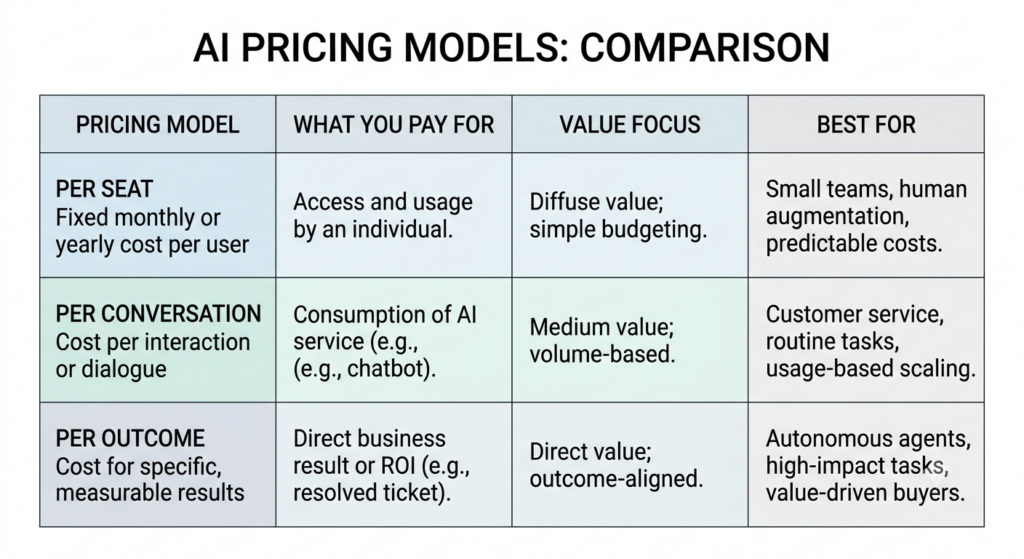
Since 14 April 2026, agents charge by outcome: about $0.50 per resolved conversation and $1 per lead the Prospecting Agent recommends, paid in credits at roughly $10 per 1,000. Agents need a Professional or Enterprise plan.
Advantage: marketing and sales in one place.
Limitation: credit costs can be hard to predict. Ideal for small and mid-sized teams.
2. Salesforce: Best for Enterprise Marketing Operations
Salesforce uses Einstein for predictions and generative features, and Agentforce for AI agents that act on your data. It’s the most customizable option here.
Agentforce bills at $2 per conversation, or through Flex Credits at $500 per 100,000 (about $0.10 per standard action). Per-user licences start at $125 a month. One org can’t mix the first two models.
Advantage: deep customization and scale.
Limitation: cost and complexity. Ideal for large organizations with admin support.
3. Zoho CRM: Best for Budget-Conscious Businesses
Zoho, headquartered in Chennai, offers a free edition for up to three users. Annual plans run $14 (Standard), $23 (Professional), $40 (Enterprise) and $52 (Ultimate) per user per month.
Zia is Zoho’s AI. Basic agents appear lower down, but the full assistant for lead and deal scoring, predictions and recommendations starts at Enterprise.
It’s often the first pick among CRM software for small businesses.
The catch: if AI is why you’re buying, your real entry price is $40, not $14. Ideal for cost-aware SMEs.
4. Freshsales: Best for AI-Assisted Lead Management
Freshsales comes from Freshworks, founded in Chennai. Freddy AI handles contact scoring, deal insights and email drafting, with forecasting insights on Enterprise.
Annual plans list at $9 (Growth), $39 (Pro) and $59 (Enterprise) per user monthly. Trackers show a Freddy Copilot add-on near $29 per user, and sources disagree on which plan carries each AI feature, so check first.
Advantage: built-in phone and email.
Limitation: the jump from Growth to Pro is steep.
5. Pipedrive: Best for Simple Sales Management
Pipedrive is built around a visual pipeline. Its AI Sales Assistant points out stale deals, overdue activities and contacts you haven’t followed up with. AI email writing needs the Premium plan.
Plans start around $14 per user monthly on annual billing, with a 14-day trial and no free plan.
Advantage: quick setup.
Limitation: it’s sales-first, so email campaigns come as paid add-ons. Ideal for small sales teams.
6. Microsoft Dynamics 365: Best for Microsoft-Based Businesses
Dynamics 365 runs Copilot inside Outlook, Teams and the rest of Microsoft 365. Sales plans cost $65 (Professional), $105 (Enterprise) and $150 (Premium) per user monthly, billed yearly.
Premium bundles 1,000 Copilot Credits per user monthly for agents. Licensing guides suggest Copilot features start at Enterprise, so the cheapest tier may lack the AI you want.
Advantage: fits Microsoft-heavy teams.
Limitation: licensing is complicated. Ideal for mid-sized and large firms.
7. monday CRM: Best for Customizable Workflows
monday CRM turns pipelines into flexible boards. Its AI Sidekick drafts emails and suggests next steps, and AI blocks can run inside automations.
CRM plans cost $12 (Basic), $17 (Standard) and $28 (Pro) per seat monthly on annual billing, with a three-seat minimum. For accounts joining from 6 May 2026, AI credits are bought alongside seats.
Limitation: Basic has no automations. Ideal for teams that like visual, custom workflows.
8. Brevo: Best for Email-Focused Marketing
Brevo combines email, SMS, WhatsApp and a built-in CRM. The free plan sends 300 emails a day. Standard, from $18 a month, adds automation, A/B testing and AI send-time optimization. Professional, from $499, adds AI segmentation and WhatsApp.
Advantage: low entry cost.
Limitation: the jump to Professional is huge, and the CRM is lighter. Ideal for small businesses that live in email.
9. Attio: Best for Modern, Flexible CRM Workflows
Attio lets you shape records around how your business works. Ask Attio, its AI assistant, answers questions about your data in plain language, and AI attributes can classify records and fill fields.
Attio’s own page lists Plus at $35 and Pro at $79 per user monthly, annual billing, though some review sites show older prices. AI actions draw on monthly credits.
Limitation: costs grow with usage. Ideal for startups and relationship-driven B2B teams.
10. Creatio: Best for Business Process Automation
Creatio blends a CRM with no-code workflow building. Its AI Studio helps teams build and manage AI agents across sales, marketing and service.
Since 1 May 2026, an Unlimited plan covers unlimited users and agents for one platform fee, per Creatio’s own announcement. Pricing is by quote.
Advantage: strong for process-heavy operations.
Limitation: setup needs planning. Ideal for mid-sized and large organizations.
11. Klaviyo: Best for E-commerce Customer Marketing
Klaviyo pulls purchase and browsing data from platforms like Shopify, segments customers and runs email and SMS flows. Paid plans add predictive analytics, and its Composer AI agent costs $20 a month.
The free plan covers 250 active profiles; Email plans start at $20 a month and scale with profile count. Customer Hub, Helpdesk and Customer Agent are separate add-ons.
Limitation: costs climb with list size, and it’s not a sales CRM. Ideal for D2C brands.
12. Close: Best for Outbound Sales Teams
Close puts calling, SMS and email sequences inside the CRM. In June 2026 it released Chloe, an AI sales agent that summarizes calls and drafts follow-ups, paid for through bundled AI credits.
The Call Assistant add-on costs $50 a month plus $0.02 a minute. Close restructured its plans in 2026 and trackers disagree on exact prices, so check its page. One review notes it has no built-in lead scoring. Ideal for outbound sales teams.
Quick Comparison of the Best Platforms
Pick AI CRM marketing tools by main need. HubSpot covers all-in-one marketing, Salesforce suits enterprises, Zoho suits small and mid-sized businesses, and Klaviyo suits e-commerce.
| Platform | Best for | Main AI capabilities |
| HubSpot | All-in-one marketing | Breeze AI |
| Salesforce | Enterprise | Einstein, Agentforce |
| Zoho | Small and mid-sized businesses | Zia |
| Freshsales | Lead management | Freddy AI |
| Pipedrive | Sales pipelines | AI Sales Assistant |
| Dynamics 365 | Microsoft users | Copilot |
| monday CRM | Workflow management | monday AI |
| Brevo | Email marketing | AI-assisted engagement |
| Attio | Flexible CRM | AI attributes |
| Creatio | Process automation | AI-driven workflows |
| Klaviyo | E-commerce | Predictive customer intelligence |
| Close | Outbound sales | AI-assisted sales workflows |
On a tight budget, look at Zoho, Freshsales, Pipedrive or Brevo first. Running an online store? Klaviyo. Heavy Microsoft shop? Dynamics 365. Need a custom setup? Attio, monday or Creatio. And if one team handles both marketing and sales, HubSpot is the easiest starting point.

Key Features to Look for When Choosing an AI CRM
Good AI CRM marketing tools do six things well. Check each against your real workflow, not the vendor’s demo.
Intelligent Lead Scoring
AI lead scoring ranks prospects by how likely they are to buy, using signals like email opens, page visits and form fills. It helps your team call the right people first.
Automated Customer Segmentation
Instead of building lists by hand, the system groups customers by interests, purchases and behaviour. AI customer segmentation also updates those groups as behaviour changes.
Personalized Marketing Campaigns
CRM personalization means each group gets a relevant message, not one blast. HubSpot’s 2026 report found only 12.6% of brands use hyper-personalization such as behaviour-based messaging. Most stop at inserting a first name.
Predictive Analytics and Forecasting
Predictive analytics in marketing uses past data to estimate what happens next: who may churn, which deals may close, what revenue to expect. Treat these as informed estimates, not promises.
Automated Follow-Ups and Workflows
Reminders, lead assignment and email sequences should run on their own. Done well, CRM marketing automation removes repetitive tasks and keeps leads from waiting.
Reporting and Performance Tracking
Good reporting explains why a campaign worked, not just that it did. AI-driven customer insights can surface patterns, like which source brings buyers who stay.
How AI CRM Tools Improve Marketing Performance
AI CRM marketing tools help most in five places: lead quality, email results, relevance, acquisition cost and retention. None of it is magic, and results depend on your data.
Generating and Qualifying Better Leads
A CRM captures leads from forms and ads, then scores and routes them. Your sales team works the warmest enquiries first.
Improving Email Campaign Performance
AI can suggest audiences, subject lines and send times. Automated email marketing then runs those sequences without manual sending. Klaviyo’s predictive features and Brevo’s send-time optimization are examples.
Creating More Relevant Customer Experiences
Past behaviour shapes what each person sees next. A customer who bought a moisturiser gets a matching serum suggestion, not a random discount.
Reducing Customer Acquisition Costs
Better targeting means less money spent on people who’ll never buy, and faster follow-ups waste fewer warm leads. Both lower the cost of each customer you win.
Improving Customer Retention
Customer retention strategies work better when you can see who’s slipping. AI can flag falling engagement, then trigger a win-back message. AppsFlyer’s published case study says Nykaa lifted user retention by 55% using audience segmentation. That’s a vendor-published result, so treat it as a signal, not a benchmark.
AI CRM tools improve marketing performance by ranking leads, tailoring messages to behaviour and flagging customers who are drifting away. The gains depend on clean data and regular review. Vendors report strong results, but you should measure your own.
Practical Ways to Use AI CRM Tools in Your Marketing Strategy
Start with one workflow in your AI CRM marketing tools, prove it works, then add the next. Here are four to try.
Automate New Lead Follow-Ups
A potential customer submits a website enquiry. Set it up like this:
- Capture the form details straight into the CRM.
- Assign the lead to the right person by region or product.
- Send an instant acknowledgement and queue a task for a personal call.
Build Personalized Email Campaigns
An e-commerce company segments customers by past purchases. Someone who bought running shoes gets sock and insole suggestions, not a generic sale email. Klaviyo and HubSpot both support this kind of flow.
Identify High-Intent Prospects
A B2B company notices certain prospects keep visiting its pricing page and requesting product information. It scores them higher and alerts sales the same day. Those are your warmest conversations.
Re-Engage Inactive Customers
A subscription business spots customers whose logins are dropping. It sends a useful tip or a small incentive before they cancel, rather than after.
Also Read: AI Agent for Marketing Teams: Use Cases, Tools, Benefits & Implementation Guide (2026)
How to Choose the Right Platform for Your Business?
When comparing AI CRM marketing tools, match them to your size, goals, existing apps and real budget. Then test before you commit.
Consider Your Business Size
Freelancers and startups should look at free or low-cost options such as Zoho, Freshsales, Brevo or Attio. Small and mid-sized businesses often fit HubSpot, Pipedrive or monday. Large enterprises lean toward Salesforce, Dynamics 365 or Creatio.
Define Your Marketing Requirements
List what you actually need: lead generation, email campaigns, segmentation, sales coordination or retention. A tool that excels at calling won’t fix weak email marketing.
Check Integrations and Scalability
Your CRM should connect to your website, ad accounts, payment tools and analytics. Also ask what happens when your team doubles. Some tools get expensive fast.
Understand the Total Cost
The seat price is only the start. Add onboarding, integrations, AI credits, usage limits and add-ons. A $14 plan that needs a $40 tier for AI isn’t a $14 plan.
Test Before Committing
Use trials and demos with real leads and workflows. Ask the vendor to run the AI feature you’re buying on your own data.
The right AI CRM depends on business size, the marketing jobs you need done, integrations and total cost including AI credits. Always test a shortlisted platform on your own workflows before signing a yearly plan.
Common Mistakes to Avoid When Using AI CRM Tools
Most failures with AI CRM marketing tools come from poor setup, not bad software.
Choosing Software Because It Has More AI Features
A long feature list means little if you’d use two of them. Pick the tool that fixes your biggest bottleneck.
Ignoring Customer Data Quality
Duplicate, outdated or incomplete records produce poor scores and wrong messages. Salesforce’s report found 98% of marketers with AI hit at least one personalization barrier, and data issues led the list. A customer data platform can help unify scattered records, but only if the inputs are clean.
Automating Everything Without Human Oversight
Review customer-facing messages and automated decisions. An AI agent that answers wrongly costs trust, not just time.
Ignoring Data Privacy
Get consent, limit who can access records and protect customer information. In India, the DPDP Act and Rules were notified on 13 November 2025. Consent manager provisions take effect from 13 November 2026, and the main obligations follow on 13 May 2027.
Not Measuring Results
Track response time, conversion rate and cost per lead before and after. Running isn’t the same as working.
Future Trends in AI-Powered Customer Management
AI CRM marketing tools are moving from suggesting to doing. The pace is uneven, so stay sceptical of hype.
The Growth of Autonomous AI Agents
Salesforce found 13% of marketers already use agentic AI. Gartner expects 60% of brands to use it for one-to-one interactions by 2028, but has also warned that over 40% of agentic AI projects may be cancelled by the end of 2027. Agents need clear permissions.
More Predictive Customer Experiences
Expect tools to anticipate needs, such as reorder timing or churn risk, not just report on them. Pricing is shifting too: HubSpot now charges for outcomes.
Better Integration Across Marketing Channels
Websites, email, social, sales and support are being joined into one customer view, so customers stop repeating themselves.
Greater Focus on Responsible AI
Transparency, privacy, accuracy and human supervision will matter more as agents take on more work.
Also Read: Agentic Marketing Platforms: The Complete Guide to AI Agents That Plan, Execute & Optimize Marketing
Conclusion
AI CRM marketing tools save time, rank your leads and keep customers from slipping away. But the best platform is the one that fits your actual needs, data and budget, not the one with the longest feature list.
Shortlist two or three, run a trial with real leads, and measure the result before you pay for a full year. Fix your data first. It makes every tool work better.
If you want to go further, our YUP AI Marketing course shows you how to put AI tools like these to work in real campaigns, step by step. Take a look, and bring your questions.
Frequently Asked Questions About AI CRM Marketing Tools (FAQ)
What are AI CRM marketing tools?
They’re CRM platforms with AI that scores leads, segments customers, personalizes messages and automates follow-ups. Their main purpose is to help marketing and sales teams spend time on the people most likely to buy.
Which AI CRM platform is best for small businesses?
It depends on your needs. HubSpot has a free CRM and is easy to learn. Zoho is budget-friendly, though its full AI starts at Enterprise. Freshsales offers built-in calling and email. Brevo suits email-heavy businesses.
Can AI CRM tools automate marketing campaigns?
Yes. They can trigger email sequences, assign leads, send follow-ups and adjust audiences based on behaviour. Still review messages before they go out, especially in the first few weeks.
How much do AI CRM platforms cost?
Several offer free tiers, including HubSpot, Zoho, Brevo, Klaviyo and Attio. Paid seats typically run from about $9 to $150 per user monthly. AI often adds usage charges, such as HubSpot’s $0.50 per resolved conversation or Salesforce’s $2 per conversation. Add onboarding and integrations too.
Are AI CRM tools suitable for startups?
Yes, if you start small. Free or low-cost plans from Zoho, HubSpot, Attio or Brevo are easy to adopt, and you can upgrade as you grow. Watch credit-based AI costs.
Can AI CRM software improve lead conversion?
It can help by prioritizing warm leads, speeding up follow-ups and making messages more relevant. No tool guarantees results. Measure conversion before and after so you know whether it’s working.
What is the difference between a traditional CRM and an AI CRM?
A traditional CRM mainly stores data you enter. An AI CRM also processes data automatically, predicts outcomes, recommends actions and drafts messages. The first records the past. The second helps you act on it.
Is AI CRM software safe for customer information?
It can be, if you pick a vendor with strong security and set it up properly. Check access permissions, data policies and where data is stored. Get customer consent and follow privacy laws such as India’s DPDP Act.