
Five years ago, “personalization” meant inserting a first name into an email subject line and calling it a day. That’s not personalization anymore. It’s noise. Customers now expect brands to know what they want before they say it, and the gap between brands that deliver on that and brands that don’t is showing up directly in revenue.
Marketing campaigns that once took weeks to segment, build, and launch now assemble themselves in hours, adjusting mid-flight based on how people actually respond. That’s the real shift. It’s not that AI writes better subject lines. It’s that AI marketing campaigns react to live customer behavior instead of running on assumptions made three months ago during a planning meeting.
This article breaks down what’s actually changed, which tools power that change, and how to build a campaign that uses both personalization and predictive analytics without needing a data science team on payroll.
Table of Contents
What Counts as AI-Driven Marketing Right Now
AI marketing campaigns are campaigns where machine learning models actively shape targeting, content, timing, or budget decisions, rather than just automating a fixed set of rules a human already wrote. That distinction matters more than most explainers give it credit for. A rule-based email flow that sends a discount code three days after cart abandonment is automation. A system that decides which discount, for which customer, at which hour, based on a model trained on thousands of past conversions, is AI.
The confusion is understandable. Marketing automation platforms have used the word “smart” for a decade to describe features that were really just conditional logic. Genuine AI marketing campaigns are different because the system is making a prediction, not following a script.
Here’s the practical test: if you could write out the exact rule the tool is following in one sentence, it’s automation. If the tool is weighing dozens of variables and adjusting its own logic as new data comes in, that’s AI. Running AI marketing campaigns without predictive data behind them means you’re optimizing half the funnel and guessing at the rest, which defeats most of the point.
According to Salesforce’s State of Marketing 2026 report, 87% of marketers now use generative AI in at least one workflow, up from 51% in 2024. That jump happened fast, and it means the baseline expectation for what counts as “using AI” in marketing has moved well past chatbots and copy generation.
AI marketing campaigns use machine learning to make live targeting, content, and budget decisions instead of following pre-written rules. The distinguishing factor is prediction versus scripted logic. Salesforce’s 2026 data shows adoption jumped from 51% to 87% of marketers between 2024 and 2026, making AI-driven decisioning the new baseline rather than a differentiator.
Why Personalization Is the Entry Point for Most Teams
Most marketers don’t start their AI journey with predictive budget allocation or churn modeling. They start with personalization because it’s visible, it’s easy to A/B test, and the ROI shows up fast. It’s also the layer customers actually notice.
Personalization used to mean segmenting an email list into three or four buckets: new subscribers, repeat buyers, lapsed customers. AI collapsed that into something closer to a segment of one. Each person’s experience, from the product they see first to the subject line that lands in their inbox, gets shaped individually.
Dynamic Content Personalization
Dynamic content personalization changes what a visitor or subscriber sees based on their behavior, without a marketer manually building separate versions for every segment. A returning visitor might see the product they abandoned in their cart. A first-time visitor sees a bestseller instead. Same page, same campaign, different experience, generated automatically.
This isn’t just about product recommendations either. Subject lines, hero images, even the order of navigation menu items can shift per visitor when the underlying engine has enough behavioral data to work with.
Behavioral Segmentation at Scale
Behavioral segmentation at scale means grouping customers by what they actually do, not by static attributes like age or location, and updating those groups continuously as behavior changes. A customer who browsed skincare three times last week but hasn’t purchased belongs to a completely different segment than someone who buys the same product every 30 days.
The old way of doing this required a marketer to manually define rules and update them periodically. AI-run segmentation updates itself in near real time, which matters because customer intent shifts faster than any manually maintained spreadsheet can track.
The Personalization Tools Marketers Are Actually Using
Plenty of tools claim AI personalization. Fewer actually deliver decisioning rather than templated logic. Here’s a detailed breakdown of the ones marketers rely on most, and what each one actually does under the hood.
Klaviyo AI
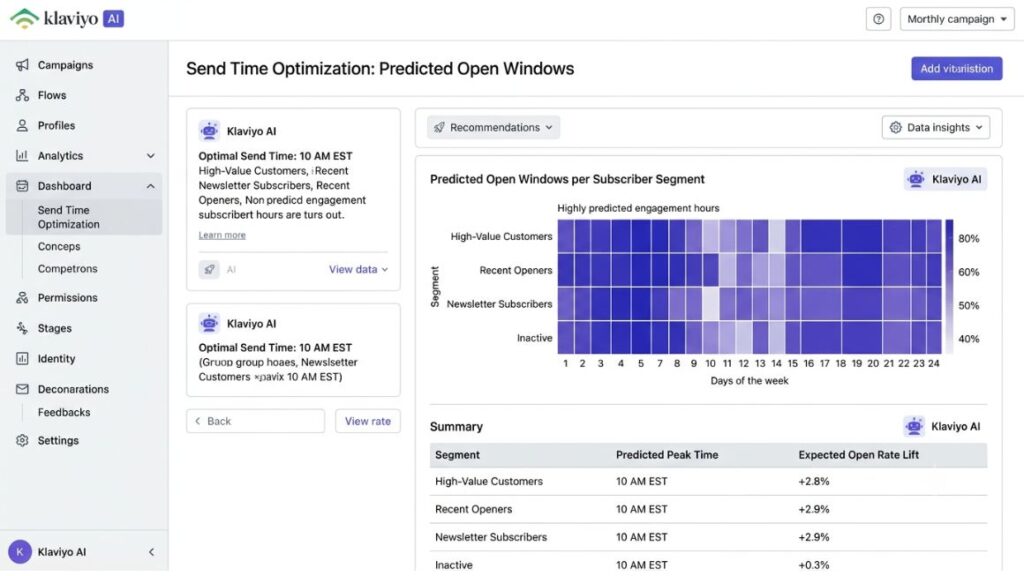
Klaviyo built its reputation on email and SMS for D2C brands, and its AI layer sits directly on top of that data. Klaviyo AI generates send-time optimization, meaning it predicts the exact hour each individual subscriber is most likely to open an email, rather than sending to your entire list at 9 a.m. because that’s when most marketing tools default to.
It also powers predictive analytics for customer lifetime value, flagging which subscribers are likely to churn before they actually stop buying. For a mid-sized D2C brand, this usually shows up as automated win-back flows that trigger earlier than a human would have caught the drop-off. Klaviyo’s smart product recommendation blocks pull from purchase and browse history to populate email content automatically, which removes the manual work of building separate template variants for every product category.
Dynamic Yield and Insider (On-Site Personalization)
Dynamic Yield, now part of Mastercard, and Insider both specialize in changing what a website visitor sees based on real-time behavior. The core function is the same: algorithmic experience decisioning that picks which banner, which product carousel, and which offer a specific visitor sees, tested continuously against alternatives.
Insider has become particularly popular with Indian D2C and e-commerce brands because it combines on-site personalization with cross-channel orchestration across WhatsApp, email, and push notifications from a single customer profile. That matters in a market where WhatsApp commerce carries real weight. Dynamic Yield leans more toward enterprise retail, with algorithmic merchandising that reorders product listing pages per visitor based on predicted purchase likelihood, not just recency or popularity.
Meta Advantage+
Meta Advantage+ automates ad creative combinations, audience targeting, and budget allocation across a campaign using machine learning trained on Meta’s advertiser-wide conversion data, not just your account’s history. Instead of building 15 separate ad sets for different audiences, you feed Advantage+ a broad audience and a set of creative assets, and the system finds which combinations convert, then shifts spend toward them automatically.
This is where a lot of brands, including Nykaa, run a meaningful share of acquisition spend. Nykaa’s own growth playbook explicitly recommends using tools like Google Performance Max and Meta Advantage+ alongside CRM data to personalize messaging at scale. The tradeoff is control. You give up granular audience-building in exchange for the algorithm’s pattern recognition, which usually wins on cost per acquisition once it has enough conversion volume to learn from, typically 50 or more conversions per week per ad set.
AI personalization tools fall into three practical categories: messaging platforms like Klaviyo AI that predict individual send times and churn risk, on-site engines like Insider and Dynamic Yield that reorder page content per visitor, and ad platforms like Meta Advantage+ that automate targeting and budget shifts using cross-account conversion data. Each requires a different data volume threshold before the AI layer outperforms manual rules.
How Predictive Analytics Changes What You Plan Before You Spend
Predictive analytics in marketing uses historical customer data to forecast future behavior, such as who is likely to purchase, churn, or respond to a specific offer, before that behavior actually happens. Personalization reacts to what a customer just did. Predictive analytics tries to get ahead of what they’re about to do next.
That’s a meaningful difference in how a campaign gets planned. Instead of asking “what should this customer see right now,” a predictive model asks “which 20% of my audience is going to generate 80% of next quarter’s revenue, and how do I protect that group from churning.” Budget planning built on this kind of forecast looks completely different from budget planning built on last month’s spreadsheet.
McKinsey’s Global AI Survey found that personalization engines built on predictive data deliver 2.7x average ROI, second only to AI content drafting among marketing use cases. That’s a meaningful gap over channels that don’t incorporate any forward-looking modeling.
Marketing campaigns built purely on past performance data are, by definition, always a step behind. A customer who’s about to churn doesn’t show up as “at risk” in a standard dashboard until after they’ve already stopped engaging. Predictive models catch the early signals, like declining email open rates or slower repurchase cycles, weeks before that customer disappears from your active list entirely.
The Predictive Analytics Tools Behind Modern Campaigns
Google Analytics 4 Predictive Metrics
GA4’s predictive metrics use your site’s historical conversion data to generate three specific forecasts: purchase probability, churn probability, and predicted revenue per user, all within a 28-day rolling window. These aren’t hypothetical numbers pulled from an industry benchmark. They’re generated from your own account’s data, which means the model needs enough conversion volume, generally a few thousand purchase events, before the predictions become statistically reliable.
Once that threshold is met, you can build predictive audiences directly inside GA4 and push them straight into Google Ads for retargeting, without needing a separate data science pipeline. Step 1: Confirm your property meets the minimum data threshold under Admin > Predictive Metrics. Step 2: Create an audience using a predictive metric, such as “likely 7-day purchasers.” Step 3: Link that audience to your connected Google Ads account for targeting.
HubSpot Predictive Lead Scoring
HubSpot’s predictive lead scoring model assigns each contact a numeric score based on hundreds of behavioral and firmographic signals, weighted against which past contacts actually converted into customers. This is where B2B teams get the most value, since sales cycles are long enough that knowing which leads to prioritize actually changes rep behavior day to day.
The model retrains itself continuously as new deals close, which means the scoring logic improves the longer you use it. A brand-new HubSpot account with limited closed-deal history won’t get much value here yet. This tool genuinely needs volume to work, which is worth acknowledging since it’s a limitation that shows up often for smaller B2B teams still building their pipeline.
Pecan AI and Amazon Forecast
Pecan AI and Amazon Forecast sit a level deeper than the marketing-native tools above. Both are built for demand forecasting and revenue prediction using time-series modeling, and marketing teams typically use them to answer questions like “how much inventory should we allocate to this campaign” or “what’s our realistic revenue ceiling for this quarter given current trends.”
Pecan AI markets itself specifically at teams without dedicated data scientists, with a no-code interface for building forecast models from existing CRM or warehouse data. Amazon Forecast requires more technical setup but integrates cleanly for brands already running infrastructure on AWS. Both matter most for larger e-commerce operations planning inventory and ad spend together, rather than as a standalone marketing tool for smaller teams.
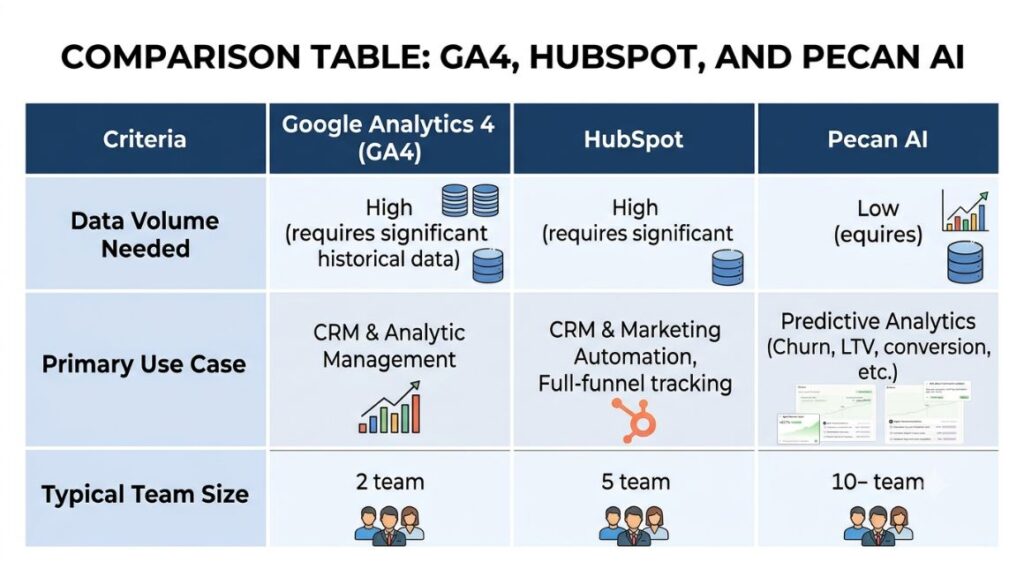
Predictive analytics tools split into two tiers: native marketing tools like GA4 and HubSpot that need moderate conversion volume to activate, and enterprise forecasting tools like Pecan AI and Amazon Forecast built for demand and revenue prediction at scale. The right tool depends less on budget and more on how much historical conversion data you already have.
How to Build an AI Marketing Campaign, Step by Step
Building one of these campaigns isn’t about buying five tools and connecting them. It’s about sequencing the right layer of AI against the data you actually have.
- Audit your existing data volume. Check conversion counts across your CRM, email platform, and ad accounts. Most predictive tools need a minimum threshold before their models outperform simple rules.
- Start with one personalization layer, not three. Pick either email, on-site, or ad personalization based on where your highest-traffic channel already sits. Running all three at once with thin data dilutes results across the board.
- Connect that tool to a single, clean customer data source. Fragmented data is the single biggest reason AI personalization underperforms. If your CRM, email platform, and website analytics don’t share a unified customer ID, fix that before adding more tools.
- Layer in one predictive metric. Add GA4’s purchase probability or your ESP’s churn score, and build one campaign, such as a win-back flow, around it.
- Set a 60-day evaluation window. Most AI marketing tools need real conversion volume to calibrate before results are meaningful. Judging performance after two weeks almost always leads to premature tool-switching.
- Scale the layer that’s working before adding the next one. Once personalization or predictive targeting shows a clear lift, expand it to a second channel rather than introducing an entirely new tool.
Brands Already Running This Playbook
Indian D2C and marketplace brands have moved fast here, partly because their transaction volumes make the data threshold problem less of an issue. Nykaa’s personalized recommendation engine, built on purchase history and browsing behavior, has been credited with driving a significant share of repeat revenue, and the brand pairs that with paid acquisition run through Meta Advantage+ and Google Performance Max.
boAt runs predictive inventory and demand forecasting ahead of major sale events, since a mistimed stock-out during a flash sale on a high-velocity SKU costs far more than the forecasting tool itself. Swiggy uses behavioral prediction models to time push notifications around individual ordering patterns rather than blasting the same reminder to every user at 8 p.m.
Globally, Sephora’s Beauty Insider program remains one of the clearest examples of predictive segmentation done well, using purchase cadence to trigger replenishment offers before a customer even realizes they’re running low on a product. This isn’t a hypothetical use case. It’s a template most beauty and personal care brands have since copied in some form.
Where Teams Get This Wrong
Not every AI marketing tool delivers what the sales deck promises, and it’s worth being honest about that. Personalization built on thin data tends to feel worse than no personalization at all, since a wrong recommendation reads as the brand not knowing its customer, which undercuts trust rather than building it.
This is where the market data gets genuinely mixed. Gartner’s 2025 survey found that 53% of B2B buyers and consumers actually report negative outcomes from traditional personalization, which is a real limitation worth sitting with, not glossing over. The gap usually comes down to fragmented data across tools rather than a flaw in AI personalization itself.
There’s also a ROI measurement problem most teams underestimate. Even with adoption climbing, only 41% of marketers could actually prove AI’s ROI in 2026, a figure that’s declined from the year before despite adoption rising sharply. That’s honestly, this gap gets skipped over in most vendor pitches, and it’s worth flagging before you commit budget to a tool that promises results your team won’t be able to measure cleanly.
This works well for D2C and e-commerce brands with high transaction volume and clean funnels. It applies less cleanly to B2B companies with long, multi-stakeholder sales cycles, where predictive models simply don’t have enough per-account conversion data to generate reliable forecasts.
What’s Changing Next
Agentic workflows are the clearest shift happening right now. Instead of a marketer reviewing a predictive model’s output and manually acting on it, autonomous agents are starting to execute campaign adjustments directly, reallocating budget or pausing underperforming creative without a human clicking approve first.
34% of enterprise marketing teams already run at least one autonomous agent in production, more than double the 14% reported just over a year earlier. That’s a fast curve, and it suggests the next competitive gap won’t be who uses AI marketing, but who trusts their models enough to let them act without a review step.
Where This Goes From Here
The brands pulling ahead right now aren’t the ones with the biggest AI budgets. They’re the ones with clean, unified customer data feeding into one or two tools that actually get used well. Personalization earns the trust. Predictive analytics earns the timing. Together, they turn a campaign from something you launch and hope works into something that adjusts itself based on what’s actually happening.
If you’re building this out and want a structured way to get hands-on with the tools covered here, from Klaviyo AI to predictive audience building in GA4, YUP’s AI Marketing course walks through the setup process with real campaign builds, not just theory. It’s a practical next step if you’d rather learn this by doing it than by reading about it a second time.
Frequently Asked Questions
What is an AI marketing campaign?
An AI marketing campaign is a campaign where machine learning models actively make decisions about targeting, content, timing, or budget, based on live customer data rather than fixed rules a marketer wrote in advance. The system learns and adjusts continuously instead of following a static script.
How is AI marketing different from marketing automation?
Marketing automation follows pre-written rules, like sending an email three days after signup. AI marketing predicts outcomes and adjusts its own logic based on new data, such as deciding the best send time for each individual subscriber. If you can describe the exact rule in one sentence, it’s automation, not AI.
Do I need a lot of customer data before AI personalization works?
Yes, generally. Most tools need a minimum volume of conversion events, often a few thousand, before predictions become statistically reliable. Smaller brands often see better early results starting with one channel, like email, rather than spreading thin data across personalization, ads, and on-site tools at once.
Which AI marketing tool should I start with?
Start with whichever tool sits closest to your highest-volume channel. If email drives most of your revenue, Klaviyo AI is the logical starting point. If paid acquisition is your primary channel, Meta Advantage+ or Google Performance Max will show results faster since they’re built on cross-account data rather than your account alone.
Is predictive analytics only useful for large enterprises?
No, but the tool selection matters. GA4’s predictive metrics and HubSpot’s lead scoring work for mid-sized teams once they hit the data threshold. Enterprise-grade demand forecasting tools like Pecan AI and Amazon Forecast are built more for larger operations managing inventory alongside marketing spend.
Is AI personalization actually worth the investment?
For high-transaction-volume brands, generally yes. McKinsey’s data shows personalization engines delivering 2.7x average ROI. That said, Gartner’s research found over half of B2B buyers report negative experiences from personalization done on fragmented data, so the investment only pays off once your customer data is unified across platforms.
Why isn’t my AI personalization tool improving conversions?
The most common cause is fragmented data. If your CRM, email platform, and website analytics track customers separately instead of through one unified profile, the AI is working with an incomplete picture and making worse predictions than a human would with full context. Fixing data unification usually matters more than switching tools.
How long does it take to see results from an AI marketing campaign?
Most predictive tools need a real conversion volume before their models calibrate properly, so a 60-day evaluation window is more realistic than judging results after two weeks. Personalization tools built on existing behavioral data, like on-site product recommendations, tend to show measurable lift faster, often within the first few weeks.
Can small D2C brands compete with enterprise AI marketing budgets?
To an extent. Tools like Klaviyo AI and Insider are priced for growing D2C brands and often deliver faster results than enterprise tools because D2C funnels are shorter and generate conversion data quickly. The gap shows up more in predictive demand forecasting, where enterprise-scale data genuinely produces better models.
What’s the biggest mistake marketers make with AI marketing campaigns?
Running personalization and predictive tools simultaneously across every channel before any one of them has enough data to work well. Layering one tool at a time, on a unified data source, consistently outperforms deploying five tools at once on fragmented data.