

It’s Monday, 9:40 a.m., and your report is due at noon. You open Google Ads, then Meta Ads Manager, then the CRM, then a spreadsheet someone named “final_v3”, then the email platform. Three hours later you know what happened last week. You still don’t know why.
That gap between data and understanding is where an AI agent for marketing teams earns its keep, or fails to. In plain terms, it’s software that takes a goal, works out the steps, uses your connected tools to carry them out, checks its own result, and reports back to a person. It isn’t a chatbot that waits for your next prompt. It isn’t a fixed automation that repeats the same steps either.
An AI agent for marketing teams isn’t magic, though. It needs clear instructions, clean data, and someone watching the controls. Gartner’s survey of 413 martech leaders, published in October 2025, found that 45% of those piloting agents say vendor-built agents don’t deliver the business performance they were promised.
This guide covers the use cases that make sense today, the tools worth comparing and a step-by-step plan to implement one without losing a quarter.
Table of Contents
What Is an AI Agent and How Does It Work?
An AI agent is software that works toward a goal by choosing its own next steps. It uses connected tools to act and check what happened along the way. A chatbot answers a question. An agent finishes a task.
You don’t need to understand the model underneath to use one well. You need to understand the loop it runs.
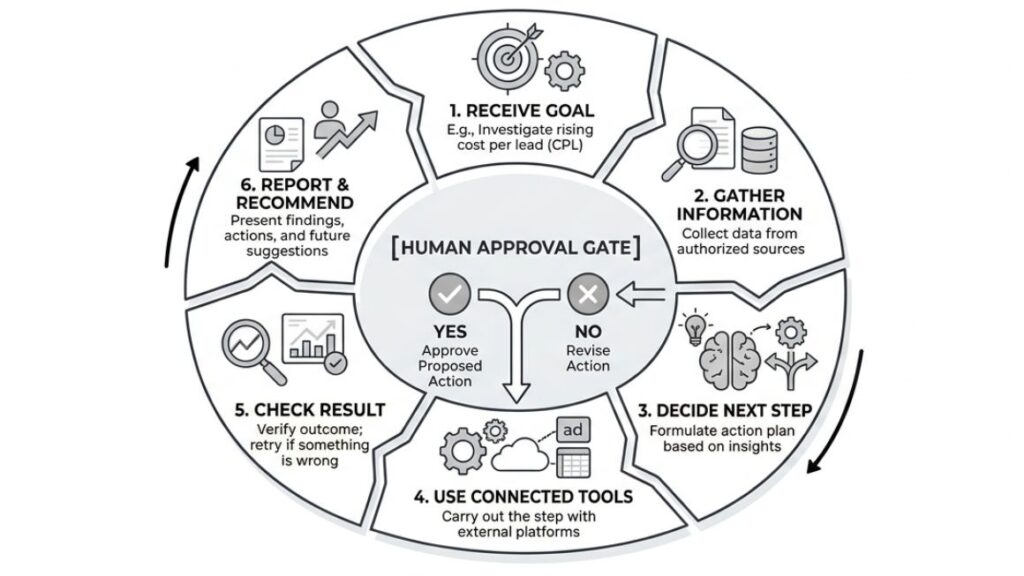
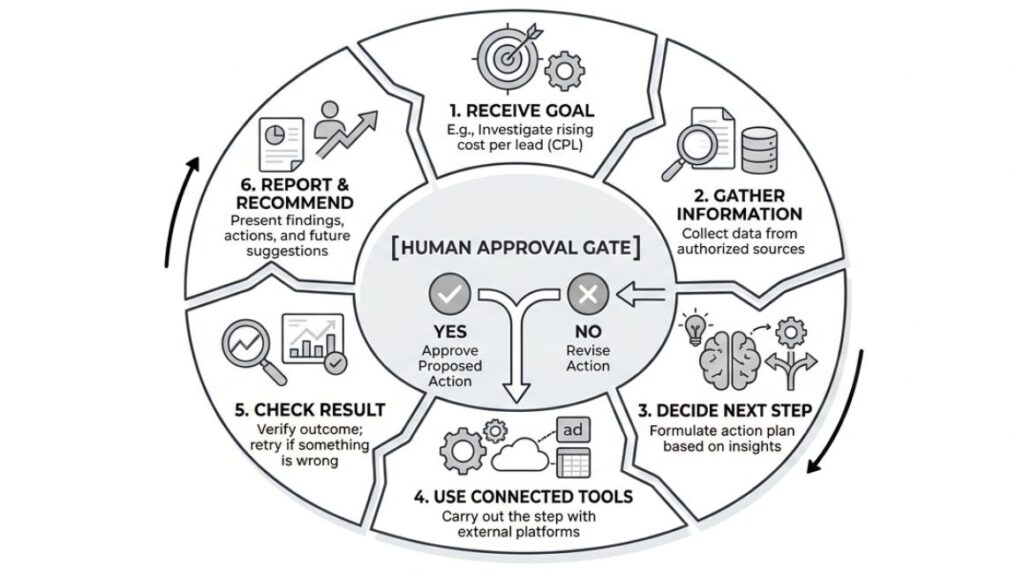
How an Agent Turns a Goal Into Action
Every AI agent for marketing teams runs some version of this loop.
- Receive a goal, such as “find out why cost per lead rose last week.”
- Gather information from the sources it has permission to read.
- Decide the next step based on what it found.
- Use connected tools, like an ad platform or a spreadsheet, to carry that step out.
- Check the result and try again if something looks wrong.
- Report back to a person with what it did and what it recommends.
The Difference Between a Chatbot, Automation, and an Agent
| Chatbot | Automation | Agent | |
| Who decides the next step? | You, with every prompt | Pre-written rules | The agent, within set limits |
| Can it use external tools? | Usually not | Yes, in fixed steps | Yes, within granted permissions |
| Human supervision needed | You read and act on each reply | Setup, plus review of exceptions | Approval for risky actions, plus regular reviews |
The labels get blurry in sales pitches. Gartner said in June 2025 that only about 130 of the thousands of vendors calling their products agentic were genuine, and it named the habit “agent washing.” So when a demo starts, ask to see an AI marketing agent make a decision nobody scripted in advance.
A Simple Marketing Example
Picture an agent that checks your paid search account every morning. It spots that cost per lead on one campaign has jumped far above its usual range. It checks tracking, finds that a landing page form stopped firing its conversion tag on Tuesday, and compares the pattern against your other campaigns. Then it writes up the cause and recommends halving that campaign’s daily budget until the tag is fixed.
It doesn’t touch the budget. It asks you first. That pattern is called human-in-the-loop AI, and it’s the habit that separates a useful AI agent for marketing teams from a risky one.
Where Marketing Teams Can Use Agents Today
Agents work best where the task repeats, the data is already connected and a person can check the output before it reaches a customer or a budget. Salesforce’s State of Marketing 2026 report found that 75% of marketers have adopted AI. Yet 84% still admit to running generic campaigns. Adoption isn’t the hard part. Picking the right job for an AI agent for marketing teams is.
Each use case below covers the input, the action, the outcome, the limit and where you step in.
Content Research and Editorial Planning
Give the agent: Your audience notes. Your best-performing posts. A keyword list. It collects sources, drafts briefs and builds a content calendar. You get a research pack in an hour instead of an afternoon. The catch is that it can cite weak sources or invent details. So an editor should check every claim and decide which topics earn a slot.
Search Engine Optimization and Content Quality
The input is your pages, Search Console exports, and competitor results. The agent audits content, suggests internal links, reads search intent, and lists pages that need updating. You end up with a prioritized fix list. But it can’t tell you whether a rewrite suits your brand, and it can’t fact-check itself. Salesforce found that 88% of marketers have started optimizing for AI-generated answers, so this audit work will keep growing. A human editor decides what goes live.
Paid Advertising and Campaign Monitoring
Feed it ad platform data, conversion tracking, and your budget rules. The agent flags anomalies, drafts creative variations, checks that tracking works, and recommends budget shifts. Treat AI agents for campaign optimization as advisors first and operators later. Google announced Ask Advisor at Marketing Live on May 20, 2026, a Gemini-based agent meant to span Google Ads, Analytics, and Merchant Center. Across platforms, the direction is clear: you set goals and guardrails, and software handles more of the rest. Let the agent recommend. Let a person approve any change to spend.
Also Read: AI Agent for Paid Advertising: How to Set Up, Control and Measure One in 2026
Lead Research and Qualification
Here the input is form fills, company data, and your agreed fit criteria. The agent enriches records, checks fit, and routes strong enquiries to the right rep. Emplifi’s CMO told Salesforce in June 2026 that after adopting Qualified’s AI SDR agent, the company cut lead-qualifying reps by about 20% while opportunity creation rose by more than 22%. That’s a vendor-published result, not an audit. AI-powered lead qualification also fails quietly: a bad scoring rule rejects good buyers and nobody notices. Review a weekly sample of rejected leads.
Email Marketing and Customer Journeys
Segments, behavior data, brand guidelines, and consent records go in. Segment suggestions, personalized drafts, lifecycle triggers, and pre-send quality checks come out. AI marketing automation like this can make emails more relevant, but it has to respect consent and suppression lists every single time. A person approves audiences and copy before anything sends, especially with India’s DPDP consent rules arriving in 2027.
Also Read: 15 Best AI Email Marketing Tools in 2026
Reporting and Competitor Monitoring
Only approved data sources should feed an AI agent for marketing teams doing this job. The agent combines numbers from several dashboards, summarizes what changed, flags odd metrics, and watches competitor pages and ads. You get a draft report instead of a blank document. The limit: it can summarize confidently even when two sources disagree. An analyst should confirm anything headed to leadership.
Benefits and Limitations: What Teams Should Expect
An AI agent for marketing teams saves the most time on boring, repeatable work. It saves the least where the work needs taste. Expecting otherwise is how pilots die.
Where Agents Can Save Time
Think repetitive research, routine checks, data preparation, and moving information between tools. Rawlings, the sporting goods brand, told Salesforce it creates campaigns 75% faster with Agentforce Marketing, though that figure comes from Salesforce’s own announcement. Work that used to mean hopping across five tabs can come back as one summary.
Where Human Judgment Still Matters
Brand positioning. Sensitive customer messages, like a delayed refund or a complaint. Creative that has to feel different from everyone else’s. Budget decisions with real consequences. And ambiguous evidence, such as a metric that dropped for three reasons at once. An agent can lay out the facts, but somebody has to own the call.
Why Better Output Does Not Automatically Mean Better ROI
Faster isn’t the same as profitable. Jasper’s State of AI in Marketing 2026 report found that 91% of marketers use AI, yet only 41% can confidently prove its return, down from 49% a year earlier. McKinsey’s State of AI survey, published in late 2025, found that only 39% of companies saw any enterprise-level earnings impact from AI.
Saved hours turn into money only when the team spends them on work that earns. Data quality, setup cost, and the time spent reviewing outputs all eat into the gain.
Using AI doesn’t prove AI pays. Jasper’s 2026 survey found 91% of marketers use AI but only 41% can prove the return, so time saved has to be tied to revenue, cost, or quality before it counts as a result.
Which Tools Should Marketing Teams Consider?
There’s no single best AI agent for marketing teams. The right pick depends on where your customer data lives, how much control you need, and who will maintain it. Prices below were checked in September and October 2026. They change often, so confirm on each vendor’s pricing page before you budget.
Tools for CRM and Customer Engagement
Salesforce Agentforce Marketing and HubSpot suit teams whose customer data already sits in those CRMs. Salesforce’s June 2026 announcement lists its Hunter prospecting agent and Qualified’s Piper as generally available, while its Content Agent and Marketing Goals Agent were still in pilot. On price, a review of Salesforce’s pricing page on October 1, 2026 shows Flex Credits at $0.10 per action, and third-party trackers put entry editions of Agentforce Marketing at roughly $1,250 to $1,500 per organization per month. Setup adds more: one vendor review estimates first-year costs of $150,000 to $600,000 for mid-market teams running advanced deployments.
HubSpot’s agents need a Professional or Enterprise plan and bill in HubSpot Credits at $10 per 1,000. Since April 14, 2026, the Customer Agent costs 50 credits, about $0.50, per resolved conversation, and the Prospecting Agent costs 100 credits, about $1, per lead it recommends. Read what counts as an outcome. One review notes the Prospecting Agent bills when it drafts outreach, not when the lead replies.
Tools for Research and Workflow Orchestration
Zapier and n8n connect your apps and handle marketing workflow automation. They aren’t agents by default. A Zap that runs the same steps in the same order is a fixed automation. It turns agentic only when a step lets a model choose what happens next. Zapier bills Agents separately from Zaps, with a free tier of 400 activities a month and a Pro tier at $33.33 a month on annual billing for 1,500. n8n Cloud starts around €20 to €24 a month for 2,500 executions, and its self-hosted Community Edition is free if your team can maintain it.
Also Read: Marketing Automation Software (2026 Guide)
Tools for Content and Performance Work
For writing, research, analytics, and advertising, most AI marketing tools add agent-like features inside products you already use. Google’s Ask Advisor and its upgraded Asset Studio, both announced in May 2026, are examples. Notice the word “announced.” Check whether a feature is live in your account, whether it acts or only suggests, and whether it works in your market before you plan around it.
How to Choose the Right Tool?
Choosing an AI agent for marketing teams is closer to hiring than shopping. Ask what it can access, what it can change, and how you’d know if it got something wrong. Compare these before you sign:
- Integration support for your CRM, ad platforms, and email tool
- Permissions you can limit by tool and by action
- Audit logs that show what the agent did
- Pricing structure, and what happens when usage spikes
- Ease of use for the people who will run it
- Data handling, including where customer data is stored and whether it trains models
- Whether you can review actions before they run
Also Read: Agentic Marketing Platforms: The Complete Guide to AI Agents That Plan, Execute & Optimize Marketing
How to Implement an Agent in Your Marketing Workflow?
A first AI agent for marketing teams should be boring on purpose. Pick one repetitive, measurable workflow, run it in recommendation mode, and expand only when the evidence says so.
Step 1. Choose One Repetitive, Measurable Problem
Pick a workflow with a named owner, frequent runs, and a baseline you can measure. Weekly ad-account audits, lead routing, and report drafting qualify. “Improve marketing” doesn’t. Write down today’s numbers: hours per task, error rate, turnaround time.
Step 2. Prepare Your Data and Integrations
An agent fed messy data produces confident mess. Check access permissions, naming conventions, data quality, and source reliability. Salesforce’s 2026 report found that only 58% of marketers have complete access to service data, 56% to sales data, and 51% to commerce data. Gartner found that half of martech leaders lack the data stack readiness agents need. Fix the plumbing first.
Step 3. Set Clear Boundaries
List the tools the agent may use, the data it may read, spending limits, escalation rules and the actions that always need human authorization. Put it in writing. If you can’t describe what your AI agent for marketing teams must never do, you aren’t ready to switch it on.
Step 4. Run a Controlled Pilot
Start in read-only or recommendation mode. Test with real examples, including ugly ones: missing data, odd campaigns, numbers that disagree. Allow external actions only after the agent handles those well. Most failures in AI agent implementation show up in week two, not day one.
Step 5. Measure and Improve
Compare results with the original workflow. Log every error. Expand when the evidence supports it, not when the vendor’s roadmap suggests it. McKinsey’s 2025 survey found that no single business function had more than 10% of respondents scaling agents, so going slowly keeps you in good company.
A good pilot is small, measurable and reversible. Pick one workflow, run it in recommendation mode, document every error. Expand only when results beat the manual baseline.

How to Measure Performance and Return on Investment?
Before you scale an AI agent for marketing teams, prove that it pays. Gut feel doesn’t count.
The Metrics That Matter
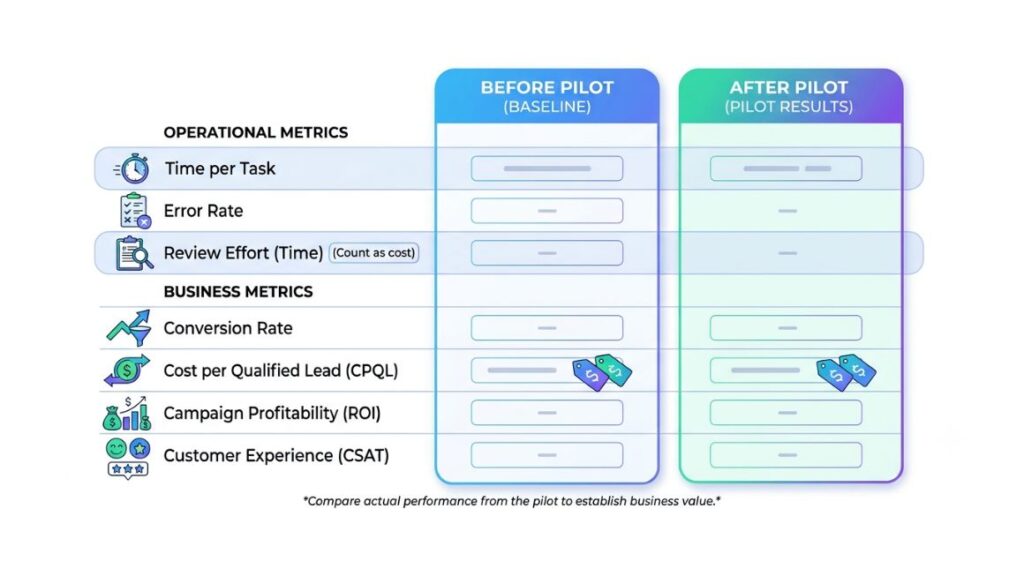
Track time per task, error rate and review effort first. Then track the business side: conversion rate, cost per qualified lead, campaign profitability, and customer experience where it applies. Count review time as a cost. Teams forget that one all the time.
Calculate the Net Business Value
Use one simple formula:
Net benefit = Measured savings and gains − Total implementation and operating costs
Gains must come from your pilot, not from industry averages. Compare against a control group where you can, like one region that keeps running the manual process. Otherwise use a before-and-after comparison that accounts for seasonality and other changes.
Here’s an illustrative example. A pilot saves 30 hours a month, worth ₹30,000, and a holdout test shows ₹40,000 in extra revenue. Tool fees are ₹25,000, setup spread over the month is ₹10,000, and review time costs ₹15,000. That’s ₹70,000 in gains minus ₹50,000 in costs, so ₹20,000 net. Positive, but thin. It’s also marketing campaign ROI you can defend in a meeting.
Risks, Data Protection, and Human Oversight
The big risks are wrong answers, too much access, and nobody owning the result.
Common Failure Points
- Inaccurate outputs that sound certain
- Outdated data feeding a current decision
- Unexpected tool actions, like emailing the wrong list
- Prompt injection, where hidden instructions in a webpage or document steer the agent. OWASP has ranked it first on its LLM risk list for two editions running
- Excessive permissions. OWASP’s 2025 list names three roots of excessive agency: too much functionality, too many permissions, and too much autonomy
- Poorly defined objectives
Practical Safeguards
- Least-privilege access, so the agent reaches only what the task needs
- Approval gates for spending and customer-facing messages
- Action logs you actually read
- Spending limits and rollback procedures
- Data minimization. India’s DPDP Rules, notified on November 13, 2025, require consent that’s free, specific, informed, and unconditional, and full obligations apply from May 13, 2027
- Regular testing with adversarial examples
Alexander Group’s 2026 research, reported in October, found that only 31% of marketing teams have managed governance around AI. AI governance for marketing is a gap you can close faster than most competitors will.
Establish Accountability
Name a human owner for every workflow your AI agent for marketing teams touches. The agent performs tasks, but a person owns the business outcome, the errors, and the customer complaints. If nobody’s name is on it, nobody’s watching it.
Agent risk grows with access. Limit permissions, require approval for spend and customer messages, log every action, and name one human owner per workflow, because prompt injection and excessive agency are the top agent risks OWASP tracks.
What Is Changing in Marketing Agent Technology?
For any AI agent for marketing teams, the shift is from one-off prompts to multi-step work, with deeper links to customer data and tighter permission controls. As of October 2026, here’s what’s real and what’s still a promise.
- Available: Salesforce’s Hunter prospecting agent and Qualified’s Piper were generally available on June 3, 2026. HubSpot has billed its Customer and Prospecting agents per outcome since April 14, 2026.
- Pilot: Salesforce’s Content Agent and Marketing Goals Agent were in pilot as of that same announcement.
- Announced: Google’s Ask Advisor, unveiled May 20, 2026.
- What surveys show: HubSpot’s 2026 State of Marketing report found 19.2% of marketers use agents to automate initiatives end to end. McKinsey found 23% of companies scaling agents somewhere, while Gartner predicted in June 2025 that over 40% of agentic projects will be canceled by the end of 2027.
AI agents for marketing now reach most teams through tools they already own. That’s good news. But the gap between a polished demo and dependable execution hasn’t closed, and agentic AI in marketing is still easier to announce than to run. Treat every vendor result as a claim until you’ve reproduced it yourself.
Conclusion
Success comes down to four moves: choose the right workflow, connect reliable data, set clear boundaries, and measure real results. An AI agent for marketing teams that saves two hours on a Tuesday is nice. One you can prove pays for itself is worth keeping.
So pick one workflow this week, write down today’s baseline, and run a small pilot in recommendation mode.
If you’d like guided practice building workflows like these, Young Urban Project’s AI Marketing course is a good place to start. Have a look at the syllabus and see what’s worth learning first.
Frequently Asked Questions (FYQs)
What is an AI agent for a marketing team?
An AI agent for marketing teams is software that takes a goal, plans the steps, uses connected tools to carry them out and reports back. It handles multi-step work like auditing ad accounts or researching leads, while a person approves anything risky.
How is an agent different from ordinary marketing automation?
Automation follows predefined steps every time. An agent decides some steps dynamically, based on what it finds. Many products combine both, using fixed rules for safe tasks and an agent for judgment calls.
Can small marketing teams use AI agents?
Yes. A small team can run an AI agent for marketing teams on one narrow workflow, like weekly report drafts or lead research, inside software you already pay for. Zapier offers a free agent tier and n8n’s self-hosted edition is free, so testing doesn’t need a big budget.
Which marketing tasks are best to automate first?
Pick repetitive and measurable tasks where a mistake costs little: report drafts, content briefs, data cleanup and tracking checks. Leave customer-facing messages and budget changes until the agent has a clean record.
Are AI agents safe to use with customer data?
It depends on permissions, the provider’s data policy, security controls, and the privacy law that applies to you. In India, that includes DPDP consent rules with full obligations due May 13, 2027. Give the agent only the data a task needs.
How much do marketing agents cost?
Costs vary by software, usage, integrations, setup, and human review. Current examples include about $0.50 per resolved conversation on HubSpot, $0.10 per action on Salesforce, and $33.33 a month for Zapier’s Agents Pro tier. Check vendor pricing before you budget.
Will AI agents replace marketing professionals?
They’ll take over tasks, not whole roles. Strategy, creative judgment, accountability, and customer understanding still need people. Someone has to own the results when an agent gets it wrong.