

Table of Contents
Introduction
What Are Factors Influencing Consumer Behaviour?
Consumer behaviour sounds like one of those textbook-heavy marketing terms at first. But in practice, it’s much simpler and way more interesting than that.
It’s basically the study of why people buy certain things, ignore others, trust one brand instantly, or spend three days researching a product only to abandon the cart at the last second. Happens all the time.
In marketing, consumer behaviour refers to the patterns, emotions, habits, motivations, and outside influences that shape purchasing decisions. Not just the purchase itself. The entire journey around it.
How people discover products.
What makes them hesitate.
Why they compare endlessly sometimes.
Why they impulse-buy other times.
And honestly, buying decisions in 2026 look very different from even five or six years ago.
Consumers don’t move in straight lines anymore. Someone might first see a product in a TikTok video, later notice it again in Instagram comments, search for reviews on Google, check Reddit opinions, ask friends in a WhatsApp group, and then finally purchase after seeing a limited-time offer at midnight. That’s pretty normal now.
Digital platforms changed consumer decision-making in a huge way.
Algorithms shape attention. Recommendations influence discovery. Reviews create trust faster than advertisements do. Even social validation has become part of the buying process. If thousands of people approve something publicly, consumers naturally feel safer choosing it too.
There’s also the emotional side of it, which businesses sometimes underestimate.
People rarely buy only because of features or specifications. A lot of purchases are tied to identity, comfort, insecurity, aspiration, convenience, status… sometimes even boredom. Logic matters, yes, but emotion usually gets there first.
Take premium coffee brands, for example. Most customers are not buying caffeine alone. They’re buying routine, lifestyle, familiarity, maybe even a version of themselves they relate to.
That’s why brands that understand consumer psychology usually communicate better. Their messaging feels sharper because it connects with what people already care about internally.
Why Businesses Must Understand Consumer Behaviour
A surprising number of businesses still market products based on assumptions instead of actual customer behaviour.
That gap becomes expensive.
Understanding consumer behaviour helps companies stop guessing and start seeing patterns more clearly. Why do customers drop off. Why certain campaigns convert better. Why one product gets attention while another barely moves despite similar pricing.
Small behavioural insights often create massive business advantages.
For example, many ecommerce brands discovered that customers weren’t abandoning carts because prices were too high. They were leaving because delivery dates looked uncertain or checkout felt annoying. Tiny friction points. Big impact.
When businesses understand buying behaviour properly, a few things improve almost immediately:
- Product positioning becomes clearer
- Messaging feels more relevant
- Customer retention improves
- Marketing waste decreases
- Personalization becomes more effective
- Pricing strategies become smarter
And personalization matters more now than ever before.
Consumers expect brands to understand preferences without making the experience feel intrusive. Recommendations should feel useful, not random. Communication should feel timely, not automated beyond recognition.
The brands doing this well usually feel effortless from the customer side.
Netflix is a good example. Same with Spotify. Recommendations feel natural enough that users keep engaging without thinking much about the underlying system behind it.
Another important shift: consumers have become less patient and less loyal.
If a competitor offers a smoother experience, faster delivery, better support, or simply feels more trustworthy, switching happens quickly. Sometimes overnight.
Which means businesses that truly understand behaviour patterns can react faster before problems become visible in sales reports.
That’s the real advantage.
What This Guide Covers
Consumer behaviour is influenced by dozens of interconnected factors, and this guide breaks those down in a practical way without overcomplicating things.
The sections ahead explore:
- The major psychological, social, cultural, personal, economic, and technological factors influencing buying decisions
- Different types of consumer buying behaviour
- Why emotions influence purchases more than most brands realize
- How social proof, convenience, trust, and personalization affect conversions
- The modern consumer decision-making process
- How businesses track and analyze consumer behaviour today
- Ethical ways brands influence purchasing decisions without damaging trust
There’s also a big focus on how technology changed consumer expectations.
Because honestly… consumers in 2026 behave differently across almost every industry. Faster decision cycles. More research. More skepticism. Higher expectations around experience and convenience.
But human psychology underneath it all still remains surprisingly consistent.
People still want certainty.
Still want social validation.
Still want convenience.
Still want to feel understood by the brands they buy from.
The channels changed. The motivations mostly didn’t.
What Is Consumer Behaviour?
Consumer behaviour refers to how individuals or groups make decisions about buying, using, evaluating, and responding to products or services.
Simple definition. But the actual behaviour behind it gets layered very quickly.
Because people don’t make decisions in purely rational ways. If they did, marketing would probably look very different.
Consumer behaviour includes everything happening before, during, and after a purchase:
- What triggers interest
- How consumers research options
- What influences trust
- Why they choose one brand over another
- How they feel after purchasing
- Whether they come back again
And those decisions are shaped by both conscious and unconscious factors.
Price matters. Of course.
But so do emotions, familiarity, social influence, convenience, brand image, previous experiences, timing, culture, lifestyle, and even mood in certain situations.
A customer buying skincare products might care about ingredients logically, but the final purchase may still come down to trust in the brand aesthetic or how confidently the product is recommended online.
That emotional layer shows up constantly in consumer behaviour.
Meaning of consumer behaviour in marketing
In marketing, consumer behaviour helps businesses understand the deeper reasons behind customer actions.
Not just what customers buy, but why they buy it.
That distinction changes how companies approach messaging, advertising, product development, and customer experience.
For example, two customers may purchase the same smartwatch for completely different reasons:
- One wants productivity and health tracking
- Another wants status and lifestyle association
Same product. Different motivations.
This is why effective marketing usually speaks to emotional context instead of listing endless features mechanically.
Consumer behaviour analysis also helps brands understand things like:
- What creates trust quickly
- Which objections stop conversions
- How consumers compare alternatives
- What drives impulse purchases
- Why retention drop over time
- What builds long-term loyalty
The strongest marketing campaigns usually feel psychologically aligned with customer intent. Not forced. Not overly persuasive. Just relevant enough to feel natural.
That’s a subtle difference, but an important one.
Difference between consumer behaviour and customer behaviour
These two terms often overlap, though they aren’t exactly identical.
Consumer behaviour focuses more on decision-making before and during the purchase process. It studies motivations, perceptions, emotional triggers, and buying influences.
Customer behaviour usually looks at actions after someone becomes a paying customer.
Things like:
- Repeat purchases
- Usage patterns
- Brand loyalty
- Subscription retention
- Customer satisfaction
- Referral behaviour
In simple terms:
Consumer behaviour explains why someone buys.
Customer behaviour explains what they do afterward.
Both matter because businesses don’t grow sustainably through acquisition alone. Retention plays a huge role now, especially with rising advertising costs across digital platforms.
And retention is heavily tied to experience.
A bad onboarding experience, confusing support process, or disappointing product quality can damage customer behaviour very quickly, even if acquisition marketing was excellent.
How consumers evaluate products and services
Consumers evaluate products through a mix of logic, emotion, comparison, and perception.
Sometimes the process is detailed and research-heavy. Other times, it’s almost automatic.
High-ticket purchases usually involve longer evaluation cycles. Consumers compare reviews, pricing, alternatives, social proof, warranties, and brand reputation before deciding.
Low-cost purchases tend to rely more on habit or familiarity.
But even logical evaluation isn’t completely objective.
Perception influences value constantly.
A product with better branding often feels more trustworthy before anyone even uses it. Packaging changes perception. Website quality changes perception. Reviews change perception. Pricing itself changes perception too.
Oddly enough, cheaper products can sometimes feel lower quality simply because consumers associate price with reliability.
Consumers also evaluate products through shortcuts.
Ratings.
Testimonials.
Follower count.
Creator recommendations.
“Best seller” labels.
These signals reduce uncertainty, especially online where customers cannot physically experience products before buying.
That’s why trust signals matter so much in modern marketing.
B2C vs B2B consumer behaviour patterns
B2C and B2B buying behaviour operate differently, though the gap between them has narrowed a bit in recent years.
B2C buying behaviour is usually faster, more emotional, and more influenced by branding, convenience, trends, and social proof.
Consumers purchasing fashion, electronics, skincare, or food products often respond strongly to visuals, identity alignment, urgency, or emotional storytelling.
B2B purchasing tends to involve:
- Longer decision cycles
- Multiple stakeholders
- More research
- Higher financial risk
- ROI-focused evaluation
But emotions still influence B2B decisions more than many companies admit publicly.
Trust matters heavily there too.
A business choosing software vendors may compare features logically, but familiarity, perceived reliability, customer support reputation, and risk reduction often shape the final decision just as much.
Nobody wants to recommend the wrong platform internally.
That fear influences behaviour quietly in many B2B purchases.
Which is why authority, case studies, testimonials, and reputation become powerful assets in enterprise marketing.
Why Understanding Consumer Behaviour Is Important
Markets change quickly now. Faster than most businesses can comfortably adapt to, honestly.
Consumer expectations shift constantly because technology, culture, media habits, and economic conditions keep evolving together. Something that worked perfectly two years ago may suddenly feel outdated or ineffective.
That’s why understanding consumer behaviour has become less of a marketing advantage and more of a business necessity.
Without behavioural insight, companies often misread what customers actually want.
A brand may assume declining sales are caused by pricing when the real issue is trust. Or poor mobile experience. Or delivery expectations. Or simply that consumer priorities changed quietly over time.
Behavioural analysis helps businesses see beyond surface-level metrics.
Instead of only asking:
“What are customers buying?”
It asks:
“Why are they behaving this way?”
That second question usually leads to much better decisions.
Personalization at Scale
Consumers have become extremely used to personalized experiences online.
Not necessarily because they demanded them initially, but because platforms trained expectations gradually over time.
Netflix recommends content.
Spotify curates playlists.
Amazon predicts purchases before customers fully realize what they need.
So now generic experiences feel noticeably weaker.
Consumers expect relevance almost automatically.
That affects ecommerce, email marketing, advertising, search experiences, onboarding flows, even customer support interactions. Brands that personalize effectively tend to reduce friction because customers spend less energy filtering irrelevant information.
And attention is already limited enough.
Good personalization usually feels subtle. Helpful. Context-aware.
Bad personalization feels invasive or strangely disconnected.
There’s a difference between:
“You might like this.”
And:
“We tracked every move you made online.”
Consumers notice that distinction pretty quickly.
Anticipating Shifts in Consumer Demand
Consumer preferences rarely stay fixed for long.
Economic uncertainty changes spending behaviour. Social trends influence purchasing priorities. Technology reshapes convenience expectations. Even platform algorithms can suddenly alter buying patterns within certain industries.
Businesses that identify behavioural shifts early often gain enormous advantages.
For example, consumers became far more convenience-driven over the past few years. Fast checkout systems, same-day delivery, mobile-first experiences, and subscription models gained traction partly because patience levels decreased across digital experiences generally.
Sustainability is another major shift.
A growing percentage of consumers now evaluate brands based on packaging, sourcing transparency, environmental positioning, and ethical practices. Especially younger demographics. Not always perfectly, obviously, but the expectation exists now.
Brands monitoring consumer behaviour closely usually detect these shifts before competitors fully react.
And timing matters.
Catching behavioural change early can influence product strategy, inventory planning, positioning, and customer acquisition costs significantly.
Optimizing the Customer Journey
Modern customer journeys are messy.
Consumers jump between platforms constantly before purchasing anything meaningful. Someone may discover a product through YouTube, compare alternatives through Google searches, check Reddit opinions, watch TikTok reviews, revisit the website later on mobile, then finally purchase after receiving a retargeting ad.
Every interaction shapes perception.
This is why businesses analyze behavioural touchpoints obsessively now.
A small problem during checkout can quietly destroy conversion rates.
Slow page speed matters.
Confusing navigation matters.
Weak trust signals matter.
Even tiny frustrations stack up surprisingly fast online because alternatives are everywhere.
Consumers don’t tolerate friction the way they used to.
The businesses performing best usually simplify decision-making instead of adding unnecessary complexity.
Simple checkout flows.
Clear pricing.
Strong product pages.
Transparent shipping information.
Nothing revolutionary there. But execution matters.
Fostering Brand Loyalty
Customer loyalty has changed a lot.
Consumers still stay loyal to brands, but loyalty today feels more conditional than before. Brands have to continuously earn attention and trust instead of assuming customers will stick around automatically.
Experience matters more now.
People stay loyal when brands consistently deliver convenience, reliability, emotional connection, or alignment with personal identity. Sometimes all four together.
Community-driven brands understand this especially well.
Customers don’t just buy products from those brands. They participate in something broader. A lifestyle, identity, or shared interest group.
That emotional connection creates stronger retention than discounts alone usually can.
Post-purchase experience also plays a bigger role than many businesses expect.
Fast support.
Clear communication.
Easy returns.
Reliable delivery.
These operational details influence future behaviour heavily because consumers remember frustration very clearly.
Sometimes more clearly than satisfaction, honestly.
Driving Product and Service Innovation
Consumer behaviour research helps businesses identify problems that customers may not be able to explain to themselves.
That’s where useful innovation usually comes from.
By analyzing feedback, reviews, usage patterns, support conversations, and behavioural data, companies start noticing recurring frustrations or unmet expectations.
For example, the rise of food delivery apps wasn’t just about food quality. It reflected demand for convenience, speed, and reduced effort in decision-making.
Same thing happened with subscription models in entertainment, software, fitness, and ecommerce. Consumers increasingly preferred access and flexibility over ownership complexity.
Behavioural insights also help companies prioritize improvements more effectively.
Instead of building features based purely on internal assumptions, businesses can focus on what customers genuinely care about.
That tends to produce better products. And fewer expensive mistakes.
Types of Consumer Buying Behaviour
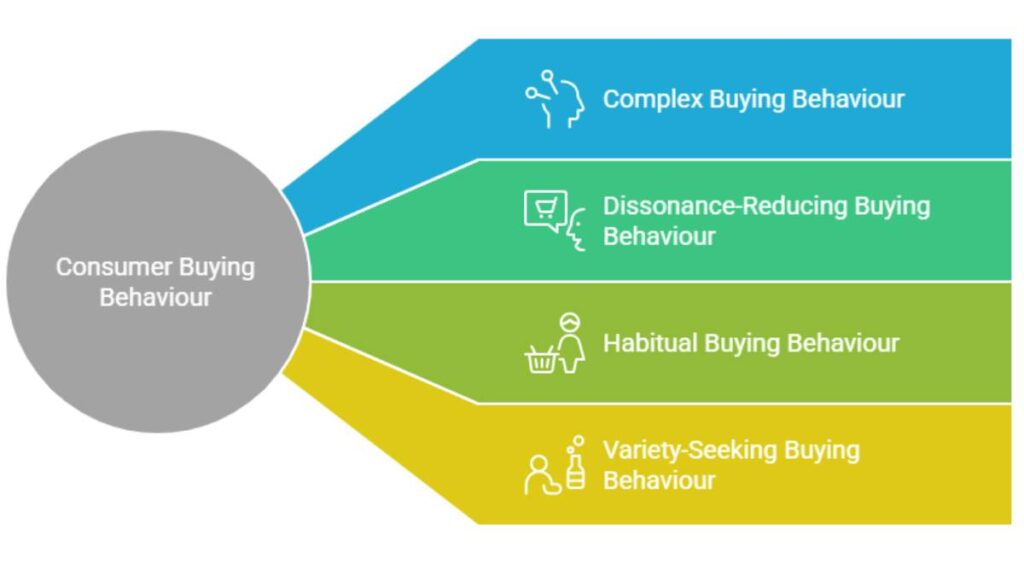
Consumer buying behaviour changes depending on the situation, product category, emotional involvement, risk level, and urgency.
Some purchases happen almost automatically.
Others become exhausting research projects.
Understanding these behaviour patterns helps businesses communicate more effectively because not every customer thinks the same way while buying.
Complex Buying Behaviour
Complex buying behaviour happens when consumers are highly involved in a purchase and perceive meaningful differences between brands.
These are usually expensive or high-risk decisions where customers spend significant time researching before committing.
Examples include:
- Cars
- Premium electronics
- Real estate
- Enterprise software
- Financial products
- Luxury purchases
Consumers compare everything during these buying journeys.
Features.
Pricing.
Reviews.
Reputation.
Customer support.
Long-term value.
And because the perceived risk is high, trust becomes extremely important.
Someone purchasing an expensive laptop, for example, may spend weeks watching comparison videos, reading reviews, checking benchmarks, and comparing alternatives before making a decision.
Not because buying itself is difficult necessarily, but because consumers want reassurance that they won’t regret the purchase later.
That’s why educational marketing performs well in high-involvement categories.
Detailed product pages, demonstrations, testimonials, comparison content, and transparent communication all help reduce uncertainty.
Consumers want confidence before spending serious money.
Dissonance-Reducing Buying Behaviour
Dissonance-reducing buying behaviour happens when consumers are highly involved in a purchase but struggle to identify major differences between competing options.
This often creates anxiety after purchasing.
A feeling like:
“Hopefully this was the right choice.”
That post-purchase uncertainty is called cognitive dissonance.
It’s common in categories where products feel relatively similar but still require meaningful financial commitment.
Examples include:
- Mattresses
- Appliances
- Insurance plans
- Mid-range laptops
- Furniture
Consumers in these situations actively seek reassurance after purchasing.
Which explains why reviews, warranties, guarantees, onboarding emails, and customer support matter so much. Brands that reduce post-purchase anxiety tend to build stronger loyalty over time.
A bad support experience after a stressful purchase can damage trust very quickly.
Especially when customers were already uncertain beforehand.
Habitual Buying Behaviour
Habitual buying behaviour happens during low-involvement, repetitive purchases.
Consumers buy without thinking deeply each time because the decision becomes routine.
Examples include:
- Toothpaste
- Coffee
- Soap
- Snacks
- Household items
In these categories, familiarity often matters more than active loyalty.
People grab what feels recognizable or convenient.
Sometimes consumers don’t even consciously evaluate alternatives unless something interrupts the habit, like stock availability, pricing changes, or strong promotions.
That’s why repetition and visibility matter heavily in these markets.
Brands want to stay mentally available.
Simple packaging recognition, consistent placement, recurring exposure… these things influence behaviour more than many businesses realize.
Habitual buying behaviour may look boring from the outside, but it’s incredibly valuable commercially because repeat purchases compound over time.
Variety-Seeking Buying Behaviour
Variety-seeking buying behaviour happens when consumers switch brands frequently, not because they dislike the current option, but because they want novelty or experimentation.
This behaviour is common in trend-driven categories.
Fashion.
Beauty.
Snacks.
Entertainment.
Apps.
Restaurants.
Social media amplified this pattern massively.
Consumers constantly discover new brands through creators, recommendation algorithms, viral trends, and online communities. Trying something new becomes part of the experience itself.
Skincare is a strong example.
Many consumers continue experimenting with products even after finding routines that already work reasonably well. Discovery feels exciting. There’s social influence involved too.
Brands targeting variety-seeking consumers usually focus heavily on freshness:
- Limited editions
- Collaborations
- Seasonal drops
- Trend participation
- Frequent launches
Consistency still matters, but novelty becomes part of the retention strategy itself.
What Are the 6 Primary Factors That Affect Consumer Behaviour?
Consumer behaviour is rarely driven by one clean reason. That’s usually where simplified marketing advice falls apart.
A customer might say price influenced the purchase. Fair enough. But underneath that, there may also be trust issues, social pressure, habit, timing, mood, convenience, maybe even identity. Human decisions are layered. Sometimes contradictory too.
That’s why two people with the same income, same age group, and same location can behave completely differently while buying the exact same product category.
One researcher for three days.
Another buys in six minutes because a creator recommended it.
Both behaviours make sense in context.
Broadly, there are six major factors influencing consumer behaviour:
- Psychological factors
- Social factors
- Cultural factors
- Personal factors
- Economic factors
- Technological factors
None of these work independently. They overlap constantly. A consumer buying expensive running shoes, for example, may be influenced by fitness identity, social trends, disposable income, perceived status, comfort, online reviews, and emotional motivation all at once.
That overlap matters more now because modern buying journeys are messy. Not linear. Consumers move between emotions and logic pretty quickly.
Psychological Factors Influencing Consumer Behaviour
Psychological factors explain what’s happening internally before a purchase happens.
Motivation.
Perception.
Beliefs.
Attitudes.
Past experiences.
These things shape buying behaviour quietly in the background, often without consumers fully noticing it themselves.
And honestly, psychology usually matters more than businesses expect.
Motivation and Consumer Needs
Every purchase starts with some kind of need or desire. Sometimes practical. Sometimes emotional. Usually both.
A person buying noise-canceling headphones may want better audio quality, sure. But there’s often another layer underneath. Focus. Escape. Personal space during commutes. Small emotional comforts people rarely say out loud.
That’s how consumer motivation works.
Consumers buy products because they want to:
- Solve problems
- Save time
- Feel confident
- Reduce stress
- Gain social approval
- Feel secure
- Reward themselves
Maslow’s hierarchy still shows up here constantly, even if marketers don’t actively think about it anymore.
Basic products often solve functional needs.
Premium products usually connect with emotional or identity-driven needs.
And emotional motivation tends to move faster than rational analysis.
A lot of purchases are emotional first, logical second.
Luxury brands understand this extremely well. Fitness brands too. They rarely sell the actual product alone. They sell a future version of the customer.
Confidence.
Discipline.
Status.
Belonging.
The product becomes the vehicle for that feeling.
Perception and Brand Image
Consumers react to perception, not objective reality.
That sounds obvious on paper, but it changes almost everything in marketing.
Packaging changes perceived quality.
Website design changes perceived trust.
Pricing changes perceived value.
Even small visual details influence behaviour more than most businesses realize.
A skincare brand using clean minimalist packaging often feels more “premium” before anyone even tries the product. Same formula in poor packaging? Completely different reaction.
Brand image works the same way.
Consumers build mental shortcuts around brands over time:
- Reliable
- Affordable
- Trendy
- Premium
- Ethical
- Innovative
Once those associations form, they influence future decisions heavily.
And perception spreads fast now because digital platforms amplify everything. Reviews, creator opinions, screenshots, Reddit discussions, reaction videos… consumers absorb all of it while forming opinions.
Sometimes a brand loses trust before customers even directly interact with the product.
That’s the reality now.
Learning and Consumer Experience
Consumers learn from every interaction with a brand. Good or bad.
A smooth experience creates familiarity and lowers hesitation next time. A frustrating experience usually sticks around longer than businesses expect.
Especially online.
Delayed shipping, poor support responses, confusing checkout flows, weak return policies… these things shape future behaviour very quickly because alternatives are always available.
There’s less tolerance for friction now.
Positive experiences also compound over time. When customers repeatedly have smooth interactions with a brand, buying becomes almost automatic. Less evaluation happens because trust already exists.
That’s part of why companies obsess over onboarding and post-purchase experience.
Reviews influence learning behaviour too.
Most consumers no longer trust brand messaging alone. They look for signals from other customers first because peer experiences feel more believable. A product with thousands of detailed reviews instantly feels safer psychologically than something with no visible feedback.
Even when consumers know reviews can be manipulated sometimes… the reassurance effect still works.
Attitude and Beliefs
People naturally move toward brands that align with their beliefs and away from brands that don’t.
Simple idea. Huge impact.
Consumer attitudes are shaped over years through media exposure, experiences, culture, conversations, and social environments. Once those attitudes form, changing them becomes difficult.
A customer who believes a brand is reliable will often defend it even after minor negative experiences.
A customer who distrusts a brand may reject it regardless of strong product quality.
Beliefs influence purchase intention more than many performance marketers like to admit.
That’s why positioning matters so much.
Brands are constantly trying to own a specific perception in consumers’ minds:
- Safe and trustworthy
- Premium and aspirational
- Sustainable and ethical
- Budget-friendly but dependable
- Innovative and modern
Consumers rarely evaluate every option from scratch. Existing attitudes filter what gets considered in the first place.
Personality and Lifestyle
Personality shapes buying behaviour constantly, though not always in obvious ways.
Some consumers enjoy trying new brands every month.
Others stay loyal for years because familiarity feels comfortable.
Some buy impulsively.
Others compare thirty tabs before deciding.
Lifestyle influences behaviour just as much.
A health-focused consumer shops differently from someone prioritizing convenience. A minimalist consumer evaluates products differently from a trend-driven shopper. Daily routines shape demand more than demographics alone.
That’s why lifestyle-based branding became so powerful.
Consumers increasingly buy products that reinforce identity:
- Wellness-focused identities
- Productivity-focused identities
- Sustainable lifestyles
- Luxury lifestyles
- Creative lifestyles
People don’t just buy products anymore. They buy alignment with the kind of person they believe they are… or want to become.
That emotional connection drives stronger loyalty than discounts usually can.
Social Factors Influencing Consumer Behaviour
Consumers like to think decisions are independent.
Most aren’t.
Social influence shapes buying behaviour constantly, sometimes subtly, sometimes aggressively. Family habits, peer opinions, online communities, creator recommendations, status pressure… all of these affect what people buy and how they justify those purchases afterward.
And social influence became stronger in the digital era because consumers are surrounded by opinions all day now.
Family Influence on Consumer Behaviour
Family is still one of the strongest behavioural influences across most product categories.
People grow up around certain spending habits, preferred brands, routines, and financial attitudes. Those early patterns tend to stay surprisingly consistent later in life.
Even grocery choices often carry family influence without consumers realizing it fully.
Household decision-making also varies by category.
Parents influence education, healthcare, food, and household purchases heavily.
Children influence entertainment, gadgets, fast food, and increasingly subscription choices.
Partners shape major financial decisions together.
And generational differences create noticeable behavioural gaps.
Older consumers often prioritize reliability and familiarity.
Younger consumers tend to prioritize convenience, experience, speed, and digital accessibility.
Neither is universally right. Just different behavioural conditioning.
Reference Groups and Peer Influence
People constantly look for validation before making decisions, especially when uncertainty exists.
That’s where peer influence becomes powerful.
Reference groups include:
- Friends
- Colleagues
- Online communities
- Industry peers
- Creators
- Social circles
Consumers observe what others approve, recommend, criticize, or avoid. Then behaviour shifts accordingly.
This becomes especially visible in categories tied to identity or visibility:
- Fashion
- Fitness
- Technology
- Beauty
- Travel
- Productivity tools
Online communities changed this dynamic even more.
Consumers trust Reddit threads, Discord groups, niche YouTube channels, and creator communities because the discussions feel less polished and more honest. Sometimes brutally honest, actually.
That perceived authenticity matters.
A random user review explaining why a product failed can influence buying decisions more strongly than an expensive advertising campaign.
Social Status and Consumer Choices
Some purchases are practical.
Others communicate something socially.
Status-driven buying behaviour exists across almost every income level, though it shows up differently depending on the category.
Luxury fashion is the obvious example. But status signaling now extends into wellness, productivity, fitness, sustainability, coffee culture, even home office setups.
Consumers often buy products because of what ownership represents publicly.
Not always consciously.
Still happens.
Aspirational behaviour plays a role here too. Social media intensified this because consumers constantly see curated lifestyles online. That exposure quietly resets expectations around what feels desirable or successful.
Sometimes consumers buy to fit in.
Sometimes, to stand out.
Usually, a mix of both.
Influencer Marketing and Social Proof
Influencer marketing works because consumers trust people more than brand messaging. Or at least they trust people who feel relatable within a niche.
That trust is earned slowly, though. Audiences have become more skeptical over time.
Overly scripted sponsorships usually feel obvious now. Consumers pick up on forced recommendations quickly. But creators who consistently provide useful opinions still influence purchasing decisions heavily.
Especially in beauty, fitness, fashion, gaming, and tech categories.
Social proof extends beyond influencers, too.
Ratings.
Testimonials.
Customer photos.
Public reviews.
Comment sections.
These signals reduce uncertainty for buyers.
A product with 20,000 positive reviews immediately feels safer than a product with no visible feedback, even if the quality difference is unclear.
Consumers interpret popularity as validation. That psychological shortcut affects behaviour constantly online.
Cultural Factors Influencing Consumer Behaviour
Culture shapes what consumers value, reject, celebrate, or consider normal.
Sometimes the influence is obvious.
Sometimes, they remain invisible until they enter new markets and realize consumer expectations work completely differently there.
Buying behaviour never exists outside a cultural context.
Role of Culture in Consumer Behaviour
Culture influences spending habits, communication styles, food preferences, fashion choices, beauty standards, and even attitudes toward money itself.
Consumers from different cultural backgrounds respond differently to the same messaging because priorities differ.
Some cultures value individuality heavily.
Others emphasize family, tradition, or collective identity more strongly.
That changes purchasing behaviour in very practical ways.
Even emotional advertising performs differently across regions because emotional triggers aren’t universal. A campaign centered around personal achievement may resonate strongly in one market and feel disconnected in another.
Global brands learned this lesson repeatedly.
Localization matters because consumers want relevance, not recycled messaging copied across markets without context.
Subculture and Consumer Segmentation
Within larger cultures, smaller subcultures shape behaviour at a more specific level.
These groups may form around:
- Religion
- Ethnicity
- Gaming
- Music
- Sustainability
- Fitness
- Internet culture
- Lifestyle interests
Each subculture develops distinct preferences, language patterns, and consumption habits.
Digital-native communities accelerate this even faster now. Trends spread globally within days because online groups amplify aesthetics, products, and behaviors rapidly.
Gen Z consumer behaviour reflects this shift clearly.
Younger audiences tend to value authenticity, speed, community validation, and cultural relevance differently from previous generations. Traditional advertising often feels too polished or corporate for them.
That doesn’t mean younger consumers reject brands.
They reject messaging that feels disconnected from reality.
Important difference.
Social Class and Consumption Patterns
Income level affects purchasing behaviour, but social class influences perception too.
Higher-income consumers often prioritize convenience, exclusivity, personalization, or premium experiences.
Budget-conscious consumers usually focus more on value, practicality, and durability.
But aspiration exists across every category.
Consumers frequently stretch spending to access products associated with status or upward mobility. That’s part of why affordable luxury categories perform so well. People want emotional access to premium identity signals without necessarily paying ultra-premium pricing.
Consumption becomes symbolic in those situations.
Cross-Cultural Consumer Behaviour
Global consumers are more connected now than ever before. Trends move internationally within hours through social platforms and creator ecosystems.
At the same time, local preferences still matter deeply.
Brands succeeding globally usually adapt products and communication regionally instead of forcing identical positioning everywhere.
Fast-food chains localize menus.
Beauty brands adapt shade ranges.
Streaming platforms adjust recommendations and content promotion.
Consumers notice when brands understand cultural nuance. And they notice when brands clearly don’t.
Personal Factors Affecting Consumer Behaviour
Personal factors relate to the individual circumstances shaping how consumers think and spend.
Two consumers from the same city and income bracket can still behave completely differently because their routines, goals, personalities, and priorities differ.
That’s why demographics alone rarely explain modern consumer behaviour properly.
Age and Life Cycle Stage
Consumer priorities change throughout life.
Teenagers, young professionals, parents, and retirees naturally evaluate purchases differently because responsibilities and routines evolve over time.
Younger consumers often prioritize trends, convenience, digital experiences, and identity expression.
Older consumers may focus more on reliability, comfort, long-term value, or ease of use.
Life events trigger major behavioural shifts too:
- Marriage
- Career changes
- Moving cities
- Parenthood
- Retirement
These moments reshape spending priorities quickly because daily life changes around them.
A new parent shops differently from someone living alone. A remote worker buys differently from someone commuting daily.
Context matters.
Occupation and Income Level
Occupation influences both financial flexibility and consumption habits.
Different professions create different routines, priorities, and purchase motivations.
A consultant traveling constantly may prioritize convenience and premium service experiences.
A student may prioritize affordability and flexibility.
A freelancer may value productivity tools more heavily than status purchases.
Income level naturally shapes spending power too.
During economic uncertainty, behavioural changes become very visible:
- Increased comparison shopping
- Delayed purchases
- Greater discount sensitivity
- Preference for practical spending
Consumers become more selective when financial confidence drops.
Lifestyle and Daily Habits
Lifestyle has become one of the strongest behavioural indicators in modern marketing.
Fitness-focused consumers buy differently from convenience-focused consumers.
Minimalists behave differently from trend-driven shoppers.
Daily routines quietly shape product demand:
- Wellness lifestyles increase supplement and fitness spending
- Remote work drives home-office purchases
- Sustainability-focused consumers prefer ethical brands
- Busy professionals prioritize convenience services
Lifestyle marketing works because consumers like products reinforcing how they already see themselves.
Or how they want to see themselves.
Personality Traits and Self-Concept
Personality affects shopping behaviour more than most customer surveys capture properly.
Some consumers love experimenting with new products.
Others avoid risk completely.
Some enjoy highly social, visible purchases.
Others prioritize functionality and privacy.
Self-concept matters too.
Consumers often choose brands reflecting their identity, values, or aspirations. That psychological alignment strengthens emotional attachment over time.
A lot of modern branding is really identity signaling underneath the surface. The strongest brands understand that quietly, even if they never say it directly.
How Sustainability and Ethical Values Shape Consumer Choice
For a long time, sustainability sat in the background of marketing. Brands mentioned recyclable packaging once in a while, added a green label somewhere on the website, maybe launched a campaign during Earth Day, and that was enough.
Not anymore.
Consumers started paying closer attention, partly because information became impossible to avoid. Factory conditions go viral. Packaging waste gets exposed online. One employee complaint can become a full-blown reputation issue by evening. Things travel fast now. Faster than most brands are built to handle.
So buying decisions changed a bit. Quietly at first.
People still care about price, obviously. Convenience too. But there’s another layer sitting underneath many purchase decisions now: “Does this company actually deserve support?”
That question matters more than it used to.
Rise of Conscious Consumerism
Conscious consumerism sounds like a buzzword sometimes, but the behavioural shift behind it is very real.
Consumers increasingly connect purchases with identity. Not always consciously. Still happens though.
Someone buying refillable skincare products may not just be buying skincare. They’re buying into a version of themselves that feels less wasteful. A customer choosing second-hand fashion over fast fashion may partly care about affordability, but also about avoiding overconsumption guilt. Human decisions are messy like that. Rarely just one motivation.
The interesting part is how this affects categories that used to compete almost entirely on price.
Fashion changed.
Food changed.
Beauty definitely changed.
Even tech buyers now ask questions around repairability, sourcing, labor ethics, and energy usage. Ten years ago most mainstream consumers barely discussed those things.
And consumers are more informed than brands sometimes assume. They compare ingredient lists. They read Reddit discussions. Watch long-form breakdown videos. Read comments underneath the controversies. The research process became surprisingly investigative.
Not for every purchase, sure. Nobody spends two hours ethically evaluating toothpaste.
But for higher-consideration purchases? Absolutely happens.
ESG and Ethical Branding
Consumers don’t separate brand ethics from brand reputation anymore. They’ve merged together.
A company can have strong products and still lose trust if the broader business behaviour feels dishonest, exploitative, or performative. That’s where ESG conversations became commercially relevant instead of just corporate reporting language.
People look at:
- labor practices
- sustainability claims
- sourcing transparency
- diversity efforts
- executive behaviour
- public accountability
And consumers have become deeply skeptical of polished corporate messaging. Understandably.
A beautifully designed sustainability campaign means very little if customers discover contradictory business practices two clicks later. That gap between branding and reality creates backlash quickly because audiences discuss brands publicly now, almost collaboratively.
Greenwashing became such a problem because too many companies treated ethics like aesthetic positioning instead of operational commitment.
Consumers noticed eventually.
That’s why vague claims feel weak today. Terms like “eco-conscious” or “planet-friendly” barely register unless supported by specifics.
People want evidence.
Numbers.
Policies.
Actual operational changes.
Not just softer brand colors and recycled-paper packaging aesthetics.
Consumer Demand for Sustainable Products
Demand for sustainable products keeps growing, though consumer behaviour here is more contradictory than headlines usually admit.
People care about sustainability. But they also care about affordability. And convenience. And quality.
Those priorities collide constantly.
A consumer may strongly prefer ethical fashion while still buying cheaper alternatives during economic pressure. Doesn’t necessarily make the values fake. Financial reality simply overrides intention sometimes.
That tension shapes modern buying behaviour more than marketers often acknowledge.
Still, clear shifts are happening:
- Resale markets are growing
- refill systems are becoming mainstream
- rental commerce expanded
- consumers increasingly question overconsumption
- packaging waste gets criticized faster
Younger consumers especially evaluate brands differently than previous generations did.
Products aren’t judged purely on utility anymore. The surrounding story matters too.
Who made it?
How was it sourced?
Does the company feel honest?
Does supporting this brand align with personal values?
That emotional alignment influences retention more than businesses sometimes realize.
How Brands Can Build Ethical Consumer Trust
Trust around ethics builds slowly. Painfully slowly sometimes.
But losing that trust? Very fast.
Consumers respond better to honesty than perfection now. Brands admitting they’re still improving often come across as more credible than companies pretending they’ve already solved everything.
Because realistically, consumers know large businesses are complicated. What creates distrust is usually not imperfection itself. It’s performative messaging disconnected from reality.
And people investigate.
They read customer complaints.
Compare sustainability reports.
Watch creator analyses.
Look at employee reviews.
Search controversies before purchasing.
That behaviour became normal.
Brands building long-term ethical trust usually focus on consistency more than dramatic campaigns. Small operational signals matter:
- transparent sourcing explanations
- realistic sustainability goals
- visible accountability
- reduced packaging waste
- honest communication during mistakes
Consumers notice alignment. They also notice when alignment disappears halfway through the customer experience.
A brand cannot position itself as ethical while creating frustrating support systems, hiding fees, or misleading customers elsewhere. People connect those dots pretty quickly now.
Why Is Understanding Consumer Behaviour Important for Businesses?
A lot of business problems are actually consumer understanding problems in disguise.
Poor retention.
Weak conversions.
Low engagement.
Pricing resistance.
Brand distrust.
Companies often treat these as isolated performance issues when they’re really behavioural misunderstandings underneath.
Because consumers rarely behave the way businesses expect them to behave on spreadsheets.
People buy emotionally and justify logically afterward.
They say price matters most, then pay extra for convenience.
They claim loyalty while comparing alternatives every week.
That unpredictability is exactly why consumer behaviour matters so much.
Improving Marketing Strategies
Most ineffective marketing sounds technically correct but emotionally disconnected.
Brands describe features while consumers care about outcomes.
Companies push specifications while customers evaluate feelings.
Marketers focus on messaging consistency while audiences decide based on trust, familiarity, or timing.
That disconnect happens constantly.
Understanding consumer behaviour helps businesses identify:
- What actually creates hesitation
- What builds confidence
- What emotional triggers matter
- What objections exist beneath the surface
- Why customers abandon decisions halfway through
And honestly, consumers became harder to impress. Attention is fragmented now. Most marketing gets filtered out instantly unless something feels relevant almost immediately.
Which means generic communication struggles more than ever.
Creating Better Products and Services
Consumer behaviour often exposes problems customers never clearly articulate.
A customer might say the product is “fine” while quietly never using it again.
Another may leave because onboarding felt confusing, not because the core product failed.
Behaviour reveals hidden friction.
That’s why strong businesses study:
- usage patterns
- cancellation reasons
- drop-off points
- support complaints
- feature adoption
- repeat purchase behaviour
Sometimes the issue isn’t product quality at all. It’s an expectation mismatch.
A customer expected simplicity and got complexity.
Expected speed and got delays.
Expected transparency and got confusion.
Those small disconnects compound surprisingly fast.
Increasing Customer Retention and Loyalty
Customer acquisition costs keep rising across industries, which has changed how businesses think about loyalty.
Retention matters more now because replacing lost customers has become expensive. Really expensive in some sectors.
But loyalty is misunderstood sometimes.
Consumers aren’t loyal simply because they like a product. They stay when the full experience consistently feels reliable:
- easy purchasing
- dependable quality
- responsive support
- predictable experience
- emotional familiarity
And little frustrations damage loyalty quietly.
Delayed responses.
Confusing billing.
Poor mobile usability.
Broken checkout flows.
None of these seems catastrophic individually. Together, though, they slowly push consumers toward alternatives.
That’s usually how churn happens. Gradually.
Enhancing Customer Experience
Customer experience shapes perception far beyond the moment of purchase.
Consumers remember how difficult something felt.
How fast support responded?
Whether expectations matched reality.
Whether the company respected their time.
And expectations are unusually high now because consumers compare experiences across industries constantly.
A smooth ride-hailing app changes expectations for banking apps.
Fast ecommerce delivery changes expectations for healthcare portals.
One seamless experience raises standards somewhere else entirely.
That ripple effect matters.
Businesses paying attention to consumer behaviour usually identify friction faster because they observe where customers hesitate, complain, or disengage instead of assuming the process works fine internally.
Internal logic and customer logic are often very different things.
Improving Conversion Rates and Sales
Conversion optimization becomes much easier once businesses understand emotional buying behaviour.
Because consumers rarely evaluate products purely rationally.
Sometimes urgency pushes action.
Sometimes reassurance matters more.
Sometimes simplicity alone increases conversion dramatically.
Risk perception also changes behaviour heavily.
A ₹500 purchase and a ₹50,000 purchase trigger completely different emotional processes even if both products are objectively valuable.
That’s why trust signals matter:
- reviews
- guarantees
- social proof
- transparent policies
- recognizable branding
Consumers want reduced uncertainty before committing.
And aggressive sales tactics often backfire long term because they create psychological resistance instead of confidence.
Building Stronger Brand Positioning
Consumers form impressions incredibly fast.
Premium.
Affordable.
Trustworthy.
Cheap.
Reliable.
Overhyped.
These associations happen almost instantly and heavily influence future behaviour.
Strong positioning helps consumers understand:
- Who the product is for
- What problem it solves
- Why it matters
- What emotional identity surrounds it
Weak positioning creates confusion. And confused consumers usually delay decisions or leave entirely.
Trying to appeal to everyone tends to weaken perception rather than broaden it.
Making Data-Driven Business Decisions
Businesses collect enormous amounts of behavioural data now. The difficult part is interpretation.
Clicks alone don’t explain motivation.
Neither do impressions or engagement metrics.
The deeper value comes from understanding why behaviour happens:
- why customers hesitate
- why some users convert faster
- why certain segments remain loyal
- why messaging resonates differently across audiences
Because raw numbers without behavioural context often lead businesses toward the wrong conclusions.
And consumer psychology rarely behaves neatly.
How Businesses Track Consumer Behaviour
Consumers leave behavioural signals everywhere now.
Searches.
Clicks.
Reviews.
Cart abandonment.
Watch time.
Scrolling behaviour.
Support conversations.
Modern businesses can observe customer behaviour in extraordinary detail compared to even a decade ago. But more information doesn’t automatically create more understanding.
Sometimes it creates confusion instead.
Because data becomes useful only when connected to real human behaviour patterns.
Website Analytics and Heatmaps
Website behaviour reveals where consumers feel interested, distracted, confused, or frustrated.
Businesses track:
- bounce rates
- conversion paths
- session duration
- navigation flow
- abandoned carts
- click patterns
Heatmaps became especially useful because they show attention behaviour visually. Where users pause. What they ignore. Which elements attract interaction.
And surprisingly often, conversion problems come from tiny usability issues rather than major strategic failures.
A confusing checkout step.
Poor mobile spacing.
Hidden pricing.
Slow-loading pages.
Consumers rarely explain these frustrations directly. Most just leave quietly.
That silence makes behavioural tracking important.
Customer Surveys and Feedback
Direct customer feedback still matters despite all the automated behavioural data available now.
Reviews, surveys, interviews, feedback forms… they reveal emotional context behind behaviour.
Of course, customer feedback isn’t always perfectly reliable either. Some consumers exaggerate. Some contradict themselves. Some explain decisions emotionally after the fact instead of accurately.
Still, patterns emerge over time.
The most useful businesses combine qualitative feedback with behavioural observation because numbers alone rarely explain human motivation completely.
A drop in retention shows something changed.
Customer feedback helps explain what changed.
Both matter.
Social Media Listening
Consumers discuss brands publicly now in ways that feel surprisingly candid.
Sometimes more candid than companies are prepared for.
Social listening helps businesses track:
- sentiment shifts
- complaints
- emerging frustrations
- viral discussions
- competitor comparisons
- trend changes
And social conversations often reveal behavioural shifts earlier than formal reports do.
A sudden wave of complaints around shipping delays.
Growing frustration around subscription pricing.
Increased excitement around product dupes.
These conversations shape perception publicly and influence future buying behaviour beyond the original audience involved.
Communities drive perception much more than traditional advertising alone now.
CRM and Customer Data Platforms
Customer relationship systems help businesses observe long-term behavioural patterns instead of isolated actions.
This includes:
- repeat purchases
- support history
- engagement frequency
- communication preferences
- retention timelines
Over time, businesses start recognizing distinct customer behaviours.
Some buyers respond to urgency.
Others avoid discounts because they associate lower pricing with lower quality.
Some value premium experiences.
Others prioritize predictability above everything else.
Not every consumer behaves according to demographic assumptions either, which is where many businesses still make mistakes.
Behavioural segmentation tends to reveal more than demographic labels alone.
AI and Predictive Analytics
Predictive analytics became important because businesses increasingly compete on responsiveness.
Brands want earlier behavioural signals:
- churn risk
- future demand
- purchase intent
- lifetime value potential
- emerging trends
But prediction isn’t perfect. Consumer behaviour remains emotional and reactive in ways algorithms still struggle to fully anticipate.
Unexpected cultural moments change behaviour.
Economic anxiety changes behaviour.
Viral trends change behaviour almost overnight sometimes.
So predictive systems work best as guidance, not certainty.
Purchase History Analysis
Purchase history reveals behavioural truth surprisingly well.
Consumers may say one thing in surveys while spending patterns reveal something entirely different.
Businesses study:
- buying frequency
- seasonal trends
- repeat purchasing
- average order value
- product combinations
These patterns help identify loyalty signals, pricing sensitivity, and changing consumer priorities.
Behaviour usually exposes priorities faster than opinions do.
Search Behaviour and Keyword Insights
Search behaviour offers direct visibility into consumer intent because people search based on immediate curiosity, concern, or desire.
Searches reveal:
- frustrations
- comparisons
- urgency
- product awareness
- hidden objections
- emerging demand
And search language evolves constantly.
A new phrase suddenly increasing in popularity often signals behavioural change before broader market trends fully catch up. That’s why businesses monitor search patterns across platforms so closely now.
Consumers often reveal what they want before they officially buy it.
Best Strategies to Influence Consumer Behaviour Ethically
Every brand influences behaviour somehow.
The important distinction is whether that influence respects consumers or exploits them.
Because consumers have become more aware of manipulation tactics over the last few years. Fake scarcity. Artificial urgency. Misleading pricing structures. Forced subscriptions. People recognize these patterns faster now.
And once trust disappears, recovery becomes difficult.
Ethical influence works differently. It reduces uncertainty instead of manufacturing pressure.
Build Trust Through Transparency
Trust lowers resistance naturally.
Consumers buy more confidently when information feels straightforward and consistent across the experience.
That includes:
- clear pricing
- realistic product claims
- visible policies
- accessible support
- honest communication
Interestingly, consumers don’t expect brands to be flawless. They expect them to feel believable.
That’s a different standard entirely.
Overly polished messaging often creates suspicion now because consumers are used to corporate exaggeration. Slight imperfections sometimes feel more trustworthy than perfectly curated brand language.
Use Social Proof Effectively
Consumers constantly look for reassurance from other consumers.
That behaviour hasn’t changed. If anything, it intensified.
Reviews, testimonials, creator opinions, customer photos, community discussions… all of these reduce perceived risk before purchase.
But social proof only works when it feels authentic.
Fake reviews usually sound fake.
Over-scripted testimonials feel unnatural.
Manufactured hype becomes obvious eventually.
Specificity matters because real experiences contain detail. Slight inconsistencies too. Human opinions rarely sound perfectly optimized.
That realism increases credibility.
Personalize Customer Experiences
Consumers expect personalization now, but only to a point.
Helpful personalization feels convenient:
- relevant recommendations
- remembered preferences
- tailored onboarding
- contextual communication
Over-targeting feels invasive.
There’s a psychological boundary consumers rarely explain directly, but they definitely feel it. Once personalization becomes “too aware,” discomfort starts replacing convenience.
Brands that balance relevance with restraint usually perform better long-term.
Reduce Friction in the Buying Journey
A surprising number of lost sales happen because the process feels unnecessarily annoying.
Not because the product failed.
Not because pricing was terrible.
Just friction.
Slow pages.
Complicated forms.
Hidden fees.
Forced account creation.
Poor mobile usability.
Tiny frustrations interrupt momentum. And modern consumers abandon processes quickly because alternatives are always available one tab away.
Convenience became a behavioural advantage, not just an operational feature.
Create Emotionally Resonant Marketing
Consumers remember emotional experiences more than informational ones.
Not necessarily dramatic emotion either.
Sometimes feeling understood matters more than feeling impressed.
Marketing resonates when consumers think:
“Yeah, that’s exactly the frustration.”
“That actually feels accurate.”
“They understand the situation.”
Subtle emotional accuracy often outperforms exaggerated emotional storytelling because it feels grounded in reality instead of advertising performance.
Consumers can sense the difference surprisingly well.
Offer Consistent Omnichannel Experiences
Consumers move between platforms constantly now.
Social media.
Search engines.
Websites.
Mobile apps.
Physical stores.
Review platforms.
And consumers expect consistency across all of them.
Different pricing, conflicting messaging, disconnected support systems… these things create distrust faster than businesses realize.
Consistency reduces cognitive friction because consumers feel confident the experience will remain reliable regardless of where the interaction happens.
That predictability influences trust heavily.
Use Consumer Data Responsibly
Consumers understand brands collect data. Most people accept that exchange to some degree.
What they don’t tolerate well is feeling manipulated or watched too aggressively.
Responsible data usage means:
- explaining data collection clearly
- offering privacy controls
- avoiding exploitative targeting
- protecting customer information
- respecting behavioural boundaries
Once consumers feel exploited instead of understood, the emotional relationship changes very quickly.
And rebuilding that trust later becomes much harder than maintaining it properly in the first place.
Common Mistakes Businesses Make When Understanding Consumer Behaviour
A lot of businesses think they understand customers because they have dashboards full of data. Traffic numbers, conversion reports, demographic charts, retention graphs. All of that looks useful on paper. Sometimes it is. But raw data can create false confidence, too.
Consumer behaviour is messy. People change opinions quickly. They say one thing and do another. They buy emotionally, justify logically, then switch brands a month later because a creator they trust recommended something else. That unpredictability is exactly where many businesses struggle.
And honestly, some brands still approach customer behaviour like it’s a math problem. Input one marketing message, get one predictable outcome. Real consumers do not work like that.
Ignoring Customer Feedback
One of the most common mistakes is collecting customer feedback without actually responding to it in a meaningful way.
A company sends surveys after purchase. Support teams log complaints. Reviews pile up across marketplaces and social platforms. Internally, everyone says customer feedback matters. But operationally? Nothing changes.
Customers notice that disconnect pretty quickly.
What makes this worse is that consumers usually repeat the same frustrations over and over before leaving entirely. Rarely dramatic. More like slow disappointment building in the background.
Sometimes the complaint itself is not even the real issue.
A customer angry about delivery delays may actually be frustrated by poor communication. Someone complaining about pricing may really be uncertain about value. Those deeper signals matter. Businesses that only react to surface-level complaints miss the behavioural insight underneath.
And over time, ignored feedback creates emotional distance from the brand. That part gets overlooked a lot.
Relying Only on Demographics
Demographics help, obviously. Age, location, income level, profession… those things still shape consumer behaviour to some extent.
But demographics alone are weak predictors of motivation now.
Two people in the same age bracket can behave completely differently online. One may prioritize convenience above everything. Another may care deeply about sustainability. Someone else may buy based almost entirely on social validation.
Yet many businesses still build broad audience assumptions like:
“Gen Z likes trends.”
“Millennials value experiences.”
“High-income consumers buy premium.”
Sometimes true. Sometimes completely wrong.
Consumer behaviour became far more fragmented because identity, lifestyle, digital habits, and emotional triggers influence purchasing decisions more than static demographic categories alone.
The brands getting this right usually study behaviour patterns instead of stereotypes.
What people search for.
What they ignore.
What creates hesitation?
What they repeatedly come back to.
That tells a much clearer story.
Overlooking Emotional Triggers
A surprising amount of marketing still sounds overly rational.
Feature-heavy.
Specification-heavy.
Benefits listed neatly in bullet points.
Meanwhile, the actual buying decision is happening emotionally underneath all of it.
Consumers buy products because they want to feel secure, confident, accepted, productive, healthier, admired, less stressed. Sometimes all at once. Even highly analytical purchases involve emotional reassurance somewhere in the process.
Luxury brands understand this well. They rarely sell products directly. They sell identity and perception.
But emotional influence exists even in practical categories too.
A parent buying a safer car is reacting emotionally.
A founder purchasing premium software wants reassurance.
A consumer choosing a familiar food brand during uncertainty is seeking comfort, not just product utility.
Businesses that ignore emotional context often create technically correct marketing that feels strangely forgettable.
And forgettable rarely converts.
Failing to Adapt to Consumer Trends
Consumer behaviour changes faster now because digital culture changes faster.
What worked a few years ago can suddenly feel outdated without warning. Attention patterns shift. Platforms evolve. Economic pressure changes spending priorities. Social conversations reshape trust.
Some brands adapt early. Others hold onto old assumptions too long because previous strategies once worked well.
That creates problems.
Consumers now expect:
faster experiences
mobile-first convenience
transparent communication
creator-led trust signals
personalized recommendations
frictionless buying journeys
These expectations did not appear randomly. They evolved gradually through repeated digital experiences across industries.
And consumers compare experiences constantly now, even between unrelated categories.
A smooth food delivery app quietly raises expectations for banking apps.
An effortless ecommerce checkout changes expectations for healthcare booking systems.
Everything influences everything else now.
Brands that pay attention early usually recognize behavioural shifts before sales decline becomes visible.
Poor Mobile and Digital Experience
Consumers became brutally impatient online.
A slow-loading page.
Confusing navigation.
Broken checkout flow.
Too many popups.
Forced signups before browsing.
Tiny friction points create disproportionately large behavioural consequences because alternatives are always available instantly.
And consumers rarely explain why they leave.
They just leave.
What makes this interesting is that usability affects perceived trust too. A poorly designed website can make even a good business feel unreliable. Not because consumers consciously analyze design quality in detail, but because digital smoothness now influences emotional confidence subconsciously.
That part matters more than many companies realize.
Misusing Personalization
Consumers like relevance. They do not necessarily like being watched.
There’s a difference.
Good personalization feels helpful:
relevant recommendations,
useful reminders,
remembered preferences,
better timing.
Bad personalization feels invasive almost immediately.
Aggressive retargeting is a good example. Seeing the same product ad twenty times across different platforms rarely builds trust anymore. Usually it creates irritation.
Consumers became more aware of behavioural tracking over the last few years, so brands now operate inside a much thinner trust margin. Over-personalization can feel uncomfortable surprisingly fast.
The strongest brands personalize subtly. They improve convenience without making customers feel monitored.
That balance matters.
Assuming All Customers Behave the Same Way
This mistake quietly damages a lot of marketing strategies.
Not every consumer responds to urgency.
Not every customer wants the cheapest option.
Not every audience values speed over quality.
Behaviour changes depending on context, emotional state, financial confidence, purchase risk, personal identity, and timing. Even the same person behaves differently across categories.
Someone extremely price-sensitive while grocery shopping may spend impulsively on travel or skincare.
A loyal customer may suddenly switch brands after one poor support interaction.
Consumer behaviour is fluid. Businesses that treat audiences as fixed groups usually struggle eventually because real people evolve constantly.
The companies that stay relevant tend to approach customer understanding as an ongoing process, not a completed research project.
And honestly… that mindset shift alone separates adaptable brands from outdated ones.
Conclusion
Key Takeaways on Factors Influencing Consumer Behaviour
Consumer behaviour has always been complicated. In 2026, maybe even more so.
People are influenced by psychology, social pressure, economic conditions, digital experiences, culture, convenience, identity, trust… all at the same time. That’s why predicting customer decisions perfectly is nearly impossible sometimes. Human behaviour rarely moves in straight lines.
Still, patterns exist.
Consumers want convenience, but they also want authenticity.
They want personalization, but not surveillance.
They care about price, yet still spend emotionally.
They expect speed, transparency, and relevance almost automatically now.
And underneath all the technology shaping modern buying habits, human emotion still drives most decisions.
People buy brands that make them feel confident.
Safe.
Understood.
Included.
Sometimes even aspirational.
That emotional layer matters far more than many businesses admit publicly.
The companies that succeed long term usually are not the loudest brands or the trendiest brands. More often, they are the ones paying closest attention to changing customer behaviour before competitors do.
Paying attention to friction.
To hesitation.
To emotional reactions.
To trust signals.
To shifting expectations.
Because consumers constantly reveal what matters to them through behaviour, even when they never say it directly.
And brands that understand those signals tend to build stronger products, stronger marketing, and stronger customer relationships over time.
FAQs
What are the main factors that influence consumer behavior?
Consumer behaviour is influenced by psychological, social, cultural, personal, economic, and technological factors working together at the same time. Emotions, family influence, income level, lifestyle choices, digital experiences, and social proof all shape purchasing decisions. Most consumers do not buy based on logic alone. Context, timing, and emotional comfort influence behaviour far more than businesses sometimes expect.
How does psychology influence consumer purchasing decisions?
Psychology affects how consumers perceive brands, process trust, evaluate risk, and emotionally react to products or marketing messages. People often purchase based on emotional reassurance first, then use logic afterward to justify the decision. Motivation, beliefs, aspirations, fear of missing out, and familiarity all influence consumer behaviour constantly, even during purchases that appear rational on the surface.
What role does culture play in shaping consumer behavior?
Culture shapes values, traditions, social expectations, and daily habits, which directly affect how consumers think and buy. Different cultural backgrounds influence preferences around food, fashion, pricing, communication, and brand perception. Even global companies adapt products and messaging regionally because consumers interpret value differently depending on cultural norms, identity, language, and social environment.
How do social influences affect what consumers buy?
Consumers naturally observe people around them before making decisions. Friends, family, creators, online communities, reviews, and social media discussions all influence purchasing behaviour. Social validation reduces uncertainty and builds confidence during decision-making. In many industries, consumers trust relatable recommendations and community opinions more than direct advertising, especially when products involve emotional or financial risk.
How does the consumer decision-making process work?
The consumer decision-making process usually begins when someone recognizes a need or problem. After that comes research, comparison, evaluation, purchase, and post-purchase reaction. Throughout this journey, consumers weigh trust, convenience, pricing, emotional comfort, and perceived value. The final decision often depends as much on confidence and reassurance as on product features themselves.
What is the impact of emotions on consumer behavior?
Emotions strongly influence attention, trust, memory, and purchasing decisions. Consumers often buy products because they want to feel secure, confident, connected, excited, or understood. Even highly practical purchases involve emotional reasoning underneath. A product may solve a functional problem, but the emotional outcome attached to that solution usually drives stronger purchasing motivation and long-term brand loyalty.
How does price perception influence consumer behavior?
Consumers respond more to perceived value than to price alone. A product that feels premium, reliable, convenient, or emotionally satisfying can justify higher pricing in the customer’s mind. Discounts and promotions influence behaviour too, but trust and perceived quality matter heavily. Consumers constantly compare whether the experience feels worth the money relative to available alternatives.
How does brand trust affect consumer purchasing behavior?
Trust reduces hesitation during purchasing decisions. Consumers are far more likely to buy from brands that feel reliable, transparent, and consistent over time. Positive customer experiences, honest communication, good reviews, and responsive support all strengthen trust gradually. Once trust breaks due to misleading messaging or poor experiences, rebuilding customer confidence becomes much harder than businesses expect.
How does technology influence modern consumer behaviour?
Technology changed how consumers discover products, compare brands, research reviews, and complete purchases. Mobile shopping, social commerce, personalized recommendations, and digital convenience reshaped expectations across industries. Consumers now expect smoother experiences, faster interactions, and more relevant communication everywhere online. Technology also shortened attention spans, which changed how consumers evaluate brands and make decisions.
How can product marketers use consumer behavior insights to improve go-to-market strategy?
Consumer behaviour insights help marketers understand customer pain points, emotional triggers, objections, and decision-making patterns. That understanding improves positioning, messaging, onboarding, pricing, and customer acquisition strategies. Instead of relying on assumptions, businesses can align product communication with actual customer needs and motivations, which usually improves engagement, trust, and adoption more effectively over time.
Why is understanding consumer behaviour important for businesses?
Understanding consumer behaviour helps businesses improve marketing, product development, retention, pricing, and customer experience decisions. Companies that understand why customers hesitate, convert, disengage, or stay loyal can respond more effectively to changing expectations. Consumer behaviour insights also help businesses reduce friction and build stronger emotional connections, which increasingly influence long-term growth and competitive positioning.
How can businesses track consumer behaviour effectively?
Businesses track consumer behaviour through website analytics, customer feedback, purchase history, social listening, CRM systems, search trends, and engagement patterns across platforms. Behavioural tracking helps identify friction points, demand shifts, and customer preferences over time. But collecting data alone is not enough. The real value comes from understanding the motivations driving customer actions and reactions.
What role does social media play in influencing consumers?
Social media heavily influences product discovery, trust formation, and trend adoption. Consumers often research products through creators, reviews, comments, community discussions, and short-form videos before purchasing. Viral content also accelerates behavioural shifts quickly because recommendations from relatable people tend to feel more authentic than traditional advertising. Social platforms now shape consumer perception across almost every industry category.
How does sustainability affect consumer buying decisions?
Sustainability increasingly affects purchasing decisions, especially among younger audiences who evaluate brands beyond product quality alone. Consumers now pay closer attention to packaging, sourcing, transparency, ethics, and environmental impact. However, sustainability competes with practical concerns like affordability and convenience, so businesses must balance ethical positioning with realistic customer expectations instead of relying only on branding language.
What are the latest consumer behaviour trends in 2026?
Consumer behaviour trends in 2026 include stronger demand for personalization, mobile-first shopping, creator-led product discovery, faster digital experiences, sustainability awareness, and convenience-driven purchasing. Consumers also expect more transparency and emotionally relevant communication from brands. Trust, authenticity, community influence, and seamless customer experience continue becoming stronger factors influencing purchasing behaviour across both online and offline markets.