

Plenty of D2C brands can get their first few hundred orders. A decent product, a handful of Reels, some Meta ads, and the orders show up. Building a brand that customers remember and come back to is a different problem, and it’s exactly where D2C brand management begins.
The market has moved around that problem. Unicommerce’s India D2C Report 2026, built on more than 410 million shipments from over 6,000 brands, found that D2C order volumes grew 34% in FY26 while gross merchandise value (GMV, the total value of orders placed) grew 33%. That gap is tiny, which means brands grew by selling to more people, not by charging more. D2C e-commerce growth in India is real. So is the pressure under it, and Forbes India’s February 2026 analysis describes the next phase as disciplined brand building rather than blitz scaling.
Launching an online store was the easy part. What keeps a brand alive is how branding, marketing, customer experience and operations work together, and most founders run them as four separate jobs. This guide covers each one with Indian examples, current data and a practical roadmap you can use whether you’ve shipped 500 orders or 50,000.
Table of Contents
What Is D2C Brand Management?
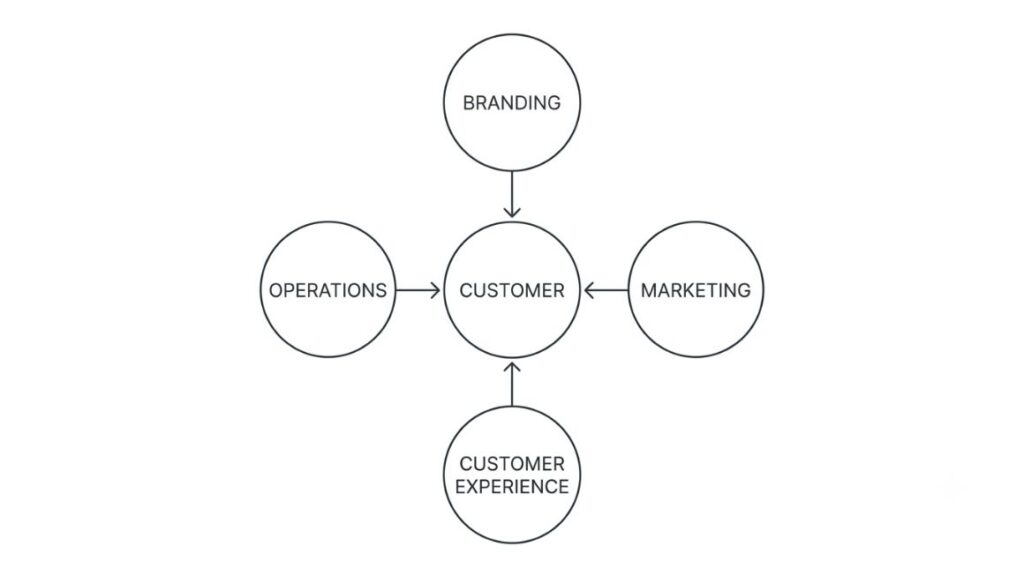
D2C brand management is the ongoing work of building, marketing and running a brand that sells straight to its own customers. It covers everything from the logo on the box to what happens when a parcel comes back undelivered.
Understanding the Direct-to-Consumer Model
The direct-to-consumer business model removes the middle layer. Instead of selling through distributors and retailers, a brand makes or sources its product and sells it to the customer itself, usually through its own website, marketplaces such as Amazon and Flipkart, and social platforms like Instagram.
Traditional retail hands the shelf, the pricing environment and most of the customer relationship to someone else. D2C keeps all three, plus the data on who bought what and why. Marketplaces blur the line a little (you’re selling directly, but from someone else’s shelf), and so does growth: Mamaearth started online and now sits in shops as well. That control is the appeal. It’s also the burden, because nobody else is going to handle your customer when something goes wrong.
What Does Managing a D2C Brand Actually Involve?
Seven things land on your desk: brand development, marketing and advertising, product quality, customer communication, sales and distribution, customer support, and business performance. D2C brand management means doing all seven at once. A retail brand can lean on distributors for some of that list. A D2C brand mostly can’t.
Why Is It Important for Long-Term Business Growth?
Consistent D2C brand management builds recognition first, then trust, then loyalty, and loyalty is what makes revenue sustainable. People remember a brand that looks and sounds the same every time they meet it. They trust one that delivers what it promised. And customers who trust you usually cost less to win again than strangers cost to win. Each layer makes the next one cheaper, which is why brands that skip the boring consistency work end up paying for every order twice.
D2C brand management is the ongoing work of building, marketing and running a brand that sells directly to its customers. It covers brand identity, marketing, product quality, customer communication, sales channels, support and business performance. Done consistently, it builds the recognition, trust and repeat purchases that make revenue sustainable.
Why D2C Brands Need a Strong Management Strategy
A good product gets you the first order. It doesn’t get you the second, and it certainly doesn’t protect you when the market gets crowded and ad costs climb. Without a D2C brand strategy, each of the pressures below gets handled in isolation by whoever is shouting loudest that week.
- Competition keeps rising. More than half the brands surveyed for the DSG Consumer Partners, Meta and ViralMint “Zero to Rs 100 Crore” playbook (December 2025) were founded in the past five years.
- Customers expect more. Fast delivery, honest descriptions and easy returns are table stakes now, not perks.
- Acquiring customers costs more. Forbes India (February 2026) notes that in the early growth phase, many D2C brands spent 30% to 40% of revenue on digital advertising, and 62% of brands in the DSG study named creative fatigue as their biggest constraint.
- Trust carries more weight. A stranger can’t touch your product, so reviews, clear claims and quick support do the persuading.
- Every channel is a fight. Your own site, Amazon, Flipkart, quick commerce and retail shelves all compete for the same customer, often at different prices.
- Revenue and profit pull apart. Growth that needs ever-bigger discounts and ad budgets isn’t really growth.
Picture a skincare startup, and to be clear, this is a made-up illustration, not a real case study. Its vitamin C serum is genuinely good. Its Instagram ads look lovely. Orders arrive for as long as the ad budget keeps rising.
But the packaging leaks in transit, delivery updates are patchy, support replies take days, and nobody ever asked first-time buyers what they thought. Reviews turn lukewarm. Repeat orders stay low. Each new customer costs more than the last.
The product was never the problem. Nobody was managing the brand around it, and that gap is exactly what D2C brand management exists to close.
The Key Elements of Managing a Successful D2C Brand
If you read one section properly, make it this one. Five elements carry most of the weight in D2C brand management, and a weakness in any single one leaks into the rest.
Define Your Target Audience
Start with who actually buys. Demographics are the easy part: age, city, income. Behaviour is harder and more useful. What do they search before buying, what makes them hesitate, how do they pay?
Then go one layer deeper into the problem they’re trying to solve and what they’re afraid of getting wrong. Build two or three personas from real customer conversations rather than guesses, and read competitor reviews to see what customers expect and where those brands let them down.
The audience is shifting too. Bain & Company and Flipkart’s How India Shops Online 2026 report says Gen Z now makes up 40% to 45% of e-retail shoppers, and Tier 2+ cities contributed about half of incremental online orders in 2025.
Establish a Clear Brand Identity
D2C brand identity is what your brand looks like, sounds like and stands for. That means the name and visual system, the voice you use in captions and support replies, and a short list of values you’ll actually act on. Consistency matters more than cleverness. A brand that’s playful on Instagram and stiff in emails feels like two different companies.
Minimalist is a useful example of a promise simple enough to repeat everywhere. The skincare brand, launched in 2020, is known for science-driven formulations and ingredient transparency, and Hindustan Unilever announced in January 2025 that it would buy a 90.5% stake in its parent company at a pre-money enterprise value of ₹2,955 crore.
Build a Strong Product Offering
Ads can’t fix a product people don’t need twice. Unicommerce’s FY26 data shows health and pharma growing 48% and beauty and personal care 41%, against 21% for fashion, and it links the gap to repeat buying: customers come back when the product runs out and the routine is set.
Treat reviews and return reasons as product feedback, not support tickets. Treat packaging as part of the product, because it’s the first thing a customer touches. And keep testing product-market fit, which simply asks whether enough of the right people want what you make, at this price, more than once.
Create a Consistent Customer Experience
D2C customer experience is every touchpoint between a customer’s first click and their last support message, and customers judge it at its weakest point. A beautiful site doesn’t help if delivery updates go quiet. So cover the whole chain: a fast website, a short path to purchase, payment options people trust, clear delivery communication, simple returns and refunds, and support that actually replies.
Payments deserve more attention than they usually get. Bain and Flipkart’s 2026 report notes that payments are shifting from cash on delivery to UPI at delivery. If your checkout still treats payment as an afterthought, that’s worth fixing.
Track Business Performance
Sales volume is the most flattering number a D2C brand has and the least honest. Track revenue, but track margins, conversion rates, customer retention and customer satisfaction next to it. The DSG Consumer Partners, Meta and ViralMint playbook found that brands consistently tracking CM2, a contribution margin measure, outperformed peers by roughly 2.3 times. Only 41.3% of brands tracked lifetime value.
Also Read: Brand Management Framework: Building Strong Brand Strategy, Identity & Equity
D2C brand management rests on five elements: knowing your audience, a clear brand identity, a product worth buying twice, a consistent customer experience and tracking performance beyond sales volume. Brands that consistently tracked contribution margin outperformed peers by roughly 2.3 times in the DSG Consumer Partners, Meta and ViralMint playbook (December 2025).

How to Build a Strong Brand Presence in the Market?
Most new D2C brands look the same from a distance: clean packaging, “science-backed” copy, a creator unboxing. D2C brand building is mostly the work of becoming recognisably different, then staying that way long enough for people to notice.
Presence is the part of D2C brand management that ads can’t shortcut. Brand search is a decent proxy for it, because people typing your name into Google already know it. Mamaearth’s parent, Honasa Consumer, reported its highest-ever brand searches in Q1 FY27 (April to June 2026), with the brand’s indexed search score rising to 136 from 100 a year earlier.
Find What Makes Your Brand Different
D2C brand positioning is the clear reason a specific customer picks you over the next option. Work it out in three moves: spell out your unique selling proposition (USP, the one thing you do that others don’t or can’t), study what competitors really offer, then say your reason to choose in one plain sentence. Here’s a quick test. If a customer can’t finish “I buy this because…” in their own words, your positioning isn’t working yet.
Develop a Consistent Brand Story
People don’t remember features. They remember why a brand exists. Say why yours was started, what problem it solves and who it’s for, in the language a customer would use at dinner, not in a pitch deck. Then back the story with proof, because real customer experiences carry more weight than anything you say about yourself.
Build Trust Through Transparency
Customers can’t touch your product before buying, so honesty has to be visible. Share authentic product information, publish customer reviews (including the mediocre ones, since a wall of five stars looks curated), state prices clearly, keep product claims honest and make support easy to reach. Claims you can’t back up are the fastest way to lose all of it.
Create a Community Around Your Brand
Community sounds soft, but it’s practical: people who feel part of something are more likely to stay and to tell others. Reply to comments properly. Share customer stories, with permission. Work with creators who already talk to your audience, and encourage user-generated content (photos, reviews and videos your customers make themselves), which tends to be more believable than anything the brand says about itself.
Marketing Strategies That Help D2C Brands Grow
Marketing is the loudest part of D2C brand management and, honestly, where a lot of the money leaks. So this section stays practical.
Build an Effective Digital Marketing Plan
Your D2C marketing strategy shouldn’t hang off a single platform. The DSG Consumer Partners, Meta and ViralMint playbook found that more than 70% of D2C brands call Meta their primary acquisition channel, and warned that relying on one platform leaves brands exposed to rising costs and algorithm shifts. Use Meta if it works for you. Then build search, email, WhatsApp, marketplaces and creators around it, so one auction change doesn’t wreck your month.
Use SEO and Content Marketing to Attract Customers
Start with search intent, which is what the person searching actually wants. What do customers type before they know your name? “Vitamin C serum for oily skin” is a very different search from “best skincare brand.”
Product and category pages catch people ready to buy. Educational blogs and buying guides catch earlier questions. Helpful landing pages, built around one question each, give people a direct answer. Over time that adds up to organic search visibility you don’t pay for per click.
Also Read: Content Marketing Strategy: The Complete Guide (2026)
Run Paid Advertising Campaigns
D2C performance marketing is paid advertising judged on measurable results, such as orders and revenue for every rupee spent. Run Meta ads for discovery, Google Search campaigns for people already looking, Shopping campaigns for product-ready intent and remarketing for visitors who left without buying.
The usual limit isn’t budget. It’s creative: 62% of brands in the DSG study named creative fatigue as their biggest constraint, so keep testing new creatives. And measure honestly. 43.8% still rely on last-click attribution, which credits whichever ad happened to come last.
Collaborate With Influencers and Creators
Three in four D2C brands now rely on creators for acquisition and sales, according to the same playbook, and 54% put 10% to 25% of their marketing budgets into influencers.
Pick creators whose audience matches your personas, not the one with the biggest following. Check audience quality: do the comments sound human, do the followers live in cities you serve? Ask for a real product demonstration and honest reviews, including the awkward ones. Then measure sales and repeat orders per creator, not views. The study also found nano and micro creators producing five to six times the engagement of larger names.
Use Email and WhatsApp Marketing
WhatsApp is no longer only a support channel. GoKwik’s WhatsApp Commerce Intelligence Report 2026, which analysed 26 billion messages from more than 1,800 D2C brands, found that 83% of WhatsApp-driven orders in October to December 2025 came from first-time buyers. GoKwik sells checkout and messaging tools, so treat that as directional. The basics still win: welcome messages, abandoned-cart reminders, order updates, product recommendations, repeat-purchase nudges and re-engagement messages for people who’ve gone quiet.
Here’s how a beauty brand could tie this together (a hypothetical example, not a case study). It publishes a guide to building a routine for oily skin, written around the questions people actually search. Five creators with oily-skin audiences post honest two-week reviews. Retargeting ads then show those reviews to everyone who read the guide, and a welcome email asks new buyers what they hoped the product would fix. Content brings people in, creators earn the trust, and ads close the gap.
How to Improve Customer Experience and Encourage Repeat Purchases?
D2C customer retention starts well before the second order. It starts at checkout. And most brands underinvest in it: 55% of brands in the DSG study admitted they under-invest in customer relationship management (CRM) and retention, which leaves room for the brands that don’t.
Simplify the Buying Journey
Open your own store on a mid-range phone and buy something. Most founders haven’t done it recently. You need a mobile-friendly site, easy navigation, a fast checkout, several payment options and product descriptions that answer the obvious questions before customers have to ask.
Personalise Customer Communication
Segment customers by what they bought and when, then message them to match. Someone who bought a serum that lasts about a month needs a reminder near the end of that month, not a generic sale email. Relevant recommendations and well-timed follow-ups feel like service. Blanket blasts feel like spam.
Build a Strong Post-Purchase Experience
This is the least glamorous part of D2C brand management, and it matters. The order isn’t finished when payment clears. Give customers order tracking, proactive delivery updates, support that responds quickly and returns that don’t feel like an interrogation. Then ask for feedback while the experience is fresh, and fix whatever it points to.
Create Reasons for Customers to Return
D2C brand loyalty is earned by the product and the experience first. Programmes only reinforce it. Once those basics hold, loyalty points, subscriptions (where the product is something people genuinely use up), bundles, referral rewards and member-only benefits give returning customers a nudge. Skip a subscription for something people buy once a year. It will just annoy everyone.
Managing Sales Channels and Expanding Your Business
Your D2C sales strategy decides where customers can find you, and every extra channel adds reach and complexity in equal measure. Channel choice is a D2C brand management decision as much as a sales one, because each channel shows customers a version of your brand. Add them in order, not all at once.
Build and Optimise Your Own Online Store
Your own store is the one place where you control the price, the story and the customer data. It’s also where you build relationships you can message directly. Keep improving conversion: clearer pages, faster loading, fewer steps to pay. Where it makes sense, everything else you do should point customers back here.
Expand Through Marketplaces
Amazon, Flipkart and other marketplaces give you reach you’d pay a lot to build alone. Brands selling through Amazon can use an Amazon scraper API to monitor competitor product listings, prices, offers, and customer reviews, helping them make more informed pricing and marketplace decisions. The trade is margin and control. When Flipkart removed commission on all fashion products in July 2026, Business Standard reported that the fees had averaged 14% to 18% of each sale, and noted that zero commission doesn’t make selling free of other costs. Marketplace terms change, so build a margin model that survives a rule change in either direction.
Explore Offline Retail and Quick Commerce
Physical retail and quick commerce make sense once you’ve proven that people reorder your product and you can restock quickly. Honasa Consumer said general trade and modern trade both grew by over 40% in the June 2026 quarter, with coverage past three lakh retail outlets. Redseer’s Brand Index put quick-commerce beauty and personal care at roughly $1 billion in annualised GMV in January to March 2026, up about 90% year on year. Quick commerce favours products people buy on impulse or run out of.
Maintain a Consistent Brand Experience Across Channels
A D2C omnichannel strategy falls apart the moment a customer finds one price on your site, another on a marketplace and a third at a retailer. Keep pricing and product information aligned, hold the same service standards everywhere, show accurate inventory so nobody orders something that’s out of stock, and keep communication in one voice.
Also Read: How to Scale an Ecommerce Brand: The 8-Pillar Framework for 8-Figure D2C Growth
How to Manage Costs and Improve Brand Profitability?
Profitability is the quiet half of D2C brand management. Plenty of brands only look at it after the cash runs short.
Understand Your Customer Acquisition Costs
D2C customer acquisition cost (CAC) is the total sales and marketing spend it takes to win one new customer. On its own, the number tells you very little. It has to sit next to what that customer is worth. Take a hypothetical serum priced at ₹699 that leaves ₹300 after product, packaging, shipping and payment costs. If winning the customer cost ₹350, the first order loses ₹50.
That’s fine if enough customers reorder. If they don’t, the brand has paid to lose money. (These are invented numbers for illustration, not real data.)
Track Customer Lifetime Value
Customer lifetime value (LTV) is the total revenue, or better, the total contribution margin, a customer brings across all their orders. Repeat purchases are what turn the arithmetic above from a loss into a profit. That’s why retention work isn’t a nice extra. It’s what makes acquisition spending defensible.
Monitor Important Business Metrics
- Average order value (AOV): total revenue divided by the number of orders.
- Conversion rate: the share of site visitors who buy.
- Repeat purchase rate: the share of customers who order again.
- Gross margin: revenue minus the cost of goods sold, as a percentage of revenue.
- Contribution margin: what’s left of each order after variable costs such as product, packaging, shipping, payment fees and returns. Subtract marketing to see whether the order really paid for itself.
- Return on ad spend (ROAS): revenue earned for every rupee spent on ads. It ignores everything except ad spend, so don’t judge a campaign on it alone.
- Return-to-origin (RTO) rate: the share of shipped orders that come back undelivered.
- Customer lifetime value: the total value of a customer over time.
Also Read: Marketing Efficiency Ratio (MER): The Metric Smart Marketers Use to Scale Revenue
Avoid Common Financial Mistakes
Five mistakes show up again and again.
- Scaling ads without checking profitability. Forbes India’s February 2026 analysis said large FMCG acquirers, used to EBITDA margins of 18% to 25%, often found digital-first brands running at low single-digit margins or at a loss at scale.
- Discounting too much. Offers train customers to wait for the next one, and founders in the DSG study admitted that pricing errors and discounting did more long-term harm than frugal marketing budgets.
- Ignoring shipping and return costs. Unicommerce found that 58% of cash-on-delivery orders came back during the festive quarter, against under 15% of prepaid orders.
- Overstocking inventory, which ties up cash in products that may never sell.
- Depending too heavily on one acquisition channel.
Customer acquisition cost only makes sense next to contribution margin and repeat purchases. A customer who costs more to win than the first order earns can still be profitable, but only if enough of them reorder.
The Role of AI and Technology in Modern D2C Businesses
AI hasn’t changed what D2C brand management is. It has changed how fast you can do parts of it, and how customers find you in the first place. Bain & Company’s November 2025 report on agentic AI in retail found that 30% to 45% of US consumers already use generative AI for product research and comparison, and Bain and Flipkart’s India report points to shopping assistants such as Amazon’s Rufus and ChatGPT’s Instant Checkout shaping discovery. The US numbers aren’t India’s, but the direction is hard to ignore.
Use AI for Customer Insights
AI tools can spot patterns in behaviour that a spreadsheet won’t show you: which customers are about to lapse, which segments respond to which offers, which products get bought together. Use that for audience segmentation, product recommendations and demand forecasting. Just remember a forecast is an estimate. Don’t order inventory as if it were a promise.
Automate Repetitive Marketing Tasks
Automate the work that doesn’t need your judgement: email workflows, first-line support replies, campaign reporting, lead nurturing and post-purchase messages. Spend the time you save on creative testing and customer research.
Also Read: AI in Brand Management: How AI Is Transforming Modern Branding in 2026
Use Technology to Improve Business Operations
Inventory management, order management, CRM and analytics dashboards sound unglamorous. They’re where margins get saved. Unicommerce’s April 2026 report credits three operational changes (a prepaid incentive at checkout, pin-code-level courier routing and address verification before dispatch) with taking RTO from 39.2% at the November 2025 festive peak to 21% by March 2026 for brands that adopted all three.
Keep Human Oversight in the Process
Automated recommendations, generated content and customer messages all need a person checking them, especially where product claims, privacy and customer trust are involved. An AI-written skincare claim that overpromises is still your claim. Privacy is also becoming a legal matter: India’s Digital Personal Data Protection Rules, 2025 were notified in November 2025, with most core obligations, including notice and consent, applying from 13 May 2027. No AI workflow replaces judgement in D2C brand management. Whoever reviews your AI workflows should know what customer data they touch.
Common Challenges D2C Brands Face and How to Overcome Them
Most problems in D2C brand management arrive in clusters. High returns inflate acquisition costs. Weak brand recognition pushes you toward discounts, and discounts wreck margins. Here are the eight that come up most, each with a first fix.
| Challenge | Practical solution |
| High acquisition costs | Improve targeting, organic discovery and retention |
| Low repeat purchases | Improve product experience and lifecycle communication |
| Weak brand recognition | Build consistent messaging and differentiation |
| High return rates | Improve product descriptions and sizing information |
| Operational inefficiencies | Use integrated inventory and order systems |
| Strong marketplace competition | Develop a distinctive brand proposition |
| Poor customer experience | Improve support, delivery and returns |
| Unprofitable growth | Monitor contribution margins and unit economics |
Don’t try to fix all eight at once. Find the one draining the most cash right now and start there.
A Practical Roadmap for Building and Managing a D2C Brand
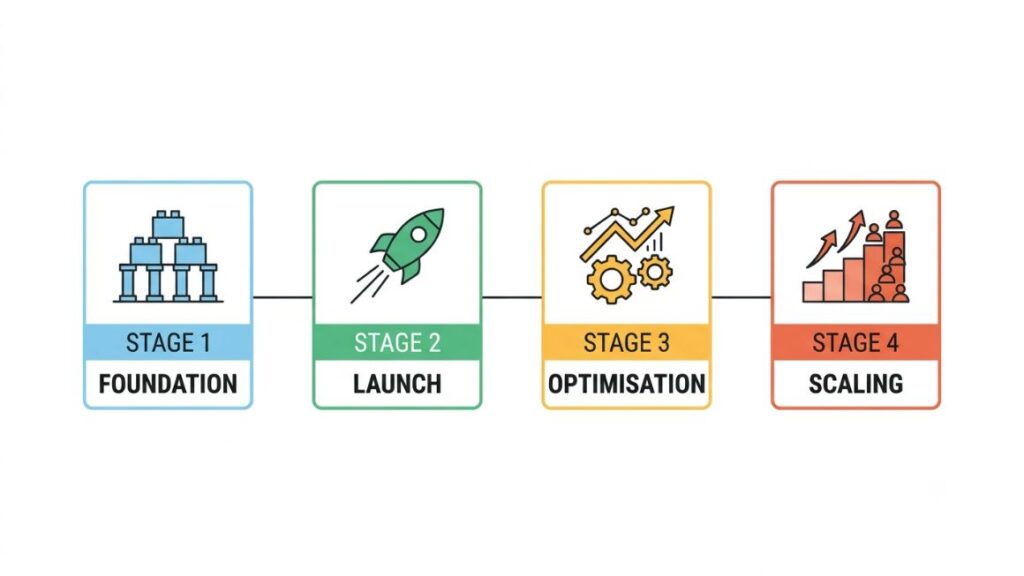
Most D2C business growth strategies fail on sequencing, not ambition. Brands try to scale before the basics work, then wonder why every new rupee of ad spend performs worse than the last. Four stages, in this order, make D2C brand management a lot less chaotic.
- Stage 1: Foundation. Define your audience, product offering, positioning and brand identity before you spend on ads.
- Stage 2: Launch. Set up your online store, establish marketing channels and create a customer acquisition plan.
- Stage 3: Optimisation. Improve conversion rates, customer experience, fulfilment and repeat purchases.
- Stage 4: Scaling. Expand distribution, strengthen retention, automate processes and monitor profitability.
Before you move to Stage 4, check that you can say yes to each of these:
- You know your repeat purchase rate, and it’s stable or improving.
- Contribution margin stays positive after shipping, returns, discounts and ad spend.
- No single channel brings in most of your orders.
- Returns and RTO are under control, and prepaid orders are growing.
- Customer queries get answered fast enough that reviews don’t complain about delays.
- Your team can run inventory, orders and reporting without one person holding it all together.
Also Read: Brand Lifecycle Management: Build, Grow & Revive Brands
Future Trends That Will Shape D2C Brands
Nobody can promise how D2C brand management will change, so treat these as directions with evidence behind them, not forecasts.
- AI-powered personalisation. Bain and Flipkart list AI-led recommendations among the innovations speeding up online shopping adoption in India.
- Creator-led commerce. Kofluence’s 2026 report found 15% of India’s active creators are now registered as formal business entities, a sign the channel is professionalising.
- Growth of quick commerce. Redseer projects quick commerce will carry 10% to 12% of all beauty and personal care sales by FY31, up from 5% in FY26.
- Expansion into Tier-2 and Tier-3 markets. Unicommerce put these cities at 66% of incremental D2C order volume in FY26, and warned that brands arriving with a metro playbook post the worst RTO numbers.
- Omnichannel shopping experiences. CBRE found D2C brands took 18% of all retail leasing in India in the first half of 2025, as reported by Entrepreneur India.
- Greater focus on retention and profitability. Experts quoted by Entrepreneur India in January 2026 expect stronger retention and clearer positioning to count for more than speed.
- First-party customer data and privacy-conscious marketing. With the DPDP Rules’ main obligations due from May 2027, data you collect directly, with clear consent, becomes the safer asset.
Conclusion
Advertising can start a D2C brand. It can’t sustain one. What does is a product people are glad to reorder, an experience that doesn’t let them down, positioning clear enough to repeat, and retention work that makes each customer more valuable than the last. Data, technology and steady execution help you scale all of it without losing control of margins. Good D2C brand management is mostly unglamorous work, done consistently.
If you want to go deeper on the marketing side, Young Urban Project’s digital marketing courses and workshops cover performance marketing, SEO and analytics in detail. A sensible first step is to look at your own numbers: repeat rate, contribution margin, return rate. Whichever is weakest tells you where to start.
Frequently Asked Questions About D2C Brand Management
What is D2C brand management?
D2C brand management is the ongoing work of building, marketing and running a brand that sells directly to customers. It covers brand identity, marketing, product quality, customer communication, sales channels, support and financial performance, so the brand earns repeat customers instead of one-time buyers.
How is D2C branding different from traditional branding?
Traditional brands depend on distributors and retailers, so they own less of the customer relationship, the shelf and the data. D2C brand management gives you more control: you talk to customers directly, set pricing and presentation, and learn from every order. You also carry support, logistics and acquisition costs yourself.
What are the biggest challenges faced by D2C brands?
Competition, rising acquisition costs, weak repeat purchases, returns, fulfilment problems and thin margins top the list. They feed each other, so start with whichever one costs you the most cash.
How can a new D2C brand attract its first customers?
Start with audience research so you know who you’re talking to. Then publish content that answers their search questions, work with a few relevant creators and test small paid campaigns on Meta and Google. Collect early reviews and use them on every ad and product page.
Which marketing channels work best for D2C brands?
It depends on your category, audience and goals. Meta suits visual discovery, Google Search catches people already looking, email and WhatsApp bring customers back, and creators build trust. Pick two or three, track contribution margin, and add more only once those are stable.
How can D2C brands increase repeat purchases?
Start with a product worth reordering, then make the experience easy: fast delivery, clear communication, simple returns. Add timely replenishment messages, personalised recommendations and loyalty or referral rewards. Track repeat rate by customer cohort so you can see what actually changes behaviour.
How does AI help businesses manage their brands?
AI speeds up customer analysis, segmentation, demand forecasting, support replies, campaign reporting and email automation. It still needs human review, especially for product claims, customer data and anything customers will read as the brand’s voice.