

According to Attentive’s 2026 State of Loyalty & Retention report, 88% of shoppers bought from a brand they’d never tried before in just the last three months. And yet 77% of consumers say they regularly shop with five brands or fewer. That’s a number that climbs to 85% among Gen Z. That’s the whole contradiction of brand loyalty in one stat. People are trying everything, but they’re only sticking with a handful.
If you’re running marketing for a D2C brand right now, that gap is either your biggest opportunity or your biggest threat, depending on whether you’re on the right side of that shortlist.
This isn’t a new problem. But something is shifting with the tools and behaviors that solve it and make loyalty in the first place. Discount-driven acquisition still works to get that first sale. But it almost does nothing to earn a second one. So, it takes a different playbook for building loyalty that survives a bad quarter, a competitor’s flash sale or a founder’s Instagram Reel.
This guide covers what brand loyalty actually means and why it’s harder to earn and more valuable than ever. A step-by-step framework is what you need to start applying this week, along with the loyalty program mechanics working right now and the metrics that tell you if any of it is working.
Table of Contents
What Is Brand Loyalty?
Brand loyalty is an ongoing preference of a customer for one brand over its competitors. This is driven by trust, emotional connection or perceived value rather than just price alone.
Here’s where most marketers get tripped up: brand loyalty and customer retention aren’t the same thing. But they are used interchangeably in every second LinkedIn post about D2C growth. Retention is behavior. It’s the fact that someone bought from you again. Loyalty is the reason behind that behavior.
A customer can be retained without being loyal. Maybe you’re the only option in their price range, or your subscription has an annoying cancellation flow, or they simply haven’t gotten around to switching yet. None of that survives the first serious competitor offer. Loyalty is what survives it.
Read More: Customer Retention Strategies (2026 Guide)
Why Brand Loyalty Matters More Than Ever in 2026
Brand loyalty compounds. A small number of repeat customers generate a disproportionate share of revenue, referrals and reviews. This means the cost of winning them back after you lose them is much higher than the cost of keeping them.
If we look at Frederick Reichheld’s research at Bain & Company, which is cited widely in Harvard Business Review, things look clearer. It found that increasing customer retention by just 5% can lift profits by 25% to 95%, depending on the industry. The same body of research puts the cost of acquiring a new customer at five to 25 times higher than retaining an existing one. The case for loyalty stops being a soft and brand team talking point if you run those two numbers together. It becomes a finance conversation.
The emotional side of this matters just as much as the math. A 2019 Motista study of over 100,000 consumers found that emotionally connected customers have a 306% higher lifetime value than customers who simply say they’re satisfied. They stay with a brand for an average of 5.1 years compared to 3.4 years for the merely satisfied group. Satisfaction is table stakes. It doesn’t predict who stays.
None of this is happening in a vacuum, either. Attentive’s 2026 data shows shoppers are more willing to experiment with new brands than they’ve been in years. This is largely because of economic pressure and AI-assisted product discovery. That makes the brands that do earn a spot on the shortlist more valuable, not less. Fewer slots and higher stakes.
According to research by Frederick Reichheld of Bain & Company, a 5% increase in customer retention can lift profits by 25% to 95%. Acquiring a new customer costs five to 25 times more than retaining an existing one. As per Motista’s 2019 study, emotionally connected customers carry a 306% higher lifetime value than merely satisfied ones. They stick around nearly two years longer on average.

Read More: Brand Marketing Strategy for 2026 Success
What Actually Makes Customers Stay Loyal to a Brand
Ask ten marketers what drives loyalty, and most may say “great product” and stop there. Product quality gets you in the door. But it’s rarely the reason someone stays for three years.
Trust and Consistency
Trust is built through repetition instead of a single grand gesture. The brand banks a small deposit of trust every time a product arrives on time, matches what was promised and does what the packaging says it does. Break that pattern once and you spend that deposit down fast. So avoid any quality dip or a shipping delay you didn’t warn anyone about.
Consistency also means the brand behaves the same way no matter if the customer is buying for the first time or the fiftieth. Different tone, different quality bar and different return policy depending on the channel. All of it chips away at the sense that this is a brand you can count on.
Emotional Connection
This is the piece that’s hardest to fake plus the easiest in underinvesting. Emotional connection is different from a fun Instagram caption. It’s the sense that a brand understands what a customer actually cares about, no matter if that’s clean ingredients, a specific aesthetic or a set of values.
Gallup’s research on decision making found that around 70% of brand related decisions are driven by emotional factors. Rational comparison makes up the rest. That’s a hard number to ignore when most marketing budgets still skew toward features and specs over story and identity.
Shared Values and Ethics
Younger consumers weigh this more heavily than the generations before them did. Per Attentive’s 2026 data, 35% of Gen Z shoppers and 26% of Millennials say they seek out a brand by name specifically because of value alignment. That is compared to 19% of Gen X and 15% of Baby Boomers. That gap is only going to widen as Gen Z’s share of spending grows.
Real example: The Whole Truth Foods actually its entire brand identity around one idea. They focused on printing every single ingredient on the front of the pack. No hidden sugars or fillers disguised under vague labels like “natural flavoring.” Founder Shashank Mehta is a former Unilever marketer who has talked about how the Indian packaged food industry survives on exactly this kind of vagueness. The brand grows into a company that is valued in the hundreds of crores with exactly that transparency-first positioning. It has a loyal and vocal community that was built before most of its competitors had scaled at all. It’s also a position that gets tested. The brand faced scrutiny from the food safety regulator in India In 2026. That was over how it labeled sugar content in its chocolate line. This is a reminder that a trust based brand has less room for error than one that never made the promise in the first place.
Read More: Brand Building Strategies: 15 Proven Ways to Build a Strong Brand in 2026
How to Build Brand Loyalty: A Step-by-Step Framework
Building loyalty isn’t one campaign. It’s a sequence of decisions that are made at every stage of the customer relationship. These start before the first purchase and continue long after it.
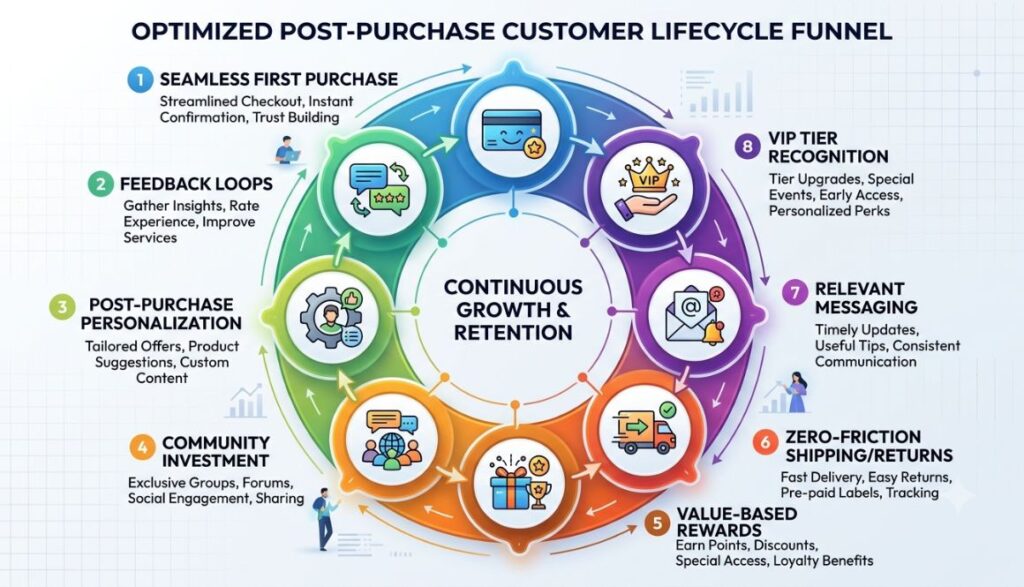
- Nail the first-purchase experience. The first order sets the tone for everything after it. That means accurate delivery timelines, packaging that matches what was advertised and zero surprises at checkout. Attentive’s 2026 data found that 45% of shoppers say low product quality makes them less likely to buy from a brand again. 34% cite poor customer service. Both are entirely within the control of a brand on order one.
- Build a feedback loop and actually use it. Send a short survey after delivery and read the reviews that come in. Then route that feedback to product and ops instead of just to a folder nobody opens. Customers notice when a brand visibly acts on what they said.
- Personalize the post-purchase experience. This goes beyond a “thank you for your order” email. Share care instructions, usage tips or content that is relevant to what someone actually bought. Attentive found that 69% of shoppers say post purchase content makes them feel more confident about their purchase. This directly reduces returns and increases the odds of a second order.
- Invest in community before you need it. Whether that’s a WhatsApp group, a Discord server, or a comments section a founder actually replies in, community gives loyal customers a reason to stay engaged between purchases, not just during them.
- Reward loyalty without training customers to wait for discounts. Constant sitewide sales teach shoppers to delay purchases until the next one. Reward mechanics like early access, free shipping thresholds or surprise gifts build value. Don’t erode margins the way blanket discounting does.
- Fix friction in shipping and returns before it costs you the second sale. Attentive’s data lists free or fast shipping as the top loyalty perk shoppers want (65%) which is ahead of rewards points (59%). A clunky returns process is one of the fastest ways to lose a customer who was otherwise happy with the product.
- Make relevance the default, not the exception. Irrelevant product recommendations and generic blanket messages are the reasons why shoppers unsubscribe or stop engaging. Segment by purchase history and browsing behavior instead of just blasting the full list every time.
- Track the handful of customers doing the heaviest lifting. Your top repeat buyers and referrers deserve visibly different treatment than a first time buyer. Most brands never build this tier and this is exactly why it stands out when a brand does.
Building brand loyalty is not one campaign but a sequence. A strong first-purchase experience. A feedback loop that’s actually acted on. Personalized post-purchase content. Community investment, reward mechanics that avoid discount dependence, low-friction shipping and returns, relevant messaging and visible recognition for top repeat customers. Skipping any single stage weakens the ones around it.
Loyalty Programs That Work in 2026
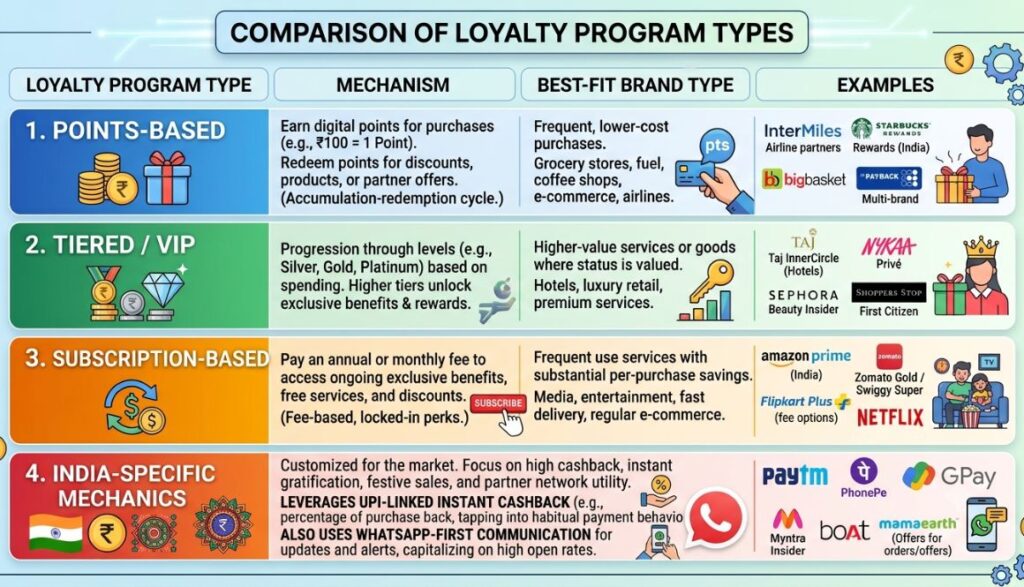
A loyalty program isn’t a substitute for the fundamentals above. It’s a structure that makes loyalty visible and rewardable once those fundamentals are already working.
Points-Based Programs
Starbucks Rewards is still the reference point for points-based loyalty done well. Customers earn stars per purchase, redeem them for free items and can track progress inside the app in real time. Amazon Prime works differently but sits in the same category. They trade a flat annual fee for tangible and constant benefits like free shipping and streaming access. Attentive’s 2026 data backs up why this mechanic still works. 81% of consumers say it’s motivating just to see their progress toward a reward.
Tiered and VIP Programs
Sephora’s Beauty Insider program is the clearest example of tiering done right. Members move from Insider to VIB to Rouge based on annual spend, with each tier unlocking better perks, from birthday gifts to early access to product launches. The appeal isn’t only the rewards. It’s the status. Per Attentive’s data, 41% of shoppers say exclusive VIP-only discounts are the single offer type most likely to keep them shopping with a brand, well ahead of one-time discounts open to everyone.
Subscription-Based Rewards
Subscribe-and-save models are common across skincare, supplements and pet care. They bundle a discount with a reduction in purchase friction. The customer commits to a cadence, the brand gets predictable revenue and both sides avoid the churn point of “I forgot to reorder.”
India-Specific Loyalty Mechanics
Loyalty in India runs through slightly different channels than in the US or UK. UPI-linked cashback offers taps into a payment behavior that’s already deeply a habit for Indian consumers. This is where a small percentage of a purchase comes back as instant cashback rather than a discount applied at checkout. It reframes a reward as a refund instead of a markdown, which protects the perceived pricing integrity of the brand.
The other major difference is WhatsApp-first communication. WhatsApp is functioning as the default messaging app for most Indian consumers which is why brands increasingly use it over email for order updates, restock alerts and loyalty program nudges. Open rates on WhatsApp consistently outperform email in the Indian market. D2C brands like Mamaearth and boAt lean on this channel heavily for exactly that reason. It’s where their customers already are and checking messages multiple times a day.
Common Mistakes That Quietly Kill Brand Loyalty
Most loyalty problems aren’t dramatic. They’re small, repeated failures that add up over months until a customer just quietly stops coming back.
- Over-reliance on discounts. Constant promotions train customers to wait for the next markdown instead of buying at full price. This erodes both margin and the perception of value.
- Ignoring the post purchase experience. Marketing effort that stops the moment checkout completes leaves customers with zero reinforcement of the decision they just made.
- Generic and one-size-fits-all rewards. A loyalty program that offers the same flat discount to every member regardless of spend or behavior. This feels transactional instead of earned.
- Poor customer service response times. Attentive’s 2026 data places poor customer service among the top reasons shoppers don’t return after a first purchase. This is cited by 34% of respondents. Slow or scripted responses undo months of brand building in a single interaction.
- Treating every channel differently. Inconsistent tone, pricing, or policy between Instagram, the website, and a marketplace listing signals a brand that hasn’t figured out who it is.
Read More: Brand Management Challenges: How to Build and Protect a Strong Brand
How Do You Measure Brand Loyalty?
Brand loyalty is difficult to observe directly, so marketers track it through a handful of proxy metrics that each capture a different angle of the same behavior.
Net Promoter Score (NPS) measures how likely customers are to recommend a brand to someone else. This is calculated as the percentage of promoters (customers who rate 9 or 10 on a 0-10 scale) minus the percentage of detractors (those who rate 0 to 6). It’s a strong proxy for emotional loyalty specifically, since recommending a brand takes more conviction than simply rebuying from it.
Repeat purchase rate is the percentage of customers who buy more than once within a given period. This is calculated as the number of repeat customers divided by total customers. It’s the most direct behavioral signal of retention. But on its own it doesn’t tell you why customers came back.
Customer lifetime value (CLV) estimates the total revenue a business can expect from a single customer over the full relationship. This is commonly calculated as average order value multiplied by purchase frequency multiplied by average customer lifespan. Rising CLV without rising acquisition spend is one of the clearest signs loyalty efforts are working.
Churn rate is the percentage of customers who stop buying or cancel a subscription within a given period. This is calculated as customers that are lost divided by customers at the start of that period. A rising churn rate is often the earliest warning sign that loyalty is breaking down. That is well before revenue itself takes a visible hit.
The four core metrics for measuring brand loyalty are Net Promoter Score, repeat purchase rate, customer lifetime value and churn rate. NPS captures emotional advocacy and repeat purchase rate captures behavioral retention. CLV captures long term revenue impact and churn rate flags erosion before it shows up in top line numbers. No single metric actually tells the full story on its own.
Brand Loyalty Trends Shaping 2026
A few shifts are changing how loyalty is built and measured this year. Most of them trace back to the same root cause. Customers have more options and less patience for irrelevance.
AI-personalized rewards are moving loyalty programs away from flat and one-size-fits-all perks. They are focusing towards rewards that are tailored to individual purchase history and browsing behavior. The own personalization research of Attentive found that 93% of shoppers are more likely to keep engaging with brands that personalize their experience. This is pushing loyalty tech toward dynamic and behavior triggered offers instead of static tiers.
WhatsApp and owned-channel retention are gaining ground over paid acquisition, particularly in markets like India where WhatsApp functions as a default communication layer. Brands are shifting retention budget away from constantly refilling the top of the funnel. They are moving towards owned channels where they don’t pay a platform toll for every message.
Community-led growth treats loyal customers as a marketing channel in their own right. This is practiced through ambassador programs, UGC incentives and private community spaces, rather than treating community as a side project separate from the core funnel.
Coalition loyalty programs, where multiple non-competing brands share a single rewards currency. They are starting to appear in categories like fashion, wellness and travel. This gives smaller D2C players a way to offer reward density they couldn’t fund alone.
Conclusion
Brand loyalty doesn’t come from a single campaign, a cleverly worded email or a loyalty program bolted onto a checkout flow. It comes from a first-purchase experience that delivers on its promise. A post-purchase experience that keeps building confidence and a pattern of consistency that survives being tested works.
The data backs this up from every angle. Emotionally connected customers are worth over three times as much. A 5% lift in retention can move profit by up to 95%. Shoppers are actively narrowing their shortlist of go-to brands even as they experiment more than ever. The brands winning in 2026 aren’t necessarily spending more. They’re spending more deliberately, especially on the parts of the customer relationship that actually compound.
Rebuilding your brand management playbook around retention rather than just acquisition? The Crystal Clear Newsletter breaks down exactly this kind of strategy every week. See real campaigns and real numbers from brands doing it well. It’s a good next step if you want the tactics behind this framework applied to live examples as they happen.
Frequently Asked Questions
What is brand loyalty?
Brand loyalty is the ongoing preference of a customer for one brand over its competitors. That is driven by trust, emotional connection or shared values rather than price alone. It shows up as repeat purchases, but the loyalty itself is the reason behind that behavior, not the behavior.
Is brand loyalty the same as customer retention?
No, retention is the behavior of a customer who’s buying again, while loyalty is the reason they do it. You can retain a customer by convenience or a lack of alternatives without being loyal. That kind of retention disappears the moment a real competitor shows up.
How do you build brand loyalty from scratch?
Start with the first-purchase experience because a strong or weak first impression shapes everything after it. Build a feedback loop, personalize post-purchase communication, reduce shipping and return friction from there. Then introduce reward mechanics that don’t rely on constant discounting.
Do loyalty programs actually work?
Yes, but only once the fundamentals are already in place. A loyalty program layered on top of a poor product experience or slow customer service won’t fix either problem. It works best as a structure that makes existing loyalty visible and rewardable, not as a substitute for earning that loyalty in the first place.
How is brand loyalty different from brand awareness?
Brand awareness measures whether people recognize or know about a brand. Brand loyalty measures whether they actively choose it over alternatives once they know their options. A brand can have high awareness and low loyalty if customers know the name but don’t feel any pull to buy from it specifically.
Is brand loyalty even worth focusing on in 2026, given how much shoppers switch brands?
It’s worth focusing on precisely because switching is up. When 88% of shoppers are trying new brands but 77% still only shop regularly with five or fewer, the brands that make that shortlist capture a disproportionate share of long-term spend. The bar to make the list is higher, but so is the payoff for clearing it.
How do you calculate customer lifetime value?
A simple formula multiplies average order value by purchase frequency by average customer lifespan. More advanced models factor in profit margin and acquisition cost, but the simple version is usually enough to spot whether loyalty efforts are moving the number in the right direction.
Why do loyalty programs fail even when customers sign up for them?
Most fail because the rewards feel generic or the earn rate feels out of reach. If a customer has to spend an unrealistic amount before a point balance means anything, or if every member gets the same flat perk regardless of behavior, the program stops feeling worth tracking.
What’s the biggest mistake brands make when trying to build loyalty?
Over-relying on discounts. Constant sitewide sales train customers to wait for the next markdown rather than buy at full price, which quietly trains away the exact behavior a loyalty strategy is supposed to build.