

Most ecommerce founders scale the wrong thing first. They pour money into ads before they know their numbers, before their tracking is trustworthy, and before they’ve built any real reason for a customer to come back. Then they wonder why growth feels expensive and fragile.
Learning how to scale an ecommerce brand isn’t really about finding a better ad hack. It’s about sequencing. Foundation before spend. Numbers before scale. Retention before acquisition volume. Get the order wrong and you end up pouring budget through a system that leaks at every stage.
This framework comes from YUP’s Ecommerce Scaling Playbook, built around eight pillars that separate brands stuck at 7 figures from the ones that break through to 8. You’ll get the exact formulas, benchmarks, and weekly systems that make that difference. Not theory. The stuff you can put into your business this week.
Table of Contents
Build Your Foundation Before You Touch the Ad Account
Clarity at the foundation stage is what makes acquisition cheap later. Brands that run ads before defining their hero product and core avatar end up paying more to acquire customers who convert less, simply because the offer isn’t sharp enough to earn attention fast.
What Makes a Hero Product
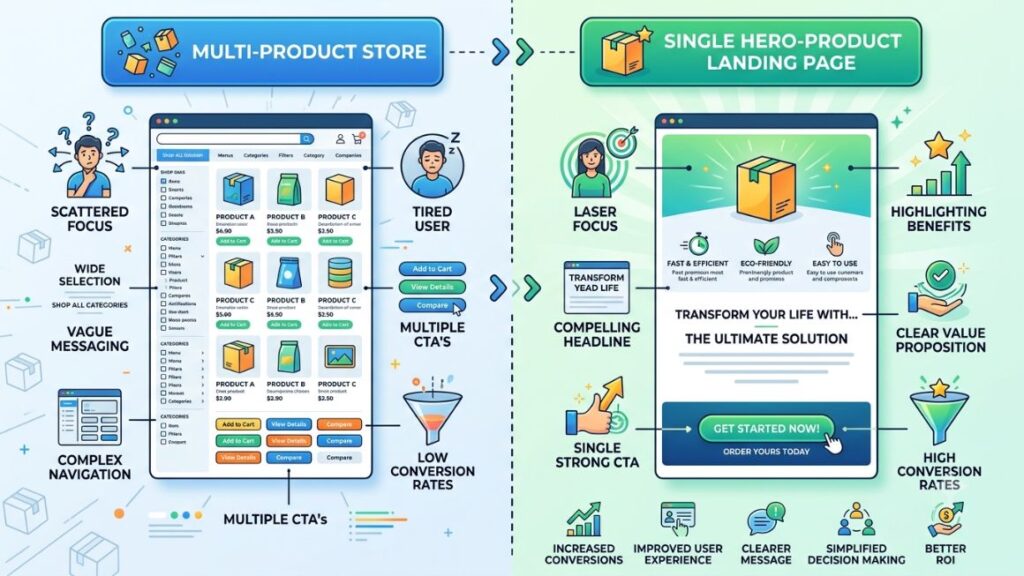
Every 8-figure brand has one product that carries most of the revenue and solves one specific problem exceptionally well. Not ten products trying to be for everyone. A hero product is the single item that is undeniably the best answer to a painful, specific problem for a specific person.
Before you run a single ad, ask yourself something simple: can a stranger understand exactly what this solves and who it’s for within five seconds of landing on the page? If the answer is no, the problem isn’t your ad copy. It’s the product’s positioning, and no amount of creative testing fixes that.
A hero product should hit four criteria. It solves one painful problem. It has a clear before and after. It can be explained in a single sentence. And it commands a gross margin of 60% or higher, because that margin is what funds your acquisition costs down the line.
Why the Problem Actually Has to Hurt
People don’t impulse-buy solutions to minor inconveniences. They impulse-buy relief from things that genuinely bother them every day. The more acutely your avatar feels the problem, the lower their resistance to buying, and the higher your allowable CAC becomes.
This is where most founders trip up. They describe their product’s features instead of the problem it eliminates. According to YUP’s 2026 Ecommerce Scaling Playbook, ads built around features underperform by 2 to 3 times against ads built around the painful problem. Lead with the pain. Follow with the product.
Mamaearth built its early growth almost entirely on this principle, naming the exact anxieties Indian parents had about chemicals in baby products rather than listing ingredient specs. The positioning did the selling before the ad spend even started.
Positioning Is About Who It’s Not For
Positioning is really the decision about who the product is not for. Most founders try to make their product appeal to everyone, which is exactly what makes it resonate with no one.
“Millennial women” is a demographic. “Working mothers in Tier 1 cities who’ve tried three hair care brands in the last year and given up on all of them” is an avatar. The second version tells you what to say in your ad, what objection to answer on your landing page, and what price point feels fair.
A hero product solves one painful, specific problem for a specific person and can be explained in a single sentence. YUP’s 2026 Ecommerce Scaling Playbook notes that ads built around the problem outperform feature-led ads by 2 to 3 times, and every rupee spent on foundation research saves 5 to 10 rupees in wasted ad spend downstream.
Before you move to the next pillar, you should have a hero product clearly defined with a single problem statement, a documented avatar covering demographics and objections, a gross margin above 60%, and a positioning statement you could say out loud to a stranger.
Know Your CAC, LTV, and CM2 Before You Spend a Rupee
Most founders discover their CAC ceiling after they’ve already lost money finding it. Top brands calculate it before they touch the ad account, while a logo maker can help establish a recognizable brand identity that supports long-term growth. That single habit is often the difference between a brand that scales and one that just burns cash faster.
The Three Numbers Every Founder Must Know
CAC is the maximum you can pay to acquire one customer and remain profitable. LTV is the total revenue a customer generates across their lifetime with your brand. CM2, or contribution margin 2, is the profit left per order after every cost including acquisition.
Here’s the formula, straight from YUP’s playbook:
CM2 = Revenue − COGS − Packaging − Shipping − Payment Fees − Returns − CAC
If CM2 is negative, you’re losing money on every new customer you acquire, full stop. A positive ROAS with a negative CM2 is one of the more dangerous positions in ecommerce, because it feels like growth while you’re quietly burning cash.
Why ROAS Is the Metric Most Brands Get Wrong
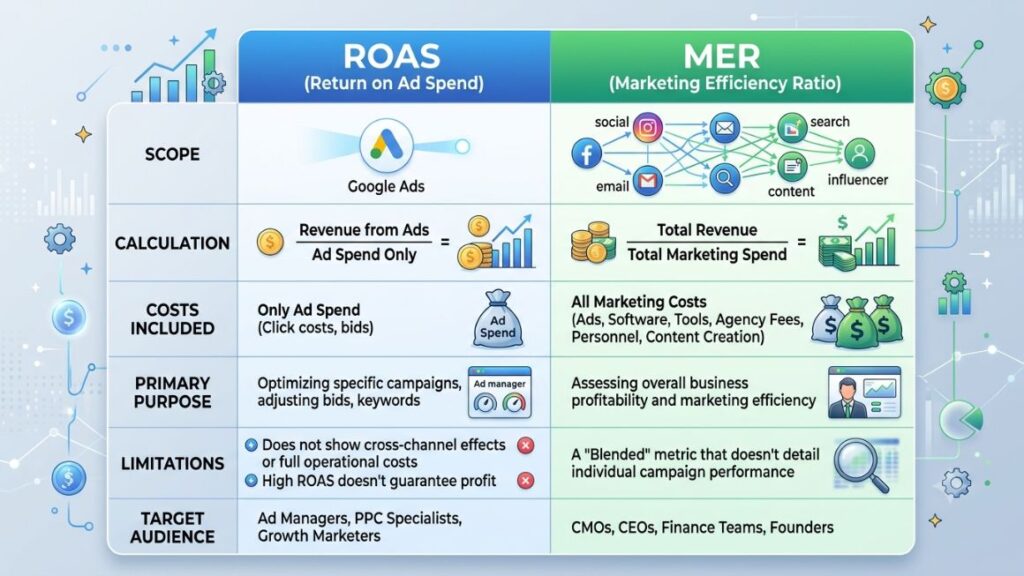
ROAS feels good because it’s a big number. A 4x ROAS sounds like a win. But ROAS only measures one channel at a time, and it ignores product costs, shipping, returns, and the organic halo effect your paid ads create.
Top brands in 2026 have shifted to MER (Marketing Efficiency Ratio), which is total revenue divided by total marketing spend across every channel. It’s messier to calculate than a platform-reported ROAS number. It’s also far more honest about whether the business is actually profitable.
Indian D2C CAC Benchmarks for 2026
| Channel | Typical CAC Range | Notes |
| Meta (Facebook / Instagram) | ₹200 – ₹800 | Premium segments can exceed ₹1,500 |
| Google Search & Shopping | ₹300 – ₹1,200 | Branded terms offer significantly lower CAC |
| Influencer Marketing | ₹100 – ₹2,000 | Highly variable by influencer tier and engagement |
| WhatsApp / Email Retention | Near ₹0 | Highest ROI channel for repeat customers |
| Referral Programs | ₹150 – ₹500 | Among the most efficient acquisition channels |
| Organic / SEO | Near ₹0 marginal | Requires sustained content investment upfront |
Building Your 90-Day Profit Plan
Before you scale, build a 90-day financial model projecting revenue by month, total marketing spend, gross margin after COGS, operating costs, and net profit. Every scaling decision for the next three months should get evaluated against this plan, not against last month’s revenue alone.
Model three scenarios. Conservative, where CAC rises 20%. Base case. And aggressive, where CAC holds flat. Only scale when all three scenarios show a clear path to positive CM2. If your model only works in the best-case scenario, you don’t have a scaling plan. You have a bet.
CM2 (contribution margin 2) is calculated as Revenue minus COGS, packaging, shipping, payment fees, returns, and CAC. A positive ROAS combined with a negative CM2 signals a business that is scaling losses, not profit, which is why YUP’s 2026 playbook recommends founders track CM2 over ROAS at every stage.
Why Your Tracking Data Is Probably Lying to You
Every optimization decision downstream depends on your data being correct. A founder optimizing toward inflated ROAS numbers ends up killing creatives that were actually working and scaling ones that weren’t. That’s not a small mistake. It compounds every week you leave it uncorrected.
Why Tracking Breaks and Nobody Notices
Browser-based pixel tracking has gotten significantly less reliable since iOS 14 and the ongoing deprecation of third-party cookies. A brand relying solely on browser-side events is likely seeing only 60 to 70% of actual conversions reflected in their ad platform dashboard. They think campaigns are underperforming. In reality, the measurement is underperforming.
Server-side tracking sends conversion data directly from your server to the ad platform, bypassing browser privacy restrictions. It recovers a meaningful chunk of that lost signal and gives the algorithm cleaner data to optimize toward.
The Non-Negotiable Tracking Setup
- Confirm Meta Pixel is firing correctly on every key page: product, cart, checkout, confirmation.
- Set up Server-side Conversions API (CAPI) and verify deduplication against browser events.
- Verify purchase events pass the value, currency, and event_id parameters correctly.
- Configure GA4 with enhanced ecommerce tracking, firing the purchase event on order confirmation.
- Add UTMs to every paid link, covering utm_source, utm_medium, utm_campaign, and utm_content.
- Build a central dashboard pulling revenue, CAC, ROAS/MER, and repeat purchase rate into one view, reviewed daily.
What Your Dashboard Should Actually Show
Your daily dashboard needs four categories working together. Revenue metrics cover total revenue, new versus repeat revenue, revenue by channel, and AOV, split paid versus organic every day. Acquisition metrics track CAC by channel, blended MER, and spend by platform, watched weekly for trend direction.
Retention metrics cover repeat purchase rate, time-to-second-purchase, subscription take rate, and 30/60/90-day cohort retention. Efficiency metrics are CM2 per order, gross margin percentage, RTO (return-to-origin) rate, and COD versus prepaid split, and these predict your profitability roughly 60 days out.
Build your tracking infrastructure before you need it, not after something breaks. The cost of getting this right is a matter of days. Getting it wrong costs months of decisions made on bad data, with no way to know afterward which ones were actually right.
Do Your Market and Competitor Research Before You Scale
Founders who skip research pay for the same information later, at the worst possible moment, after they’ve already committed budget and it isn’t working.
What to Research and Where to Find It
You need to understand total addressable market size, growth trends and seasonality, demand signals like search volume, category-specific return-to-origin rates, COD versus prepaid split in your category, and average gross margin benchmarks.
Google Trends handles search volume and seasonality. Amazon Best Sellers validates demand. The Meta Ad Library shows competitor creative data. Nykaa, Meesho, and Flipkart category pages reveal pricing norms. Shiprocket and Delhivery publish RTO benchmarks by category. Industry reports from Redseer and Blume Ventures round out the picture.
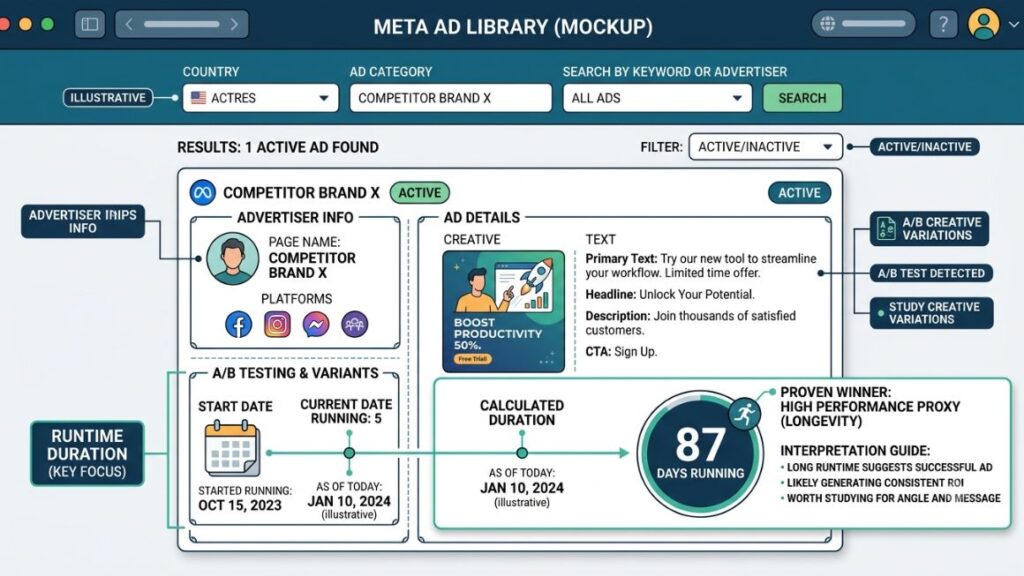
The Meta Ad Library Is the Most Underused Free Tool in Indian D2C
Every competitor’s active ads, how long they’ve been running, and what formats they’re using are publicly visible. An ad that’s been live for 60-plus days is almost certainly profitable. Nobody keeps spending money on an ad for two months if it isn’t converting.
Map the top five competitors’ ads, including hooks, formats, offers, and how long each has been active. Document their pricing and packaging structures. Read their one-star and two-star reviews on Amazon or Nykaa, because that’s your list of unmet needs handed to you for free. Audit their landing pages for claims and social proof structure, and note what they’re not saying, since gaps in the market often show up in what nobody’s claiming.
Mapping the Customer Journey
Map every touchpoint from the moment a potential customer first hears about your brand to the moment they make a repeat purchase. Most brands have obvious leaks at two points: the product page, where traffic arrives but doesn’t convert, and post-purchase, where customers buy once and disappear.
In the awareness stage, figure out how your avatar first encounters the brand and which platform and hook drove that. Consideration covers what they research before buying: reviews, comparison videos, ingredient checks. Your content should answer every question they’d ask before purchasing.
At purchase, every 1% improvement in checkout conversion directly lowers your CAC without touching ad spend. This is where money quietly leaks out. And at repeat and referral, ask what triggers the second purchase and what makes someone tell a friend, because those two questions decide whether LTV is a strength or a liability for your brand.
Retention Is the Fastest Path to 8-Figure Growth
More retention means higher LTV. Higher LTV means a higher allowable CAC. And a higher allowable CAC means you can outbid every competitor chasing the same customers, which is why retention, not acquisition, is usually the fastest lever to 8 figures.
The Math Most Brands Never Run
Say a brand’s AOV is ₹800 and CAC is ₹600. The first purchase alone is barely profitable after COGS and shipping. But if that same customer buys 2.5 times over 12 months, LTV jumps to roughly ₹2,000. That ₹600 CAC now looks brilliant instead of risky.
Higher Retention → Higher LTV → Higher Allowable CAC → Bigger Scale.
This is why brands with strong retention can afford to outspend competitors on acquisition and still come out more profitable. They aren’t competing on the same terms anymore.
Retention Benchmarks by Month
| Metric | Strong | Average | Needs Work |
| Subscription Take Rate | 80%+ | 50–79% | Below 50% |
| Month 1 Retention | 70%+ | 45–69% | Below 45% |
| Month 2 Retention | 60%+ | 35–59% | Below 35% |
| Month 3 Retention | 50%+ | 25–49% | Below 25% |
| Repeat Purchase Rate (overall) | 40%+ | 20–39% | Below 20% |
The Retention Stack Top Brands Actually Use
WhatsApp automation covers order confirmation, shipping updates, delivery confirmation, a review request on day 7, and a reorder nudge on day 21. Brands using WhatsApp flows see 25 to 35% repeat rates, compared to 12 to 18% for email-only brands, according to YUP’s 2026 playbook data.
Email flows still matter, especially for higher-AOV brands: a five-email welcome series, a three-email abandoned cart sequence, four-email post-purchase onboarding, and a win-back sequence for customers inactive 60-plus days.
A subscription engine turns one-time buyers into predictable monthly revenue for consumable products. Aim for 80%+ take rate through frictionless opt-in at checkout, not upsells bolted on after the fact. And post-purchase upsells convert at 5 to 15% with essentially zero CAC, since the customer just bought, making bundled complementary products a nearly free way to lift AOV.
The single highest-ROI retention action for most brands is a 3-email abandoned cart sequence. Most brands send one email. Top brands send three, spaced at 1 hour, 24 hours, and 72 hours, with a small offer reserved for the third email only.
Brands using WhatsApp retention flows see 25 to 35% repeat purchase rates, compared to 12 to 18% for brands relying on email alone. A 3-email abandoned cart sequence spaced at 1 hour, 24 hours, and 72 hours, with an offer only in the final email, is the single highest-ROI retention action most D2C brands can implement.
Why You Can’t Depend on Meta Ads Alone
A brand with 90% of its acquisition on one channel is one algorithm update away from a very bad quarter. Channel diversity is risk management. It’s not just a growth tactic you add once things are stable.
Meta CPMs Have Risen 40 to 60% Since 2023
Meta CPMs in India have risen 40 to 60% since 2023, according to YUP’s 2026 Ecommerce Scaling Playbook. A brand that built its entire acquisition model on 2022-era Meta costs is very likely operating at meaningfully lower margins today, even if top-line revenue looks unchanged. When the one channel you depend on gets 40% more expensive, there’s no lever left to pull.
The Multi-Channel Acquisition Stack
Meta Ads remains the highest-reach paid channel for most D2C categories in India. Build a three-layer funnel: broad awareness through Reels and video, interest-based targeting through UGC and testimonials, and retargeting with a direct offer. Test 15 to 20 creatives a week, not 3 or 4, and launch weekly with a review at 72 hours.
Google Brand Search is the free win most brands miss. Someone searching your brand name is already sold; they just need to find you easily. Running branded search campaigns captures that high-intent traffic for a fraction of non-branded CAC and stops competitors from intercepting it. This should be the second channel almost every brand turns on, regardless of scale.
Amazon and marketplace PPC catches customers already in purchase mode. Someone searching “vitamin C serum” on Amazon is much further down the funnel than the same person scrolling Instagram. Amazon Sponsored Products can run at healthy returns for consumable categories with strong reviews, something boAt has leaned into heavily across its audio category.
Organic and content takes 6 to 12 months to show results but is the most defensible acquisition channel a brand can own. Can you create 100-plus pieces of content around your category? SEO and YouTube content compound, and the marginal CAC from organic eventually approaches zero.
Quick commerce platforms like Blinkit and Zepto take a 30 to 40% commission but carry near-zero CAC and no shipping cost for the brand. For consumable, high-frequency categories, calculate CM2 per quick commerce order and compare it against paid acquisition. Plenty of brands find it competitive despite the commission.
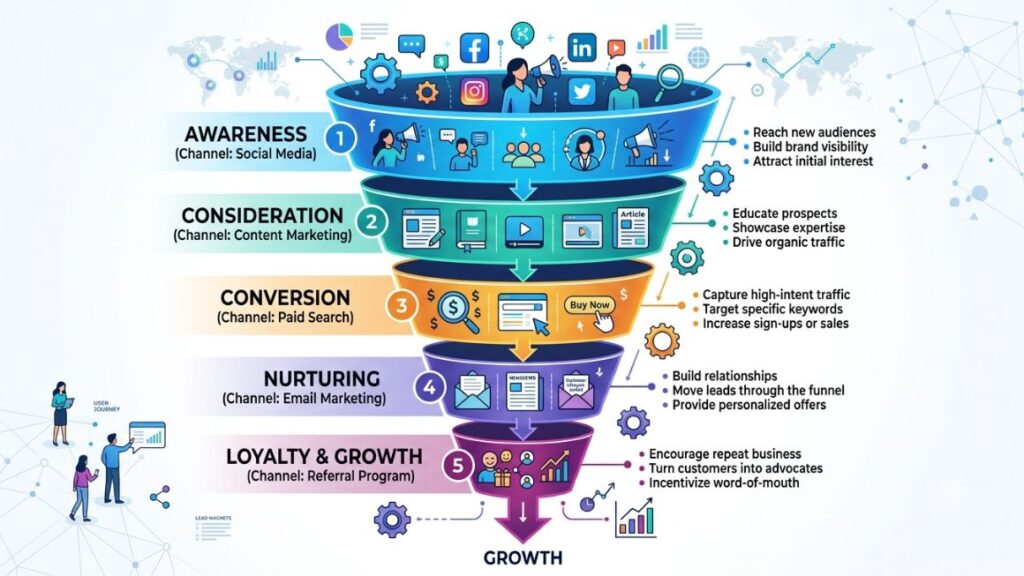
Don’t launch every channel at once. Nail Meta first until it’s consistently profitable, then add Google Brand Search immediately since it’s low effort. Add marketplaces once your product has 50-plus reviews, and build organic in parallel the whole time. Each channel should hit CM2-positive before you scale the next one.
The 72-Hour Creative Testing Framework Top Brands Use
The brands that grow fastest don’t have better ideas. They have better testing systems. Scientific iteration beats creative intuition over time, every time, even when the intuition comes from someone experienced.
How the 72-Hour Framework Works
Most brands test too few creatives and wait too long to decide. Top brands flip that completely.
- Launch 15 to 20 new creatives every week, testing different hooks (problem-led, curiosity, social proof, transformation) across formats like static, short video, UGC, and founder-led content. The hook determines about 80% of whether an ad works, so test the hook harder than anything else.
- Review performance at exactly 72 hours, not before and not much after. That window gives the algorithm enough data to optimize delivery while keeping your testing loop tight.
- Apply kill and keep criteria decided in advance. Kill anything with a Hook Rate below 20%, Hold Rate below 30%, or CPA above your max CAC after 72 hours. Keep anything with Hook Rate 25%+, CTR above 1.5%, and CPA within your CAC ceiling.
- Document winners and losers both. A winner tells you what to scale. A loser tells you what your audience isn’t responding to, and after six months of this, you own a proprietary pattern library no competitor can copy.
Daily Ad Review Metrics
| Metric | What It Tells You | When to Act |
| Hook Rate (3-sec views / impressions) | Is the opening stopping the scroll? | Kill if below 20% at 72h |
| Hold Rate (watches to 75% / 3-sec views) | Is the middle holding attention? | Kill if below 30% at 72h |
| CTR (Link clicks / impressions) | Is the CTA driving to the landing page? | Investigate if below 1% |
| CPA / CAC | Is it profitable to acquire from this creative? | Kill if above max CAC ceiling |
| Conversion Rate (landing page) | Is traffic converting after the click? | Fix page if below 2–3% |
Hypothesis, test, learn, iterate. Brands running this loop weekly compound their creative advantage over months. Brands running it monthly, or never, fall further behind with every week that passes.
What Separates 7-Figure Brands From 8-Figure Brands
The gap between a brand stuck at 7 figures and one that breaks through isn’t budget or luck. Honestly, it comes down to how the founder makes decisions when data and gut feeling disagree.
Revenue Is Not the Same Thing as a Business
Revenue is what the Shopify dashboard shows. A business is what’s left after COGS, shipping, returns, CAC, team costs, and platform fees get subtracted. Plenty of 7-figure brands have impressive revenue and barely-positive or negative real profit. They know the first number. They don’t know the second.
Top 1% founders obsess over contribution margin, not topline. They’ll turn down a month of flashy revenue growth if the CM2 tells them it isn’t sustainable. They’d rather run a smaller, profitable business today than a large, unprofitable one that needs outside capital just to keep the lights on.
They Scale Systems, Not Effort
A brand that hits ₹5 crore because the founder personally manages every ad, email, and customer complaint isn’t a scalable business. It’s a job that pays variably. Top brands document every repeatable process into SOPs early, not when something breaks, but before it does. The goal is a business that grows when the founder isn’t in it, not one that only survives because they are.
| 7-Figure Brand Patterns | 8-Figure Brand Patterns |
| Scales budget when revenue goes up | Scales budget when CM2 confirms it |
| Makes creative decisions by gut feeling | Makes creative decisions by documented data |
| Tracks ROAS on one platform | Tracks MER across all channels |
| Treats retention as nice-to-have | Treats retention as the primary growth lever |
| Reacts to data when things break | Reviews data weekly on a fixed schedule |
| Founder makes every decision | Systems make most decisions, founder sets direction |
They’re Ruthlessly Patient
The most counterintuitive trait of top 1% ecommerce founders is their willingness to not scale. They’ll spend three months fixing tracking and retention before touching the ad budget, even when the temptation to scale is strong. They know scaling a leaky system just makes the leak bigger.
That’s really the whole framework. Foundation fixes positioning leaks. Numbers fix profit leaks. Data fixes measurement leaks. Retention fixes LTV leaks. Every pillar here exists to patch a leak before you pour more budget through the system.
The Real Playbook Is Refusing to Skip Steps
Brands that reach ₹50 crore and beyond didn’t find a shortcut. They fixed the foundation, nailed their numbers, built retention before scaling acquisition, and tested creative like a discipline instead of an afterthought.
If you’re stuck at a revenue plateau right now, don’t reach for a bigger ad budget as the first move. Go back to whichever pillar in this framework feels weakest in your business today, fix it completely, and only then move to the next one. That’s how the brands actually operating at 8 figures got there, one pillar at a time.
If you want to go deeper into the performance marketing side of this, specifically CAC modeling, MER tracking, and the creative testing systems covered here, YUP’s Performance Marketing course walks through all of it with live mentorship and real brand case studies. You can also get frameworks like this one straight to your inbox through the Crystal Clear Newsletter.
Frequently Asked Questions
What is CM2 in ecommerce?
CM2, or contribution margin 2, is the profit left per order after subtracting COGS, packaging, shipping, payment fees, returns, and CAC from revenue. It’s a more accurate profitability measure than ROAS because it accounts for every real cost of making a sale, not just the ad spend.
Is MER the same as ROAS?
No. ROAS measures return on ad spend for a single channel, while MER (Marketing Efficiency Ratio) divides total revenue by total marketing spend across every channel. MER gives you a full-business view of efficiency, which is why most brands scaling in 2026 track it alongside or instead of channel-level ROAS.
How do I calculate my CAC ceiling?
Start from your CM2 formula and work backward: subtract COGS, packaging, shipping, payment fees, and expected returns from your revenue per order, and whatever’s left before CAC is your maximum allowable acquisition cost. Model this against conservative, base, and aggressive scenarios before committing ad budget.
Who should use the 72-hour creative testing framework?
Any D2C or ecommerce brand running paid social ads, particularly on Meta, benefits from this framework. It’s most useful once you have enough budget to launch 15-plus creatives weekly, since the framework depends on volume to generate a reliable 72-hour read.
Do I really need server-side tracking, or is the pixel enough?
Browser-side pixel tracking alone typically captures only 60 to 70% of actual conversions due to iOS 14 restrictions and cookie deprecation. If you’re making budget decisions off pixel data alone, you’re very likely optimizing toward incomplete numbers. Server-side CAPI recovers a meaningful share of that lost signal.
What’s a good repeat purchase rate for a D2C brand?
According to YUP’s 2026 benchmarks, a repeat purchase rate above 40% is considered strong, 20 to 39% is average, and anything below 20% needs work. The right target depends heavily on your product category and typical repurchase cycle.
Why isn’t my ROAS improving even after creative testing?
Often it isn’t the creative. Check whether your tracking is under-reporting conversions, whether your landing page conversion rate is the actual bottleneck, or whether your CAC ceiling was miscalculated in the first place. Creative testing can’t fix a broken foundation or bad measurement underneath it.
Should I diversify acquisition channels even if Meta is working well?
Yes. Meta CPMs in India have risen sharply since 2023, and single-channel dependency leaves you exposed to algorithm changes and cost spikes you can’t control. Add Google Brand Search early since it’s low effort, then layer in marketplaces and organic content as your reviews and content library grow.
Is retention really more important than acquisition for scaling?
For most D2C brands, yes. Higher retention raises your LTV, which raises your allowable CAC, which lets you outbid competitors for the same customers while staying more profitable. This may not hold for categories with genuinely one-time purchase behavior, but for repeat-purchase categories it’s usually the highest-leverage lever available.