

Somewhere right now, a customer is complaining about a brand on X. Another is raving about the same brand in a Reddit thread, and a third has left a three-star review that just says “fine, I guess.” The brand’s team sees one of those three. Probably the loudest.
That gap is exactly what AI brand sentiment analysis closes. It reads thousands of mentions, reviews and comments, sorts them by tone, and shows the pattern a person skimming dashboards would miss. India alone had 500 million social media user identities in October 2025, according to DataReportal’s Digital 2026 report, so nobody is reading all of it by hand.
Not long ago, brand sentiment analysis mostly meant counting keywords and hoping for the best. Today it can read context, mixed feelings and, some of the time, sarcasm. This guide covers what sentiment actually is, how the technology works, which tools are worth a look, how to set it up step by step, and where it still gets things wrong.
Table of Contents
What Is Brand Sentiment and Why Does It Matter?
Brand sentiment is the overall tone of what people say about your brand, sorted into positive, negative or neutral. It matters because that tone quietly shapes who buys from you, who stays, and who tells a friend to look elsewhere.
Understanding the Meaning of Brand Sentiment
Think of it as the mood around your brand. Not a number yet. Just the mood.
Take three comments about the same food delivery app. “Hot food, ten minutes early, bless you.” That’s positive. “Order delivered at 8:42 pm.” Neutral, because it’s just a fact. “Third refund request this month and still nothing.” Negative, and probably heading for a one-star review.
Brand Sentiment vs Brand Perception vs Brand Reputation
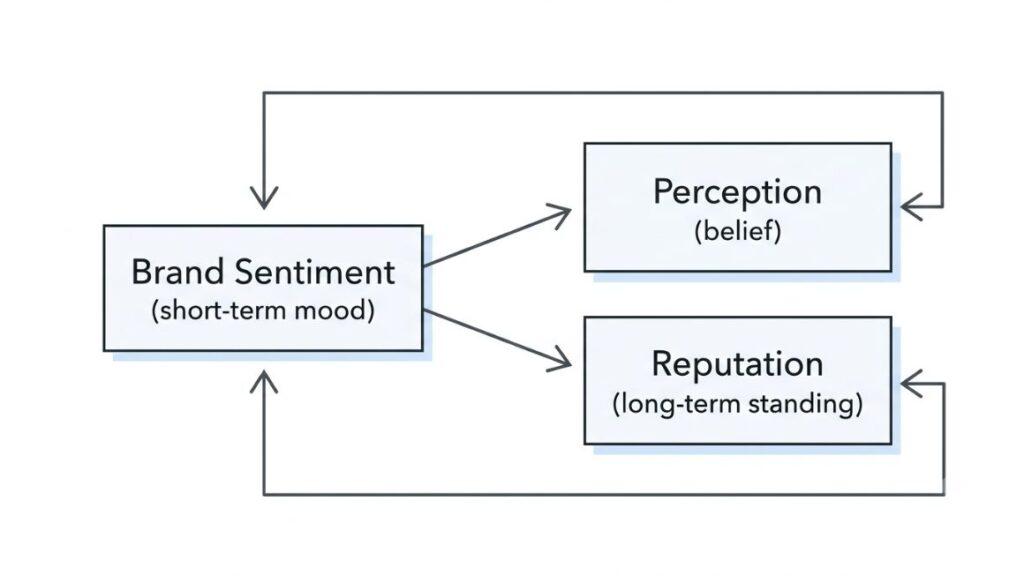
Three terms, one big pile of confusion. Sentiment is what people are saying right now, so it moves week to week. Perception is what they believe about you, built from many experiences. Reputation is your standing over years, the thing people assume before they’ve even tried you.
They feed each other. A heap of bad sentiment, left alone, bends perception. Bent perception, given enough time, damages reputation.
It runs in reverse too. Picture a hypothetical appliance maker with a 30-year name for durability. A faulty batch ships, and for two weeks the sentiment around it turns sour even though the reputation is still strong. Reputation buys you patience. It doesn’t buy immunity.
Why Businesses Need to Understand Customer Opinions
Opinions turn into behaviour fast. According to the 2025 Sprout Social Index, 73% of social media users agree that if a brand doesn’t respond on social, they’ll buy from a competitor. So silence isn’t neutral. It costs you.
Here’s what tracking opinions protects or improves:
- Trust and loyalty: people stay with brands that notice complaints
- Purchasing decisions: reviews are often read just before someone buys
- Marketing effectiveness: you see whether a campaign landed or annoyed people
- Brand reputation: small problems get caught early
- Products and services: repeat complaints point at what needs fixing
Doing that across thousands of posts is what AI brand sentiment analysis is for.
Also Read: 16 Best Sentiment Analysis Tools to Cut Through Online Noise
Brand sentiment is the current emotional tone of customer conversations about a brand, usually labelled positive, negative or neutral. It differs from brand perception, which is what people believe about a brand, and from brand reputation, which is its long-term standing. Sentiment moves fastest, which makes it the earliest warning sign of a problem.
How Does AI Brand Sentiment Analysis Work?
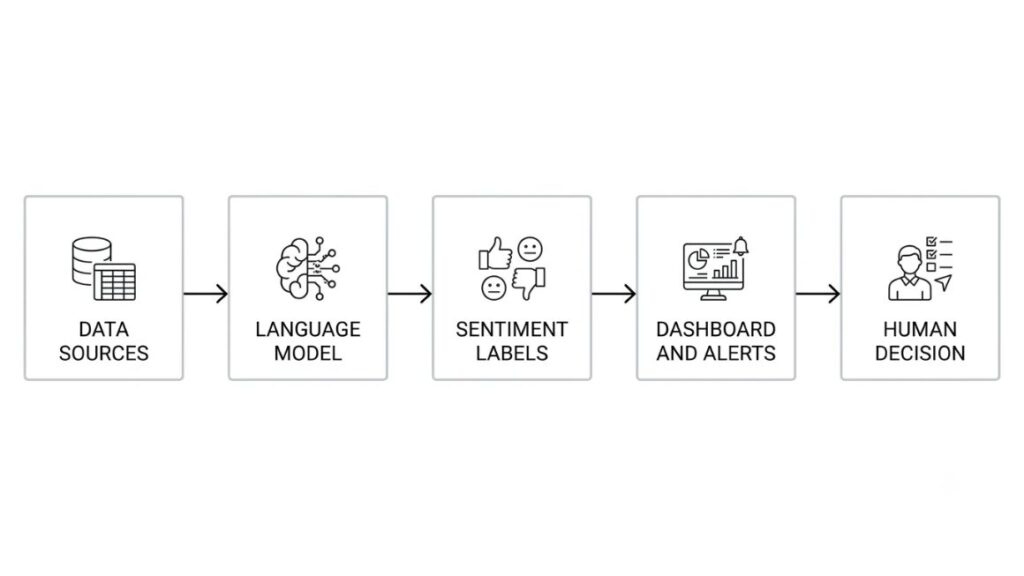
AI brand sentiment analysis works in four stages. It collects mentions of your brand from across the web, reads each one with language models, labels it positive, negative or neutral, and then turns the totals into dashboards and alerts. The AI does the reading. You do the deciding.
Collecting Customer Conversations and Feedback
Everything starts with data, and a tool can only judge what it can see. Most platforms pull from a mix of sources:
- Social media platforms, including posts, comments, replies and mentions
- Online reviews on marketplaces, app stores and Google
- Customer surveys, especially the open-text answers
- Discussion forums and Q&A sites
- News websites and blogs
- Customer support chats, emails and tickets
For social media sentiment analysis, the tool watches for your brand name, product names, campaign hashtags and common misspellings. Coverage isn’t identical everywhere, since each network decides how much of its data outsiders can access. Ask any vendor about that before signing anything.
How Natural Language Processing Understands Human Language
Natural language processing (NLP) is the branch of AI that helps computers read and interpret human language. Sentiment analysis using NLP breaks a sentence into parts, looks at the words and how they relate to each other, and estimates the feeling behind them.
Early versions were basically word lists. “Great” scored plus, “awful” scored minus. That falls apart quickly. “Not bad at all” contains the word “bad” and is still praise.
Modern NLP reads the whole phrase instead. It notices negation, intensity (“absolutely love” versus “kind of like”) and what the feeling is aimed at. So it can tell that “the camera is brilliant but the app is clunky” holds two opinions, not one.
Machine Learning and Large Language Models
Machine learning is how those patterns get learned. Developers show a model thousands of comments already labelled by people as positive, negative or neutral, and it works out which language tends to go with which label.
Large language models (LLMs) take that further. They’re trained on huge amounts of text, so they read context better: who a comment is aimed at, what came earlier in the thread, whether “sick” means ill or impressive. That context is the biggest jump over older tools.
None of this removes people from the loop, though. Analysts spot-check labels, correct the odd ones and add brand-specific language like product nicknames or slang, so the system keeps improving. Skip that step and you end up trusting a dashboard that’s quietly wrong.
Turning Customer Opinions into Actionable Insights
Raw labels aren’t useful on their own. What helps is how the results show up. Dashboards show sentiment by channel, topic and time. Reports summarise the month for people who don’t live inside the tool. Alerts ping you when negative mentions cross a threshold, and trend views show whether a dip is a blip or a slide.
AI brand sentiment analysis collects online mentions, uses natural language processing and machine learning to classify each as positive, negative or neutral, and summarises the results in dashboards, reports and alerts. Large language models improve accuracy by reading context, but human review is still needed to catch errors and brand-specific language.
Different Types of Sentiment AI Can Identify
AI brand sentiment analysis can sort mentions into positive, negative and neutral sentiment, and better tools go further by detecting specific emotions and tying each opinion to a topic such as price, delivery or support.
Positive Sentiment
Positive mentions show satisfaction: thank-you notes, recommendations, “finally a brand that gets it.” The best of them are advocacy, where someone volunteers to sell your product to their friends. Those are worth finding and amplifying, because a peer’s recommendation usually carries more weight than your own ads.
Negative Sentiment
Complaints, disappointment, product defects, bad service. Not all of it deserves the same urgency, though. A grumble about price is one thing. A post saying a product irritated someone’s skin is another entirely. Good tools help you tell them apart, and good teams read the second kind first.
Neutral Sentiment
Neutral is the quiet middle: news mentions, product announcements, questions like “does this work with iOS?” People assume neutral means ignorable. It doesn’t. A pile of neutral questions about the same missing feature is a product signal, and a surge in neutral chatter can mean a story is about to tip one way or the other.
Emotion and Aspect-Based Sentiment
Basic sentiment gives one label per comment. Emotion detection goes deeper and tags things like anger, joy or frustration. Aspect-based sentiment ties each opinion to a specific topic: price, delivery, customer support, product quality.
Here’s why that matters. A customer writes: “Love the kurta, hate that it took 11 days to arrive.” A simple positive or negative classifier has to pick one, and either answer is wrong. Aspect-based analysis scores the product as positive and the delivery as negative, which tells you exactly where to act.

Key Benefits of Using AI for Brand Sentiment Analysis
AI brand sentiment analysis helps you understand what customers think at scale, catch reputation problems early, sharpen campaigns, improve customer experience and see how you compare with competitors. Here’s how each one plays out.
Understand What Customers Really Think
Surveys tell you what people choose to tell you. Social posts and reviews often show what they actually think. Customer sentiment analysis pulls that unfiltered feedback together, so you can see expectations, worries and small delights you never thought to ask about. Honestly, it’s the closest thing marketers get to overhearing the room.
Identify Potential Reputation Problems Early
Most reputation crises start small. A handful of angry posts, then a screenshot, then a thread, then a news story. Sentiment alerts can flag the jump in negative volume while it’s still a handful of posts. For online reputation management, that head start is the whole game, because a reply within hours lands very differently from one three days late.
Improve Marketing Campaigns
Likes don’t tell you whether people liked the message. Comments do. Sentiment around a launch shows whether the tone, creative or offer worked. You can adjust mid-flight instead of finding out in the quarterly review.
Improve Customer Experience and Retention
Recurring complaints are a free audit. If “refund” keeps showing up next to “support,” the issue isn’t a few cranky customers. It’s a process.
Brandwatch publishes a case study in which OnePlus used its platform for brand sentiment, customer support and market share work in India. The results are reported by the vendor, so treat the numbers as a story rather than proof. The pattern behind it is real, though: listening feeds support, and support feeds retention.
Discover Competitor Strengths and Weaknesses
Your competitors’ customers are talking too, and nobody’s stopping you from listening. Say a rival’s customers keep praising its returns policy but complaining about app crashes. Hypothetical, but the move is obvious: promote your own returns clearly and keep your app steady. Gaps in their sentiment are openings in your positioning.
How to Implement AI Brand Sentiment Analysis in Your Business?
To implement AI brand sentiment analysis, define what you want to measure, pick the channels where customers actually talk, choose a tool that fits your budget, check how it categorises feedback, track trends on a schedule and act on what you find. Six steps, and the last one is the one most teams skip.
Step 1: Define Your Brand Monitoring Goals
Decide what you’re trying to learn before you open a single vendor tab. “Track everything” isn’t a goal. It’s a bill. Pick one or two to begin with:
- Customer satisfaction
- Campaign performance
- Product feedback
- Reputation management
- Competitor comparison
A D2C skincare brand might start with product feedback alone. The goal decides which data and which tool make sense.
Step 2: Identify the Right Data Sources
Go where your customers actually talk. A B2B software company probably cares more about LinkedIn, G2 and Reddit than Instagram. A restaurant lives on Google reviews and Zomato. Look at where complaints already reach you, whether that’s support tickets, DMs or review sites, and begin there. Adding sources later is easy. Cleaning up noise from sources you never needed is not.
Step 3: Select an Appropriate AI Tool
Four things drive the choice: budget, business size, data coverage and reporting needs. Small teams usually want fast setup and clear pricing. Larger ones want historical data, many languages and custom dashboards. Whatever sentiment analysis software you shortlist, ask for a trial on your own brand’s data, not the vendor’s demo data. Demo data always looks great.
Step 4: Analyse and Categorise Customer Feedback
Once data flows in, AI brand sentiment analysis tags each mention with a sentiment and groups mentions into themes such as delivery, pricing or app performance. Don’t treat the first grouping as gospel. Read a sample of 50 to 100 mentions per theme and check the labels. Fix what’s wrong, add custom categories for your products, and filter out noise like unrelated brands that share your name.
Step 5: Track Sentiment Trends and Important Changes
Set a rhythm. A daily glance at alerts catches fires. A weekly report spots slower shifts, like a feature people keep misunderstanding. A monthly comparison shows whether your work is paying off. Look at direction rather than one day’s number, since a single viral post can swing everything.
Step 6: Turn Insights into Business Decisions
This is the step that justifies the subscription. Some practical moves:
- Fix recurring product complaints before the next batch ships
- Improve support by routing negative mentions to a senior person quickly
- Adjust advertising messages that are drawing confusion
- Reply to negative reviews with specifics, not copy-pasted apologies
- Build content around the questions and interests customers keep raising
It’s also the answer to a question plenty of teams ask: how do you improve negative brand sentiment? Find the root cause, fix it, then tell people it’s fixed. Replying without fixing just earns a second round of complaints.
Best AI Tools for Brand Sentiment Analysis
The right pick depends on your size and your goal. Brandwatch and Meltwater tend to suit enterprise research and PR teams, Brand24 suits smaller teams that want accessible monitoring, Sprout Social suits teams already managing social there, and Talkwalker is built around international consumer intelligence.
There’s no shortage of AI sentiment analysis tools, and these five come up often for brand monitoring. Details below are as of November 2026. Features and pricing change fast, so confirm everything on the vendor’s own site.
Brandwatch
Brandwatch is an enterprise consumer intelligence platform that has been around since 2007. Cision acquired it in 2021. It’s known for social listening, deep historical data, competitive analysis and sentiment and trend insights. Pricing isn’t published, so you request a quote. One GetApp reviewer flagged inconsistent sentiment on non-English content, which is worth testing if your customers don’t write in English.
Brand24
Brand24 tracks mentions across social media, news, blogs, video, forums, podcasts and reviews, and gives each one a sentiment label. Plans are tiered by number of keywords and monthly mentions, so it’s easier to start small. It has also added tracking for how brands show up in AI-generated answers. Check its own pricing page, since published prices differ between review sites.
Talkwalker
Talkwalker is a consumer intelligence and social listening platform. Hootsuite announced in April 2024 that it would acquire it, and Talkwalker’s analysis covered more than 30 social platforms at that point. It’s positioned around international market insight and image and video analysis, which it markets as visual listening.
Sprout Social
Sprout Social is mainly a social media management platform. Its Smart Inbox pulls messages, comments and mentions into one place, and it adds listening features and sentiment tagging on top. Engagement and sentiment sit together, so the person replying can see the mood. One caution: some sentiment and listening features sit on higher plan tiers, so check which plan includes what you need.
Meltwater
Meltwater is a media intelligence platform that monitors news, broadcast and print alongside social, which suits PR and communications teams. It also tracks brand reputation and competitors, and has added features for tracking how brands appear in generative AI answers. Pricing is custom.
How to Choose the Right Tool?
Rank these six criteria by what matters for the goal you set in Step 1.
| Selection criteria | What to check |
| Accuracy | Context and language understanding |
| Data coverage | Social, reviews, forums and news |
| Reporting | Custom dashboards and trends |
| Alerts | Timely notifications |
| Integrations | CRM and marketing systems |
| Budget | Pricing and scalability |
None of the five is the universal winner, and any ranking claiming otherwise is selling something. Whichever brand monitoring tools you compare, run the same 200 real mentions through each and see which one agrees with a human reader most often. That’s a better test than any feature list.
Also Read: 17 Best Brand Management Platform: Tools, Features & Benefits
Real-World Applications Across Different Industries
Any business with lots of public feedback can use AI brand sentiment analysis. Only the questions change. The examples below are illustrations, not documented case studies, unless a source is named.
Ecommerce and Retail
A fashion retailer’s reviews might average 4.2 stars. Run customer feedback analysis on the review text, though, and you may find sizing complaints clustered around one product line and delivery gripes clustered around one city. Stars hide that. Text doesn’t. This is a made-up example, but the pattern shows up constantly.
SaaS and Technology
Software companies get feature requests, usability complaints and subscription gripes all mixed together. After a pricing change, a project management tool might find that most negative mentions come from small teams, not enterprise accounts. That’s a hypothetical, and it points to a very different fix than “everyone hates the new price.”
Food and Hospitality
A restaurant chain can compare reviews outlet by outlet. If one branch collects “slow” on Friday nights while others don’t, that’s a staffing question, not a menu question. Sentiment by location is one of the most practical views in this industry.
Education and Online Learning
Course providers can track satisfaction through reviews, community posts and survey comments. If learners keep writing “too fast” about one module or “no feedback” about assignments, that’s a design fix waiting to happen. Course completion numbers alone wouldn’t tell you why people drop off.
How to Measure Brand Sentiment and Track Performance?
With AI brand sentiment analysis, you count positive, negative and neutral mentions over a fixed period, calculate a net sentiment score, and track it over time against your own baseline and your competitors.
Understand Sentiment Scores
The common formula looks like this:
Net Sentiment = (Positive – Negative) ÷ Total Mentions × 100
Suppose a brand receives 1,000 mentions: 600 positive, 250 neutral and 150 negative. Its net sentiment is (600 – 150) ÷ 1,000 × 100 = 45. So the score is +45.
That sounds great. But it isn’t a universal measure of brand health. A +45 could be exceptional for a bank and worrying for a brand people usually adore. Tools also calculate net sentiment in slightly different ways, so confirm how yours does it. Treat the number as one input to brand perception analysis, not the verdict.
Track Share of Positive and Negative Mentions
Two brands can both score +45 and look nothing alike. Brand A has 70% positive, 25% negative and 5% neutral. Brand B has 50% positive, 5% negative and 45% neutral. Same score. But Brand A is polarising, with a loud group of unhappy customers, and Brand B is mostly being ignored. They need very different strategies.
Monitor Sentiment Changes Over Time
One reading is a snapshot. Trends are the story. Compare week against week and month against month, and mark events on the chart: a launch, an outage, a price change, a viral post. Without markers, a dip in March is just a dip.
Compare Your Brand with Competitors
A score only means something next to another score. Track two or three real competitors with the same queries and dates, then compare net sentiment, share of negative mentions and the topics driving each. If everyone in your category dips after a festival-season delivery crunch, that’s the industry. If only you dip, that’s you.
Net sentiment equals positive mentions minus negative mentions, divided by total mentions, multiplied by 100. A brand with 600 positive, 250 neutral and 150 negative mentions scores +45. The score is only meaningful when compared with the brand’s own history and with competitors, and it should be read alongside the share of positive, neutral and negative mentions.
Also Read: Brand Awareness Metrics: Complete Guide to Measuring, Tracking & Improving Brand Visibility in 2026
Challenges and Limitations of AI Sentiment Analysis
AI brand sentiment analysis is useful but not infallible. It struggles with sarcasm, slang and mixed languages, can be skewed by incomplete data, raises privacy questions and still needs human review.
Understanding Sarcasm and Humour
“Great, another outage right before the sale. Love that for us.” Every word is cheerful. Every feeling is not.
Research shows why this trips systems up. A 2025 study by Bhargava and colleagues, posted on arXiv, tested language models on 5,929 human-labelled tweets. A model trained on narrow, topic-specific tweets about nuclear power got only 30% of sarcastic tweets right, while models trained on general tweets reached around 60%.
A 2026 paper at the ACL conference went further, reporting that models that looked near-perfect on synthetic sarcasm dropped to roughly random guessing on real human speech. So when a vendor says it detects sarcasm, ask how it was tested, and on whose data.
Language and Cultural Differences
India makes this harder. Customers write in English, Hindi, Hinglish and regional languages in Roman script, with emojis and slang thrown in. “Wah, kya service hai” is praise or a dig depending on the day. Ask vendors which languages they support, then test with real mentions from your market.
Inaccurate or Incomplete Data
Garbage in, garbage out. Private accounts and platform restrictions hide mentions. Reposts and duplicates inflate volume. Spam and bots add fake enthusiasm or fake outrage. And whoever writes reviews is rarely typical: people with very good or very bad experiences post far more than people with an ordinary Tuesday. That’s sampling bias, and it tilts every score.
Data Privacy and Ethical Considerations
Public doesn’t mean free for all. Collect only what you need, follow each platform’s terms and limit who sees raw data. In India, the Digital Personal Data Protection Act, 2023 governs how personal data is processed, so ask your legal team what applies to your setup.
Why Human Review Is Still Important
Spot-check AI brand sentiment analysis every week. And before any decision with real consequences, like pulling a product, changing a price or replying publicly to a crisis, read the actual comments. The dashboard tells you where to look. People tell you what’s happening.
Emerging Trends Shaping the Future of Brand Sentiment Analysis
Four shifts are changing how AI brand sentiment analysis works, and most are already showing up in tools.
Real-Time Sentiment Monitoring
Faster alerts shrink the gap between a customer’s complaint and your reply, and that’s where AI brand sentiment analysis earns its keep. The goal is catching a negative spike in minutes, not at the next weekly review.
Multimodal Sentiment Analysis
People don’t only write. They post photos, record video reviews and leave voice notes. Multimodal analysis reads text, images, audio and video together, so a sarcastic caption on an unboxing video, or your logo in a photo with no caption at all, doesn’t slip through.
AI-Powered Brand Visibility Monitoring
People now ask ChatGPT, Gemini and Perplexity what to buy, and those answers describe your brand too, accurately or not. Peak Ace, a digital agency, ran a study of how ChatGPT perceives and recommends smart ring brands, and tools such as HubSpot’s AEO grader, Brand24 and Meltwater now offer ways to track how AI assistants describe brands. Early days, but worth a quarterly check at least.
Also Read: How to Measure Share of Model: Tracking Brand Visibility in ChatGPT, Gemini, and Perplexity
Predictive Customer Insights
Some platforms claim they can flag patterns before an issue spreads. Treat predictions as hints, not forecasts. They’re useful when they point you to look closer, and risky when they replace looking.
Conclusion
Customers are already telling you what they think. The only question is whether you’re hearing it. AI brand sentiment analysis makes that listening practical at a scale no team could manage by hand, but it works best when someone with judgement reads alongside it. The tool finds the pattern, and a person decides what it means.
Start small. Pick two or three channels where your customers actually talk, set up one dashboard, and review it every week for a month. Expand once the numbers begin matching what your team hears on the ground.
Knowing how to read sentiment is one skill. Putting AI to work across your daily marketing is another, and it’s where most marketers feel stuck. The YUP AI Marketing course teaches practical ways to use AI tools in real marketing work. Explore the YUP AI Marketing course to start building those skills.
Frequently Asked Questions
What is AI brand sentiment analysis?
AI brand sentiment analysis uses natural language processing and machine learning to read online mentions of a brand, such as posts, reviews and comments, and label each as positive, negative or neutral. It helps businesses see how customers feel at scale and spot changes in opinion early.
How does AI identify positive and negative brand mentions?
AI brand sentiment analysis breaks each mention into words and phrases, then looks at how they relate. Context matters: “not bad” reads very differently from “bad.” Models trained on labelled examples assign a sentiment, often with a confidence score, and newer language models use the surrounding conversation to sharpen those labels.
What are the best AI tools for analysing brand sentiment?
Common names include Brandwatch (enterprise consumer intelligence), Brand24 (accessible mention tracking), Talkwalker (international consumer intelligence), Sprout Social (social management with listening) and Meltwater (media and social monitoring). The best fit depends on your budget, data sources and reporting needs.
Is AI sentiment analysis accurate?
Accuracy of AI brand sentiment analysis depends on the model, the language, the context and the quality of the data. It tends to be strong on clear positive and negative statements and weaker on sarcasm, slang and mixed languages. Regular human validation is the most reliable way to keep results trustworthy.
Can small businesses use AI for brand sentiment analysis?
Yes. Several tools offer entry-level plans based on keyword and mention limits, and free alerts for your brand name are a reasonable first step. A small business can start by tracking its own name, reviews and one or two competitors, then use the results to fix repeat complaints and improve replies.
How often should businesses monitor brand sentiment?
Most AI brand sentiment analysis setups collect data continuously, with alerts for sudden spikes in negative mentions. Review dashboards weekly for emerging themes, and produce a monthly report to compare trends, campaigns and competitors.
Can AI detect sarcasm in customer reviews?
Sometimes, but not reliably. Sarcasm often uses positive words to express frustration, and research shows models can perform well on tidy test data yet struggle with real conversations. Human validation matters most for high-stakes decisions.
How can businesses improve negative brand sentiment?
Start by finding the root cause: which topic, product or channel is driving the negativity. Respond to complaints quickly and specifically, fix the recurring issue, and then tell customers what changed. Keep monitoring afterwards to confirm sentiment actually improves.
What is the difference between social listening and sentiment analysis?
Social listening gathers and tracks conversations about your brand, competitors and topics across the web. Sentiment analysis evaluates the emotional tone of those conversations. Listening gives you the raw material, and sentiment analysis tells you how people feel about it. Most platforms combine both.
Can ChatGPT and other AI platforms influence brand perception?
They can. People increasingly use AI assistants to compare products and shortlist options, and those answers describe and recommend brands. If the description is outdated or wrong, it can shape first impressions. Check regularly how ChatGPT, Gemini and Perplexity describe your brand, and correct the sources they draw from.