

AI in brand management has moved well beyond simple automation now. Brands are using it to understand customers faster, react to shifts earlier, and keep messaging aligned across dozens of channels that never really slow down anymore. This blog looks at where AI is genuinely helping branding teams and where things get messy too. Because they do. From personalization and customer experience to AI search visibility, brand monitoring, and creative consistency, the entire branding process is changing quietly in the background. At the same time, there’s growing pressure to avoid sounding generic or over-engineered. That tension matters. The companies getting this right aren’t replacing human thinking with AI. They’re using it carefully, selectively, and with a clearer sense of brand identity than before.
Table of Contents
Introduction
Brand management feels very different now compared to even three or four years ago.
Not long ago, most branding decisions moved slowly. Teams spent weeks refining campaigns, reviewing customer feedback manually, debating messaging in meeting rooms, and planning quarterly launches months in advance. There was more breathing room. More predictability too.
That pace is mostly gone.
Brands are expected to respond almost instantly. Customer sentiment shifts overnight. Trends appear and disappear within days. Audiences expect personalization everywhere, whether they’re browsing a website, opening an email, talking to support, or scrolling through TikTok at 1 AM. And if a brand feels generic for even a moment, attention disappears fast.
That’s one of the biggest reasons AI in brand management has moved from “interesting experiment” to core business function.
Not because AI suddenly became creative on its own. It hasn’t. But because modern branding has become too fast, too fragmented, and honestly too data-heavy for human teams to manage manually at scale.
Most brand teams today are juggling:
- Dozens of content channels
- Real-time customer feedback
- Constant campaign testing
- Personalized messaging
- Reputation monitoring
- Community management
- AI-driven search visibility
- Cross-platform consistency
At enterprise scale, that becomes overwhelming pretty quickly.
So AI stepped in first as an efficiency tool. Then as an analytics layer. Now it’s becoming part of the actual decision-making infrastructure behind modern branding.
And the shift is bigger than content generation. That part gets overhyped a little.
The real transformation is happening underneath.
AI systems are now helping brands analyze customer perception, predict market trends, identify positioning opportunities, monitor sentiment, optimize messaging, and maintain consistency across thousands of assets simultaneously. Some companies are even using AI agents to manage campaign workflows and customer interactions semi-autonomously. Strange to think about a few years ago, but here we are.
At the same time, the internet itself is changing.
Search behavior no longer revolves only around clicking blue links on Google. Consumers increasingly discover brands through AI-generated answers inside ChatGPT, Gemini, Perplexity, and Google AI Overviews. Which means brands are no longer competing just for rankings or impressions. They’re competing to become part of machine-generated recommendations and summaries.
That changes branding strategy quite a bit.
A brand now needs to be understandable not only to humans, but also to AI systems interpreting authority, trust, sentiment, and topical relevance. This is why conversations around Generative Engine Optimization, entity-based search, and AI visibility have become so important recently.
There’s another side to this too, though.
As AI tools become more accessible, branding is starting to look… similar. Same tone. Same visual style. Same predictable messaging frameworks. The internet is filling up with content that technically works but feels oddly empty.
Consumers notice it.
That’s why the brands standing out right now are usually the ones using AI carefully rather than aggressively. The companies combining machine efficiency with strong human judgment, creative restraint, and actual brand perspective.
Because branding still depends on things AI struggles with:
Taste. Timing. Emotional nuance. Cultural instinct. Originality.
Those things still matter. Maybe more now than before.
This guide explores how AI is reshaping brand management in 2026, where it genuinely helps, where it creates problems, and why the future probably belongs to hybrid systems rather than fully automated branding.
Some of the changes happening right now are incremental.
Others are going to redefine how brands operate entirely.
What Is AI in Brand Management?
AI in brand management refers to the use of artificial intelligence systems to support how brands are built, positioned, communicated, monitored, and evolved over time.
Simple definition. But the actual scope is much wider than most people expect.
A lot of businesses still think AI branding mainly means generating social posts or writing ad copy faster. That’s only a small part of it. Helpful, yes. But surface-level.
Modern AI brand management touches almost every layer of brand operations, including:
- Customer perception analysis
- Brand positioning
- Audience segmentation
- Creative production
- Messaging consistency
- Reputation monitoring
- Trend forecasting
- Personalization systems
- Customer experience optimization
In practice, AI acts less like a replacement for branding teams and more like a continuous intelligence layer running underneath the brand itself.
That distinction matters.
Traditional branding relied heavily on periodic research. Quarterly surveys. Focus groups. Campaign reviews. Maybe a few customer interviews if teams had the time. Decisions often depended on intuition combined with incomplete data.
Now brands can process enormous volumes of information continuously.
Reviews. Social conversations. Customer support transcripts. Community discussions. Search behavior. Purchase patterns. Video engagement. Sentiment changes.
AI systems can identify patterns across all of that much faster than human teams realistically could.
And unlike older automation systems, newer AI models don’t just organize information. They interpret it. Or at least approximate interpretation well enough to influence decisions.
That’s where the line between AI marketing and AI brand management starts becoming important.
AI marketing usually focuses on performance metrics:
- Lowering acquisition costs
- Improving conversion rates
- Optimizing ads
- Automating campaigns
- Increasing clicks or revenue
AI brand management is broader and more strategic. It focuses on long-term perception and emotional positioning.
Different priorities entirely.
A campaign can perform well and still weaken the brand over time. Happens more often than marketers admit. Especially when short-term optimization overrides consistency or trust.
AI branding systems are supposed to help balance both.
Several technologies sit underneath modern AI-powered branding platforms:
Machine Learning
Used to detect behavioral patterns, predict customer actions, identify trends, and improve targeting systems over time.
Natural Language Processing (NLP)
Allows AI systems to analyze conversations, reviews, comments, and sentiment across huge volumes of text.
Generative AI
Creates content variations, campaign ideas, visuals, product descriptions, branded messaging, and creative assets.
Predictive Analytics
Forecasts future behavior based on historical patterns and live consumer data.
Computer Vision
Helps brands analyze visual consistency, user-generated imagery, and image-based brand mentions online.
AI Agents
Probably the biggest shift is happening now. AI agents can monitor workflows, generate recommendations, coordinate tasks, and sometimes execute branding operations with limited human involvement.
What’s interesting is how quickly branding has evolved from using isolated AI tools toward building interconnected AI ecosystems.
That’s the real shift underway.
Brands aren’t just using AI occasionally anymore. Many are restructuring workflows around it.
How Artificial Intelligence Supports Brand Management
Some AI use cases in branding get a lot of attention because they’re flashy. AI-generated ads, synthetic influencers, automated videos. Those examples spread quickly online.
But the more valuable applications are often less visible.
One of the biggest is perception analysis.
Brands today receive feedback constantly from everywhere:
- TikTok comments
- Reddit threads
- Product reviews
- Customer support chats
- YouTube discussions
- Community forums
- Survey responses
- Social mentions
No human team can realistically process all of that manually anymore. Especially global brands dealing with millions of interactions every month.
AI systems help identify recurring emotional patterns, emerging complaints, reputation risks, and shifts in audience perception before they become major problems.
That speed matters.
Brand damage often builds quietly before becoming obvious publicly.
AI also plays a growing role in brand positioning. Instead of relying only on annual competitor research, companies can now track market messaging continuously. AI tools analyze how competitors communicate, what audiences respond to, where sentiment gaps exist, and which narratives are becoming saturated.
Useful because many industries are starting to sound the same.
Especially in SaaS and ecommerce. Endless repetition of “innovative,” “customer-centric,” “personalized,” “next-generation.” AI can actually help identify these patterns and surface differentiation opportunities if used properly.
Another major application is brand consistency management.
This becomes difficult once brands scale across multiple regions, teams, agencies, creators, and channels. Messaging starts drifting. Tone changes subtly. Design systems become fragmented.
Over time, trust weakens.
AI governance systems now help monitor:
- Tone consistency
- Logo usage
- Visual identity
- Messaging alignment
- Compliance standards
- Brand terminology
- Content approval workflows
Not glamorous work. But extremely important.
Personalization is another area where AI has transformed branding.
Consumers increasingly expect brands to adapt experiences dynamically. Product recommendations, email content, landing pages, support interactions, even ad creative can now change based on customer behavior or intent signals in real time.
When done well, personalization feels helpful.
When done poorly, it feels invasive or strangely artificial. There’s a thin line there. Some brands still cross it without realizing.
That’s partly why human oversight remains important even inside heavily AI-assisted branding systems.
Evolution of AI Branding From 2023 to 2026
The evolution happened faster than most businesses expected.
Back in 2023, AI branding mostly revolved around experimentation. Teams were testing copy generators, image tools, and chatbot integrations because everyone suddenly felt pressure to “do something with AI.”
A lot of the output looked impressive initially.
Then much of it started sounding repetitive.
By 2024, companies began integrating AI into broader workflows rather than using standalone tools. CRM systems connected with AI analytics. Content systems integrated personalization engines. Customer support became increasingly automated.
That changed AI from a creative shortcut into operational infrastructure.
Now in 2026, branding is moving toward fully connected AI ecosystems.
Content generation, customer analytics, workflow automation, predictive forecasting, sentiment analysis, search visibility optimization, and conversational AI increasingly operate together rather than separately.
Multimodal AI accelerated this shift even further.
Modern branding systems can now generate and analyze text, images, audio, video, and conversational interactions simultaneously. Which means brand management itself has become more fluid and adaptive than before.
AI agents are another major development.
Instead of waiting for human instructions constantly, newer systems can monitor performance, identify anomalies, suggest adjustments, generate reports, and execute certain operational tasks semi-autonomously.
Not fully independent decision-making. At least not in most organizations yet.
But definitely moving beyond basic automation.
The interesting part is that branding teams are becoming smaller in some cases while output volume keeps increasing. A lean team today can execute at a scale that once required entire departments.
Still, there’s a tradeoff.
As AI-generated branding becomes easier, differentiation becomes harder. The internet is filling with polished but forgettable brand content. Technically correct. Emotionally flat.
That’s why human creativity matters even more now, not less.
AI can replicate patterns extremely well. It struggles with genuine originality, cultural instinct, emotional tension, and unconventional taste. The brands creating lasting attention are usually the ones combining AI efficiency with strong human editorial judgment.
The companies relying entirely on automation often end up sounding like everyone else after a while.
And audiences pick up on that surprisingly quickly.
Why AI in Brand Management Is Growing Rapidly
Consumer Expectations Have Changed
Consumer expectations shifted quietly at first. Then all at once.
People now expect digital experiences to feel immediate, personalized, and responsive almost everywhere. Waiting days for replies or receiving generic communication feels outdated very quickly.
This change wasn’t caused only by AI. Streaming platforms, ecommerce recommendations, social algorithms, and mobile-first experiences trained consumers over years to expect relevance constantly.
Now that expectation applies to brands too.
Customers expect companies to:
- Understand their preferences
- Recommend relevant products
- Respond quickly
- Maintain context across channels
- Deliver consistent experiences
- Adapt communication dynamically
And honestly, most traditional branding systems were never designed for that level of responsiveness.
Manual segmentation and static campaigns simply can’t keep pace anymore. Not at scale.
AI helps brands process chatbot continuously and adjust experiences in real time. Recommendation systems, predictive messaging, conversational support, and adaptive content all come from this broader pressure toward hyper-personalization.
But there’s another layer here that matters.
Consumers have also become much better at detecting generic brand communication.
People scroll past templated messaging instantly now. They’ve seen too much of it. Especially after the explosion of AI-generated content online. Audiences may not always recognize exactly why something feels artificial, but they usually sense it.
That creates an unusual challenge for brands.
AI is helping companies produce more content faster, while simultaneously making originality more important than ever.
Which means brand strategy in 2026 isn’t just about scale anymore. It’s about maintaining distinctiveness while operating at scale.
Not easy, honestly.
Especially when competitors are using similar AI systems trained on similar internet patterns.
That’s partly why stronger brands are investing heavily in voice development, editorial standards, community positioning, and differentiated brand perspectives rather than relying entirely on automation.
Core Applications of AI in Brand Management
AI for Brand Strategy Development
This is probably where AI is having the deepest impact, even if it’s less visible from the outside.
Brand strategy used to depend heavily on delayed information. Teams ran surveys, reviewed campaign reports weeks later, studied competitors manually, and tried to piece together consumer behavior from fragmented data. Useful process, but slow. Sometimes too slow for how quickly markets move now.
AI changes that dynamic quite a bit.
Modern branding teams can monitor audience sentiment, competitor messaging, search behavior, community discussions, and cultural trends almost continuously. Not perfectly, obviously. But fast enough to spot shifts earlier than before.
That matters because consumer perception changes gradually until suddenly it doesn’t.
A positioning strategy that worked 18 months ago can start feeling outdated without the company fully realizing it. AI-powered market analysis helps surface those subtle changes earlier:
- Emerging customer frustrations
- Language patterns consumers are adopting
- New competitor narratives
- Saturated messaging categories
- Shifts in purchase behavior
- Rising micro-trends
Consumer sentiment analysis has become especially important here.
Brands now have access to enormous volumes of unstructured feedback across reviews, Reddit threads, support conversations, TikTok comments, forums, and social platforms. Human teams can sample it. AI systems can process all of it at scale and identify recurring themes before they become obvious publicly.
Not every insight is revolutionary. Sometimes the value comes from small pattern recognition.
A beauty brand, for example, may discover customers repeatedly describing products with emotional language tied to confidence rather than appearance. That changes messaging strategy completely. Small distinction. Big impact.
Predictive analytics is another growing layer in brand strategy.
Instead of reacting to trends after they peak, brands are increasingly using AI systems to forecast behavior shifts earlier:
- Product demand changes
- Cultural trend acceleration
- Seasonal intent signals
- Customer churn risks
- Content engagement patterns
Still imperfect, of course. Prediction models aren’t magic. But they’re getting more useful every year.
The strongest use case, honestly, is competitive intelligence.
Most industries are overcrowded with nearly identical positioning. Especially SaaS, wellness, ecommerce, fintech. Same language everywhere. Same promises. Same visual style. AI analysis can identify where competitors are clustering too heavily and where differentiation opportunities still exist.
That’s becoming critical because generic branding is quietly becoming one of the biggest risks in the AI era.
AI for Brand Identity Creation
This area gets a lot of attention online because it’s visual and easy to demonstrate.
AI-generated logos. Instant brand kits. Automated typography systems. AI-generated moodboards. Entire visual identities built in minutes.
Some of it is genuinely useful. Some of it creates extremely forgettable brands.
That’s the tension.
AI tools are very good at generating polished outputs based on existing design patterns. But branding isn’t just about aesthetics looking “clean” or modern. Strong brand identity usually comes from distinctiveness, emotional association, and consistency over time. AI still struggles with originality in that deeper sense.
Still, many companies now use AI to accelerate parts of identity development:
- Logo ideation
- Color palette exploration
- Typography pairings
- Packaging concepts
- Moodboard generation
- Design system scaling
For lean startups or smaller teams, this dramatically reduces early production time.
Where AI becomes more valuable is actually in maintaining identity consistency after creation.
As brands expand across channels, regions, creators, and campaigns, visual consistency often starts drifting. Slight changes in tone. Different image styles. Inconsistent layouts. Over time, the brand loses coherence without anyone noticing immediately.
AI systems can now monitor assets across platforms and flag inconsistencies automatically:
- Incorrect logo use
- Off-brand visuals
- Tone mismatches
- Design deviations
- Typography inconsistencies
- Unauthorized brand variations
This matters more than many marketers realize.
Strong brands are often remembered less because of one brilliant campaign and more because of repeated consistency over years. Tiny details compound.
AI-generated brand voice systems are also becoming common.
Brands increasingly train internal AI systems using existing messaging frameworks, tone guidelines, campaign archives, and approved communication styles. The goal isn’t necessarily to automate all communication. Mostly it’s to reduce inconsistency across large content operations.
Still, there’s a risk.
When brands over-standardize AI-generated messaging, the voice starts sounding overly controlled and strangely lifeless. A little unpredictability is part of what makes brands feel human in the first place.
Perfect consistency can become sterile surprisingly fast.
AI for Brand Messaging and Communication
This is probably the most widespread use case today.
AI-generated messaging now powers everything from ad variations and product descriptions to social captions, email flows, customer support responses, and campaign concepts.
The obvious advantage is scale.
A global brand may need thousands of content variations across multiple regions, audiences, languages, and platforms simultaneously. Human teams alone struggle to keep pace with that demand now.
AI dramatically accelerates content production by helping teams:
- Generate campaign concepts faster
- Produce multiple messaging variations
- Personalize communication by segment
- Adapt content across channels
- Test creative angles quickly
- Localize messaging efficiently
Dynamic ad creative is becoming especially important in performance branding.
Instead of serving identical ads to every audience segment, AI systems can adapt headlines, visuals, offers, and copy based on behavioral data or contextual signals. Sometimes in real time.
When done carefully, this improves relevance without weakening brand identity.
When done poorly, brands start sounding fragmented depending on who sees the message.
That’s why strong editorial oversight still matters even inside heavily automated systems.
AI-generated social content has also exploded over the last two years. Some brands publish at volumes that would’ve been impossible previously. But volume alone doesn’t build perception.
Consumers are already getting better at recognizing generic AI-driven communication. Especially repetitive motivational phrasing or oddly polished “human” language. The internet is saturated with it now.
The brands cutting through tend to use AI more selectively:
- Faster ideation
- Research support
- Draft acceleration
- Version testing
- Workflow efficiency
…while still preserving strong human judgment over final messaging.
Because brand communication isn’t just information delivery. It’s emotional signaling too.
And emotion gets flattened very easily when automation goes too far.
AI for Customer Experience and Brand Perception
Brand perception today is shaped less by advertising alone and more by accumulated customer experience.
Every interaction matters:
- Support conversations
- Delivery communication
- Product recommendations
- App usability
- Community engagement
- Website responsiveness
- Search experience
AI is increasingly operating across all of these touchpoints simultaneously.
AI-powered chatbots and conversational systems have become much more sophisticated compared to earlier scripted versions. Customers now expect immediate support, contextual understanding, and continuity across channels.
Not just quick replies. Useful replies.
Brands using conversational AI effectively are reducing friction in customer interactions while maintaining consistent tone and messaging. That’s important because customer support is often overlooked as a branding function when it absolutely is one.
A frustrating support interaction damages perception faster than most ad campaigns can repair it.
Sentiment tracking has also become a major application in brand management.
AI systems continuously analyze public reactions across social media, reviews, forums, news mentions, and creator content to detect reputation changes early. Sometimes this helps brands identify emerging issues before they become larger crises.
Speed matters here.
Brand reputation problems often escalate within hours now, especially online. AI monitoring allows companies to respond faster instead of discovering problems days later through reporting dashboards.
Real-time perception analysis is becoming standard for larger brands because public opinion moves too quickly for slower systems.
AI for Brand Consistency Management
As brands scale, consistency becomes surprisingly difficult to maintain.
Different teams create content differently. Agencies interpret guidelines loosely. Regional campaigns drift away from core positioning. Social content evolves faster than official brand systems can keep up.
Eventually the brand starts feeling fragmented.
AI governance systems are increasingly being used to prevent that drift.
These systems monitor:
- Tone alignment
- Approved terminology
- Visual consistency
- Compliance requirements
- Accessibility standards
- Campaign alignment
- Asset usage
Large enterprise brands especially rely on AI-assisted governance because manual review processes simply can’t handle the scale anymore.
AI-powered approval workflows are also becoming more common.
Instead of routing every asset through long review chains manually, AI systems can pre-check content against style guides, legal requirements, platform standards, and brand rules before human approval happens.
This speeds up production without removing oversight entirely.
And honestly, most strong branding systems in 2026 are moving toward hybrid governance models rather than fully automated approval.
Because context still matters.
Sometimes a campaign intentionally bends brand rules slightly for cultural relevance or creative effect. AI systems don’t always understand when inconsistency is strategic rather than accidental.
Humans still make that judgment better.
AI for Influencer and Creator Brand Management
Influencer marketing has become much more data-driven than it used to be.
A few years ago, many partnerships were chosen mostly based on follower count or surface-level engagement metrics. Now brands increasingly use AI systems to evaluate creator fit more deeply.
Things like:
- Audience authenticity
- Engagement quality
- Brand alignment
- Sentiment consistency
- Content style compatibility
- Purchase influence patterns
This matters because influencer-brand mismatch damages trust quickly.
AI-powered creator analysis can identify whether an influencer’s audience genuinely overlaps with a brand’s target customers or just appears similar superficially.
Predictive performance modeling is also becoming common.
Brands now estimate likely campaign outcomes before partnerships even launch, including engagement potential, conversion probability, and audience resonance.
Synthetic influencers are another emerging category.
Virtual creators generated partly or fully through AI are already being used in fashion, gaming, beauty, and entertainment campaigns. Some brands like the control and scalability these virtual personalities offer.
Still… consumer reactions remain mixed.
Synthetic personalities may work for certain audiences, but authenticity becomes complicated quickly when audiences feel emotionally manipulated or misled. Especially among younger consumers who are already highly skeptical of overly manufactured branding.
That skepticism is growing, not shrinking.
Benefits of AI in Brand Management
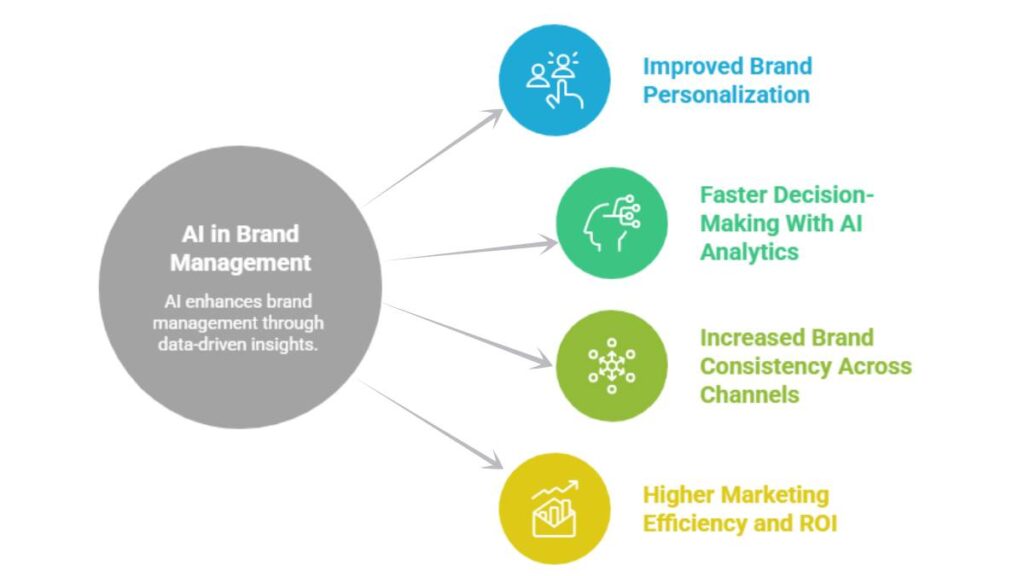
Improved Brand Personalization
Personalization has shifted from competitive advantage to baseline expectation.
Consumers now expect brands to understand preferences, anticipate needs, and deliver experiences that feel contextually relevant rather than generic. Static communication feels outdated very quickly.
AI makes this level of personalization possible at scale.
Brands can now adapt:
- Website experiences
- Product recommendations
- Email journeys
- Ad creative
- Messaging tone
- Customer support responses
- Loyalty offers
…based on behavioral signals and real-time interactions.
The important part is that personalization today goes beyond demographic segmentation. AI systems increasingly analyze intent patterns, engagement behavior, browsing habits, purchase cycles, and emotional signals to shape communication dynamically.
When done well, customers barely notice the technology behind it. The experience simply feels smoother.
But there’s a balance brands still struggle with.
Over-personalization can become uncomfortable fast. Consumers appreciate relevance, but not surveillance. The line between “helpful” and “creepy” is thinner than many companies realize.
The smarter brands tend to personalize selectively rather than aggressively.
Faster Decision-Making With AI Analytics
One of the biggest operational advantages of AI is speed.
Traditional brand analysis often involved delayed reporting cycles. Teams reviewed campaign results weekly or monthly, gathered customer feedback gradually, and adjusted strategy after trends had already shifted.
That pace doesn’t work very well anymore.
AI-powered analytics systems now provide near real-time insight into:
- Audience sentiment
- Campaign performance
- Emerging trends
- Customer retention risks
- Content engagement
- Brand perception changes
This allows teams to make adjustments earlier instead of reacting after momentum is lost.
Predictive analytics also improves strategic planning.
Brands can identify patterns before they become obvious externally:
- Declining engagement signals
- Category fatigue
- Shifting purchase intent
- Market saturation risks
- Audience migration patterns
Not perfect predictions, obviously. Human interpretation still matters heavily. But AI significantly reduces the lag between market movement and strategic response.
That responsiveness is becoming a serious competitive advantage.
Increased Brand Consistency Across Channels
Consistency sounds boring until a brand loses it.
Most consumers interact with brands across multiple touchpoints now:
- Social media
- Search
- Apps
- Customer support
- Creator partnerships
- Ecommerce experiences
- Video platforms
When tone, visuals, or messaging feel disconnected across those channels, trust weakens gradually.
AI helps brands maintain alignment at scale.
Automated systems can monitor brand assets continuously and flag inconsistencies related to:
- Visual identity
- Messaging tone
- Compliance standards
- Design systems
- Brand terminology
- Localization accuracy
This becomes especially valuable for enterprise organizations managing large distributed teams.
Without centralized oversight, fragmentation happens naturally over time.
AI governance systems don’t replace creative teams, but they reduce operational chaos considerably.
Higher Marketing Efficiency and ROI
This is the benefit most businesses notice first because the operational impact is immediate.
AI reduces time spent on repetitive branding and campaign tasks:
- Content adaptation
- Reporting
- Asset tagging
- Campaign testing
- Audience segmentation
- Workflow approvals
- Creative variations
That efficiency allows teams to spend more time on strategy, positioning, and creative direction rather than production bottlenecks.
Campaign experimentation also becomes faster.
Brands can test messaging variations, audience responses, creative formats, and channel strategies much more rapidly than traditional production cycles allowed. Faster iteration usually leads to stronger optimization over time.
But there’s an important nuance here.
Higher efficiency does not automatically create stronger branding.
Some companies mistake content volume for brand strength. The internet is already full of AI-generated content produced efficiently but remembered by nobody.
Efficiency matters. Distinctiveness matters more.
The best results usually come when AI improves operational speed while human teams protect originality and positioning.
Better Customer Engagement and Loyalty
Loyalty is increasingly tied to experience quality rather than just product quality.
Customers remember how brands make interactions feel:
- Easy
- Relevant
- Consistent
- Responsive
- Personalized
- Human
AI helps brands maintain those experiences continuously across large customer bases.
Predictive retention systems are becoming particularly valuable.
Brands can now identify signs of customer disengagement early and intervene proactively through personalized offers, support outreach, content recommendations, or loyalty incentives.
Emotional AI is another emerging layer.
Some systems now analyze emotional tone within customer interactions to improve support responses and communication timing. Still evolving technology, and definitely imperfect. But brands are investing heavily here because emotional perception strongly influences retention.
That said, emotional connection itself still comes primarily from brand meaning, trust, and shared identity. AI can support those relationships operationally. It doesn’t fully create them on its own.
Consumers still connect most deeply with brands that feel culturally aware, emotionally intelligent, and genuinely distinct.
Technology can amplify that.
It can’t fake it forever.
Challenges and Risks of AI in Brand Management
AI-Generated Brand Homogeneity
This is becoming one of the biggest branding problems online right now.
As more companies use the same AI systems trained on similar internet patterns, branding output starts converging. Similar language. Similar aesthetics. Similar campaign structures. Similar tone.
Everything becomes polished but strangely forgettable.
The issue isn’t that AI-generated content looks “bad.” Often it looks perfectly acceptable. That’s almost the problem. Acceptable branding rarely builds strong emotional memory.
Many AI systems naturally optimize toward patterns that already perform well statistically. Which means brands gradually drift toward the middle rather than developing distinctive positioning.
This is already visible across industries like:
- SaaS
- Ecommerce
- Wellness
- Productivity tools
- DTC brands
Same minimalist visuals. Same aspirational messaging. Same emotionally flattened tone.
Over-reliance on AI templates amplifies the issue further.
Without strong human direction, AI tends to recycle dominant category conventions instead of challenging them. And brands that sound interchangeable eventually compete mostly on price or convenience.
That’s not a great long-term position.
The companies standing out right now usually use AI operationally while protecting a very clear editorial and creative perspective.
Ethical Concerns in AI Branding
AI branding raises ethical questions that many companies are still figuring out in real time.
Transparency is one of the biggest.
Consumers increasingly want to know:
- Was this content AI-generated?
- Is this creator real?
- Is this interaction automated?
- Was this image synthetic?
- Is this recommendation personalized ethically?
Trust becomes fragile when audiences feel manipulated without disclosure.
Deepfakes and synthetic media make this more complicated.
AI-generated video and voice systems are improving rapidly. Brands can now create realistic synthetic spokespeople, cloned voices, and AI-generated personalities. Useful in some contexts, potentially damaging in others.
The risk isn’t just deception. It’s erosion of trust generally.
Once consumers start doubting what’s real, skepticism spreads across all brand communication.
That’s why responsible AI branding increasingly depends on transparency standards and internal governance, not just technical capability.
Data Privacy and Compliance Challenges
AI systems depend heavily on customer data.
And consumers are becoming much more aware of how their information is collected, tracked, and used.
Brands now operate under growing regulatory pressure related to:
- Customer consent
- Data storage
- AI decision-making
- Personalization transparency
- Cross-border data use
- Behavioral tracking
Regulations like GDPR already reshaped parts of digital marketing, and newer AI governance frameworks are expanding those expectations further.
The challenge is balancing personalization with privacy.
Customers want relevant experiences but also expect control over their information. Brands that ignore this tension risk damaging trust long term.
First-party data strategies are becoming more important partly because third-party tracking environments continue weakening globally.
But even with compliant systems, perception matters.
Consumers may react negatively if personalization feels excessively invasive, even when technically legal.
Bias in AI Branding Systems
AI systems inherit biases from training data, historical patterns, and human assumptions embedded within algorithms.
That creates serious branding risks.
Biased AI outputs can affect:
- Audience targeting
- Product recommendations
- Hiring representation
- Visual generation
- Language tone
- Customer segmentation
Representation issues in AI-generated visuals have already become a concern across fashion, beauty, and advertising industries. Certain demographics may be underrepresented, stereotyped, or portrayed inaccurately depending on the training data behind the systems.
Brands ignoring these issues risk public backlash very quickly.
Inclusive branding requires intentional oversight. AI alone doesn’t guarantee fairness automatically. Sometimes it reinforces existing imbalances instead.
Human review remains essential here.
Especially in global campaigns where cultural nuance matters heavily.
Human Creativity vs Artificial Intelligence
This conversation usually becomes too extreme in one direction or the other.
Some people claim AI will replace branding teams entirely. Others insist AI has no meaningful creative value at all.
Reality is somewhere in between.
AI is exceptionally good at:
- Speed
- Pattern recognition
- Data analysis
- Content variation
- Operational scale
- Repetitive execution
But branding depends on more than pattern prediction.
Strong brands often come from unconventional thinking, emotional tension, cultural instinct, timing, originality, and creative risk. AI struggles with those areas because it learns primarily from existing patterns rather than lived human context.
That’s why fully AI-generated branding often feels technically competent but emotionally thin.
Human judgment still matters most in:
- Brand positioning
- Narrative direction
- Emotional storytelling
- Cultural relevance
- Taste
- Strategic restraint
- Creative intuition
The strongest workflows emerging right now are hybrid models.
AI handles operational acceleration and analytical support. Humans shape perspective, originality, emotional resonance, and strategic direction.
That balance will probably define the next era of branding more than full automation ever will.

Enroll Now: Brand Management course
AI in Brand Management Use Cases and Real-World Examples
AI Brand Management Examples From Global Brands
The most interesting thing about AI adoption in branding right now is that the biggest companies are not using it in just one department anymore.
It’s spreading across the entire brand ecosystem.
Creative production, personalization, customer experience, product recommendations, audience analysis, media optimization, support workflows, even internal brand governance. The shift is becoming structural rather than experimental.
Some global brands are already operating this way at scale.
Nike and Generative AI in Creative Ideation
Nike has been exploring AI across product innovation, customer experience, and campaign ideation for a while now. But the more important shift is how AI supports speed inside the brand’s creative process.
Large brands like Nike produce massive volumes of content globally:
- Product launches
- Athlete campaigns
- Regional activations
- Ecommerce assets
- Social content
- Personalized app experiences
AI helps accelerate early-stage concept generation and audience analysis without fully replacing creative direction. That distinction matters.
The strongest Nike campaigns still feel emotionally human because the final storytelling layer remains culturally grounded and creatively led. AI supports the workflow. It doesn’t define the soul of the brand.
That’s usually where strong companies draw the line.
Coca-Cola and AI-Powered Creative Campaigns
Coca-Cola became one of the most visible examples of AI-generated advertising experimentation after integrating generative AI into campaign production and digital experiences.
Some campaigns leaned heavily into AI visuals and synthetic creativity. Reactions were mixed, honestly.
On one hand, the campaigns generated enormous attention because people were curious. On the other, many audiences felt parts of the execution looked too artificial or emotionally distant.
Which actually revealed something important about AI branding.
Consumers may appreciate innovation, but they still expect emotional texture from legacy brands. Especially brands built on nostalgia, familiarity, and human connection. If AI-generated experiences feel cold or overly synthetic, audiences notice immediately.
The takeaway wasn’t “AI doesn’t work.”
It was that AI needs stronger human creative restraint than many brands initially assumed.
Netflix and Personalization as Branding
Netflix rarely gets discussed as a brand management example, but it probably should.
Its recommendation engine isn’t just a product feature anymore. It’s part of the brand experience itself.
The platform continuously adapts:
- Content recommendations
- Visual thumbnails
- Viewing suggestions
- Engagement prompts
- Discovery pathways
…based on user behavior and predictive analysis.
Over time, that personalization shapes customer perception of the brand as intuitive and highly relevant. The product experience becomes the branding.
That’s happening across many industries now.
Brand management is no longer limited to campaigns and messaging. Increasingly, the customer experience itself defines the brand more than advertising does.
Sephora and AI-Driven Customer Experience
Sephora has integrated AI into beauty recommendations, virtual try-ons, customer support, and personalized shopping experiences.
This works particularly well in beauty because customers often want guidance before purchasing. AI helps simplify discovery while still making the experience feel tailored rather than transactional.
What Sephora does well is balancing technology with human-style interaction. The brand experience still feels aspirational and community-driven instead of purely automated.
That balance becomes increasingly important as more retail experiences become AI-assisted.
Because convenience alone rarely builds emotional loyalty.
AI Branding Strategies Used by Startups
Startups are adopting AI differently compared to enterprise brands.
Large organizations usually integrate AI gradually into existing systems. Startups often build entire operating models around AI from day one.
That changes the economics of branding significantly.
Small teams can now produce outputs that once required:
- Large creative departments
- Multiple agencies
- Dedicated research teams
- Expensive production cycles
- Specialized analytics infrastructure
A lean startup can launch with AI-assisted:
- Brand positioning research
- Visual identity development
- Product photography
- Social content production
- Customer segmentation
- Email automation
- Audience analysis
This dramatically lowers barriers to market entry.
But there’s a downside too.
Because AI makes launching easier, markets become saturated faster. Many AI-native startups end up looking and sounding nearly identical within months.
Especially in categories like:
- Productivity apps
- AI SaaS tools
- Wellness brands
- DTC ecommerce
- Creator platforms
Same minimalist design language. Same conversational tone. Same “future-focused” messaging.
The startups breaking through usually develop a very distinct point of view beyond AI-generated efficiency.
That’s becoming more valuable, not less.
B2B AI Brand Management Examples
B2B branding is changing quickly because decision-making behavior itself is changing.
Buyers increasingly research companies through AI-driven search systems, conversational interfaces, recommendation engines, and expert content ecosystems before ever speaking to sales teams.
Which means enterprise visibility now depends heavily on authority signals and informational trust.
AI helps B2B brands in several areas:
AI-Powered Thought Leadership
Enterprise companies are using AI-assisted workflows to scale educational content, research summaries, industry analysis, webinars, and expert commentary faster than before.
The key difference is that strong B2B brands still anchor this content in real expertise rather than generic AI-generated publishing.
Because enterprise buyers are skeptical. Very skeptical.
Surface-level content rarely builds trust in B2B environments anymore.
Enterprise Brand Positioning
AI systems help B2B companies analyze:
- Competitor positioning
- Industry narratives
- Buyer sentiment
- Sales objections
- Market gaps
- Category saturation
This allows companies to refine messaging based on actual customer language rather than internal assumptions.
Sometimes the gap between how brands describe themselves and how customers perceive them is surprisingly large.
AI analysis helps expose that disconnect faster.
Brand Visibility in AI Search Systems
B2B companies are also adapting content structures to improve visibility inside conversational AI platforms and AI-generated search experiences.
This includes:
- Clear expertise signals
- Structured informational content
- Entity consistency
- Research-backed publishing
- Topical authority development
Brands increasingly need to become understandable to AI systems, not just search engines or human readers.
That shift is quietly reshaping B2B content strategy already.
Best AI Tools for Brand Management
The AI branding landscape is becoming crowded very quickly.
Every week there seems to be another “AI brand platform” promising automation, personalization, predictive analytics, or fully autonomous marketing workflows. Most won’t matter long term. Some genuinely will.
The important thing is understanding that no single AI tool manages branding entirely.
Strong AI-powered brand systems usually combine multiple categories of tools depending on the business size, workflow complexity, and customer experience goals.
AI Brand Strategy Tools
Brandwatch
Used heavily for consumer intelligence and social listening.
Brandwatch helps companies monitor audience sentiment, conversations, trends, and brand perception across digital channels. Particularly useful for identifying emerging customer concerns before they escalate publicly.
One of the more valuable capabilities is pattern detection across large-scale conversation data. Helpful for positioning analysis and reputation monitoring.
Sprinklr
Sprinklr focuses heavily on enterprise customer experience management across multiple channels.
Large brands use it for:
- Social media operations
- Customer engagement
- Sentiment monitoring
- Workflow management
- Unified communication systems
It’s less about flashy AI generation and more about operational coordination at scale.
Qualtrics
Qualtrics remains important for customer experience analysis and perception research.
AI-enhanced feedback systems now allow brands to analyze emotional patterns, satisfaction drivers, and customer expectations more dynamically than traditional survey reporting methods.
Particularly useful for enterprise experience optimization.
AI Content and Creative Tools for Branding
This category exploded after generative AI became mainstream.
Some tools focus on writing. Others specialize in visuals, design systems, or multimedia production.
Jasper
Jasper is widely used for AI-assisted brand messaging, campaign ideation, and content scaling.
Many teams use it less for publishing finished content directly and more for:
- Draft generation
- Messaging variations
- Creative exploration
- Campaign adaptation
- Workflow acceleration
That’s usually the smarter approach.
Copy.ai
Popular among marketing teams needing scalable copy generation across sales, content, and customer communication workflows.
Useful for operational efficiency, though heavy human editing is still important if brands want to maintain a distinctive voice.
Otherwise everything starts sounding strangely interchangeable.
Canva
Canva integrated AI features aggressively over the last few years.
It now supports AI-assisted design generation, image editing, presentation workflows, and visual content production at scale. Particularly valuable for lean teams without large in-house design departments.
Adobe
Adobe’s AI integrations across creative workflows have become increasingly sophisticated.
Especially for:
- Image generation
- Video editing
- Asset scaling
- Design automation
- Creative production workflows
Enterprise creative teams often use Adobe AI systems more as accelerators than replacements.
The production gains can be substantial when managed properly.
AI Brand Asset and Governance Platforms
As content volume increases, brand governance becomes harder.
That’s where asset management and consistency systems matter more than most companies initially expect.
Frontify
Frontify focuses heavily on brand guideline management and design consistency.
Brands use it to centralize:
- Brand assets
- Style systems
- Visual guidelines
- Collaboration workflows
- Approval structures
AI-enhanced governance features now help monitor asset usage automatically across distributed teams.
Bynder
Bynder operates as a digital asset management platform with increasing AI functionality around organization, tagging, workflow automation, and content distribution.
Especially useful for global brands managing very large asset libraries.
Figma
Figma has evolved beyond collaborative design into broader product and brand system infrastructure.
AI-assisted design workflows inside Figma now support faster prototyping, asset generation, and interface experimentation while maintaining design consistency.
Still heavily human-led creatively, though. At least for strong design teams.
AI Analytics and Customer Insight Tools
This category often delivers more strategic value than content generation tools, honestly.
Because better decisions usually matter more than producing more assets.
HubSpot
HubSpot integrates AI into CRM workflows, customer segmentation, lead analysis, content recommendations, and campaign optimization.
Particularly valuable for mid-sized companies needing connected marketing and customer experience systems without overly complex enterprise infrastructure.
Salesforce
Salesforce continues expanding AI capabilities across customer data, predictive analytics, automation, and personalization systems.
Large enterprise brands rely heavily on it for customer journey orchestration and behavioral analysis at scale.
Google Analytics
Google Analytics remains foundational for customer behavior analysis, traffic interpretation, and engagement tracking.
AI-powered insights increasingly surface predictive trends automatically rather than requiring manual interpretation for every dataset.
Though interpretation still matters. Raw data alone rarely produces good branding decisions.
How to Build an AI-Powered Brand Management Strategy
Define Brand Goals Before Implementing AI
A surprising number of companies start with tools instead of strategy.
That usually creates messy branding very quickly.
Before introducing AI into workflows, brands need clarity around what they’re actually trying to improve:
- Brand awareness
- Customer engagement
- Retention
- Personalization
- Content production
- Reputation monitoring
- Operational efficiency
- Customer experience
Without clear priorities, AI often just increases output volume without improving brand quality.
And more content is not automatically better branding. Sometimes it’s just more noise.
The strongest AI-powered brand systems usually start with a few focused objectives tied directly to customer perception and business outcomes.
Not experimentation for the sake of experimentation.
Build a Strong Brand Data Foundation
AI systems are only as useful as the information feeding them.
Poor-quality customer data creates poor personalization, weak recommendations, inaccurate predictions, and fragmented experiences. Happens constantly.
Brands need structured first-party data systems capable of organizing:
- Customer behavior patterns
- Purchase history
- Engagement signals
- Support interactions
- Preference data
- Audience segmentation
- Content performance insights
This becomes especially important as third-party tracking environments continue weakening globally.
Many brands are now investing heavily in owned customer ecosystems partly because AI personalization depends increasingly on direct data relationships.
But data collection alone isn’t enough.
The information also needs to be usable operationally across teams and systems. Otherwise companies end up with fragmented intelligence trapped inside disconnected platforms.
Choose the Right AI Branding Tools
Tool selection should follow workflow needs, not hype cycles.
A common mistake is adopting too many disconnected AI systems at once. Teams end up overwhelmed with overlapping tools producing inconsistent outputs.
The better approach is usually gradual integration around specific operational gaps.
Questions worth asking before implementation:
- Does this tool improve decision-making or just speed?
- Will it integrate with existing workflows?
- Can teams realistically maintain it?
- Does it strengthen consistency or weaken it?
- Will it scale operationally over time?
- Does it protect brand identity properly?
Scalability matters more than flashy features.
Especially for enterprise brands managing multiple markets and large content ecosystems.
Create AI Brand Governance Policies
Governance is becoming one of the most important parts of AI branding strategy.
Because once AI systems begin generating large volumes of communication and creative assets, inconsistency risks increase quickly.
Strong governance policies typically define:
- Human review requirements
- AI usage boundaries
- Approval workflows
- Brand safety standards
- Disclosure policies
- Content escalation procedures
- Compliance expectations
The goal isn’t to slow down production unnecessarily.
It’s to maintain trust and consistency while scaling operations responsibly.
Brands without governance frameworks often drift into fragmented messaging surprisingly fast.
Combine Human Creativity With AI Efficiency
This is where most mature branding strategies are heading now.
Not fully automated branding. Not anti-AI resistance either.
Hybrid systems.
AI handles:
- Research acceleration
- Data analysis
- Workflow automation
- Content scaling
- Pattern recognition
- Operational efficiency
Humans lead:
- Positioning
- Storytelling
- Creative direction
- Emotional nuance
- Strategic judgment
- Cultural relevance
The combination tends to work better than either extreme individually.
Because branding still depends heavily on human instinct and perspective. AI can support those decisions, but not fully replace them in meaningful ways yet.
And honestly, consumers still respond most strongly to brands that feel emotionally real rather than mechanically optimized.
Optimize Brand Content for AI Search Engines
Search behavior is shifting rapidly toward AI-generated answers and conversational discovery systems.
Brands now need content that AI systems can interpret clearly and trust confidently.
That means moving beyond keyword-heavy publishing toward more structured informational ecosystems.
Strong AI-visible brand content typically includes:
- Clear topical depth
- Expert-led explanations
- Consistent entity references
- Well-structured information
- Original insights
- Strong credibility signals
- Accurate contextual relationships
Brands are also paying closer attention to structured data, semantic organization, and knowledge graph consistency because AI systems increasingly rely on entity understanding rather than isolated keywords alone.
This is where Generative Engine Optimization, or GEO, starts becoming relevant.
The goal is no longer just ranking pages.
It’s becoming part of the information layer AI systems pull from when generating answers, recommendations, and summaries.
That changes brand visibility completely.
AI in Brand Management and SEO
How AI Search Engines Interpret Brands
AI-driven search systems don’t interpret brands the same way traditional search engines did.
Older search systems focused heavily on keywords, backlinks, and page relevance. Those factors still matter, but AI-generated search experiences evaluate broader contextual relationships now.
Brands are increasingly interpreted as entities rather than just websites.
That includes understanding:
- What the brand represents
- Which topics it’s associated with
- How consistently it’s referenced
- Whether it’s trusted
- Which sources mention it
- What customers say about it
- How authoritative its content appears
This creates a much more interconnected visibility environment.
A brand’s reputation now extends across articles, reviews, discussions, podcasts, social platforms, creator mentions, community conversations, and structured data ecosystems simultaneously.
AI systems synthesize all of it together.
That means branding, reputation, content strategy, and search visibility are becoming deeply interconnected rather than separate functions.
AI Overviews and Brand Visibility
Google AI Overviews changed how information appears inside search results.
Instead of simply displaying links, search systems increasingly summarize information directly inside generated responses. ChatGPT, Gemini, and Perplexity operate similarly in conversational formats.
This changes visibility dynamics significantly.
Brands now compete not only for rankings, but for inclusion inside AI-generated summaries and recommendations.
The difference matters because users increasingly consume answers without clicking multiple websites.
Brands appearing consistently inside AI-generated responses tend to gain stronger perceived authority over time.
Several factors influence this visibility:
- Consistent topical expertise
- Strong citation signals
- Clear informational structure
- Trusted references
- Brand mention frequency
- Accurate entity relationships
- Expert-driven content ecosystems
Brand mention optimization is becoming increasingly important because AI systems rely heavily on contextual association patterns across the broader web.
In simple terms, brands need to become recognizable informational authorities, not just publishers of content.
Generative Engine Optimization (GEO) for Brands
GEO is emerging because traditional search optimization alone no longer fully explains how AI-generated discovery works.
Search engines increasingly generate answers rather than simply organizing links.
That changes the objective.
Traditional SEO focused heavily on rankings and clicks.
GEO focuses more on becoming part of AI-generated responses themselves.
This includes:
- Entity clarity
- Contextual authority
- Structured expertise
- Citation potential
- Information reliability
- Cross-platform consistency
- Conversational relevance
AI systems prefer information that feels trustworthy, structured, and contextually complete.
Thin content struggles increasingly in these environments because AI systems synthesize broader understanding rather than matching isolated keywords.
Brands investing in deep topical ecosystems, research-backed publishing, and expert-driven educational content are generally adapting more effectively to this shift.
Content Strategies That Improve AI Brand Visibility
The content strategies working best in AI-driven discovery environments usually prioritize depth and clarity over pure volume.
Several patterns are emerging consistently.
Expert-Led Content
AI systems increasingly prioritize content tied to expertise and authority signals.
That includes:
- Specialist insights
- Research-backed analysis
- Industry expertise
- Original commentary
- Technical depth
- Real-world examples
Generic summaries are becoming less valuable because AI systems can generate those instantly already.
Original Research and Statistics
Original data creates stronger citation potential.
Brands publishing:
- Surveys
- Industry benchmarks
- Consumer research
- Trend analysis
- Proprietary insights
…often gain stronger visibility because AI systems look for differentiated informational value.
Consistent Topical Authority
Scattered publishing rarely builds strong authority anymore.
Brands performing well tend to develop deep content ecosystems around clearly defined expertise areas rather than chasing disconnected trends constantly.
Consistency compounds over time.
Conversational and Answer-Focused Content
AI-generated discovery environments favor content that explains concepts clearly and directly.
Dense corporate language performs poorly compared to structured, genuinely useful explanations written with actual reader intent in mind.
Which, interestingly enough, pushes branding back toward clarity and substance rather than pure optimization tactics.
Probably a good thing overall.
Future Trends of AI in Brand Management
AI Agents Managing Brand Operations
The conversation around AI in branding is shifting again. A year or two ago, most companies were focused on content generation. Faster blogs, faster ads, faster captions. That phase is still happening, obviously, but something else is creeping in underneath it.
Operations.
AI agents are slowly becoming part of day-to-day brand management workflows. Not in a dramatic “robots replacing marketers” way. More quietly than that. Teams are using AI systems to monitor campaigns, flag sentiment changes, adjust targeting suggestions, organize reporting, even recommend messaging tweaks before performance drops become obvious.
And honestly, this makes sense. Modern brand management became too fragmented for purely manual oversight a while back.
A single campaign now touches:
- social platforms
- paid media
- customer support
- creator partnerships
- ecommerce experiences
- search visibility
- community reactions
- AI search engines
Everything moves at once. Constantly.
So brands are starting to rely on AI systems to spot patterns humans would probably miss at scale. Or miss too late.
Still, there’s a weird tension here. Brands that automate too aggressively often start sounding strangely flat. Efficient, yes. But forgettable. Like every interaction was polished by the same machine.
That’s going to become a bigger issue over the next few years.
Hyper-Personalized Brand Experiences
Consumers got used to personalization very quickly. Faster than most brands expected, actually.
Now, generic experiences feel broken.
People expect brands to remember preferences, understand context, recommend relevant products, adjust messaging naturally, maybe even anticipate intent before it’s explicitly stated. Sometimes that expectation is reasonable. Sometimes not. But it’s there.
AI is making this level of personalization possible at scale.
Instead of broad demographic targeting, brands can now adapt experiences based on:
- browsing behavior
- purchase patterns
- engagement history
- timing signals
- location context
- customer intent indicators
- predicted behavior shifts
Two people visiting the same website might see completely different experiences. Different product recommendations. Different homepage messaging. Different offers. Even different visual emphasis.
That level of adaptation used to be an extremely difficult operation.
But there’s also a point where personalization starts feeling… uncomfortable. Too precise. Too predictive.
And consumers notice that instantly.
The brands that win here probably won’t be the ones with the most aggressive personalization engines. It’ll be the ones that understand restraint. Relevance without crossing into surveillance vibes. Hard balance to get right, honestly.
Voice AI and Conversational Branding
Voice branding is becoming more important than many companies realize.
Not just smart speakers either. Customer support systems, AI assistants, conversational commerce, audio interfaces, even branded AI agents. More customer interactions are happening through conversation instead of traditional interfaces.
Which changes branding quite a bit.
A brand voice used to mean copy guidelines and tone documents. Now it increasingly means:
- how the brand responds
- pacing of conversation
- emotional tone
- clarity
- empathy
- conversational rhythm
And awkward conversational experiences stand out immediately.
Consumers are surprisingly sensitive to unnatural interactions. One robotic response can damage trust faster than a mediocre visual campaign ever could.
That’s why conversational branding is becoming its own strategic category now. Brands are realizing that speaking naturally at scale is harder than it sounds.
Especially when AI enters the picture.
Synthetic Media and Virtual Brand Identities
Synthetic influencers used to feel like a novelty. Now they’re becoming part of actual marketing strategies.
Fashion, beauty, gaming, ecommerce, entertainment… these industries are moving quickly into AI-generated media because the economics are attractive:
- lower production costs
- faster content creation
- easier localization
- complete visual control
- scalable campaigns
But audiences are getting more skeptical too.
Consumers don’t necessarily hate synthetic content. That part gets overstated sometimes. What people react negatively to is deception. Feeling manipulated. Feeling like authenticity is being faked instead of reimagined honestly.
That distinction matters.
Some virtual influencers perform surprisingly well because audiences understand the concept upfront. It’s transparent. Almost entertainment-first. Problems usually start when brands blur the line too aggressively between artificial and human identity.
Trust erodes fast once audiences feel tricked.
And rebuilding trust is expensive. Usually slower than executives expect.
AI Governance and Brand Trust
Governance sounds boring until a brand crisis happens. Then suddenly everyone cares.
As AI becomes more integrated into customer-facing experiences, governance is becoming part of brand perception itself. Consumers increasingly want to know:
- how data is used
- whether content is AI-generated
- who reviews automated decisions
- whether systems are biased
- how transparent the brand is being
This isn’t just a legal issue anymore. It’s reputational.
Brands that appear careless with AI usage are starting to face pushback much faster than before. Especially among younger audiences who are very aware of synthetic media and algorithmic manipulation.
The companies handling this best usually build clear internal rules around:
- human oversight
- disclosure standards
- ethical boundaries
- content review
- customer data handling
Not because regulation forced them to. Because trust became commercially important.
Big difference.
Human Creativity vs AI in Brand Management
What AI Does Better Than Humans
Some branding tasks are simply better handled by AI now. That’s the reality.
Especially repetitive analytical work.
AI is extremely effective at:
- processing huge datasets
- identifying behavioral patterns
- scaling personalization
- automating workflows
- generating content variations
- spotting performance anomalies
- speeding up operational execution
Humans get tired. AI systems don’t.
A campaign analyst might manually review patterns across dozens of audience segments. AI can process thousands simultaneously and surface trends almost instantly. That operational advantage is real.
The same goes for repetitive production work. Asset resizing, message adaptation, campaign testing, reporting workflows… AI removes a lot of tedious execution bottlenecks.
Which honestly frees teams to spend more time on strategic thinking instead of mechanical tasks. At least in theory.
What Humans Still Do Better
This part gets overlooked constantly.
Branding isn’t just optimization. It’s interpretation.
The strongest brands usually succeed because they understand emotion, tension, timing, identity, aspiration, culture. Those things are messy. Human. Sometimes irrational.
AI still struggles with that depth.
Emotional Storytelling
AI can imitate emotional language surprisingly well now. But emotional storytelling is more than language patterns.
Real brand storytelling depends on:
- context
- timing
- subtext
- contradiction
- restraint
- emotional intuition
The best campaigns often work because they capture something culturally true at exactly the right moment. Not because the copy was technically efficient.
Audiences feel the difference, even when they can’t explain it clearly.
Cultural Nuance
Culture changes unevenly. Fast in some places, slowly in others.
A phrase, visual, or campaign tone that feels relevant in one audience can feel completely off somewhere else. Human strategists still interpret nuance better than automated systems, especially during emotionally sensitive moments.
That instinct matters more than companies sometimes admit.
Brand Taste
This is becoming a huge differentiator now.
As AI-generated branding becomes more common, many brands are starting to look strangely similar. Same visual softness. Same startup tone. Same polished minimalism. Same predictable messaging structure.
Taste is what breaks that sameness.
Good creative teams know when to simplify, when to hold back, when to introduce tension, when to avoid trends entirely. AI generally optimizes toward recognizable patterns because that’s how the systems are trained.
Originality usually requires intentional deviation from patterns.
Humans still drive that.
Why Hybrid AI + Human Branding Models Win
The strongest approach emerging right now isn’t anti-AI or fully automated branding.
It’s collaboration.
AI handles:
- scale
- speed
- analysis
- workflow efficiency
- operational execution
Humans lead:
- positioning
- storytelling
- emotional intelligence
- cultural understanding
- strategic judgment
- creative direction
That balance tends to produce stronger outcomes than either extreme alone.
Brands leaning too heavily into automation often become generic over time. But brands refusing AI completely risk moving too slowly in increasingly competitive markets.
The middle ground is where most sustainable brand systems are heading.
Not because it sounds balanced theoretically. Because operationally, it works better.
Is AI in Brand Management Worth It for Businesses?
Benefits for Small Businesses and Startups
For startups, AI changes the economics of branding quite a bit.
A small team can now do things that previously required agencies, analysts, production teams, designers, and expensive infrastructure. That’s a major shift.
AI helps smaller businesses:
- launch faster
- test messaging quickly
- produce content efficiently
- analyze customer behavior
- automate support
- personalize communication
- monitor brand perception
Which lowers the barrier to entry in many industries.
But there’s a tradeoff people don’t talk about enough.
When everyone has access to similar AI systems, differentiation gets harder. Markets fill up with brands that sound vaguely identical. Similar positioning language. Similar aesthetics. Similar “smart casual” brand tone.
Consumers notice eventually.
The startups standing out right now usually combine operational efficiency with a very distinct point of view. Something recognizably human underneath the automation.
That layer matters more than ever.
Benefits for Enterprise Brands
Large brands have a completely different problem: complexity.
Enterprise organizations manage massive ecosystems:
- multiple regions
- global campaigns
- thousands of assets
- large customer datasets
- distributed teams
- cross-channel communication
- compliance requirements
AI helps reduce operational fragmentation.
Particularly around:
- personalization at scale
- asset management
- predictive analytics
- campaign coordination
- customer experience consistency
- reputation monitoring
For enterprise companies, AI is often less about replacing people and more about reducing inefficiency between systems.
And inefficiency becomes extremely expensive at scale.
Large brands also benefit from earlier pattern detection. AI systems can surface consumer behavior changes before they become obvious in traditional reporting cycles. That responsiveness matters in fast-moving markets.
Industries Seeing the Biggest AI Branding Impact
Some industries are moving faster than others here.
Ecommerce
Probably one of the clearest examples.
AI now shapes:
- product recommendations
- shopping experiences
- pricing systems
- customer support
- retention campaigns
- merchandising
For many ecommerce brands, the buying experience itself has become the branding.
SaaS
Software companies rely heavily on AI for onboarding, personalization, customer education, and lifecycle marketing.
Especially in crowded markets where product differentiation alone isn’t enough anymore.
Fashion
Fashion brands are using AI for:
- trend forecasting
- virtual campaigns
- synthetic models
- creative testing
- personalization
Though fashion still depends heavily on instinct and cultural relevance. More than pure optimization.
Beauty
Beauty brands benefit strongly from personalized recommendations and conversational customer experiences. Trust matters heavily in this category, so AI systems work best when they feel assistive rather than overly sales-driven.
Media and Entertainment
Streaming platforms and entertainment brands increasingly use predictive systems to shape discovery experiences. Recommendation engines now influence how audiences perceive the brand itself.
That’s a big shift.
Consumer Packaged Goods (CPG)
CPG companies use AI heavily for audience analysis, retail forecasting, campaign optimization, and sentiment tracking across massive datasets.
Especially useful in saturated categories where tiny perception shifts can influence buying behavior.
Conclusion
Key Takeaways on AI in Brand Management
AI is changing brand management at a much deeper level than many companies initially expected.
At first, most discussions focused on content generation. Faster campaigns. Faster copy. Faster production workflows.
But the real transformation is broader than that.
AI is reshaping:
- customer experience
- personalization
- brand operations
- audience analysis
- search visibility
- reputation management
- creative workflows
- strategic decision-making
And honestly, branding is becoming more fluid because of it.
Consumers now expect brands to respond quickly, understand context, communicate consistently, and feel personally relevant almost all the time. AI helps companies operate at that speed.
But speed alone doesn’t build strong brands.
That’s the important part.
As more companies adopt similar AI systems, sameness becomes a real problem. Audiences are already seeing endless polished-but-forgettable content online. Generic positioning is everywhere now.
Which means originality matters more, not less.
The strongest brands moving forward will probably be the ones that combine:
- operational efficiency
- clear identity
- emotional intelligence
- creative restraint
- human perspective
- trustworthy experiences
Not the ones producing the most automated output.
Final Thoughts on the Future of AI Branding
The future of branding likely won’t belong to fully automated companies.
It’ll belong to brands that know how to stay emotionally recognizable inside increasingly automated environments.
That’s harder than it sounds.
Consumers are becoming more sensitive to authenticity, trust, transparency, and originality precisely because AI-generated experiences are becoming so common. Strange dynamic, really.
The more artificial the internet becomes, the more valuable genuinely human brands may feel.
And maybe that’s the deeper shift happening underneath all this technology.
AI is changing how brands operate, yes.
But it’s also forcing companies to rethink what makes a brand feel real in the first place.
FAQs:
What is AI in brand management?
AI in brand management is really about helping brands react smarter and faster without losing direction in the process. A lot of people reduce it to “automation,” but that’s only part of it. The bigger shift is visibility. Brands can now notice customer behavior changes earlier, catch sentiment shifts before they grow, and maintain consistency when campaigns are running across ten places at once. Which, honestly, became difficult to manage manually a while ago.
How is AI used in branding?
Most companies are already using AI in some form, even the ones claiming they aren’t. Sometimes it sits quietly inside analytics systems or customer support workflows. Other times it shapes personalization, campaign testing, audience targeting, and content production directly. The interesting part is how invisible it has become. Customers usually notice bad automation immediately, but they rarely notice good implementation at all.
What are the best AI tools for brand management?
There’s no universal answer anymore because branding problems vary so much from business to business. Some teams need stronger audience intelligence. Others care more about workflow management or content scaling. And honestly, many brands waste time chasing trendy platforms instead of fixing basic operational gaps first. The better approach is usually building a stack that actually fits the company’s communication habits and internal structure.
Can AI replace brand managers?
Probably not in the complete sense, people keep debating online. AI can absolutely speed up research, automate repetitive execution, and surface useful patterns quickly. But branding decisions are rarely just logical exercises. Timing matters. Emotion matters. Taste matters too, even if marketers don’t always say that openly. Strong brand strategy often comes from instinct mixed with experience, and machines still struggle with that layer.
How does AI improve brand consistency?
Consistency becomes surprisingly hard once a brand scales across regions, platforms, agencies, and internal teams. Messaging slowly drifts. Visual styles shift. Tone changes without anyone noticing immediately. AI helps by continuously checking patterns across communication channels and flagging inconsistencies earlier. Not glamorous work, maybe, but important. Consumers usually feel inconsistency emotionally before they consciously recognize what’s causing the disconnect.
What are the risks of AI in branding?
The biggest problem right now is sameness. A lot of AI-assisted branding already feels strangely blended together. Similar pacing, similar tone, same polished confidence everywhere. Beyond that, there are concerns around privacy, bias, synthetic content, and over-automation. Consumers generally tolerate imperfections better than brands expect. What they react against is communication that feels empty, engineered, or emotionally detached from actual people.
How does AI affect customer perception of brands?
When implemented carefully, AI can make a brand feel more responsive and useful. Faster support, smarter recommendations, smoother experiences. That part works. But audiences are also becoming more sensitive to artificial-feeling interactions. Robotic replies, overly predictive messaging, generic personalization… people pick up on it fast. There’s a thin line between convenience and discomfort now, and many brands still misread where that line actually sits.
What is Generative Engine Optimization (GEO)?
Generative Engine Optimization, or GEO, is basically the shift toward making brands visible inside AI-generated answers rather than only traditional search rankings. Discovery behavior is changing pretty quickly. More people now ask conversational questions directly to AI systems instead of clicking through multiple websites manually. So brands increasingly need content that feels trustworthy, structured clearly, and easy for AI systems to interpret correctly.
How can brands rank in AI Overviews?
Brands appearing consistently in AI Overviews usually demonstrate depth and clarity around a topic. Thin promotional content doesn’t perform particularly well there. AI systems tend to prioritize information that answers questions directly, references credible sources naturally, and stays topically consistent over time. Brand authority also matters more now because AI-generated summaries often rely heavily on trusted mentions and contextual relevance signals.
Is AI branding good for small businesses?
For smaller companies, AI can remove a lot of operational friction. Lean teams can create faster, test ideas quicker, and compete more efficiently without massive budgets behind them. But there’s another side to it. Since everyone now has access to similar systems, differentiation becomes harder. A small brand still needs a strong point of view. Otherwise everything starts blending into the same digital noise.
How do brands maintain authenticity while using AI?
The brands handling this well usually keep humans deeply involved in strategic and creative decisions. AI can support execution, absolutely, but authenticity tends to come from judgment and perspective rather than efficiency alone. Audiences notice when communication feels overly manufactured. Maybe not instantly every time, but eventually. Strong branding still depends on emotional texture, small imperfections, and a sense that real thinking exists behind the messaging.
What industries benefit most from AI brand management?
Ecommerce, SaaS, beauty, retail, fashion, and entertainment are moving especially fast here because customer interaction happens constantly in digital environments. AI helps these industries personalize experiences, analyze behavior, and respond quicker to changing preferences. Retail is particularly interesting because branding now happens through recommendations, support interactions, delivery experiences, and algorithms almost as much as through traditional advertising itself.
How does AI help with brand monitoring?
AI makes reputation tracking much more immediate than older monitoring methods. Instead of manually reviewing conversations or waiting for reports, brands can detect sentiment changes while they’re happening. That speed matters more than companies sometimes realize. Small complaints can snowball very quickly online now, especially when ignored early. Often the slow response creates more damage than the original issue ever did.
What are AI agents in branding?
AI agents are basically systems that can handle ongoing operational tasks with limited manual involvement. In branding, that might include monitoring campaigns, organizing workflows, analyzing customer behavior, or recommending adjustments automatically. Sounds futuristic when phrased dramatically, but parts of this already exist quietly inside larger companies. Mostly on the operational side for now, not full strategic decision-making. At least not yet.
Will AI-generated brands dominate in the future?
AI-generated brands will definitely become more common, but total dominance feels unlikely. Consumers still connect more deeply with originality and emotional perspective. Fully automated branding often becomes efficient but forgettable after a while. There’s a certain predictability that creeps in. The brands people remember usually communicate something slightly imperfect, distinct, maybe even irrational at times. Machines still struggle to create that naturally.
What role does AI play in customer experience and brand loyalty?
AI improves customer experience mainly through responsiveness and relevance. Better recommendations, smoother support, more adaptive communication. Those things absolutely help loyalty. But loyalty isn’t built only through efficiency. Customers also want trust, emotional comfort, familiarity. If automation starts feeling invasive or emotionally flat, engagement quietly drops off. Sometimes brands don’t notice until retention numbers begin slipping months later.
How does AI improve brand decision-making and market research?
AI helps process massive amounts of consumer and market data far faster than traditional research workflows ever could. That allows teams to notice trends, behavioral shifts, and campaign patterns earlier. Useful advantage, obviously. But raw analysis still needs interpretation. Strong decisions usually come from combining analytical insight with human understanding of culture, timing, emotional context, and customer psychology. Data alone rarely tells the full story.
Can AI-generated content maintain a consistent brand voice?
To a degree, yes. AI systems are actually quite effective at following tone structures and messaging rules when clear guidelines exist. The problem appears later. Consistency without personality eventually starts feeling repetitive. Strong brand voices usually contain nuance, restraint, and little unpredictable touches that make communication feel alive. That’s harder to automate because memorable brands rarely sound perfectly optimized all the time.
How can businesses balance AI automation with authentic branding?
The healthiest balance usually comes from separating operational efficiency from brand identity itself. AI can handle repetitive execution, analysis, reporting, and workflow acceleration very effectively. But positioning, storytelling, emotional direction, and trust-building still need human leadership involved consistently. Otherwise brands risk becoming technically efficient while slowly losing the distinct personality that made people care about them in the first place.