

Picture two brands selling almost the same product. One disappears the moment your payment clears. The other answers your question, reads your feedback, and makes you feel like your opinion counted. Six months later, which one do you remember?
That gap is the whole reason brand engagement strategies exist. Getting attention isn’t hard anymore, and it isn’t worth much either. A reel gets watched, scrolled past, forgotten. A relationship sticks.
Customers also expect more than they used to. Social media taught them to expect a reply. AI taught them to expect relevance, and to notice when automation feels cold. Every brand you compete with is being compared to the best experience that person ever had.
Below you’ll find 15 strategies with real examples, a short section on measurement, the mistakes that quietly waste effort, and a 30-day plan. The point isn’t collecting likes and comments. It’s creating experiences people actually remember.
Table of Contents
What Is Brand Engagement and Why Does It Matter?
Brand engagement is the ongoing, two-way relationship between a brand and its audience. It’s built through every interaction before, during and after a purchase, and it shows up as attention, participation, trust and repeat choice, not just clicks.
Understanding the Meaning of Brand Engagement
Think of it as the sum of how people feel about you and how they act around you. The feeling side is emotional: do they trust you, like your tone, see themselves in your story? The action side is practical: do they reply, share, come back, recommend you?
Interactions count at every stage. Before a purchase, it’s the helpful post or the quick answer to a pre-sales question. During it, it’s a checkout that doesn’t fight the buyer. After it, it’s the follow-up, the support, the invitation to say what they thought. Customer brand engagement is usually decided in those small, ordinary moments, rarely in the big campaign. A real emotional connection with customers comes from reliability repeated, not from one clever ad.
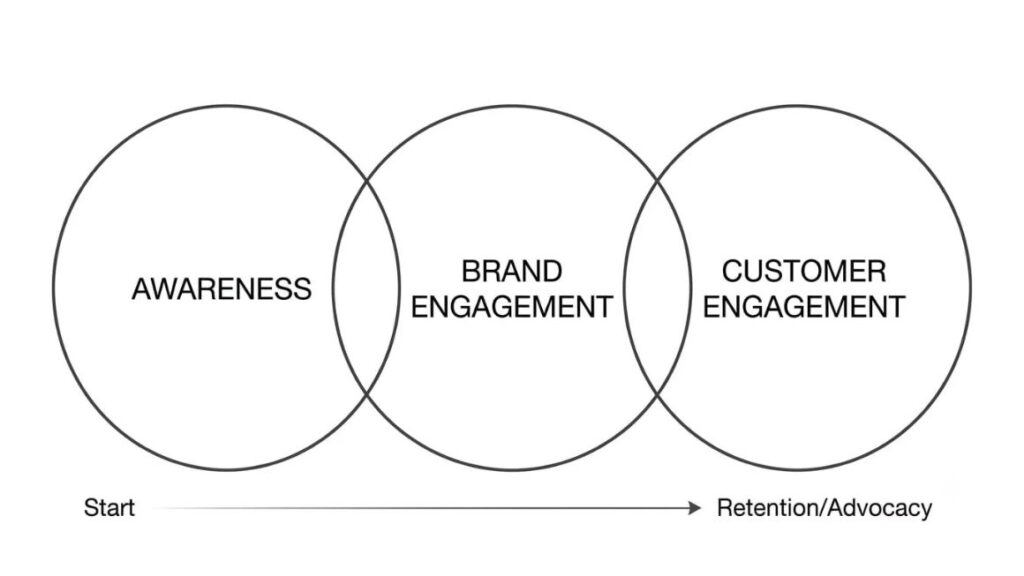
Brand Engagement vs. Brand Awareness vs. Customer Engagement
The three terms get mixed up constantly, so here’s the short version.
| Concept | What it means |
| Brand awareness | People recognise or remember your brand. |
| Brand engagement | People actively interact with and connect with your brand. |
| Customer engagement | People interact with your business across their customer journey. |
Awareness is the doorway. Engagement is what happens once someone steps through. Treat brand awareness and engagement as two stages of one journey and you’ll stop judging a trust-building campaign by reach alone. Customer engagement strategies sit wider still, covering support, onboarding and retention across the whole relationship, while brand engagement focuses on how people feel about the brand itself.
Why Engagement Is Important for Businesses
Sprout Social’s 2025 Index found that consumers value authenticity and relatability above everything else in the brands they follow, and about half say original content is what makes a favourite brand stand out. That’s the business case in one line: people reward brands that feel real.
In practice it means five things. Trust builds, and trusted brands get the benefit of the doubt when something goes wrong. Retention improves, because people with a relationship have fewer reasons to leave. Recommendations rise, since nobody recommends a faceless company. Differentiation gets easier when your product looks a lot like a competitor’s. And growth turns steadier, because you’re building on customers who already know you instead of starting from zero every month. Good brand engagement strategies are really just a way of making all five happen on purpose.
Also Read: Brand Marketing Strategy for 2026 Success
Brand engagement is the ongoing two-way relationship between a brand and its audience, built across the full purchase journey. It differs from awareness because it needs people to act, not just recognise. Sprout Social’s 2025 Index found consumers value authenticity and relatability most in the brands they follow.
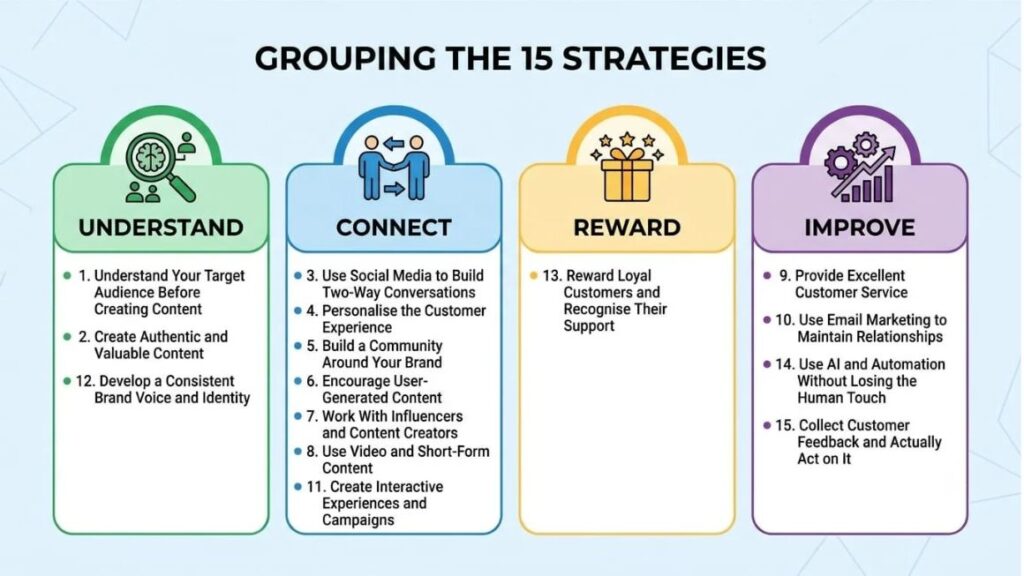
15 Effective Brand Engagement Strategies to Build Stronger Brand Relationships
The most effective brand engagement strategies start with knowing your audience, then add useful content, real conversations, personalisation, community, loyalty rewards and honest feedback loops. Pick three, run them properly, measure the results, and add more only when the first three are working.
1. Understand Your Target Audience Before Creating Content
Most weak content starts with the brand’s agenda instead of the customer’s problem. Flip it. Write down what your customers need, what keeps annoying them, and what they keep asking your support team. Then check it against data: website behaviour, social comments, surveys, a handful of real customer conversations.
Spotify is the clean example. It uses listening behaviour to shape recommendations and experiences, so people feel recognised instead of marketed to.
Try this: build two or three audience personas, and tie each content idea to a real problem that persona has. Not demographics. Problems.
2. Create Authentic and Valuable Content
Useful beats polished, almost every time. Educational posts, behind-the-scenes stories, entertaining bits and customer-led storytelling all work when they respect the reader’s time. What kills them is inconsistency. If Monday’s post sounds like a friend and Thursday’s sounds like a legal notice, people notice.
Quick tip: balance educational, entertaining, community-driven and promotional content. When every post is a sales pitch, nobody listens to the one that actually matters.
3. Use Social Media to Build Two-Way Conversations
Posting isn’t a conversation. Replying is. Answer comments, respond to messages, ask questions people can really answer, run a poll when you genuinely want the result, and join discussions already happening in your space. Then choose platforms by where your audience behaves, not where a trend report says you should be.
Social media brand engagement also rewards personality. Duolingo’s playful, deliberately offbeat tone, built around its owl mascot, shows how a distinctive voice turns a feed full of ads into something people recognise instantly.
4. Personalise the Customer Experience
McKinsey’s 2021 research found that 71% of consumers expect personalised interactions and 76% get frustrated when they don’t get them. Nothing since suggests that has softened. Personalisation can be simple: recommendations based on behaviour, emails tied to what someone browsed or bought, offers that reflect purchase history.
Amazon is the textbook case. Its recommendation system has used customers’ purchase histories to suggest related items for more than two decades. Just be careful. Personalisation that feels like surveillance backfires, so collect only what you need, say why, and respect privacy.
5. Build a Community Around Your Brand
A community gives customers a reason to show up even when you aren’t selling anything. Start small: a Facebook or WhatsApp group, a monthly live session, a space where customers answer each other’s questions. Then give your most loyal people a real role, like early feedback or a say in what comes next.
LEGO Ideas does this at scale. Fans submit their own designs, other fans vote, and projects that reach 10,000 supporters get reviewed by LEGO for a chance to become official sets.
Also Read: Social Media Marketing for Small Businesses: A Complete Practical Guide
6. Encourage User-Generated Content
Customers trust other customers more than they trust your ad copy. Reviews, photos, videos, customer stories and hashtag campaigns all count, as long as you feature them properly.
GoPro leaned into this early. Its GoPro Awards programme, launched in 2015, paid creators for standout photos and video shot on its cameras: $500 for photos, $1,000 for raw video and $5,000 for edited clips.
Try this: run a campaign inviting customers to show how they use your product. Always get permission before featuring anyone’s content.
7. Work With Influencers and Content Creators
Follower count has become a poor shortcut. Sprout Social’s 2026 Influencer Marketing Report, based on a May 2026 survey of 2,250 social media users across the US, UK and Australia, found that only 17% of consumers consider follower count when deciding whether to follow a creator. Topic fit and community relevance matter more. It also found that 60% of Instagram Reels reach audiences made up mostly of non-followers.
So choose creators whose audience matches yours, think in long-term partnerships rather than one-off posts, give micro-influencers a serious look, and track conversions, not just views. The same report found only 24% of companies design influencer campaigns around revenue outcomes. That’s a gap worth closing.
8. Use Video and Short-Form Content
Short video is where a lot of attention lives now. In India, the IAMAI and Kantar Internet in India 2025 report counted 588 million people, about 61% of internet users, consuming short-form video. Instagram Reels and YouTube Shorts suit product demonstrations, quick lessons and customer testimonials, and TikTok can work where it’s available and relevant.
Actionable tip: turn one useful topic into a short video, an infographic and a carousel post. One idea, three formats, far more mileage from the same thinking.
9. Provide Excellent Customer Service
Service is engagement in its least glamorous form, and probably the most convincing. Reply quickly, explain clearly what’s happening, resolve the complaint, then follow up afterwards. That’s what customer experience strategies look like at their most basic, and plenty of brands still fumble it.
Zappos built its reputation here. In a 2010 Harvard Business Review piece, CEO Tony Hsieh wrote that Zappos didn’t hold reps accountable for call times and didn’t push upselling, and that the company treated free shipping and its 365-day returns policy as a marketing expense.
10. Use Email Marketing to Maintain Relationships
Email still does the quiet work. A welcome email sets the tone. Educational newsletters earn their inbox space. Personalised recommendations and post-purchase messages show you’re paying attention, and a re-engagement campaign can wake up people who drifted.
Segment, though. Sending one email to everyone is the fastest way to teach people to ignore you. Actionable tip: group subscribers by interest and behaviour, starting with three segments such as new subscribers, recent buyers and lapsed customers.
11. Create Interactive Experiences and Campaigns
Some engagement is built to be played with. Quizzes, polls, contests, challenges, interactive product demos and online events all pull people in because they ask for participation, not just attention.
Spotify Wrapped is the high-water mark. Spotify said Wrapped 2025 reached more than 200 million engaged users in roughly 24 hours, with over 500 million shares. Worth knowing: Spotify counts someone as engaged if they viewed at least one story, which is a generous definition. Even so, turning personal data into something people want to show off is an idea any brand can borrow in a smaller form.
12. Develop a Consistent Brand Voice and Identity
People should be able to tell it’s you with the logo covered. That takes a consistent voice, recognisable visuals, a relatable personality, and the same tone across your website, social media, email and ads.
Quick tip: write a one-page brand voice guide covering how you speak, the language you use, and what you’d never say. Share it with everyone who writes for you, freelancers and agencies included.
13. Reward Loyal Customers and Recognise Their Support
Reward people for staying. Loyalty programmes, early access, exclusive offers, referral incentives and simple thank-you campaigns all count as brand loyalty strategies, and none of them has to be expensive.
Starbucks is a useful study. It relaunched Starbucks Rewards on 10 March 2026 with Green, Gold and Reserve tiers, and CEO Brian Niccol said the programme needed to be about engagement, personalisation and recognition rather than coupons. Starbucks reported 35.6 million 90-day active US members in its second quarter of fiscal 2026. Closer to home, Nykaa said its One Nykaa loyalty programme crossed 66 million customers in the fourth quarter of FY26.
14. Use AI and Automation Without Losing the Human Touch
AI can make engagement faster and more relevant. It can also make a brand feel like nobody’s home. The difference is how you use it.
Good uses include AI-supported customer service, automated email journeys, personalised recommendations, and social listening with sentiment analysis. Keep a person reviewing what goes out, and be upfront about when someone is talking to a bot and what you’re doing with their data. Five9’s 2026 Consumer CX Report, which surveyed 3,000 consumers, found trust in AI more than doubled, from 26% to 55%, when a human option was visible.
The rule is simple. Automation should make communication more useful and timely. It should never make customers feel they’re talking to a business that doesn’t care.
15. Collect Customer Feedback and Actually Act on It
Asking for feedback and then doing nothing is worse than never asking. Use satisfaction surveys, reviews and testimonials, social listening and plain feedback forms, then look for what keeps coming up. Complaints that repeat are your roadmap.
And tell people what changed. A short ‘you said, we did’ update costs almost nothing and shows customers that speaking up works.
Actionable tip: hold a monthly feedback review, pick the three recurring problems you can realistically fix, and report back when you do.
Effective brand engagement strategies combine audience research, useful content, two-way conversation, personalisation, community, loyalty rewards and honest feedback loops. Sprout Social’s 2026 research shows creator relevance matters more than follower count, and Five9’s 2026 report found trust in AI more than doubles when customers can reach a human.

Real-World Examples of Brands That Get Engagement Right
The best brand engagement examples are the ones you can shrink to a lesson. Here are five, with what each brand does and what a smaller business can borrow.
| Brand | Engagement approach | Key lesson |
| Spotify | Spotify Wrapped | Make personal experiences shareable. |
| Duolingo | Distinctive social media personality | Develop a recognisable brand voice. |
| LEGO | LEGO Ideas | Give customers opportunities to participate. |
| GoPro | Customer-created content | Let customers become part of the brand story. |
| Starbucks | Starbucks Rewards | Give customers reasons to return. |
Spotify turns each listener’s own data into a story they want to post. A smaller business can do a version of that with a customer’s year in review: orders, milestones, a sincere thank-you. Duolingo keeps a voice that’s easy to recognise and a bit chaotic. You don’t need a mascot. You need a tone you’re willing to keep using for years.
LEGO lets fans propose and vote on ideas, which makes them part of the product. Ask your customers to vote on your next flavour, colour or feature. GoPro made customer footage part of its brand story, so feature your best customer photos, with permission. And Starbucks gives people reasons to come back. A simple stamp card or points system that people understand beats a clever one they don’t.
None of this guarantees a particular revenue result, and nobody should promise one. These are approaches, not formulas, and what works depends on your audience.
How to Measure the Success of Your Engagement Efforts?
Measure what people do, not just how many of them follow you. Engagement rate, comments and shares, repeat purchases, retention, Net Promoter Score and customer satisfaction together show whether engagement is turning into loyalty.
Follower growth is the easiest number to report and the weakest proof of a relationship. A brand with 50,000 followers and a silent comment section is in worse shape than it looks.
Important Metrics to Track
Pick a handful of brand engagement metrics and review them on a fixed schedule. Go past seven and nobody reads the report.
| Metric | What it tells you |
| Engagement rate | How audiences interact with content. |
| Comments and shares | Whether content encourages participation. |
| Reach and impressions | How many people see content. |
| Repeat purchase rate | Whether customers return. |
| Customer retention rate | Whether customers continue their relationship with the brand. |
| Net Promoter Score (NPS) | Whether customers are willing to recommend the brand. |
| Customer satisfaction score (CSAT) | How customers evaluate their experience. |
How to Calculate Engagement Rate
Engagement rate is the share of people who saw your content and then did something with it. The formula is simple:
Engagement Rate (%) = (Total Engagements ÷ Total Reach) × 100
Say a post earns 450 interactions and reaches 12,000 people. That’s 3.75% (illustrative numbers). The catch is definition. Decide once whether saves, link clicks and profile visits count as engagements, then stick with it. Compare results against your own history rather than someone else’s benchmark, because industries, platforms and audiences differ a lot.
Two warnings. Meta has been shifting its reporting from reach and impressions towards views and viewers, and retired several legacy reach metrics from its Page Insights API in June 2026, so reach can read lower with no real change in performance. Note the switch date in your reports. And Google Analytics 4 uses the same name for something different: engaged sessions divided by total sessions, where a session counts as engaged if it lasts more than 10 seconds, includes a key event or has at least two page or screen views.
Also Read: A Beginners Guide to Marketing Analytics in 2026
Tools That Can Help You Track Performance
Google Analytics 4 shows what visitors do on your website, including engaged sessions and key events. Meta Business Suite covers Facebook and Instagram performance, including views and interactions. Sprout Social pulls publishing, engagement, reporting and social listening across networks into one place. HubSpot ties marketing and CRM activity together, so you can see how contacts respond across email and sales touchpoints. Your CRM and email platform analytics fill in the rest: opens, clicks, replies and repeat purchases.
You don’t need all five on day one. Start with whichever one answers the question you’re actually asking.
Engagement rate measures interactions as a share of reach, but the definition has to stay consistent over time. In Google Analytics 4, engagement rate means engaged sessions divided by total sessions, which is a different calculation. Compare results against your own history instead of industry averages.
Common Mistakes Businesses Should Avoid
Most brand engagement strategies fail for boring reasons, and the biggest is confusing activity with connection.
Chasing likes and followers comes first, because it’s the number everyone can see. Close behind is posting promotional content too often, until the feed reads like a shop window. Then there’s ignoring comments and complaints, and its cousin, brushing off negative feedback. Unanswered criticism is public, and so is the silence.
Copying competitors without understanding your own audience is another trap. What works for a brand with different customers can flop for yours. Using automation for every customer interaction makes things worse, and so does inconsistent communication, where the website sounds warm and the support emails read like a form letter. Last, collecting customer data without clear privacy practices damages the trust you’re trying to build.
More activity doesn’t automatically mean better engagement. The quality of the interaction matters. If you want to improve brand engagement quickly, start by answering every unanswered comment from the last month. It costs nothing, and it’s usually overdue.
How to Create a 30-Day Action Plan?
A 30-day plan turns a long list into an order of work. A pile of brand engagement ideas won’t help unless somebody decides what happens first, so here’s a sequence that suits most small teams. Use it to run your first three brand engagement strategies, not all fifteen.
| Timeline | Activities | Expected output |
| Week 1 | Research audience, review competitors, analyse existing engagement | Audience insights and baseline metrics |
| Week 2 | Create content pillars, improve social profiles, plan campaigns | Content calendar |
| Week 3 | Launch interactive content, collect feedback, respond to customers | More meaningful audience interactions |
| Week 4 | Analyse results, identify gaps, refine the approach | Next month’s improvement plan |
In week one, resist the urge to create anything. Look at what people already do with your content, read your last 50 comments, and write down the baseline numbers. Week two is for decisions: a few content pillars, tidier profiles, one or two campaigns, and a calendar you can actually keep. Week three is when you launch something interactive, ask for feedback and reply to everyone who responds. Week four asks for honesty about what worked, what didn’t and what to drop.
A note on expectations. Results depend on your industry, audience, budget and how consistently you execute. Thirty days is a starting point, not a promise of instant loyalty or revenue growth.
The Future of Brand Engagement: What Businesses Should Expect
Nobody can promise where this goes, but several shifts are already visible. They’re worth planning around without betting everything on any one of them.
AI-powered personalisation and conversational marketing will keep growing, though Five9’s data suggests customers still want a person within reach. Community-led growth and employee-generated content are rising too. Sprout Social’s 2026 report found that 40% of consumers, and 62% of Gen Z, discover new products through employee-generated content at least once a month.
Social commerce is gaining ground in India alongside quick commerce, according to the 2025 IAMAI and Kantar report, and regional, culturally relevant content matters because 98% of Indian internet users accessed content in Indian languages in 2024.
Then there’s generative engine optimisation, which simply means making your brand easy for AI assistants to find and describe. Adobe Analytics reported that AI-referred traffic to US retail sites grew 393% year over year in the first quarter of 2026. That’s one market and one period, and growth rates cool, but it hints at how people may discover brands.
Expect higher standards on privacy and transparency too. The brand engagement strategies that last will be the ones built on trust, which none of these shifts changes.
Conclusion
Attention fades fast. Relationships don’t, or at least not nearly as quickly, which is why a meaningful relationship is worth more than a moment of attention. Understand your customers properly. Keep the experience consistent, the content useful and the replies quick. Then test, measure, listen and improve, and keep doing it.
Good brand engagement strategies only work when somebody actually runs them. So don’t try all fifteen. Choose three, give them a full month, and look at what changed before you add a fourth. Starting with three brand engagement strategies you’ll really finish beats a perfect plan nobody follows.
If you’d like guided practice turning these ideas into a working content system, YUP’s Social Media and Content Marketing courses are a sensible next step.
Frequently Asked Questions
What is brand engagement in simple terms?
Brand engagement is how people interact with, respond to and build a relationship with a brand. It covers everything from a comment or share to repeat purchases and recommendations. Strong engagement means people feel connected to you, not just aware of you.
What are the most effective ways to build brand engagement?
The most effective brand engagement strategies start with audience research, then add valuable content, social interaction, personalisation, community building and excellent customer service. Pick a few, run them consistently, and let customer feedback decide what to adjust.
How can small businesses build engagement without a large marketing budget?
Lean on organic social media, customer stories, email newsletters, feedback collection and community participation. The best brand engagement strategies for small teams cost time, not money. Reply to everyone, feature real customers with permission, and send one useful email a month before adding anything else.
What is the difference between brand engagement and brand awareness?
Awareness is about recognition: people know your brand exists. Engagement involves active interaction and a deeper connection, such as replying, sharing, buying again or recommending you. Awareness opens the door, and engagement is what keeps people inside.
How does social media help businesses build engagement?
Social media supports conversations, content sharing, feedback, customer support and community development in one place. It lets you reply in public, see what people say about you and build a recognisable voice. Brand engagement strategies on social work best as a two-way channel, not a broadcast.
Is AI actually worth using for brand engagement?
Yes, within limits. AI supports personalisation, automation and customer insights, and it can speed up replies. Human oversight still matters. Five9’s 2026 research found trust in AI rose from 26% to 55% when customers could see a human option, so use AI to help people, not to hide from them.
How do you measure brand engagement?
Track engagement rate, comments and shares, repeat purchases, customer satisfaction and retention, then compare against your own past results. Engagement rate is total engagements divided by total reach, multiplied by 100. Measuring brand engagement strategies only works if the definition of an engagement stays the same every month.
How long does it take to build strong brand engagement, and why does it feel slow?
It’s an ongoing process, not a one-off project. Results depend on customer expectations, consistency, competition and the quality of the experiences you deliver. Brand engagement strategies feel slow because trust builds through repeated good interactions. You may see early signals sooner, but loyalty usually takes longer.