

Sellers face direct competition in 68% of deals, yet the average sales team rates its own competitive preparedness at just 3.8 out of 10, according to Crayon’s 2025 State of Competitive Intelligence report. That gap, real competitive pressure on one side, weak sales readiness on the other, is exactly the problem a good competitive analysis is supposed to close. When it doesn’t, it’s usually because the analysis was a one-time slide deck instead of a living system feeding sales, product, and marketing on an ongoing basis.
Here’s how to actually run a competitive analysis that closes that gap, not the version that turns into a stale spreadsheet nobody opens after the first quarterly review.
Table of Contents
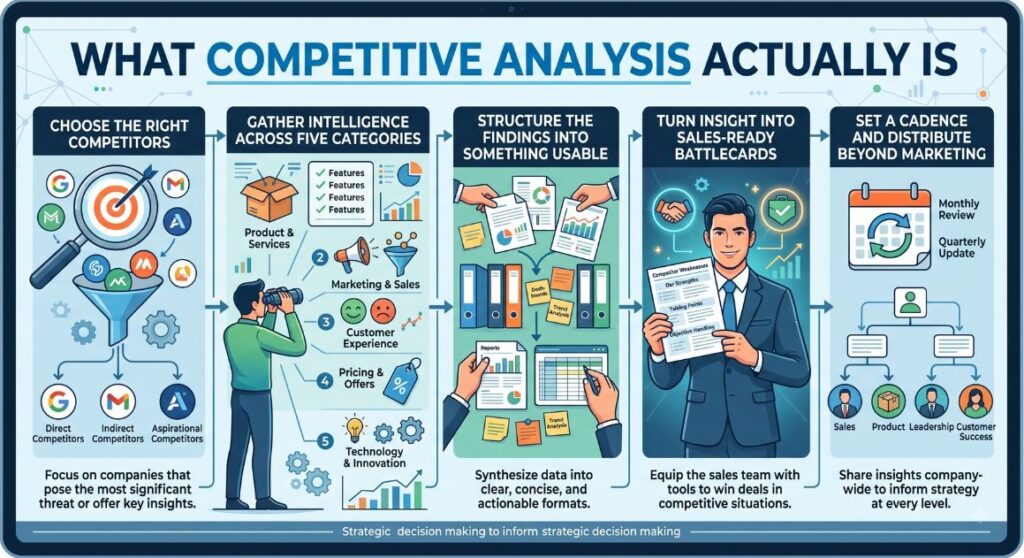
What Competitive Analysis Actually Is
Competitive analysis is the systematic process of researching, documenting, and interpreting how competitors operate, their product, pricing, marketing, and customer experience, so the insight can inform real decisions across positioning, sales enablement, and product roadmap. It’s not a features comparison table, and it’s not about copying what a competitor does well. Done properly, it reveals gaps competitors have missed, sharpens where your own positioning should focus, and gives sales a genuine edge in a competitive deal instead of a generic feature list nobody reads under pressure.
This connects directly to positioning work. Identifying the right competitive alternative is step one of a strong positioning statement, and a real competitive analysis is what actually generates that insight, rather than assuming you already know who you’re up against.
Step 1: Choose the Right Competitors
Start with five to ten competitors, according to project management platform Asana’s competitive analysis guidance, chosen for having a genuinely similar product offering and business model to yours, not just companies that happen to be top of mind.
Resist narrowing this list too early. According to product management research from PMPrompt, the most common mistake at this stage is only considering the obvious direct competitors and ignoring adjacent markets or emerging players who could become real competitors soon. And as covered in the positioning framework above, the most important “competitor” for many products isn’t a rival vendor at all, it’s the status quo: the manual process, spreadsheet, or internal workaround the customer is currently using instead of buying anything. Leaving that alternative out of a competitive analysis produces a skewed picture focused only on head-to-head software comparisons while missing the actual thing most deals are competing against.
Step 2: Gather Intelligence Across Five Categories
A competitive analysis that only looks at product features misses most of the useful signal. According to workflow platform Monday.com’s 2026 competitive analysis research, strong intelligence gathering spans five distinct categories.
Product information. Features, pricing models, and actual user experience, gathered through trials and demos where possible, not just marketing copy. Document what’s offered and how it’s packaged, not just what a features page claims.
Marketing strategies. Content themes, SEO keyword targeting, and advertising approaches reveal a competitor’s customer acquisition tactics and messaging priorities, often more honestly than their own “About” page does.
Business model insights. Revenue streams, partnership announcements, and customer success stories or case studies reveal how a competitor actually makes money and what they’re optimizing to retain.
Operational data. Hiring patterns and technology choices are an underused signal. Job postings frequently reveal a competitor’s future product priorities well before any official announcement, a company hiring aggressively for an “AI integrations” role is telegraphing its next roadmap direction months in advance.
Financial performance. Funding rounds, acquisitions, and any reported metrics help assess a competitor’s staying power and how much investment capacity they have behind their next move.
Effective competitive intelligence gathering spans five categories beyond just product features, according to 2026 research from Monday.com: product information, marketing strategy, business model insights, operational data like hiring patterns, and financial performance. Job postings in particular are an underused signal, often revealing a competitor’s future roadmap priorities well before any official product announcement.
Step 3: Structure the Findings Into Something Usable
Raw research doesn’t become strategic insight until it’s organized into a format that supports a real decision. A capability assessment framework, comparing competitors systematically across the same set of dimensions, standardizes what would otherwise be a pile of inconsistent notes.
At the synthesis stage, a SWOT-style framework, strengths, weaknesses, opportunities, and threats, applied both to your competitors and to your own position, is genuinely useful here, according to competitive research from ALM Corp, particularly when the analysis is feeding into a major positioning decision, a product roadmap discussion, or a broader go-to-market strategy. The mistake to avoid is stopping at the SWOT itself and treating it as the deliverable. It’s a synthesis step, not the end product, the actual output needs to be specific enough to change a real decision, not just describe the landscape.
Step 4: Turn Insight Into Sales-Ready Battlecards
This is the step most competitive analyses skip entirely, and it’s the one that actually closes the readiness gap the Crayon data points to. A battlecard translates the research into something a sales rep can use live, in a deal, under pressure, not a document they’d need ten minutes to digest before a call.
A strong battlecard covers the competitor’s likely positioning against you, the two or three objections a prospect is most likely to raise based on that competitor’s marketing, and a clear, specific counter for each one grounded in your actual differentiation, not a generic “we’re better” claim. This is where the value-and-proof work from a real positioning exercise pays off directly: a battlecard built on genuine differentiated value holds up in a live conversation. One built on a vague sense of “we’re more innovative” falls apart the moment a prospect pushes back.
Step 5: Set a Cadence and Distribute Beyond Marketing
A competitive analysis that lives in one PMM’s folder and never gets updated has a shelf life of about one product release cycle before it’s stale. According to competitive intelligence research published by Swap Biswas, primary competitors deserve quarterly updates, while secondary competitors can run on a semi-annual cycle, paired with a lightweight ongoing monitoring system to catch major moves between formal review cycles.
Distribution matters just as much as cadence. Sales needs the battlecards directly, not a summary buried in a quarterly newsletter. Product and leadership benefit from a periodic competitive landscape briefing that surfaces trend-level shifts, not just individual competitor updates, feeding those insights into positioning shifts and roadmap conversations rather than letting them sit isolated inside a single team’s competitive research doc.
Tools Worth Knowing About
You don’t need an enterprise competitive intelligence platform to run a genuinely effective competitive analysis, match the tooling to your team’s actual size and competitive complexity.
For teams running lean, a combination of manual tools covers most of the ground: Semrush and Ahrefs for digital competitive research including SEO and content strategy visibility, G2 and Capterra for mining competitor customer reviews directly, and Google Alerts or Mention for ongoing, free monitoring of competitor news and mentions. LinkedIn remains one of the most underused free tools here, tracking a competitor’s hiring pattern and company announcements directly from their own page.
For organizations running a more formal competitive intelligence program, especially with five or more primary competitors and a sales team regularly encountering competitive deals, dedicated platforms like Klue, Crayon, or Semrush Kompyte automate a meaningful share of the collection and distribution work, at an investment level that only makes sense once the competitive workload justifies it.
Read More: Positioning vs Messaging: Key Differences Explained
Common Mistakes That Undermine a Competitive Analysis
A handful of mistakes show up repeatedly across competitive analysis work, and most trace back to treating it as a one-time project instead of an ongoing discipline.
Stopping at a features comparison table is the most common. Feature parity or feature gaps alone rarely explain why deals are actually won or lost, the real signal usually lives in pricing structure, customer experience, or how a competitor’s marketing frames the problem differently than you do.
Treating the analysis as a single event rather than a maintained system is a close second. A competitive landscape from eight months ago is often meaningfully out of date, particularly in fast-moving categories where a competitor’s last funding round or newest hire signals a real strategic shift already underway.
Keeping the findings inside marketing or product, without ever reaching the sales team that actually needs them live in a deal, wastes most of the value the research generated in the first place. The Crayon competitive-readiness gap cited earlier exists precisely because this distribution step gets skipped or under-resourced at so many companies.
And ignoring win/loss data as an input is a mistake worth naming specifically. Real deal outcomes, why a prospect actually chose a competitor or chose you, are some of the most concrete, ground-truth competitive intelligence available, and a competitive analysis built without referencing them is working from assumption rather than evidence.
Read More: How to Create a GTM Strategy for SaaS Products: A Practical Guide
The Bottom Line
A competitive analysis earns its value the moment it changes a real decision, a positioning shift, a battlecard a rep actually uses mid-deal, a roadmap adjustment based on where a competitor is clearly headed next. Choose the right competitor set, including the status quo alternative most teams overlook, gather intelligence across more than just product features, and build the output into something sales can actually use live, on a cadence that keeps it from going stale. Skip any of these steps, and the analysis becomes exactly the kind of shelved slide deck the Crayon data suggests most companies are still running on.
If you want to practice building a full competitive analysis and battlecard set on a real product, our Product Marketing Manager Course walks through the entire process with worked examples and templates.
FAQ
What is competitive analysis in product marketing?
Competitive analysis is the systematic process of researching and interpreting how competitors operate, their product, pricing, marketing, and business model, to inform positioning, sales enablement, and product decisions. It’s not a one-time features comparison, it’s an ongoing discipline that feeds multiple teams across the company.
How many competitors should I include in a competitive analysis?
Most guidance recommends starting with five to ten competitors that closely match your product and business model, while also considering adjacent markets and emerging players rather than only the obvious direct competitors. Don’t overlook the status quo alternative, the manual process or workaround a customer might use instead of buying any product at all.
What should I actually research about each competitor?
Beyond product features and pricing, strong competitive intelligence covers marketing strategy and messaging, business model and revenue signals, operational data like hiring patterns that hint at future roadmap direction, and financial performance like funding rounds that indicate staying power.
What is a battlecard and why does it matter?
A battlecard is a sales-ready summary translating competitive research into something a rep can use live during a deal, covering a competitor’s likely positioning, the objections a prospect is likely to raise, and a specific counter for each one. It matters because research that never reaches sales in a usable format fails to close the exact competitive readiness gap it was meant to solve.
How often should a competitive analysis be updated?
Primary competitors generally deserve a quarterly review, while secondary competitors can run on a semi-annual cycle, paired with lightweight ongoing monitoring to catch major moves in between. Treating competitive analysis as a one-time project rather than a maintained system is one of the most common reasons it goes stale.
What tools are used for competitive analysis?
Lean teams can cover most needs with tools like Semrush or Ahrefs for digital competitive research, G2 or Capterra for review mining, and free tools like Google Alerts, Mention, and LinkedIn for ongoing monitoring. Larger organizations with more complex competitive landscapes often invest in dedicated platforms like Klue, Crayon, or Semrush Kompyte to automate collection and distribution.
How is competitive analysis different from positioning?
Competitive analysis is the research process that identifies who you’re really competing against and how, while positioning is the strategic decision about where your product sits and why it wins, built using that competitive research as a direct input. Positioning can’t be done credibly without first doing real competitive analysis.
Why do sales teams often feel unprepared for competitive deals despite having competitive research available?
Often because the research stays inside marketing or product and never reaches sales in a usable, deal-ready format like a battlecard. According to Crayon’s 2025 State of Competitive Intelligence report, sales teams face direct competition in 68% of deals but rate their own preparedness at only 3.8 out of 10, a gap that traces directly back to distribution, not a lack of research effort.
Should I use win/loss data in a competitive analysis?
Yes, and skipping it is a common mistake. Real deal outcomes, why a prospect chose a competitor or chose you, are some of the most concrete competitive intelligence available, and building an analysis without referencing them means working from assumption rather than actual evidence.