

Two brands can sell the exact same product, at the exact same price, made in the exact same factory, and one will sell out in a week while the other sits on shelves. That gap isn’t about the product. It’s about what’s happening inside the customer’s head before they ever pick anything up.
Marketers have a name for that gap, and it’s not just a buzzword you throw into a brand deck to sound smart. Customer-based brand equity is the actual value a brand carries because of how customers think, feel, and respond to it, separate from the product’s functional worth. Get it right and you can charge more, launch new products faster, and survive a bad quarter without losing customers. Get it wrong and you’re stuck competing on price forever.
This piece breaks down what customer-based brand equity actually means, walks through Kevin Lane Keller’s CBBE model in full, and shows how real brands (not hypothetical ones) have built and measured it. By the end, you’ll have a working framework you can apply to your own brand, not just a definition to file away.
Table of Contents
What Is Customer-Based Brand Equity?
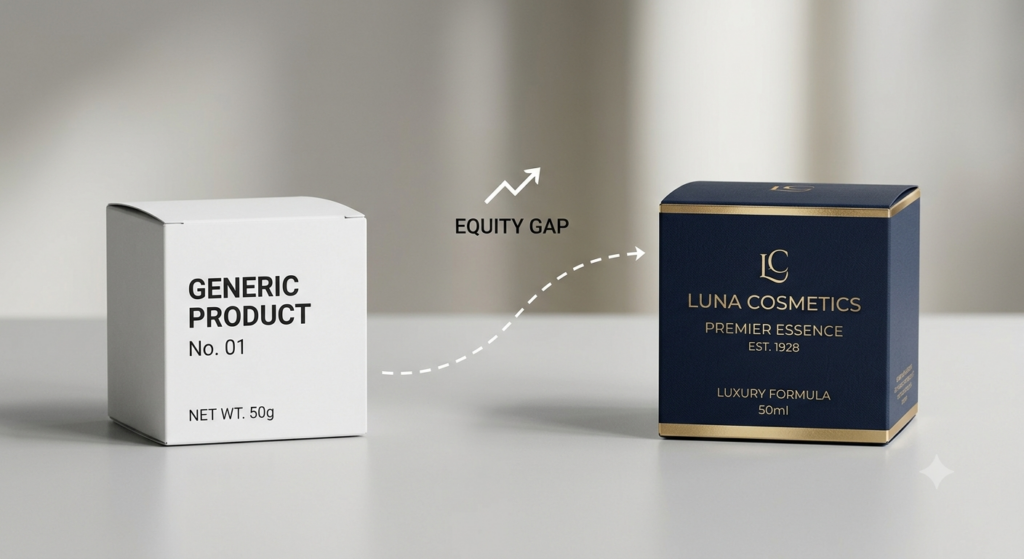
Customer-based brand equity is the differential effect that brand knowledge has on how a customer responds to marketing for that brand, compared to an unbranded or generic version of the same product. In plain terms: it’s the premium value your brand adds purely because people know it, trust it, or feel something about it.
This customer-based brand equity definition comes from Kevin Lane Keller, a marketing professor whose 1993 paper in the Journal of Marketing laid the groundwork most brand strategists still use today. Keller’s core idea was simple but genuinely useful. Brand equity doesn’t live on a balance sheet. It lives in the customer’s mind, built up through every exposure, interaction, and experience they’ve had with the brand.
That’s the part a lot of founders miss. They think brand equity is the logo, the tagline, or the Instagram aesthetic. It’s none of those things directly. It’s the mental shortcut a customer takes because of everything those visual elements represent to them.
Think about it this way. If you handed someone a plain white bottle of shampoo and a bottle of Mamaearth shampoo with identical ingredients, most customers wouldn’t respond the same way to both. That difference in response, in willingness to pay more, trust the claims, or recommend it to a friend, is customer-based brand equity in action.
Customer-based brand equity is the added value a brand generates purely from customer perception, separate from the product’s actual features. It was formalized by Kevin Lane Keller in 1993 and remains the most widely taught brand equity framework in marketing education today. Strong brand equity shows up as price premiums, higher loyalty, and faster adoption of new products.
Where the CBBE Model Comes From: Keller’s Framework
Most brand equity theory before Keller focused on the company’s side of things: market share, revenue premiums, financial valuation. Useful for a CFO. Not that useful for a marketer trying to figure out what to actually do on Monday morning.
The CBBE model flipped the lens. Instead of asking “how much is our brand worth on paper,” it asks “what does this brand mean inside a customer’s mind, and how did it get there.” Keller argued that brand equity builds in a specific sequence. You can’t skip steps and expect the same result.
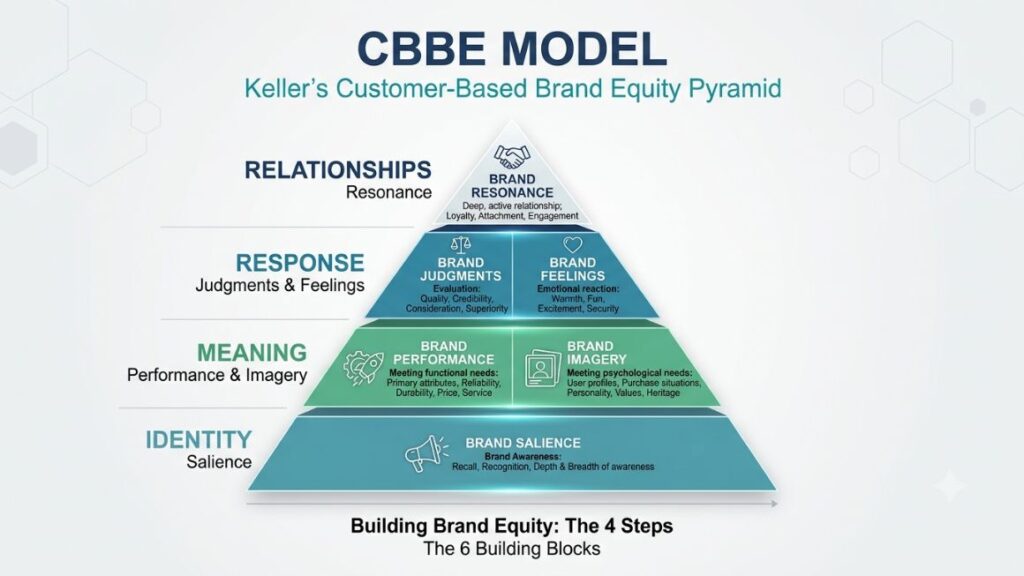
That sequence has four stages, and Keller organized them into what’s now taught in nearly every marketing program as the customer-based brand equity pyramid. Each stage answers a different question the customer is unconsciously asking about your brand:
- Who are you? (Salience)
- What are you? (Performance and Imagery)
- What do I think or feel about you? (Judgments and Feelings)
- What kind of relationship do I want with you? (Resonance)
You build from the bottom up. A customer can’t reach brand resonance, the top and most valuable stage, without first passing through awareness, meaning, and response. Skip a stage and the whole structure gets shaky, no matter how much you spend on the top.
Read More: How to Transition Into Brand Management: A Roadmap for Marketing Professionals
Inside the CBBE Pyramid: Four Stages to Brand Resonance
Here’s where the framework gets practical. Each level of the CBBE pyramid has two building blocks, and understanding what belongs where changes how you plan campaigns.
Stage 1: Brand Salience (Who Are You?)
Brand salience is how easily and how often customers think of your brand in relevant buying situations. This is pure awareness, but it’s more specific than most people assume. It’s not just “have they heard of you.” It’s “do they think of you at the right moment.”
Swiggy doesn’t just want awareness. It wants to be the first thing that pops into your head the second you feel hungry at 9 PM. That’s depth and breadth of salience working together. Depth means the brand comes to mind easily. Breadth means it comes to mind across a wide range of situations, not just one narrow use case.
Read More: Brand Architecture: A Practical Guide to House of Brands, Branded House, and Hybrid Models
Stage 2: Brand Performance and Brand Imagery (What Are You?)
This stage splits into two parallel tracks. Brand performance covers the functional side: does the product actually work, is it reliable, does it deliver on price and quality expectations. Brand imagery covers the psychological side: what does using this brand say about the person using it, what kind of user profile does it suggest.
boAt built performance credibility through affordable, durable audio products that consistently worked as promised. But its imagery, youthful, rebellious, “plug into nation” energy, is what separated it from a dozen other affordable audio brands doing the same functional job.
Stage 3: Brand Judgments and Brand Feelings (What Do I Think and Feel?)
Judgments are the rational evaluations customers form: quality, credibility, consideration, superiority. Feelings are the emotional responses: warmth, fun, excitement, security, social approval, self-respect. Both matter, and they don’t always move together. A customer can respect a brand’s quality (judgment) without feeling anything toward it emotionally (feeling), and that gap is usually where competitors sneak in.
Read More: Is Brand Management a Good Career in 2026? An Honest Answer
Stage 4: Brand Resonance (What Kind of Relationship Do I Want?)
This is the peak of the pyramid and the hardest to earn. Resonance means the customer has an active, loyal relationship with the brand: they repurchase without comparing options, they feel a sense of community around it, and they actively engage with the brand beyond just buying from it.
Nike sits here for a huge portion of its customer base. People don’t rebuy Nike because they compared ten sneaker brands each time. They buy it because it’s part of how they see themselves.
The customer-based brand equity pyramid moves through four stages: salience, performance and imagery, judgments and feelings, and resonance. Brand resonance sits at the top and represents active loyalty, where customers repurchase without comparison shopping and feel genuine attachment to the brand. Reaching resonance requires successfully building every stage beneath it first.
Why a Strong Brand Equity Framework Changes How You Market
Honestly, most teams treat brand and performance marketing as two separate budgets fighting for the same pie. That’s a mistake, and a customer-based brand equity framework is exactly what closes that gap.
When resonance is high, your paid acquisition costs go down. Customers already trust the brand, so conversion rates on ads improve and customer acquisition cost drops because word-of-mouth and repeat purchase start doing part of the job your media budget used to carry alone.
It also changes how much pricing power you have. According to Interbrand’s 2024 Best Global Brands report, the world’s most valuable brands consistently command price premiums well above category averages, purely because of accumulated brand equity rather than product differences. That’s not theory. That’s why Apple can charge more for a phone with comparable hardware specs to competitors.
And this may not apply equally everywhere. A B2B SaaS company with a long sales cycle builds equity differently than a D2C skincare brand selling on Instagram. The pyramid still applies, but the pace and the channels change.
Read More: Corporate Brand Management: The Competitive Advantage Most Companies Ignore
How to Start Building Strong Brand Equity: A Practical Strategy
Building customer-based brand equity isn’t a campaign you run for a quarter. It’s a compounding process, and most brands underestimate how long the early stages take. Here’s a practical sequence to follow.
- Nail consistent brand identity first. Fix your name, logo, color system, tone of voice, and core messaging before spending on awareness. Inconsistency at this stage wastes every dollar you spend later, because customers can’t build salience around something that keeps shifting.
- Invest in reach before you optimize for conversion. Salience needs repeated, broad exposure. This is where top-of-funnel spend, PR, influencer partnerships, and organic content matter more than performance ads.
- Prove functional performance relentlessly. Reviews, product quality, delivery experience, customer service. This is where brand promises either get validated or destroyed. One bad delivery experience can undo months of awareness spend.
- Shape imagery through who you associate with. The creators you partner with, the communities you show up in, and the visual world you build all signal who this brand is “for.” Nykaa didn’t just sell beauty products, it built imagery around confidence and self-expression through its content and influencer ecosystem.
- Design for emotional response, not just rational appeal. Ask what feeling you want a customer to associate with your brand, then build campaigns, packaging, and service moments that consistently deliver that feeling.
- Create reasons for active engagement. Loyalty programs, community features, user-generated content campaigns. Resonance needs participation, not just repeat purchase.
That said, sequencing matters more than speed. A brand that rushes to stage four without solid salience and performance underneath usually collapses the first time a competitor undercuts on price. This is where a deliberate customer-based brand equity strategy beats reactive marketing every time. You’re not chasing trends. You’re building a specific mental structure in a specific order.
Read More: Brand Identity Management: Building a Brand People Instantly Recognize
How to Measure Brand Equity: Tools Marketers Actually Use
You can’t manage what you don’t measure, and measuring customer-based brand equity requires a different toolkit than measuring campaign performance. Here’s every major tool marketers actually use, explained in detail.
Brand Tracking Surveys
Brand tracking surveys run at regular intervals (usually quarterly) and measure unprompted and prompted awareness, consideration, preference, and Net Promoter Score over time. Platforms like Latana and Attest let brands run continuous or wave-based tracking studies with statistically significant sample sizes. The value here is trend data. A single snapshot tells you little, but six quarters of tracking shows you exactly which pyramid stage is stalling.
Net Promoter Score (NPS)
Net Promoter Score asks one core question: how likely are you to recommend this brand to a friend or colleague, on a scale of 0 to 10. Tools like Delighted and SurveyMonkey automate collection and segmentation. NPS is a rough proxy for resonance, since a customer who actively recommends a brand has usually moved well past simple satisfaction into genuine attachment.
Social Listening Platforms
Social listening tools like Brandwatch and Sprinklr track brand mentions, sentiment, and share of voice across social platforms, forums, and news in real time. These tools matter because they capture unprompted brand conversation, which reflects imagery and feelings more honestly than a survey where customers know they’re being asked.
YouGov BrandIndex
YouGov BrandIndex is a daily brand perception tracker used heavily in the UK, US, and India, measuring metrics like impression, quality, value, and reputation across thousands of brands continuously. It’s particularly useful for benchmarking against direct competitors on the exact same metrics, something internal surveys often can’t replicate at scale.
Google Trends and Search Data
Google Trends won’t give you sentiment, but it’s a free, direct proxy for salience. A rising trend line in branded search volume, especially relative to category search volume, is one of the clearest signals that top-of-pyramid awareness is growing. Pair it with Google Search Console data if you’re tracking your own branded search performance.
Conjoint Analysis
Conjoint analysis is a research method where customers evaluate different product and brand combinations, letting researchers isolate exactly how much value the brand name itself adds compared to features and price. This is the most rigorous way to quantify the dollar value of brand equity, and it’s the method underlying valuation models like Y&R’s Brand Asset Valuator.
The Brand Asset Valuator (BAV)
Developed by Young & Rubicam (now VMLY&R), BAV measures brand equity across four pillars: differentiation, relevance, esteem, and knowledge. It’s one of the largest brand databases in the world, tracking tens of thousands of brands across dozens of countries, and it maps closely onto Keller’s pyramid stages even though it was built independently.
Measuring customer-based brand equity requires combining survey-based tools like brand tracking and NPS with behavioral signals like social listening and branded search volume. No single tool captures the full pyramid, so most brand teams triangulate across at least three data sources: a perception survey, a social listening platform, and search or sales data.
Read More: Luxury Brand Management: Building Desire, Exclusivity, and Lasting Value
Customer-Based Brand Equity in Action: Real Brand Examples
Theory only lands when you see it applied. These customer-based brand equity examples show the pyramid working in the real market.
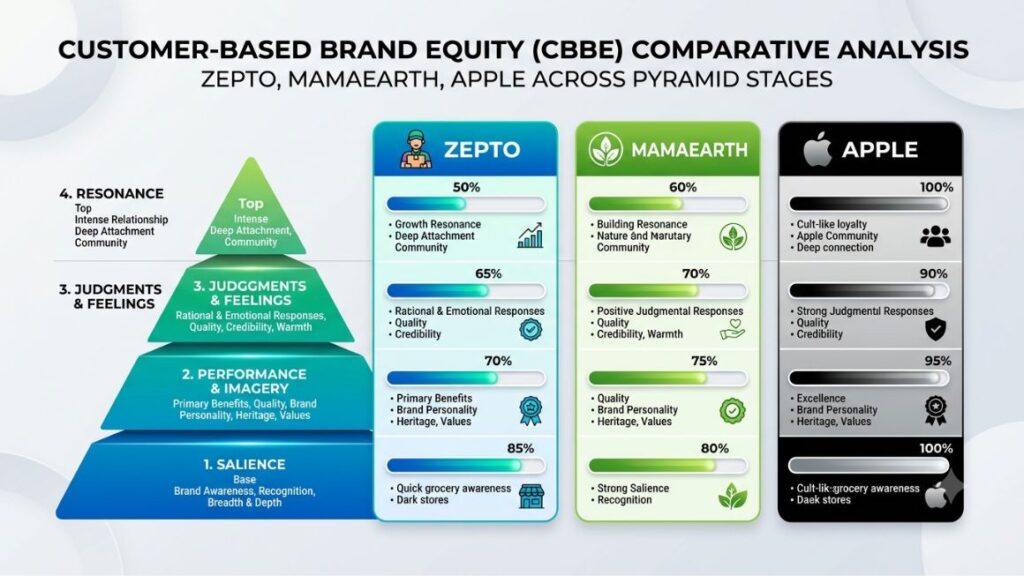
Zepto built salience aggressively in its first two years through relentless app install campaigns and category-defining messaging around 10-minute delivery. But performance is what locked it in: consistent delivery speed and product availability turned early curiosity into habitual use, moving customers from awareness straight into functional trust faster than most quick commerce competitors managed.
Mamaearth is a strong example of imagery-led equity building. Its “toxin-free” positioning and Ghazal Alagh’s founder-led storytelling created a specific identity around conscious, safe parenting and personal care, which built emotional resonance with a particular customer segment well before the brand reached mass scale.
Globally, Apple remains the textbook case for full-pyramid resonance. Customers don’t just prefer Apple products, they identify with the brand, defend it in conversations, and often won’t seriously consider switching ecosystems even when a competitor product is objectively cheaper or has stronger specs on paper. That’s judgment, feeling, and resonance working together at full strength.
Common Mistakes That Kill Brand Equity Building Efforts
Most marketers skip straight to campaigns without fixing the foundation. It shows. A few patterns come up again and again.
Teams often chase virality at the salience stage without controlling what that virality actually communicates about the brand, which builds awareness with the wrong imagery attached. Others invest heavily in performance marketing and loyalty programs while skipping brand tracking entirely, so they have no idea whether resonance is actually growing or just repeat-purchase behavior driven by discounts.
There’s also a common trap of treating brand equity as a marketing-only problem. Product, customer service, and operations all shape judgments and feelings just as much as advertising does. A brand can run a flawless campaign and still lose equity if delivery is inconsistent or support is slow to respond.
Conclusion
Customer-based brand equity isn’t an abstract marketing concept you park in a slide deck and forget. It’s a real, buildable asset that shapes pricing power, loyalty, and how fast customers trust your next product launch. The CBBE pyramid gives you the sequence: salience, performance and imagery, judgments and feelings, and finally resonance. Skip a stage and the whole thing gets fragile.
The brands that get this right, from Zepto’s speed-driven salience to Apple’s category-defining resonance, didn’t stumble into it. They built deliberately, measured consistently, and treated brand equity as infrastructure, not decoration.
If you’re working on your brand strategy right now and want a structured way to think through positioning, brand architecture, and equity building step by step, YUP’s Crystal Clear Newsletter breaks down frameworks like this one every week with real examples from the Indian and global market. It’s a solid next step if you want to keep building on what you just read.
FAQs
What is customer-based brand equity in simple terms?
It’s the extra value a customer places on a product simply because of the brand attached to it, separate from the product’s actual features. Two identical products can get very different customer responses based purely on brand perception.
Who created the CBBE model?
Kevin Lane Keller introduced the model in a 1993 Journal of Marketing paper, and it has since become one of the most widely taught brand equity frameworks in marketing education worldwide.
What are the four stages of the CBBE pyramid?
The four stages are brand salience, brand performance and imagery, brand judgments and feelings, and brand resonance. Each stage builds on the one below it, moving from basic awareness to deep customer loyalty.
Customer-based brand equity vs financial brand equity, what’s the difference?
Customer-based brand equity measures value inside the customer’s mind, like awareness, trust, and loyalty, while financial brand equity measures the brand’s monetary worth on a company’s balance sheet. The two are related but measured completely differently.
How long does it take to build strong brand equity?
There’s no fixed timeline, but most brands need at least 18 to 24 months of consistent effort before reaching meaningful resonance, and category, budget, and competitive intensity all affect the pace significantly.
Do small businesses need to worry about brand equity?
Yes, though the scale looks different. A local business builds equity through consistent service quality and word-of-mouth reputation within its community, following the same pyramid logic on a smaller footprint.
Is brand equity only relevant for consumer brands?
No. B2B companies build brand equity too, though it typically moves through longer sales cycles and relies more heavily on reputation, case studies, and account relationships than mass advertising.
What’s the fastest way to measure brand equity right now?
Combine a quick NPS survey with a social listening check on brand sentiment and a look at branded search trends. It won’t be as rigorous as a full brand tracking study, but it gives a directional read within days.
Can a brand lose customer-based brand equity it already built?
Yes, and it can happen quickly. A major service failure, a controversy, or inconsistent product quality can damage judgments and feelings fast, even after years of built-up resonance.
Is customer-based brand equity actually worth investing in for early-stage startups?
For very early startups still finding product-market fit, functional performance usually deserves priority over brand-building. But once the product works, delaying brand equity investment gets more expensive later, since undoing weak early awareness is harder than building it correctly from the start.