

“Your Product is your Brand and your Brand is your Product”
Going by this saying, we can understand that your brand reputation management is just as important as managing the product itself. Before the product, your customer would first get acquainted with your brand and, most importantly, how it is perceived by others online. Any stain in your reputation could, and in most cases would, directly impact the customer’s experience with your product.
In this article, we’ll take a deeper look at everything required to maintain a good brand reputation and how to do so.
Table of Contents
What is Brand Reputation Management?
Brand reputation management essentially entails navigating the sentiment around your brand, meaning the views of people towards your brand and those associated with it. What is being said about your Brand online? Is it positive? If not, then why? Being in the know of and answering these questions is what Brand reputation management involves.
The landscape of social media is such that, before interacting with any of the brand’s services, people look at reviews, influencer videos, AI summaries, and recommendations to decide whether it’s worth it. Being featured in trusted media and having social proof through positive reviews sends a signal to customers about your brand’s trustworthiness. Neglecting any of these aspects can become detrimental to your Brand in the long run.
In this guide, we will walk through the Brand management strategies, the tools used, metrics to consider, how you can manage your own Brand reputation, and much more. This is all done so you will leave not only understanding the concept but also gaining the knowledge of practical methods you can apply right this instant to manage your brand reputation.
Brand Reputation, Brand Image, and Brand Equity
It’s easy to get these mixed up because they all sound similar. But they aren’t. Not really.
Brand image is what people see right now. How the logo looks, the campaigns, the social posts. It can flip fast. One big campaign or even a single viral post can change what people think in a matter of days. But it’s shallow in a way. Looks can be deceiving.
Brand Reputation is different. That’s built slowly. It comes from what people remember you for over time. How past mistakes were handled, how consistent your service is, and the little things that don’t get noticed at first. It sticks. And once it’s there, it’s not easy to change. You can’t just run a campaign and hope a bad reputation disappears.
Brand Equity is the money side of it. The value your brand actually carries in the market. Loyal customers, awareness, pricing power, all of it. Image and reputation feed it, but equity is the result. If image is what you hope people see, reputation is what they actually see, equity is what that actually earns you, or costs you.
One way to think of it: image is intention. Reputation is reality. Equity is the outcome. Pretty simple, but easy to forget.
Online Reputation Management versus Brand Reputation Management
These get used a lot interchangeably, and that’s misleading.
Online reputation management is the digital side of things. Social media, reviews, Google search results. All the stuff people see on a screen. Likes, comments, complaints, it matters. The goal is to keep the brand looking decent online and deal with negative things before they spread.
Brand reputation management is the bigger picture. Online plus offline. PR, company culture, stakeholder relationships, and real-world perception. ORM is just a slice of it. And honestly, that slice won’t save a brand if the rest is neglected.
In short, ORM is part of brand reputation management, but it’s just one part. The full work involves paying attention everywhere, not just on screens.
Why Brand Reputation Management Is Important for Businesses
Boosts Sales and Revenue Through Trust Signals
Customers tend to trust brands with strong ratings that have verifiable testimonials and consistent messaging. A one-star difference on review platforms can significantly impact conversion rates, thus affecting the sales and revenue of the business.
Builds Customer Loyalty and Retention
Once you have established your brand as something trustworthy, customers will return to your brand repeatedly. People tend to choose something they trust multiple times instead of trying out new things they know nothing about. These returning customers then turn into your loyal advocates.
Attracts Top Talent and Employer Branding
The reviews and ratings on platforms like Glassdoor shape how candidates perceive your workplace. If the online consensus about your brand and business culture is weak or negative, then the top talented individuals would not want to associate with you; conversely, if people working for your brand are highly sought-after talents, then your brand also presents as a highly reputable business.
Increases Brand Awareness and Visibility
Positive mentions of your brand increase the organic reach across the search engines and social media, building brand awareness and visibility.
Strengthens Brand Equity and Market Position
A strong reputation often equates with higher pricing power. The stability of your market position is generally dictated by its brand reputation.
Enables Better Partnerships and Collaborations
Brands prefer to work with other credible and trusted partners. Such collaboration, in turn, also benefits your brand and helps maintain a positive and credible brand reputation.
Minimizes Damage During PR Crises
A strong reputation acts like a buffer during crises. PR crises can strike at any time and to any brand, and here we can see the true benefit of a good brand reputation. In such cases, a good brand reputation acts as a buffer.
What Does Brand Reputation Management Involve?
Brand reputation management isn’t something you do once and tick off a list. Think of it more like… keeping an old car running. It needs attention, and if you ignore it, problems pop up when you least expect them. A lot of brands don’t realize it until it’s too late, and by then, fixing things is way harder.
At its heart, it’s a bunch of moving parts:
Watching what people say online
Not just social media, though that’s obvious. Search engines, forums, Reddit threads, news articles… it all matters. People notice, and it all adds up to an impression. Some of it stings. Some of it’s harmless. The trick is figuring out which is which.
Handling reviews on places like Google or Trustpilot
Reviews are often the first thing someone sees about a brand. Not responding? That’s basically handing over control of your image to whoever’s complaining. A quick note to thank someone, a thoughtful answer to a problem, it goes a long way. And yes, encouraging happy customers to leave reviews matters too.
Actually using customer feedback
Surveys, NPS scores, emails… most brands collect feedback and then do… nothing. That’s a missed opportunity. Feedback only works if you act on it and close the loop. Sometimes that means a small product tweak. Sometimes it’s a change in how customer service responds. Either way, ignoring it is a mistake.
Dealing with crises
Things break. People get angry. Stuff happens. How a brand reacts matters way more than the mistake itself. Being slow, defensive, or evasive just makes things worse. Quick, honest, sometimes awkward responses build trust, even in a mess.
Using content to shape perception
Content isn’t just for clicks. When people Google your brand, what shows up is the story you’re telling. Blogs, press mentions, case studies… it all counts. Skip this, and guess what? Others will fill in the gaps with whatever they want.
Talking to people on social media
Social media is tricky. It’s personal. One day, a post is harmless, the next it sparks something you didn’t expect. Being present, responsive, and human, rather than just scheduling posts, matters a lot. People notice.
The takeaway? There’s no finish line. It’s ongoing. A little work every day keeps problems from piling up. Treat it like a living thing, not a campaign. Brands that do tend to survive, and sometimes even come out stronger after a hit.
How Do You Measure Brand Reputation?
We don’t have to do any guesswork when it comes to measuring your brand reputation. There are certain metrics and KPIs that can be used to effectively measure both the qualitative and quantitative aspects of your brand reputation.
Let us break them down.
Brand Sentiment Analysis
Brand sentiment analysis tells you how people feel about your brand, what their sentiments are regarding your brand, and not just how often they mention it. It includes both the positive and negative mentions of your brand among the general public.
Modern tools like Brandwatch or Talkwalker use AI and natural language processing to scan thousands of mentions across:
- Social media
- News articles
- Blogs
- Forums
And then categorize them into:
- Positive
- Negative
- Neutral
Through them, we can infer informative insights, e.g., a sudden spike in negative sentiment could signal:
- A product issue
- A PR crisis
- A viral complaint
Tracking this over time helps you catch problems early, before they escalate publicly.
Online Reviews and Ratings
Nowadays, before buying anything, most people are sure to check reviews on different platforms like:
- Trustpilot
- Google Reviews
These platforms play a massive role in shaping the public perception.
A few key things to track:
- Average rating
- Review volume
- Recency (recent reviews matter more than old ones)
In all this, one thing to note is the consistency of the good review rather than one odd good review mixed with multiple bad ones.
Also, consistency matters. A brand with steady 4-star reviews often performs better than one with mixed extreme ratings.
Share of Voice and Brand Mentions
Share of Voice (SOV) tells you how visible your brand is in comparison to your competitors. For example, if your brand gets 500 mentions per month and competitors are getting 1500 combined, then your SOV will be roughly around 25%.
A higher share of voice usually means stronger awareness and better positioning for your brand and creates more influence in your category. Tools like Mention help track this across channels. But also, we have to consider the context; if the high visibility is with negative sentiment, then that is not a win.
Customer Satisfaction Score (CSAT)
CSAT measures how satisfied customers are with specific interactions, like customer support, onboarding, purchasing experience, etc. It is typically collected through surveys like
“Rate your experience from 1 to 5.” It’s more granular than NPS and helps identify operational gaps. For example, a low CSAT in support shows slow response times, while a low CSAT in onboarding means a confusing product experience.
Fixing these directly greatly improves the reputation.
Search Engine Reputation
This is one of the most underrated metrics. Search your brand name and look at the first page results, the reviews, the news articles, Reddit threads, etc. This is what the potential customers see before interacting with you. If the top results include negative press, poor reviews, or complaints, then that’s a reputation problem we have to solve. SEO tools like Ahrefs or SEMrush can help monitor and improve these branded search results.
Social Media Engagement and Feedback Signals
Social media isn’t just about posting. It’s about how people respond to your brand that matters.
Some key signals include:
- Likes and shares (visibility)
- Comments (engagement depth)
- Sentiment in replies (perception)
A post with high engagement but has quite a few negative comments is very different from one with more positive interaction. Platforms like Sprout Social provide you with deeper analytics into engagement quality.
How to Monitor and Track Your Brand Reputation Online
Monitoring is where most brands either stay proactive or have to struggle to catch up. To solve that struggle, we have some tools to help with brand monitoring.
A few reliable tools include:
- Google Alerts: Good for basic tracking, especially for small businesses
- Brand24: Real-time tracking across social and web
- Mention: Multi-channel monitoring with competitive insights
Each tool has its own strengths, but the goal is the same for all: to never miss a conversation about your brand.
Setting Up Alerts
You should track:
- Brand name, which includes all the variations and misspellings.
- Product or service names.
- Founders and leadership team.
- Campaign hashtags.
- Competitor brand names.
This creates a stronger and complete monitoring ecosystem.
Tracking Branded Keywords
Search your brand regularly. Don’t just rely on tools. Look for any negative blog posts, complaint threads, review site rankings, and forum discussions like Reddit, Quora, etc. Sometimes, manual checks reveal things that automated tools happen to miss.
Monitoring Competitors’ Reputation
This is a smart shortcut. By analyzing your competitors, you can:
- Identify gaps in their service
- Learn from their mistakes
- Spot opportunities to differentiate
For example, if competitors are getting complaints about their support delays, you can position your brand around faster and better service.
10 Effective Brand Reputation Management Strategies
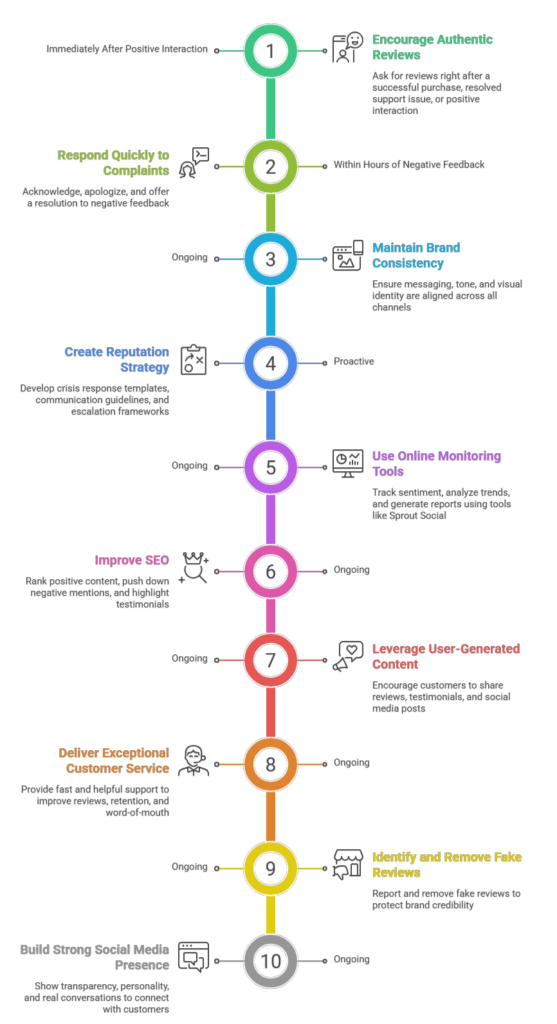
Here are some effective and efficient strategies that mix the theory into an action plan.
1. Encourage Authentic Customer Reviews and Ratings
Timing is everything. Ask for reviews right after a successful purchase, a resolved support issue, or a positive interaction.
Platforms like:
- Google Reviews
- Yelp
- Trustpilot
are essential for such reviews.
2. Respond Quickly to Negative Feedback and Complaints
A fast response shows accountability and that you, as a brand, care about the customer experience.
Use this structure:
- Acknowledge the issue
- Apologize genuinely
- Offer a resolution
Sometimes, a well-handled complaint creates more trust than a perfect experience.
3. Maintain Brand Consistency Across All Channels
Consistency reduces friction. Your messaging, tone, and visual identity should all feel aligned across all your website, ads, and social media platforms.
4. Create a Brand Reputation Management Strategy and Guidelines
Don’t improvise during the crises; instead, create a plan ready on hand that includes crisis response templates, communication guidelines, and escalation frameworks.
This ensures clarity under pressure.
5. Use Online Reputation Monitoring Tools
Use tools like:
- Sprout Social
- Hootsuite
- Brandwatch
They help to track sentiment, analyze trends, and generate reports for your brand.
6. Improve SEO to Control Search Results
SEO can be one of the most powerful reputation tools, if used right.
Using it, you can:
- Rank positive content
- Push down negative mentions
- Highlight testimonials and case studies
Over time, this reshapes your brand perception on a large scale.
7. Leverage User-Generated Content and Brand Advocates
Encourage your customers to share their reviews, testimonials, and social media posts. UGC builds authenticity in a way branded content can not do.
8. Deliver Exceptional Customer Service
Though obvious, it can be overlooked by brands. Fast and helpful support leads to:
- Better reviews
- Higher retention
- Stronger word-of-mouth
Because in all honesty, customer experience is the foundation of reputation.
9. Identify and Remove Fake Reviews
Fake reviews can do some serious damage to brand credibility. Do not use them yourself and otherwise report them on Google reviews or Yelp.
In serious cases, legal action may be required.
10. Build a Strong Social Media Presence
Polished brands don’t always win; it’s the relatable brands that do.
Why? Because they show:
- Transparency
- Personality
- Real conversations
People trust brands that feel human.

Enroll Now: Brand Management course
How You Can Create a Brand Reputation Management Strategy Right Now
Now we are putting everything we learned into practice.
Define Your Brand Identity and Values
Your reputation should reflect your core values; otherwise, it will feel inconsistent. Inconsistency lowers the brand credibility and hence the brand reputation.
Audit Your Current Online Reputation
Search your brand name as if you were a customer. Look at the reviews, social mentions, news, and even forums about the brand. You might find things you didn’t expect, which can be good or bad, and that is exactly the point.
Monitor Brand Mentions and Conversations
Set up systems to track what people are saying about you in real time. Tools like Brand24 make doing this easier, but even manual checks can help. The goal is simple: don’t be the last one to know when something happens.
Engage Actively with Your Audience
Don’t just observe silently, be the active participant. Reply to the comments, thank people for their feedback, and address any concerns openly. Even a simple acknowledgment can change how someone feels about your brand. Silence, on the other hand, can feel like indifference.
Establish Brand Guidelines and Communication Policies
Create clear rules for how your brand communicates with its customers. Your tone, language, response style, all of it. This ensures that whether it’s marketing, support, or social media, the brand feels consistent and recognizable everywhere.
Train Employees on Brand Communication
Your employees are your brand in action. Whether they’re replying to emails or posting on LinkedIn, they shape the brand perception. A little training for your employees goes a long way in making sure that everyone represents the brand in the same way.
Measure Results and Optimize Continuously
Track your key metrics regularly, customer sentiment, reviews, engagement, search results, everything. Then adjust your strategy based on what’s working and what’s not. Reputation management isn’t static; it evolves, and your strategy should too, along with it.
Trends and Innovations in Brand Reputation Management
AI-Powered Reputation Monitoring
AI is stepping up the game and making things easier than ever before. It is now predicting reputation risks before they even happen, all the while providing solutions to tackle them as they come.
Role of Generative AI in Brand Perception
AI-generated summaries influence how users perceive any brand instantly, more often before they even visit a website.
Rise of Decentralized Reviews
Blockchain-based systems are being put to use that aim to reduce fake reviews on platforms and improve transparency for users.
Impact of Google AI Overviews on Brand Visibility
Search has already shifted from earlier, just links to top summaries, making reputation signals even more important for visibility.
Importance of EEAT
Experience, Expertise, Authority, and Trust: these four factors are no longer optional. They directly impact the visibility and the credibility of the brands.
Brand Reputation Management Case Studies
Domino’s Pizza’s reputation recovery:
Domino’s showed the best example of how being transparent and honest with their customers always works in favour of the brand. This happened when widespread criticism was shoved their way, accusing their pizzas of being of low quality, but instead of staying silent, what they did was to openly acknowledge the problem and then publicly show the resolution. This not only helped them gain the trust of their audience back but also cemented them as one of the more reputable brands in the market.
What we Learned from it is that:
- Speed matters.
- Transparency builds trust.
- Silence creates risk.
Common Brand Reputation Mistakes to Avoid
A few common mistakes a brand makes that can affect its brand reputation are:
- Ignoring negative feedback
- Inconsistent messaging
- Lack of monitoring systems
- Slow crisis response
- Fake engagement tactics
These mistakes often seem small at first, but they easily compound over time and make you pay in the long term.
Conclusion
Brand reputation isn’t just a marketing metric anymore. It’s a core business asset. If you’re starting, just keep it simple and pay attention to a few things like monitoring online spaces, responding quickly, and investing in the right tools. All you have to do in the end is to focus on the real customer experience.
FAQs: Brand Reputation Management
1. What are the 3 C’s of Brand Reputation Management?
The 3 C’s get mentioned a lot, but in practice, they’re less “framework” and more like habits brands either stick to… or don’t.
Credibility comes first, obviously. But it’s not built through big claims or polished messaging. It usually shows up in smaller things. Honest reviews. Transparent responses. Admitting mistakes without over-explaining. People notice that stuff. Especially now.
Then there’s Consistency. This is where most brands quietly fall apart. Messaging sounds great on the website, but customer support feels completely different. Social media tone shifts depending on who’s posting. Over time, that disconnect chips away at trust.
And Communication… not just talking, but actually responding. Brands that reply to feedback, even negative ones, tend to feel more human. Silence, on the other hand, almost always gets interpreted as indifference.
Put together, these three don’t just “build reputation.” They make a brand feel reliable. Predictable in a good way.
2. What is the 3-7-27 Rule of Branding?
This one’s interesting because it matches how people actually behave, not how brands think they behave.
3 seconds: Visual impression. Design, colors, layout. Basically, “Does this feel legit?”
7 seconds: Quick judgment. Tone, clarity, and initial trust signals.
27 seconds: Deeper evaluation. Messaging, credibility, relevance.
Most brands obsess over the 27-second layer. Long copy, detailed pages, storytelling. But if the first 3 seconds don’t land, nobody gets there anyway. It’s not really a rule. More like a reminder: attention is short, and first impressions are doing more work than most teams realize.
3. What Does a Brand Reputation Manager Actually Do?
On paper, it sounds straightforward. Monitor mentions. Respond to reviews. Handle PR.
In reality, it’s a bit messier.
A good reputation manager is constantly scanning for signals. Not just obvious complaints, but subtle shifts. A change in tone on social media. A sudden spike in negative feedback. Even silence where there used to be engagement. They’ll use tools, sure. But tools don’t replace judgment. Deciding when to respond, how to respond, and when to step back… that’s where experience shows. They also work closely with marketing, support, and sometimes leadership. Because reputation isn’t owned by one team. It leaks into everything.
4. How Can You Measure Brand Reputation Effectively?
There’s no single metric that tells the full story. That’s probably the first thing to accept.
Instead, it’s a mix:
Sentiment analysis gives a broad direction. Positive, negative, neutral.
NPS (Net Promoter Score) shows how likely people are to recommend.
CSAT reflects immediate satisfaction.
Reviews and ratings offer raw, unfiltered feedback.
But numbers alone can be misleading. A brand might have decent ratings and still feel “off” in public perception. Sometimes, just reading reviews manually reveals more than dashboards. Patterns show up. Repeated complaints. Specific praise. Tone. That’s where the real insight usually sits.
5. How Can Businesses Improve Their Online Reputation?
There’s no shortcut here. Most improvements come from fixing real problems, not just managing perception.
A few things that consistently help:
Encouraging genuine reviews.
Responding quickly, especially when something goes wrong
Keeping messaging aligned across platforms
Publishing useful, relevant content that actually helps users
SEO plays a role, too. When positive, helpful content ranks well, it shapes what people see first. That matters more than it sounds.
6. How Do Companies Monitor Their Reputation Online?
Most brands rely on a mix of tools and manual tracking.
Tools help track:
Mentions across platforms
Keywords related to the brand
Reviews and ratings
Social conversations
But tools don’t catch everything. Some conversations happen in closed communities, or in ways that aren’t easy to track. That’s why many teams still do manual checks. Browsing comments. Checking forums. Looking beyond dashboards. It’s a bit old-school, but it works.
7. What Makes a Strong Brand Reputation?
It usually comes down to a few core things:
1. Consistency in experience
2. Trust (earned, not claimed)
3. Transparency when things go wrong
4. Good customer support, not just fast, but actually helpful
Also, internal culture matters more than most brands admit. If employees aren’t aligned, that disconnect eventually shows up externally.
8. Why Is Reputation Management So Important Now?
Because everything is visible. A single bad experience can spread fast. Not always viral-level fast, but fast enough to shape perception. At the same time, positive experiences spread too. Reviews, testimonials, and word-of-mouth compound over time.
Reputation now influences:
Purchase decisions
Search visibility
Brand trust
It’s not just a “PR concern” anymore. It directly affects revenue.
9. ORM vs Brand Reputation Management
Online Reputation Management (ORM) focuses on digital channels. Reviews, social media, search results.
Brand Reputation Management is broader. It includes offline experiences, PR, internal culture, and even leadership behavior.
In simple terms:
ORM is a subset. Brand reputation is the bigger picture.
10. How Long Does It Take to Improve a Brand’s Reputation?
It depends on the starting point. For minor issues, improvements can show within a few months. Better reviews, improved sentiment, stronger engagement. For more serious damage, it takes longer. Sometimes a year or more. There’s no quick fix. Consistency over time is what shifts perception.
11. Can Small Businesses Benefit from Reputation Management?
Probably more than large brands, actually.
For smaller businesses:
1. A few strong reviews can drive significant growth
2. Local SEO and reputation are tightly connected
3. Trust plays a bigger role in conversion
Handled well, reputation becomes a competitive advantage.
12. Role of Social Media in Reputation
Social media is where perception moves fastest. It amplifies everything. Good experiences, bad experiences, even small interactions. Brands that stay active, respond quickly, and sound human tend to build stronger trust. Ignoring social media doesn’t make problems disappear. It usually does the opposite.
13. Do Negative Reviews Affect SEO?
They do not directly affect the rankings, but indirectly,
They impact:
1. Click-through rates
2. User trust
3. Engagement
A brand with poor reviews often gets skipped, even if it ranks well. Responding to negative reviews helps. Not just for the customer, but for everyone reading.
14. What Is Brand Sentiment?
Brand sentiment is basically how people feel about a brand. Not what they say explicitly, but the tone behind it. AI tools can analyze sentiment at scale. But they’re not perfect. Sarcasm, context, and cultural nuance still need human interpretation.
15. How Can SEO Help Brand Reputation?
SEO shapes what people see first.
If positive content ranks higher:
1. Case studies
2. Testimonials
3. Helpful blog content
It naturally improves perception. It doesn’t actually erase the negative content, but it helps balance the narrative.
16. How to Handle a Reputation Crisis?
Speed matters. But so does tone.
The usual pattern that works:
1. Acknowledge the issue
2. Avoid defensiveness
3. Share clear next steps
4. Keep communication open
Silence makes things worse. Overreaction can too. Measured, honest communication tends to land better.
17. How Often Should Reputation Be Monitored?
Ideally, daily.
At the very least:
Social media: daily
Reviews: a few times a week
Overall sentiment: weekly
Real-time alerts help catch issues early.
18. Common Brand Reputation Risks
Some patterns show up repeatedly:
1. Poor customer service
2. Negative reviews left unanswered
3. Inconsistent messaging
4. PR missteps
5. Data or trust-related issues
Most of these aren’t sudden. They build up over time.
20. How Employee Behavior Impacts Reputation?
Employees are often the real face of the brand. One bad interaction can undo a lot of marketing. On the flip side, positive interactions build trust faster than ads ever could. Training, culture, and internal alignment matter here.