
Brand awareness metrics sound straightforward on paper, but in practice, they rarely behave that cleanly. Most of the time, what gets measured is only a shadow of how people actually remember a brand. This blog takes that reality into account and breaks things down in a more grounded way. How awareness really builds across search behavior, traffic patterns, and scattered touchpoints… and why none of those signals mean much on their own.
The focus stays on the messy middle where recognition actually forms. Branded searches, direct visits, share of voice, mentions, all those small signals that only start making sense when seen together over time. The goal is simple: make brand awareness metrics feel less abstract and a bit more like what’s actually happening behind the dashboards.
Table of Contents
Introduction
Brand awareness metrics tend to get misunderstood as something abstract or “branding fluff,” but in practice, they’re one of the clearest signals of whether a marketing system is actually working or just creating noise.
At a basic level, these metrics show how often a brand is seen, searched, remembered, or talked about. Simple idea, but the reality behind it is layered. Some signals are obvious, like search volume. Others are quieter, like someone typing your brand name directly instead of searching for a category term.
That difference matters more than it seems.
What are brand awareness metrics in digital marketing?
Brand awareness metrics are essentially the collection of data points that reflect how visible a brand is across digital spaces. Not just exposure, but recognition.
This usually includes:
- Branded search activity (people searching your name directly)
- Direct traffic patterns (users bypassing search entirely)
- Mentions across social platforms or blogs
- Engagement with branded content
What makes these metrics tricky is that none of them alone tells the full story. They only make sense when viewed together, almost like scattered clues forming a pattern.
Why brand awareness metrics matter for SEO, performance marketing, and growth strategy
There’s often a misconception that performance marketing works independently from brand-building. In reality, they constantly influence each other.
A familiar brand name changes user behavior in subtle ways:
- Ads feel more trustworthy, even if nothing else changes
- Organic listings get clicked more often
- Conversion hesitation drops without any funnel optimization
This is where brand awareness quietly starts affecting ROI. Not loudly, not immediately, but consistently over time.
How search engines interpret brand authority signals
Search engines have become less about matching keywords and more about understanding entities and trust patterns.
When a brand shows up repeatedly across:
- Search queries
- External mentions
- User engagement patterns
- Content ecosystems
…it starts to look less like a keyword match and more like a real-world entity.
That distinction changes visibility. Strong brand signals often correlate with better placement in competitive SERPs, even when content differences are minor.
Difference between vanity metrics vs actionable brand awareness KPIs
This is where a lot of confusion happens in reporting dashboards.
Vanity metrics look impressive, but don’t really change decisions:
- Raw impressions without context
- Follower counts that don’t correlate with engagement
- Viral spikes that disappear in a week
Actionable brand awareness metrics behave differently. They show direction, not just volume:
- Growth in branded search over time
- Increasing direct traffic share
- Rising share of voice against competitors
- Consistent mention patterns across platforms
The key difference is stability. Actionable metrics tend to hold meaning over time, not just in snapshots.
What Is Brand Awareness?
Brand awareness is really about mental availability. Whether someone thinks of a brand when a relevant need comes up, or whether it simply doesn’t enter the picture at all.
It sounds simple, but in competitive markets, being “remembered at the right moment” is actually difficult to earn.
Definition of brand awareness in marketing
Brand awareness refers to how easily a target audience recognizes or recalls a brand within a specific category.
There are two layers here:
- Recognition: “This name feels familiar.”
- Recall: “This is the brand I think of first.”
Recognition is surface-level. Recall is deeper and usually more valuable from a business standpoint.
How users recognize and recall a brand across channels
People rarely build brand awareness from one interaction. It’s usually fragmented.
A typical pattern looks something like:
- A user sees a short-form video or ad
- Later, they come across a related search
- Then maybe they revisit the brand via direct traffic or recommendation
Each touchpoint reinforces familiarity a little more. Not dramatically, but gradually. And that repetition is what eventually turns into memory.
Role of brand awareness in the customer journey funnel
Brand awareness sits at the top of the funnel, but its influence doesn’t stay there.
It quietly affects every stage:
- Discovery: whether the brand is even noticed
- Consideration: how much effort is needed to build trust
- Conversion: how quickly decisions are made
- Retention: whether users come back without prompting
The interesting part is how awareness reduces friction. Less explanation is needed. Less convincing. Fewer doubts.
Connection between awareness, trust, and conversions
There’s a fairly consistent pattern in user behavior:
When awareness increases, trust usually follows. And when trust increases, conversion barriers start to fall.
It doesn’t mean people convert automatically, but the decision-making process becomes shorter. Less comparison. Less hesitation. More familiarity guides the choice.
And in most markets, familiarity often wins more often than logic alone would suggest.
Brand Awareness vs Brand Perception vs Brand Recall
These three concepts often get bundled together, but they behave very differently when you actually track them in real marketing data.
Mixing them leads to confusion in reporting. Separating them makes patterns easier to understand.
Brand awareness: visibility and recognition
Brand awareness is the most basic layer. It answers a simple question: Does the audience know this brand exists?
This is mostly about exposure:
- Have users seen the brand before?
- Does it appear in relevant search results or feeds?
- Is the name recognizable at a glance?
It doesn’t evaluate quality or sentiment. Just presence.
Brand perception: sentiment and reputation
Brand perception goes a step deeper. It reflects how people feel about the brand once they’ve encountered it.
This includes:
- Reviews and ratings across platforms
- Social media sentiment and discussions
- General tone of conversations around the brand
A brand can be widely known but poorly perceived, which creates an odd situation where visibility is high but trust is low. That imbalance often shows up in conversion metrics.
Brand recall: ability to remember a brand unaided
Brand recall is usually where strong brands separate from average ones.
It measures whether someone can think of a brand without prompts.
For example:
- Thinking of a category like “project management tools” and immediately recalling a brand name
- Or associating a service need with a specific brand instinctively
This level of memory doesn’t happen quickly. It builds through repeated exposure and consistent positioning.
How these three influence brand awareness metrics
These layers interact more than they operate independently.
- Awareness gets you noticed
- Perception determines whether you’re trusted
- Recall determines whether you’re chosen
If one of these is weak, the overall brand system feels incomplete. For example, high awareness with weak perception leads to hesitation. Strong perception with weak awareness leads to invisibility.
Why Google AI Overviews distinguish between these signals
Search systems are increasingly trying to reflect real-world credibility, not just keyword relevance.
That means they look at:
- Whether a brand is consistently mentioned (awareness)
- Whether those mentions carry positive sentiment (perception)
- Whether users actively search for it again (recall)
When these signals align, the brand tends to show up more consistently across modern search experiences, including AI-driven summaries and entity-based results.
Why Measuring Brand Awareness Metrics Is Important
There’s a tendency in marketing teams to focus heavily on immediate performance metrics. Clicks, conversions, cost per lead. All important, but incomplete.
Brand awareness metrics fill in the gap between short-term activity and long-term growth.
Improves Marketing Decision-Making
Without awareness data, decisions tend to lean toward whatever is performing fastest in the moment. That can work temporarily, but it often ignores compounding effects.
For instance:
- A campaign might not convert immediately, but increase branded searches later
- A channel might appear inefficient in isolation, but contribute to long-term recognition
These patterns only become visible when awareness is tracked consistently.
Measures Brand Equity Over Time
Brand equity isn’t built overnight. It shows up slowly in data patterns.
Tracking awareness helps identify:
- Whether visibility is expanding or shrinking
- If brand searches are becoming more frequent
- Whether recognition is becoming more consistent across platforms
It’s less about spikes and more about direction.
Benchmarks Competitive Positioning
Markets rarely stay static. Competitors are always fighting for the same attention.
Brand awareness metrics help answer:
- Who is dominating visibility in search and social spaces
- Where attention is being concentrated
- Whether your brand is gaining or losing mental space in the category
Sometimes the gap isn’t product quality. It’s simply who is more present in the user’s environment.
Justifies Marketing ROI
One of the harder parts of marketing is explaining value beyond immediate conversions.
Awareness metrics help connect delayed effects:
- Increased branded traffic after campaigns
- Higher conversion rates from familiar audiences
- Reduced acquisition costs over time due to recognition
It makes marketing impact easier to explain beyond last-click attribution.
Improves SEO & Organic Visibility
Search behavior changes when people already know a brand.
They:
- Search the brand directly instead of generic terms
- Click branded results more often
- Spend more time engaging with content
Over time, these behavioral signals reinforce visibility. Not through manipulation, but through repeated user preference patterns that search systems tend to notice.
Core Brand Awareness Metrics
This is usually the section where things start getting real. Because brand awareness, in theory, is easy to talk about, but once you try to measure it properly, it quickly becomes a mix of search behavior, social signals, user intent, and a bit of interpretation.
No single metric gives the full picture. The useful approach is to read patterns across multiple layers.
Search-Based Brand Awareness Metrics
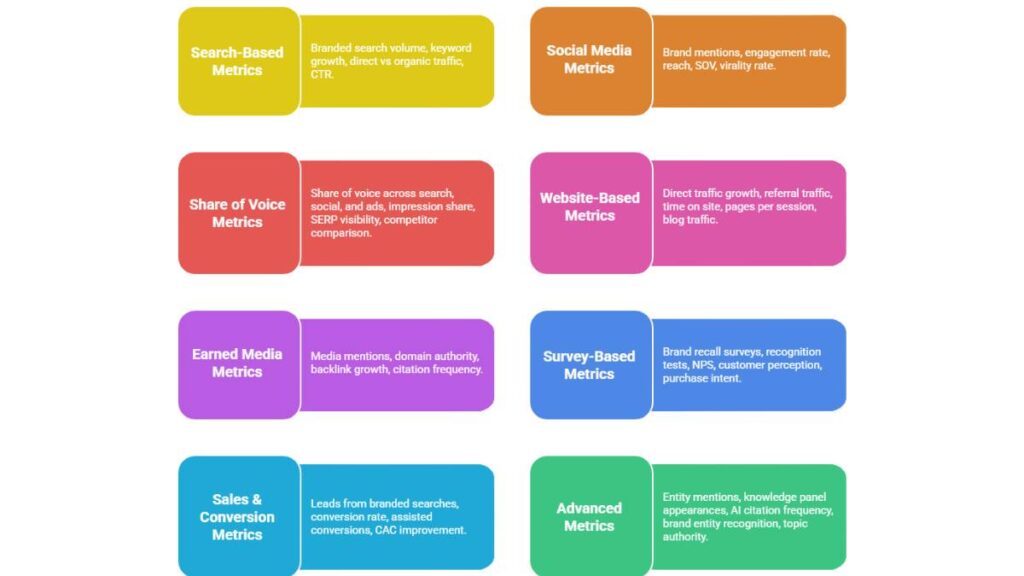
Search behavior is often the cleanest reflection of brand awareness because it shows intent without filters. If someone types a brand name directly, that usually means they already know it exists in some form.
Branded search volume is the most obvious signal here. When people start searching a brand name more often over time, it usually indicates that awareness is building outside of paid effort alone. It’s not always linear, though; sometimes it spikes after campaigns, sometimes it grows slowly through repetition.
Growth in branded keywords also tells a quieter story. Not just the main brand name, but variations, misspellings, product names, and combinations. These long-tail branded searches often show deeper familiarity.
Then there’s traffic behavior:
- Direct traffic usually signals memory or strong recall
- Organic branded traffic shows search-driven recognition
- Click-through rate on branded queries tends to be significantly higher than non-branded ones, which is expected, but still worth tracking because it confirms trust
What matters here isn’t just volume, but consistency. A brand that shows steady growth in search signals tends to have stronger long-term awareness than one with occasional spikes.
Social Media Brand Awareness Metrics
Social platforms are a different kind of environment. Awareness here is less about intent and more about exposure and repetition.
Brand mentions are one of the most useful indicators, especially untagged ones. Tagged mentions are easy to track, but untagged mentions often show organic conversation, people talking about the brand without being prompted.
Engagement rate adds another layer, but it should be read carefully. Likes and shares alone don’t always mean awareness is improving. Sometimes content just performs well in isolation. The more reliable reading comes from consistent engagement across multiple posts over time.
Reach and impressions are useful, but again, context matters. High reach with low retention or engagement often means surface-level exposure rather than real recognition.
Social share of voice is where things become more competitive. It’s basically a comparison of how often a brand is being talked about versus others in the same space. It’s not perfect, but it gives a rough sense of visibility in crowded categories.
The virality rate of branded content is more situational, but when it happens repeatedly, it usually indicates a strong top-of-mind presence or emotional resonance.
Share of Voice & Competitive Awareness Metrics
This is where brand awareness stops being absolute and becomes relative. Because visibility doesn’t exist in isolation, it exists compared to competitors.
Share of voice across search, social, and ads gives a combined view of how much attention a brand is capturing in its category. It’s not just about being present, but about how often a brand appears compared to others competing for the same attention.
Share of impressions in paid and organic spaces adds another dimension. Sometimes a brand might be ranking well but still losing visibility share because competitors dominate more frequently across multiple queries.
Brand visibility in SERPs is another layer worth watching. Not just rankings, but how often a brand appears across different result types, organic listings, ads, featured snippets, and sometimes even related searches.
Competitor comparison in listening tools tends to reveal gaps that aren’t obvious in isolated dashboards. A brand might feel active internally, but still be underrepresented compared to others dominating conversation frequency.
This category of metrics is less about absolute growth and more about positioning.
Website-Based Brand Awareness Metrics
Website behavior often reflects awareness indirectly. People don’t just arrive randomly; there’s usually some prior exposure involved.
Direct traffic growth is one of the strongest indicators of brand recall. When users skip search entirely and type a URL or brand name directly, it usually signals familiarity.
Referral traffic also plays a role, especially when it comes from mentions, blogs, or external content. It shows that the brand is being referenced elsewhere, which often feeds awareness loops.
Time on site behaves differently for new vs returning users. Returning users usually spend more time and explore deeper, which can suggest stronger familiarity. New users, on the other hand, often bounce faster unless something immediately resonates.
Pages per session gives a sense of engagement depth. Not always perfect, but useful when tracked over time rather than in isolation.
Blog traffic and content shares add another layer; they show whether content is spreading beyond owned channels. Sometimes this is where early awareness signals show up before search data catches up.
Earned Media & PR Metrics
Earned media is one of those areas that often gets underestimated because it doesn’t feel as controllable as paid campaigns, but its impact on awareness is usually strong and long-lasting.
Media mentions and press coverage volume are the obvious starting points. The more a brand is mentioned across credible sources, the more it becomes part of industry conversation.
Domain authority of referring publications adds weight to those mentions. A mention on a small blog doesn’t carry the same awareness impact as coverage in a well-recognized publication, even if both are technically “mentions.”
Backlink growth from earned content is another indirect signal. It’s not just an SEO factor; it reflects how often others are referencing the brand enough to link to it.
Citation frequency in industry articles is often overlooked, but it’s actually a strong indicator of authority. When a brand starts being used as an example or reference point repeatedly, awareness tends to compound naturally.
Survey-Based Brand Awareness Metrics
Surveys bring something digital metrics can’t always capture: direct human recall.
Aided vs unaided recall is especially useful. Aided recall asks if someone recognizes a brand when shown options. Unaided recall asks if they can name it without prompts. The gap between the two often tells you how strong the brand memory really is.
Brand recognition tests sit somewhere in between. They measure familiarity without requiring full recall.
Net Promoter Score is sometimes used as a proxy, though it’s not a pure awareness metric. Still, it can reflect emotional connection, which indirectly influences how likely someone is to remember or recommend a brand.
Customer perception surveys and purchase intent feedback after exposure help connect awareness to behavior. Not perfectly scientific, but useful for direction.
Sales & Conversion Linked Awareness Metrics
This is where awareness starts showing business impact more clearly.
Leads generated from branded searches are usually high-intent by default. People searching for a brand name are already closer to decision-making.
Conversion rate comparisons between branded and non-branded traffic often reveal a noticeable gap. Branded traffic almost always converts better, sometimes significantly.
Assisted conversions are important too, even if they’re often ignored. Not every user converts on the first interaction. Awareness plays a role across multiple touchpoints before conversion happens.
Customer acquisition cost trends can also reflect awareness impact over time. As brand recognition increases, acquisition often becomes less dependent on aggressive targeting.
Advanced Brand Awareness Metrics
This is a newer layer of measurement, and it’s still evolving in how it’s interpreted.
Entity mentions in AI-generated answers or summaries indicate whether a brand is being recognized as part of relevant topic spaces. It’s less about ranking and more about inclusion.
Knowledge panel appearances are another strong signal of entity recognition. When search systems confidently associate a brand with structured information, it usually reflects strong awareness consistency.
AI citation frequency across systems like conversational engines or assistants shows how often a brand is referenced when topics are discussed. Not always visible in traditional analytics, but increasingly relevant.
Brand entity recognition across ecosystems is about consistency, whether the brand is understood the same way across different platforms and contexts.
Topic authority clustering signals refer to how often a brand appears within grouped subject areas. If a brand repeatedly shows up around a specific topic cluster, awareness tends to strengthen within that category.
Taken together, these metrics don’t behave like a checklist. They behave more like signals in a system. Some are loud, some are subtle, and the real insight usually comes from how they move together over time rather than individually.

Enroll Now: Brand Management course
Common Challenges in Measuring Brand Awareness Metrics
Measuring brand awareness always sounds cleaner in theory than it plays out in real marketing setups. On paper, everything looks trackable. In reality, people don’t move in straight lines, and that’s where most of the confusion starts.
One of the first issues is attribution gaps across channels. A typical user journey today is fragmented in a way that’s hard to fully reconstruct. Someone might see a brand on social media, not act on it, forget it completely, then come back days later through search or a direct visit after hearing about it again elsewhere.
So the question becomes: which touchpoint deserves credit?
Honestly, there’s no perfect answer. Each touchpoint probably played a part, even if the reporting tools try to simplify it into a single source.
Then there’s offline awareness, which still refuses to fit neatly into dashboards. Word-of-mouth, events, casual conversations, even something like seeing a brand name in passing somewhere, all of that builds familiarity. But when it finally shows up in analytics, it often appears as “direct traffic,” which doesn’t really explain much.
Social media brings its own set of complications. Engagement numbers can look encouraging, sometimes even exciting, but they don’t always translate into memory or recognition. A post can be shared widely just because it’s entertaining, not because the brand behind it is becoming more memorable.
Sentiment data also tends to be noisy. A spike in positive or negative mentions can look meaningful, but sometimes it’s just context distortion, one viral moment skewing the perception of overall awareness.
Another common mistake is treating engagement as awareness. A lot of likes or views doesn’t automatically mean people remember the brand later. Sometimes it just means the content worked in isolation, then disappeared from memory right after.
And then there’s timing, which gets overlooked more often than it should. Awareness rarely shows up immediately. A campaign might run today, but the actual effect could surface weeks later in branded search, direct visits, or even higher conversion rates from returning users. That delay often leads to undervaluing what actually worked.
Step-by-Step Process to Measure Brand Awareness Metrics
Measuring brand awareness properly is less about collecting every possible metric and more about building a structure that actually reflects how people move across touchpoints. Without that structure, data becomes noisy pretty quickly.
Step 1: Define Brand Awareness Goals
This step is often rushed, but it sets the tone for everything else.
Brand awareness doesn’t mean the same thing for every business. For some, it’s about visibility. For others, it’s recall. And sometimes it’s more about shaping perception than reach.
So it helps to be clear upfront:
Awareness usually means people are starting to recognize the brand more often
Recall means the brand comes to mind without prompting
Perception means the impression people carry after exposure
These are related, but not interchangeable. Mixing them usually leads to unclear reporting later.
Step 2: Select Key Brand Awareness KPIs
There’s a tendency to track too much here. It feels productive, but it often creates clutter instead of clarity.
A better approach is to stick to signals that actually show movement over time:
- Branded search behavior
- Direct traffic patterns
- Share of voice in relevant spaces
- Mentions across platforms
- Returning user behavior
Not all of these carry equal weight. Some are early signals, others are outcome signals. Reading them together matters more than obsessing over each one individually.
Step 3: Set Up Tracking Tools
This is where the foundation either holds or starts to fall apart later.
Different data sources serve different purposes:
- Web analytics helps understand how users behave once they arrive
- Search data shows whether brand discovery is increasing over time
- Social listening picks up conversations that don’t always get tagged properly
- CRM or lead systems help connect awareness to actual business outcomes
Nothing needs to be overly complex here. In fact, complexity usually makes interpretation harder. Clean inputs matter more than fancy dashboards.
Step 4: Analyze Cross-Channel Data
This is usually where patterns start to appear, but only if the data isn’t viewed in silos.
For example, it’s common to see things like:
- Social reach is increasing before search interest picks up
- Direct traffic is rising without a clear campaign trigger
- Referral traffic acts as an early signal of external validation
None of these is an isolated event. They’re usually connected, just not immediately obvious.
The key is not to force a single narrative too early. Sometimes the data tells a slower story, and rushing it leads to wrong conclusions.
Step 5: Benchmark Against Competitors
Brand awareness doesn’t exist in isolation. Even strong internal growth can feel underwhelming if competitors are growing faster in the same space.
Benchmarking usually focuses on a few consistent areas:
- Share of voice across search and social
- Frequency of brand mentions compared to competitors
- Overlap in visibility across key topics
- Presence in broader industry conversations
This step often reveals something uncomfortable but useful. Growth is relative. And in many cases, perception in the market matters as much as actual performance.
Step 6: Report & Iterate Monthly
Brand awareness metrics don’t behave like performance metrics that change overnight. They move slowly, and sometimes unevenly.
That’s why monthly reporting tends to work better. It allows enough time for patterns to settle instead of reacting to short spikes that don’t really mean much on their own.
Monthly cycles help with:
- Filtering out noise
- Seeing campaign impact more clearly
- Understanding direction instead of isolated fluctuations
And iteration is where things actually improve. Not in the measurement itself, but in how strategy adjusts based on what the data keeps repeating over time.
Best Tools to Track Brand Awareness Metrics
There’s no single system that captures brand awareness fully. That’s probably the first thing to accept. It always ends up being a mix of different tools, each showing a slightly different angle of the same reality.
The real value comes from how these signals are combined, not from any one platform doing everything.
Google Analytics 4 (GA4)
This is mostly about understanding what happens after people already reach the site.
Useful for:
- Tracking direct traffic shifts
- Comparing new vs returning users
- Understanding how deeply users engage with content
It doesn’t explain awareness directly, but it reflects what awareness eventually leads to.
Google Search Console
Search data here is one of the clearest indicators of brand familiarity building over time.
It helps identify:
- Growth in branded searches
- Click-through behavior on brand-related queries
- Visibility trends for branded terms
When branded queries start rising consistently, it usually signals that awareness is no longer dependent on campaigns alone.
SEMrush / Ahrefs (branded keywords + backlinks)
These tools help understand how a brand exists outside its own ecosystem.
They are useful for:
- Tracking variations in branded keyword searches
- Monitoring backlink growth from external mentions
- Observing competitor visibility shifts
It’s less about precision here and more about spotting direction, where attention is moving in the broader market.
Brandwatch / Mention (social listening)
Social listening tools capture conversations that don’t always show up in structured analytics.
They help with:
- Identifying untagged mentions
- Tracking sentiment patterns across discussions
- Spotting recurring themes in brand conversations
Often, early awareness signals appear here before they show up in search behavior.
HubSpot (lead attribution + CRM tracking)
CRM systems connect awareness signals to actual business outcomes, which is where things become more tangible.
They help track:
- Branded vs non-branded lead sources
- Conversion paths across multiple touchpoints
- Assisted conversions that don’t show up in last-click reports
This is usually where awareness stops being abstract and starts showing business impact.
Sprout Social (social engagement analytics)
This focuses more on how audiences interact with content over time.
Useful for:
- Engagement consistency across posts
- Content reach patterns
- Audience growth quality rather than just quantity
Engagement alone doesn’t define awareness, but repeated engagement patterns often hint at familiarity building in the background.
When all of these are viewed together, brand awareness stops looking like a single metric and starts looking like a system. And that system only really makes sense when the focus shifts from isolated numbers to how user behavior actually unfolds across time and platforms.
How to Improve Brand Awareness Using Metric Insights
Improving brand awareness is rarely about doing “more marketing.” It usually comes down to noticing what the data is already trying to say, then adjusting the system around it. Most brands already have enough activity; the real gap is in interpretation.
When awareness metrics start being used properly, a few practical shifts usually stand out.
Strengthen Content Strategy
Content is often where awareness either compounds quietly or starts to fragment.
The strongest patterns usually don’t come from volume alone. They come from repetition with intent. When people keep seeing the same themes, the same positioning, and even the same tone across different content formats, recognition starts to build almost passively.
A few things tend to matter more than they’re given credit for:
- Consistency in topics rather than constant expansion into new ones
- Repeated association between brand and category language
- Content that reinforces “what the brand is known for,” not just what it does
There’s also a subtle shift that happens over time. Content stops being about discovery and starts becoming about reinforcement. That’s usually where awareness starts stabilizing.
Build Consistent Social Presence
Social presence isn’t about viral moments. It’s more like background exposure that slowly builds familiarity.
Most awareness growth on social platforms doesn’t come from one big post. It comes from repeated, predictable visibility.
What tends to work better in practice:
- A steady posting rhythm that doesn’t fluctuate too much
- A recognizable content style that feels consistent even without branding
- Messaging that doesn’t change direction too often across platforms
There’s a quiet effect here that’s easy to underestimate. People don’t always remember individual posts. They remember patterns. And patterns build familiarity.
Leverage Influencer & Partnership Marketing
Partnerships influence awareness in a slightly indirect way, which is why they’re sometimes misunderstood.
Instead of building recognition from scratch, they borrow it. The brand gets introduced inside an environment where trust already exists, which shortens the familiarity curve.
What usually works better:
- Partnerships where audience overlap feels natural, not forced
- Repeated exposure through a few strong partners rather than scattered one-offs
- Context-driven mentions instead of overly promotional placements
The key here isn’t just reach. It’s an association. People often remember where they first heard about a brand before they remember the brand itself.
Run Paid Awareness Campaigns
Paid campaigns often get judged too quickly based on immediate conversions. That creates a blind spot, because awareness-driven campaigns rarely behave like performance campaigns.
Their impact usually shows up later, not immediately.
Typical outcomes of awareness campaigns:
- Increase in branded search activity over time
- Higher direct traffic as recognition builds
- Improved conversion rates from users who already recognize the brand
The effect is cumulative. Not instant.
Channels like video, display, and broad reach formats tend to work better here because they focus on repeated exposure rather than immediate action.
Encourage Reviews & Word of Mouth
This is one of those areas that doesn’t scale neatly, but carries disproportionate influence when it works.
Reviews and word of mouth often act as silent validation loops. They don’t just inform new users, they reinforce memory in existing ones.
What usually helps:
- Making feedback feel natural instead of transactional
- Encouraging real experiences instead of scripted responses
- Creating moments that people actually feel like sharing
The tricky part is that word of mouth rarely shows up cleanly in dashboards. But its effects are visible in indirect signals like branded search growth and repeat visits
Advanced Strategies to Improve Brand Awareness Metrics
At a more advanced level, brand awareness stops being just about visibility and starts becoming about how consistently a brand is understood across systems, platforms, and search environments.
This is where structure matters more than isolated tactics.
Building entity SEO for AI search visibility
Brands today are increasingly treated as entities rather than just websites or keywords. That means consistency becomes critical.
When a brand is described the same way across multiple trusted sources, it becomes easier for systems and users to recognize it as a stable reference point.
It’s less about optimization tricks and more about clarity:
- Clear positioning across all mentions
- Consistent naming and context usage
- Repeated association with specific topics
Optimizing for Google Knowledge Graph inclusion
Knowledge Graph presence usually reflects one thing: clarity and repetition.
When a brand is consistently referenced in a structured and recognizable way, it becomes easier for search systems to confidently associate it with a defined identity.
It doesn’t happen from a single action. It builds over time through repeated validation across multiple sources.
Creating “topic authority clusters” in content strategy
Content that builds strong awareness usually isn’t scattered. It clusters.
Instead of publishing across unrelated topics, stronger systems tend to:
- Focus deeply on a few core subject areas
- Build interconnected content around those themes
- Reinforce the same positioning repeatedly across formats
Over time, this creates familiarity not just with the brand, but with what the brand represents.
Multi-channel consistency (search + social + video)
One of the most overlooked drivers of awareness is consistency across platforms.
Not identical messaging everywhere, but a recognizable identity that carries across formats.
When users repeatedly encounter a brand in different environments, search results, social feeds, and video platforms, and it still feels like the same voice, recognition builds faster.
Inconsistency does the opposite. It slows down recall even if the reach is high.
Leveraging AI-generated content distribution insights
Content distribution today is less about one-time publication and more about reinforcement across formats.
What tends to work better:
- Repackaging core ideas into multiple content formats
- Maintaining consistent messaging while adapting delivery style
- Observing which formats reinforce recognition rather than just reach
The focus shifts from producing more content to making sure the same ideas are seen often enough to be remembered.
Brand Awareness KPIs Dashboard
A useful dashboard doesn’t try to capture everything. It focuses on signals that actually move together and reflect direction over time.
Weekly tracking is usually too sensitive for awareness metrics. Monthly views tend to give a more stable picture.
The most useful indicators usually include:
- Branded search volume trend
One of the clearest signals of growing recognition. When people start searching the brand name more often without prompting, awareness is expanding. - Social share of voice
Not just activity, but relative presence compared to competitors in the same space. - Website direct traffic growth
Often a strong indicator of recall and familiarity building over time. - Brand mentions across platforms
Especially untagged mentions, which tend to reflect organic conversation rather than structured engagement. - Backlink acquisition rate
A proxy for external validation. When more sources reference the brand, awareness tends to strengthen indirectly. - Conversion from branded traffic
This helps connect awareness to actual intent. Branded users usually behave differently, and that difference becomes more meaningful over time.
The key is not to treat these as isolated metrics. They work better as a system that shows movement rather than static performance.
Conclusion:
Turning Brand Awareness Metrics into Growth Strategy
Brand awareness metrics are often treated like reporting outputs, but their real value shows up when they start shaping decisions.
Measurement alone doesn’t move growth. Interpretation does.
The shift usually happens when awareness data stops being a monthly report section and starts becoming part of how campaigns, content, and positioning decisions are made.
A few things tend to matter most in the long run:
- Awareness builds slowly, but compounds when consistent
- Short-term spikes rarely reflect long-term recognition
- The strongest signals often come from repeated behavior patterns, not single metrics
And in more connected digital environments, awareness is no longer separate from performance. It influences how users search, how they click, and how they decide, often without them realizing it.
The real work is less about tracking awareness and more about making sure it keeps moving in the right direction, steadily, over time.
FAQs: Brand Awareness Metrics
What are the most important brand awareness metrics?
There isn’t really a single clean answer here, even though people try to make it sound tidy. The usual set that actually holds up in practice is branded search, direct traffic, share of voice, and mentions. But even these behave differently depending on the industry. It only starts making sense when looked at together, not in isolation.
How do you measure brand awareness in digital marketing?
It’s more of a patchwork than a formula. Search data shows what people are actively looking for, analytics shows how they behave once they land, and social or PR data shows exposure in the background. None of it is perfect alone. But when the direction lines up across all three, that’s usually the signal that something is working.
Which KPI best reflects brand awareness growth?
Branded search is usually the closest thing to a “real” signal. When people start typing the brand name directly instead of category terms, something has shifted in memory. Direct traffic kind of supports this, too, though it can get messy with bookmarks, apps, and all that. Still, the trend matters more than precision here.
How often should brand awareness be measured?
Monthly works best most of the time. Weekly checks can feel useful, but honestly, they tend to create more confusion than clarity. Awareness doesn’t really jump around day to day. It builds slowly, sometimes annoyingly slow. So, giving the data some breathing room usually makes interpretation a lot more reliable.
Is social engagement a reliable brand awareness metric?
Not fully, no. Engagement can look great on paper and still mean very little in terms of actual memory or recall. A post can get shared widely just because it’s entertaining. The metric starts becoming useful only when it’s consistent and lines up with other signals like search growth or repeat visits.
What tools track brand awareness effectively?
There isn’t a single tool that gets the full picture, and trying to force one usually backfires. Search data gives one angle, analytics another, social listening another, and CRM data something else entirely. The real insight comes from comparing these layers, even if they don’t always agree perfectly.
How do small businesses measure brand awareness?
Smaller setups usually keep it pretty straightforward, and that actually works better in the early stages. Branded searches, direct traffic, and word-of-mouth referrals already tell a lot. Sometimes, even customer conversations or repeat inquiries give more clarity than dashboards. Overcomplicating it early on just adds noise.
What is the difference between reach and brand awareness?
Reach is just exposure… basically, how many people saw something. Awareness is slower and messier. It’s whether they actually remember it later or not. A high-reach post can disappear from memory in hours. Awareness only builds when exposure keeps repeating across time and channels.
How long does it take to improve brand awareness metrics?
Longer than most people expect, to be honest. Some early movement can show up in a few weeks if campaigns are strong, but deeper recognition takes months. There’s no shortcut here. It’s mostly repetition, consistency, and a bit of patience, even when results feel like they’re moving too slowly.
Can SEO directly improve brand awareness?
Not directly in a visible way, at least not immediately. But repeated exposure in search results does something subtle. People start noticing the name without really trying. Over time, that familiarity builds up. It’s slow, almost invisible at first, but it compounds if the visibility stays consistent.
How do brand awareness metrics differ from brand performance metrics?
Awareness is more about being remembered or recognized. Performance is about action, like conversions or revenue. They sit in different layers. Awareness builds the base, even if it doesn’t show immediate returns. Performance usually becomes harder and more expensive without that base underneath it.
What are the best KPIs to measure brand awareness for startups?
Startups don’t need too many signals at once. Branded search, direct traffic, mentions, and referrals are usually enough to start with. There’s a temptation to track everything, but early on, that just creates confusion. It’s better to watch a few things consistently and see direction, not perfection.
Can brand awareness be measured without paid tools?
Yes, it can. Not in a super detailed way, but enough to understand movement. Search Console, basic analytics, and platform insights already show a lot. Paid tools just add layers of detail. Early on, though, clarity comes more from consistency than from expensive dashboards.
How do backlinks contribute to brand awareness metrics?
Backlinks are less about ranking in this context and more about exposure. When other sites mention or reference a brand, it quietly expands visibility. Over time, repeated mentions across relevant spaces start reinforcing recognition. It’s subtle, not immediate, but it builds up in the background.
What is the role of SEO in improving brand awareness metrics?
SEO helps mostly through repetition. When people keep seeing a brand in search results across related topics, familiarity builds slowly. It doesn’t feel dramatic in the moment. But over time, that repeated exposure starts turning into recognition, especially when the messaging stays consistent.
How do you measure offline brand awareness effectively?
Offline awareness is tricky because it doesn’t show up cleanly anywhere. Usually, it gets inferred through indirect signals like branded search spikes, direct traffic jumps, or even customer feedback. Sometimes there’s no obvious trigger, just a shift in behavior that suggests something is landing offline.
What is a good benchmark for brand awareness growth?
There really isn’t a universal benchmark, even though people want one. It depends too much on the market and starting point. What matters more is steady movement in a few core signals like branded searches and direct visits. Slow growth is still growth here, even if it doesn’t feel exciting.
How does content marketing impact brand awareness metrics?
Content works in a repetitive way more than anything else. When the same ideas show up again and again, people start linking them with the brand. It doesn’t always feel like impact at first. But over time, it shows up in search behavior and returning visitors.
Which social media metrics best indicate an increase in brand awareness?
Not just reach, even though that’s usually the first thing people look at. Consistent mentions and repeated engagement matter more. Awareness shows up when people keep talking about or interacting with a brand across different posts, not just reacting once and moving on.
How do you connect brand awareness metrics to revenue attribution?
It rarely connects cleanly, which is where most frustration comes from. But patterns show up over time. Branded traffic usually converts better, and people often return multiple times before buying. So awareness doesn’t show up as a straight line to revenue, more like a quiet influence in the background.