
Most marketing teams don’t have a tool problem. They have a tool pile-up. One app for emails, another for social posts, a third for ads, and a spreadsheet nobody trusts holding it all together.
That pile-up eats real hours. And AI has made it messier, because every tool now ships its own assistant and none of them talk to each other. An all-in-one AI marketing platform tries to fix this by putting content, campaigns, customer data and reporting in one connected place.
The pitch sounds great. The reality is more mixed. Jasper’s State of AI in Marketing 2026 report found that 91% of marketers now use AI, but only 41% can show it pays off.
This guide covers what these platforms actually do, which features matter, how seven popular options compare, and how to choose without overpaying. Whether you run a small D2C brand or a growing agency, you’ll leave with a simple way to build your shortlist.
Table of Contents
What Is an All-in-One AI Marketing Platform?
An all-in-one AI marketing platform is software that brings content creation, campaign execution, customer data and reporting into one system, with AI doing the repetitive work and suggesting next steps. You still make the calls. The platform speeds up everything around them.
How Does It Work?
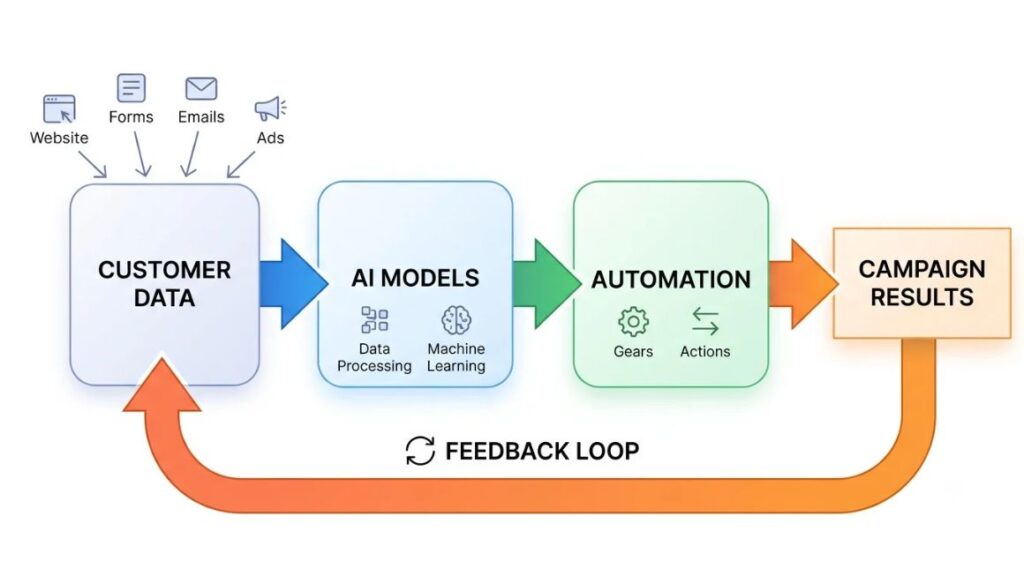
Three layers do the heavy lifting. A shared customer database collects data from your website, forms, emails and ads. AI models then use that data to draft content, group customers and predict who’s likely to buy. Automation handles the rest: sending the email, pausing the weak ad, updating a lead score.
The loop is what matters. Results flow back into the customer data, so the next suggestion gets better. Think of it as a marketing technology platform with an AI layer on top, tying together what most people call digital marketing automation.
How Is It Different from Using Separate AI Tools?
Separate tools are fast in one spot. A connected platform keeps context everywhere. Your writing assistant doesn’t know which segment clicked most last month, and your ad tool doesn’t know which leads became customers. On an all-in-one AI marketing platform, they do.
That also means one set of reports, one approval flow, and fewer “which file is final?” messages.
One honest caveat. Not every piece of AI marketing software covers every function. Most platforms are strong in two or three areas and average in the rest, which is why the platform list later in this guide groups them by strength.
Why Businesses Are Moving Towards AI-Powered Marketing
Businesses are moving to AI-powered marketing because customers expect fast, relevant messages on every channel, and small teams can’t produce that by hand. AI marketing automation handles the drafting, targeting and reporting at a pace people can’t match.
Changing Customer Expectations
People expect a quick reply, an offer that fits their habits, and a brand that sounds the same on Instagram, email and WhatsApp. Indian apps have set that bar high. Swiggy Instamart, for instance, used generative video tools to launch festive campaigns faster, according to a Social Samosa report on Google’s India roundtable.
Miss the bar, and customers simply open another app.
The Growing Role of AI in Marketing in 2026
Adoption isn’t the question anymore. Jasper’s survey of 1,400 marketers found 91% use AI, up from 63% a year earlier, yet only 41% can demonstrate ROI. Gartner’s 2026 CMO Spend Survey adds an awkward detail: 70% of CMOs call becoming an AI leader a critical goal, and 70% admit their internal processes aren’t mature enough to scale it.
India shows the same split. MoEngage’s 2026 India report found 37% of brands make AI the core driver of their campaigns, while 16.5% are still experimenting with basic tools.
Two shifts sit underneath. AI agents, which plan and run multi-step tasks without constant prompting, are moving into campaign work. And Google’s AI Overviews are changing how people find brands, which makes generative engine optimization (GEO, the practice of getting cited inside AI-generated answers) a real job. That pressure is pushing teams toward an all-in-one AI marketing platform. Human oversight stays part of the deal.
AI use in marketing is close to universal in 2026, but proof of impact lags behind. Jasper’s 2026 survey found 91% of marketers use AI while 41% can demonstrate ROI. Connected workflows and shared data are one way teams try to close that gap.
Essential Features to Look for in an AI Marketing Platform
The features worth checking first in an all-in-one AI marketing platform are content creation, SEO research, social scheduling, email automation, ad management, CRM and analytics. Don’t just confirm each one exists. Ask how deep it goes, because a thin module inside a long feature list is the most common disappointment.
AI Content Creation and Optimization
Look for blog outlines, website copy, emails and social captions in one editor. The real test is brand voice. Can you upload past work and get drafts that sound like you? AI content generation is easy now. Keeping it consistent and accurate across a team is the hard part, so check the editing and approval controls too.
SEO and Content Research
Good platforms cover keyword research, topic gaps and competitor content in one view. In 2026, add AI search visibility to that list. A Carnegie Mellon University and Indian School of Business study found that Google’s AI Overviews cut organic clicks by 38% on queries where they appear. You need to know whether AI answers cite you at all.
Also Read: Types of SEO (Search Engine Optimization) – Complete Guide
Social Media Management
You want planning, scheduling, caption and creative generation, engagement monitoring and clean reporting. Digiday+ Research found 49% of marketers used AI in social campaigns in early 2026, so this is now standard. Check that the scheduler supports the platforms you actually post on.
Email Marketing and Automation
Look for campaign builders, automated follow-ups, journey mapping and audience targeting. This is where AI customer segmentation pays off: grouping people by behavior, such as cart abandoners or repeat buyers, instead of by a static list. Ask whether segments update on their own as behavior changes.
Advertising Campaign Management
Support for Google and Meta ads should include copy and creative variations, performance analysis and budget alerts. Marketers are cautious here. Digiday+ found skepticism about AI ad buying, so look for AI advertising tools that recommend and let you approve, rather than spending your budget on their own.
CRM and Customer Management
Lead capture, customer profiles, lead scoring and follow-up reminders. The point is that marketing and sales see the same record. If they can’t, you’ve rebuilt the silo inside a new tool.
Analytics and Performance Reporting
Dashboards, conversion tracking and behavior analysis are the baseline. Good marketing analytics software tells you what to change, not just what happened. Here’s a quick test: can you see revenue by channel and campaign without exporting to a spreadsheet?
Major Benefits of Using an Integrated AI Marketing Solution
An integrated AI marketing solution saves time, lets small teams do more, supports relevant messaging and puts decisions on firmer data. The gains come from connected workflows, not from AI alone. That’s the whole case for an all-in-one AI marketing platform.
Saves Time and Reduces Repetitive Work
Marketing workflow automation takes over scheduling, resizing, reporting and follow-ups. One marketing leader quoted by exchange4media in April 2026 said automation cut manual effort by nearly 40%. Treat that as one data point, not a promise.
Improves Marketing Productivity
A small team can manage more channels without hiring for each one. The catch: someone still has to review what the AI produces.
Creates More Personalized Customer Experiences
When customer data sits next to your content tools, messages can reflect what someone bought or browsed. Nykaa is reported to use AI recommendations based on past purchases and browsing patterns. Done well, personalized marketing feels like good service, not surveillance.
Makes Marketing Decisions More Data-Driven
Connected reporting shows which campaign led to a sale, not just which one got clicks. Budget conversations get shorter.
Brings Marketing Activities Together
Marketing campaign management across email, ads and CRM in one place means fewer handoffs and less version confusion.
Supports Business Growth
As your list and channels grow, you add contacts and seats instead of building a new stack. Watch the pricing, though. Many platforms charge by contacts, so costs rise as you succeed.

Best AI Marketing Platforms to Consider in 2026
HubSpot suits CRM-led teams, Jasper suits content teams, Semrush suits SEO, Mailchimp and ActiveCampaign suit email and automation, Canva suits design, and Klaviyo suits online stores. None of them replaces a full marketing department.
Few can claim to be a true all-in-one AI marketing platform for every job, so these AI-powered marketing tools are grouped by strength, not by who has the longest feature list. Prices below are in US dollars, checked in November 2026, and they change often.
HubSpot: Best for CRM-Connected Marketing Automation
HubSpot’s Breeze AI sits on top of its CRM, so content, lead scoring and workflows all use the same customer record. You also get campaign assistance, customer journeys and reporting. The cost climbs fast, though. Marketing Hub Professional is listed at roughly $800 to $890 a month, and AI features draw on usage credits. Best for growing businesses with a sales team.
Jasper: Best for Brand-Controlled Content Creation
Jasper focuses on writing and campaign content with brand voice settings, content workflows and team collaboration. There’s no free plan, and the Pro plan at $59 per seat a month on annual billing covers one seat, so teams end up asking sales about Business. Best for content-heavy teams.
Semrush: Best for SEO and Search Visibility
Semrush is the research engine: keyword research, competitor analysis, content optimization and AI search visibility tracking. The classic Pro plan has been listed at $139.95 a month, while its newer Semrush One bundles with AI visibility start at $199. Best for SEO-focused businesses.
Mailchimp: Best for Email and Audience Management
Mailchimp covers email creation, audience segmentation, automated journeys and campaign analytics in a familiar interface. Pricing follows your contact count, and in January 2026 it cut its free plan to 250 contacts and 500 sends a month. Best for businesses whose marketing is mostly email.
ActiveCampaign: Best for Customer Journey Automation
ActiveCampaign is built for automation depth: workflows, lead nurturing, segmentation and personalized email. Starter begins at $15 a month for 1,000 contacts on annual billing, but advanced segmentation sits in Pro and above. Best for businesses with complex customer journeys.
Canva: Best for AI-Powered Marketing Design
Canva handles social graphics, ad creatives, brand templates and AI-assisted visuals. AI features share one credit pool across the platform, so heavy users can run short mid-month. Pro works out to about $12 a month on annual billing in the US, so check Indian pricing at checkout. Best for visual content teams.
Klaviyo: Best for Ecommerce Marketing
Klaviyo ties customer data, segmentation and email and SMS automation to purchase behavior. Since February 2025 it bills by active profiles, so dormant contacts cost you money. It’s free up to 250 profiles, and email plans start at $20 a month. Best for online stores.
Comparison
| Platform | Primary use case | Main strengths | Ideal business type | Pricing model |
| HubSpot | CRM-led marketing automation | CRM, workflows, reporting | Growing B2B and service businesses | Per seat plus contact tiers; AI credits |
| Jasper | Brand-controlled content | Brand voice, team workflows | Content-heavy teams | Per seat; Business is a custom quote |
| Semrush | SEO and AI search visibility | Keyword and competitor data | SEO-led sites and agencies | Monthly tiers with usage limits |
| Mailchimp | Email and audiences | Easy builder, segmentation | Small businesses | Tiers by contact count; free plan |
| ActiveCampaign | Journey automation | Workflows, lead nurturing | Complex funnels | Tiers by plan and contacts |
| Canva | Marketing design | Templates, AI visuals | Visual and social teams | Per user; shared AI credits |
| Klaviyo | Ecommerce email and SMS | Purchase-based segments | Online stores | Active profiles; SMS credits |
For small businesses, Mailchimp or ActiveCampaign Starter plus Canva keeps costs low. Agencies should look at Semrush for research and Jasper for brand-controlled content across clients. Ecommerce stores should start with Klaviyo. Enterprise teams will find HubSpot’s CRM depth and governance easier to justify.
One more point. Most AI marketing solutions are strongest in one area, and specialists often beat broad platforms at their own game. Semrush will out-research HubSpot’s SEO tools. Klaviyo will out-segment Mailchimp for a store. Choose an all-in-one AI marketing platform only if connection matters more to you than depth.
How to Choose the Right AI Marketing Platform?
Choosing an all-in-one AI marketing platform starts with the tasks that eat your week. Then check integrations, ease of use, total cost and data security, and test two or three platforms on real work before committing. That order keeps you from buying features you’ll never open.
Identify Your Marketing Requirements
Write down the five tasks that take the most hours. Weekly reporting? Email follow-ups? Social posts? Shortlist platforms that fix those first.
Check Features and Integrations
Confirm it connects with your CRM, website, ad accounts and analytics. A missing connector means manual exports, which defeats the purpose.
Evaluate Ease of Use
Ask how long onboarding takes and who will use it daily. If only one person can run it, you’ve built a bottleneck.
Compare Pricing and Additional Costs
Add up seats, contact tiers, AI credits and onboarding. Toolradar reports a mandatory onboarding fee of $1,500 to $3,000 for HubSpot Professional. Jasper Pro covers one seat. Canva’s AI credits are shared.
Check Data Security and Privacy
Read the vendor’s security documents, check who can see what, and ask where your data is stored. If you serve customers in India, find out how the vendor handles consent under the Digital Personal Data Protection Act, 2023.
Test Before Making a Long-Term Commitment
Use free trials or demos on a live workflow, such as one real email campaign. Judge the result, not the demo script. Jasper and Semrush both offer 7-day trials.
The best all-in-one AI marketing platform is the one that fixes your biggest time drains. Check integrations, total cost (seats, contacts, AI credits and onboarding) and data handling, then test two or three options on one live campaign before signing a long contract.
Practical Example: How a Business Can Use AI to Manage a Complete Marketing Campaign?
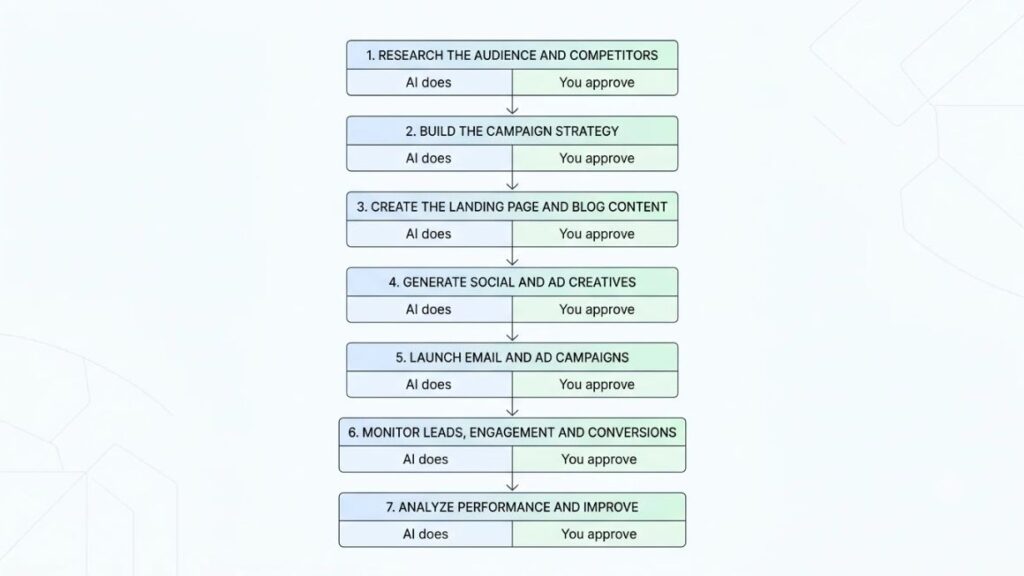
This is an illustrative workflow, not a verified customer case study. Imagine a small D2C skincare brand using an all-in-one AI marketing platform to launch a new vitamin C serum, with one marketer and a part-time designer.
- Research the audience and competitors. AI summarizes competitor pages and customer reviews. You decide which gaps are worth chasing.
- Build the campaign strategy. AI drafts positioning options. You pick one and set the budget.
- Create the landing page and blog content. AI writes first drafts. You check every ingredient claim.
- Generate social and ad creatives. AI produces variations. You reject anything off-brand.
- Launch email and ad campaigns. Automated marketing campaigns send the welcome series and retarget site visitors. You approve the spending cap.
- Monitor leads, engagement and conversions. Dashboards flag drop-offs. You decide whether it’s a real problem.
- Analyze performance and improve. AI summarizes what worked. You carry the lessons into the next launch.
The pattern is simple. AI drafts, tests and reports. Humans approve claims, spending and brand voice.
Also Read: AI Agent for Marketing Campaigns: How to Plan, Launch, and Scale Campaigns Autonomously
Common Mistakes to Avoid When Using AI Marketing Software
Most failures with an all-in-one AI marketing platform come from process, not technology.
Depending Entirely on AI-Generated Content
Ahrefs’ 2026 survey found marketers growing both more confident in AI content and more careful about checking it. Copy that habit. Edit every draft before it goes out.
Ignoring Brand Voice and Accuracy
Feed the platform real past work, then fact-check every number and claim. One wrong statistic costs more trust than ten good posts earn.
Choosing Software Based Only on Price
A cheap plan with no CRM link creates manual work later. Compare the cost per task saved, not the monthly fee.
Overlooking Integration Requirements
List your current tools first. Then test each connector during the trial.
Ignoring Data Privacy
Limit who can export customer data. And don’t paste sensitive customer details into tools you haven’t vetted.
Failing to Measure Actual Results
Set a baseline before you switch: hours spent, cost per lead, revenue per campaign. Without one, you can’t tell whether the platform helped.
Future Trends in AI Marketing to Watch
These are forecasts, not facts. Treat them as direction, not destiny, whichever all-in-one AI marketing platform you end up using.
AI Agents and More Connected Workflows
Gartner predicts that by 2028, 60% of brands will use agentic AI for one-to-one customer interactions. It also expects more than 40% of agentic AI projects to be canceled by the end of 2027, and estimates only about 130 vendors offer real agentic features. Be skeptical of agent claims.
Generative Engine Optimization and AI Search
Pew Research found users click through to organic results 8% of the time when an AI Overview appears, versus 15% when it doesn’t. Being cited inside the answer may soon matter as much as ranking under it.
Predictive Analytics and Personalization
Expect more predictions of churn and next purchase. India may lag on speed: an AgencyReporter analysis argues that Indian brands remain disproportionately batch-oriented, updating data overnight instead of in real time.
Automated Advertising Optimization
Ad platforms will handle more bidding and creative testing on their own. Keep spending caps and approvals in your hands.
Human-Led Strategy and AI-Assisted Execution
Gartner’s Predicts 2026 report says AI will augment 90% of marketing workflows by 2029, but only 20% will show incremental ROI beyond the pilot stage. A sound AI-driven marketing strategy starts with the business goal, then uses AI to execute it.
Conclusion
A connected platform earns its place when it removes handoffs, not when it adds features. The right pick depends on your goals, budget, team size and the tools you already own.
So don’t buy on a demo. Run one real campaign through two shortlisted options, then compare hours saved and results. If you pick an all-in-one AI marketing platform, pick the one that improves your workflow, even if it shows fewer AI features on the pricing page.
If you want hands-on practice using AI inside real marketing workflows, YUP’s AI Marketing course is built for that.
Frequently Asked Questions (FAQ)
What is an AI marketing platform?
It’s software that uses AI to help plan, create, run and measure marketing across channels. An all-in-one AI marketing platform bundles several of those jobs, usually content, email, ads, CRM and reporting, on shared customer data.
What is the best AI marketing platform for small businesses?
It depends on your main channel. Email-led businesses can start with Mailchimp or ActiveCampaign Starter, online stores with Klaviyo’s free plan, and visual-heavy brands with Canva Pro. Fix your biggest time drain first, then add more.
Can AI marketing platforms manage multiple marketing channels?
Yes, many handle email, social, ads and CRM together. Depth varies, though. HubSpot spans a wide range of functions, while Klaviyo goes deep on email and SMS for stores. Check how strong each channel module is before you buy.
Is an AI marketing platform worth the investment?
Only if it replaces real work. Jasper’s 2026 survey found just 41% of marketers can demonstrate ROI from AI. Measure hours saved and cost per lead for 60 to 90 days before you commit to annual billing.
Can AI automate social media and email marketing?
Yes, with limits. AI can draft captions, schedule posts, trigger email sequences and adjust send times. It can’t judge tone during a sensitive moment or verify your product claims, so keep a human approval step.
What is the difference between AI marketing software and traditional marketing automation?
Traditional automation follows rules you set: if someone does X, send Y. AI adds prediction and generation, like drafting the email, choosing the segment or estimating who will buy. The strongest setups combine both.
Do businesses need separate SEO and advertising tools?
Often, yes. Specialists such as Semrush usually go deeper on SEO than a broad platform’s built-in module. A smaller business can start with one platform and add a specialist once search or ads become a main revenue source.
How much does AI marketing software cost?
Prices run from free tiers to thousands of dollars a month. In 2026, Mailchimp starts at about $13 a month, ActiveCampaign at $15, Klaviyo at $20, Jasper Pro at $59 to $69 per seat, and HubSpot Marketing Hub Professional at roughly $800 to $890. Costs rise with contacts, seats and AI credits.
Can AI marketing platforms replace marketing teams?
No. An all-in-one AI marketing platform can take over drafting, scheduling and reporting, but strategy, creative judgment, approvals and customer relationships stay human. Gartner urges CMOs to build hybrid models where people and AI agents work together.
What should businesses consider before choosing an AI marketing platform?
Your biggest time drains, integrations with current tools, ease of use, total cost including credits and onboarding, data security, and how the platform performs in a trial. Test it on a real campaign before signing a long contract.