

Meta says its Advantage+ suite has passed a $75 billion annual revenue run rate. Agency leads at Monks came back from Google Marketing Live 2026 saying that knowing how to build a campaign is no longer a competitive edge. And yet most ad teams still use AI the way they did in 2024: paste a report into a chat window, ask for ideas, then copy the answer into Ads Manager by hand.
That gap is exactly where an AI agent for paid advertising fits. Instead of advising from the sidelines, it connects to your live ad accounts, reads the numbers and, if you allow it, changes things. Between February and June 2026, Amazon, Meta, TikTok and Microsoft all opened their ad platforms to outside agents, and Google already had an official server of its own.
The doors are open. What you let through them is the real decision.
This guide covers what an AI agent for paid advertising actually does today, where it falls over, how to set one up in seven steps, how to keep it on a short leash and how to tell whether it’s earning its place. There’s also a section for Indian marketers, because the rollout looks different here.
Table of Contents
What Is an AI Agent for Paid Advertising?
An AI agent for paid advertising is software that reads your ad account data, decides what should change, makes the change on platforms like Google Ads, Meta or Amazon, and then checks what happened. It works toward a goal you set, such as a target cost per lead, instead of waiting for you to type a prompt at every step.
The word “agent” gets stretched a lot, and plenty of tools sold as an AI agent for paid advertising are really assistants. So here’s a simple test: if it can’t act inside your account, it’s an assistant, not an agent. And if it acts without ever checking the result, it’s just a script.
How an AI Agent Works
Every agent, whatever brand name is stuck on it, runs some version of the same loop. Take a lead-gen campaign on Meta where cost per lead has crept up over a week.
- Observe. The agent pulls fresh numbers from the account through a connection to the platform. For most tools today, that connection runs on the Model Context Protocol (MCP), an open standard that lets AI apps talk to outside software in a consistent way.
- Analyse. It compares this week with last week and with your target, then works out which ad set is dragging the average.
- Decide. It picks a move: shift budget, pause a weak ad, or draft a replacement.
- Act. It makes the change or, better, proposes it and waits for your approval.
- Check. A few days later it looks again and records whether cost per lead actually moved.
That last step is the one cheap tools skip. It’s also what separates an agent from a rules engine with a chatbot stuck on top.
It matters for another reason too: platforms have their own rules about change. When Meta launched its connectors, Client Partner Brody K. told advertisers on LinkedIn to remind their agent about the learning phase, the stretch after big edits when Meta’s delivery system resets and results wobble (PPC Land, 2026). A human media buyer knows that by instinct. An agent needs it written down.
Also Read: How to Automate Meta Ads Reporting With Claude Code: A Step-by-Step Guide
AI Agent vs Ad Automation vs Chatbot
Three things get mixed up here, and the difference decides what you can safely hand over.
| Chatbot | Platform automation | AI agent | |
| What it sees | Only what you paste in | One platform’s own signals | Live data from one or more platforms |
| Who acts | You, by hand | The platform, inside its own rules | The agent, within permissions you set |
| Example | Asking a chat tool to rewrite headlines | Meta’s Advantage+ delivery, Google’s Smart Bidding | An assistant wired to Meta’s ads server that audits ad sets and drafts changes |
| Main risk | Stale or partial data | Black-box decisions | Acting on wrong data with real money |
Platform automation is the engine inside each platform. An agent sits above it. It doesn’t replace Google’s or Meta’s bidding; it decides how you use it, and it can work across accounts.
Why 2026 Is the Year Ad Platforms Opened Their Doors to Agents
In 2026, ad platforms stopped treating outside AI agents as a threat and started shipping official connections for them. Access that once needed a developer and weeks of app review now takes minutes on some platforms. That shift, more than any single feature, is why an AI agent for paid advertising suddenly matters to everyday media buyers.
Before April 2026, running Meta ads from an AI tool meant choosing a third-party connector, creating your own Meta developer app and waiting four to six weeks for app review, according to a Claude Fast guide. Meta’s own launch material says the MCP route now takes minutes and needs no developer credentials.
Adoption is high in some corners and thin in others. A May 2026 advertiser survey reported by NewscastStudio found that 73% of respondents use AI for campaign work like bidding, audience and creative adjustments. This is the everyday kind of AI ad optimization most teams already run without thinking about it. Only 25% use AI for creative production, and most of those stick to testing and iteration. Meanwhile, the IAB’s January 2026 outlook study of more than 200 brand and agency buyers found that two-thirds are focusing on agentic systems that run campaigns on their own.
Money is following. On Meta’s Q2 2026 earnings call, the company said its Advantage+ end-to-end tools crossed a $75 billion annual revenue run rate, and that new ranking and matching models lifted Facebook conversions by 15.7% in early deployment. Treat that with some care. A run rate describes scale, not proof that Advantage+ created the revenue, and Meta hasn’t published what revenue would have looked like without it.
India is part of this story. WPP Media’s June 2026 forecast puts India’s ad market at $22.5 billion this year, up 8.8%. Commerce advertising, which means retail media and quick commerce, is expected to jump 29% to $3.9 billion, with Blinkit, Zepto and Instamart gaining ground with consumer goods and direct-to-consumer brands.
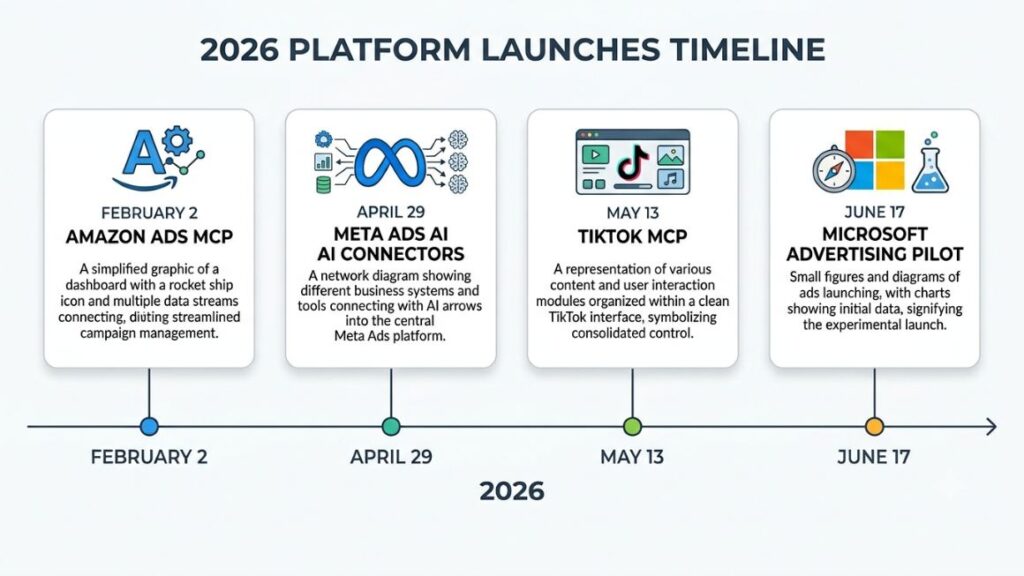
In 2026, Amazon, Meta, TikTok and Microsoft each opened their ad platforms to outside AI agents, and Google offers an official read-only server. The change turns an AI agent for paid advertising from a developer project into something a media buyer can connect in minutes. What each platform lets the agent do, though, varies widely.
What Google, Meta and Amazon Let an Agent Do Today
Every major platform now lets an agent in, but on very different terms. Google’s official server only reads data, Meta’s lets an agent create and edit campaigns, and Amazon’s goes furthest, reaching all the way to billing data. Which one you start with changes how careful you need to be with your first AI agent for paid advertising.
Google Ads: read-only access and an in-platform advisor
Google’s official open-source Ads server is deliberately read-only. According to Wideworks’ September 2026 rundown, it offers three tools: list the accounts you can access, run a query in Google’s GAQL language, and look up field details. It can’t change a bid, pause a campaign or create an ad. It’s free, but you host it yourself and usually need a developer token from Google.
Read-only is still useful. A prompt as plain as “show me my top 5 campaigns by spend in the last 7 days, with conversions and CPA” gets turned into a GAQL query and returned as a table, per Soku’s 2026 guide.
Google’s other route sits inside its own products. At Google Marketing Live on May 20, 2026, it introduced Ask Advisor, a Gemini-powered agent that spans Google Ads, Analytics and Google Marketing Platform, with Merchant Center following. It launched in beta, English first. Google’s own example: ask it to find new customers for your hair care products, and it pulls product details from Merchant Center to set up the campaign in Google Ads. Google also began rolling out AI Brief, which lets you steer Google Ads AI Max campaigns in everyday language, covering your business context, what to say and what to avoid.
Meta: write access, with a catch
Meta went the other way. Its Ads AI Connectors, announced in open beta on April 29, 2026, pair a hosted MCP server with a command line tool, and both can read and write. Meta says agents can handle reporting, campaign creation and editing, catalog management and signal diagnostics. The MCP route needs no developer credentials or coding.
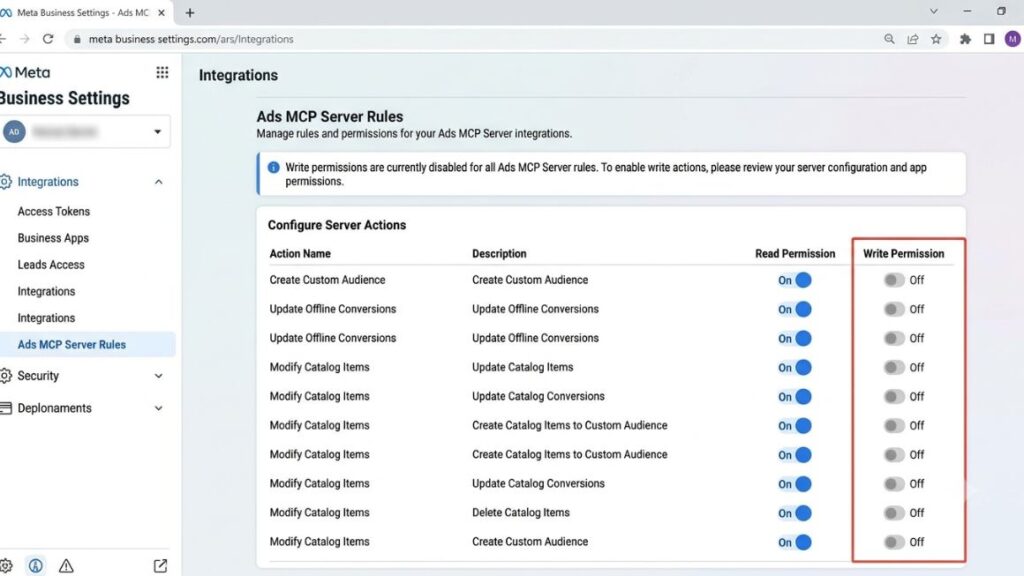
The catch is permissions. Every action the agent takes needs your authorisation inside the AI assistant. On July 16, 2026, Meta added Ads MCP Server rules, a panel where full-control users of a business portfolio can choose exactly which actions an agent may take. Then consultant Jon Loomer checked his own accounts in August and found the panel opened with all seven actions switched on, including budget changes (Wideworks, September 2026). Loomer notes the assistant’s own connector settings may still block an action, but read that again before you connect anything.
One more point about scope. The agent runs your operations, while delivery and bidding still happen inside Meta Advantage+. Agency leads quoted by AdsGo in 2026 said the connectors help with analysis and daily operations, not with what Meta’s auction does.
Amazon Ads: open beta and global partner access
Amazon opened its Ads MCP Server in open beta on February 2, 2026, announcing it at the IAB Annual Leadership Meeting. It turns plain-language prompts into structured API calls and is available globally to partners with active Amazon Ads API credentials. Wideworks reports it has the broadest permissions of any platform so far: creating, editing and deleting campaigns, reporting, account settings and even billing data.
Amazon isn’t alone in going wide. TikTok announced its MCP server on May 13, 2026, then launched an Agentic Hub of ready-made skills on June 30, with read and write access. Microsoft Advertising is the cautious one, running a read-only pilot with waitlist access since June 17, 2026.
| Platform | What launched | What launched | Setup effort | Watch out for |
| Google Ads | Official open-source Ads server; Ask Advisor (beta) | Server is read-only | Developer token plus self-hosting | Can’t act on its own findings |
| Meta | Ads AI Connectors (MCP server and CLI), open beta since Apr 29, 2026 | Read and write | Minutes, no developer credentials on the MCP route | Permissions panel may start wide open |
| Amazon Ads | Ads MCP Server, open beta since Feb 2, 2026 | Read and write, including billing data | Partner API credentials | Broadest permissions of the group |
| TikTok | MCP server (May 13, 2026) and Agentic Hub (Jun 30, 2026) | Read and write | Skills marketplace | Newer, fewer field reports |
| Microsoft Advertising | Open pilot since Jun 17, 2026 | Read only | Waitlist | Limited access |
Google’s official Ads server only reads data, Meta’s connectors can create and edit campaigns, and Amazon’s server reaches as far as billing data. Before connecting any AI agent for paid advertising, check what each platform lets it change, because permissions matter more than the model behind the agent.
Where AI Agents Can Help With Paid Advertising
Agents earn their keep on work that’s repetitive, data-heavy and easy to check afterwards: audits, alerts, routine budget moves, creative variations and reporting. They’re weakest where the call depends on brand, taste or strategy. The survey split from the last section fits that pattern, with heavy use in optimization and light use in creative production.
Audits and anomaly checks
Start here, because the risk is low and the payoff is quick. An agent can scan an account in minutes for things a person skims past: campaigns that stopped spending, a sudden cost spike, ad sets choked by budget. Brody K. said at Meta’s launch that an agent spotting under-delivery or a performance drop could flag it to you.
Google is building similar checks into its own tools. Its Missed Opportunity Reporting dashboard, announced at Marketing Live 2026, uses Google’s AI to show conversion value lost to restricted bids or budgets, with one-click fixes (Monks’ recap, 2026). The best first job for an AI agent for paid advertising is exactly this kind of audit.
Budget and bid decisions across channels
Here the agent’s job is to decide where money goes, not to outbid the auction. Google’s Smart Bidding and Meta’s delivery system already do the bidding. Fighting them rarely ends well. The useful work for an AI agent for paid advertising is cross-channel budget allocation. Spotting that Meta is saturating while search still has room, then proposing a shift.
Targets need watching too. An agent can check whether a cost-per-acquisition goal is realistic for the automated bidding running underneath and suggest a change, rather than tinkering mid-learning. Retailers get a sharper tool from Google’s Product Value Adjustments pilot, which lets them apply percentage multipliers to conversion values for specific products so Smart Bidding pushes harder on high-margin or overstocked items (Monks, 2026). An agent that knows your margins can keep those multipliers current.
Move money in small steps. On Meta, big edits can send an ad set back into the learning phase, which typically runs to about 50 optimization events, according to PPC Land.
Creative production and testing
Creative is where agents are both most tempting and most dangerous. Meta said on its Q2 2026 call that more than 9 million small businesses now use at least one of its generative creative tools. Swiggy Instamart ran festive campaigns with AI-made creative at lower production cost, according to a Google India round-up published by Adgully. It shows AI-generated creatives can carry a real campaign.
Still, the paid search team at Monks draws a useful line. Net-new video concepts are better built by a human-led creative team, they argue, while dubbing, resizing and cutting different lengths are exactly what Google’s Asset Studio is for. It now lets you test newly generated assets against an account’s historical top performers while you build the campaign. Use agents for the second job first.
Reporting nobody wants to build
Every performance team has a Monday spreadsheet that eats an hour. Connect two or three platforms, ask for the same five numbers in the same layout each week, and the agent does the assembly. Brody K. called the reporting side a media buyer’s best friend and said it could replace manual rules.
Reporting is also the safest place to begin, because nothing gets changed. Wideworks, an ad agency, runs precisely that policy: agents read reports and suggest changes, and no budget change reaches the account without a media buyer’s sign-off.
Also Read: AI Performance Marketing Strategies That Drive Measurable Growth

Where AI Agents Still Get Paid Advertising Wrong
An AI agent for paid advertising goes wrong in four predictable ways: it trusts numbers platforms inflate, it misses platform rules nobody told it about, it can be tricked by content it reads, and it produces creative people don’t trust. None of that is a reason to skip agents. All of it is a reason to set them up carefully.
Start with overlap. Google’s automation has produced campaign types that step on each other. Monks warned after Marketing Live 2026 that AI Max for Shopping and Performance Max both extend where shopping ads can serve, which risks cannibalization until advertisers learn how to run them together. An agent that only sees each campaign’s own report may happily scale both.
Then there’s the scoreboard problem. Platform numbers are the agent’s raw material, and platforms grade their own homework. A paid search director at Monks argues that in-platform data should guide in-platform decisions, not stand in for the health of the business. It isn’t a fringe worry. A whistleblower complaint in August 2025 alleged that Meta inflated return figures for Shops ads by 17% to 19%, a claim Meta disputed (PPC Land).
Plain mistakes come next. Google Ads reports money in micros, so a careless setup can show figures a million times too big, Soku’s guide warns. The learning-phase problem catches agents that edit too often. Small stuff, sure. But small stuff costs real rupees at scale.
The scarier one is prompt injection, when an agent obeys instructions hidden in text it reads. Palo Alto Networks’ Unit 42 documented an attempt in 2026 to fool an AI ad-review system: a discount ad’s landing page hid 24 separate tries at slipping in an “approve” command, and Unit 42 doesn’t know whether any worked. Microsoft’s security team put the stakes plainly in June 2026: an injection against a summarizer biases an answer, but against an agent it can trigger an action.
And then trust. Gartner’s March 2026 survey found that 50% of US consumers would rather buy from brands that avoid generative AI in customer-facing content. The Bentley-Gallup survey of 3,270 US adults in May 2026 found that 79% had seen ads that looked AI-made in the previous month. 62% called AI-created people or voices in ads unacceptable even when disclosed. Yet the IAB’s January 2026 report found that 82% of ad executives believed Gen Z and Millennial consumers feel positive about AI-generated ads. That’s a wide gap between what advertisers assume and what people say.
Now the honest limits. An AI agent for paid advertising can’t rescue a weak offer, a slow landing page or broken tracking. Ask Advisor was in English-only beta at launch, and Meta’s connectors are still in open beta. Most of the evidence on results comes from vendors who sell agents. So read their case-study numbers as claims, not facts.
How to Set Up an AI Agent for Paid Advertising in 7 Steps?
Setting up an AI agent for paid advertising comes down to seven steps in a fixed order: set the goal and limits, fix tracking, pick a build path, connect read-only, write the brief, turn on write access with approvals, and set a review rhythm. Skip ahead and you’ll spend the first month debugging things that step two would have caught.
- Set the goal and hard limits. Write down one outcome, such as a target cost per lead or return on ad spend (ROAS), which is revenue divided by ad spend for a campaign. Then write the limits: the biggest daily budget change allowed, the campaigns that are off-limits, and anything that must never be paused.
- Fix tracking first. An agent optimizes whatever your data tells it, right or wrong. Meta announced AI-powered Pixel updates and a one-click Conversions API setup in April 2026, and Google’s Data Manager now offers low-code connectors for tools like Klaviyo and Mailchimp. Check that platform conversions match your CRM before any agent trusts them.
- Pick your build path. Native tool, hosted connector or do-it-yourself. The next section compares them. If you’re unsure, start native.
- Connect read-only. Google’s official server already works this way. On Meta, open Business Settings, go to Integrations, then Ads MCP Server, and switch off every write action for now. Let the agent audit the account for two weeks.
- Write the brief. Give the agent what a new media buyer would get on day one: brand rules, margins, seasonality, the learning-phase rule and what “good” looks like. Google’s AI Brief works on the same idea. Keep it in one plain file so anyone on the team can read and update it.
- Turn on write access with approvals. Enable one action at a time, starting with the lowest-risk, like drafting new ads in a paused state. Every change gets a human yes until you’ve seen a handful of clean ones.
- Set a review rhythm. A daily glance at flagged issues, a weekly review of every change and the reason behind it, and a monthly test against a group the agent didn’t touch.
Notice what’s missing from the list: a shopping list of tools. Tool choice is step three for a reason.
Build, Buy or Use the Platform’s Own Tool?
Use the platform’s own tool if most of your spend sits on one platform, build your own with Claude or ChatGPT if you run several and can handle the setup, and buy a hosted connector if you want several platforms without the setup work. There’s no universally right home for an AI agent for paid advertising. There’s only the right one for your account count and your patience.
| Route | Examples | Cost | Control | Effort | Best for |
| Native | Google’s Ask Advisor (beta), Meta’s AI business assistant inside Ads Manager | No separate fee announced | Low, stays inside one platform | Lowest | Single-platform teams, small accounts |
| Hosted connector | Pipeboard, Markifact and similar services | Paid plans, check current pricing | Medium, many add approval steps | Low to medium | Agencies and multi-platform brands |
| DIY | Google’s official server or Meta’s connectors, wired to Claude or ChatGPT | Assistant subscription plus your time | High | Highest | Technical teams |
Cost deserves a straight answer. As of September 23, 2026, Wideworks notes that Meta, Amazon, TikTok and Microsoft haven’t announced a separate MCP fee or published pricing. Google’s server is free and open source. You pay separately for the AI assistant itself, or for a hosting service that removes the setup.
For an Indian D2C brand running Meta and Google with a two-person team, a hosted connector with approval gates is usually the least painful start. A solo founder with one ad account may not need anything beyond the native tools.
How Do You Keep Spend and Brand Safe When an Agent Has Write Access?
Give an AI agent for paid advertising the smallest set of permissions that gets the job done. Make a human approve anything that moves money or goes live, and keep a log of every action. Treat it like a new hire: no access on day one, more as it earns trust. Single Grain’s 2026 guide on marketing agent security uses that same new-hire framing, with read-only reporting as the first rung.
In practice, that comes down to five habits.
- Approval tiers. Tier one reads and reports freely. Tier two proposes changes and waits for a yes. Tier three acts alone only on small, reversible things, like pausing an ad that’s been disapproved.
- Spend caps. Set a ceiling on how far the agent can move any budget in a day, and a hard stop on total spend.
- Paused by default. Have new campaigns drafted in a paused state so a person flips the switch, as one Meta MCP setup guide from AdLibrary recommends.
- An audit trail. Save every prompt, action and reason. When something looks off, you’ll want to replay it.
- Reading and acting kept apart. An agent that browses competitor pages shouldn’t hold budget rights in the same session, since mixing the two is exactly what prompt injection exploits.
Creative needs its own gate. Given the Gallup finding on AI-created people and voices, anything with a human face, a voice or a testimonial claim should get a person’s eyes before it runs.
The safest setup gives an agent read-only access first, then adds one write action at a time behind human approval. Log every action, cap daily budget changes and keep untrusted web content away from any session that can spend money. Wideworks follows this rule: agents suggest, and no budget change lands without a media buyer’s sign-off.
How to Tell If the Agent Is Actually Working?
To judge an AI agent for paid advertising, measure the outcome it was hired for against a comparison group it doesn’t touch. If cost per lead fell 12% but the campaigns it doesn’t manage improved just as much, the agent didn’t cause that.
Keep one region, one product line or one campaign on manual for a month and compare. Then track two sets of numbers side by side. Business numbers: cost per acquisition, revenue and marketing efficiency ratio (MER), which is total revenue divided by total ad spend across all channels. Operating numbers: hours saved, how fast problems get caught, and wasted spend flagged.
Platforms are handing out better measurement tools, and they’re worth using. Google is bringing Meridian, its open-source marketing mix model, into Google Analytics 360. Cars24 used Google’s Attributed Branded Searches to measure upper-funnel YouTube Shorts and connected TV ads, and saw twice the incremental searches with a 7% better customer acquisition cost (Google India, July 2026). That’s Google’s number about Google’s ads, so still ask for an independent check.
The Monks team says the same thing in different words: pair platform data with incrementality testing and marketing mix modeling, and treat in-platform results as directional. Meta’s $75 billion run rate is a reminder of why. Scale isn’t proof of cause.
To judge an AI agent, compare it against campaigns or regions it doesn’t manage, and track business outcomes alongside time saved. Platform dashboards are directional because platforms report on their own results. Add incrementality tests or marketing mix modeling before you credit the agent with a win.
What This Means for Indian Marketers and Brands
Indian marketers get the same agent tools as everyone else, but budgets, languages and channels look different here. Commerce advertising is growing fastest, small daily budgets are normal, and English-only beta features don’t fit every team. An AI agent for paid advertising has to be judged against those realities, not against a US playbook.
Start with where the growth is. Per WPP Media’s June 2026 forecast, retail media and quick commerce lead India’s ad growth, and AI-linked advertising revenue is expected to pass $2.5 billion. Google reports that, according to an Ipsos survey it commissioned in July 2025 (7,907 Indian adults), Google or YouTube appears in 93% of journeys where people discovered a new brand, product or service.
Google’s tools are arriving in India with local proof points. At its July 2026 India event, Google said upGrad is testing Business Agent for Leads, a chat agent inside the ad that qualifies student leads around the clock. Nykaa, Policybazaar, Lenovo and Cashify were among the brands using AI Max for Search by late 2025, per a Google India round-up. And Google confirmed Hindi support across newer tools like AI Max for Search. Ask Advisor and AI Brief, though, began in English.
ChatGPT is the new wildcard. OpenAI launched ads for Free and Go-tier users in India in late August 2026, with WPP and Omnicom as first agency partners and self-serve buying opening in early September. Third-party guides report a daily minimum of ₹725, which makes a test affordable for smaller brands, though you should confirm the current figure in OpenAI’s Ads Manager.
For smaller Indian teams, the sensible route to an AI agent for paid advertising is native tools first, one hosted connector second. Save the DIY build for when you have someone who can maintain it.
What to Watch Through the Rest of 2026
Four things are worth watching if you run an AI agent for paid advertising: ads moving inside AI answers, software agents buying media from each other, measurement catching up and platforms tightening permissions. Each one changes how much you can safely delegate.
Ads inside AI answers are already here. Google said at Marketing Live 2026 that AI Mode passed 1 billion monthly users and announced new ad formats inside it. On September 10, 2026, Amazon Ads began letting select US advertisers buy ChatGPT ads through Amazon DSP in a pilot. Marketing Dive reports ChatGPT ads recently hit a $1 billion annualized revenue run rate.
Then there’s machine-to-machine buying. The IAB Tech Lab published an agentic roadmap in January 2026, extending existing standards like OpenRTB so that agentic advertising, where software agents buy and sell media directly with each other, doesn’t split into incompatible systems. Early tests are vendor-reported, so hold them loosely. Adgentek’s roundup cites Level Agency running an agentic platform against its usual DSP for an education client with the same budget, and getting 351 qualified impressions per dollar versus 164.
Permissions will likely tighten after the Meta panel episode. Measurement should catch up too, with Meridian arriving inside Analytics 360. The skill that keeps its value through all of this? Judgment about strategy, data and creative. The Monks team put it bluntly: the ability to build a campaign will stop being an advantage.
Conclusion
Three things are worth carrying out of this guide. The platforms have opened up, but on very different terms, so read the permissions before the feature list. The agent is rarely the weak link; your tracking and your brief usually are. And the honest test of any result is a comparison group, not a dashboard the platform built.
So start small. This week, connect one account read-only and ask for a spend audit. See what it catches that you’d missed. Then decide how much more to hand over.
Knowing how an AI agent for paid advertising works is one thing. Building the brief, the guardrails and the review habit is where most teams stall. The YUP AI Marketing course is built for marketers who want to put AI to work in real campaigns, from prompting to automation. If you want a structured way to learn that, start there.
FAQs
What is an AI agent for paid advertising?
An AI agent for paid advertising is software that connects to your ad accounts, reads performance data, decides what to change and carries out those changes toward a goal you set. It then checks the result. The difference from a chatbot is that it acts inside your account, within permissions you control.
Is an AI agent the same as the automation already inside Google and Meta?
No. Platform automation works inside one platform on that platform’s own signals. An AI agent for paid advertising sits above it, can read several platforms, and follows your rules and brief. It usually doesn’t replace the platform’s bidding; it decides how you use it.
Can AI run my Google ads for me?
Partly. Google’s official server is read-only, so it can analyse an account but not change it. Google’s Ask Advisor, in beta, can help launch and adjust campaigns from inside Google’s own tools, and some third-party servers can edit accounts. For now, keep a person approving changes that move money.
Will connecting an AI tool to my ad account get it banned?
Official connectors from Meta and Amazon were built by the platforms themselves, which mostly settles the old worry about unauthorised automation. Some practitioners still asked Meta to state its policy clearly at launch. The bigger risk is a badly configured agent, so use official routes and limit permissions.
How much does it cost to get started?
Google’s Ads server is free and open source, though you host it and need a developer token. As of late September 2026, Meta, Amazon, TikTok and Microsoft haven’t published separate fees for their connectors. You’ll pay for the AI assistant subscription or a hosting service, plus your normal ad spend.
Which platform should I start with?
Start where most of your spend sits. If you want write access with the least setup, Meta’s MCP route needs no developer credentials. If you mostly want audits and reports, Google’s read-only server is a safe first step.
Do I need to know coding to do this?
Not for Meta’s MCP route, which needs no coding or developer credentials, according to Meta. Google’s server takes more technical comfort, since you host it and request a developer token. Meta’s command line tool is aimed at technical users.
Is it worth it on a small budget?
If you run one small account, the native tools give you most of the benefit for free. An AI agent for paid advertising starts to pay off when you juggle several accounts or channels and reporting eats hours each week. The time saved matters more than the ad spend size.
Why is my agent making bad calls?
Nine times in ten, it’s the inputs, not the agent. Check for broken conversion tracking, a vague brief, missing platform rules like the learning phase, and permissions that are too wide. Also confirm your numbers aren’t off by a unit error, such as Google’s micros.
Will agents replace performance marketers?
Not the good ones. Monks argues that building campaigns is no longer an advantage and that success will depend on first-party data, creative and measurement. Meta’s Brody K. described the connectors as a media buyer’s best friend. Expect the job to shift toward strategy and oversight.