

Most marketing teams are running five to ten channels with the same headcount they had two years ago. Campaigns go stale between Monday’s review and Friday’s report because nobody has time to touch them in between. That’s the actual problem an AI agent for marketing campaigns is built to solve, and it’s different from what most vendors are selling you.
An AI agent for marketing campaigns doesn’t just draft an ad or schedule a post. It can pull performance data, decide where budget should move, make the change and tell you what it did and why. That’s a meaningfully different job than a chatbot that writes copy on request.
This guide covers what these agents actually are, how they differ from the automation you already run, what’s working in real deployments right now, and where you still need a human in the loop. We’ll also look at the platforms doing this in production and how to build your first workflow without breaking anything important.
Table of Contents
What Is an AI Agent for Marketing Campaigns?
An AI agent for marketing campaigns is a system that pursues a defined goal, such as “keep CAC under ₹800” or “hit 2x ROAS,” by reasoning through the steps needed to get there and executing them across connected tools, largely without a human writing each instruction.
That’s the standalone definition. Now here’s what it actually means day to day.
How It Differs from Traditional Marketing Automation
Traditional marketing automation runs on if-then rules someone wrote in advance. If a user abandons a cart, send email one. If they don’t open it in 48 hours, send email two. The system executes exactly what it was told and nothing more.
An agent works differently. You give it an objective and it decides the path. It might notice that cart-abandonment emails are underperforming for a specific segment, pull in a different offer, test it against a smaller slice of the audience and only roll it out wider once the numbers hold up. McKinsey and the marketing analyst firm EICTA have both framed this same distinction: automation executes rules, agents pursue goals through reasoning. That’s the line that actually matters when you’re deciding whether to call something “agentic” or just well-configured automation.
How It Differs from a Simple AI Copywriting Tool
A copywriting tool like Jasper or an early version of Copy.ai produces text when you ask for it. An AI agent for marketing campaigns produces the text, decides where it goes, publishes it, watches how it performs and adjusts the next round based on that performance data. The copywriting tool stops at the draft. The agent doesn’t stop until the goal is closer or it hits a wall it needs a human to clear.
An AI agent for marketing campaigns is a goal-driven system that plans, executes, and adjusts marketing actions across channels with minimal manual input, distinct from rule-based automation that only follows pre-set triggers, and distinct from content tools that stop at the draft stage.
Why Marketing Teams Are Adopting AI Agents in 2026
Marketing teams are adopting AI agents in 2026 because the gap between what leadership expects and what teams have actually shipped has become too visible to ignore. That said, a handful of platforms have finally moved from demo to production.
The adoption numbers tell a story of pressure without follow-through. According to McKinsey’s State of AI Global Survey, 88% of organizations now use AI in at least one business function. But only 23% report scaling an agentic AI system anywhere in the enterprise. No more than 10% are scaling agents in any single function. That’s a wide gap between “we’re using AI” and “AI is doing real work unsupervised.”
Marketing shows the same pattern, maybe sharper. Supermetrics’ 2026 Marketing Data Report found that 80% of marketers feel pressure to adopt AI. But only 6% have it fully embedded into their workflows. Nearly 90% of that pressure traces back to the C-suite or board. It’s not to marketers asking for it themselves. And when teams do use AI, most of it is still low-hanging fruit. The same report found 87% are using it for content creation, copywriting, and creative ideation, not for the harder work of campaign optimization or budget decisions.
That gap is the opportunity. Teams that get past copywriting and into genuine agentic AI marketing before it becomes standard practice have a real head start, not because the technology is rare anymore, but because the operational discipline to use it well still is.
The India Angle: A Crowded Stack, a Cautious Industry
Indian marketing teams face the same gap with an added layer. B2B organizations globally are now allocating more budget to martech than ever. Over a tenth of companies are directing more than 40% of marketing spend to technology. Most report they’re using less than half of what they’ve already bought. For an Indian team juggling a martech stack that’s already sprawling across CRM, WhatsApp automation, ad platforms, and analytics tools, adding an autonomous agent on top without fixing that foundation first just adds another unused subscription.
The industry conversation reflects the same caution. At Goafest 2026 in Panaji, Google India’s Satya Raghavan, Director of Marketing Partners, told a packed session titled “There’s an Agent for That” that the agent economy is set to reshape consumer behavior the way the app economy did over the past decade. He demonstrated AI agents generating thousands of ad variations in seconds, work that used to sit with a creative team for days. But the broader mood at the festival, according to multiple sessions on Day 2, was less triumphant: agencies and brands spent as much time discussing “AI washing,” the practice of relabeling ordinary automation as agentic, as they did celebrating what agents can genuinely do.
Marketing teams are adopting AI agents in 2026 under top-down pressure that outpaces actual capability, with Supermetrics finding 80% of marketers feel pressure to adopt AI while only 6% have it fully embedded, and McKinsey finding just 23% of organizations scaling agentic systems anywhere in the enterprise.
How an AI Agent for Marketing Campaigns Actually Works
An AI agent for marketing campaigns runs on a loop. It takes in data, reasons about what that data means against a goal, acts across connected tools and then checks whether the action moved the needle, adjusting the next cycle accordingly.
Inputs: Data Sources and Tool Connections
Every agent starts with access. That means connections to ad platforms an open standard that lets an AI assistant query and act on external tools without custom-coded integrations for each one. These include Meta Ads, Google Ads, TikTok Ads, your CRM, your analytics stack and increasingly, live connectors built on the Model Context Protocol (MCP). Meta released its own Ads MCP server in open beta in April 2026. Third-party servers like Windsor MCP and Pipeboard now connect Claude and similar assistants to more than 300 marketing data sources, from Meta and TikTok Ads to Shopify and Salesforce.
Read More: AI Agent for Marketing Operations: How to Automate Campaigns, Data, and Reporting in 2026
Reasoning and Decision-Making Loop
This is where the agent earns the name. Given a goal like “reduce CPA by 15% this month,” it evaluates current spend against performance, identifies underperforming ad sets or keywords, and works out which lever to pull, whether that’s a budget shift, a bid change, or a creative swap, based on what’s actually moving the metric rather than a fixed rulebook.
Execution Across Channels
Once it has a decision, the agent acts. That might mean pausing an ad set, depending on the platform and the permissions you’ve granted. It may be about reallocating budget between Meta and Google, sending a follow-up sequence to a re-engaged segment or publishing a scheduled post. This is the step that separates an AI agent for marketing campaigns from a reporting dashboard: it doesn’t just tell you what to do, it does it.
Learning and Self-Correction
The loop closes when the agent checks the result. Did the budget shift actually lower CPA, or did it just move the problem to a different channel? Platforms like Braze’s BrazeAI Decisioning Studio use reinforcement learning specifically for this step, making one-to-one decisions optimized against whatever KPI you’ve set and refining that decision-making with every cycle.
- Ingest data from connected ad platforms, CRM, and analytics tools.
- Reason about what the data means against a stated goal.
- Act by executing a change, campaign, or message across a channel.
- Learn by measuring the result and adjusting the next cycle.

Core Use Cases: What AI Agents Can Do in a Real Campaign
Audience Segmentation and Targeting
Agents can build and refine audience segments continuously rather than once a quarter. They can pull in new behavioral signals as they happen. For example, HubSpot’s Data Agent answers natural-language questions across CRM data to surface segments a human might not think to query for.
Content Generation and Personalization at Scale
This is where most teams start and for good reason. It’s the lowest-risk use case. Klaviyo Composer generates and personalizes email and SMS content directly against a brand’s own purchase and behavior data. So a D2C brand running lifecycle campaigns gets copy variants tuned to actual customer history rather than generic templates.
Read More: AI Agents for Content Marketing: How Autonomous Workflows Are Replacing Manual Content Ops in 2026
Campaign Optimization and Budget Reallocation
This is the use case with the clearest ROI story and the clearest risk. Salesforce’s Agentforce, built on its Einstein AI and Data Cloud, now processes more than 3 billion monthly workflows across 18,500 customers, a chunk of which involves shifting spend and adjusting bids based on live performance data rather than a weekly manual review.
Read More: AI Agent for Campaign Optimization: From Data Analysis to Automation
Lead Scoring and Nurturing
HubSpot’s Prospecting Agent researches and recommends outreach targets, moving from a flat monthly fee to outcome-based pricing at $1 per recommended lead as of April 2026, a shift HubSpot made specifically because customers wanted to pay for results rather than access. This kind of AI campaign optimization applied to the top of funnel means fewer leads sitting untouched in a CRM for weeks.
Reporting and Performance Analysis
Supermetrics AI and similar tools now let a marketer query performance in plain language rather than building a new dashboard for every question, standardizing naming conventions and currency conversions across channels so an agent working off that data inherits a consistent definition of “conversion” instead of five different ones.
| Use Case | Named Example |
| Content and personalization | Klaviyo Composer |
| Budget and bid optimization | Salesforce Agentforce |
| Lead scoring and outreach | HubSpot Prospecting Agent |
| Cross-channel reporting | Supermetrics AI |
| Decisioning across KPIs | Braze BrazeAI Decisioning Studio |
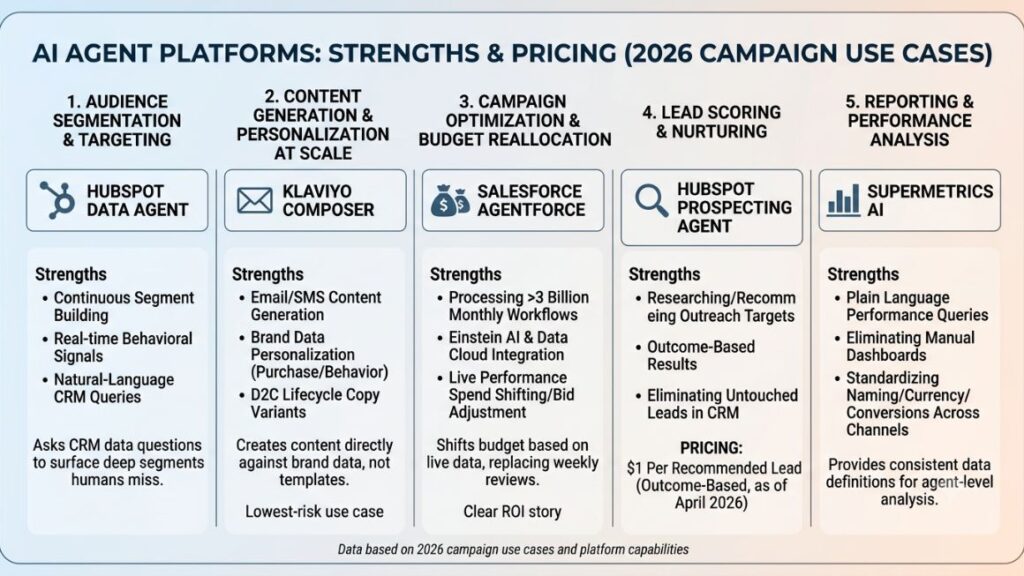
An Indian D2C brand running Meta and Google campaigns alongside WhatsApp lifecycle marketing, similar to how Mamaearth or boAt run multi-channel acquisition, is exactly the profile that benefits most from this stack: high SKU count, frequent creative refresh needs, and budget that shifts weekly based on what’s converting.
The highest-value use cases for an AI agent for marketing campaigns are budget reallocation and lead scoring, where Salesforce’s Agentforce now processes over 3 billion monthly workflows and HubSpot has moved to outcome-based pricing because customers wanted to pay only when an agent’s recommendation actually converted.
Read More: How to Automate Meta Ads Reporting With Claude Code: A Step-by-Step Guide
Best AI Agent Platforms for Marketing Campaigns in 2026
Salesforce Agentforce suits enterprise teams that already run Salesforce as their system of record. It’s powerful for orchestrating multi-step workflows across CRM, service, and marketing data, but it needs Data 360 underneath it. The headline price rarely reflects the full deployment cost once implementation and governance are factored in.
HubSpot Breeze (Agent Hub) fits mid-market teams already living in HubSpot’s Smart CRM. Its Customer Agent resolves conversations at $0.50 per resolved conversation, its Prospecting Agent charges $1 per recommended lead, and Data Agent runs $0.10 per response, all metered through HubSpot Credits. Marketing Hub Professional starts around $890 a month, with Marketing Cloud Next starting near $1,500.
Klaviyo Composer is built directly into the email and SMS platform most DTC and ecommerce brands already use for retention. It won’t touch your paid ads or CRM, but if your revenue runs through Klaviyo already, the agent layer removes an integration step other platforms require.
Braze Operator (BrazeAI Decisioning Studio) uses reinforcement learning to make individual customer decisions optimized against whatever KPI you set, and it integrates with other execution platforms including Salesforce Marketing Cloud and Klaviyo rather than staying siloed to Braze alone.
n8n paired with Claude is the self-hosted option for teams that want custom logic without buying an enterprise suite. n8n starts from a blank canvas with marketing templates layered on top, and connecting it to Claude through MCP servers like Windsor or Pipeboard gives a lean team access to hundreds of marketing tools without the per-seat pricing of a full platform.
Read More: Agentic Marketing Platforms: The Complete Guide to AI Agents That Plan, Execute & Optimize Marketing
[IMAGE: comparison chart of Agentforce, Breeze, Klaviyo Composer, Braze Operator, and n8n + Claude by team size fit]
How to Build Your First AI Agent Marketing Workflow?
Building an AI agent marketing workflow for the first time comes down to six steps. Skipping any of the first three is where most rollouts stall.
- Define the goal. Pick one measurable outcome, like “improve email open rate by 10%” or “reduce CPA on Meta by ₹50,” rather than a vague ask like “use AI more.”
- Choose the platform. Match the platform to where your data already lives. A Klaviyo-native ecommerce brand doesn’t need Salesforce Agentforce.
- Connect your data sources. An agent is only as good as its access. Fix broken tracking and inconsistent conversion definitions before connecting anything.
- Set permission and approval gates. Decide upfront which actions the agent can take on its own and which need a human sign-off before going live.
- Test with limited autonomy. Run the agent on a small budget slice or a single segment first, and watch what it actually does, not just what it reports.
- Scale gradually. Expand budget and scope only after the agent has proven it makes decisions you’d have made yourself.
Read More: How to use Zapier to automate marketing workflows
[IMAGE: workflow diagram showing the six-step rollout path]
Where Human Oversight Still Matters
Human oversight still matters most around spend approval and brand voice, because Gartner predicts that more than 40% of agentic AI projects will be canceled by the end of 2027, not because the underlying models fail, but because of escalating costs, unclear business value, and weak governance around what the agent was allowed to do.
That prediction, first published in June 2025, still holds up in Gartner’s 2026 Hype Cycle for Agentic AI. Only 17% of organizations have actually deployed AI agents to date, even though more than 60% expect to within two years, a gap that sets up exactly the kind of rushed, under-governed rollout Gartner is warning about. Gartner has also separately predicted that in 2026, a third of companies will damage customer trust by deploying AI prematurely, whether that’s a personalization agent that misreads a customer’s history or a pricing agent that makes a call nobody would have approved.
The honest read for 2026 is that “trustworthy enough to run completely unchecked” isn’t where the technology sits yet, whatever the vendor demo suggests. Spend approval gates, a human review on anything customer-facing, and a clear rollback path aren’t slowing the agent down. They’re what keeps a bad decision from compounding across a full campaign before anyone notices.
Gartner’s June 2025 prediction that over 40% of agentic AI projects will be canceled by 2027 holds through its 2026 Hype Cycle for Agentic AI, with only 17% of organizations having deployed agents so far against 60% planning to within two years, a gap that points squarely at governance rather than model capability as the real risk.
Common Mistakes When Deploying AI Agents for Campaigns
Over-automating without approval gates. Handing an agent full budget control before it has a track record is how a bad optimization decision burns a week of spend before anyone catches it.
Ignoring data hygiene. Supermetrics found that 52% of marketing teams don’t own their data strategy and 37% are blocked by a lack of integration between analytics and activation tools. An agent working off fragmented data will confidently make wrong decisions.
Treating agents as chatbots. If the only thing your “agent” does is answer questions when prompted, you’ve bought a chatbot with better branding, not autonomous marketing agents doing real work.
No clear KPI baseline. You can’t tell whether an agent’s optimization actually helped if you didn’t measure performance before it started acting. Set the baseline first.
Conclusion
The teams pulling ahead in 2026 aren’t the ones with the most AI agents running. They’re the ones who fixed their data foundation first, picked one clear goal, and let the agent earn broader autonomy over time instead of handing it the keys on day one. That’s a less exciting story than “autonomous campaigns,” but it’s the one actually showing up in the adoption numbers.
Start small: one channel, one KPI, one approval gate you can loosen later. If you want a structured way to build that first workflow and understand the platforms well enough to pick the right one for your stack, YUP’s AI Marketing course walks through exactly this, from choosing a platform to setting the guardrails that keep an early rollout from becoming a Gartner cancellation statistic.
Frequently Asked Questions
What is an AI agent for marketing campaigns?
An AI agent for marketing campaigns is a system that pursues a stated goal, like a target CPA or ROAS, by reasoning through the necessary steps and executing them across connected marketing tools with minimal manual input at each step.
How is an AI agent different from marketing automation?
Marketing automation follows pre-set if-then rules a human wrote in advance. An AI agent reasons about a goal and decides its own path to it, adjusting actions based on live performance rather than a fixed script.
AI agent vs AI copywriting tool, what’s the difference?
A copywriting tool produces text on request and stops there. An AI agent for marketing campaigns can produce that content, decide where it publishes, watch how it performs, and adjust the next round based on the results.
How do I set up an AI agent for my first campaign?
Start by defining one measurable goal, connect it to clean data from your ad platforms and CRM, set clear approval gates for any spend or customer-facing action, and test on a small budget slice before scaling.
Who should use AI agents for marketing campaigns?
Teams managing multiple channels with limited headcount get the most value, particularly ecommerce and D2C brands running frequent creative refreshes and budget shifts across Meta, Google, and email or SMS.
Is an AI agent for marketing campaigns actually worth it in 2026?
For teams with clean data and a clear KPI to optimize toward, yes, particularly for budget reallocation and lead scoring. For teams still fixing fragmented tracking, the agent will make confident decisions on bad data, which is worse than no agent at all.
Do I need a data team to run AI agents in marketing?
Not necessarily, but you do need someone who owns your data strategy and conversion definitions. Supermetrics found over half of marketing teams don’t own this today, which is the most common reason agent rollouts stall.
Why isn’t my AI agent improving campaign performance?
The most common cause is fragmented or inconsistent data across your ad platforms and analytics tools, which means the agent is optimizing against numbers that don’t actually reflect what’s happening. Fix the data foundation before troubleshooting the agent itself.
Can AI agents replace a marketing team?
No. Gartner’s own research points the other way, predicting that weak governance and unclear business value, not a shortage of AI capability, will cause more than 40% of agentic AI projects to be canceled by 2027. Human judgment on brand voice and spend approval remains the load-bearing part of the system.
What’s the difference between agentic AI marketing and a multi-agent marketing system?
Agentic AI marketing describes the broader shift toward goal-driven, autonomous marketing tools. A multi-agent marketing system is a specific setup where several specialized agents, say one for bidding and one for creative, coordinate through AI agent orchestration to hit a shared campaign goal.