

Picture a sales team with 800 new leads this week. Maybe 40 of them are ready to buy. The rest are browsing, comparing, or clicked something by accident. Nobody can tell which is which by scrolling a spreadsheet.
That’s the gap AI lead scoring software fills. It studies how your past customers behaved. It spots the same patterns in new prospects. Then, it ranks them so reps call the right people first. The time pressure is real. Salesforce’s 2023 State of Sales report found reps spend only 28% of their week actually selling.
This guide covers how the technology works, the features worth paying for, ten platforms to compare, how to roll scoring out, and how to choose without overspending.
Table of Contents
What Is AI Lead Scoring Software?
AI lead scoring software uses machine learning to rank prospects by how likely they are to become customers. It reads behaviour, company details and past sales outcomes. Then it gives each lead a score. Sales and marketing teams use that score to decide who gets attention first.
Scoring and qualifying sound alike, but they’re different jobs. Scoring ranks leads by likelihood. Lead qualification software, or a human rep, goes further. It checks budget, authority, need and timing before a lead moves to sales. Scoring sorts the pile. Qualification starts the conversation.
Here’s a simple example. Two people visit a software company’s website. Person A downloads a beginner’s guide. Person B visits the pricing page, compares subscription plans and requests a demo. Both are potential customers. Person B looks like the stronger opportunity. The software spots that by weighing several signals together, such as pages viewed, job title and company size, instead of trusting one click.
So why are teams dropping manual scoring? Because it ages badly. Someone picks the point values once and nobody revisits them. Products change, buyers change and the scores drift away from reality. AI models can be retrained on newer data, though that brings its own demands.
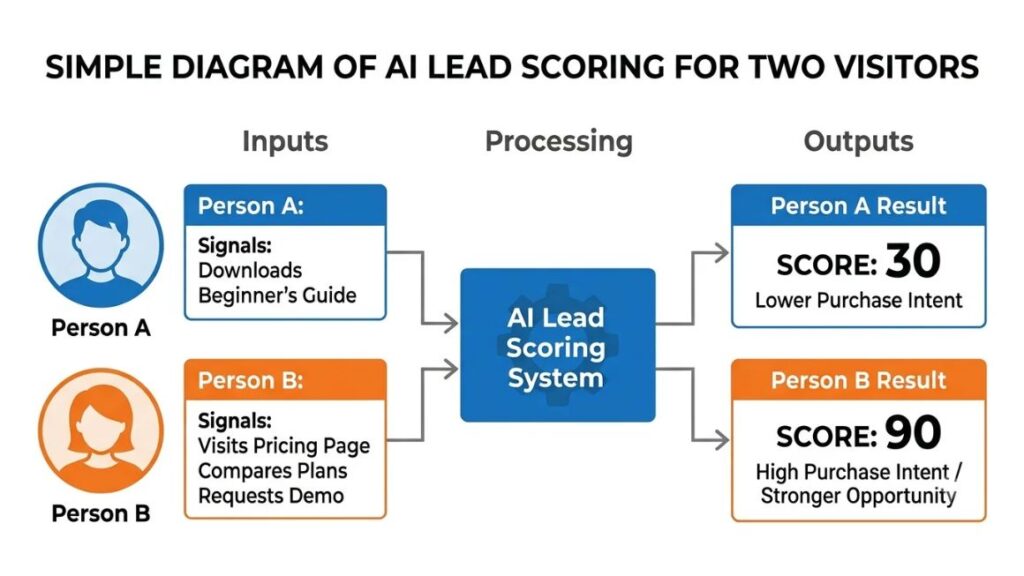
AI lead scoring software uses machine learning to rank prospects by their likelihood to buy, based on behaviour, company fit and historical sales outcomes. Scoring sorts leads for follow-up, while lead qualification confirms whether a prospect has the budget, authority, need and timing to buy.
How Does AI-Based Lead Scoring Work?
AI-based lead scoring collects data on prospects, compares it with the traits of past customers, and assigns a score that estimates conversion likelihood. The score then updates as behaviour changes. Five stages make up the process.
1. Collecting customer information
The model needs raw material. Typical inputs include website visits, form submissions, email engagement, CRM records, purchase history and company information. Software businesses often add product usage. More complete data means a better model. Messy data means messy scores.
2. Analysing customer behaviour
Machine learning algorithms study historical conversion data. That means leads that became customers and leads that didn’t. They hunt for patterns. Maybe buyers view the pricing page twice in a week. Maybe they open the third email but skip the first. This is predictive lead scoring: using the past to estimate the future.
3. Identifying ideal customer characteristics
Behaviour shows interest. Fit shows whether the lead is worth chasing. Firmographic data, such as company size, industry, location and the contact’s job role, lets the model compare prospects against your ideal customer profile (ICP). That’s the description of the company type that buys from you most successfully.
Also Read: 14 Customer Segmentation Models: Types, Examples, and How to Choose the Right One
4. Assigning scores to potential customers
The system ranks each prospect by estimated lead conversion probability. Some tools show a 0 to 100 number. Others use labels like hot, warm and cold. Treat the number as a ranking aid, not a promise. A score of 85 doesn’t mean an 85% chance of a sale unless the vendor says its scores are calibrated that way.
5. Updating scores as behaviour changes
A lead who ignores your emails for two months should cool down. One who suddenly returns to the pricing page should heat up. Real-time scoring handles this. Some tools add score decay, which reduces points as old activity ages.
Here’s a hypothetical run. A prospect fills in a contact form on Monday. The CRM pulls in their company details. The model scores them 62. On Wednesday they open a pricing email and revisit the plans page. The score jumps to 84, crossing your threshold. The CRM assigns a rep and sends an alert. The rep calls on Thursday morning.
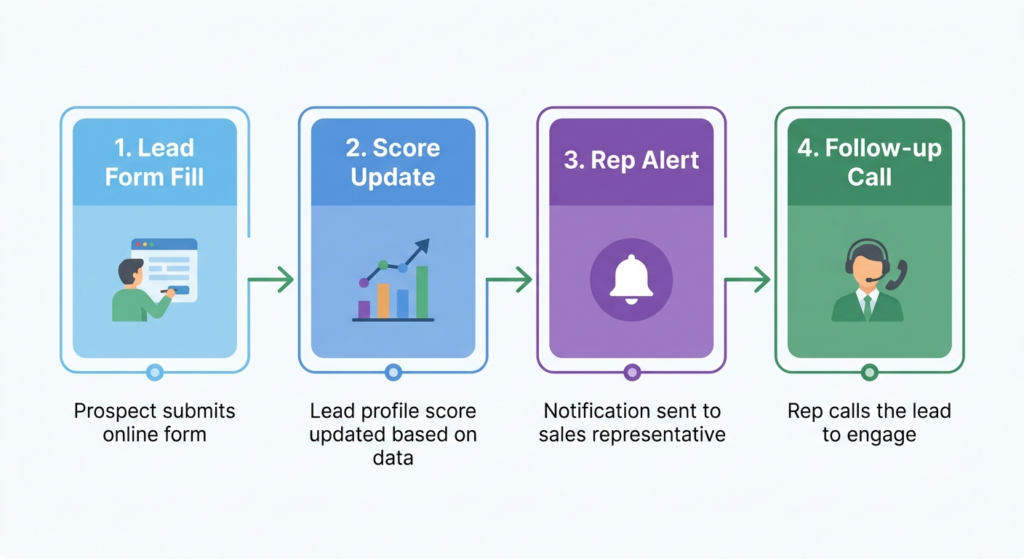
Traditional Lead Scoring vs AI-Powered Scoring
Traditional scoring uses points you assign by hand, such as +10 for a demo request. AI scoring learns which signals predict sales from your own data. Rules are easy to read. Models can catch patterns people miss.
| Comparison factor | Traditional scoring | AI-based scoring |
| Scoring method | Manually assigned points | Model-driven predictions |
| Data analysis | Predefined rules | Patterns in available data |
| Adaptability | Requires manual updates | Can be retrained or updated |
| Personalisation | Limited by configured rules | Can identify complex patterns |
| Implementation | Often simpler | Depends on data and model |
| Transparency | Usually easy to inspect | Depends on model explainability |
When is traditional scoring enough? If you get a few hundred leads a month, sell to one clear buyer type and have little history, simple rules often do the job. Honestly, plenty of teams jump to AI too early. AI earns its place when you have thousands of leads, several products or regions and enough closed deals for a model to learn from.
Plenty of tools blend both anyway. Adobe Marketo Engage, for example, centres on rules you configure, with a separate predictive layer called Predictive Audiences on top.
Key Features to Look for in AI Lead Scoring Software
The right AI lead scoring software predicts conversions from your own history, updates scores in real time, connects to your CRM and explains why a lead scored the way it did. Everything else is a bonus.
Predictive scoring capabilities
Look for models that learn from historical conversion data and estimate who’s likely to convert next. Ask how much history the tool needs before it works. Some need thousands of records.
Real-time behavioural tracking
Recent visits, enquiries and clicks should move scores quickly. Website engagement from last week is old news. A score that updates weekly is already stale.
CRM integration
A score nobody sees is worthless. Whether you pick an AI-powered CRM or a standalone scoring tool, check that scores land inside the system your reps already use. Ask about sync frequency and field mapping too.
Lead enrichment and data accuracy
Lead enrichment fills gaps, like missing company size, and flags duplicates and outdated company details. Models trained on bad data learn bad lessons.
Customisable scoring models
Your best customers don’t look like anyone else’s. You should be able to change criteria by product, region or buyer persona.
Automated lead routing
Automated lead scoring only pays off if high scorers reach the right rep fast. Routing rules cut the hand-off delay.
Reporting and performance analytics
Look for score explanations, conversion tracking by score band and model monitoring. If reps can’t see why a lead scored 90, they won’t trust it.
Data privacy and security
Check access controls, consent handling, retention policies and compliance with the laws that apply to you. India’s DPDP Rules were notified in November 2025, with most obligations phasing in over roughly 18 months. GDPR matters if you market to Europe.
10 Best AI Lead Scoring Software Platforms in 2026
Not every platform solves the same problem. Some score contacts inside a CRM. Others rank whole accounts using intent data. Some predict conversions from product usage. These lead scoring tools are ten candidates worth comparing, not a verified ranking. Features and plan limits change often, so confirm details on each vendor’s official pages before you buy.
1. HubSpot
Best for: businesses that want lead scoring, CRM and marketing automation in one place.
HubSpot’s lead scoring tool builds fit, engagement or combined scores, with optional score decay. Its documentation lists Marketing Hub or Sales Hub Professional or Enterprise, with AI-created contact scores at Marketing Hub Enterprise. The older HubSpot Score property stopped updating on 31 August 2025, so be wary of old tutorials.
2. Salesforce Einstein
Best for: established businesses already on Salesforce that want predictive scoring.
Einstein Lead Scoring studies past converted leads, ranks current leads by similarity and shows the factors behind each score. It needs enough history to train. Consultancies such as SalesFive cite roughly 1,000 leads and 120 conversions in six months, so check Salesforce’s help pages for current thresholds.
3. Freshsales
Best for: growing teams that want CRM-based scoring and sales intelligence.
Freshsales uses Freddy AI to score contacts from 0 to 99, combining signals you define (job title, firmographics, engagement) with machine learning. Reviews disagree on which plan includes contact scoring, so check Freshworks’ pricing page.
4. Zoho CRM
Best for: businesses already using Zoho’s other apps.
Zoho’s Zia AI scores leads and deals by their likelihood to convert, separately from manual scoring rules. When Zoho introduced Zia scoring, it said at least 200 records were needed to start. Zoho is headquartered in Chennai, which may help if you want an India-based vendor.
5. 6sense
Best for: B2B organisations running account-based marketing.
6sense scores accounts, not just individuals, and places them in buying stages from Target through Purchase using intent signals and your CRM history. Pricing isn’t public. Reviewers say it works best with dedicated RevOps staff.
Also Read: Account Based Marketing: What It Is, How It Works, and Why B2B Teams Swear by It
6. Adobe Marketo Engage
Best for: larger marketing teams managing complex campaigns and lead nurturing.
Marketo’s core scoring is rules-based. You build behavioural and demographic scores in Smart Campaigns, with degradation for stale activity. Predictive Audiences adds machine-learning predictions from your conversion history. It’s marketing automation software first and AI scoring second.
7. Apollo.io
Best for: outbound sales teams that need prospect data and engagement insights.
Apollo bundles a B2B contact database, enrichment, sales sequences and scoring. Its site describes real-time AI scores with transparent criteria, so reps can see why a prospect ranks high. It suits teams that want prospecting and scoring in one tool.
8. Demandbase
Best for: enterprise account-based marketing and account intelligence.
Demandbase treats buying groups as a core object, so you can score the committee behind a deal instead of one contact. It blends intent, engagement and firmographic signals. Pricing is quote-based, and reviewers report a heavier setup.
9. MadKudu
Best for: SaaS companies running product-led growth.
MadKudu scores customer fit and behaviour, including product usage, to flag product-qualified leads (PQLs): users whose in-app activity suggests they’re ready to buy. Its documentation claims “very good” fit leads convert about ten times more often than low-fit ones. That’s the vendor’s own claim, so test it on your data. It’s far less useful without usage data.
10. Pecan AI
Best for: businesses building predictive models on their own customer and sales data.
Pecan is a no-code predictive analytics platform. You connect your data, it builds a conversion model, and scores can flow back to your CRM. It also covers churn and lifetime value. It isn’t a CRM, so you’ll need clean data and someone who owns the model.
Quick Comparison of the Top Platforms
Prices change often, so this table shows how each vendor sells, not what it costs. Use the official pricing pages for current numbers.
| Software | Best suited for | Main strength | Pricing |
| HubSpot | SMBs and growing teams | CRM-native scoring | Plan-dependent |
| Salesforce | Enterprises | Predictive AI | Plan-dependent |
| Freshsales | Growing sales teams | Freddy AI | Plan-dependent |
| Zoho CRM | SMBs and mid-market | Zia AI | Plan-dependent |
| 6sense | B2B enterprises | Account intelligence | Custom |
| Marketo | Enterprise marketing | Behavioural scoring | Custom |
| Apollo.io | Outbound sales | Prospect intelligence | Plan-dependent |
| Demandbase | Enterprise ABM | Account intelligence | Custom |
| MadKudu | SaaS businesses | Custom predictive models | Custom |
| Pecan AI | Data-driven teams | Predictive modelling | Custom |
Also Read: Marketing Automation Software (2026 Guide)
Benefits of Using AI-Based Lead Scoring
AI-based lead scoring helps teams find strong prospects sooner, respond faster and spend marketing effort where it counts. The main payoff is focus.
Better identification of high-quality prospects
Several data points together reveal what one metric can’t. A visitor from a target industry who attends a webinar and views pricing says more than any single action alone.
Faster sales response
Speed matters. A 2011 Harvard Business Review study found firms that contacted online leads within an hour were nearly seven times as likely to qualify them (meaning a real conversation with a decision maker) as firms that waited an hour longer. The data is old, but the logic holds. Sales lead prioritization puts the hottest leads at the front of that queue.
Improved sales and marketing alignment
Shared criteria end the old argument about what counts as a good lead. Both teams see the same score and the same reasons behind it. That’s sales and marketing alignment you can actually measure.
More efficient marketing campaigns
Scores feed segmentation. Marketing automation software can send high-fit but low-engagement leads into a nurture sequence and skip people who’ll never buy.
Better visibility into the sales pipeline
Patterns across score bands show which sources deliver quality leads. That helps with sales pipeline planning and forecasting.
Also Read: B2B Marketing Funnel: Complete Guide & Tips
AI-based lead scoring helps sales teams respond faster and focus on better-fit prospects. A 2011 Harvard Business Review study found firms that contacted online leads within an hour were nearly seven times as likely to qualify them as firms that waited an hour longer.
How to Implement AI Lead Scoring in Your Business?
To implement AI lead scoring, define your ideal customer profile, clean your data, choose your signals, pick a platform, set thresholds and test against real sales outcomes. Skipping the first two steps is the usual reason projects stall.
Step 1. Define your ideal customer profile
List the traits of your most valuable customers: industry, company size, buyer role, deal value, sales cycle length. Use closed-won data, not opinions. If sales and marketing disagree, settle it here.
Step 2. Organise and clean your existing data
Remove duplicates, fill gaps and update stale records in your lead management system. Gartner has estimated that poor data quality costs organisations an average of $12.9 million a year (a 2020 estimate). Your loss will be smaller. The principle is the same.
Step 3. Identify the right scoring signals
Sort signals into four groups. Fit: industry and company size. Engagement: email clicks and visits. Intent: pricing page views, demo requests and other customer intent data, the buying intent signals that show someone is shopping. Negative: unsubscribes, competitor email domains and job seekers.
Step 4. Select the right platform
Match the tool to your size, budget, data maturity and CRM. A ten-person team on Zoho doesn’t need an enterprise ABM suite.
Step 5. Establish scoring thresholds
Thresholds turn scores into actions. Here’s an illustrative framework.
| Score | Lead category | Recommended action |
| 80-100 | High priority | Immediate sales follow-up |
| 50-79 | Medium priority | Personalised nurturing |
| 0-49 | Low priority | Continued education and monitoring |
These are example thresholds, not industry benchmarks. Set yours by checking which score bands actually converted.
Step 6. Test and improve the model
Compare predictions with real sales outcomes every quarter. Ask reps which high-scoring leads were duds. Then adjust the criteria or retrain.
Real-World Examples of How Businesses Can Use Lead Scoring
These three scenarios are hypothetical illustrations, not verified company case studies.
SaaS company. A project-management software firm notices that trial users who repeatedly use premium features tend to buy. Its model scores those users high and alerts a rep mid-trial.
B2B service provider. An IT services firm uses B2B lead scoring to prioritise decision-makers, such as CTOs, at companies matching its target profile. A director’s pricing-page visit outranks a student’s whitepaper download.
E-commerce business. An online beauty store spots a visitor who keeps returning to the same product page and adds it to the cart twice. The model flags repeated purchase intent and triggers a reminder offer.
Common Mistakes to Avoid When Using AI Lead Scoring
Most lead scoring failures come from poor inputs and low sales trust, not bad algorithms. Six mistakes show up again and again.
Depending on incomplete customer data
Missing job titles and company sizes starve the model. Fix the data first.
Treating every website interaction as equally important
A blog visit isn’t a pricing page visit. Weight signals by how closely they track purchases.
Ignoring negative buying signals
Unsubscribes, bounced emails and competitor domains should lower scores.
Failing to involve the sales team
Reps know which leads feel right. If they don’t help build the model, they won’t use it.
Not reviewing scoring performance
Models drift as markets shift. Check conversion by score band regularly.
Assuming a high score guarantees a sale
It doesn’t. A score is a probability signal. Human review still matters, because reps catch context a model can’t see, like a frozen budget or a champion who just left the company.
Latest Trends Shaping AI Lead Scoring in 2026
Lead scoring in 2026 is shifting from single contacts to accounts and buying groups, with more real-time signals and more AI-assisted research. No platform does all of it, so separate what’s established from what’s emerging.
Established:
- Real-time behavioural and intent signals
- CRM-native predictive scoring (HubSpot, Salesforce, Zoho)
- Account-level scoring (6sense, Demandbase)
- Explainable scores, such as Einstein’s score factors and Apollo’s transparent criteria
Still emerging:
- Generative AI for prospect research
- Buying-group scoring beyond a handful of vendors
- AI agents that run sales follow-up workflows
- Stronger use of first-party data as privacy rules tighten, including India’s DPDP framework
Predictive analytics in sales is also spreading past scoring into forecasting and churn, which tools like Pecan already cover. Ask vendors for a live demo of any “new” feature. Slides are cheap.
How to Choose the Right AI Lead Scoring Platform?
Choose AI lead scoring software by checking CRM fit, data requirements, score transparency, customisation, automation, total cost and privacy compliance. Use this checklist:
- Does it integrate with your existing CRM?
- Does it support your business’s sales process?
- What historical data does it require?
- Can you understand why a prospect received a particular score?
- Does it support automation and lead routing?
- Can you customise the scoring model?
- What are the implementation and ongoing costs?
- Does it meet your data protection requirements?
The most expensive platform isn’t automatically the best. A mid-priced tool your reps trust and use beats an enterprise suite nobody configures. Run a pilot on your own data before you sign.
Choose AI lead scoring software by checking CRM integration, data requirements, score explainability, customisation, automation, cost and privacy compliance. The best fit is the tool your sales team trusts and uses, not necessarily the most expensive one.
Conclusion
The point of scoring isn’t to stick numbers on people. It’s to understand your potential customers and make better sales decisions. Start with the data you already have. Define your ideal customer, sketch simple rules, and test a scoring model on past deals before you pay for anything complex.
If you’re curious how AI fits into everyday marketing and sales workflows, that’s exactly the ground our AI Marketing course covers. You’ll learn to apply AI tools to real campaigns instead of just reading about them. Have a look and see whether it fits where you want to go next: CTA: YUP AI Marketing course.
Frequently Asked Questions About AI Lead Scoring Software
What is AI lead scoring software used for?
It ranks prospects by likelihood to buy so sales can prioritise follow-up and marketing can target nurturing. Many tools also route leads and show which behaviours predict a purchase.
How accurate is AI-based lead scoring?
It depends on data quality, data volume and how repeatable your buyers’ behaviour is. No honest vendor can promise a fixed accuracy. Test the model against your own closed deals first.
Is AI lead scoring better than traditional lead scoring?
Not always. Rules suit small, simple pipelines and are easy to explain. AI helps when you have many leads and enough history. Many teams use both.
Which AI lead scoring software is best for small businesses?
Start with scoring inside the CRM you already use, such as HubSpot, Zoho CRM or Freshsales. Extra vendors add cost. Check which plan includes scoring, because it varies.
Does AI lead scoring require historical customer data?
Predictive models usually do, and vendors set minimums. Some alternatives exist: MadKudu’s Startup plan uses an industry-specific model. Without history, start with rule-based scoring and record outcomes.
Can AI lead scoring integrate with an existing CRM?
Usually, yes. HubSpot, Salesforce, Zoho and Freshsales have native scoring, and third-party tools like MadKudu push scores into Salesforce or HubSpot. Confirm field mapping and sync frequency.
How much does AI lead scoring software cost?
It ranges from plan-dependent CRM add-ons to custom enterprise contracts. Always check official pricing and count setup, data and training costs too.
Can AI lead scoring improve conversion rates?
It can, by focusing effort on better-fit leads and speeding up response. But it doesn’t create demand. Measure conversion by score band before and after rollout.