

Most buyers don’t convert the first time they see your brand. They click an ad, then forget. They read a blog, then leave. They see a retargeting post, open an email, and finally buy.
The question attribution tries to answer is: which of those touchpoints deserves the credit?
Single touch attribution gives all the credit to one touchpoint and ignores the rest. That sounds like a flaw. And honestly, sometimes it is. But there are situations where it’s the most practical, most honest answer you can work with.
This article explains how single touch attribution works, what the two main versions look like, where it holds up, and where it breaks down.
Table of Contents
What Is Single Touch Attribution?
Single touch attribution is a marketing attribution model that assigns 100% of the credit for a conversion to a single touchpoint in the customer journey.
It doesn’t split credit. It doesn’t weight touchpoints. It picks one and gives it everything.
There are two versions: first touch and last touch. First touch credits the very first interaction a customer had with your brand. Last touch credits the final interaction before they converted.
Both are simple. Both are fast to implement. And both have the same core problem: they ignore everything in between.
Single touch attribution is a model that assigns 100% conversion credit to one touchpoint, either the first or last interaction a customer had before converting. It is the simplest attribution approach available, requires no advanced tooling, and works well for brands with short buyer journeys or early-stage analytics setups.
Also Read: Best Marketing Analytics Tools
First Touch Attribution: How It Works
First touch attribution gives full credit to the first channel, campaign, or ad that brought a customer to your brand.
If someone finds your website through a Google search, then later converts via email, first touch credits the Google search. The email gets nothing.
The logic is that without that first touchpoint, the customer never would have entered your funnel. It rewards top-of-funnel channels for doing the hardest work: getting strangers to notice you.
Where first touch tends to show up: brands that are still in awareness-building mode. Startups trying to understand which channels are driving new audience discovery. Teams where the main question is “how are people finding us for the first time?”
A brand like boAt, when scaling from a niche audio brand to a mass-market name, would care deeply about first touch. Which channel is pulling in customers who’ve never heard of them? First touch answers that.
The downside is real. If you have any kind of nurture sequence, retargeting, or multi-step content journey, first touch attribution makes your conversion-stage activity look worthless. It’s not worthless. It’s just invisible in this model.
Last Touch Attribution: How It Works
Last touch attribution gives all the credit to the final touchpoint before conversion.
If someone clicked a Google ad, read your blog twice, got on your email list, and then converted through a promotional email, last touch credits the email. Everything before it: ignored.
This is the default model in most analytics platforms, including Google Analytics 4 (UA before it). It’s also the most commonly misused model in marketing.
The logic is that the last touchpoint was the one that pushed the customer over the line. And there’s something to that. Not every touchpoint closes. Some open the door. Some warm the lead. Some finally trigger the action.
Where last touch makes sense: short, simple buyer journeys. If your customer goes from ad to landing page to purchase in one session, last touch is basically accurate. There’s no complexity to miss.
A brand like Zepto, running performance campaigns with a checkout-to-purchase journey that takes minutes, can make reasonable decisions with last touch data. The journey is too short for multi-touch to add much signal.
But for anything involving longer consideration, email sequences, or content marketing, last touch creates a distorted picture. It makes you over-invest in conversion-stage channels and starve your awareness and nurture activity.
Last touch attribution credits 100% of a conversion to the final customer touchpoint before purchase. It is accurate for short, linear buyer journeys but systematically under-values awareness and nurture channels in complex funnels.
Also Read: Benefits of a Customer Data Platform
Single Touch vs Multi-Touch Attribution
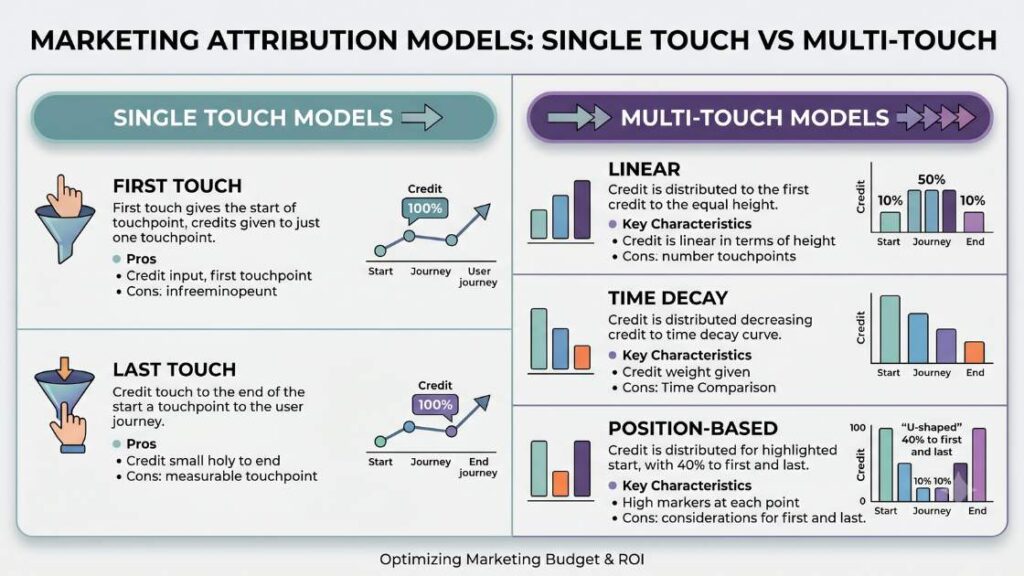
The difference is how credit gets distributed.
Single touch picks one winner. Multi-touch attribution spreads credit across multiple touchpoints, either equally (linear model), weighted by recency (time decay), or split between first and last with some credit in the middle (position-based, also called U-shaped).
Single touch is simpler. It works with basic analytics setups. You don’t need a CRM with full touchpoint tracking. You don’t need to stitch together cross-channel data. You run your report, see a number, make a decision.
Multi-touch is more accurate. It reflects reality better. But it comes with real requirements: consistent UTM tagging across every campaign, cross-device tracking, a CRM or analytics platform that can handle multi-touch data (like HubSpot, Rockerbox, or Northbeam), and someone who knows how to interpret the output.
Here’s the thing most people don’t say: a well-implemented single touch model beats a poorly implemented multi-touch model every time. Bad data with a sophisticated model is worse than clean data with a simple one.
When Does Single Touch Attribution Make Sense?
Single touch attribution gets dismissed too quickly. There are real situations where it’s the right call.
Short buyer journeys
If your customer typically converts in one or two sessions, single touch is often accurate enough. There isn’t much journey to miss. A D2C brand selling a low-cost impulse product, a SaaS with a free trial that converts quickly, or an e-commerce store running tight performance campaigns, these are setups where last touch attribution captures most of what matters.
Early-stage analytics
If you’re just starting to track attribution and your data infrastructure is basic, starting with single touch is honest. It gives you clean directional signal: which channel is driving new users (first touch) or which is closing them (last touch). You build from there.
Many YUP learners building their first marketing dashboards start here, not because it’s perfect but because it’s reliable with limited tooling.
Channel-specific reporting
Some channels lend themselves to single touch reporting. If you’re evaluating a cold outreach campaign that is specifically designed to generate first awareness, first touch attribution is the right lens. If you’re evaluating a retargeting campaign designed to close, last touch is the right lens.
Using single touch at the channel or campaign level, even when your overall attribution is more complex, is a completely legitimate practice.
Benchmarking and simplicity
Boardrooms and leadership teams often want simple numbers. “Which channel drove the most revenue?” is easier to answer with single touch. When you need to communicate attribution findings to non-marketing stakeholders quickly, single touch models are easier to explain and defend.
When You Should Stop Using It
Single touch attribution breaks down in specific, predictable ways.
Long consideration cycles. B2B software, high-ticket services, insurance, real estate, financial products. These buyers interact with your brand 10, 15, 20 times before signing. Last touch attribution will tell you that your salesperson’s follow-up email drove the conversion. That’s technically true and practically useless.
Multi-channel buyers. If your customers regularly move through 3+ channels before converting, single touch will systematically misrepresent which channels are working. A buyer who discovered you through a YouTube ad, read your blog, joined your email list, and then converted through a direct visit will be attributed entirely to direct. Your YouTube spend looks like it did nothing.
Any budget decision that affects mid-funnel. If you’re using last touch attribution to allocate budget and you have significant nurture activity, you’ll starve your mid-funnel channels over time. They’ll stop performing. You’ll think they were always useless. They weren’t.
The honest test: if your average customer journey involves more than two sessions before conversion, single touch attribution is giving you directional signal at best. It shouldn’t be driving your budget decisions alone.
Single touch attribution becomes unreliable when buyer journeys span multiple sessions, channels, or weeks. In these cases, it systematically over-credits one touchpoint and makes mid-funnel and awareness activity appear ineffective, leading to misallocated budgets.
How to Set Up Single Touch Attribution
Setting up single touch attribution doesn’t require advanced tooling. Here’s how to do it in the most common setups.
Step 1: Define your conversion event. Decide what counts as a conversion for this report. A purchase, a sign-up, a lead form submission. Be specific. Vague conversion definitions produce vague attribution data.
Step 2: Tag your campaigns consistently with UTMs. Every paid campaign, every email, every social post needs UTM parameters: source, medium, campaign. Without consistent UTMs, your attribution data will have gaps that make any model unreliable.
Step 3: Choose your model in Google Analytics 4. In GA4, go to Advertising > Attribution > Attribution Settings. You can compare attribution models across your conversion events. GA4 defaults to data-driven attribution, but you can view first-touch and last-touch in the Model Comparison report.
Step 4: Cross-check with your ad platforms. Meta Ads Manager and Google Ads both have their own attribution windows and models. These will not match GA4 numbers exactly. That’s normal. Use platform data to evaluate platform performance, and GA4 for cross-channel comparison.
Step 5: Document your model choice. Write down which attribution model you’re using for which decisions. “We use last touch for weekly performance reporting. We use first touch quarterly to evaluate awareness channel health.” This sounds obvious. Most teams skip it and then argue about the numbers because everyone is looking at different models.
Frequently Asked Questions
What is single touch attribution in simple terms?
Single touch attribution is a model that gives 100% of the credit for a customer conversion to one specific touchpoint. Either the first interaction the customer had with your brand (first touch) or the last interaction before they converted (last touch). It’s the simplest attribution model available.
What’s the difference between first touch and last touch attribution?
First touch attribution credits the channel or campaign that first brought a customer to your brand. Last touch credits the channel or campaign they interacted with right before converting. Both ignore everything in the middle. The right choice depends on what question you’re trying to answer: how are people discovering us (first touch) or what is closing them (last touch).
Is last touch attribution accurate?
Last touch attribution is accurate for short, simple buyer journeys where a customer typically converts in one or two sessions. For longer journeys involving multiple channels and touchpoints, it overstates the importance of conversion-stage activity and undercounts awareness and nurture channels. It’s the most widely used model but not the most accurate one for complex funnels.
What are the limitations of single touch attribution?
Single touch attribution ignores all touchpoints except one, which means it can’t tell you how your full funnel is performing. It over-credits one channel and under-credits others. For brands with complex multi-channel journeys, this leads to budget decisions that consistently undervalue mid-funnel and top-of-funnel activity.
When should you use single touch attribution?
Use it when your buyer journey is short (one to two sessions), when your analytics setup is early-stage, when you’re evaluating a channel specifically designed for one stage of the funnel, or when you need to communicate attribution results to non-marketing stakeholders who need simple numbers. It’s also a reasonable starting point before you have the infrastructure for multi-touch.
What is multi-touch attribution and how is it different?
Multi-touch attribution distributes conversion credit across multiple touchpoints rather than assigning all of it to one. Common multi-touch models include linear (equal credit to all touchpoints), time decay (more credit to recent touchpoints), and position-based (more credit to first and last, some in the middle). Multi-touch is more accurate for complex funnels but requires better data infrastructure and more analytical skill to interpret.
Does Google Analytics 4 support single touch attribution?
Yes. GA4 lets you compare attribution models in the Model Comparison report under Advertising. You can view first-click and last-click attribution alongside other models for any conversion event. GA4’s default is data-driven attribution, which requires sufficient conversion volume, but single touch models are available regardless of volume.
Is single touch attribution good enough for a D2C brand?
It depends on your funnel complexity. For D2C brands running tight performance campaigns with a one-click checkout journey, last touch attribution is often accurate enough. For D2C brands running content, email nurture, and influencer campaigns alongside paid, single touch will miss too much. From what we’ve seen with YUP learners running D2C campaigns, brands that have invested in email or content typically graduate to position-based or time decay attribution within the first year of serious tracking.
What should I use instead of single touch attribution?
If your buyer journey involves 3+ touchpoints or multiple channels, the most common upgrades are position-based attribution (U-shaped), which gives 40% to first touch, 40% to last touch, and 20% split across the middle, or time decay, which weights recent touchpoints more heavily. For high-budget multi-channel campaigns, dedicated attribution platforms like Northbeam, Rockerbox, or Triple Whale give you more granular cross-channel data than GA4 alone.
Conclusion
Single touch attribution isn’t broken. It’s just limited. And most of the criticism it gets comes from teams using it in the wrong situations, not from the model itself being fundamentally wrong.
If your buyer journey is short, your analytics setup is basic, or you need to communicate clearly to non-technical stakeholders, single touch is a reasonable, defensible choice. Use first touch when you care about discovery. Use last touch when you care about closing.
The moment your customer journey gets complex, with multiple channels, multiple sessions, and any meaningful nurture activity, single touch will start misleading you. That’s when you move to a model that can see the whole journey.
Start where your data quality allows. Upgrade when the complexity demands it. That’s the right approach to attribution at any stage.