

Customer data platforms have been getting a lot of attention lately, and not without reason. As marketing stacks grow more complex, managing customer data across channels starts to feel… messy. This guide looks at how customer data platforms actually fit into that picture. It breaks down what they do, how they work behind the scenes, and why they’ve become more relevant now than a few years ago. There’s also a closer look at use cases, benefits, and some of the friction teams run into during implementation. Nothing overly theoretical here. Just a grounded view of where customer data platforms help, where they don’t, and what to think through before adopting one.
Table of Contents
What Is a Customer Data Platform?
The term “Customer Data Platform” gets thrown around a lot. Sometimes loosely. Sometimes, it serves as a catch-all for anything data-related.
But at its core, a customer data platform is pretty specific.
A Customer Data Platform is a system that pulls customer data from different places, stitches it together, and creates a unified profile that marketing and product teams can actually use.
That last part is where things usually break in most companies. Data exists. Plenty of it. But it’s scattered, inconsistent, and often locked inside tools that don’t talk to each other.
A customer data platform fixes that… or at least tries to.
Customer Data Platform
In practical terms, a customer data platform is a centralized platform that collects, organizes, and activates customer data across channels.
Not just storage. Not just reporting. It sits somewhere in between.
The idea is simple: take fragmented data and turn it into something usable, preferably in real time.
Vendors like Adobe describe customer data platforms as systems built for real-time customer profiles and personalization. On the other side, platforms like Databricks frame it more from a data infrastructure angle, focusing on unification at scale.
Different positioning, same direction. Clean data, connected profiles, usable insights.
Customer data platform explained in simple terms
Most businesses already have customer data. That’s not the problem.
The problem is… It’s everywhere.
Website analytics shows behavior. CRM shows deals and contacts. Email tools track engagement. Ad platforms track clicks and conversions. None of them fully agrees with the others.
So instead of one customer, you end up with multiple versions of the same person.
A customer data platform brings those versions together.
It connects identifiers, aligns interactions, and builds a single view of the customer. Not perfect, but far better than guessing based on partial data.
And once that view exists, things start to click. Campaigns feel more relevant. Messaging becomes more consistent. Fewer awkward moments where a customer gets treated like a stranger.
Why customer data platforms matter in modern marketing stacks
Marketing today is less about channels and more about continuity.
Customers don’t think in terms of “email campaign” or “paid ad.” They just interact with a brand. Across devices. Across platforms. Sometimes within minutes.
Without a unified data layer, those interactions feel disconnected.
A customer data platform helps bridge that gap by:
- Reducing fragmentation across tools
- Enabling consistent messaging across channels
- Supporting first-party data strategies as third-party tracking fades
It’s not a silver bullet. But without it, scaling personalization becomes messy, slow, and honestly… a bit unreliable.
What Does a Customer Data Platform Do?
There’s a tendency to overcomplicate this.
A customer data platform doesn’t do everything. It does a few things really well, and that’s where its value comes from.
It collects data, organizes it, builds profiles, and sends that data back out to other systems.
That’s the loop.
Core function of a customer data platform in marketing and data ecosystems
Think of a customer data platform as a connector layer.
Most marketing stacks are made up of multiple tools that weren’t designed to work together. Each one solves a specific problem, but they don’t naturally share data in a clean way.
A customer data platform sits in the middle and creates alignment.
Instead of each team working with its own version of customer data, everyone works from the same base.
That shift sounds small, but it changes how decisions get made. Fewer discrepancies. Less back-and-forth. More confidence in what the data is actually saying. Teams can also use a pie chart creator to visualize customer segments, channel performance, and engagement data, making it easier to interpret insights from a customer data platform.
Customer data platform as a centralized customer data hub
Without a customer data platform, data tends to live in silos.
Analytics tools track behavior. CRM systems store contact details. Marketing platforms track engagement. Each one holds a piece of the puzzle.
A customer data platform pulls those pieces together into a single, structured system.
Every interaction gets tied to a profile. Every profile builds over time. And importantly, that profile is accessible across teams.
It’s not just about centralization for convenience. It’s about consistency.
Because inconsistent data leads to inconsistent experiences. And that’s usually where customers start to notice something’s off.
Real-time vs batch data processing in customer data platforms
Not all customer data platforms operate the same way under the hood.
Some rely on batch processing. Data gets collected, processed, and updated at intervals. Maybe every few hours, maybe daily.
Others lean into real-time processing.
Real-time systems update profiles instantly and trigger actions as events happen. A user clicks something, abandons a cart, revisits a page… and the system reacts right away.
Batch systems are often simpler to manage and work well for scheduled campaigns or reporting.
Real-time systems are more responsive, but also more complex.
Most mature setups end up using both. Real-time, where immediacy matters, batch, where efficiency is enough.
Role of customer data platforms in omnichannel marketing
Omnichannel marketing sounds great in theory. In practice, it’s mostly a data coordination problem.
To deliver consistent experiences across email, ads, websites, and apps, there needs to be a shared understanding of the customer.
A customer data platform provides that shared layer.
So instead of:
- Showing irrelevant ads to existing customers
- Sending generic emails to high-intent users
- Missing key behavioral signals
The system starts responding with context.
It’s not perfect. There are always gaps. But it’s a noticeable step up from disconnected campaigns.
What Is the Purpose of a Customer Data Platform?
A customer data platform isn’t just another tool to add to the stack. It exists to solve specific, recurring problems that show up as businesses scale.
Mostly around data fragmentation, identity, and control.
Collect and Consolidate Customer Data
Data comes from everywhere.
Websites, mobile apps, CRM systems, ad platforms, support tools, and even offline systems like point-of-sale. Each source captures something slightly different.
Individually, these datasets are useful. Together… they’re powerful, but only if they’re properly connected.
A customer data platform pulls in:
- First-party data from owned channels
- Second-party data from partnerships
- Third-party data, where applicable
And consolidates it into a structured format.
The goal isn’t just aggregation. It’s making sure the data can actually be used downstream without constant cleaning or manual effort.
Because messy inputs usually lead to messy outputs.
Build Unified Customer Profiles
This is where customer data platforms earn their keep.
Identity resolution connects different data points to a single user profile.
So instead of multiple fragmented identities, there’s one evolving profile that includes:
- Behavioral activity
- Purchase history
- Engagement across channels
This process relies on both deterministic signals, like email or login data, and probabilistic signals, like device patterns or browsing behavior.
It’s not always perfect. Edge cases exist. But it’s far more accurate than treating each interaction in isolation.
And once unified profiles are in place, segmentation and personalization become much more meaningful.
Improve Data Protection and Privacy
Data privacy isn’t just a compliance checkbox anymore. It’s becoming part of the overall customer experience.
Users expect transparency. Control. And increasingly, relevance without feeling tracked.
A customer data platform helps by centralizing how data is managed.
Consent preferences can be stored and enforced across systems. Data usage becomes more traceable. And compliance frameworks like GDPR or CCPA become easier to manage at scale.
There’s also a broader shift happening toward first-party data.
Instead of relying heavily on third-party tracking, businesses are focusing more on the data they collect directly. A customer data platform plays a key role here by organizing and activating the data responsible.
How Does a Customer Data Platform Work?
Underneath the surface, a customer data platform follows a fairly structured process.
It’s not as abstract as it sounds. There’s a clear flow, even if the technical details can get complex.
Step 1: Data Collection
Everything starts with data ingestion.
A customer data platform collects different types of data across touchpoints. Behavioral signals like clicks and page views. Transactional data from purchases or subscriptions. Basic attributes like location or device.
This data comes from multiple systems and needs to be standardized.
That part is often underestimated. If tracking isn’t set up properly at the source, the customer data platform ends up inheriting those issues.
And fixing them later is… not fun.
Step 2: Data Consolidation (Identity Resolution)
Once data is collected, it needs to be mapped to users.
Identity resolution connects different identifiers and interactions into a single profile.
Deterministic matching handles exact identifiers. Probabilistic matching fills in the gaps where direct identifiers aren’t available.
Over time, profiles become richer and more accurate.
This step is critical. If identity resolution is weak, segmentation becomes unreliable and personalization loses its edge.
Step 3: Audience Segmentation
With unified profiles in place, segmentation becomes much more dynamic.
Users can be grouped based on behavior, intent, lifecycle stage, or predictive signals.
Segments update automatically as user behavior changes.
That means less manual effort and more responsive campaigns.
Instead of building static lists, teams work with living audiences that evolve in real time.
Step 4: Data Activation
This is where everything connects back to execution.
The customer data platform sends enriched customer data to other platforms. Email tools, ad networks, CRM systems, and personalization engines.
And in more advanced setups, it does this instantly.
So when a user takes a specific action, the system can trigger a response almost immediately.
A follow-up email. A personalized offer. A change in website content.
That’s where the value shows up. Not in the data itself, but in how quickly and effectively it’s used.
Top 15 Customer Data Platforms
Picking a Customer Data Platform sounds straightforward… until it isn’t.
On paper, most customer data platforms promise similar things. Unified profiles, better segmentation, and real-time activation. But once you get into the details, the differences are pretty real. Some are built for data teams. Some for marketers. Some sit quietly on top of your warehouse and just move data around.
So it helps to look at them in buckets instead of one big list.
Enterprise & Advanced customer data platforms
These are the heavy-duty platforms. Built for scale, complexity, and usually… patience. Implementation takes time. But once they’re running properly, they can handle almost anything.
Treasure Data
AI personalization at scale
Treasure Data tends to show up in large enterprise setups where data volume isn’t small, and use cases aren’t simple.
It’s not the kind of tool you “just plug in.” There’s a setup curve. But it’s built for depth.
Best for
Enterprises dealing with large, messy datasets across multiple regions or business units. Especially where personalization needs to scale beyond basic segmentation.
Key features
- Combines batch and real-time processing without much friction
- Advanced segmentation tied to behavioral and transactional data
- Built-in predictive models for things like churn or affinity
- Strong integration with enterprise systems
Pros and cons
Pros:
- Handles complexity well
- Flexible enough for custom use cases
- Reliable at scale
Cons:
- Implementation isn’t light
- Needs technical ownership
- Overkill for smaller teams
Tealium AudienceStream
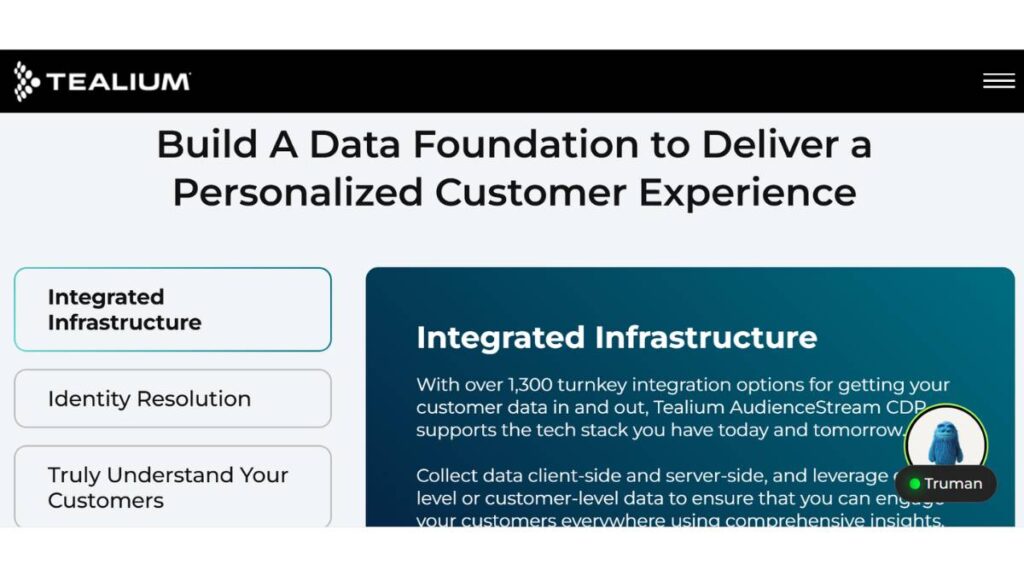
Tealium leans heavily into real-time data. That’s kind of its thing.
It also pairs closely with its tag management system, which makes data collection cleaner if everything is set up right from the start.
Best for
Teams that care about event-level data and want to react quickly. Works well for brands with lots of digital touchpoints, including apps and connected devices.
Key features
- Real-time audience updates
- Event stream processing across channels
- Tight integration with tag management
- Handles device-level and IoT data
Pros and cons
Pros:
- Fast response to user behavior
- Strong data collection layer
- Flexible integrations
Cons:
- Can feel a bit complex once scaled
- UI isn’t always intuitive
- Needs careful implementation planning
Twilio Segment
API-first data integration
Twilio Segment is often where teams start when they want to clean up their data pipelines.
It’s very developer-friendly. Less about flashy dashboards, more about making sure data flows correctly between systems.
Best for
Product-led companies or teams with strong engineering support that want clean, structured data across tools.
Key features
- API-first data collection
- Event tracking across the web and apps
- Large integration library
- Reverse ETL capabilities
Pros and cons
Pros:
- Solid foundation for data consistency
- Easy to plug into modern stacks
- Well-documented
Cons:
- Not very marketer-centric
- Activation often needs additional tools
- Costs can creep up with scale
Adobe Real-Time customer data platform
Predictive analytics
Adobe brings its ecosystem into play here. Which is both the biggest advantage… and sometimes the limitation.
If everything already runs on Adobe, this fits naturally. If not, things can get a bit rigid.
Best for
Enterprises already invested in Adobe’s ecosystem that want deep integration across analytics, content, and personalization.
Key features
- Real-time unified profiles
- Predictive segmentation
- Native integration with Adobe Experience Cloud
- Cross-channel orchestration
Pros and cons
Pros:
- Strong ecosystem synergy
- Advanced personalization
- Built for large-scale operations
Cons:
- Expensive, no way around it
- Less flexible outside the Adobe stack
- Takes time to fully adopt
Composable & Warehouse customer data platforms
This category has grown fast. Mostly because data teams want more control.
Instead of duplicating data inside a customer data platform, these tools sit on top of your warehouse and push data outward. Cleaner architecture… but requires a solid data setup to begin with.
Hightouch
Reverse ETL leader
Hightouch is often mentioned when people talk about reverse ETL. It’s focused, and it does that job well.
Best for
Teams already using a warehouse like Snowflake or BigQuery and want to activate that data directly without moving it around.
Key features
- Syncs warehouse data to marketing tools
- SQL-based audience building
- Keeps data centralized
- Works across multiple destinations
Pros and cons
Pros:
- No data duplication
- Flexible and scalable
- Fits modern data stacks
Cons:
- Requires SQL knowledge
- Not beginner-friendly
- Depends heavily on warehouse quality
RudderStack
RudderStack appeals to teams that want more control, especially around data privacy and infrastructure.
It’s a bit more hands-on compared to plug-and-play tools.
Best for
Companies that prefer open-source flexibility or need tighter control over how data flows and is stored.
Key features
- Event streaming pipelines
- Warehouse-native approach
- Open-source core
- Privacy-first design
Pros and cons
Pros:
- Highly customizable
- Good for privacy-focused setups
- Cost-efficient at scale
Cons:
- Requires engineering effort
- Setup isn’t instant
- UI is functional, not polished
ActionIQ
ActionIQ sits somewhere between data infrastructure and marketing execution.
It focuses a lot on decision-making. Not just moving data, but deciding what to do with it.
Best for
Enterprises that want to connect data with campaign decisioning without fully replacing their existing stack.
Key features
- Hybrid customer data platform architecture
- Advanced segmentation
- Campaign orchestration tools
- Works with existing warehouses
Pros and cons
Pros:
- Strong marketing use cases
- Flexible integration
- Balances data and activation
Cons:
- Enterprise pricing
- Needs alignment across teams
- Implementation can take time
E-commerce & Growth customer data platforms
These tools are more marketer-friendly. Faster to launch. Less dependency on engineering. Not as deep technically, but often enough for growth-focused teams.
Klaviyo
SMB personalization
Klaviyo is often treated as an email platform, but in practice, it behaves like a lightweight customer data platform for many e-commerce brands.
Best for
Small to mid-sized e-commerce teams focused on email and SMS as primary channels.
Key features
- Unified customer profiles
- Built-in segmentation
- Email and SMS automation
- E-commerce integrations
Pros and cons
Pros:
- Easy to use
- Quick to see results
- Strong for lifecycle marketing
Cons:
- Limited to owned channels
- Not a full customer data platform in complex setups
- Less flexible for advanced use cases
Bloomreach Engagement
Bloomreach leans heavily into personalization, especially for product discovery and shopping experiences.
Best for
E-commerce brands that want to go deeper into on-site personalization and product recommendations.
Key features
- Real-time customer data
- AI-driven recommendations
- Omnichannel campaigns
- Deep segmentation
Pros and cons
Pros:
- Strong personalization capabilities
- Good for retail and e-commerce
- Integrated experience tools
Cons:
- Setup can get complex
- Pricing isn’t entry-level
- Needs ongoing optimization
Insider
Cross-channel orchestration
Insider focuses on journeys. How users move across channels, and how messaging adapts along the way.
Best for
Teams that want to manage cross-channel campaigns without building everything from scratch.
Key features
- Journey orchestration
- Real-time personalization
- Predictive segmentation
- A/B testing
Pros and cons
Pros:
- Easy to launch campaigns
- Strong omnichannel focus
- Marketer-friendly
Cons:
- Less control over raw data
- Limited customization in some areas
- Not as deep as enterprise customer data platforms
Mid-Market & Specialized customer data platforms
These tools fill the gap. More advanced than entry-level platforms, but not as heavy as enterprise systems.
Lytics
Behavioral scoring
Lytics is known for how it handles behavioral data.
It’s less about raw data volume, more about understanding intent.
Best for
Teams focused on content, engagement, and behavioral targeting.
Key features
- Behavioral scoring models
- Predictive audiences
- Content personalization
- Data unification
Pros and cons
Pros:
- Strong behavioral insights
- Good for content-driven strategies
- Flexible segmentation
Cons:
- Smaller ecosystem
- Learning curve on UI
- Less known in the market
Blueshift
Blueshift blends customer data platform capabilities with campaign execution. It tries to do both in one place.
Best for
Teams that want data unification and campaign activation without stitching multiple tools together.
Key features
- Unified profiles
- Predictive recommendations
- Cross-channel campaigns
- Real-time triggers
Pros and cons
Pros:
- All-in-one approach
- Faster time to value
- Strong personalization
Cons:
- Less flexible than modular setups
- May not scale for very large enterprises
- Platform dependency increases
mParticle
Mobile-first data
mParticle has strong roots in mobile data. That still shows in how it handles event tracking and identity.
Best for
Mobile-first companies or apps where user behavior is heavily app-driven.
Key features
- Mobile data collection
- Identity resolution
- Real-time event streaming
- Privacy controls
Pros and cons
Pros:
- Strong mobile capabilities
- Reliable data pipelines
- Good identity management
Cons:
- Less emphasis on non-mobile channels
- Requires technical setup
- UI could be smoother
BlueConic
Consent-driven data
BlueConic puts privacy and consent at the center, which is becoming more relevant with each passing year.
Best for
Organizations focused on first-party data and privacy-first strategies.
Key features
- Consent and preference management
- First-party data collection
- Real-time segmentation
- Personalization tools
Pros and cons
Pros:
- Strong privacy features
- Marketer-friendly
- Good for compliance-heavy industries
Cons:
- Less advanced in predictive modeling
- Limited compared to enterprise tools
- Needs integrations for full stack
RedPoint Global
Predictive modeling
RedPoint Global leans into analytics and modeling alongside data unification.
It’s more data-heavy than most mid-market tools.
Best for
Enterprises that want deeper analytics and predictive modeling baked into their customer data platform.
Key features
- Data unification
- Predictive analytics
- Journey orchestration
- Advanced segmentation
Pros and cons
Pros:
- Strong analytics capabilities
- Good for data-driven teams
- Scales well
Cons:
- Complex implementation
- Needs skilled teams
- Higher cost
There’s no clean winner here.
Some tools are better if speed matters. Others if control matters. Some require engineering muscle, others are built for marketers to move fast.
Most teams end up choosing based on constraints rather than features. Existing stack, team skillset, budget… those tend to decide more than feature lists ever will.

Enroll Now: Advanced Digital Marketing Course
What Kind of Data Does a Customer Data Platform Collect?
A customer data platform doesn’t just “collect data.” That phrase gets used a lot, but it’s vague. The real question is what kind of data actually matters once everything is stitched together.
Because collecting everything… isn’t always helpful. It just creates noise.
Most customer data platforms work with four main types of data, and each plays a slightly different role.
Behavioral data usually comes first. This is the raw activity layer. Page views, clicks, time spent, product interactions, scrolls… all the small signals users leave behind. On their own, they don’t say much. But patterns start to show up when enough of it is connected. Someone visiting three times in two days? That means something.
Then there’s transactional data. This is cleaner. More definitive. Purchases, subscriptions, renewals, cancellations. It answers the “what actually happened” question. Not intent, but action. And over time, this becomes one of the most reliable inputs for segmentation.
Demographic data adds structure. Location, age range, device type, and sometimes gender. Not always perfectly accurate, and honestly, sometimes overused. But still useful when combined with behavior. It helps narrow things down without overcomplicating it.
Psychographic data is where things get a bit fuzzy. Interests, preferences, intent signals. This isn’t always directly collected. A lot of it is inferred. For example, repeated engagement with a certain category might suggest interest. It’s not exact, but it’s directionally useful.
What makes a customer data platform different is how it blends all of this.
Online behavior, offline purchases, CRM records, support interactions… all tied into one profile. So instead of fragmented snapshots, there’s a timeline. Not perfect, but closer to how real users behave.
And that’s usually where the value shows up. Not in the volume of data, but in how connected it is.
Key Benefits of Using a Customer Data Platform
The benefits of a customer data platform don’t always show up immediately. In fact, early stages can feel a bit underwhelming. There’s setup, alignment, data cleanup… not the most exciting phase.
But once things start working together, the impact becomes harder to ignore.
Better Customer Data Organization and Management
Most teams aren’t struggling because they lack data. They’re struggling because the data is scattered.
Different tools, different formats, different owners. Marketing sees one version, sales sees another. The product has its own view entirely.
A customer data platform pulls that into one place.
Not just physically centralized, but structured. Cleaned. Standardized. So when someone looks at a customer profile, it actually reflects reality… or at least gets close.
That alone reduces a lot of friction. Less time questioning data. More time using it.
Better Customer Analytics and Insights
Once the data is organized, analysis becomes less of a guessing game.
Patterns start to emerge that weren’t visible before. Not just “what happened,” but hints of “what might happen next.” Who’s likely to convert? Who’s quietly disengaging. Which behaviors tend to lead somewhere meaningful?
It’s not about perfect predictions. That’s unrealistic.
But even directional insight helps. It changes how campaigns are planned, how budgets are allocated, and how segments are built.
And over time, those small adjustments add up.
Better Customer Data Protection and Privacy
Data privacy used to sit in the background. Mostly a compliance thing.
Now it’s more visible. Customers care. Regulations are tighter. And systems need to reflect that.
A customer data platform helps by centralizing how data is handled.
Consent preferences aren’t scattered across tools. Data usage becomes easier to track. When something needs to be updated or removed, it doesn’t require digging through multiple systems.
It also supports a shift toward first-party data. Which, realistically, is where things are heading anyway.
Less reliance on external tracking. More control over data that’s collected directly.
Improved Personalization Across Channels
Personalization often breaks because data isn’t consistent.
One system thinks a user is new. Another knows they’ve already purchased. Messaging ends up conflicting, and the experience feels off.
A customer data platform helps smooth that out.
Because every channel pulls from the same underlying profile. So the messaging reflects what’s actually happening across touchpoints.
It doesn’t mean every interaction becomes perfectly personalized. That’s a stretch.
But it reduces obvious mismatches. And those small fixes make a difference in how the brand is perceived.
Increased Marketing ROI
This is usually the end goal, even if it’s not always stated directly.
Better data leads to better targeting. Better targeting reduces wasted spend. More relevant messaging improves conversion.
A customer data platform doesn’t magically improve ROI overnight. That expectation tends to backfire.
But it removes inefficiencies that quietly drain performance. Overlapping audiences. Mistimed campaigns. Irrelevant messaging.
Fix enough of those… and performance starts to move in the right direction.
How Does a Customer Data Platform Help With Personalization?
Personalization sounds simple on the surface. Show the right message to the right person.
In practice, it’s messy.
Without a unified data layer, most personalization ends up being shallow. Based on one or two signals. Sometimes outdated. Sometimes just wrong.
A customer data platform changes that by improving context.
Real-time behavior tracking plays a big role here. Instead of relying only on historical data, the system can react to what a user is doing right now. Browsing a category, revisiting a product, and spending more time on certain pages.
Those signals can trigger adjustments almost immediately.
Not always big ones. Sometimes it’s just a slight shift in messaging. A more relevant product recommendation. A better-timed email.
Then there’s the cross-channel aspect.
A user interacts with a product on the website, later sees a related ad, and then receives an email that aligns with that journey. Not random, not disconnected.
That consistency is what makes personalization feel intentional rather than automated.
Common workflows start to feel more cohesive:
- A user browses but doesn’t buy, and follow-ups reflect what they actually viewed
- Existing customers stop seeing acquisition-heavy messaging
- High-intent users move into more focused campaigns automatically
None of this is new in theory. The difference is execution.
With better data, personalization stops being reactive and starts becoming… a bit more anticipatory. Not perfect, but closer.
Customer data platform vs CRM vs DMP: What’s the Difference?
These three get mixed up all the time. Understandably.
They all deal with customer data. They all sit somewhere in the marketing or sales stack. But they’re built for different jobs.
Customer data platform vs CRM
A CRM is built around relationships. Mostly sales-driven.
Tools like Salesforce or HubSpot track interactions with leads and customers. Calls, emails, deals, pipeline stages. Structured data, tied to known contacts.
A customer data platform works differently.
It focuses on collecting and unifying data from multiple sources, including anonymous interactions. It builds a broader profile, not just tied to sales activity but to overall behavior.
So while a CRM answers “what’s happening in the sales process,” a customer data platform answers “what is this customer actually doing across channels.”
They complement each other. One doesn’t replace the other.
Customer data platform vs DMP
DMPs were built for advertising. Specifically, large-scale audience targeting using mostly anonymous data.
They rely heavily on third-party cookies and short-lived identifiers. The goal is reach, not depth.
Customer data platforms take a different route.
They focus on first-party data and persistent profiles. Instead of resetting data frequently, they build a long-term view of the customer.
This difference is becoming more important.
As third-party tracking becomes less reliable, DMPs are losing some of their relevance. customer data platforms, on the other hand, fit better into a world where businesses rely more on their own data.
Quick Comparison Table
The distinction becomes clearer when looked at side by side.
A customer data platform handles both known and unknown users, but leans toward building persistent profiles over time. It’s used by marketing, product, and data teams to unify and activate data.
A CRM focuses on known users only. It’s primarily used by sales and support teams to manage relationships and track interactions.
A DMP deals mostly with anonymous users. Its data is short-lived and mainly used for advertising and audience targeting.
Each system has its place.
The challenge isn’t choosing one. It’s making sure they work together without creating more fragmentation than they solve.
Learn 8 Key Uses for a Customer Data Platform
Audience segmentation for ads
A customer data platform sounds powerful on paper. But the real test is what actually gets done with it after implementation.
And this is where things split. Some teams build a strong data layer… and then struggle to activate it. Others go straight into use cases, sometimes too quickly, and end up with messy execution.
Somewhere in the middle tends to work best.
Audience segmentation for ads is usually the first visible win. Instead of relying on platform-based targeting alone, segments are built using actual behavior and purchase data. Not just “interested in X,” but “looked at X three times, didn’t convert.” That level of specificity changes how campaigns perform. Not dramatically overnight, but enough to notice.
Personalized email marketing
Personalized email marketing gets sharper. Not necessarily more complex, just more relevant. Emails reflect what users actually did, not what they might be interested in. There’s a difference. Open rates improve a bit, click-through improves a bit… but more importantly, it feels less generic.
Customer journey orchestration
Customer journey orchestration is where things get interesting. Instead of isolated campaigns, there’s some continuity. A user moves from one stage to another, and messaging adapts accordingly. Doesn’t mean it’s perfect. There are still gaps. But it’s less random.
Retargeting and remarketing
Retargeting becomes less repetitive. This one’s subtle, but important. Instead of showing the same ad endlessly, messaging can shift based on behavior. Someone who’s already engaged heavily might get a different angle. Or maybe a softer push instead of another hard sell.
Predictive analytics and churn prevention
Predictive use cases tend to come later. Churn prediction, lifetime value modeling… useful, but only if the underlying data is clean. Otherwise, predictions become noise. When it works, though, it helps prioritize. Not all users need the same attention.
Cross-sell and upsell strategies
Cross-sell and upsell efforts become more natural. Recommendations aren’t just based on what’s trending, but on what fits the user’s history. It’s still not perfect, but it’s closer.
Omnichannel campaign execution
Omnichannel campaigns start to feel… aligned. Not fully synchronized, but at least consistent. Messaging doesn’t contradict itself across channels, which happens more often than teams realize.
Customer experience optimization
And then there’s customer experience. Harder to measure. But fewer awkward moments. Fewer irrelevant messages. Less friction overall.
What are the Common Challenges With Implementing a customer data platform?
Data integration complexity
Customer data platforms solve a lot of problems. They also introduce a few of their own.
Data integration is usually where friction shows up first. Pulling data from multiple systems sounds manageable, but formats rarely match. Naming conventions differ. Some data is clean, some isn’t. Fixing that takes time. More than expected, usually.
Identity resolution issues
Identity resolution can be… messy. Matching users across devices and platforms isn’t always straightforward. Deterministic data helps, but it’s not always available. Probabilistic methods fill the gaps, but they’re not perfect. There’s always a margin of error.
High implementation cost
Then there’s cost. Not just the platform cost, but everything around it. Implementation, maintenance, internal resources. It adds up quietly. And if the use cases aren’t clear from the start, it can feel like a long wait before value shows up.
Organizational silos
Organizational silos don’t magically disappear either. Marketing, sales, product… each team still has its own priorities. A customer data platform can unify data, but it can’t force alignment. That part still needs work internally.
Data privacy compliance challenges
Data privacy adds another layer. Regulations like GDPR and CCPA aren’t optional. Consent tracking, data deletion, compliance processes… all need to be handled properly. A customer data platform can support this, but it doesn’t remove responsibility.
None of these is unusual. But ignoring them early tends to slow things down later.
Why Should Marketers Care About Customer Data Platforms?
Death of third-party cookies
There’s a shift happening in how marketing works. Not dramatic all at once, but steady.
Third-party cookies are becoming less reliable. Targeting based on external data isn’t as straightforward as it used to be. Platforms still offer options, but control is slipping a bit.
Rise of first-party data strategies
At the same time, expectations around personalization haven’t dropped. If anything, they’ve increased. Users notice when messaging feels off. Or repetitive. Or irrelevant.
That creates a gap.
Customer data platforms help fill that gap by making first-party data usable. Not just stored somewhere, but actually applied across campaigns.
Need for personalization at scale
Instead of relying heavily on external signals, brands start leaning more on their own data. What users are doing on their properties. How they interact. What they buy.
There’s also a competitive angle here.
Some brands move faster because their data is structured and accessible. Campaigns adapt quicker. Messaging stays relevant longer. It’s not about having more data, it’s about using it better.
Competitive advantage through data
And over time, that difference shows up.
Not always immediately. But consistently.
Important Customer Data Platform Strategies to Consider
First-party data collection strategy
A customer data platform without a clear strategy tends to drift. Data gets collected, but not always used effectively.
Starting with a first-party data strategy helps. What data actually matters? Where is it coming from? How is it structured? Without clarity here, everything downstream becomes harder than it needs to be.
Data governance framework
Data governance is another piece that often gets overlooked early. Who owns the data? Who maintains it? What standards are followed? These questions don’t feel urgent at the beginning… but they catch up later.
Real-time vs batch architecture decisions
Architecture decisions matter too. Real-time vs batch processing, for example. Not everything needs to happen instantly. But some use cases benefit from it. Finding the right balance avoids unnecessary complexity.
Integration with martech stack
Integration with the existing stack needs careful thought. A customer data platform doesn’t replace other tools; it connects them. If those connections aren’t clean, things break. Slowly, but noticeably.
AI and predictive modeling adoption
There’s also a tendency to jump straight into advanced features. Predictive modeling, complex segmentation… all useful, but not always necessary right away. Starting simple usually works better. Build a few strong use cases, then expand.
And one thing that comes up often… activation gets delayed.
Data gets collected. Profiles get built. But campaigns don’t fully use that data. That’s where value gets stuck.
A customer data platform only proves its worth when the data starts influencing real decisions. Campaigns, targeting, and personalization. Otherwise, it just sits there.
Best Practices for Implementing a Customer Data Platform
Start with clear KPIs
A surprising number of customer data platform initiatives begin with energy… and then sort of drift.
Not because the tech fails. Usually, because no one pinned down what success actually looks like. Everyone has a slightly different version in mind.
Clear KPIs help anchor things. Not broad targets like “improve personalization.” That’s too vague. Something tighter works better. Lift repeat purchase rate by a few points. Cut wasted spending on overlapping audiences. Improve engagement for a specific lifecycle segment.
When those are in place, decisions get easier. Without them, teams tend to circle around ideas without really committing.
Align marketing and data teams
This one sounds straightforward. It rarely is.
Marketing teams lean toward speed. Launch, test, iterate. Data teams care about structure, accuracy, and governance. Both are right, just… pulling in different directions sometimes.
A customer data platform sits right in that tension.
If alignment isn’t there, things stall. Campaigns wait for clean data. Data waits for approvals. Everyone feels busy, but progress feels slow.
Even simple alignment helps. Regular syncs. Shared priorities. Nothing overly complex. Just enough to keep both sides moving in the same direction.
Ensure clean data pipelines
There’s no shortcut here. Messy data in… messy output later. Always.
Event tracking needs to be consistent. Naming should actually make sense when someone looks at it a month later. Duplicate records? Deal with them early, not after they’ve spread across systems.
It’s not the most exciting part, honestly. Easy to push aside.
But when it’s ignored, things get weird. Segments don’t behave as expected. Campaign results look off. And then people start questioning the entire setup, even when the issue is just bad input.
Build incremental use cases
There’s always that urge to go big right away.
Full personalization, predictive scoring, multi-channel journeys… all switched on at once. It feels efficient, but it usually creates more confusion than impact.
Starting smaller tends to work better. A couple of focused use cases. Get them working properly. Understand what’s actually driving results.
Then expand.
It might feel slow in the beginning. But it saves a lot of backtracking later.
Focus on activation, not just collection
This is where many customer data platform setups quietly lose momentum.
Data gets collected. Profiles look detailed. Dashboards look impressive. But campaigns… stay mostly the same.
And that’s the issue.
A customer data platform isn’t valuable because it stores data neatly. It matters when that data changes decisions. Who gets targeted? When messages go out. What those messages say.
Without that shift, it’s just a well-organized system sitting in the background.
Conclusion: Is a Customer Data Platform Worth It?
When businesses should invest in a customer data platform
There’s usually a point where things start to feel scattered.
Different tools hold different pieces of the customer. Teams are pulling reports from multiple places. A lot of time is spent just trying to get a clear picture.
That’s often when a customer data platform starts making sense.
On the flip side, if everything is still fairly simple, a customer data platform can feel like over-structuring. Too much setup for too little complexity.
So timing matters. Probably more than most expect.
Who benefits most
Larger organizations tend to feel the impact sooner. More channels, more data, more fragmentation to fix.
They also have the resources to manage it properly, which makes a difference.
For smaller businesses, it’s a bit more nuanced. The benefits are there, but only if the approach stays focused. Otherwise, the system can feel heavier than necessary.
So it’s less about company size, more about how complex the data environment has become.
Future of customer data platforms in AI-driven marketing
There’s a gradual shift happening. Not dramatic, but steady.
Third-party data is becoming less reliable. At the same time, expectations around personalization keep rising. That combination pushes teams toward better control over their own data.
Customer data platforms fit into that shift quite naturally.
They’re not a cure-all. Worth keeping that in mind. But they’re becoming a core piece in how modern marketing systems are structured, especially as things move more toward first-party data.
FAQs: Customer Data Platforms
What is a customer data platform in marketing?
A customer data platform, in practical terms, is where customer data finally stops being scattered. It pulls information from different systems and ties it back to a single profile. Not just for storage, that part is easy. The real value shows up when teams can actually use that data in campaigns without stitching things manually every time.
How is a customer data platform different from CRM?
A CRM is built around known customers, mostly to track relationships, deals, and conversations. A customer data platform doesn’t wait for that. It collects behavior early, even before someone becomes a “contact.” So while a CRM tells what happened in a relationship, a customer data platform explains how that relationship started and how it evolves across channels.
Do small businesses need a customer data platform?
Sometimes yes, often not in the early stage. When there are only a few tools and data sources, things are still manageable. But over time, gaps start appearing. Data lives in different places, reports don’t match, targeting feels off. That’s usually when a customer data platform starts becoming relevant. Not urgent, but useful.
What is a composable customer data platform?
A composable customer data platform doesn’t replace existing systems. It builds on top of them. So instead of moving data into a new platform, it uses the data warehouse as the base and adds layers for segmentation and activation. This setup gives more flexibility, though it does require a bit more technical maturity to manage properly.
Are customer data platforms expensive to implement?
Short answer: They can be. But the cost isn’t just the license. Integration takes time. Data needs cleaning. Teams need to adjust how they work. All of that adds up. Without clear use cases, it can feel like a slow return. That’s why phased rollouts tend to work better than big, all-at-once implementations.
Can a customer data platform replace a data warehouse?
Not really. They solve different problems. A data warehouse handles storage and large-scale processing. A customer data platform sits closer to marketing use cases, making customer data accessible and actionable. In most setups, both exist together. One feeds the other. Trying to replace one with the other usually creates gaps somewhere.
What are the key features of a customer data platform (CDP)?
At a core level, a customer data platform collects data from multiple sources, resolves identities, builds unified profiles, and allows segmentation. Then comes activation, which is where things get interesting. Sending that data into campaigns, adjusting targeting, and personalizing experiences. Without activation, the rest doesn’t really go far.
How long does it take to implement a customer data platform?
It depends, and that’s not a vague answer. A clean setup with limited integrations can move fairly quickly. A complex environment with messy data can take months. Internal alignment also slows things down more than expected. It’s rarely plug-and-play, even though it’s sometimes presented that way.
What is identity resolution in a customer data platform?
Identity resolution is basically the process of figuring out which data points belong to the same person. Sounds simple, but it isn’t always. Users switch devices, use different emails, and browse anonymously. The customer data platform tries to connect those dots using identifiers. It’s not perfect, but it makes the data far more usable than before.
Can a customer data platform integrate with existing marketing tools and CRMs?
Yes, and that’s kind of the point. A customer data platform connects with email platforms, ad networks, CRMs, analytics tools… so data flows where it needs to go. But integration quality matters. If connections are weak or delayed, the whole system feels slower and less reliable than it should.
What is the difference between a customer data platform and a data warehouse?
A data warehouse is where large volumes of data are stored and processed, often used by analysts. A customer data platform focuses on customer-level data and brings it closer to marketing teams. One is built for scale and analysis, the other for usability and activation. They overlap a bit, but their roles are quite different.
How do customer data platforms support first-party data strategies?
Customer data platforms help collect and organize data that comes directly from customers, like website interactions or purchase behavior. This reduces dependence on third-party data, which is becoming less reliable anyway. More importantly, it gives businesses control over their own data, which is starting to matter a lot more now.
Are customer data platforms suitable for small businesses?
They can be, but only when there’s enough complexity to justify them. For simpler setups, adding a customer data platform too early can feel like overkill. But once data starts spreading across tools and channels, the benefits become clearer. Timing is important here. Maybe more than the tool itself.
What industries benefit the most from customer data platforms?
Industries with frequent customer touchpoints see the biggest impact. E-commerce, retail, finance, travel, media… basically anywhere users interact across multiple channels. In those cases, having a unified view makes targeting and personalization much easier. Without it, things stay fragmented and harder to manage.
How does a customer data platform improve customer journey mapping?
A customer data platform connects interactions that would otherwise stay isolated. So instead of seeing random touchpoints, teams can follow a more complete path. Where users drop off, what drives engagement, and how channels interact. It doesn’t make journeys perfect, but it makes them a lot clearer to work with.
What are the costs associated with implementing a customer data platform?
Costs usually include licensing, integration work, data infrastructure, and ongoing maintenance. There’s also the cost of time, which often gets overlooked. Teams need to adapt, processes need to change. Without clear priorities, it can feel expensive. With the right setup, though, the value tends to catch.