

Your biggest rival just rewrote its pricing page. Another one shipped three integrations last month, and a third is suddenly ranking for the search terms you’ve been chasing for a year. Everyone on your team has an opinion about what it all means. Nobody has checked.
That gap between noticing and understanding is what SaaS competitive analysis closes. It’s the habit of studying competitors in a structured way, so you can decide what to build, how to price it, and what to tell buyers.
This guide covers the whole process: choosing the right competitors, researching them, comparing products and pricing, picking tools, and turning findings into a strategy. There’s a comparison table you can copy and a worked example near the end. None of it needs a big budget.
Table of Contents
What Is SaaS Competitive Analysis?
SaaS competitive analysis is the process of researching competing software companies to understand their products, pricing, positioning, and customers, then using what you learn to make better decisions. It turns scattered observations about rivals into evidence that product, marketing, pricing, and sales teams can act on.
You’ll also hear it called SaaS competitor analysis. Same thing. What matters is scope: you’re not collecting trivia about other companies, you’re working out which differences actually change a buyer’s mind.
Here’s where it gets practical. Product teams use the findings to decide which gaps deserve a roadmap slot. Marketing sharpens messaging, pricing teams test packaging, and sales reps stop improvising when a prospect says “but Competitor X does this.” The research also feeds wider SaaS market research, because rival behaviour shows you which segments are crowded and which are oddly quiet.
Also Read: SaaS Product Marketing: The Blueprint for Sustainable Growth
SaaS competitive analysis is the structured study of competing software companies across product, pricing, positioning, marketing, and customer feedback. Its value comes from the decisions it changes, such as what to build, how to package plans, and how to sell against specific rivals. Research that never reaches a decision is just a document.
Competitive Analysis vs. Competitor Monitoring
Competitive analysis evaluates the market and points to strategic openings. Competitor monitoring tracks changes over time: a new pricing tier, a feature launch, a rewritten homepage. One is the map. The other is the weather report.
A growing SaaS company needs both. Analysis without monitoring goes stale within a quarter, and monitoring without analysis hands you a pile of alerts with no way to tell which ones matter.
Why It Matters for SaaS Businesses
Subscription revenue raises the stakes. When a buyer picks a rival, you don’t lose one sale, you lose months or years of recurring revenue. And a customer who later churns to a competitor takes that revenue with them, which makes retention as much a competitive question as acquisition.
Pricing is the other pressure point. Buyers compare plans side by side, so a packaging decision made in isolation can quietly cost you deals.
A few other places where the research pays off:
- Product differentiation, because you can’t differentiate from something you haven’t looked at
- Sales effectiveness, since reps who know how a rival pitches handle objections better
- Entering a new market or customer segment, where incumbents’ habits and weak spots show you whether there’s room
Types of Competitors Every SaaS Business Should Identify
SaaS competitors fall into three groups: direct competitors that sell similar software to the same buyers, indirect competitors that solve the same problem a different way, and substitutes such as spreadsheets, in-house tools, or AI assistants. Mapping all three keeps your analysis from being too narrow.
Ask a team selling project management software who they compete with, and Asana and monday.com come up within seconds. Ask what customers use instead, and the answers get stranger.
Direct Competitors
Direct competitors are businesses selling similar software to the same target customers. Asana and monday.com are a clean example in work management: overlapping features, overlapping buyers, and prospects who often trial both. These are the easiest rivals to find and, usually, the first ones you study.
Indirect Competitors
Indirect competitors are products that solve the same problem through a different approach. A team might skip dedicated project software altogether and build its workflows in Notion, because it already holds their documents and databases. Different category, same job.
Emerging and Substitute Competitors
This group covers new entrants, AI-powered alternatives, spreadsheets, in-house tools, and plain manual workflows. The spreadsheet is the rival most early-stage SaaS companies underestimate. It’s free, everyone knows it, and it’s good enough right up until it isn’t.
How to Choose the Right Competitors to Study?
You can’t study everyone, so don’t try. Start with three to five priority competitors and go deep.
- Review your lost deals and onboarding feedback to see who customers actually mention.
- Search category-specific alternatives and comparison pages, the way a buyer would.
- Prioritize rivals that keep appearing in real buying decisions, not the ones that simply look impressive.
A Bengaluru CRM startup selling to small businesses will probably meet Zoho CRM and HubSpot in most deals. A founder tracking only those two can still miss the third rival: the shared spreadsheet the buyer already has open.

How to Conduct SaaS Competitive Analysis Step by Step?
To run a SaaS competitive analysis, define one objective, research a short list of competitors, compare their product, pricing, positioning, marketing, and customer feedback, then turn the findings into prioritized actions with owners and deadlines. The eight steps below follow that order.
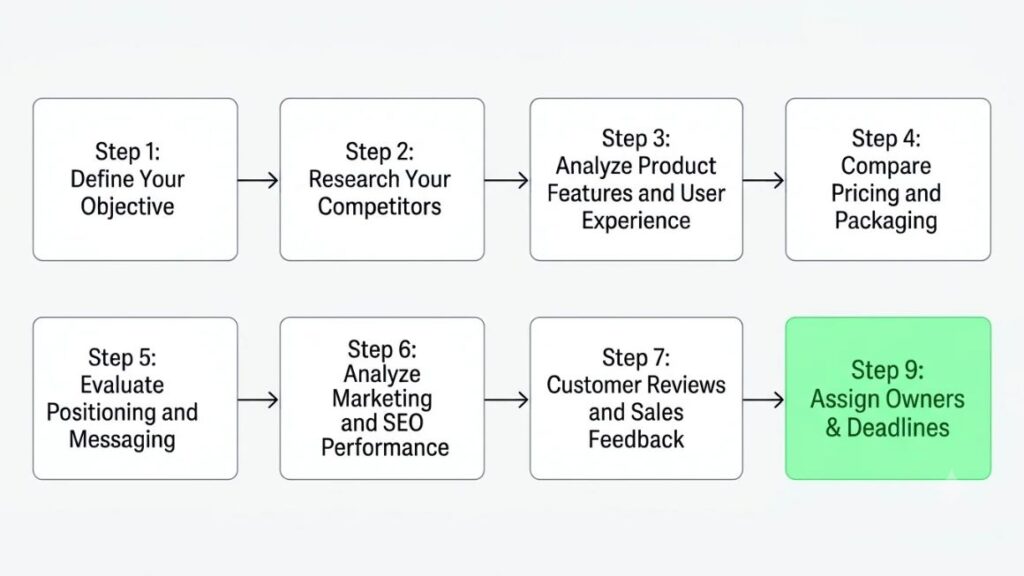
Step 1: Define Your Objective
Start with the decision, not the data. Is the goal sharper positioning, a pricing change, a roadmap input, a better trial conversion rate, or lower churn? Pick one. Maybe two.
Then write the questions the research has to answer, such as “Why do mid-market buyers shortlist Competitor X before us?” Skip this and you’ll end up with a hundred screenshots and no conclusion.
Step 2: Research Your Competitors
Go to the primary sources first: official websites, product pages, pricing pages, and documentation. Then add recent customer reviews, public changelogs, case studies, integration directories, and company announcements.
Record the source and date of every finding. Three months from now you’ll want to know whether a claim came from a pricing page last week or a blog post from 2023, and your memory won’t help.
Step 3: Analyze Product Features and User Experience
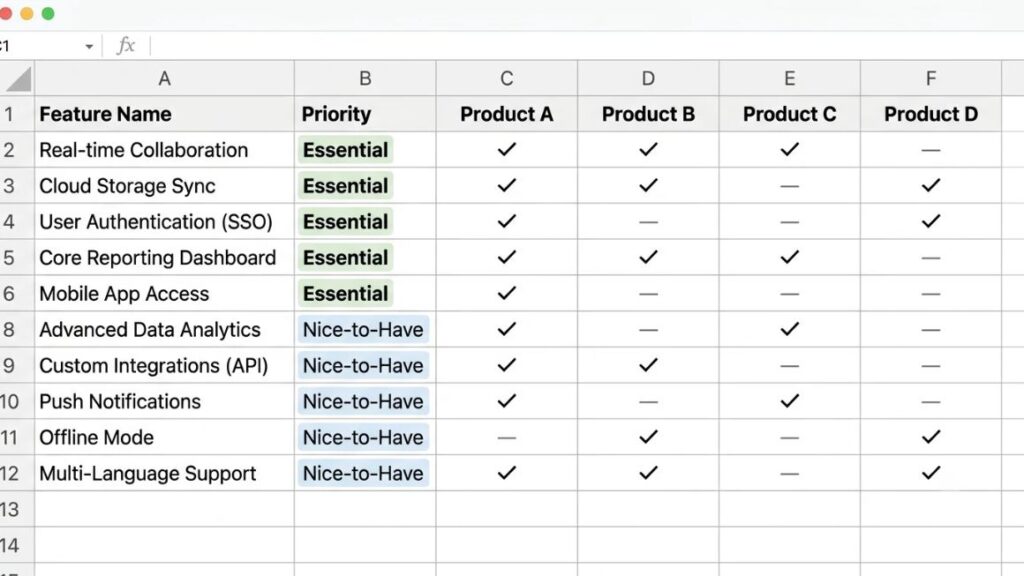
Build a competitor feature comparison that covers core capabilities, integrations, onboarding, customization, security, and support. Sign up for a trial if you can. Reading about onboarding is nothing like sitting through it.
Separate the essentials from the nice-to-haves, because a long checklist flatters whoever has the most boxes ticked. What counts are gaps that matter to customers. A missing feature nobody asks for isn’t a weakness, and a clunky setup flow that makes people quit in week one very much is.
Step 4: Compare Pricing and Packaging
Competitor pricing analysis goes beyond the headline number. Look at subscription tiers, per-user charges, usage-based billing, free plans, trials, and how enterprise contracts are handled.
Then calculate what a comparable customer would likely pay. Take a ten-person team needing the same core features and price it across each rival. Check billing terms and plan limits before concluding anything, since a cheap plan with a hard cap on usage or seats can end up costing more than it first appears. And remember that pricing pages change, so date every figure you record.
Step 5: Evaluate Positioning and Messaging
Read each rival’s homepage as if you were a stranger. Who is it for? What’s the main promise? Which proof points does it lean on?
Compare headlines, calls to action, case studies, and customer logos. This is where competitive positioning becomes visible, because every choice on that page signals who the company wants and who it’s happy to lose. Then look for customer segments nobody seems to be speaking to. That’s often where an opening sits.
Step 6: Analyze Marketing and SEO Performance
Run a competitor keyword analysis to see which topics bring rivals organic visibility, which content formats they favour, and which comparison pages they’ve built. Review backlinks too, since they show who is willing to link to them and why.
Public ad libraries, such as the Meta Ad Library and Google Ads Transparency Center, show what competitors are paying to promote. Then flip the question: which topics do they cover well that your site handles poorly? Keep in mind that third-party traffic figures are estimates. Don’t mix them up with verified analytics.
Step 7: Study Customer Reviews and Sales Feedback
Customer review analysis starts with patterns, not individual comments. Look for recurring praise, repeated complaints, and feature requests that show up again and again. Compare recent reviews with older ones, because a complaint that vanished eighteen months ago may mean the product changed.
Public feedback only tells half the story. Pair it with win-loss analysis: interviews with buyers who chose you and buyers who didn’t. Clozd, a win-loss research firm, reports that CRM “closed-lost” reasons were wrong 85% of the time when checked against buyer interviews. That’s a vendor’s own figure, so treat it as a signal rather than a law, but it matches what many sales teams quietly suspect.
Step 8: Turn Findings Into Decisions
Now the research has to earn its keep. Run a competitor SWOT analysis, listing strengths, weaknesses, opportunities, and threats for each rival relative to you.
Then prioritize gaps by customer impact, business value, effort, and how confident you are in the evidence. Assign an owner and a deadline to every important action. An insight without an owner is a nice slide.
A SaaS competitive analysis follows eight steps: define the objective, research competitors from primary sources, compare features, compare pricing, evaluate positioning, study marketing and SEO, analyze customer and sales feedback, then convert findings into prioritized actions. Each finding should carry a source and a date so the research can be checked and refreshed.
What Should You Compare in a SaaS Competitor Analysis?
A useful comparison covers seven areas: product, pricing, positioning, marketing, customer experience, sales, and business direction. Each area gets its own question, so you compare what drives buying decisions instead of what’s easiest to count.
Use the table below as a SaaS competitive analysis template. Copy it into a spreadsheet, add one column per competitor, and fill each cell with evidence and a date.
| Category | What to examine | Key question |
| Product | Features, integrations, usability | Which customer needs remain unmet? |
| Pricing | Tiers, billing models, limits | What does a comparable customer actually pay? |
| Positioning | Target audience, value proposition | Why would a buyer choose this product? |
| Marketing | SEO, content, ads, partnerships | How does the competitor attract demand? |
| Customer experience | Onboarding, support, reviews | Where do customers struggle or succeed? |
| Sales | Demo process, proof points, objections | What helps the competitor win deals? |
| Business direction | Product releases, hiring, partnerships | Which strategic changes are supported by evidence? |
How to Score Competitors Fairly?
Scoring makes a messy comparison easier to read, but only if you do it consistently.
- Use one scale, such as 1 to 5, for every competitor.
- Define what each score means before you start comparing companies.
- Weight categories to match your business objectives, so a pricing gap counts for more if pricing is your problem.
- Label missing information as “unknown” instead of assuming a competitor is weak.
That last one trips people up constantly. A blank cell isn’t a zero.
A fair competitor comparison uses the same scoring scale for every company, defines each score before comparing, and weights categories by business objective. Missing data should be marked unknown, because absence of evidence is not evidence of weakness.
Best Tools for SaaS Competitive Research
The best tool depends on the question you’re asking, not on the length of its feature list. SEO platforms answer search questions, review sites answer customer questions, and traffic tools give rough audience estimates. Most SaaS competitor analysis tools overlap more than their sales pages admit, so match the tool to the question first.
SEO and Keyword Research Tools
Semrush covers keywords, search visibility, and competitor research, including a Keyword Gap report that shows terms rivals rank for and you don’t. Ahrefs is strongest on organic search analysis and backlinks, and its Content Gap tool lets you compare your domain against several competitors at once. Many teams pick one and stick with it. You rarely need both.
Traffic and Audience Research
Similarweb provides estimated traffic and audience insights. Treat the numbers as directional. They come from modelled data, not from the competitor’s own analytics.
Customer Reviews and Market Feedback
G2 and Capterra hold product reviews and side-by-side comparisons. In early 2026, G2 acquired Capterra, Software Advice, and GetApp from Gartner, which puts close to six million verified reviews under one company, according to ZoomInfo’s 2026 G2 review. One caveat worth remembering: Capterra states that the placement of listed alternatives may be influenced by client status.
Lightweight Research for Startups
No budget? Public pricing pages, product documentation, release notes, a spreadsheet, and a handful of customer interviews will take you surprisingly far.
Features, plan limits, and prices change often. Check current pricing on each vendor’s site before you buy anything.
SaaS Competitive Analysis Example
Everything below is hypothetical. The companies and findings are invented to show the method, so don’t read them as real market data.
An Illustrative Project Management Software Example
Imagine comparing three fictional project management platforms for a small agency.
| Product A | Product B | Product C | |
| Price | Lower | Mid-range | Higher |
| Onboarding | Simple, fast | Moderate | Complex |
| Integrations and reporting | Limited | Broad, advanced reporting | Moderate |
| Enterprise controls | Basic | Moderate | Strong |
Product A wins on price and simple setup. Product B has broader integrations and advanced reporting, and Product C offers stronger enterprise controls but a heavier setup.
Turning the Comparison Into a Strategy
Look at what’s missing. Nobody here serves customers who want straightforward setup, predictable pricing, and only a handful of essential integrations. A smaller company could build its SaaS market positioning around exactly that.
| Opportunity | Supporting evidence | Potential impact | Next action |
| Predictable pricing for small teams | Hypothetical review complaints about surprise charges | High | Test a flat-rate plan on the pricing page |
| Setup in under a day | Hypothetical onboarding complaints about Product C | Medium | Interview three churned trial users |
If real brands replace these in your own version, verify every feature and price against current primary sources first.
Common Mistakes to Avoid
Most failed competitor research goes wrong in five predictable ways, and almost all of them come from treating the exercise as a one-off report rather than an ongoing input to decisions.
Copying Competitors Instead of Differentiating
A competitor’s success doesn’t prove its strategy will work for your audience. They may have a bigger budget, an older brand, or customers you’ll never meet.
Competing on Price Alone
Cheaper is easy to copy and hard to defend. Compare total value instead: service quality, onboarding, reliability, and how well the product fits the customer.
Treating Estimates as Exact Data
Traffic tools estimate. In a 2026 comparison of Similarweb against Google Analytics across 1,787 ecommerce sites, Omniconvert found that accuracy improved sharply as site size grew. So the smaller the competitor, the shakier the number.
Conducting Research Once and Forgetting It
Schedule reviews and keep a change log. A comparison from last year describes a market that no longer exists.
Ignoring Customer Feedback
Competitor websites won’t mention what their customers struggle with. Your own customers, and your lost prospects, will.
How to Build a Repeatable Competitive Monitoring Process?
A repeatable process means lightweight weekly checks, a monthly review, and a deeper quarterly reassessment. That rhythm keeps competitive intelligence current without turning it into a second job.
A Simple Weekly, Monthly, and Quarterly Routine
- Weekly: watch for meaningful product releases, announcements, and pricing changes.
- Monthly: review positioning, search visibility, customer feedback, and relevant campaigns.
- Quarterly: reassess the competitor set, strategic opportunities, and business priorities.
Metrics Worth Tracking
Competitor benchmarking only helps when the metrics tie back to your own results. Track win rate against named competitors, reasons for lost deals, trial-to-paid conversion and retention where relevant, share of target search visibility, and changes in competitor packaging and customer sentiment.
One boundary matters here. Internal metrics like win rate, conversion, and retention should come from your own analytics, CRM, billing, and customer research. Don’t infer them from public competitor data.
Conclusion
Research only becomes valuable when it changes a decision. A spreadsheet full of competitor notes that nobody acts on is a hobby.
So pick three competitors this week and complete a first comparison, using the table above. Keep the evidence honest, look for the space your rivals aren’t covering, and revisit it on a schedule. That’s the whole discipline behind SaaS competitive analysis: evidence, differentiation, and consistent follow-up.
If you’d like structured guidance on positioning and competitor research, Young Urban Project’s Product Marketing course is a good next step.
Frequently Asked Questions
What is SaaS competitive analysis?
SaaS competitive analysis is the process of researching competing software companies to understand their products, pricing, positioning, and customers. Its purpose is to support better product, marketing, pricing, and sales decisions.
How many competitors should a SaaS company analyze?
Three to five for an initial in-depth assessment. Expand the list when your market is complex, for example when different customer segments buy from entirely different sets of rivals.
Which tools are best for competitor research?
It depends on the question. SEO tools like Semrush and Ahrefs answer search questions, review platforms like G2 and Capterra show customer sentiment, and traffic services like Similarweb give rough audience estimates. Public sources cover the rest.
How often should SaaS competitors be reviewed?
Run lightweight monitoring continuously and a thorough review every quarter. Fast-moving markets may need a tighter rhythm, and slower ones can stretch it.
Can startups perform competitive analysis without expensive tools?
Yes. Start with free public sources: pricing pages, documentation, release notes, and reviews. Add customer interviews and organize everything in a spreadsheet.
How does competitor research improve marketing and sales?
It gives marketing clearer messaging and stronger content, and it gives sales better battlecards and honest answers to objections. When you know where rivals are strong and weak, you stop guessing in the room.