

Most SaaS companies do their marketing the way a retail store would. Big ads. A nice-looking website. A “Sign Up Free” button. And then they sit back and wait.
It doesn’t work. Not for long, anyway.
SaaS is different. You’re not asking someone to buy a product once. You’re asking them to log in every week, build habits around your tool, and keep paying for it every single month. That’s a bigger ask. And that means the marketing has to work harder, smarter, and for much longer than a one-time sale would require.
This article breaks down what SaaS product marketing actually is, what makes it different from regular marketing, and how to build a strategy that keeps growing, not just one that spikes and crashes.
Table of Contents
What Is Product Marketing in SaaS?
Think of it this way. Your product team builds the thing. Your SaaS product marketing team makes sure the right people find it, understand it, and stick around.
It covers a lot: who you’re targeting, how you describe what the product does, how you launch it, why someone should choose you over a competitor, and how you keep customers from leaving. In a small startup, one person handles all of this. In a bigger company, there’s a whole team.
SaaS product marketing is different from regular marketing because the customer relationship doesn’t end at sign-up. It actually starts there. Every email, every onboarding screen, every in-app message, all of it is product marketing. The goal isn’t just to get users in the door. It’s to make them stay.
And the staying part? That’s where most SaaS companies lose.
Read More: What is product marketing
SaaS product marketing connects a software product to the right audience through clear positioning, good messaging, and a strong go-to-market plan. Because SaaS works on subscriptions, product marketing doesn’t stop at acquisition. It runs through onboarding, retention, and expansion across the full customer lifecycle.
What Makes SaaS Marketing Different
Retention Is the Real Growth Driver
Here’s something that catches a lot of SaaS marketers off guard.
You can run great ads, fill your trial pipeline, and still be losing money if people keep leaving after month two. Churn, which just means people cancelling their subscriptions, is the silent killer of SaaS growth.
According to Bain & Company research, a 5% improvement in customer retention can increase profitability by 25 to 95%. That’s not a typo. Keeping your existing users is often far more valuable than finding new ones.
So when you’re thinking about SaaS marketing strategy, retention isn’t something you deal with after acquisition. It starts with who you target, what you promise in your ads, and how you set up your free trial. Get those wrong, and no amount of spending fixes the churn.
The Customer Journey Isn’t Linear
In most product businesses, the buying path is simple. Someone sees your product, they consider it, and they buy it. Done.
In SaaS, it’s messier. A potential user might sign up after reading one blog post. Or they might spend three months reading reviews, watching demos, asking their team, and comparing five tools before they ever click your CTA. Some users sign up, don’t do anything, and then come back six months later and become your best customers.
You can’t assume everyone takes the same path. Your marketing needs to work at every stage, including the stages that come after the first payment.
How to Market a SaaS Product: Core Channels
Social Media Marketing for SaaS
Let’s be honest. Nobody sees a reel and immediately buys accounting software.
But social media does something else for SaaS. It builds trust over time. Every useful LinkedIn post, every honest product update, every behind-the-scenes founder thread adds a little more credibility to your brand. When someone finally needs what you sell, they already know you.
For B2B SaaS, LinkedIn is where the decision-makers hang out. For developer tools or products aimed at indie builders, Twitter/X and Reddit communities matter a lot more. For SaaS tools targeting small business owners in India, Instagram and YouTube have worked really well. Zoho’s educational YouTube content and Razorpay’s consistent LinkedIn presence are both solid examples of Indian SaaS brands playing the long game on social.
The point of social for SaaS isn’t to get someone to buy today. It’s to make sure they think of you first when they’re ready.
Email Marketing for SaaS Products
Email is probably the most underrated channel in SaaS. And also one of the most effective.
According to a 2023 Litmus Email Marketing report, email generates an average of $36 for every $1 spent. The reason it works so well in SaaS is simple: people who give you their email are already interested. You’re not interrupting them with an ad. You’re following up on the interest they showed.
The best SaaS email sequences aren’t about timing. They’re about behaviour. Instead of sending everyone the same “Day 3” onboarding email, the smart move is to trigger emails based on what users actually do. Did they activate a feature? Send a tip for the next one. Haven’t logged in for two weeks? Send them a specific use case that might bring them back.
Small change. Big difference in how users respond.
Video Marketing for SaaS Products
A short product demo video is more convincing than almost any other piece of content in SaaS. Because the first question every new visitor has is: “Does this actually do what they claim?”
Loom built most of its early growth on exactly this. When users recorded videos using Loom and shared them with teammates, those teammates became users too. The product was doing the marketing just by being used. That’s the dream.
For most SaaS companies, the video investment should go into three things: a short homepage demo (under two minutes), explainers for features that are hard to describe in text, and customer testimonials that feel real and not scripted. YouTube tutorials also pull in great search traffic from people actively looking for tools like yours.
SEO for SaaS Product Marketing
Search is one of the most powerful long-term channels for SaaS. Someone searching “best project management tool for remote teams” is already most of the way to buying. Getting in front of them at that moment, with the right content, is far cheaper than running ads to people who’ve never heard of you.
But SaaS SEO isn’t just about your product name. The best SaaS companies own the whole problem space. Notion ranks for productivity content. HubSpot ranks for practically every marketing concept. Intercom ranks for customer support topics. They didn’t do that by accident.
The article you write today can keep bringing in users for years. Paid ads stop the moment you stop paying. Content compounds.
How to Build a SaaS Marketing Strategy
Before you think about channels, tactics, or budgets, answer these five questions. Honestly.
1. Who Are You Targeting?
Not “small businesses” or “marketers.” That’s too vague to do anything useful with.
Get specific. Are you going after early-stage D2C founders in India who are managing their own Meta Ads? Or are you targeting senior marketing managers at Series B startups who are tired of manual reporting? The more specific your answer, the better everything else works. Your messaging, your content topics, your ad targeting, all of it sharpens when you know exactly who you’re talking to.
2. What Problem Do You Solve Best?
Most SaaS products can technically solve five or ten different problems. But if you try to market all of them at once, your messaging turns into a mess, and nobody understands what you actually do.
Pick the one problem you solve better than everyone else. The thing your best customers actually chose you for. Lead with that.
3. Where Is Your Biggest Bottleneck?
Before you add new channels, find where you’re already losing users.
Is traffic good, but trial sign-ups are low? Is the sign-up page working but activation is broken? Are people converting to paid but leaving after two months? Each of these is a different problem with a different fix. Throwing more acquisition spend at a retention problem just makes the hole bigger.
4. Which Channels Match Your Growth Model?
Not every channel works for every SaaS company.
A $5/month tool that users can figure out on their own doesn’t need a sales team or a complex ABM strategy. It needs product-led, low-friction channels. A $2,000/month enterprise tool usually needs outbound sales, personalised demos, and event presence. Picking channels without thinking about your price point and sales process is how teams waste budget.
5. How Will You Measure Success?
Before you run anything, decide what winning looks like.
Is it paid sign-ups? Monthly recurring revenue growth? Trial-to-paid conversion rate? Net revenue retention? Each of these leads to completely different decisions. Without a clear metric, you end up optimising for whatever looks good in a spreadsheet, which is rarely the thing that actually matters.
12 Proven SaaS Marketing Strategies
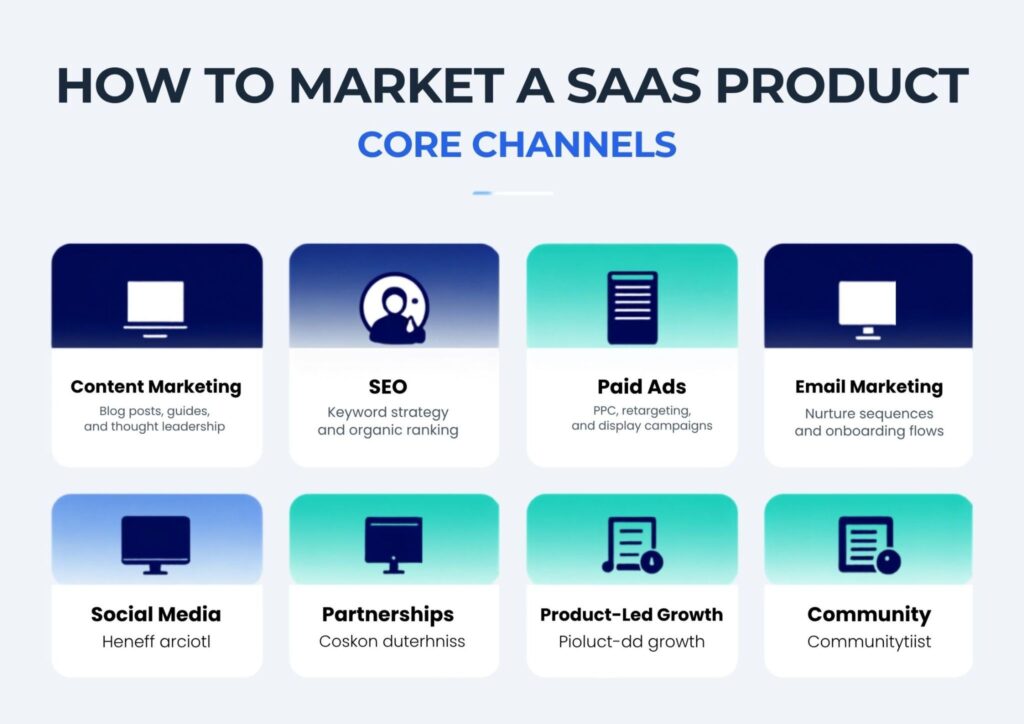
1. Content Marketing
Content marketing for SaaS means building a library of useful articles, guides, and resources that answer the questions your ideal customer is already asking. Not promotional stuff. Actually useful stuff.
HubSpot is the clearest example of this done right. Their blog pulls in millions of organic visitors every month and has driven more product sign-ups than any paid campaign they’ve ever run. They write about marketing, sales, and business problems. People who have those problems find the content. Some of them become customers.
The key is connecting your content to what your product actually solves. A blog post about “how to write cold emails” on a sales tool’s website is doing two jobs: pulling in the right reader and positioning the product as the answer.
2. SEO and AI (GEO) Optimisation
There are two layers to SaaS SEO strategy now, and you need both.
The first is traditional search optimisation. Good content, relevant keywords, clean site structure, and links pointing back to your pages. You know this part.
The second is newer. It’s called Generative Engine Optimisation (GEO), and it’s about getting your content cited by AI tools like ChatGPT, Perplexity, and Google’s AI Overviews. According to Similarweb’s 2024 Digital Report, over 65% of Google searches now end without a single click to any website because AI answers the question directly on the results page. Getting cited in those AI answers is sometimes worth more than ranking number one.
The way you get cited is by writing clearly structured content with direct definitions, named sources, and specific facts. AI tools pull clean, quotable content. Give them that.
3. Pay-Per-Click Ads
PPC works really well for SaaS, but only when the numbers make sense. If a customer pays you for two years and your lifetime value is $1,200, spending $150 to acquire them through Google Ads is a great deal. If you don’t know your numbers, PPC just burns money fast.
The mistake most SaaS teams make with PPC is going after their own brand keywords and broad category terms, then wondering why clicks are expensive and conversions are low. The real value is in bidding on competitor names, “alternatives to [tool]” searches, and specific problem-aware queries like “how to reduce customer churn.”
Those are the searches where the buyer is already thinking about spending money.
4. Social Ads and Retargeting
For SaaS, paid social works best when you’re staying visible to people who’ve already shown interest. Not trying to convert strangers.
Someone visited your pricing page and didn’t sign up? That’s your retargeting audience. Hit them with a customer testimonial, a case study ad, or a limited-time trial offer. They already know you exist. You just need to give them a reason to come back.
Meta Ads work well for consumer-adjacent SaaS, tools used by freelancers, creators, or small business owners. LinkedIn Ads work for B2B SaaS, where you need to target people by job title or company size. Don’t confuse the two.
5. Email Marketing
The SaaS companies that get the most out of email treat it like an extension of the product, not a newsletter blast.
Canva sends each user a weekly email showing their recent designs and suggesting features they haven’t tried yet. Grammarly sends weekly writing stats that make users feel good about their progress. Both emails feel personal because they’re based on what that specific user did in the app. That’s the difference between an email that gets opened and an email that gets ignored.
6. Founder-Led Marketing
This one is hard to copy, which is exactly why it works so well.
When the founder of a SaaS company builds an audience by sharing real, specific content about what they’re building and what they’re learning, it creates trust that no ad budget can replicate. People follow the person, and some of them become customers.
Gumroad’s Sahil Lavingia built a massive following by being transparent about building and growing a SaaS product. Closer to home, Zepto’s Aadit Palicha’s candid LinkedIn posts about scaling fast commerce in India drew genuine brand attention. Founder-led marketing also pulls in press and investors as a side effect. It’s one strategy with multiple returns.
7. Influencer Marketing and Affiliate Marketing
For SaaS, niche influencers beat big influencers every time.
A productivity YouTuber with 50,000 engaged subscribers who reviews your project management tool will convert far better than a general tech influencer with 2 million followers who covers everything. The smaller audience already cares about the exact problem your product solves.
Affiliate marketing is the more passive version of this. Tools like Notion, ClickUp, and Canva all have affiliate programmes where bloggers, educators, and content creators earn a commission for every user they refer. For SaaS with a broad audience, this can become a real acquisition channel with a very low cost per user.
8. SaaS Comparison Websites
These platforms get underestimated all the time. But SaaS comparison websites like G2, Capterra, and Trustpilot sit right at the bottom of the buyer’s journey.
Someone comparing “Asana vs Monday.com” on G2 is minutes away from making a decision. Having a strong, reviewed presence on these platforms is not optional if you’re selling to businesses. The strategy is simple: get genuine reviews from happy customers, respond to reviews (both good and bad), and make your product listing clear and detailed. Buyers on these sites are sceptical by default. Show them the evidence.
9. Account-Based Marketing (ABM)
Account-based marketing in SaaS means flipping the usual funnel.
Instead of broadcasting to everyone and hoping the right companies show up, you pick specific high-value target companies and build campaigns just for them. Personalised outreach. Custom case studies. LinkedIn Ads targeting specific job titles at specific companies.
ABM makes the most sense when your contracts are large enough to justify the effort. If you’re selling a Rs 40 lakh/year enterprise deal, a personalised campaign for one company is absolutely worth it. If you’re selling a Rs 499/month tool, it probably isn’t.
10. Partnerships and Integrations
Your users don’t just use your tool. They use five or ten tools every day. If your SaaS connects with those tools, you get distribution through their user bases, their app marketplaces, and their community recommendations.
Slack’s app directory has driven adoption for hundreds of SaaS products. HubSpot’s integrations marketplace has done the same at scale. For SaaS companies targeting Indian businesses, integrating with Razorpay, Zoho, or Shopify gives access to large existing communities of merchants and businesses.
And partnerships don’t have to be technical. Co-marketing campaigns, joint webinars, and cross-promotional newsletters with a complementary brand all of these work when you’re serving a similar audience without competing.
11. Event Marketing
Events build a kind of relationship that no digital channel can replicate.
A 45-minute webinar where someone walks through a real customer problem with actual data shows expertise in a way that a blog post simply can’t. People remember it. They share it. They come back.
For SaaS targeting Indian businesses, events like SaaStock India, Product Folks meetups, and IndiaSaaSBoost are worth attending and, if possible, speaking at. The audience is already pre-qualified. Everyone in the room is either building or buying.
Virtual events are easier to scale. A well-promoted product launch webinar or an industry roundtable can bring in hundreds of qualified leads for a fraction of what paid ads would cost for the same result.
12. Conversion Rate Optimisation (CRO)
SaaS conversion rate optimisation is about improving how many visitors actually do the thing you want them to do, whether that’s starting a free trial, booking a demo, or completing a key step in onboarding.
Most SaaS teams spend a lot on getting traffic and almost nothing on making that traffic convert. But small changes add up fast. Changing a CTA button from “Get Started” to “Start Your Free Trial” has moved conversion rates by 10 to 20% in multiple tests. Removing unnecessary form fields increases sign-ups. Adding a short product demo video above the fold on a pricing page often increases paid conversions noticeably.
And the compounding effect is real. A 10% improvement in trial sign-up rate combined with a 10% improvement in trial-to-paid conversion results in roughly a 21% increase in total paid users, without spending a single extra rupee on ads.
SaaS conversion rate optimisation targets the gaps between website traffic and user action. Even small improvements to CTA copy, onboarding flows, and pricing page design compound across the full funnel. Reducing friction at any single stage can significantly lower customer acquisition costs without increasing ad spend.
SaaS Product Marketing Examples
Mailchimp
Mailchimp is one of the most-studied growth stories in SaaS for good reason. For most of its early years, it grew almost entirely through word of mouth and content. No massive ad campaigns. No expensive sales team. Just a genuinely useful free plan and educational content that helped small businesses get started with email.
The free plan was the whole strategy. Small business owners built their email lists on Mailchimp, sent their first campaigns, saw results, and told other small business owners. Product-led growth at its clearest.
WeTransfer
WeTransfer figured out something clever early on. Every time someone sent a file, the person receiving it also experienced the product. And WeTransfer made that experience genuinely nice by putting full-screen art on the transfer page.
The product became a discovery platform for artists. Artists became brand fans. And those fans talked about it. That’s product marketing that lives inside the product itself, not outside it.
Userpilot
Userpilot is a smaller example, but a really instructive one.
It’s an onboarding tool for SaaS products, and it grew mostly through content. The team published deeply researched articles on every term in the product adoption space: user onboarding, feature activation, in-app messaging, churn reduction. Each article pulled in exactly the kind of reader who would need Userpilot, which is product managers and SaaS growth teams.
That’s SEO-led SaaS product marketing done well. The content wasn’t generic or surface-level. It was specific enough to be useful to the exact person who would consider buying.
4 SaaS Product Marketing Tips
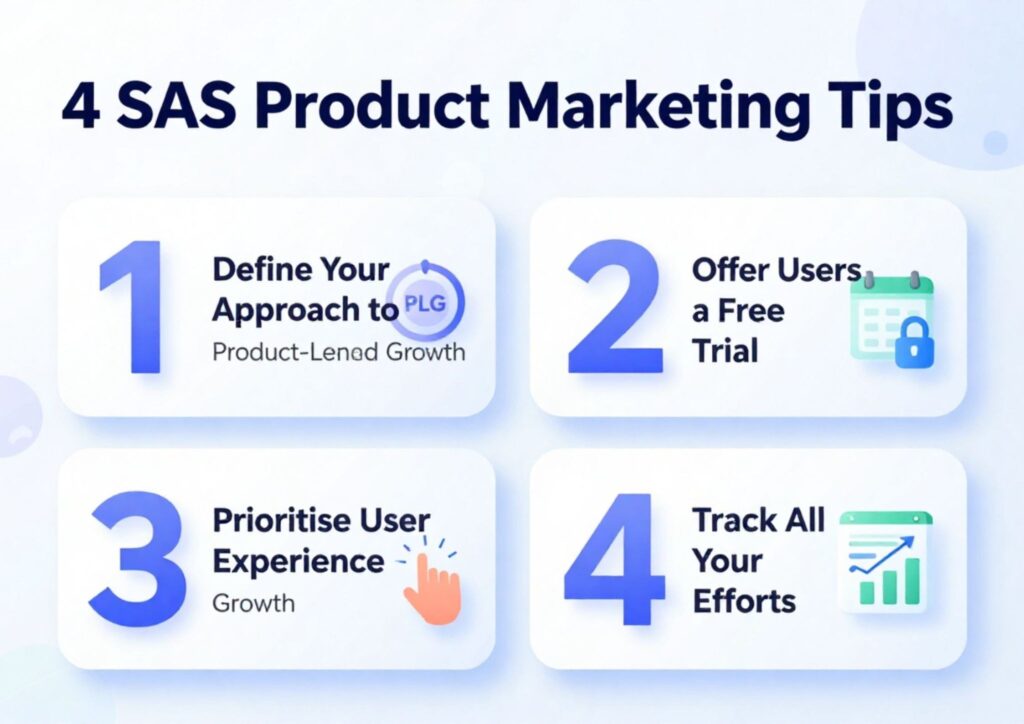
1. Define Your Approach to Product-Led Growth
Product-led growth (PLG) means the product is the main driver of getting new users, keeping them, and growing revenue. Users try it, get value, and either upgrade themselves or tell others without needing a salesperson in the middle.
Not every SaaS can go fully PLG. But every SaaS team should know where they sit on that spectrum and build their marketing motion to match. If your product is easy to set up and delivers quick value, lean into PLG. If it needs a long onboarding or technical setup, you’ll need a more sales-assisted approach even for trial users.
2. Offer Users a Free Trial
This sounds obvious. But the details matter more than most people realise.
A 14-day free trial with no credit card required converts significantly better than a shorter trial that asks for payment upfront. Calendly, Notion, and ClickUp all built large user bases on frictionless trial models. The fewer obstacles between a visitor and their first experience of value, the better.
The trial itself is also a marketing asset. If the product delivers value quickly and the onboarding is well-designed, the trial period does more convincing work than any ad campaign you could run.
3. Prioritise User Experience
Bad user experience kills SaaS growth quietly. A product that’s confusing to set up, hard to navigate, or slow to show value loses users before your marketing team even realises there’s a problem.
The most effective SaaS product marketers work closely with product and design teams, specifically on onboarding. They know that the most important moment in the entire funnel isn’t the trial sign-up. It isn’t even the first payment. It’s the moment a user thinks, “Okay, this actually works.” That’s activation. Everything else builds on it.
4. Track All Your Efforts
SaaS marketing without proper tracking is just expensive guessing. You need to know which channels bring in not just sign-ups, but paid users, retained customers, and expanded accounts.
A basic but effective setup for SaaS marketing analytics includes Google Analytics 4 for web traffic, Mixpanel or Amplitude for in-product behaviour tracking, and a CRM like HubSpot or Salesforce for pipeline visibility. Connecting these three gives you the ability to trace a customer from their very first visit all the way to renewal.
Without that visibility, you’ll keep spending on channels that look good in reports but aren’t actually growing revenue.
SaaS Product Marketing vs. Traditional Marketing
Traditional marketing is mostly about winning attention. You run an ad, people see it, some buy, and the job is done. The product doesn’t change based on how you market it. The customer relationship ends at purchase.
SaaS product marketing is a loop, not a funnel. The product keeps getting updated. The customer’s needs change over time. And the subscription model means you need to keep earning their trust every month.
How Is Product Marketing Different for SaaS Companies?
Here’s the real difference, broken down simply.
It’s a subscription, not a sale. A regular sale ends when the money changes hands. In SaaS, that’s just the beginning. Marketing has to support every renewal, not just the first conversion.
You can see how customers use the product. In SaaS, you have data on what users actually do. If 80% of users activate one feature and almost nobody touches another, that’s a signal for your messaging. Traditional product marketers rarely get feedback that directly.
Churn is a marketing problem, too. In traditional product marketing, once someone buys, they’re out of your funnel. In SaaS, every user who leaves is partly a marketing failure. If you attracted the wrong users with misleading promises, that shows up in churn.
You optimise for lifetime value, not just the first sale. A customer who pays Rs 3,000 a month for three years is worth over Rs 1 lakh. Spending Rs 10,000 to acquire them is a great deal. Thinking only about the first transaction gets the whole of economics wrong.
SaaS product marketing differs from traditional marketing because it must support the full customer lifecycle from trial to retention to expansion. Churn is partly a marketing failure. The most effective SaaS marketing teams treat lifetime value as their primary success metric, not conversion rate alone.
The Three Growth Layers Most SaaS Companies Miss
Customer Journey
Most SaaS companies map out their customer journey when they launch and never look at it again.
The problem is that the journey your users actually take is almost never the one you designed. Do the work to figure out the real path. Talk to users who cancelled and ask them what went wrong. Talk to your most active users and ask what made them stay. Talk to users who signed up but haven’t really used the product. The gaps in those conversations are your biggest growth opportunities.
Digital Experience
Your digital experience is everything a potential or existing customer touches when they interact with your brand. Your website, your onboarding flow, your emails, your in-app messages, your help docs. All of it together.
Most SaaS teams treat these as separate things owned by separate teams. But users experience them as one continuous interaction with your brand. A product that’s great but has confusing documentation loses users who would otherwise have stayed. A beautiful landing page that leads into a clunky sign-up flow wastes every rupee of acquisition spend that brought the user there.
Attribution
Attribution in SaaS is hard because buyers take long, winding paths. Someone might read your blog in January, see a retargeting ad in March, and sign up in May after a colleague mentioned you. Which channel gets the credit?
Honestly? All of them, in different amounts. Last-click attribution, which gives all the credit to the final touchpoint, systematically undervalues the content and brand work that built trust earlier. First-click attribution does the opposite.
The best SaaS teams use multi-touch attribution models. They’re imperfect, but they lead to much better decisions than optimising on flawed single-touch data. Tools like Rockerbox, Triple Whale, or HubSpot’s attribution features can help, depending on what your budget and stack look like.
Read More: marketing attribution models
Conclusion
SaaS product marketing isn’t just a department or a launch checklist. It’s everything that connects your product to the people it’s built for, and keeps them coming back.
The companies that get this right, Mailchimp, Notion, Canva, Razorpay, they’re not doing something mysterious. They know exactly who they’re building for. They’ve built their marketing into the product experience. And they care as much about what happens after someone signs up as they do about getting them to sign up in the first place.
Don’t try to run all 12 strategies at once. Pick two or three that match your stage, your budget, and your team. Do those well. Then build from there.
If you want to get serious about SaaS product marketing, from nailing your positioning to building a go-to-market strategy that actually sticks, YUP’s Product Marketing course is the most direct path. It’s built for practitioners who want to apply what they learn, not just read about it.
FAQs
What is SaaS product marketing?
SaaS product marketing is the work of connecting a software product to the right audience and keeping them engaged over time. It covers how you position and describe the product, how you launch it, how you compete, and how you keep customers from leaving. Unlike regular marketing, it spans the entire customer relationship from first sign-up to renewal.
How is SaaS marketing different from traditional product marketing?
Traditional product marketing focuses on winning the first sale. SaaS marketing has to support every stage of a subscription, including onboarding, retention, and expansion. Churn is partly a marketing problem in SaaS, not just a product or customer success problem. The goal is lifetime value, not just a one-time conversion.
What does product-led growth mean in SaaS?
Product-led growth (PLG) is when the product itself drives users to sign up, stay, and refer others, without needing a sales team in between. The product is designed to deliver value fast and naturally encourages sharing or upgrading. Notion, Slack, and Canva are well-known examples of PLG done well.
Is a free trial actually worth offering for SaaS products?
Yes, for most products. A free trial with no credit card required lowers the barrier to trying the product significantly. The key is making sure users get to a clear moment of value during the trial. A great free trial that’s well-designed converts better than any ad or landing page. A poorly designed one just delays churn.
Which SaaS marketing channel drives the best ROI?
It depends on your price point and how your product is sold. For low-cost, self-serve SaaS, content marketing and email tend to have the best long-term ROI. For enterprise SaaS with high contract values, ABM and events often justify their cost. Most successful SaaS companies use three or four channels together rather than betting everything on one.
What is account-based marketing in SaaS?
Account-based marketing (ABM) means targeting specific companies you want to win, rather than running broad campaigns to a general audience. You build personalised outreach, content, and ads specifically for those target accounts. It works best for B2B SaaS where the deal size is large enough to justify the extra effort involved.
How do you measure success in SaaS product marketing?
The main metrics to track are trial-to-paid conversion rate, monthly recurring revenue (MRR), net revenue retention (NRR), customer acquisition cost (CAC), and customer lifetime value (LTV). These five numbers together give you a complete picture of whether your marketing is actually growing the business sustainably.
What are SaaS comparison websites, and why do they matter?
SaaS comparison websites like G2, Capterra, and Trustpilot are platforms where buyers read reviews and compare tools before making a decision. People on these sites are at the bottom of the funnel and actively evaluating options. A strong, well-reviewed presence on these platforms can be a significant and relatively cheap source of high-intent leads for B2B SaaS.
How do you reduce churn with product marketing?
Reducing churn starts before someone even signs up. It means being honest in your marketing so you attract the right users, not just any users. It means designing an onboarding flow that gets people to value fast. It means sending emails based on actual product behaviour, not generic drip sequences. And it means reaching out proactively when accounts start going quiet. Churn is a product marketing problem just as much as it is a customer success problem.
Can small SaaS teams compete with bigger brands in marketing?
Yes, and often they can outperform bigger competitors in specific niches. Content-led SEO, founder-led marketing, and product-led growth all favour execution and authenticity over budget. A small team with a sharp, well-defined target audience and clear positioning will consistently beat a larger brand with vague messaging trying to appeal to everyone at once.