

Most positioning statements read the same because they were built the same way: fill in a template, swap in your product name, done. The result sounds professional and says almost nothing, because filling in blanks was never the actual work. The actual work is the thinking that should happen before you write a single sentence, and skipping straight to the template is exactly why so much SaaS positioning is interchangeable.
Positioning strategist April Dunford, whose five-component framework has become the industry standard, makes this point bluntly on her own site: a positioning statement is “a way to write down positioning,” not a substitute for doing it. If nobody’s done the actual analysis, the template just gives you a confident-sounding sentence with nothing real behind it.
Here’s how to do the real work first, using Dunford’s framework, and then translate it into a statement that actually holds up.
Table of Contents
Positioning Is the Foundation, Not the Sentence
Before the framework, one distinction matters more than anything else in this article: positioning and a positioning statement are not the same thing.
Positioning is the strategic decision about what market you’re competing in, who you’re for, and why you deserve to win against the alternative your buyer would otherwise choose. According to Dunford’s own writing on the topic, everything that comes after this, storytelling, messaging, taglines, brand voice, requires positioning as an input. Skip the positioning work and every downstream message is being built on guesswork, no matter how polished it sounds.
A B2B content marketing analysis from Digital Applied puts this well: when teams skip the foundation and jump straight to clever copy, the symptoms show up predictably, a homepage that lists features without a clear frame, sales reps who each describe the product differently, ad campaigns that win clicks but not consideration. The fix in all three cases isn’t better copywriting. It’s going back and doing the positioning work the copy was supposed to sit on top of.
The Five Components of Dunford’s Framework
Dunford’s framework, first published in her book Obviously Awesome, breaks positioning into five components, and the order matters more than most people realize.
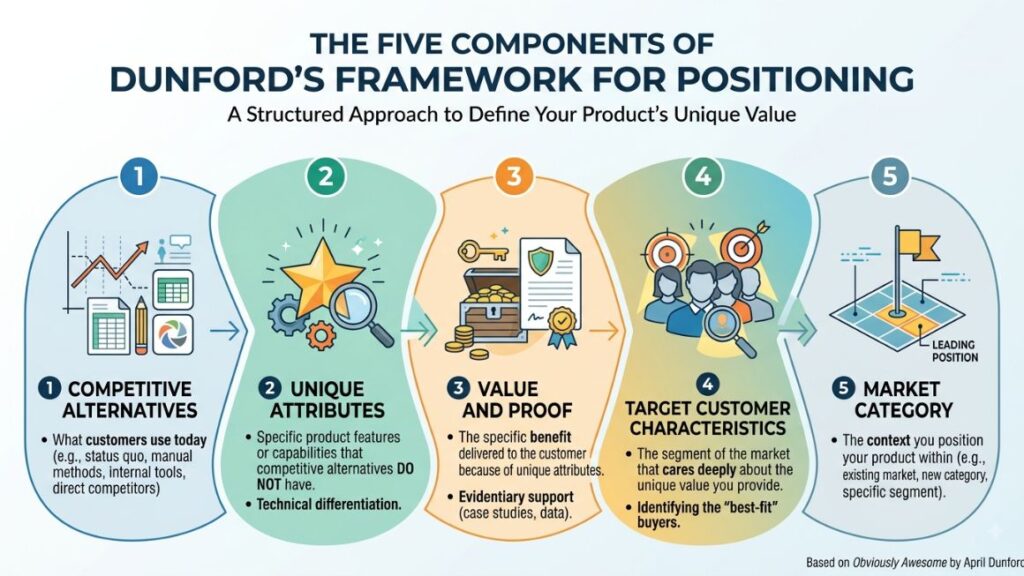
1. Competitive alternatives. What would your customer actually do if your product didn’t exist? This is rarely “the other vendors in our category.” According to positioning research from consultancy Swap Biswas, the real comparison set is most often a spreadsheet, a manual process, an internal tool, or simply doing nothing at all. Getting this wrong at the start throws off every component that follows, because you end up differentiating against the wrong competitor entirely.
2. Unique attributes. What does your product actually have that those specific alternatives don’t? Not a features list. The handful of capabilities that genuinely don’t exist in the buyer’s current alternative. List three to five, and be ruthless about cutting anything that’s just parity with what’s already out there.
3. Value and proof. For every unique attribute, ask “so what?” A unique attribute that doesn’t produce a meaningful customer outcome is feature trivia, not differentiation. This step is where a lot of positioning work quietly falls apart, teams list a real technical differentiator and never translate it into a value the customer actually cares about.
4. Target customer characteristics. Which customers care the most about the value you just identified? Not a broad demographic description, the specific segment for whom this value is urgent and obvious, not merely nice to have.
5. Market category. What market frame helps your target customer understand your value fastest? This is a strategic choice, not just a label, entering an existing, well-understood category borrows instant context but inherits its baggage, while creating a new category gives you more control over the narrative but requires far more work to educate the market on why it should exist at all.
April Dunford’s positioning framework, first published in her book Obviously Awesome, breaks positioning into five sequential components: competitive alternatives, unique attributes, value and proof, target customer characteristics, and market category. The order matters because each component builds on the one before it, starting with competitive alternatives ensures you’re differentiating against what a customer would realistically choose instead, not against the wrong comparison entirely.
Read More: How to Create a GTM Strategy for SaaS Products: A Practical Guide
A Worked Example
Abstract frameworks are easier to apply with a concrete run-through. Take a hypothetical project management tool built specifically for creative agencies managing client approvals.
Competitive alternatives: Most creative agencies aren’t choosing between project management tools. They’re using a mix of email threads, shared Google Drive folders, and Slack messages to chase client approvals, an unstructured, manual process, not a competing piece of software.
Unique attributes: The product has a client-facing approval interface requiring no login, version-stamped feedback tied directly to specific design files, and a built-in approval audit trail.
Value and proof: No-login client approval means faster turnaround because clients aren’t blocked by account creation friction. Version-stamped feedback eliminates the “which version is this comment about” confusion that eats real time on every project. The audit trail protects agencies from scope disputes by showing exactly what was approved and when.
Target customer characteristics: Small to mid-size creative agencies running high client-approval volume, where a single delayed sign-off can stall an entire production timeline, not enterprise in-house design teams with a single internal stakeholder chain.
Market category: Rather than entering the broad, crowded “project management software” category, this product positions itself in a narrower, more specific frame: “client approval workflow for creative agencies,” a smaller category, but one where the value proposition is instantly obvious to the exact buyer who needs it.
Notice what happened here. None of this reads like a template. It reads like a specific, defensible argument for why this exact product wins for this exact customer against this exact alternative.
Read More: Is Product Marketing Manager a Good Career in 2026? Honest Take
Turning the Work Into a Statement
Once the five components are genuinely worked out, writing the statement itself becomes almost mechanical. The classic format, popularized by Geoffrey Moore and still widely used, reads: “For [target customer] who [statement of need],

Applied to the example above: “For creative agencies juggling constant client approval cycles, [Product] is a client approval workflow tool that eliminates delays from version confusion and login friction. Unlike managing approvals through email and shared drives, [Product] gives every stakeholder a single, no-login approval interface with a built-in audit trail.”
Worth being direct about this: Dunford herself is openly critical of leading with the template. Her argument is that if you jump straight to filling in these blanks without doing the five-component analysis first, you’re just making up confident-sounding answers with no real strategic backing underneath them. The template is a legitimate way to write down positioning once the real thinking is done. It’s a poor substitute for the thinking itself.
Read More: Product Marketing KPIs: 14 Essential KPIs Every Product Marketer Must Track
Common Mistakes That Undermine a Positioning Statement
A handful of mistakes show up constantly in positioning work, and they’re worth naming directly.
Confusing positioning with messaging is the most common one. A tagline, a homepage headline, or a sales pitch are all downstream expressions of positioning, not positioning itself. Writing clever copy before the underlying positioning is settled means every one of those expressions is standing on nothing.
Naming the wrong competitive alternative is the second, and it quietly derails everything else. If a B2B SaaS product’s real competition is a spreadsheet and manual process, but the positioning work assumes the competition is another SaaS tool, the entire unique-attributes analysis ends up solving the wrong comparison.
Listing features instead of translating them into value is a close third. A capability that doesn’t pass the “so what?” test isn’t differentiation, no matter how technically impressive it is. According to the digital marketing playbook from Digital Applied, positioning drift, where a homepage line contradicts what’s in the sales deck, or two reps describe the product differently, traces directly back to skipping this translation step.
And treating positioning as a one-time exercise rather than something to revisit is a mistake that compounds silently over time. As a product evolves, competitors shift, or a company enters a new market segment, the original positioning can quietly stop matching reality, and nobody notices until messaging across different teams starts visibly contradicting itself.
Read More: Product Marketing Campaigns: How to Plan, Launch & Measure Success in 2026
Why This Matters More Than It Sounds Like It Should
Positioning isn’t a nice-to-have exercise that happens after the “real” marketing work starts. According to 6sense’s 2025 B2B Buyer Experience Report, the winning vendor is already on the buyer’s shortlist 95% of the time before any direct contact happens, and four out of five deals are won by whichever vendor was the buyer’s pre-contact favorite. That statistic makes the stakes plain: positioning largely decides the outcome of a deal before a sales conversation even begins, which is exactly why getting it right matters more than any single piece of copy that comes after it.
The Bottom Line
A strong positioning statement isn’t a clever sentence, it’s the visible output of real strategic work: naming the actual alternative a customer would choose instead, identifying what your product genuinely has that alternative doesn’t, translating that into value the customer cares about, and choosing a market category that makes the whole argument land instantly. Do that work first, and the statement almost writes itself. Skip it, and no amount of polished copywriting will make the positioning actually differentiate anything.
If you want to practice this framework on a real product with guided feedback, our Product Marketing Manager Course walks through positioning, from competitive alternative analysis through to a finished statement, with real worked examples.
FAQ
What is a product positioning statement?
A product positioning statement is a written summary of a product’s strategic position relative to what customers would use instead, its target customer, and its core differentiated value. It’s the output of the positioning work, not a substitute for doing that work first.
What is April Dunford’s positioning framework?
April Dunford’s framework breaks positioning into five sequential components: competitive alternatives, unique attributes, value and proof, target customer characteristics, and market category. It was developed specifically because generic fill-in-the-blank templates produce confident-sounding statements without real strategic reasoning behind them.
What’s the difference between positioning and messaging?
Positioning is the strategic decision about what market you compete in and why you win against the real alternative a customer would choose. Messaging, taglines, and marketing copy are all downstream expressions of that positioning, they require it as an input and fall apart if the underlying positioning was never properly worked out.
How do I identify my product’s real competitive alternative?
Ask what your customer would actually do if your product didn’t exist, not which other named competitors exist in your category. Often the real alternative is a manual process, a spreadsheet, or simply doing nothing, not a rival piece of software.
Should I use the Geoffrey Moore positioning statement template?
It’s a reasonable way to write down positioning once you’ve done the underlying analysis, competitive alternatives, unique attributes, value, target customer, and market category. Using the template as a shortcut without doing that work first tends to produce a professional-sounding sentence with little real strategic backing.
How often should positioning be revisited?
Positioning should be revisited whenever the product, competitive landscape, or target market shifts meaningfully, not treated as a one-time exercise. Skipping this leads to positioning drift, where different teams start describing the product inconsistently without anyone noticing until it shows up as visible contradictions across sales and marketing materials.
Should I create a new market category or compete in an existing one?
Entering an existing, well-understood category gives your positioning instant context but inherits whatever assumptions and baggage already exist there. Creating a new category offers more control over the narrative and can make a differentiated product’s value obvious faster, but requires significantly more work educating the market on why the category should exist at all.
Why does positioning matter for sales, not just marketing?
Positioning largely determines the outcome of a deal before a sales conversation even starts. According to 6sense’s 2025 B2B Buyer Experience Report, the eventual winning vendor is already the buyer’s favorite 95% of the time before direct contact happens, which makes positioning a pre-sales strategic function, not simply a marketing deliverable.
What’s the most common mistake in writing a positioning statement?
Confusing positioning with messaging, jumping straight to writing clever copy or a tagline before doing the underlying strategic analysis, is the most common mistake. It produces polished-sounding statements that have no real differentiation behind them once a customer starts asking harder questions.