

That’s the problem a competitive positioning strategy solves. It’s a deliberate choice about where your business stands in a customer’s mind compared with every other option they’re weighing, including doing nothing at all. Get it right and buyers understand you in seconds. Get it wrong and you end up discounting your way through every sales call.
This guide gives you a practical framework for building a competitive positioning strategy you can start using this month. You’ll see how customers compare businesses, which approaches are open to you, a seven-step process with a worked example, the frameworks worth using, lessons from Apple and IKEA, the mistakes that drain budgets, how to measure results, and a 30-day plan.
The goal is simple. Find a position customers understand, value, and have a reason to trust.
Table of Contents
What Is Positioning in a Competitive Market, and How Do Customers Judge It?
Competitive positioning is the place your business holds in a customer’s mind relative to the alternatives they could choose instead. It comes from who you serve, what you offer, and why that offer suits those people better than the next option on the list.
Understanding how customers compare competing businesses
Nobody compares you to your mission statement. They compare you to the three other tabs open on their phone. Price, reviews, speed, how confident they feel about the result: customers weigh a handful of things, fast, without noticing they’re doing it.
Reviews carry plenty of that weight. BrightLocal’s 2026 Local Consumer Review Survey of 1,002 US consumers found that 97% read online reviews, and the average person checks six review sites before choosing a business. So your position is shaped by what you say and by what everyone else says about you.
Why positioning involves more than a slogan or advertising message
A tagline is one sentence. Positioning is a decision, and it shows up in what you build, how you price, who you hire, and which customers you politely turn away. The market positioning strategy behind a brand is the plan. The slogan is just one way of announcing it.
Plenty of businesses write “quality service at affordable prices” on their homepage. So do their competitors. No customer could disagree with that line, which is exactly why it positions nobody.
How a strong position connects customer needs with a company’s strengths
Take a local digital marketing agency (an illustrative example, not a real business). It could sell SEO, social media, web design and video to anyone who walks in. Or it could choose one job: bringing in enquiries for small businesses such as clinics and coaching centres. That second agency is easier to explain, refer and trust, because what it does well lines up with something a specific group urgently needs. A competitive positioning strategy starts at exactly that overlap.
Positioning is the place a business holds in a customer’s mind relative to its alternatives. A strong position links a specific customer need to something the business can credibly deliver, and it shows up in pricing, product and messaging, not just in a slogan.
Why Does Positioning Matter When Customers Have So Many Choices?
Positioning matters because it gives customers a clear reason to choose you and keeps your pricing, messaging and growth decisions pointing the same way. Without a competitive positioning strategy, businesses drift toward price cuts, scattered messaging and customers who were never a good fit.
Helping customers understand why they should choose you
People pick the option they can explain to a colleague in one sentence. If a buyer can’t tell why you’re different, they fall back on the cheapest or the most familiar name. Clarity is the least expensive competitive advantage you’ll ever build.
Supporting pricing decisions and customer retention
A clear position gives you a reason to charge what you charge, and customers who chose you for a specific reason tend to stay for it.
Making marketing messages more consistent
Once the position is settled, the website, the sales deck, the Instagram captions and the cold emails start saying the same thing. Without it, every channel invents its own pitch.
Giving the business a clearer direction for growth
It also tells you what to turn down. The side service nobody asked for. The client who wants everything for less.
Unclear positioning has a predictable bill. You compete on price because nothing else separates you from the next quote. Your messaging shifts with whoever wrote the last campaign. And you attract customers who expect something you never meant to offer, then lose them. Sound familiar?
Also Read: Brand Management Strategy: The Discipline Behind Enduring Brands
Which Positioning Approach Fits Your Business?
Every competitive positioning strategy ends up leaning on one of four approaches: affordability and value, quality and innovation, serving a specific customer group, or convenience and service. Pick the one your resources can actually back up, because customers notice fast when a promise isn’t kept.
Competing through affordability and value
This works when buyers are price-sensitive and you can genuinely run leaner than rivals, through volume, tight operations or low overheads. It needs strict cost discipline. What goes wrong is a price war with a bigger player, or “cheap” becoming the only thing anyone remembers about you.
Competing through quality and innovation
Buyers who’ll pay more for better results or something new are your audience here. You’ll need real investment in product, talent and proof, like case studies or certifications. The risk? Rivals copy your innovation faster than you recover its cost, or you charge a premium for quality customers can’t see.
Serving a specific customer group exceptionally well
Works when a segment has needs that generalists treat as an afterthought. You need deep knowledge of that group’s language, problems and buying process, and that’s where brand differentiation actually gets built, not in the logo. The downside is a smaller market, and if the niche shrinks, so do you.
Winning through convenience, service, or customer experience
When products look alike across a category, the hassle is the real pain: delivery, onboarding, support, returns. Removing it takes people, process and often technology. It goes wrong the first time a promised “fast response” takes three days.
One rule applies to all four. Don’t promise premium service, the lowest prices and industry-leading innovation in the same breath unless you can credibly deliver all three. Almost nobody can. Whichever approach you choose, your competitive positioning strategy only holds if the business delivers on it every single time.
Also Read: Brand Differentiation Strategy Framework for Modern Businesses
How to Build a Competitive Positioning Strategy, Step by Step?
A competitive positioning strategy comes together in seven steps: choose your customers, list their real alternatives, compare competitor offerings, find a gap you can fill, pick one main difference, write it down clearly, and test it with real customers.
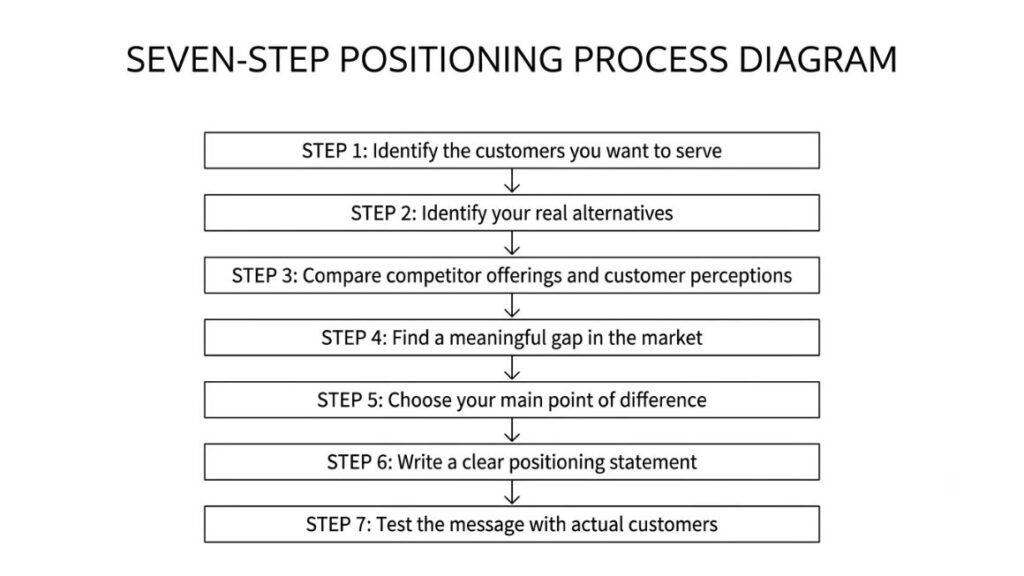
Step 1: Identify the customers you want to serve
Study their needs, buying habits, and frustrations
Start with people who already buy from you. Ask what they used before, what nearly stopped them from buying, and what they’d miss if you vanished tomorrow. Read your own reviews and support emails for patterns. This is target audience segmentation in practice: grouping customers by shared needs and behaviour, not just age or job title.
Separate high-value customer groups from poor-fit audiences
Look at who stays, who pays on time, who refers friends, and who sends constant complaints or discount requests. The best-fit group is rarely the biggest one.
Step 2: Identify your real alternatives
Include direct rivals, indirect alternatives, and doing nothing
Your competition isn’t only the agency down the road. It’s the freelancer on a marketplace, the in-house intern, the spreadsheet, and the decision to wait another year. April Dunford, author of Obviously Awesome, argues that the real alternative is often something that doesn’t look like a competitor at all, such as doing nothing, and that getting this wrong throws off everything built on top of it.
Step 3: Compare competitor offerings and customer perceptions
Review pricing, service, messaging, product quality, and reviews
Build a simple grid of five or six rivals and score what each one actually offers. This competitive analysis doesn’t need special software to start. A shared spreadsheet, their pricing pages and an afternoon with their reviews will tell you more than most paid reports.
Verify public claims instead of assuming they reflect reality
A rival’s website promises 24/7 support. Their one-star reviews say otherwise. Place a test order, call as a mystery customer, or ask people who switched. Treat every claim as a guess until you’ve checked it.
Step 4: Find a meaningful gap in the market
Look for needs that matter but are not being served well
Where do customers complain across every competitor, not just one? A frustration that repeats across the whole category is usually your gap.
Check whether your business can deliver on the opportunity
A gap only helps if you can fill it profitably, again and again. Be honest about capacity, skills and cost before you announce anything.
Step 5: Choose your main point of difference
Pick one. Your competitive positioning strategy needs a single difference that matters to your chosen customers, that rivals don’t credibly claim, and that you can prove. Two is hard to remember. Five is a brochure. A blunt test helps: would a customer pick you for this, and could a rival say the same thing tomorrow?
Step 6: Write a clear positioning statement
Put the decision into a sentence your whole team can repeat. A simple template: For [target customer] who [need or frustration], [business] is the [category] that [main difference], unlike [real alternative], because [proof]. Fill every blank with something specific, since “businesses” is not a target customer.
This positioning statement isn’t your homepage headline. It’s an internal anchor. The customer-facing version is your value proposition, the specific outcome you promise in return for someone’s money.
Step 7: Test the message with actual customers
Show the statement to ten customers and five people who didn’t buy. Ask them to say it back in their own words. If they can’t, or they describe something else entirely, the message needs work. Then run it as one landing page or ad variant and watch the quality of enquiries, not only the volume.
Illustrative example, not a real case study. A ten-person digital agency in Pune offers everything to everyone and keeps losing pitches on price. The owner interviews twelve past clients and lost prospects, mostly dental and physiotherapy clinics. One frustration keeps coming up: earlier agencies sent traffic reports, not booked appointments. Next, the owner lists what clinics really use instead: a relative who handles Instagram, a freelancer, a large agency with a minimum retainer, or nothing. A check of rival sites and reviews shows nobody promises appointments as the outcome.
The agency can deliver that, since it already runs call tracking for two clinics. So the agency’s competitive positioning strategy becomes patient enquiry generation for local clinics. The new message goes on one landing page, and the owner asks five prospects to describe the agency before and after reading it. No results are claimed here. This is a method, not a story.
A competitive positioning strategy works backwards from customers. Start with who you serve and what they’d do without you, check what rivals really deliver, then choose one difference you can prove and test it before rolling it out.

Which Frameworks Help You Test and Sharpen Your Position?
Frameworks don’t make the decision for you. They stop you skipping the awkward questions. Used together as a competitor analysis framework, these four cover most of what a small team needs when shaping a competitive positioning strategy.
SWOT analysis for evaluating internal strengths and market risks
SWOT lists strengths, weaknesses, opportunities and threats. It’s quick, and it gets a team talking. But it produces long lists with no priorities, and people tend to rate their own strengths generously, so check each “strength” against what customers say.
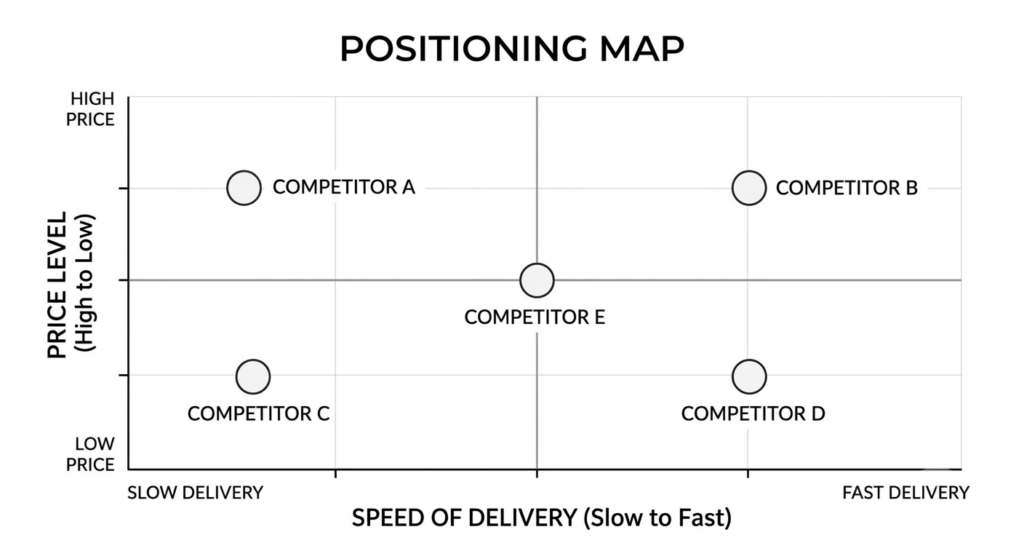
A positioning map for visualizing competing offers
A positioning map plots competitors on two axes. The trick is choosing axes that reflect two decisions customers really make, such as price level against speed of delivery, rather than features your company happens to be good at. A map built to flatter you will always show an empty corner, and nobody may want to be there.
Porter’s generic strategies for choosing how to compete
Harvard Business School professor Michael Porter described three generic strategies in his 1980 book Competitive Strategy: cost leadership, differentiation, and focus on a narrow segment. He warned that firms trying to do several at once risk getting stuck in the middle. Critics point out that customers often want some mix of price, quality and convenience, so treat it as a lens, not a law.
Customer feedback and win-loss interviews for validating assumptions
A win-loss interview is a short conversation with a customer you won or a prospect you lost, asking why they decided as they did. Lost deals are usually the more honest ones. The limits: small samples, and people are polite. Ask what they compared you with, not whether they liked you.
What Can Apple and IKEA Teach You About Positioning?
Neither company is a template to copy. Each runs a competitive positioning strategy built on one clear choice, repeated for years, and that beats a vague promise to please everyone. No single factor explains either success.
Apple and the role of design, ecosystem, and premium experience
Apple said in January 2026 that its installed base had passed 2.5 billion active devices, up from 2.35 billion a year earlier. Counterpoint Research’s first-half 2026 data, as reported by Thairath Online, puts Apple at 65% of global premium smartphone sales (phones priced at $600 or more), up from 63% a year earlier but below the 74% it held in 2022. Samsung sits at 19%.
Counterpoint analysts link Apple’s huge installed base to user loyalty, a deep iOS experience and tightly connected services, not hardware alone. The position isn’t really “good phones.” It’s a premium, connected experience that gets harder to leave with every device you add.
The catch for smaller businesses: that takes a premium price, deep pockets and constant upkeep. Even Apple’s premium share has slipped since 2022.
IKEA and accessible design with a self-service model
IKEA’s own website says its Democratic Design approach balances five things: form, function, quality, sustainability and low price. Products start from the price tag, and the company says it makes thousands of home visits every year to learn how people live. Customers also do part of the work by assembling flat-packed furniture themselves, which IKEA presents as part of how prices stay low.
The lesson is that a low price is credible when the whole operation is built around it, and customers accept the trade (assembly) knowingly. Copying IKEA’s prices without IKEA’s scale is a trap, though.
A hypothetical small business finding an underserved niche
Illustrative example. A two-person bookkeeping practice in Bengaluru can’t out-market the big accounting firms, which mostly chase companies. It notices that freelance designers and developers keep asking the same tax and GST questions, and nobody answers them in plain language. So the practice serves only freelancers, with a flat monthly fee and a short monthly call. Same method as the steps above: a specific customer, a real alternative (doing it themselves), a gap, one difference.
Also Read: 15 Brand Management Case Studies: Real-World Examples & Strategic Lessons
Which Positioning Mistakes Cost Businesses the Most?
Five mistakes quietly wreck a competitive positioning strategy, and they show up again and again. Each has a fix that takes a week or less.
Trying to appeal to every customer
Broad targeting feels safe and quietly makes you forgettable.
Corrective action: pick one best-fit customer group and write it into every ad, page and pitch for the next quarter.
Copying competitors instead of finding a meaningful difference
If your site could swap logos with a rival’s and nobody would notice, there’s the problem.
Corrective action: list the three claims your top competitors all make, then drop or reframe at least one.
Making claims without evidence
A 2005 Bain & Company survey of 362 firms found that 80% believed they delivered a superior customer experience, while only 8% of customers agreed. It’s an old study, but the gap shows up in plenty of sales calls today.
Corrective action: attach proof to every claim, whether that’s a number, a case, a guarantee or a review.
Competing on price without understanding margins
Discounting feels like action.
Corrective action: calculate your break-even discount before any promotion, and set a floor price below which you walk away.
Failing to adapt when customer expectations change
A position that worked three years ago can go stale quietly.
Corrective action: read recent reviews and lost-deal notes every quarter, and write down any new phrases customers use.
How Do You Measure Whether Your Positioning Is Working?
Measure your competitive positioning strategy by comparing a few customer and revenue indicators against a baseline you recorded before the change. One number proves little, so track perception, lead quality, cost and win rate together.
Brand awareness and customer perception
Track branded search, direct visits, and how customers describe you in surveys and sales calls. Are they using your words, or someone else’s?
Conversion rates and qualified leads
Watch the share of enquiries that fit your ideal customer. Fewer leads can be a good sign if the right ones are converting.
Customer acquisition cost and retention
Customer acquisition cost (CAC) is total sales and marketing spend divided by the new customers won. Retention shows whether the promise holds after the purchase.
Win rates, pricing power, and customer feedback
Win rate, the average discount you give, and the themes in your reviews all show whether customers see the difference. Competitor benchmarking helps here: compare your numbers and review scores against the same three rivals each quarter, using the same method every time.
| KPI | What it tells you | Where to find it |
| Branded search and direct traffic | Whether more people know you by name | Google Search Console, analytics |
| Qualified lead rate | Whether you attract the right customers | CRM, enquiry forms |
| Customer acquisition cost | What winning a customer costs | Finance sheet, ad platforms |
| Retention or repeat rate | Whether the promise holds up | CRM, billing data |
| Win rate and average discount | Whether buyers see the difference | Sales notes, quotes |
| Review themes | How customers describe you | Google, review sites, surveys |
Record the baseline first, tie each metric to a business goal such as more profitable clients, and give changes at least one full sales cycle before judging them.
Also Read: Strategic Brand Management: Guide to Building, Measuring & Growing Brand Equity
How Should You Keep Your Position Current as Search and AI Change?
A competitive positioning strategy is something you maintain, not something you finish. Use AI to speed up research, check what it produces yourself, and keep your message the same everywhere customers find you.
Use AI tools to speed up research, not replace judgment
AI can summarise competitor pages, group reviews into themes and draft interview questions in minutes. It can also invent features and agree with whatever you ask it to confirm, so check every claim against the original source. Mind privacy too: India’s DPDP Rules, notified in November 2025, phase in most obligations by May 2027, so keep customer names, phone numbers and call recordings out of public AI tools unless you have consent and a clear policy.
Monitor customer feedback and competitor changes
Set alerts for rival pricing pages, watch new reviews, and keep sales-call notes. Search habits are shifting too. Pew Research Center’s March 2025 study of 900 US adults found people clicked a regular result link in 8% of visits when Google showed an AI summary, against 15% when it didn’t. BrightLocal’s 2026 survey also ranks AI tools like ChatGPT third among the sources people use for local business recommendations.
Keep messaging consistent across search, social media, and sales
Same claim, same proof, same words. If your Google Business Profile, LinkedIn page and sales deck describe three different businesses, people and AI tools alike will struggle to place you.
Revisit assumptions when the market changes
Dunford has said positioning isn’t a set-and-forget job, because everything that affects it keeps moving. Put a quarterly review in the calendar.
Also Read: Positioning vs Messaging: Key Differences Explained
A 30-Day Plan to Put Your Positioning to Work
Week 1: Research customers and alternatives
Interview five to ten customers, list the real alternatives, and pull rival pricing, messaging and reviews into one sheet.
Week 2: Evaluate gaps and choose a position
Mark the repeated frustrations, check your capacity, pick one main difference, and write your statement.
Week 3: Test messaging and update marketing assets
Test the statement with customers, then update your homepage, profile pages, sales deck and email signature.
Week 4: Measure early results and refine the plan
Compare against your baseline. Keep what’s working. Fix what isn’t.
Use this checklist as you go:
- Best-fit customer group named in one sentence
- Top three real alternatives listed, including doing nothing
- Five rivals checked against their public claims
- One main difference chosen, with proof
- Statement read aloud to five customers
- Homepage, profiles and sales deck updated
- Baseline numbers recorded
- Next review date set
Conclusion
An effective competitive positioning strategy rests on three things: what your customers actually need, a difference you can credibly prove, and delivery that stays consistent long after the campaign ends. Miss one and the whole thing wobbles.
Start small. Interview five customers this week and write down what they’d do if you didn’t exist.
If you want more practical marketing breakdowns like this one, YUP’s Crystal Clear Newsletter is a good place to keep learning.
Frequently Asked Questions About Positioning
What is the difference between positioning and differentiation?
Differentiation is what makes you different. Positioning is how you choose, communicate and own that difference in a specific customer’s mind, relative to their alternatives. A difference customers don’t care about, or never hear about, won’t help your position.
How do small businesses find a position in a crowded market?
Narrow the focus. A small business can build a competitive positioning strategy by picking one customer group, finding the frustration rivals keep ignoring, and building the offer around it. Small businesses usually win by serving a niche better than generalists do, not by outspending them.
How often should a company review its positioning?
At least once a year, and again after big changes such as a new competitor, a price shift or a product launch. A quarterly check of your KPIs and customer feedback is a good habit.
Can a company change its position without changing its product?
Yes. Changing the target customer, the comparison set or the message can change how the same product is understood. The product still has to deliver on the new promise, though.
How can a business measure positioning success?
Compare a baseline with later results: qualified lead rate, win rate, average discount, acquisition cost, retention, and how customers describe you in their own words.
Can AI tools help with positioning research?
Yes, for summarising reviews, grouping feedback and drafting questions. But people should verify every claim, and personal customer data shouldn’t go into public tools without consent and a clear policy.