

Sign-ups look great on a dashboard. Then you open the usage data and find that half of those users logged in once, clicked around for four minutes, and never came back. Sound familiar?
That gap is where most growth plans quietly fall apart. Acquisition gets people through the door. It doesn’t make them stay, and it certainly doesn’t make them renew. Product adoption strategies fill the gap, because they focus on the stretch between “I signed up” and “I can’t work without this.”
This guide covers how product adoption works, 12 practical product adoption strategies, the metrics that show whether they’re working, three real examples and a 30-day plan. It’s written for marketers, product people and founders who would rather fix the experience than buy more traffic. Some of it is SaaS-specific. Most of it travels well to apps and subscriptions too.
Table of Contents
What Is Product Adoption and Why Does It Matter?
Product adoption is the process by which a user moves from trying a product to relying on it as part of a regular routine. Trying is easy. Getting consistent value is the hard part, and it’s where retention, satisfaction and expansion revenue come from. That’s why product adoption strategies belong in the growth plan, not the support backlog.
Picture a project management tool. A team signs up, adds three tasks and forgets about it. That’s a trial. Another team runs its weekly planning inside the tool. That’s adoption. Same product, completely different business. The second team renews, invites colleagues and maybe upgrades. The first becomes a line in your churn report.
Adoption feeds user retention directly, which is why it sits underneath growth, not beside it. The terms around it get muddled constantly, so here’s the cleanest split.
Product adoption vs. activation vs. retention
| Term | What it means | Example metric |
| Activation | The user reaches their first meaningful value | % of new users who finish a first project |
| Engagement | How actively users interact over a period | Weekly active users, sessions per week |
| Adoption | The user builds the product into a regular workflow | % of users using core features every week |
| Retention | Users keep coming back over time | 30-day cohort retention |
Who needs a product adoption strategy?
Anyone selling something people have to learn to use. SaaS product adoption is the obvious case, because a team that never builds the habit cancels at renewal. Mobile apps live or die on day-7 and day-30 returns. Subscription businesses carry the same risk as SaaS. Enterprise software adds a twist: the person who signs the contract often isn’t the person who has to use it, so weak adoption can sit hidden for months until the renewal call gets awkward.
Product adoption is the point where a user stops trying a product and starts relying on it in a regular workflow. It differs from activation, which is the first moment of value, and from retention, which measures whether users keep returning. Strong adoption is what turns sign-ups into renewals and expansion revenue.
Understanding the Product Adoption Journey
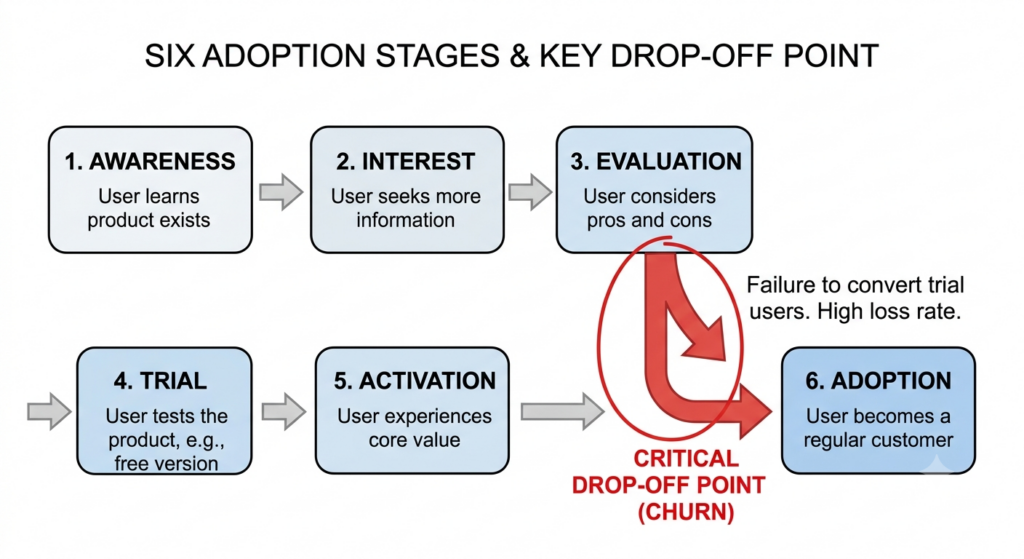
Users move through six stages before a product sticks: awareness, interest, evaluation, trial, activation and adoption. The product adoption process isn’t a straight line, though, and the stages often overlap or loop back. Treat the six stages as a useful framework, not a law of nature. The exact path depends on your product and the people using it. Good product adoption strategies start by asking which stage your users stall at.
The six stages of adoption
- Awareness: the user discovers the product.
- Interest: they explore its potential benefits.
- Evaluation: they weigh whether it fits their needs.
- Trial: they try it on a real task.
- Activation: they experience meaningful first value.
- Adoption: they build it into a regular workflow.
Where users typically get stuck
Most users don’t leave in a dramatic moment. They drift. The usual culprits are confusing onboarding, too many steps before any payoff, features they never discover, and no clear reason to come back tomorrow. Trust matters too. If support feels hard to reach, people assume the product will be hard to rely on.
12 Product Adoption Strategies to Turn Users into Regular Customers
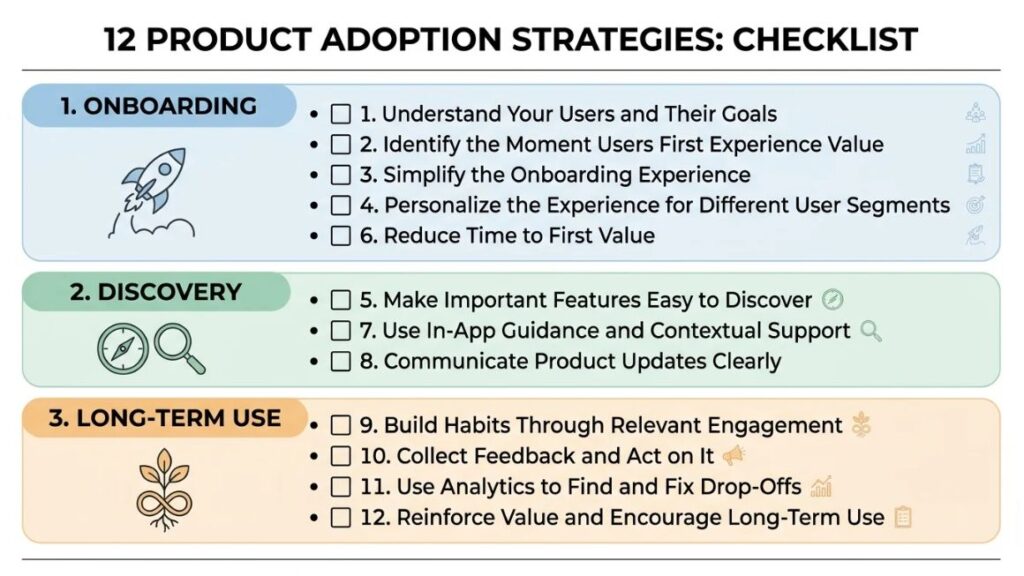
These product adoption strategies work best together, and in a product-led growth model, where the product itself drives sign-ups and upgrades, they aren’t optional extras. They’re how the model runs. Start with the first three if you’re short on time.
1. Understand Your Users and Their Goals
Start with conversations, not dashboards. Five or six interviews will tell you more about why people sign up than a month of analytics. Ask what they were trying to get done when they found you and what they used before. That’s the job-to-be-done: the outcome someone hires your product to deliver. Then split users by role, needs and experience.
A solo freelancer and a ten-person ops team want different things from the same tool, and treating them as one audience is the quiet reason so many onboarding flows feel generic.
Also Read: Product Growth Strategy: A Step-by-Step Guide to Sustainable Growth in 2026
2. Identify the Moment Users First Experience Value
Every product has a moment where it clicks. Find yours. Compare what retained users did in their first week with what the users who left did, and look for the action that separates them. That action becomes your activation milestone, and user activation only means something once it’s measurable, like “created and shared a first report.” Slack did this with team message volume, which we’ll get to below. Your number will be different. Pick one, define it clearly and build everything toward it.
3. Simplify the Onboarding Experience
Most product onboarding asks for too much, too early. Cut every setup step that isn’t needed for the first win, then look at what’s left and cut again. Short checklists beat long tours. Task-based guidance beats feature walkthroughs. And let people skip. Experienced users hate being walked through basics, and forced tours are a reliable way to teach everyone to click “next” without reading. If a step can wait until day three, move it to day three.
4. Personalize the Experience for Different User Segments
Ask two or three questions at sign-up, and only questions you’ll act on. “What’s your role?” can send a marketer to campaign templates and an engineer to API docs. “What’s your phone number?” sends nobody anywhere. If an answer doesn’t change what the user sees next, don’t ask. Skip personal details you don’t need, too. People notice, and it costs you trust. Airtable’s template picker, covered below, shows the idea well: the choice itself tells the product what to show next.
5. Make Important Features Easy to Discover
A feature nobody finds might as well not exist. Introduce capabilities when they become useful, not in a welcome tour on day one. Use contextual prompts, and make empty states do some work: an empty dashboard should say what belongs there and offer one button to add it. Then test discovery honestly. Give five new users a task that needs the feature, say nothing and watch. If they can’t find it, a tooltip isn’t the real fix. Placement is. Better feature adoption starts with that slightly uncomfortable test.
6. Reduce Time to First Value
Time to value is the gap between signing up and getting something useful out of the product. Shorter is nearly always better. Offer templates, sample data or a guided first task so users see a finished result before they’ve built anything. Strip out avoidable friction, like mandatory email verification before the user has seen a single screen. Then measure it. Track the time from sign-up to your activation milestone, and watch the median, not the average, because a few slow outliers skew averages badly.

7. Use In-App Guidance and Contextual Support
Help works best where the person is actually stuck. A short tooltip on the confusing field beats a link to a 40-page help centre. Keep searchable documentation and relevant tutorials one click away, and link them from the screens that cause the most support tickets. The risk is overdoing it. Three pop-ups on one screen, repeated every login, and users start dismissing everything, including the one message that mattered. Show guidance once, show it to the right segment and let it stay dismissed.
8. Communicate Product Updates Clearly
Shipping a feature isn’t the same as users knowing it exists. Say what changed, why it matters and which task it makes easier. “Bulk edit is here” is a headline. “Update fifty rows in one go” is a reason. Send updates only to the segments who’d care, since a feature for admins is noise for everyone else. And connect each announcement to a real task, ideally with a button that takes the user straight there. A changelog nobody reads is a diary, not communication.
9. Build Habits Through Relevant Engagement
Habits form when the product shows up at the moment someone would naturally need it. Use reminders tied to what the user is doing, like a nudge to finish a half-built report, instead of generic “we miss you” emails. Make recurring workflows easy to repeat with saved views, duplicate buttons and recurring templates. That’s customer engagement that earns attention. Notifications that exist only to drag people back are just noise, and Duolingo, below, is a useful reminder of how thin that line is.
10. Collect Feedback and Act on It
Short surveys, interviews and support chats all feed the same pile. What matters is spotting what repeats. One angry comment is an anecdote. The same complaint in seven tickets and three interviews is a roadmap item. Ask in context, with a single question right after a task, so answers are fresh. And close the loop. When a change ships because of user feedback, tell the people who asked. It costs nothing and quietly turns critics into regulars. Silence after feedback teaches users that asking is pointless.
11. Use Analytics to Find and Fix Drop-Offs
Map the key journeys first: sign-up to first value, first value to second session. Then look for where people fall away. Break the numbers down by cohort and segment, because an overall average can hide one segment thriving while another leaves by the dozen. Fix one thing, then test it against a comparison group instead of assuming it worked. Plenty of well-meant changes do nothing. Some make things worse. Only a test tells you which.
Also Read: 15 Best Product Analytics Tools
12. Reinforce Value and Encourage Long-Term Use
Adoption isn’t a one-time event. Once the basics stick, point users toward advanced capabilities that fit what they already do, and teach through milestones: a short guide after the tenth project, not on day one. Keep support easy to reach. Then measure sustained use, like users still active in week twelve, rather than one-time clicks on a banner. Long-term use is the evidence that the value is real. A click on “Learn more” is evidence of curiosity, nothing else.
Effective product adoption strategies shorten the time between sign-up and first value, personalize onboarding by user segment, and keep users returning with relevant guidance rather than noise. The strongest programs define one activation milestone, measure it by cohort, and test every change against a baseline.
Real-World Product Adoption Examples
Three well-known products show product adoption strategies in practice, each solving a different problem. None of what follows claims a precise lift from a single change. The public sources don’t support that, and honestly, most claims floating around online don’t either.
Airtable: Helping Users Start With Relevant Templates
Airtable can be a CRM, a content calendar or a hiring tracker, which makes onboarding hard. A blank grid tells a marketer nothing. So the product has asked new users about their role and use case, then offered matching templates. The team has written that its user studies showed templates mattered enormously, because for new users the templates and the product felt almost the same thing. The lesson for any product serving several audiences: give people a relevant starting point instead of an empty screen. Onboarding flows change, so check Airtable’s current version before copying it.
Slack: Connecting Product Value to Team Workflows
Nobody gets much from a team chat tool with one person in it. Slack’s onboarding therefore pushes users to invite teammates, and skipping that step triggers a warning. Co-founder Stewart Butterfield has said the company decided a team that had exchanged 2,000 messages had really tried Slack, and that 93% of such customers were still using it, according to a 2019 conference deck quoting him. Treat that as the company’s own observation of a pattern, not proof that pushing messages causes retention. For any collaborative product, individual value only becomes team value once a second person shows up.
Duolingo: Making Repeat Usage Easier
Duolingo makes coming back easy and rewarding with streaks, visible progress and reminders. Its quarterly filing with the US Securities and Exchange Commission reports roughly 58.7 million daily active users for the three months ended June 30, 2026, up 23% from a year earlier, driven largely by better retention of current users. The filing credits a mix of product work and marketing, so don’t pin it on streaks alone. And hold onto the distinction: encouraging repeat sessions is different from proving people learned a language. A streak shows someone turned up. Learning outcomes need their own evidence.
How to Measure Product Adoption and Track Progress?
Activity alone doesn’t prove a product delivers value. A user can log in every day and accomplish nothing. Product adoption strategies are only as good as the numbers used to judge them. Good product adoption metrics connect behavior to outcomes, and that takes a handful of clearly defined numbers instead of one big dashboard.
The most useful adoption metrics
- Activation rate: how many new users reach your activation milestone.
- Time to value: how long that takes.
- Feature adoption rate: how many eligible users actually use a given feature.
- Weekly or monthly active users: pick whichever matches how often people naturally need your product. A payroll tool isn’t a daily habit. A messaging app is.
- Cohort retention: whether groups of users who started in the same period keep returning.
- Product adoption rate: the share of new users who become regular users.
- Trial-to-paid conversion, where you offer trials.
- Customer satisfaction and qualitative feedback, which explain the numbers above.
Also Read: Product Marketing KPIs: How to Track and Own the Right Metrics
How to calculate the key metrics
- Activation rate = users reaching the defined activation milestone ÷ eligible new users × 100
- Feature adoption rate = eligible users who use a specified feature ÷ eligible users × 100
- Retention rate = users in a defined starting cohort who return in the specified period ÷ users in that cohort × 100
Say 500 people sign up and 200 reach your milestone. That’s a 40% activation rate. The number only works if “eligible” and “milestone” are defined before you look at results.
Also Read: Customer Retention Strategies (2026 Guide)
Set a baseline before changing anything
Fix your event definitions and measurement window first, or every comparison afterward is shaky. Compare similar cohorts, and track outcomes before and after each change. Be careful with external benchmarks, too. Userpilot’s 2024 Product Metrics Benchmark Report, drawn from 181 companies, found an average core feature adoption rate of 24.5% and a median of 16.5%. Useful context. But it’s data from one vendor’s customers, and Pendo defines adoption differently, around usage of designated Core Events. Use benchmarks to sense-check, not to set targets.
Product adoption metrics should link user behavior to value, not just activity. Core measures include activation rate, time to value, feature adoption rate, cohort retention and trial-to-paid conversion, each calculated from a fixed milestone and measurement window. External benchmarks, such as Userpilot’s 24.5% average core feature adoption rate across 181 companies in 2024, are references, not universal targets.
Product Adoption Tools Worth Considering
Buy nothing until you know what you’re trying to move. Tools speed up good product adoption strategies. They don’t replace them.
Product analytics
Amplitude and Pendo both track how users behave inside a product, which is where adoption measurement starts. Pendo’s approach centres on Core Events, the actions that represent real value.
Onboarding and in-app guidance
Appcues and Userpilot let teams build checklists, tooltips and guided flows without waiting on engineering. Both also offer analytics, so the line between categories is blurry.
Feedback and user research
Surveys tell you what people say. Behavioral data tells you what they do. Interviews tell you why. Use all three. When they disagree, believe the behavior first, then interview to find out what’s behind it.
How to choose the right tools
Weigh budget, integrations, privacy, ease of setup and your team’s capacity to actually use the thing. Instrumentation comes first: if events aren’t tracked cleanly, even the best platform will show you tidy charts of the wrong data.
Product Adoption Trends to Watch in 2026
Several shifts are underway, though a lot of the loudest predictions come from vendors selling into them. Treat them as emerging product adoption strategies to test, not settled fact.
AI-assisted personalization
Behavioral context can inform more relevant recommendations and guidance, like surfacing the feature a user is most likely to need next. The risks are real, though: privacy, transparency about what’s being tracked, and automation that confidently suggests something irrelevant.
Adaptive, outcome-based onboarding
Identical product tours are giving way to guidance based on a user’s goals and actions. Fewer clicks through a tour. More help with the task they came to do.
Human and AI-assisted product experiences
Userpilot’s 2026 playbook argues that products now serve both humans and AI agents acting on their behalf, and that an agent can “activate” a product in seconds without any real adoption happening. That’s a vendor’s view, and it’s early. Plenty of products will stay almost entirely human-used. But if agents touch yours, separate their activity from human activity in your reports.
Greater focus on meaningful adoption metrics
Raw activity counts are losing credibility. Teams are leaning towards successful workflows, sustained use and customer outcomes, which is where this guide has been pointing all along.
Common Product Adoption Mistakes to Avoid
Most weak product adoption strategies look sensible in a planning meeting. They fail in practice.
- Treating sign-ups as proof of success.
- Showing every feature in the first session.
- Giving every user the same onboarding journey.
- Sending excessive notifications.
- Measuring clicks without connecting them to outcomes.
- Ignoring customer feedback and accessibility. A flow that excludes some users is a flow that loses them.
- Changing too many variables at once. If three things changed, you won’t know which one worked.
A Practical 30-Day Product Adoption Improvement Plan
You don’t need a six-month program. You need one clear month. Four weeks is enough to test one or two product adoption strategies properly.
Week 1: Research and measurement
Interview users, review your analytics and define the activation event. Write the definition down so nobody argues about it later.
Week 2: Identify friction
Map the user journey and rank the biggest drop-off points. Pick the one that costs you most.
Week 3: Implement one or two improvements
Simplify onboarding, add targeted guidance or improve a single key workflow. Resist the urge to fix everything.
Week 4: Measure and iterate
Compare results with your baseline, document what you learned and plan the next experiment.
Conclusion
Product adoption strategies don’t work because they’re clever. They work because they help people get something done faster than before, then make it easy to do again tomorrow.
Pick one friction point this week. Measure it, change it, and measure again. That small loop is the heart of every product adoption best practice worth following, and it beats any grand redesign you haven’t tested.
If you want to go deeper on onboarding, activation and the metrics behind them, Young Urban Project’s Product Marketing course covers how product teams and marketers work these levers together. Have a look and see if it fits where you’re headed.
Frequently Asked Questions
What are product adoption strategies?
Product adoption strategies are the planned actions that help users move from signing up to using a product regularly. They cover onboarding, feature discovery, guidance, communication and measurement. The goal is repeated use that delivers real value.
How do you improve product adoption?
Define the moment users first get value, then remove everything slowing them down. Simplify onboarding, personalize by segment, and measure results against a baseline. Change one thing at a time, the way the best product adoption strategies do, so you can see what worked.
What is a good product adoption rate?
There’s no universal number. Benchmarks vary by product, audience and definition, so a “good” rate is one that improves against your own baseline. Userpilot’s 2024 report put the average core feature adoption rate at 24.5%, but treat that as context only.
Which metrics should you track to measure adoption?
Start with activation rate, time to value, feature adoption rate, cohort retention and active users matched to your natural usage pattern. Add trial-to-paid conversion if you offer trials, plus satisfaction feedback.
How is product adoption different from user activation?
Activation is the first moment a user gets meaningful value. Adoption is what happens afterward, when they build the product into a regular workflow. You can have strong activation and weak adoption if users never come back.
What tools help improve adoption?
Analytics tools like Amplitude and Pendo show behavior. Onboarding platforms like Appcues and Userpilot deliver in-app guidance. Surveys and interviews fill in the reasons behind the numbers.
How long does it take to improve product adoption?
Small onboarding fixes can show early signals within weeks, as the 30-day plan above suggests. Lasting changes in retention take longer, because you need cohorts to mature before comparing them fairly.