

Most product teams don’t fail because they can’t build. They fail because nobody agreed on what was worth building. One feature ships because a big customer asked, another because a competitor launched something similar, a third because someone senior liked the idea. Six months later the roadmap is full and the numbers haven’t moved.
A product strategy framework fixes that. It gives your team a repeatable way to decide who you’re serving, which problem matters most, what you’ll do about it, and how you’ll know it worked.
This guide covers what a product strategy framework includes, a seven-step way to build one, how to choose between methods like Jobs to Be Done and RICE, a worked example, a copyable template, and the metrics that keep you honest. It’s written for founders, product managers and marketers who need decisions they can defend. You’ll finish with a checklist to run against your own plan today.
Table of Contents
What Is a Product Strategy Framework?
A product strategy framework is a structured plan that connects customer needs, business goals and product decisions to measurable outcomes. It tells a team who the product is for, which problems to solve first, and how success will be judged.
The easiest way to hold the idea in your head is a journey.
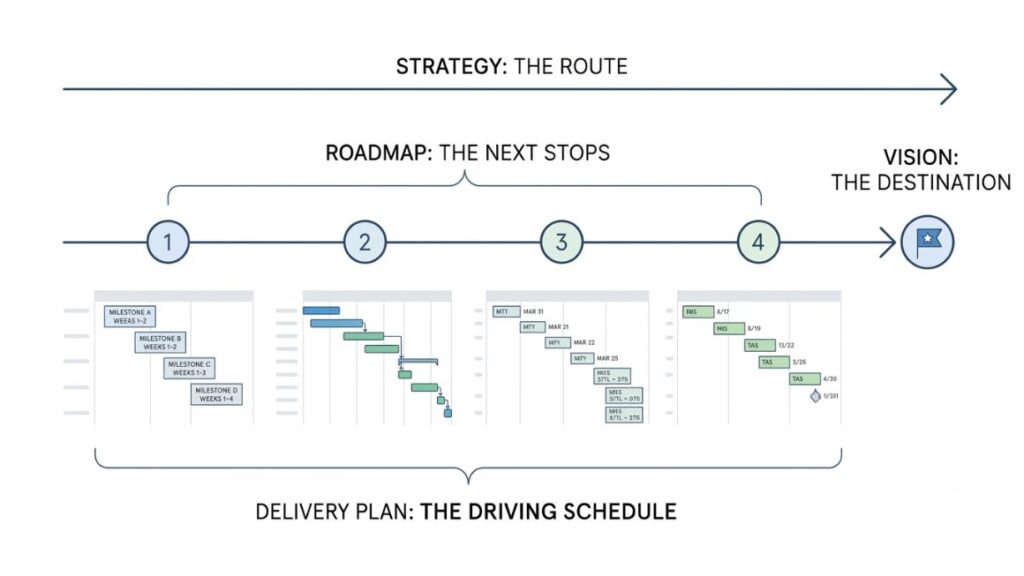
The vision is the destination, the future you want customers to live in. Strategy is the route you pick, given the traffic, fuel and budget you actually have. The roadmap lists the next stops so people can see what’s coming. Underneath all of it sits the delivery plan, which covers who drives which stretch and when.
People mix these up constantly, and it does real damage. A roadmap with no strategy behind it is just a list of things somebody wanted. And none of the four is more important than the others. They answer different questions, and a struggling team is usually missing the second one.
So who needs one? Everyone, honestly. A two-person startup deciding what to build first needs it as much as an established team juggling competing requests. The format changes, a one-page doc versus a quarterly planning cycle. The need doesn’t.
A product strategy framework links customer needs, business goals and product decisions to measurable outcomes. The vision is the destination, the strategy is the route, the roadmap is the sequence of next steps, and the delivery plan covers day-to-day execution. Teams of any size can use one.
Why Does Your Business Need a Clear Product Strategy?
A clear product strategy stops your team from spending months on work that moves no number the business cares about. It gives everyone one shared answer to “why are we building this?”
In practice, that means:
- Less wasted development effort, because ideas get tested against the strategy before they get built
- Teams stay on customer problems instead of working through a pile of feature requests
- Product, engineering, marketing, sales and leadership pull in the same direction
- Trade-offs get easier when time and budget run short
- Results are judged on the same basis every time
The waste is measurable. Pendo’s 2019 Feature Adoption Report, which drew on usage data from 615 customer subscriptions, found that 80% of features in the average software product are rarely or never used. It’s an older, vendor-run dataset, so treat it as a signal rather than a law. It still matches what many teams see in their own analytics.
Picture a hypothetical team that ships something every two weeks: dark mode, new export options, a redesigned dashboard. Retention stays flat. The real reason customers leave is that they never finish setup, and nothing on the roadmap touches that. Busy, yes. Strategic, no.
What Are the Key Components of a Strong Product Strategy?
Five parts, each answering a different question. Skip one and the plan develops a hole.
Product vision and long-term direction
The vision describes the future you want customers to live in once the product works. Teams often squeeze it into a short product vision statement. The test of a good one is practical: can it help you say no to something this week?
Target customers and their unmet needs
Be specific about who. “Small businesses” isn’t a customer. “Agencies of five to fifteen people who run client work out of spreadsheets” is. Back it up with customer interviews, usage patterns, the pain points people keep repeating, and the alternatives they use today, including doing nothing.
Market opportunity and differentiation
Size the demand honestly, list the alternatives, then say why someone would choose you. That last part is your product positioning strategy: a specific customer, a specific problem, and a reason you solve it better. Skip it and you risk the most common cause of failure in CB Insights’ startup post-mortems, where 42% of the 101 companies analyzed, as Fortune reported in 2014, cited no market need. Marc Andreessen’s 2007 essay popularized the cure, product-market fit, which he described as a good market paired with a product that satisfies it.
Business goals and strategic priorities
Customer value only counts when it connects to an outcome the business can measure: retention, revenue, activation or lower cost to serve. Pick one or two. A strategy with six top priorities doesn’t have any.
Success metrics, assumptions, and risks
Define what success looks like, which assumptions need testing, and what could undermine the plan. The assumptions are the useful part. “Teams will invite colleagues if setup is faster” can be tested. “Customers will love it” can’t.
How to Build a Product Strategy Framework Step by Step?
Seven steps take you from raw evidence to a living plan: research, problem, vision, goals, bets, roadmap, then testing. The order matters because each step feeds evidence into the next, which is the whole point of a good product strategy process.
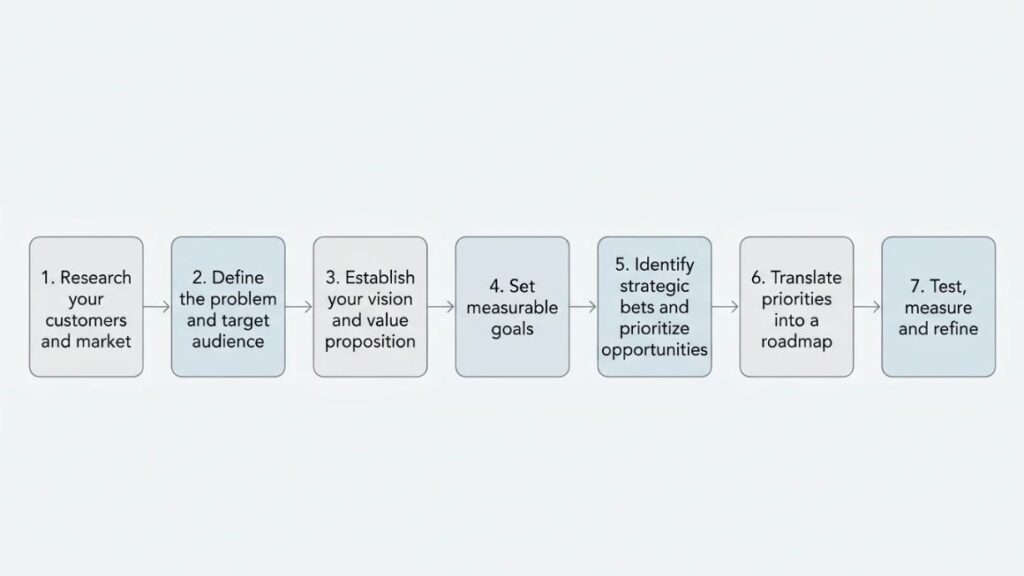
Step 1. Research your customers and market
Start with what’s already on your desk: customer interviews, support tickets, product analytics, market research and competing solutions. Sort everything into two piles, observed evidence and assumptions. Aim for a mix of sources, because any single one misleads a little: interviews tell you why, analytics tell you what, and tickets tell you where it hurts. Support tickets deserve more attention than they get, since they’re unfiltered, repeated and free. Product strategy development goes wrong most often right here, when a team skips the evidence and starts from a solution it already likes.
Step 2. Define the problem and target audience
Name the user segment, the problem, how often it happens, and why solving it matters. One sentence is enough: “Small agency owners can’t get their teams into the tool, which delays their first finished project.” If you can’t write that sentence from your research, go back to Step 1. Frequency matters more than people admit. A painful problem that shows up once a year rarely supports a product; a mild one that shows up daily often does.
Step 3. Establish your vision and value proposition
Describe the change the product should create, then explain why it beats what customers use today. A value proposition is a plain statement of the benefit a specific customer gets and why your product delivers it better than the alternatives. Keep the adjectives out. Then say it to someone outside the team. If they can’t repeat it back, it’s still too abstract.
Step 4. Set measurable goals
Turn broad ambitions into outcomes with a baseline, a target and a deadline. “Improve onboarding” is a wish. “Raise setup completion from 40% to 60% by the end of next quarter” (illustrative numbers) is a goal. Check that the baseline is real, too. If nobody can tell you today’s number, getting it becomes your first goal. OKRs, short for Objectives and Key Results, can help: one qualitative objective backed by two or three measurable key results.
Step 5. Identify strategic bets and prioritize opportunities
A strategic bet is a focused investment built on a clear hypothesis. Compare candidates on customer impact, business value, your confidence in the evidence, cost and risk. Then use judgment, because the highest score isn’t automatically the right call. A scoring sheet can’t see that a lower-ranked item unblocks three others, or that a key account is about to leave. Write down why the winner won. That reasoning is what you’ll reread when priorities get challenged.
Step 6. Translate priorities into a roadmap
Now, and only now, build the roadmap. A product roadmap framework that groups work into strategic themes across time horizons (Now, Next, Later) keeps the plan honest. Promise precise dates only for work you understand well. Uncertain items stay flexible until evidence firms them up. Each theme should read like an outcome, for instance “make first-week setup painless”, with the specific initiatives listed underneath.
Step 7. Test, measure and refine
Launch experiments, review the results, watch what customers actually do, and revise the strategy when the evidence changes. Behavior beats the plan every time. A failed bet is information, not embarrassment. Your product strategy framework only stays useful if the results actually change what the team does next quarter.
Use this checklist to evaluate your own strategy:
- Your target customer is one specific segment, not “everyone”
- The core problem is backed by evidence you can point to
- Observed facts and assumptions are labelled separately
- Every goal has a baseline, a target and a deadline
- Priorities were scored, then challenged with judgment
- You’ve written down what the team won’t build
- Each roadmap item traces back to a strategic theme
- Review dates are already on the calendar
Also Read: How to Write a Product Requirements Document (PRD) Engineers Actually Use?
Which Product Strategy Framework Should You Choose?
Choose by the question you’re stuck on. Jobs to Be Done explains why customers buy, Lean Startup tests risky assumptions, SWOT maps your position, RICE ranks options and OKRs track progress. They aren’t interchangeable.
Jobs to Be Done
Use it to understand what customers are trying to get done and why existing solutions fall short. It’s strongest early, while you’re still working out the problem.
Lean Startup and Build-Measure-Learn
Run small, fast experiments to test your riskiest assumption before investing heavily. Build something minimal, measure what people do, learn from it, repeat. It’s the right fit when you can’t yet tell whether customers want the thing at all.
SWOT analysis and competitive positioning
SWOT lines up internal strengths and weaknesses against external opportunities and threats. It frames a competitive position well, but it only lists. It doesn’t decide anything.
RICE and impact-versus-effort prioritization
Among product prioritization frameworks, RICE is a common first pick. Sean McBride developed it at Intercom: Reach times Impact times Confidence, divided by Effort. Impact-versus-effort is the quicker two-by-two cousin. Both make resource trade-offs explicit.
OKRs and North Star metrics
OKRs connect intent to measurable outcomes. A North Star metric is the single measure that best captures the value customers get from your product. Used together, they keep progress visible.
So which one? Choose the smallest set of tools that answers your team’s actual questions rather than adopting every framework at once. Most teams do fine with one discovery method, one prioritization method and one goal-setting method.
Each strategy method answers a different question. Jobs to Be Done clarifies customer needs, Lean Startup tests assumptions, SWOT maps position, RICE ranks options and OKRs track outcomes. Pick the smallest set that answers your team’s real questions.
A Practical Product Strategy Example
Most product strategy examples online jump straight to a famous company’s results. This one doesn’t. It’s an illustrative, hypothetical example: an imaginary subscription project management product for small agencies. It isn’t a real company, and nothing below claims the changes worked.
The problem
New customers sign up but struggle to invite teammates and complete their first project. In this imagined scenario, interviews and support tickets point at the setup flow, not at missing features. The team’s first instinct is to add features, since competitors list more of them. But people who never get past setup never see those features anyway.
The strategic decision
Focus on onboarding and time-to-value before building more advanced features. Advanced reporting and extra integrations wait. That exclusion is part of the decision, not a footnote to it. It also means telling sales and leadership what the team won’t build this quarter, and why.
The execution plan
Test a simplified setup flow, clearer in-app prompts and guided project creation. Run each as a small experiment so the team learns which change actually matters. Each gets a written hypothesis first, such as “guided project creation will help more new accounts finish a first project.”
How success will be measured
Track activation, time to first completed project, early retention and qualitative feedback from new accounts. Set baselines first. Without them, any improvement is a guess. A product strategy framework like this one only works if the metrics are chosen before the experiments run.
Product Strategy Template: What to Include
Here’s a compact product strategy template you can copy into a document and fill in, one line at a time.
The essential strategy template
- Product vision: the future state, in a sentence or two
- Target customer: the specific segment you’re serving
- Customer problem and supporting evidence: what’s wrong, and how you know
- Market opportunity and alternatives: demand, competitors and workarounds
- Value proposition and differentiation: why customers would choose you
- Business objectives and product outcomes: what the business and the customer should gain
- Strategic priorities and excluded work: what you’ll do, and what you won’t
- Roadmap themes and experiments: the bets and how you’ll test them
- Success metrics and baselines: how you’ll measure, and from where
- Assumptions, risks, owners and review dates: what could be wrong, who’s watching, and when you’ll recheck
A useful template records decisions and reasoning, not just headings and status updates. Next to each answer, write why you chose it and what evidence would change your mind. Six months from now, that’s the part you’ll actually reread. Keep it to a page or two, too. A product strategy framework that needs fifteen pages usually hides the choices instead of making them.
How to Measure and Improve Your Product Strategy?
Measure whether customers are getting value, review those numbers on a fixed schedule, and change course when the evidence says so.
Choose metrics that reflect delivered value
Good product success metrics show that customers got value, not just that they showed up. Depending on your product, that could be activation, adoption, retention, conversion, customer satisfaction or revenue. Pick a few. A dashboard with forty numbers hides everything.
Review leading and lagging indicators
Leading indicators are early signals, like setup completion or first-week feature use. Lagging indicators, like 90-day retention and revenue, take longer to appear but tell you whether the strategy worked. You need both: the first to steer, the second to judge.
Establish a review cadence
Monthly metric reviews and quarterly strategic reviews are a sensible starting point. Adjust to your product and market. A fast-moving consumer app may look weekly; an enterprise product may need longer cycles. Whatever you pick, put the dates in calendars on day one. Reviews that depend on someone remembering rarely happen.
Know when to change direction
New evidence, shifting customer needs or poor results can all justify changing priorities. One bad week usually doesn’t. Look for a pattern across several reviews, then decide. Changing direction doesn’t mean your product strategy framework failed. It means it did its job.
Product Strategy Trends to Watch in 2026
Four shifts are worth watching this year, though none of them replaces customer evidence.
AI-assisted research and synthesis
AI can summarize feedback and help teams spot patterns faster, and adoption is real. Atlassian’s 2025 State of Product report, based on 700 respondents across the US, Germany and France, found that 60% use AI for product documentation and 34% for market research. Atlassian sells product tools, so read the numbers with that in mind. Humans still need to check findings against the original interviews and tickets.
Outcome-based roadmaps
More teams are moving away from long feature lists toward desired outcomes and flexible initiatives. “Cut time to first project” tells people what to achieve. “Ship feature X” doesn’t.
Continuous discovery and experimentation
Rather than one big research push, teams keep talking to customers every week and run small tests. Feedback loops get shorter, and mistakes get cheaper.
Responsible use of data and AI
Privacy, data quality, bias and human accountability matter more as AI touches more decisions. If your product handles personal data in India, the Digital Personal Data Protection Rules were notified on 13 November 2025, with full compliance due by May 2027. Someone still has to own every decision an AI tool informs.
Common Product Strategy Mistakes and How to Avoid Them
Most product management strategy failures are quiet ones. Nobody decides to ignore the plan; it just fades. Watch for these seven, and apply the fix next to each.
- Confusing a roadmap with a strategy. Write the strategy first, then check that every roadmap item traces back to it.
- Trying to serve every customer segment. Pick one primary segment and say who’s out of scope.
- Setting goals without measurable baselines. Measure today’s number before you set a target.
- Prioritizing stakeholder opinions over customer evidence. Ask for the evidence behind each request and label what’s only a hunch.
- Treating scoring models as automatic decision-makers. Use scores to start the debate, then apply judgment and write down why.
- Failing to communicate what the team won’t build. Publish a short “not now” list next to the roadmap.
- Creating a strategy document and never reviewing it. Book the monthly and quarterly reviews before you finish the doc.
Conclusion
Effective strategy comes down to deliberate choices. You pick a customer, pick a problem worth solving, and learn from what the numbers say afterwards. The document doesn’t do that for you. The habit of reviewing it does. A product strategy framework earns its place by changing what your team does on Monday morning.
So start small: one clear customer problem, one meaningful goal, and a short list of priorities you’re willing to defend. Run it for a quarter, check the evidence, adjust.
If you’d like to practice this on real product problems, YUP’s 12-week live Product Management course is built for working professionals.
FYQ: Frequently Asked Questions
What is a product strategy framework?
A product strategy framework is a structured way to decide who your product serves, which problems it solves first, and how you’ll measure success. It connects customer needs and business goals to product decisions, so the team builds on purpose instead of by request.
What are the five main elements of product strategy?
Vision, target customers, differentiation, goals and measurement. The vision sets direction, customers define who you serve, differentiation explains why they’d choose you, goals set priorities, and measurement shows whether the strategy is working.
How do you create a product strategy from scratch?
Follow seven steps: research customers and the market, define the problem and audience, set the vision and value proposition, set measurable goals, choose strategic bets, build a roadmap, then test and refine. Customer evidence comes first at every stage.
What is the difference between product strategy and a roadmap?
Strategy sets direction and guides decisions: who you serve, what matters most, what you’ll skip. A roadmap lists the planned initiatives that carry the strategy out. Strategy explains why. The roadmap shows what and roughly when.
Which framework is best for product prioritization?
For most teams, RICE is a sound default because it forces you to state your confidence. The right choice still depends on the decision, the evidence you have and your constraints. Impact-versus-effort suits quick calls, and Jobs to Be Done suits early problem discovery.
How often should product strategy be reviewed?
Review metrics monthly and strategy quarterly as a starting point. Update it sooner whenever an important assumption changes, such as a shift in customer behavior, a new competitor or a failed experiment.