

A founder spends eight months building a tool. Launch day comes, a few friends sign up, and then nothing. The software works fine. Nobody needed it.
That story is more common than it should be. A sound product development strategy is how you avoid it. It gives you a plan, real customer evidence and a clear tie to business goals. You also get a habit of learning once the product is out. This guide covers what the strategy involves, the main approaches to choose from, a nine-step plan from idea to launch and how to pick what to build first. See the tools worth using, a worked example, the metrics to watch and the mistakes that cost the most.
Table of Contents
What Is a Product Development Strategy?
Understanding the core concept
A product development strategy is a plan that decides what you’ll build, who it’s for, and why it deserves to exist. After that, it steers every choice. It goes from the first rough idea to the updates you ship years later. It settles which features make the cut and what gets a firm no.
Strategy, process, and execution are not the same
Strategy is the decision about what to build and why. The product development process is the sequence of stages you follow to get there. That goes from research through launch. Execution is the daily work. Writing the spec. Fixing the bug. Answering the support email.
You can run a spotless process and still build the wrong thing. That’s what skipping strategy looks like.
Why businesses need a clear direction
Without direction, every request looks equally urgent. A clear plan cuts guesswork. It points limited money and people at the right work. You get a sharper pitch than “we’re cheaper.”
The risk is real. CB Insights analysed founder post-mortems. “No market need” was the top cause of failure at 42% across 101 startups in its first study, and 35% across 111 in a later one. Those are founders’ own explanations from small samples. So read them as a pattern, not a law.
A product development strategy decides what to build, for whom and why. It then guides every decision from first idea to ongoing improvement. CB Insights’ post-mortem studies of failed startups rank “no market need” among the top causes of failure.
The Main Approaches Businesses Can Choose From
Four approaches come up again and again, and they overlap.
Improving an existing offering
Small improvements make sense when customers already use what you’ve built. Especially when their complaints are specific. The risk stays low because the demand is already proven. A major overhaul only earns its cost when the core design is the problem, not the details.
Creating something new
Sometimes nothing in your lineup solves the problem you’ve found. That’s where new product development starts: with a customer problem, not an existing feature set. It carries the most uncertainty. So it needs the most testing before you commit serious money.
Expanding into a different market
Same product, new customers. Or the same customers with a new need. Swiggy was a food delivery app when it launched Instamart in Gurugram in August 2020. It was offering groceries in 45 minutes (Entrepreneur India, 2020). It used its existing delivery fleet but entered a category with different expectations about speed and stock. A new segment changes pricing, support and even what “good” looks like.
Differentiating through quality, cost, or innovation
Pick the lever you can actually pull. Quality asks for better materials, support or reliability. Cost asks for a leaner way to deliver. Product innovation asks for a feature or format competitors can’t copy quickly. That means more testing and more patience. A small team rarely wins on all three. So choose based on the money, skills, and time you have.
These approaches overlap. The right mix for your product development strategy depends on your goals, what customers need and what competitors are doing right now.
How to Build a Plan From Idea to Launch?
Think of these nine steps. They turn a product development strategy into actual work, as one lap around the product development life cycle. Every step ends with an output. It’s something written down that the team can point to. If a step ends with nothing on paper, it didn’t really happen.
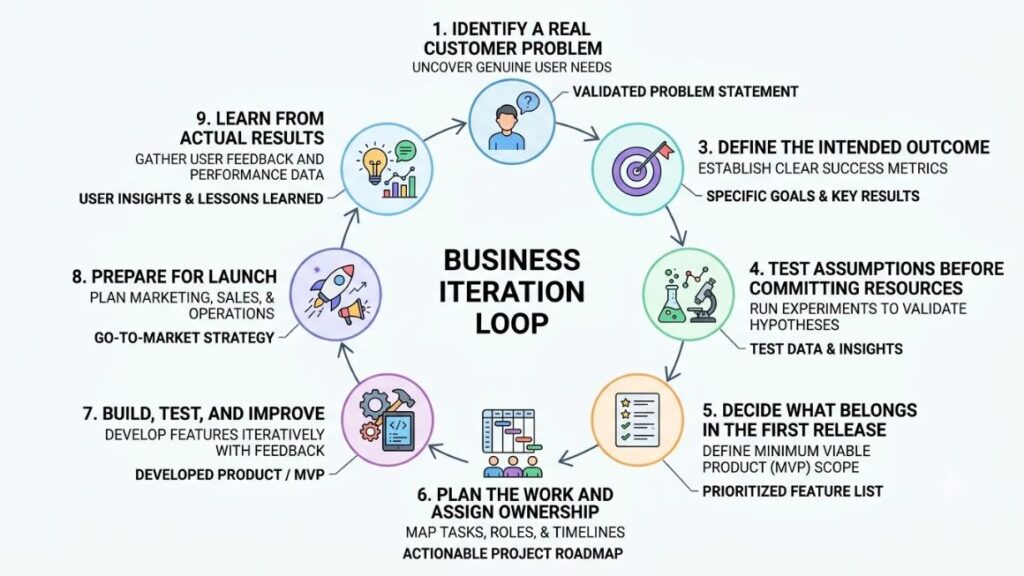
Step 1: Identify a Real Customer Problem
Start by talking to people who have the problem. Read their complaints, reviews and support emails. Then look at their workarounds: a spreadsheet, a WhatsApp group, a paper diary. Nobody builds a workaround for a minor annoyance, so workarounds show real pain.
This matters because customers describe symptoms (“the app is slow”) while you need the cause underneath. Run five to eight interviews and ask about the last time the problem happened, not what they’d like in the future.
Output: a one-paragraph problem statement naming who has the problem, when it appears, and what it costs them.
Step 2: Assess the Market and Alternatives
Now check whether enough people share the problem. Market research, such as surveys, search data, industry reports, and sales conversations. This tells you how big the need is and who feels it most. Competitive analysis then lists what customers use today. That includes free tools and doing nothing at all.
Doing nothing is often your toughest rival. List what each alternative does badly, along with its price, and the gaps start to show.
Output: a one-page map of segments, alternatives, price points, and the gap you can fill.
Step 3: Define the Intended Outcome
This is where a product development strategy gets specific. Write down who the product is for, what value it gives them, and what the business wants from it. One sentence helps: “For [customer] who [has this problem], our product [gives this benefit], unlike [alternative].”
Then set success criteria before building anything. For example, a share of trial customers finishing their first booking in week one.
Output: a short brief with the audience, value proposition, business objective, and two or three measurable targets.
Step 4: Test Assumptions Before Committing Resources
Every plan hides guesses. List them, rank them by risk, and test the riskiest first. You can run a concept test, put up a landing page with a sign-up button, share a clickable prototype or run a small pilot.
A minimum viable product, a term Eric Ries popularised in The Lean Startup, is the simplest version of a product that tests your riskiest assumption with real customers. Dropbox is the classic case. Drew Houston shared a demo video of an early prototype in 2007, and by his own account the beta waitlist jumped from 5,000 to 75,000 overnight (TechCrunch, 2011). Demand showed up before the finished product did.
Output: an assumptions list with each item marked proved, disproved, or still unclear.
Step 5: Decide What Belongs in the First Release
Ask one question: what is the smallest set of features that lets a customer finish the job? Everything else waits. Note the dependencies too. Payments, for instance, may need a provider’s approval that takes weeks.
Complexity arrives quietly, one “small” request at a time. A written scope gives you something to point at when it does.
Output: a scope list with two columns, “in the first release” and “later.”
Step 6: Plan the Work and Assign Ownership
Connect design, engineering, operations, sales and marketing in one plan. Give every deliverable one named owner. Agree on who makes the final call when opinions clash.
Priorities will change. Decide now how that works. A weekly check where new requests go onto a list, not straight into the current work, keeps changes deliberate.
Output: a plan with owners, dates, dependencies and a written rule for handling changes.
Step 7: Build, Test, and Improve
Test the basics: usability, function, accessibility, security, and performance. Check contrast, keyboard navigation and screen reader support. Review how customer data is stored before launch, not after.
For usability, Nielsen Norman Group’s long-cited guidance says five testers from the same user group uncover about 85% of usability problems. That holds for one group of similar customers, so test more if you serve distinct groups. Fix what you find, then test again.
Output: a test log listing issues found, fixed, and deferred.
Step 8: Prepare for Launch
A product launch strategy answers four questions: who hears about it, through which channel, at what price and who’s ready to help when questions arrive. Align positioning, pricing, distribution, support, and communications before the date, not on it.
Consider a soft launch to a small group first. And set up tracking before day one. A launch you can’t measure teaches you nothing.
Output: a launch checklist with owners, plus a sheet showing what you’ll measure.
Step 9: Learn From Actual Results
Review usage, retention, customer feedback, revenue and unmet needs. Product lifecycle management is the practice of managing a product from first concept to eventual withdrawal. This review is its first loop. Book review dates at 30 and 90 days so it actually happens.
Honestly, this step gets skipped most often. Teams celebrate the launch and move on. But a product development strategy nobody reviews is just a launch plan.
Output: a short learning report listing what to keep, change, and drop.
A sound product development plan moves through nine steps: identify a customer problem, assess alternatives, define the outcome, test assumptions, scope the first release, assign ownership, build and test, prepare the launch and learn from results. Each step produces a written output so decisions can be checked later.
How to Choose What to Build First?
Every team has more ideas than time. Your product development strategy only works if the order is right. A product roadmap is really a list of choices. So the order matters as much as the content. Three habits keep that order honest.
Use a simple impact-versus-effort assessment
Plot each idea on two axes: how much it helps customers, and how much it costs to build. Add risk and strategic value if you can. High benefit and low effort goes first. High effort and low benefit goes last, or never.
Apply a consistent scoring method
RICE is an optional framework developed at Intercom to compare ideas on four factors, according to ProductPlan. Reach is how many customers an idea touches in a set period. Impact is scored from 0.25 (minimal) to 3 (massive). Confidence is 100%, 80% or 50%, depending on how solid your evidence is. Effort is the work in person-months. The score is Reach x Impact x Confidence, divided by Effort.
| Feature | Reach | Impact | Confidence | Effort | RICE score |
| Automatic reminders | 1,000 | 1 | 100% | 1 | 1,000 |
| Online deposits | 800 | 2 | 80% | 2 | 640 |
| Staff-specific calendars | 600 | 2 | 80% | 4 | 240 |
These scores are invented to show the math. They aren’t research findings. Notice how reminders win despite the lowest impact: they’re cheap and certain.
Separate urgent requests from important work
Ask who’s asking, how many customers it affects and what evidence backs it. The biggest client’s request may be real, but it’s still one customer. Log it, score it alongside everything else, and don’t let the loudest voice decide.
Also Read: Product Prioritization Frameworks Every PM Should Know

Tools and Technologies That Can Help
Tools don’t fix a muddled plan. They speed up a clear product development strategy. Product management tools earn a place on your list only when they solve a specific problem you already have.
Tools for collecting and understanding feedback
Surveys through Typeform or Google Forms handle quick questions. Interviews recorded on Zoom or Google Meet capture detail you’d otherwise forget. Analytics tools such as Google Analytics 4, Mixpanel, or Amplitude show what customers do. Hotjar’s session recordings show where they get stuck. Productboard gathers requests in one place so patterns become visible.
Tools for planning and collaboration
Jira, Linear, and Trello track tasks. Notion and Confluence hold documentation. Figma and Miro suit prototypes and workshops. Keep it to one place for tasks and one for documents.
Also Read: 15 Best Product Analytics Tools
Where AI can save time, and where it cannot replace judgment
AI can summarise interview transcripts, draft prototype copy, suggest test cases, and tidy documentation. According to the Delight Path and Lyssna State of Product Leaders Report for Q2 2026, a survey of 107 senior product leaders, 80% use AI tools to conduct or synthesise user research and 34% use them heavily.
But watch the limits. AI can invent facts and quotes. So check every output against the source. Don’t paste confidential customer data into tools your company hasn’t approved. And remember that bias in the input can show up in the output. AI can’t decide what’s worth building.
A Practical Example: Turning an Idea Into a Usable Product
This example is illustrative. The business, the findings and the decisions are invented to show how evidence shapes each choice. No real company results are claimed.
Every stage below ends with a decision. Each decision rests on something the team learned, not something it assumed.
Imagine a small team applying a product development strategy to an appointment-booking product for independent salons and tutors.
They start with the problem. Interviews reveal that bookings run through phone calls and WhatsApp messages. Owners lose time to double bookings and missed appointments. That finding sets the direction.
Next they study alternatives. Existing booking apps look built for larger chains, with heavy setup. Free calendars lack reminders. The gap is a simple tool a solo owner can set up in an afternoon.
Then they test a basic booking flow with a clickable prototype. Testers hesitate at the time-slot screen, so the team redesigns it before any code exists.
For the first release, they keep the booking page, a calendar, and automatic reminders. Deposits and staff calendars wait.
A small pilot follows with a handful of businesses. The team watches behavior, not opinions: do customers finish bookings, do they book again, do owners keep opening the product?
Before expanding, they review completion rates, repeat bookings, and customer feedback. If completion lags, they fix the flow first. Growth waits.
Key takeaway: evidence changed or confirmed a decision at every stage, and the team never relied on a feeling that the product was good.
How to Measure Whether the Plan Is Working?
Your product development strategy needs numbers that match what you built.
Customer metrics
Adoption, activation, task completion, satisfaction and retention show whether customers get value. Product-market fit, popularised by Marc Andreessen in 2007, means a good market paired with a product that satisfies it. Sean Ellis’s survey tests for it: ask customers how they’d feel if they could no longer use the product. If at least 40% say “very disappointed,” fit is likely in that segment. Treat it as one signal among several.
Business metrics
Conversion, revenue, margin, acquisition cost and repeat purchases show whether the business works.
Delivery and quality metrics
Time to deliver, defects, reliability and rework show whether the team can keep up.
Set targets that fit the product
A booking tool cares about repeat bookings. A one-off purchase doesn’t. No universal benchmark applies. So record your baseline in the first month and aim to beat it.
| Metric | What it tells you | When to review |
| Activation rate | Whether new customers reach first value | Weekly after launch |
| Task completion rate | Whether customers finish the main job | Every test round |
| Retention | Whether customers come back | Monthly |
| Conversion rate | Whether interest turns into purchases | Weekly |
| Customer acquisition cost | What it costs to win one customer | Monthly |
| Defect and rework rate | Whether quality is slipping | Every release |
Mistakes That Can Undermine Your Efforts
Each of these slows a good product development strategy down, and each has a simple fix.
Building before understanding demand
Talk to at least five customers. Then look for commitment: a waitlist, a deposit or a signed pilot. Compliments cost nothing. Five conversations won’t prove demand. But they’ll expose a missing problem fast.
Adding too many features too early
Write down the one job the first release must do. Cut anything that doesn’t serve it. Every extra feature adds testing, support, and delay.
Treating assumptions as facts
Label every belief an assumption until a test says otherwise. Zomato launched Zomato Market in April 2020 and shut it about two months later. That is according to Inc42’s 2021 reporting. The reporting names no single cause, but the lesson holds: a plausible idea still needs evidence.
Ignoring technical, operational, and financial constraints
Ask engineering, operations, and finance to review the scope before anything is promised to customers. A great feature the team can’t support or afford helps nobody.
Launching without a measurement plan
Pick three numbers you’ll check and set up tracking before launch day. Otherwise launch week passes with plenty of opinions and no evidence.
Failing to respond to what customers do after launch
Give every finding an owner and a decision: fix it, test it, or drop it.
Your First 30 Days: An Action Plan
Any size of team can run this, even a team of one.
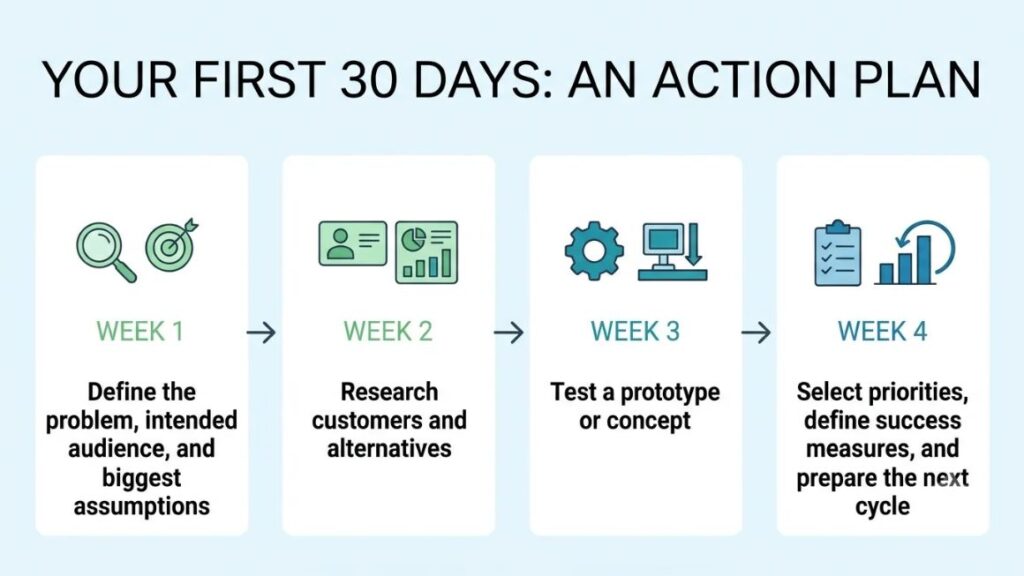
Week 1: Define the problem, intended audience, and biggest assumptions
Write the problem statement, name the customer and list your riskiest guesses.
Week 2: Research customers and alternatives
Interview five to eight people and map what they use today. Pick the most important unmet need.
Week 3: Test a prototype or concept
Put a sketch, a landing page or a clickable prototype in front of real customers. Record what they do, then judge the evidence.
Week 4: Select priorities, define success measures, and prepare the next cycle
Score your ideas, choose what comes first, and set the numbers you’ll track.
Your checklist for today:
- Write a one-paragraph problem statement
- Book three customer conversations
- List your five riskiest assumptions
- Choose one cheap test to run this week
- Pick three success measures before you build
Revisit this list each time your product development strategy changes.
Final Thoughts
Successful products come from understanding real problems, testing assumptions, making deliberate trade-offs, and learning from what customers do. A good product development strategy doesn’t need a big team or a big budget to start. This week, write the problem statement from Step 1 and show it to three people who have the problem. Their reactions will tell you more than another month of planning. If you want guided practice applying these steps to real products, take a look at Young Urban Project’s Product Management course.
FAQ: Frequently Asked Questions
What is the difference between a product strategy and a development plan?
A product strategy decides what you’ll build and why. A development plan sets out how and when. Strategy names the customer, the problem and the goal. The plan assigns owners, order and dates. Strategy changes slowly. The plan changes whenever evidence does.
What are the main stages of creating a product?
Most products pass through problem discovery, market assessment, goal setting, assumption testing, scoping, building and testing, launch, and learning from results. Teams label them differently, and the stages loop rather than run in a line. Testing often sends you back to the problem.
How can a small business develop a product with a limited budget?
Test before you build. Interview customers, sketch a prototype in a free tool, and collect a waitlist or deposits before writing code. Then build the smallest version that completes one job. Dropbox tested demand with a demo video before its full product existed.
How do you know whether an idea is worth pursuing?
An idea is worth pursuing when real customers have the problem, already spend time or money on workarounds, and show commitment before the product exists. A deposit, a signed pilot, or a waitlist of people you’ve spoken to counts. Compliments don’t.
Which metrics should teams track after launch?
Track a few customer metrics, one or two business metrics, and one quality metric. Activation, task completion, and retention show whether customers get value. Conversion or repeat purchases show business health. Defects or rework show quality. Choose the ones that fit your business model.
Can AI help with product development?
Yes. Inside a clear product development strategy, it speeds up routine work such as summarising interviews, drafting documentation, and suggesting test cases. It can’t judge what’s worth building, and it can invent facts. Check outputs against source material, and keep confidential customer data out of unapproved tools.