
Most PRDs fail before a single line of code gets written. They’re either bloated documents nobody reads past page two, or vague one-pagers that spark three follow-up meetings just to clarify what “user-friendly” was supposed to mean. Either way, the document didn’t do its job.
The cost of this is bigger than it sounds. Research compiled by Carnegie Mellon’s Software Engineering Institute found that reworking requirements defects can consume 40 to 80 percent of total development effort, depending on the project, and that most software project failures trace back to requirements problems in the first place. That’s not a documentation problem. That’s a product requirements document problem, and it’s one of the highest-leverage skills a PM can actually get good at.
This guide walks through how to write a PRD that engineers trust enough to build from directly, without the back-and-forth that eats an entire sprint before development even starts.
Table of Contents
What a PRD Actually Needs to Do (And What It Isn’t)
A PRD’s job is alignment. It’s the shared reference point that gets product, engineering, and design agreeing on what’s being built and why, before anyone starts writing code. It is not a technical implementation plan, and treating it like one is one of the most common ways PMs undermine their own document.
Here’s where a lot of PRDs go wrong early. A PM writes a requirement like “the button should use a blue gradient with rounded corners,” which sounds specific but is actually dictating a UI decision that belongs to design. Over-specifying implementation details stifles the exact cross-functional judgment you’re paying engineers and designers to bring. The PRD’s job is to nail the outcome. It’s not to prescribe the solution.
The opposite failure is just as common, though. A requirement like “the app should feel fast and modern” sounds harmless but leaves so much open to interpretation that three engineers will build three different things, all technically compliant with the sentence. Good PRD writing sits between these two failure modes: specific enough to be testable, open enough to let the people building it actually do their jobs.
Start With the Problem, Not the Feature
Open a PRD with a feature description and you’ve already lost the thread. Open it with the problem, backed by real data or user research, and everything that follows has something to anchor against.
A strong problem statement names who’s affected, what’s actually going wrong for them, and why it matters now. “Users are dropping off during onboarding” is a start. “43% of new signups abandon onboarding at the payment step, according to last quarter’s funnel data” is a PRD opener that gives engineering and design a reason to care before you’ve described a single feature.
Amazon’s internal “working backwards” practice takes this discipline to its logical extreme, and it’s worth understanding even if you never adopt the full format. Instead of starting with a spec, Amazon PMs write a mock press release and a set of anticipated customer FAQs before the product exists, forcing total clarity on the customer problem and the value being delivered, before any technical discussion begins. Most teams won’t go that far, and they don’t need to. But the underlying instinct, prove the problem is real and worth solving before describing how you’ll solve it, belongs in every PRD regardless of company size.
A strong PRD opens with a specific, data-backed problem statement rather than a feature description, an approach Amazon takes to its logical extreme with its “working backwards” practice of writing a mock press release before building anything. Grounding the opening in a real, quantified problem gives engineering and design a reason to care before any technical discussion starts.
The Core Sections Every PRD Needs – How to write a PRD
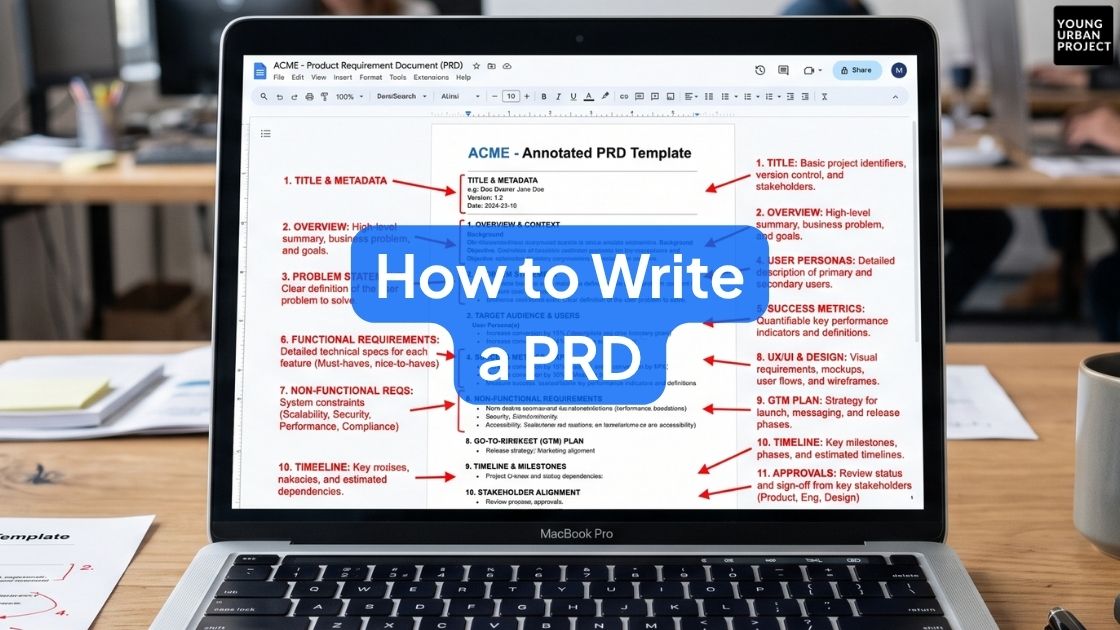
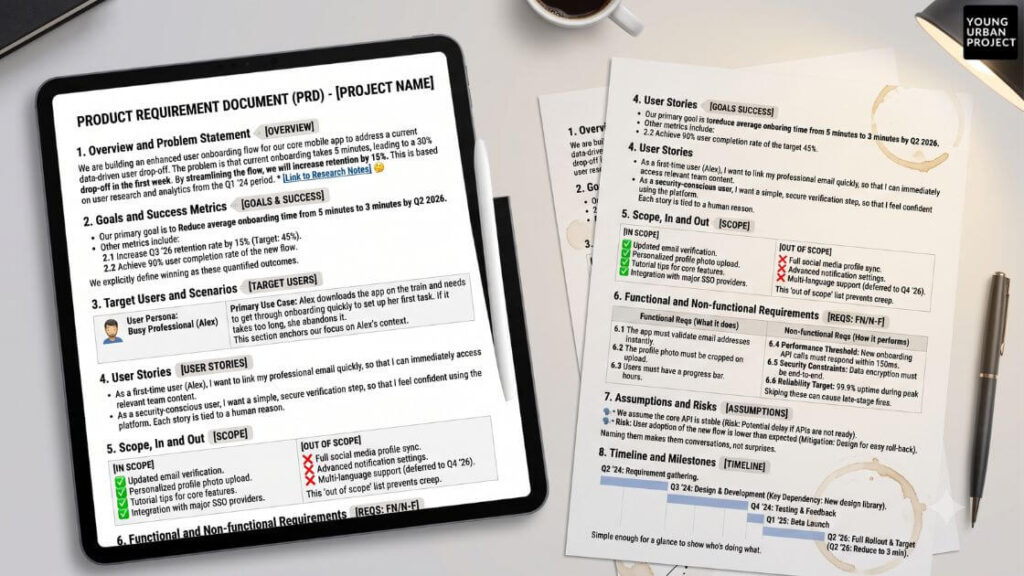
There’s no single universally correct PRD format, but strong PRDs consistently share the same backbone. Here’s what each section needs to actually do.
Overview and problem statement. One tight paragraph covering what you’re building and why now, grounded in the data point from the section above. Link out to any discovery notes or research that back it up, so a skeptical reader can go verify the claim themselves.
Goals and success metrics. Vague goals produce vague evaluation later. Use the SMART approach, specific, measurable, achievable, relevant, and time-bound, and quantify wherever possible. “Reduce average onboarding time from 5 minutes to 3 minutes by Q2 2026” tells everyone exactly what winning looks like. “Improve onboarding” doesn’t.
Target users and scenarios. Name the specific audience or persona this feature serves, and walk through the primary use case scenario. This section keeps engineering and design anchored to a real person’s context rather than an abstract user.
User stories. The Agile Alliance’s simple format still holds up well here: “As a [user], I want [goal], so that [benefit].” It’s a small structure, but it forces every requirement to stay tied to a human reason for existing, not just a checklist item.
Scope, in and out. What’s included in this release, and just as important, what’s explicitly excluded or deferred. Skipping the “out of scope” list is one of the fastest routes to scope creep, since without it, every stakeholder assumes their pet request is fair game.
Functional and non-functional requirements. Functional requirements describe what the product does. Non-functional requirements, performance thresholds, security constraints, reliability targets, get skipped far too often, and they tend to surface as painful, late-stage fires when a feature technically works but falls over under real load.
Assumptions and risks. Every PRD carries assumptions, don’t hide them. Naming them explicitly means a wrong assumption becomes a conversation, not a surprise discovered three weeks into a build.
Timeline and milestones. Key dates and dependencies, kept simple enough that anyone glancing at the doc knows what’s due when, without needing a separate project plan just to answer that question.
Writing Requirements Engineers Can Actually Build From
This is where most PRDs quietly fall apart, even ones with all the right sections. The requirements themselves are too vague to build against with confidence.
The fix is writing testable acceptance criteria instead of descriptive adjectives. The Given/When/Then format, popularized through behavior-driven development tools like Cucumber, forces this discipline naturally: “Given a user has an item in their cart, when they apply an expired discount code, then the system displays an error message and does not apply the discount.” That’s unambiguous. Compare it to “the system should handle discount codes properly,” which sounds reasonable and tells an engineer almost nothing.
Specific thresholds beat adjectives every time. “Page load time under 500 milliseconds at the 95th percentile” is buildable and testable. “Fast page load” is a debate waiting to happen during QA. This same discipline applies to non-functional requirements just as much as functional ones, “the system supports up to 10,000 concurrent users” is a real requirement. “Scalable” is not.
Cover the edge cases directly in the requirements, not as an afterthought discovered during testing. What happens on a permissions failure. What happens on a timeout. What happens when a user does the thing you didn’t expect them to do. A PRD that only describes the happy path is really only half a PRD.
Common PRD Mistakes That Create Rework
A handful of mistakes show up across nearly every messy PRD, and they’re worth naming directly because they’re avoidable once you know to watch for them.
Over-specifying is the first. PMs who dictate implementation details, specific UI treatments, specific technical approaches, are usually trying to reduce ambiguity, but they end up removing the room engineers and designers need to solve the problem well. Focus the requirement on the outcome, not the mechanism.
Under-specifying is the mirror image, and it’s just as damaging. Vague language like “intuitive” or “user-friendly” feels harmless in the moment and creates conflicting interpretations the moment three different engineers start building against it independently.
Treating the PRD as a static, finished artifact is another common failure. Requirements evolve as a team learns more during a build, and a PRD that never gets updated stops matching reality within days, quietly becoming a source of confusion rather than alignment.
Ignoring non-functional requirements until they cause a problem is a mistake that tends to surface at the worst possible time, usually right before a launch, when a performance or security issue that should have been a documented requirement from day one becomes an emergency instead.
And unresolved stakeholder disagreements buried instead of addressed in the document itself tend to resurface later, usually during a review meeting that should have been a formality, not a re-litigation of a decision everyone thought was already made.
How PRD Practices Differ by Company Stage and Methodology
A fully-structured, eight-section PRD makes sense for a significant feature at a company with established process. It’s overkill for a small fix at an early-stage startup moving fast with a five-person team.
Lean teams often scale the same template down to a one-pager: a tight problem statement, a couple of goals, the core user stories, and the most critical requirements, skipping the more formal risk and timeline sections unless the feature genuinely warrants them. The underlying discipline, ground it in a real problem, make requirements testable, doesn’t change. Only the level of formality does.
Methodology matters too, though maybe less than people assume. Agile teams often break a PRD’s contents across a set of linked user stories in a backlog tool rather than one static document, while Waterfall-style teams typically favor a single, more comprehensive PRD upfront before development starts. Either way, the core sections above still need to exist somewhere, whether that’s one document or a connected set of tickets.
Worth a direct note on where this stands in 2026: AI drafting tools can now generate a reasonable first-pass PRD structure from a rough problem description in minutes. That’s a genuine time-saver for the boilerplate. It doesn’t replace the judgment call at the center of the whole exercise, deciding what the real problem actually is, and how specific a requirement needs to be to prevent rework without over-constraining the build. That part is still squarely the PM’s job.
Finally…
A PRD’s real value isn’t the document itself, it’s the thinking the writing forces you to do before engineering ever touches the problem. Start with a real, quantified problem instead of a feature idea. Make every requirement specific enough to test. Name your assumptions instead of hiding them. And treat the document as living, not something you write once and never revisit.
Get this right consistently, and the payoff shows up exactly where the Carnegie Mellon data pointed: far less rework, fewer defects, and a lot fewer meetings spent clarifying what a vague sentence was supposed to mean.
If you want to build this skill properly, alongside prioritization and stakeholder alignment, our Product Management Course covers PRD writing with real templates and worked examples from actual product launches.
FAQs About How to Write a PRD (Product Requirements Document)
What is a product requirements document?
A product requirements document, or PRD, is a document that defines what a product or feature needs to do, who it’s for, and why it matters, acting as a shared reference point for product, engineering, and design. It’s meant to drive alignment before development starts, not to serve as a detailed technical implementation plan.
How long should a PRD be?
There’s no fixed length, and shorter is usually better. A significant feature at a larger company might need a full multi-section document, while a small fix or an early-stage startup often does fine with a scaled-down one-pager covering just the problem, goals, and core requirements.
What’s the difference between a PRD and a spec?
A PRD typically covers the “what” and “why” at a product level, the problem, goals, and user stories, while a technical spec goes deeper into the “how,” the actual implementation approach engineering will take. A PRD should generally avoid dictating implementation details that belong in the spec.
Do I need to write a full PRD for every single feature?
No. Small, low-risk changes rarely need the full structure, while significant features involving multiple teams or meaningful user impact benefit from a more complete PRD. Match the level of formality to the size and risk of what you’re building.
How do I get engineering buy-in on a PRD?
Involve engineering early in the drafting process rather than presenting a finished document, since input at the discovery stage catches feasibility issues before they become late-stage blockers. Writing testable, specific requirements instead of vague ones also builds trust, since engineers can see exactly what’s being asked of them.
What’s the biggest mistake PMs make when writing a PRD?
Vague, untestable requirements are the most common failure, phrases like “user-friendly” or “fast” that sound reasonable but leave too much open to interpretation. The fix is writing specific, measurable acceptance criteria that a non-developer could still verify.
Should a PRD include a timeline?
Yes, at least key milestones and dependencies, so anyone reading the document understands what’s due when without needing a separate project plan. The timeline doesn’t need to be exhaustive, just clear enough to prevent confusion about sequencing.
Can AI tools write a PRD for me?
AI tools can generate a reasonable first-draft structure from a rough problem description, which saves time on the boilerplate. They can’t replace the judgment involved in defining the real underlying problem or deciding how specific a requirement needs to be, that part still depends on the PM’s own thinking.
What’s the difference between functional and non-functional requirements?
Functional requirements describe what the product does, like specific features or user actions it supports. Non-functional requirements cover how well it does it, performance thresholds, security constraints, and reliability targets, and they’re skipped far too often, usually surfacing as painful issues late in development.