

Most people trying to escape their 9-to-5 make the same mistake. They start looking for “a side hustle” before they have a skill anyone is actually paying for. In 2026, that mistake is more expensive than it used to be. The gap between generic freelance work and AI-specific freelance work has never been wider.
According to Upwork’s 2026 In-Demand Skills report, freelance hiring tied explicitly to AI grew 109% year over year. That is more than four times the 23% growth rate for other in-demand skills on the platform. That is not a trend piece. That is actual client spending data, and it points to exactly where the freelance income opportunity is right now.
This article is a working list of the in-demand AI skills 2026 clients are actually paying for. They are organized by how hard they are to learn and what they realistically pay, so you can pick one and start building a real exit plan instead of another bookmark folder.
Table of Contents
Why AI Skills Are the Fastest Route Out of a 9-to-5 Right Now
Freelancing itself is not new. What changed is how fast clients are willing to pay a premium for AI-specific capability over generic execution.
Upwork’s 2026 report, which analyzed completed freelance earnings across six work categories through 2025, found AI video generation and editing grew 329% year over year, AI integration work grew 178%, and AI data annotation and labeling grew 154%. Compare that to established categories like graphic design or accounting. Both are growing at a comparatively modest 23%. The freelancers earning the most right now are rarely the most experienced generalists. They are the ones who picked a narrow, AI-specific lane and got good at it fast.
There is a second reason this matters specifically if you are trying to leave a job. Most AI skills worth learning do not require quitting first. You can build proof of work on evenings and weekends, using the same tools your employer may already be paying for, and start taking paid client work before you give notice.
Compare that to five years ago. Leaving a 9-to-5 for freelance income usually meant competing on a crowded skill, writing, design and basic marketing execution. That was against thousands of other freelancers worldwide, most of them willing to work for less. AI skills reset that competition. The pool of freelancers who can competently run AI workflow automation, build a RAG system or run AI-powered SEO at a professional standard is still small relative to demand. That gap may not stay open forever, but it is open right now.
Upwork’s 2026 In-Demand Skills report found AI-related freelance hiring grew 109% year over year, over four times the 23% growth rate of other skill categories. Within that, AI video generation and editing grew 329%, the single fastest-growing freelance skill on the platform. This is based on actual completed earnings data, not job posting volume or survey responses.
How to Read This List?
Two things before you scroll through 23 skills and feel overwhelmed.
First, these skills sit on a spectrum from applied to technical. Applied skills use existing AI tools to produce client outcomes and usually take weeks to get paid-work-ready. Technical skills involve building or customizing AI systems and usually take months. Neither is better. They lead to different income ceilings and different learning curves, and the right starting point depends on where your current skills already sit.
Second, “in-demand” in this article means one thing: skills clients are actually paying for right now, based on real freelance marketplace data, not skills that sound impressive on LinkedIn. A few of the highest-searched AI job titles, like AI research scientist, require years of specialized education and rarely translate into freelance income quickly. Those are excluded here on purpose.
One more thing worth saying plainly. Almost every skill on this list is a layer on top of an existing discipline. It is not a replacement for one. AI video editing still requires an eye for pacing and story. AI-powered SEO still requires understanding how search intent works. The freelancers who struggle most are the ones who treat AI tools as a shortcut around learning the underlying discipline. It’s actually a multiplier on top of it.
The Exhaustive List of In-Demand AI Skills in 2026
Here is the full list, grouped into four clusters by entry difficulty. Each skill includes what it actually involves, who pays for it and a realistic starting point.
Applied AI and No-Code Operator Skills
These require no coding background and are the fastest path to your first paid client, usually within a few weeks of focused practice.
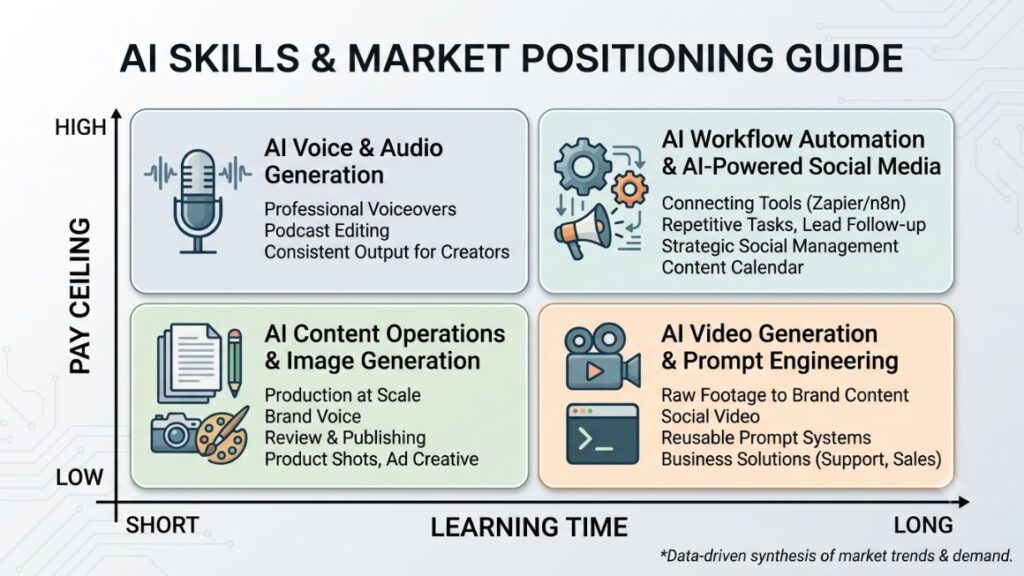
- AI workflow automation. Connecting tools like Zapier, Make or n8n to GPT or Claude. The goal is for the business’s repetitive tasks, lead follow-up, report generation, data entry, to run without a human doing them manually. Small business owners pay well for this because it saves them hours every week and rarely requires custom code.
- AI content operations. Running a brand’s content production at scale using ChatGPT, Claude, and Midjourney together, with a defined process for brand voice, review, and publishing. This is different from casually using AI to write a caption. Clients pay for the system, not the individual output.
- AI video generation and editing. Using tools like Runway, Sora and Kling to turn raw AI-generated footage into usable brand or social content. This is the single fastest-growing AI freelance skill on Upwork. Demand is coming from brands that want video content without a full production budget.
- AI voice and audio generation. Producing voiceovers, AI podcast editing and voice cloning for brands with tools like ElevenLabs. Demand is rising fastest from content creators and course businesses. They need consistent audio output without hiring a full-time audio editor.
- AI image generation for brand assets. Producing on-brand product shots, ad creative and social visuals using Midjourney and similar tools. All that happens without any traditional photography or design budget. E-commerce brands are the biggest buyers of this skill right now.
- AI-powered social media management. Running a brand’s content calendar, captions, and community response using AI tools layered onto a real strategy, not just automated posting. Clients pay for consistency and strategic judgment, with AI handling the production load.
- Prompt engineering for business use cases. Designing reusable prompt systems that solve a specific business problem, customer support responses, sales email personalization, internal research, rather than one-off clever prompts. The commercial version of this skill looks more like systems design than creative writing.
AI-Augmented Marketing Skills
For anyone with a marketing background, this cluster is the fastest bridge between an existing skill set and AI-specific freelance income.
- AI-powered SEO and GEO content strategy. Building content that ranks on Google and also gets cited by AI answer engines like ChatGPT and Perplexity. That is a discipline often called generative engine optimization or GEO. Brands are actively worried about losing organic traffic to AI Overviews. So they are paying for expertise that addresses both.
Read More: GEO vs AEO vs SEO - AI ad creative generation and testing. Using AI tools to rapidly produce and test ad variations for Meta and Google campaigns, cutting creative production time from weeks to days. Performance marketers who add this skill to media buying expertise typically command higher rates than either skill alone.
- AI-driven email and lifecycle marketing. Using AI to personalize email sequences at a segment-of-one level. This was something too labor-intensive to do manually before generative tools came around. D2C and SaaS brands pay well for this. Email is still one of their highest-ROI channels.
- Conversational AI and chatbot setup. Building and training customer-facing chatbots on platforms like Intercom or custom GPT-based systems for lead qualification and support. The primary buyers are small and mid-size businesses not able to afford a full support team.
- AI-powered market research and customer insights. Using AI tools to synthesize customer interviews, reviews, and survey data into usable insight reports. This is far faster than manual analysis. It appeals to brands that know research matters but have never had the bandwidth to do it properly.
- AI-personalized landing pages and CRO. Using AI to generate and test landing page variations that are tied to different traffic sources or audience segments. Then optimization happens based on real conversion data. This sits at the intersection of marketing and technical skill. It pays accordingly.

Technical AI Skills
Longer ramp-up of usually months rather than weeks, but a meaningfully higher pay ceiling once you are client-ready.
- AI integration. Connecting AI capabilities into the existing software and workflows of a business. That is often done through APIs, so AI output flows directly into tools the team already uses. This was the second-fastest-growing AI category on Upwork in 2026. It is growing 178% year over year.
- AI automation and agent building. Building AI agents that complete multi-step tasks with limited human input, research, drafting, scheduling, rather than answering a single prompt. This is a meaningfully more technical skill than basic workflow automation and pays accordingly.
Read More: AI Agents for Content Marketing - RAG systems for businesses. Building retrieval-augmented generation systems that let a company’s AI tools answer questions using their own internal documents and data, often using frameworks like LangChain paired with a vector database such as Pinecone. This is in heavy demand from businesses trying to make AI tools actually useful on proprietary knowledge, not just public information.
- Data annotation and labeling. Labeling and verifying data used to train and evaluate AI models. That work grew 154% year over year on Upwork in 2026. It requires less coding than most technical AI skills. That said, it rewards deep attention to detail and, increasingly, subject-matter expertise.
- AI QA and model evaluation. Testing AI systems for accuracy, bias, and reliability and designing evaluation criteria and running structured tests before a client deploys an AI feature. Companies shipping AI products need this far more than most realize, and the freelance supply is thin.
- AI app development. Building lightweight applications on top of LLM APIs from OpenAI, Anthropic, or Google, custom internal tools, client-facing AI features, or standalone products. This is the most technical skill on the list. It’s the one with the widest pay range. Output quality varies enormously.
AI Consulting, Strategy, and Governance Skills
The smallest client pool but the highest hourly rates. These skills combine AI literacy with judgment that is hard to fake.
- AI adoption consulting for SMBs. Helping small and mid-size businesses figure out where AI actually saves them time or money, then implementing it, rather than selling them tools they will not use. Most successful freelancers here come from operations, consulting, or marketing backgrounds, not engineering.
- AI training and enablement. Teaching teams how to actually use AI tools inside their existing workflows, through live workshops or structured internal training. Demand is high because most companies bought AI tool licenses in 2024 and 2025 that employees still barely use.
- AI ethics and governance advisory. Helping companies assess AI systems for bias, transparency, and compliance risk before deployment. That is an increasingly common requirement as regulation around AI use tightens globally. According to Deel’s 2026 compensation data, full-time AI ethics and governance roles pay between $80,000 and $120,000 annually. Freelance advisory work in this space commands a comparable hourly premium.
- Fractional AI product management. Acting as a part-time or contract product lead for companies building AI features. This bridges technical teams and business stakeholders without a full-time hire. Deel’s 2026 data puts full-time AI product management salaries between $85,000 and $200,000 annually. Fractional arrangements typically price at a proportional hourly rate.
The highest freelance rates in AI right now sit in consulting, governance, and fractional leadership roles, not pure technical execution. That is because these roles combine AI literacy with business judgment and communication. This combination remains genuinely hard to automate and even harder to hire for on a full-time basis.
What These In-Demand AI Skills Actually Pay
Be skeptical of any AI side hustle claim that sounds like a screenshot from social media. Realistic numbers matter more than motivational ones.
Applied and operator-level skills, workflow automation, AI content operations and AI video editing typically start freelancers in the $25 to $60 an hour range early on. They move higher with a track record and case studies. Marketing-adjacent AI skills tend to command similar or slightly higher rates, especially when paired with existing performance marketing or SEO experience.
Technical AI skills, integration work, agent building, and RAG systems generally start higher, often $50 to $100 an hour even for freelancers relatively new to freelancing. That is because the barrier to entry filters out more competition. Consulting and governance work sits at the top of the range, frequently $100 to $250 an hour. But client volume is lower, and sales cycles are longer.
None of this happens in the first month. Expect the first few client projects to underpay relative to your target rate while you build case studies. The freelancers who reach strong rates fastest are the ones who specialize early instead of offering “AI help” broadly across five different skills at once.
Location matters less than it used to, but it still matters. A freelancer based in India charging global clients through Upwork or direct outreach can realistically command rates closer to the U.S. ranges above. The work is priced against the client’s market, not the freelancer’s. The same skill sold only to local clients in a smaller market will usually price lower, which is one more reason serious AI freelancers tend to build an international client base early rather than staying local by default.
Platform choice also affects realistic earnings. Upwork and Fiverr remain the largest general marketplaces for these skills, but direct outreach, LinkedIn content, and referrals from the first few clients typically produce better rates than marketplace bidding alone, since you are not competing purely on price against every other freelancer with the same listed skill.
How to Start Learning These Skills While Still Employed?
You do not need to quit your job to start. You need a sequence.
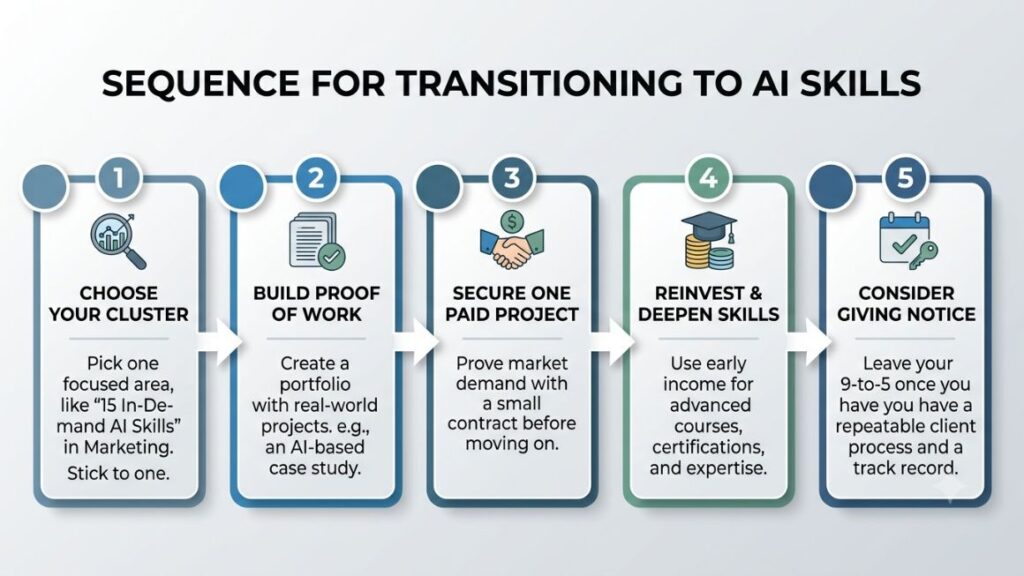
- Pick one cluster, not five. Choose the cluster closest to your current skills. A marketer should start in AI-augmented marketing skills, not AI app development. A generalist with no technical or marketing background often does best starting with an applied skill like AI content operations or AI workflow automation.
- Build proof of work before you pitch anyone. Use the skill on a real project first, even a personal one or a favor for a friend’s small business, so you have something concrete to show rather than a claim about what you can do.
- Take on one small paid project before you leave your job. This single step separates people who actually make the transition from people who talk about it for two years. It does not need to replace your salary. It needs to prove the demand is real.
- Reinvest early income into deeper skill-building, a focused course, a certification, or simply more reps. Spreading thin across every AI tool that launches doesn’t work.
- Track your time against your job, honestly. Most people who successfully transition spend somewhere between five and ten hours a week on the new skill for the first three to six months. That is sustainable alongside full-time work. Trying to do it in stolen hours during your actual job, or in the last exhausted hour before bed, rarely produces work good enough to charge for.
- Only then consider giving notice, once you have a repeatable process for finding clients and a small track record you can point to.
If you already have a marketing background, this sequence moves faster than it does for a true beginner. Someone who already understands SEO, paid media, or content strategy is not starting from zero when they add AI skills on top. They are adding a multiplier to expertise a client already needs, which is exactly why the AI-augmented marketing cluster tends to be the fastest realistic path out of a 9-to-5 for YUP’s audience specifically.
Conclusion
The freelancers earning real money from AI skills in 2026 are not the ones who learned the most tools. They are the ones who picked one in-demand skill, built proof of work and found the first paying client before quitting anything.
Start with the cluster closest to what you already know, not the one that sounds most impressive. A marketer adding AI-powered SEO or ad creative skills will reach paid work faster than a marketer trying to become an AI app developer from a standing start.
If you want a structured way to actually build one of these skills instead of piecing it together from scattered YouTube videos and half-finished courses, Hotskill was built for exactly this: short, practical AI skill tracks designed for working professionals who need to learn fast, apply immediately, and see whether a skill is worth going deeper on before committing months to it.
FAQs
What are the most in-demand AI skills in 2026?
The fastest-growing are AI video generation and editing, AI integration, and AI data annotation, based on Upwork’s 2026 In-Demand Skills report. Beyond raw growth rate, AI-augmented marketing skills and AI consulting command strong demand. They are more accessible to people coming from non-technical backgrounds.
Do I need to know how to code to learn AI skills?
No. Applied skills like AI workflow automation, AI content operations, and AI-powered marketing require no coding background at all. Coding becomes relevant only in the technical cluster, things like AI app development, RAG systems and agent building.
How long does it take to become client-ready with an AI skill?
Applied and marketing-adjacent AI skills can be client-ready within four to eight weeks of focused practice. That is so, since they build on tools rather than requiring new technical foundations. Technical AI skills usually take three to six months before you have work worth charging premium rates for.
Is prompt engineering still a real, in-demand skill in 2026?
Yes, but the paid version looks different from casually writing clever prompts. Businesses pay for reusable prompt systems built around a specific commercial use case, like customer support or sales personalization. That is closer to systems design than creative experimentation.
Which AI skill is best for someone with a marketing background?
AI-augmented marketing skills are the fastest fit, particularly AI-powered SEO and GEO strategy, AI ad creative generation and AI-driven email marketing. They add AI capability to expertise a marketer already has, rather than requiring an entirely new skill set from scratch.
Are AI skills actually worth learning, or is this just hype?
The demand data backs it up. Upwork’s 2026 report found AI-related freelance hiring grew 109% year over year based on actual completed earnings, not survey sentiment or job posting counts. That said, results depend heavily on choosing one specific, in-demand skill rather than a vague claim of “AI expertise.”
How much can you realistically earn with AI freelance skills?
Applied skills typically start in the $25 to $60 an hour range for newer freelancers, while technical and consulting-level AI skills often start at $50 to $100 an hour or higher. Reaching the top of any range takes real client work and case studies, not just course completion.
What do most people get wrong when trying to learn AI skills to escape their job?
The most common mistake is spreading effort across too many AI tools and skills at once instead of specializing in one clear, paid use case. A close second is waiting to feel “ready” before taking any paid work, rather than taking a small project early and learning from it.
Can I start learning AI skills while still working full-time?
Yes, and it is the recommended path rather than a compromise. Most of the applied and marketing-adjacent AI skills on this list can be learned and practiced on evenings and weekends. Your first paid project is completed well before you would need to give notice.
Which AI skills pay the most in 2026?
AI consulting, governance advisory and fractional AI product management sit at the top of the range, often $100 to $250 an hour. That is because they combine technical AI literacy with business judgment that is genuinely hard to hire for. Technical execution skills like AI integration and agent building follow closely behind, generally outpacing purely applied or operator-level skills.
Is it too late to learn AI skills, given how fast the field moves?
No. Upwork’s 2026 data shows AI-related freelance hiring still growing at 109% year over year. That means demand is accelerating, not saturating. The specific tools will keep changing, but the underlying skills, like workflow design, prompt systems, and AI-augmented marketing, transfer across whichever tools are dominant at any given time.