
Most performance marketers don’t have a tool problem. They have a stack problem. There are easily 40+ legitimate AI tools fighting for budget in any single category right now, and the average growth team ends up with three overlapping subscriptions and zero clarity on which one actually moved the needle last quarter.
That’s the gap this guide closes. Instead of ranking AI tools for performance marketers by popularity or marketing spend, we’ve organized 100 of them by the actual job they do inside your campaign workflow: research, creative, launch, optimization, and retention. If you run paid acquisition for a D2C brand, an agency managing five client accounts, or a solo growth marketer juggling everything yourself, you’ll find the right entry point here.
A quick note before we get into it: this isn’t a “use all 100” list. It’s a map. Pick the four or five tools that solve your actual bottleneck, not the ones with the loudest LinkedIn presence.
Table of Contents
How We Categorized These 100 AI Tools for Performance Marketers
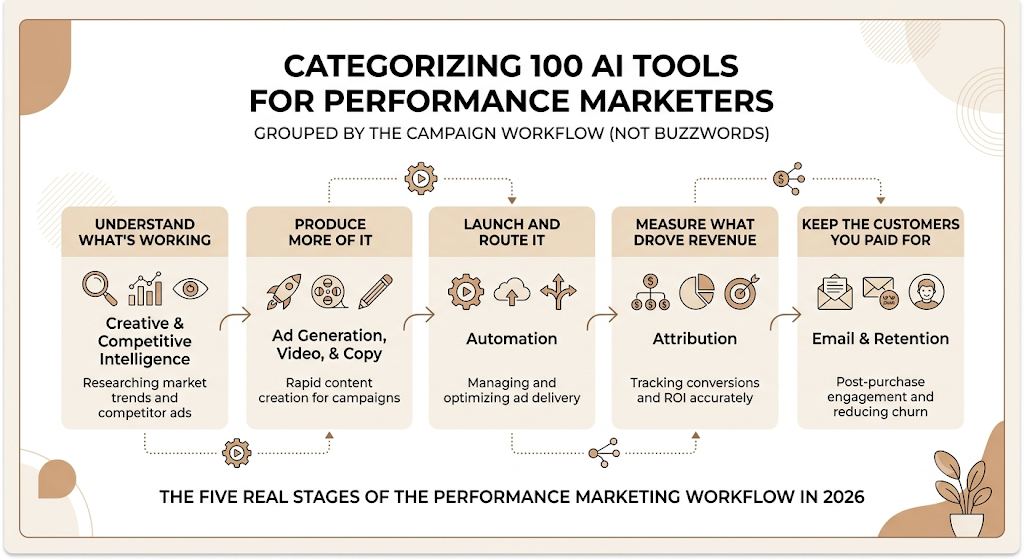
These 100 AI tools for performance marketers are grouped into ten categories that mirror the actual campaign workflow, from researching what’s working in your market to retaining the customers your ads bring in. That’s a deliberate choice. Most “best AI tools” roundups group things by buzzword, which is how you end up comparing a video generator to an attribution platform, like they solve the same problem.
Performance marketing in 2026 runs through five real stages: understand what’s working (creative and competitive intelligence), produce more of it (ad generation, video, copy), launch and route it (automation), measure what actually drove revenue (attribution), and keep the customers you paid for (email and retention). Every category below maps to one of these stages.
Performance marketing tools fall into ten functional categories spanning creative intelligence, production, automation, attribution, CRO, competitive research, copywriting, retention, and media buying. Choosing tools by workflow stage rather than feature list prevents the overlap that causes most marketing teams to pay for three tools doing the same job.
That said, plenty of these categories blur at the edges. A tool like Madgicx straddles ad generation and analytics. Don’t get precious about the lines. Use the category as a starting filter, not a cage.
Best AI Creative Intelligence Tools
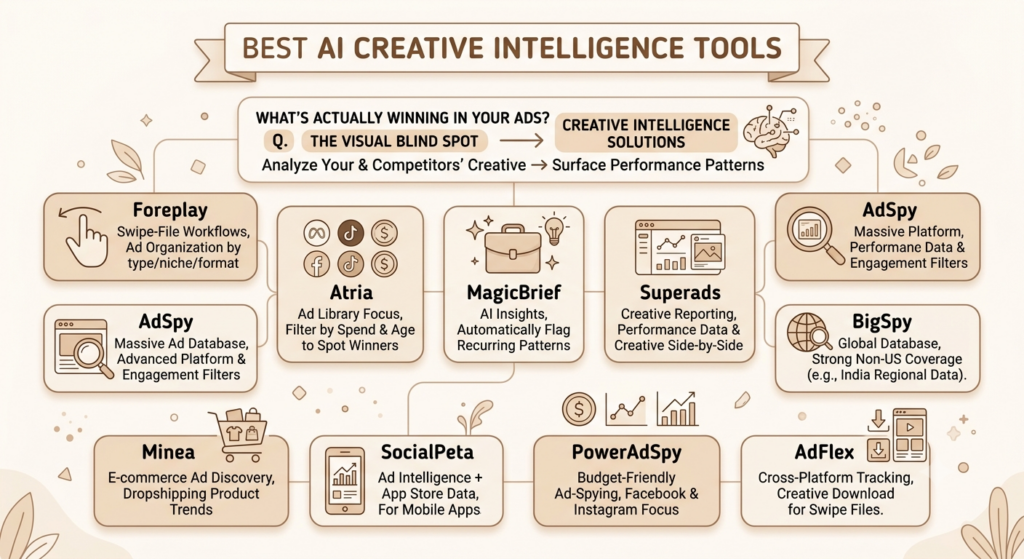
What’s actually winning in your ads right now? Most teams can’t answer that with any precision, and creative intelligence tools exist to fix exactly that blind spot.
Creative intelligence tools analyze ad creative, your own and your competitors’, to surface patterns in what’s driving performance.
Tools Covered:
- Foreplay is built specifically for swipe-file workflows. It’s the closest thing to a shared Pinterest board for high-performing ads, with boards organized by hook type, niche, and format.
- Atria focuses on Meta and TikTok ad libraries with filtering by spend estimate and ad age, useful for spotting what a competitor has been running long enough to call a winner.
- MagicBrief layers AI-generated insights on top of saved creative, flagging recurring patterns across your swipe file automatically.
- Superads centers on creative reporting, pulling performance data alongside the actual creative so you’re not toggling between Ads Manager and a spreadsheet.
- AdSpy remains one of the largest searchable ad databases, with filters by engagement, language, and platform.
- BigSpy offers a similar database with strong coverage outside the US and Europe, which matters if you’re running campaigns for an Indian audience and need regional competitor data.
- Minea specializes in dropshipping and e-commerce ad discovery, tracking which products are scaling across multiple ad networks.
- SocialPeta combines ad intelligence with app store data, a strong fit if you’re running performance campaigns for a mobile app alongside web.
- PowerAdSpy is a budget-friendly entry point into ad-spy tooling with solid Facebook and Instagram coverage.
- AdFlex rounds out the category with cross-platform tracking and creative download capability for swipe file building.
A D2C skincare brand like Mamaearth, for instance, could run a weekly Foreplay or Atria scan across competing brands before a new product launch, building a hook library before a single rupee of media spend goes out. That’s a different exercise than creative intelligence platforms that analyze your own spend data: those tools (Segwise is a notable 2026 entrant in this space, though not covered in this list) tag your own creative elements and map them directly to ROAS, which is a deeper, more technical layer than competitive swipe-filing.
What Creative Intelligence Tools Actually Do
They don’t write ads for you. What they do is shorten the research phase from days of manual scrolling to an afternoon, and they make the patterns visible that you’d otherwise only notice after running the same losing angle for three weeks straight.
Who Should Use Them
Anyone briefing a creative team or media buyer benefits here. If you’re the one writing the brief, a swipe file beats a blank page every single time.
Best AI Ad Generation Tools
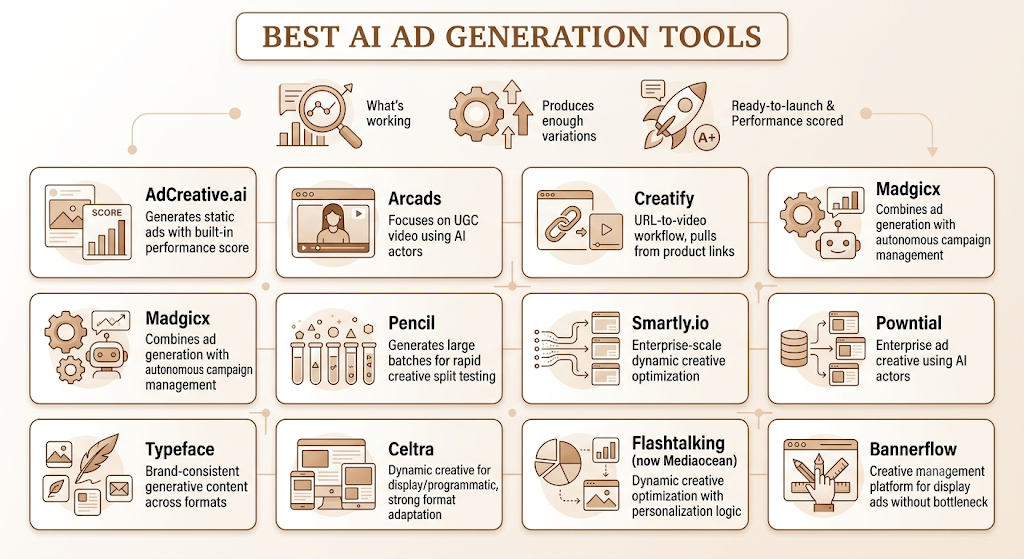
Once you know what’s working, the next bottleneck is producing enough variations to actually test it. This is where AI ad generation tools earn their keep, and honestly, this category has matured fast. The output two years ago was unusable. It isn’t anymore.
AI ad generation tools take a product, audience, and brand input and output multiple ready-to-launch ad variations across formats.
The best ones don’t just look polished. They score variations against likely performance before you spend a single rupee testing them live.
Tools:
- AdCreative.ai generates static and display ad variations with a built-in performance score, and it’s become a default starting point for teams that need volume fast.
- Arcads focuses on UGC-style video ads using AI actors, which sidesteps the logistics of booking real creators for every test.
- Creatify runs a URL-to-video workflow: paste a Shopify or Amazon product link, and it pulls listing details straight into a script and renders an ad.
- Madgicx combines ad generation with autonomous campaign management, leaning closer to a full-stack media buying assistant than a pure creative tool.
- Pencil specializes in rapid creative testing, generating large batches of variations specifically built for split testing.
- Smartly.io is built for enterprise-scale dynamic creative optimization, automatically assembling ad variations from creative components at a volume that manual teams can’t match.
- Typeface brings brand-consistent generative content across formats, useful when a marketing team needs output that doesn’t drift off brand voice.
- Celtra focuses on dynamic creative at scale for display and programmatic, with strong format adaptation across screen sizes.
- Flashtalking (now part of Mediaocean) handles dynamic creative optimization with deep personalization logic for programmatic buyers.
- Bannerflow rounds out the category with a creative management platform geared toward in-house teams producing display ads without a design bottleneck.
AI ad generation tools have moved past producing “AI-looking” generic creative. Platforms like AdCreative.ai and Smartly.io now generate ad variations that hold up against manually designed creative, giving performance teams the volume advantage needed to test significantly more concepts per week without expanding headcount.
The honest limitation here: volume isn’t the same as quality. You’ll still need a human reviewing what gets shipped, especially for brand-sensitive categories.
Best AI Video Ad Creation Tools
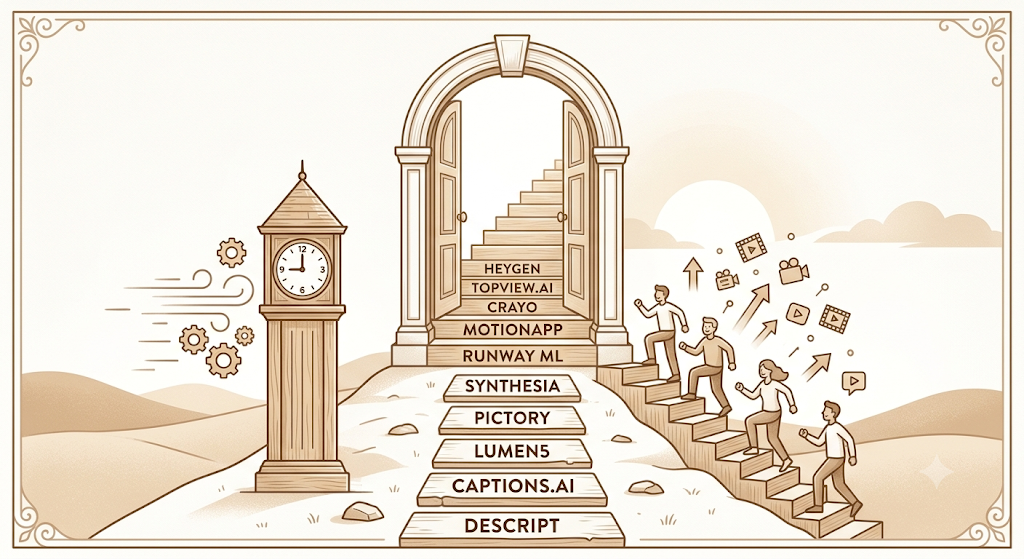
Video still dominates paid social, and the production bottleneck that used to gate video testing has mostly disappeared.
Why does this matter so much right now? Because every major platform, Meta, TikTok, and YouTube Shorts, now favors video inventory in its algorithm, and brands that can’t produce video at volume are simply paying more per result than competitors who can.
Tools:
- HeyGen generates talking-head AI avatar videos from a script, widely used for UGC-style testimonial ads.
- Topview.ai specializes in product video ads with AI voiceover and auto-editing from product links.
- Crayo focuses on short-form vertical video for TikTok and Reels, optimized for fast turnaround.
- MotionApp brings template-driven motion graphics into reach for teams without a dedicated motion designer.
- Runway ML is the most flexible tool in this category, covering generative video editing, background removal, and effects beyond pure ad production.
- Synthesia leads in corporate and multilingual avatar video, strong for brands localizing the same ad across markets.
- Pictory turns long-form content (blog posts, webinars) into short video clips, useful for repurposing existing content into ad creative.
- Lumen5 does similar repurposing with a simpler, more template-driven interface aimed at smaller teams.
- Captions.ai specializes in auto-captioning and AI editing for talking-head video, a near-default tool for creator-style ad content now.
- Descript functions as a full audio and video editor with AI-powered transcription and “overdub” voice editing, popular with teams producing podcast-style or long-form video ads.
A brand like boAt running performance campaigns across five regional languages could use Synthesia or HeyGen to localize the same script into Hindi, Tamil, and English variants without booking five separate shoots.
Best AI Attribution and Analytics Tools
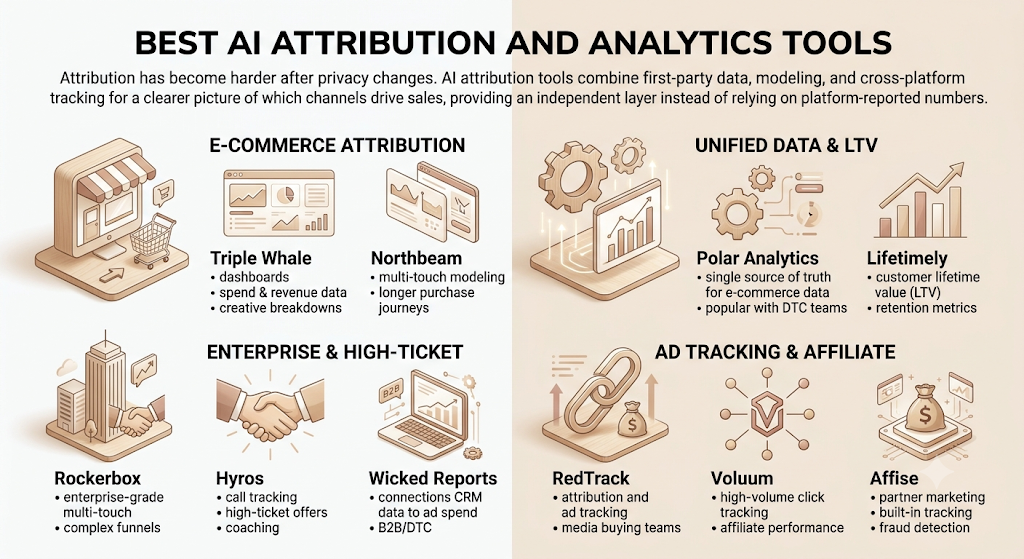
Attribution got harder, not easier, after privacy changes reshaped what platforms can track. AI attribution tools rebuild a clearer picture of which channel actually drove a sale by combining first-party data, modeling, and cross-platform tracking instead of relying on platform-reported numbers alone.
This category exists because Meta and Google have every incentive to tell you their own channel deserves the credit. An independent attribution layer doesn’t.
Tools:
- Triple Whale has become close to a category standard for e-commerce attribution, pulling spend and revenue data into one dashboard with creative-level breakdowns.
- Northbeam offers similar cross-channel attribution with a stronger emphasis on multi-touch modeling for brands with longer purchase journeys.
- Polar Analytics centers on unifying e-commerce data sources into a single source of truth, popular with DTC finance and marketing teams jointly.
- Lifetimely focuses specifically on customer lifetime value and retention metrics layered on top of attribution data.
- Rockerbox brings enterprise-grade multi-touch attribution with deeper customization for complex funnels.
- Hyros built its reputation on call tracking and attribution for high-ticket offers, common in coaching and info-product spaces.
- Wicked Reports offers similar attribution depth with a focus on connecting CRM data to ad spend for B2B and high-ticket DTC.
- RedTrack functions as both an attribution and ad tracking platform, popular with affiliate and media buying teams.
- Voluum is a long-standing tracker in the affiliate and performance marketing space, built for high-volume click tracking across networks.
- Affise rounds out the category as a partner and affiliate marketing platform with built-in tracking and fraud detection.
Post-privacy-update attribution requires combining first-party data with modeled cross-channel tracking rather than trusting any single platform’s self-reported numbers. Tools like Triple Whale and Northbeam exist specifically to correct the bias each ad platform has toward over-crediting itself.
This may not apply if you’re running a single-channel, low-complexity funnel. But for most multi-channel D2C brands, skipping this layer means making budget decisions on data that’s quietly wrong.
Best AI Automation and Workflow Tools
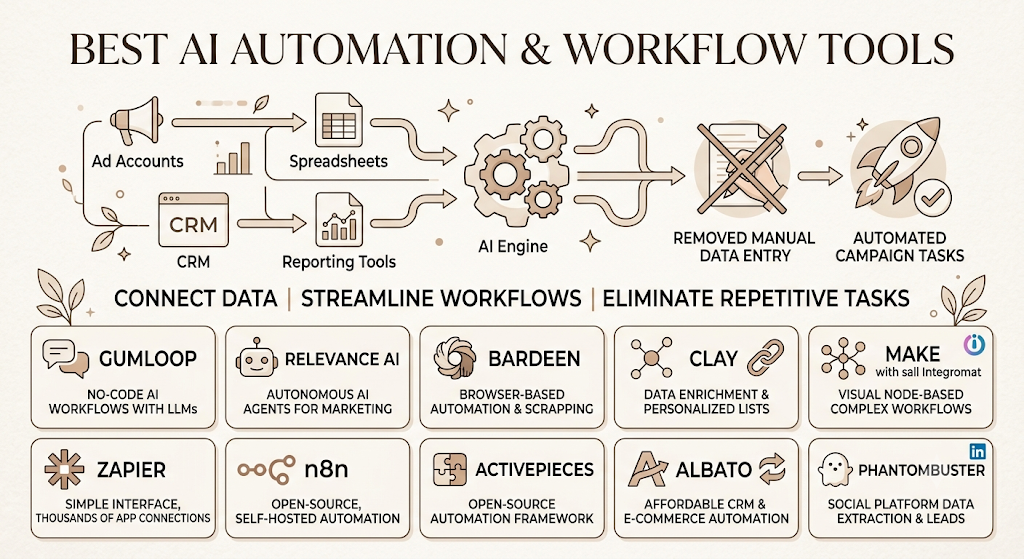
The thing about performance marketing is that half the job isn’t strategy. It’s moving data between five tools that don’t talk to each other. AI automation tools close that gap.
These platforms connect your ad accounts, CRM, spreadsheets, and reporting tools into automated workflows, removing manual data entry and repetitive campaign tasks.
Tools:
- Gumloop connects large language models directly into no-code workflows, letting teams build AI-powered automation without writing code.
- Relevance AI focuses on building autonomous AI agents for repetitive marketing and research tasks.
- Bardeen specializes in browser-based automation, scraping, and routing data directly from web pages into your workflow.
- Clay combines data enrichment with automation, popular for building highly personalized outbound and audience lists.
- Make (formerly Integromat) offers visual, node-based automation building for complex multi-step workflows.
- Zapier remains the most widely adopted automation platform, connecting thousands of apps with a simpler interface than Make.
- n8n is the open-source alternative favored by technical teams who want self-hosted control over their automation infrastructure.
- Activepieces offers a similar open-source automation framework with a growing library of pre-built integrations.
- Albato focuses on affordable automation for smaller teams, with strong coverage of CRM and e-commerce platforms.
- Phantombuster specializes in automating data extraction from social platforms like LinkedIn for lead generation workflows.
No-Code Workflow Builders
Tools like Zapier, Make, and Albato fit teams that need automation without engineering resources. You describe the trigger and the action, and the platform handles the rest.
Agentic Automation Platforms
n8n, Gumloop, and Relevance AI sit a level deeper, letting teams build workflows where an AI agent makes decisions mid-process rather than just routing data on a fixed path. That’s the direction this category is heading in 2026: less “if this, then that,” more autonomous judgment calls inside the workflow itself.
Best AI Landing Page and CRO Tools
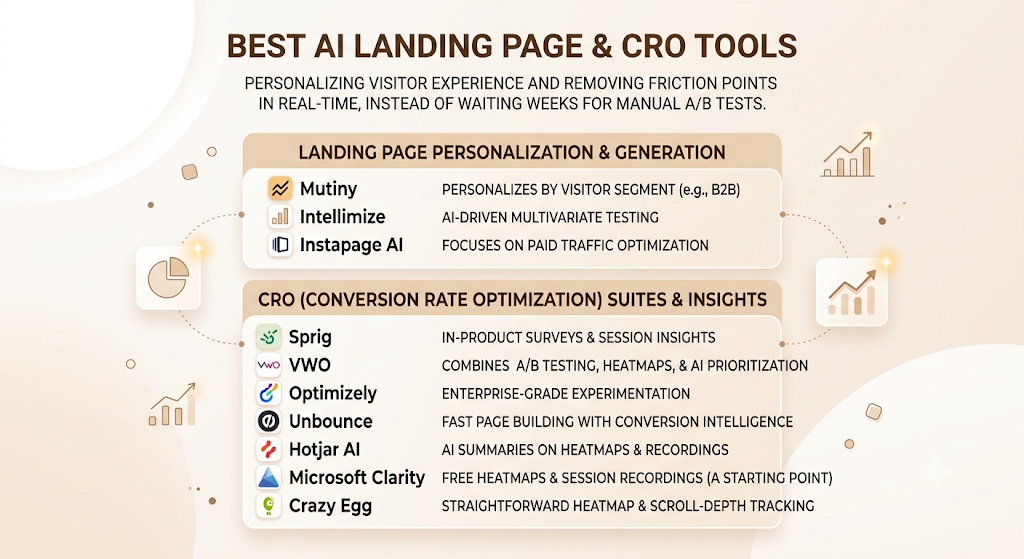
Sending more traffic to a landing page that converts at 1.2% is just an expensive way to lose money more slowly. AI landing page and CRO tools personalize page experiences and automatically surface friction points in your funnel, instead of waiting weeks for a manual A/B test to reach significance.
Tools:
- Mutiny personalizes landing pages by visitor segment in real time, commonly used for B2B accounts with different buyer personas.
- Intellimize offers similar personalization with a stronger emphasis on AI-driven multivariate testing across page elements.
- Instapage AI focuses on landing page generation and optimization specifically for paid traffic campaigns.
- Sprig specializes in in-product surveys and session insights to understand why visitors drop off.
- VWO combines A/B testing, heatmaps, and session recordings into one CRO suite with AI-assisted test prioritization.
- Optimizely offers enterprise-grade experimentation infrastructure for teams running high-volume, statistically rigorous testing programs.
- Unbounce remains a go-to for fast landing page building with built-in conversion intelligence, scoring pages before launch.
- Hotjar AI layers AI summaries on top of its heatmap and session recording tools, surfacing patterns without manual review.
- Microsoft Clarity offers free heatmaps and session recordings, a strong starting point for teams without a CRO budget yet.
- Crazy Egg rounds out the category with straightforward heatmap and scroll-depth tracking for smaller sites.
A growth team running Meta traffic to a Shopify store could pair Microsoft Clarity (free) with Unbounce to identify where mobile visitors abandon checkout, then build a variant landing page targeting just that friction point.
Best AI Competitive Intelligence Tools
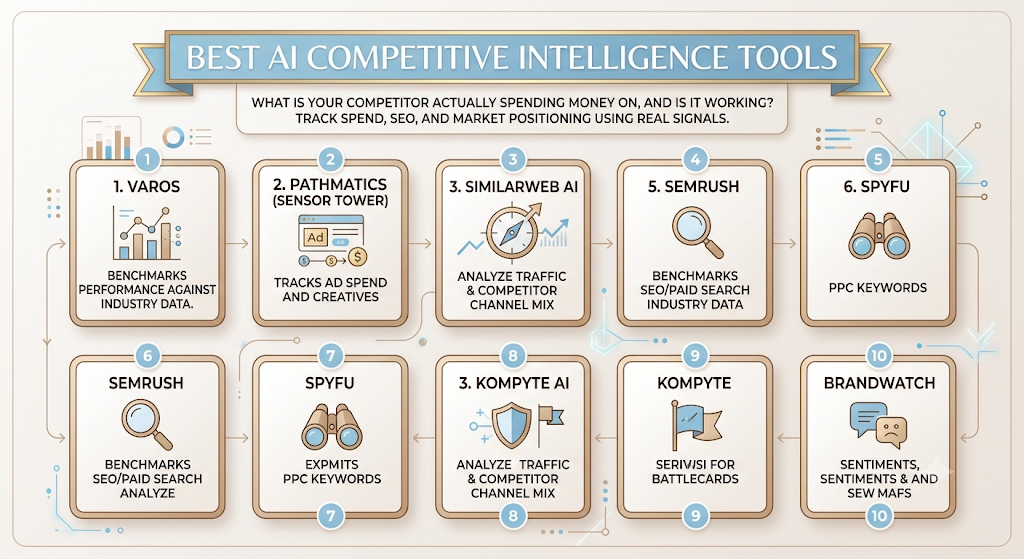
What is your competitor actually spending money on, and is it working? Competitive intelligence tools track competitor ad spend, SEO visibility, and market positioning so you’re reacting to real signals instead of guesswork.
Tools:
- Varos benchmarks your performance metrics against anonymized industry data, showing where you stand relative to peers.
- Pathmatics (Sensor Tower) tracks competitor ad spend and creative across display and social with strong historical data depth.
- Similarweb AI layers AI insights on top of its traffic and engagement estimation, useful for understanding competitor channel mix.
- Crayon specializes in broader competitive intelligence, tracking competitor website changes, pricing, and messaging shifts.
- Semrush combines SEO, paid search, and competitive ad intelligence into one of the most widely used marketing research suites.
- SpyFu focuses specifically on competitor PPC and keyword strategy, showing what a competitor has bid on historically.
- iSpionage offers similar PPC competitive tracking with a focus on smaller agency budgets.
- Kompyte automates competitive battlecards, alerting sales and marketing teams when a competitor changes pricing or messaging.
- Klue offers enterprise-grade competitive enablement, commonly used by larger B2B sales organizations.
- Brandwatch processes social conversation at scale to surface brand sentiment and competitive positioning trends.
Honestly, this is a category where it’s easy to over-invest. Most performance marketers need Semrush or SpyFu for paid search intelligence and Pathmatics or Similarweb for spend tracking. The enterprise tools like Klue and Brandwatch make sense mainly once you’ve got a dedicated competitive intelligence function, not before.
Best AI Copywriting and Hook Generation Tools
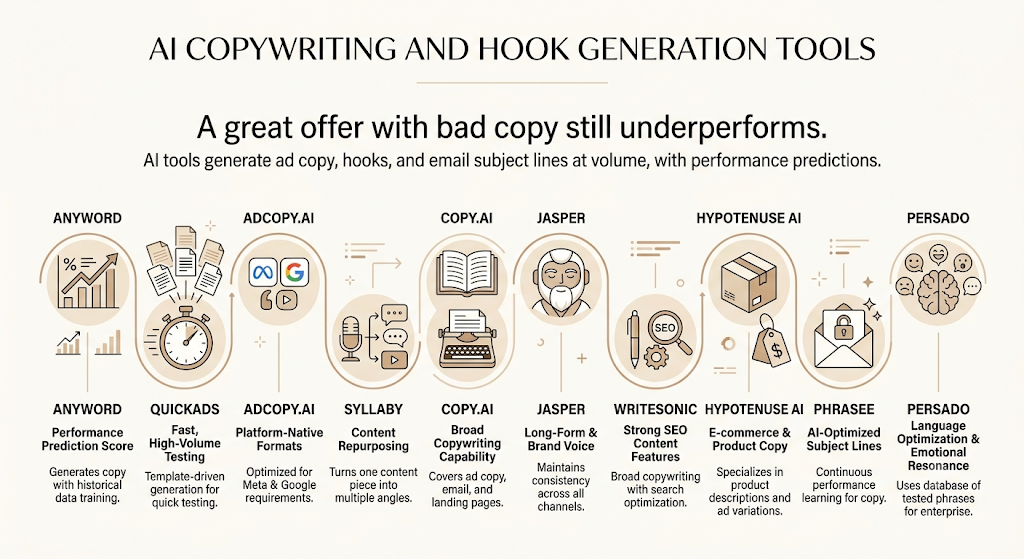
A great offer with bad copy still underperforms. AI copywriting tools generate ad copy, hooks, and email subject lines at volume, with some now predicting performance before you spend on testing.
Tools:
- Anyword generates ad copy with a built-in performance prediction score trained on historical campaign data.
- Quickads specializes in fast, template-driven ad copy generation for high-volume testing.
- AdCopy.ai focuses specifically on platform-native copy formats for Meta and Google ad requirements.
- Syllaby combines content repurposing with copy generation, useful for turning one piece of content into multiple ad angles.
- Copy.ai offers broad copywriting capability across ad copy, email, and landing page content.
- Jasper remains a category leader for long-form and brand-voice-consistent copy generation across channels.
- Writesonic provides similar broad copywriting capability with strong SEO content features layered in.
- Hypotenuse AI specializes in e-commerce product copy and ad variations at scale, useful for catalog-heavy brands.
- Phrasee focuses on AI-optimized subject lines and ad copy with continuous performance learning built in.
- Persado offers enterprise-grade language optimization, using a large database of tested phrases to predict emotional resonance.
Where These Tools Actually Save Time
The real value isn’t the first draft. It’s the fortieth variation, the one a human copywriter would never bother writing because testing a 41st hook angle feels tedious. AI doesn’t get tired of producing those.
Best AI Email Marketing and Retention Tools
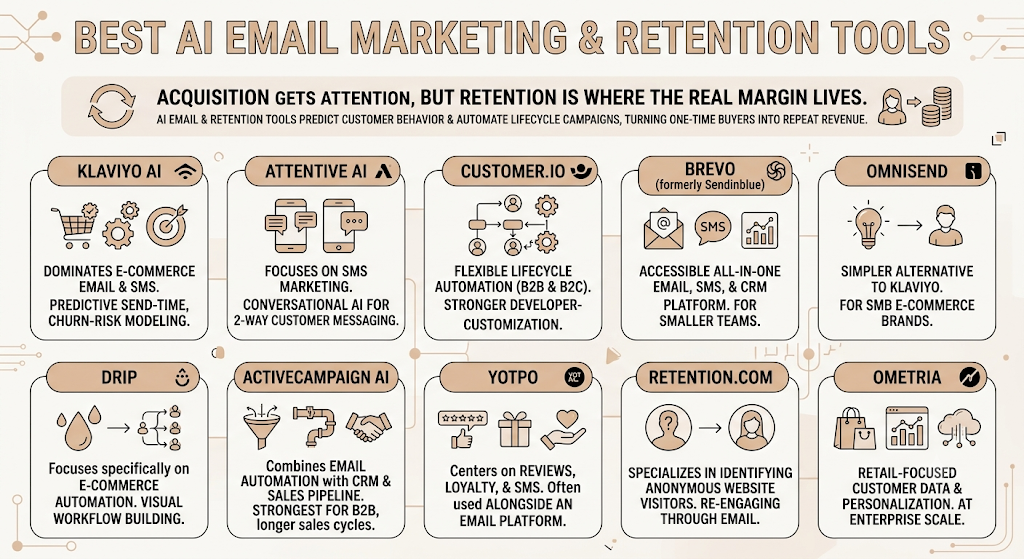
Acquisition gets all the attention, but retention is where the real margin lives. AI email and retention tools predict customer behavior and automate lifecycle campaigns, turning one-time buyers into repeat revenue.
Tools:
- Klaviyo AI dominates e-commerce email and SMS, with predictive send-time and churn-risk modeling built directly into segmentation.
- Attentive AI focuses heavily on SMS marketing with conversational AI for two-way customer messaging.
- Customer.io offers flexible lifecycle automation for both B2B and B2C, with stronger developer-facing customization.
- Brevo (formerly Sendinblue) provides an accessible all-in-one email, SMS, and CRM platform for smaller teams.
- Omnisend positions itself as a simpler alternative to Klaviyo for SMB e-commerce brands.
- Drip focuses specifically on e-commerce automation with visual workflow building.
- ActiveCampaign AI combines email automation with CRM and sales pipeline tools, strongest for B2B with longer sales cycles.
- Yotpo centers on reviews, loyalty, and SMS, often used alongside an email platform rather than replacing one.
- Retention.com specializes in identifying anonymous website visitors and re-engaging them through email.
- Ometria rounds out the category with retail-focused customer data and personalization at enterprise scale.
For most D2C brands, the calculation is fairly direct: Klaviyo if you’ve got 1,000+ contacts with real purchase history feeding the predictive models, Omnisend or Brevo if you’re earlier stage and the volume isn’t there yet. B2B teams running longer sales cycles tend to lean toward ActiveCampaign or Customer.io instead.
Best AI Testing, Research, and Media Buying Tools
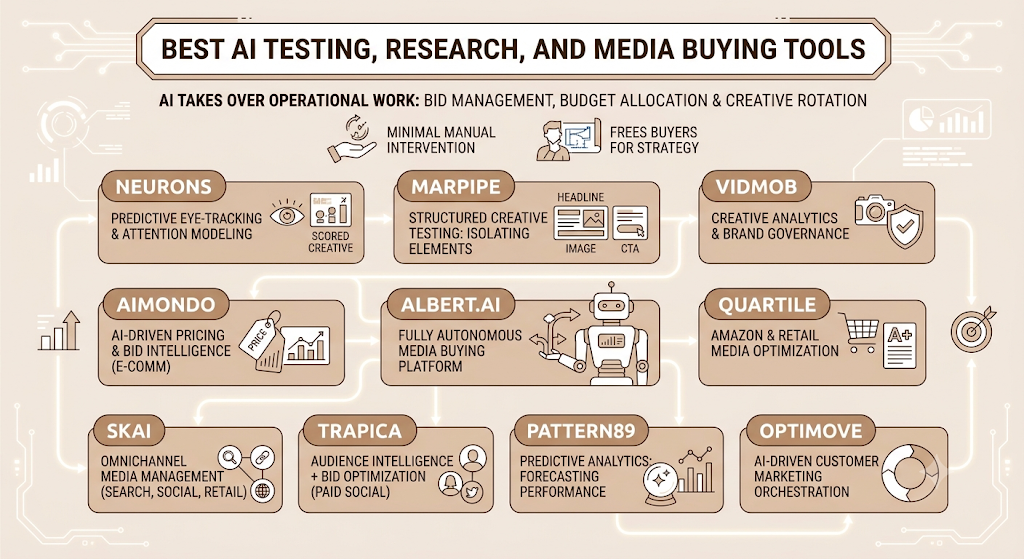
This last category is where AI takes over the most operational work: actual bid management and budget allocation, not just insight generation.
AI media buying tools manage bids, budgets, and creative rotation across campaigns with minimal manual intervention, freeing media buyers to focus on strategy instead of daily account babysitting.
Tools:
- Neurons uses predictive eye-tracking and attention modeling to score creative before it goes live.
- Marpipe specializes in structured creative testing, isolating which specific element (headline, image, CTA) drove a result.
- VidMob focuses on creative analytics with strong brand governance features for large, regulated advertisers.
- Aimondo offers AI-driven pricing and bid intelligence for e-commerce advertisers.
- Albert.ai runs as a fully autonomous media buying platform, managing budget allocation across channels with minimal human input.
- Quartile specializes in Amazon and retail media optimization through automated bid management.
- Skai (formerly Kenshoo) offers omnichannel media management across search, social, and retail media.
- Trapica combines audience intelligence with automated bid optimization across paid social.
- Pattern89 uses predictive analytics to forecast which creative and audience combinations will perform before scaling spend.
- Optimove rounds out the category with AI-driven customer marketing orchestration tied closely to lifecycle and retention data.
Agentic media buying tools like Albert.ai now manage cross-channel budget allocation with minimal manual oversight, shifting the media buyer’s role from daily bid adjustments toward strategic oversight and creative direction.
That’s a meaningful shift from even two years ago, when “AI bidding” mostly meant the platform’s own automated bid strategy inside Ads Manager.
AI Performance Marketing Tools Comparison Table
| Category | Best For | Beginner Friendly | Enterprise Ready | Free Plan |
| Creative Intelligence | Competitor research, swipe files | Yes | Yes | Limited (Foreplay, BigSpy) |
| Ad Generation | High-volume static/display testing | Yes | Yes | Limited (AdCreative.ai) |
| Video Ad Creation | UGC and localized video at scale | Yes | Yes | Limited (Captions.ai) |
| Attribution & Analytics | Cross-channel revenue tracking | No | Yes | Rare |
| Automation & Workflows | Connecting tools, removing manual work | Yes | Yes | Yes (Zapier, n8n) |
| Landing Pages & CRO | Conversion rate improvement | Yes | Yes | Yes (Microsoft Clarity) |
| Competitive Intelligence | Tracking competitor spend and SEO | No | Yes | Limited (SpyFu) |
| Copy & Hook Writing | Ad copy and subject line generation | Yes | Yes | Limited (Copy.ai) |
| Email & Retention | Lifecycle marketing, churn reduction | Yes | Yes | Yes (Omnisend, Brevo) |
| Testing & Media Buying | Autonomous bid and budget management | No | Yes | Rare |
How to Build Your AI Performance Marketing Stack
There’s no universal stack. What you need depends entirely on team size and what’s actually broken right now. Here’s how we’d approach it across four common setups.
For Solopreneurs
You need breadth over depth, since you’re covering every function yourself. Eight tools cover most of what you need: one ad-spy tool for research (Foreplay or BigSpy), one ad generator (AdCreative.ai), one video tool (Captions.ai or HeyGen), one copy assistant (Copy.ai or Jasper), one automation platform (Zapier), one CRO tool (Microsoft Clarity, since it’s free), one email platform matched to your store size (Omnisend), and one attribution layer once revenue justifies it (Triple Whale).
For Agencies
Agencies managing multiple client accounts need tools that scale across accounts without per-client setup overhead. Semrush or Similarweb AI for competitive research across clients, Madgicx or Smartly.io for creative production at volume, Triple Whale or Northbeam for attribution reporting clients actually understand, and n8n or Make for connecting reporting across every client account into one dashboard.
For E-commerce Brands
The priority order shifts toward attribution, creative optimization, retention, and CRO, in that order. Klaviyo AI for retention almost always pays for itself faster. Triple Whale or Northbeam for attribution stops the budget from leaking into underperforming channels. Then Unbounce or VWO for CRO, and AdCreative.ai or Creatify for creative volume.
For Enterprise Teams
Enterprise stacks emphasize governance, personalization, experimentation, and omnichannel execution over speed of setup. That means VidMob or CreativeX-style governance for brand safety, Optimizely for rigorous experimentation, Mutiny for account-based personalization, and Skai or Albert.ai for omnichannel media management across search, social, and retail.
Conclusion
The hundred tools above aren’t a checklist to work through. They’re a map of where the bottlenecks usually sit in a performance marketing workflow, and which category to look in once you’ve identified yours. Most teams need four or five of these working together, not forty.
Start with whichever stage is actually broken right now. If you can’t tell what’s working creatively, fix that before you touch attribution. If attribution is the gap, no amount of new creative will fix a budget that’s silently leaking into the wrong channel.
Frequently Asked Questions
What are AI tools for performance marketing?
AI tools for performance marketing are software platforms that use machine learning and generative AI to automate or improve specific parts of a paid campaign workflow, including creative production, attribution, bidding, and retention. They range from narrow single-function tools to full-stack autonomous media buying platforms.
Which AI tool is best for Meta Ads?
For Meta specifically, Foreplay or Atria for creative research, AdCreative.ai for ad generation, and Triple Whale for attribution form a strong combination. Madgicx also covers Meta-specific creative and campaign management in one platform if you want fewer tools.
Which AI tool is best for Google Ads?
Albert.ai and Skai both offer strong AI-driven bid management for Google Ads, while Anyword and Phrasee help with responsive search ad copy variations specifically built for Google’s ad format requirements.
What AI tools help improve ROAS?
Creative intelligence and ad generation tools (Foreplay, AdCreative.ai, Madgicx) improve ROAS by surfacing winning creative patterns faster, while attribution tools (Triple Whale, Northbeam) improve it by redirecting budget away from channels that look good on the platform but aren’t actually driving incremental revenue.
Can AI replace performance marketers?
No, not the strategic parts of the job. AI tools handle production volume, data aggregation, and repetitive bid adjustments extremely well, but they still need a human setting the strategy, interpreting what the data actually means for the business, and making judgment calls AI doesn’t have context for.
Which AI tools are free?
Microsoft Clarity, Zapier (free tier), n8n (self-hosted), and Omnisend all offer usable free plans. Most attribution and media buying platforms in this list don’t, since they’re built for teams already spending enough on ads to justify the cost.
Which AI tools are best for Shopify brands?
Triple Whale and Polar Analytics both have deep native Shopify integrations for attribution, while Klaviyo AI and Yotpo are near-default choices for email and retention on Shopify stores specifically.
How do I choose the right AI marketing tools?
Start by identifying your actual bottleneck, not by browsing a tool list. If creative testing is slow, fix that category first. If you can’t tell which channel is driving revenue, fix attribution first. Buying tools before identifying the bottleneck is the most common and most expensive mistake teams make.
Is it worth paying for multiple AI tools, or should I consolidate?
It depends on team size. Solopreneurs and small teams benefit from consolidating into fewer, broader tools (Madgicx instead of separate creative and analytics tools). Larger teams with dedicated specialists per function usually get better results from best-in-class tools per category, even if it means more subscriptions.
What’s the biggest mistake marketers make when building an AI stack?
Buying tools for problems they don’t actually have yet. Most teams reach for an attribution platform before they’ve fixed a weak creative testing process, which means they end up with very accurate reporting on campaigns that were never going to perform well in the first place.