

Marketing is one of the few professional skills where you can start earning real client money before quitting your job, before building a portfolio website, and before deciding what you want to be “known for.” You do not need a business plan to run someone’s first Meta ads campaign for ₹15,000. You need a client and a result.
The harder problem is not whether marketing skills can make money. It is that most people trying to monetize them get stuck picking a single lane too early, or stay so vague about what they offer that nobody hires them at all. This article is a practical map on how to make money offering marketing services: every realistic service you can sell, how to price it, how to package it so people actually buy, and how to land the first client without a portfolio full of client logos you do not have yet.
Table of Contents
The Marketing Services You Can Actually Sell
Below is the full menu, grouped by channel. You do not need to offer all of these. Pick two or three you are already decent at, and treat the rest as a map of where you could go later.
Content and Copy Services
1. Blog and SEO content writing. Writing search-optimized articles for company blogs. B2B SaaS companies and content-driven brands are the steadiest buyers, since content is one of the few marketing functions they cannot easily automate away.
2. Email copywriting. Writing the actual words inside email campaigns, newsletters, launch sequences, promotional blasts, separate from the technical setup. D2C brands and course creators buy this constantly because email remains one of their highest-return channels.
3. Ad copywriting. Writing the headlines and body copy for Meta, Google, and LinkedIn ads, often paired with a media buyer who handles targeting and spend. Performance-focused brands pay well for copy that is tested and iterated, not just written once.
4. Website and landing page copy. Writing the copy for a company’s website or individual landing pages, usually a project-based engagement tied to a launch or redesign. Startups and small businesses are the most frequent buyers.
5. Case study and testimonial writing. Turning a client win into a polished case study a sales team can actually use. B2B companies with strong results but no one internally who can write them up are reliable, repeat buyers of this niche service.
Read More: How to Become a Freelance Copywriter – Step by Step for beginners
Paid Media Services
6. Meta ads management. Running and optimizing Facebook and Instagram ad campaigns for a client’s budget, from creative testing to audience targeting to daily spend monitoring. D2C and e-commerce brands are the largest buyer segment here.
7. Google Ads management. Managing search and shopping campaigns, keyword strategy, and bid optimization. This tends to attract higher-intent, higher-budget clients than social ads, since search traffic converts closer to the point of purchase.
8. LinkedIn ads management. Running B2B-focused campaigns on LinkedIn, a smaller but higher-value niche since B2B companies often have larger budgets per lead than consumer brands.
9. Paid media audits. A one-time diagnostic review of a client’s existing ad account, flagging wasted spend and quick fixes. This is one of the best low-commitment entry offers, since it is fast to deliver and easy for a client to say yes to.
Organic and Social Services
10. Social media management. Running a brand’s content calendar, posting, and captions across Instagram, LinkedIn, or X. This is the most saturated service on this list, which means differentiation and results matter more here than almost anywhere else.
11. Community management. Managing a brand’s existing engaged community, comments, DMs, groups, separate from content creation. Brands with real audiences but no bandwidth to respond to them are steady buyers.
12. UGC and influencer coordination. Sourcing creators, negotiating rates, and coordinating user-generated content campaigns for brands. This requires relationship-building more than marketing theory, and pays well once you have a creator network.
13. YouTube channel management and video strategy. Planning content, writing scripts, and managing the publishing cadence for a brand or creator’s YouTube channel. Course creators and B2B founders building personal brands are common buyers.
Read More: Paid vs Organic Social Media: Which is Better for Your Business?
SEO and Search Services
14. Technical SEO audits. Diagnosing site speed, crawlability, and structural issues holding a website back in search rankings. This tends to command higher rates than content SEO because fewer freelancers can actually do it well.
15. On-page SEO and content optimization. Optimizing existing pages and content for target keywords, often as an ongoing monthly service rather than a one-time project.
16. Local SEO and Google Business Profile management. Helping local businesses, clinics, restaurants, service providers, rank in local search and maps results. This is one of the most underrated entry points, since local business owners are often willing to pay immediately for something that clearly drives foot traffic or calls.
17. Link building services. Securing backlinks from other websites to improve a client’s domain authority. This is relationship-driven work and one of the higher-priced SEO specialties, since it is genuinely time-consuming to do well.
CRM, Automation, and Lifecycle Services
18. Email lifecycle and CRM marketing. Building welcome sequences, abandoned cart flows, and win-back campaigns inside tools like Klaviyo. According to 2026 industry rate data, specialists building proper lifecycle programs charge $100 to $200 an hour, well above generic email management.
19. Marketing automation setup. Setting up and configuring platforms like HubSpot or ActiveCampaign so a business’s lead nurturing actually runs itself. This sits closer to technical marketing than creative marketing, and is priced accordingly.
20. Lead scoring and nurture sequence design. Designing the logic behind how leads get scored and routed to sales. This is a niche, high-value skill mostly bought by B2B companies with a real sales team to hand leads off to.

E-commerce and Platform-Specific Services
21. Amazon PPC and listing optimization. Managing ad spend and optimizing product listings inside Amazon’s marketplace, a highly specialized skill with its own rules and bidding logic, separate from Meta or Google ads.
22. Shopify and e-commerce marketing setup. Setting up tracking, email integrations, and conversion tools for e-commerce stores. This overlaps with technical skill but is very much within reach for marketers comfortable with no-code platforms.
23. App Store Optimization. Optimizing app listings, keywords, and screenshots to improve visibility and downloads in the App Store and Google Play. A narrow niche, but one with very little freelance competition relative to demand.
Read More: 35 Best E-Commerce Marketing Strategies and Techniques
PR, Influencer, and Partnerships Services
24. Press release writing and media outreach. Writing press releases and pitching journalists or publications on a client’s behalf. This rewards people who already have some media relationships or are willing to build them cold.
25. Influencer marketing management. Running full influencer campaigns end to end, sourcing, negotiating, briefing, tracking performance, rather than one-off UGC coordination. This is a bigger, more strategic engagement than service 12 above.
26. Partnership and affiliate program management. Building and running a brand’s affiliate or partner referral program. A quieter niche, but one that pays consistently since it is directly tied to revenue.
Strategy and Consulting Services
27. Marketing audits. A full-funnel diagnostic reviewing a client’s entire marketing setup and flagging the fixes that matter most. This is often the highest-converting first engagement, since it is lower-risk for the client than a retainer.
28. Go-to-market strategy for launches. Helping a company plan the marketing behind a product or feature launch. Startups raising funding or preparing a launch are the primary buyers, and this tends to be well-compensated project work.
29. Fractional CMO or fractional marketing lead work. Acting as a part-time senior marketing lead for a company that cannot yet afford a full-time hire. According to MarketerHire’s 2026 rate data, fractional CMOs with over a decade of experience typically charge $250 an hour or $15,000 a month and up.
30. Marketing analytics and reporting-as-a-service. Building dashboards and delivering regular performance reports for clients who run their own campaigns but have no one tracking whether any of it is working.
B2B and Lead Generation Services
31. LinkedIn ghostwriting and personal branding. Writing LinkedIn posts on behalf of founders and executives who know their content builds pipeline but do not have time to write it themselves. This has become one of the fastest-growing niches in B2B marketing services.
32. Cold email and B2B lead generation setup. Building outbound email systems, list building, sequencing, deliverability, for B2B sales teams. This sits closer to sales operations than traditional marketing, and pays accordingly.
33. Webinar and event marketing management. Planning and promoting webinars or virtual events, from registration page to follow-up sequence. A specific, repeatable service that B2B and education companies run constantly.
Productized and Teaching-Based Income
34. Selling templates, playbooks, and swipe files. Packaging your existing knowledge, ad templates, content calendars, email swipe files, into a one-time purchase on platforms like Gumroad or Etsy. This is the only service on this list that earns money while you sleep.
35. Marketing coaching or mentorship. Offering one-on-one coaching to other marketers or small business owners trying to run their own marketing. This works well once you have enough experience and a reputation, even a small one, to point to.
36. Corporate workshops and training sessions. Running paid training sessions for a company’s internal marketing team on a specific skill, AI tools, paid media, or content strategy. This pays well per session and builds referral relationships with larger companies.
37. Building and selling a marketing mini-course. Turning a specific skill into a structured, sellable course. This takes longer to build than any other item on this list, but it is the closest thing to true passive income in marketing services.
Behind-the-Scenes Work
38. White-label subcontracting for agencies. Doing the actual execution work for an agency that keeps the client relationship and pays you separately. This is one of the fastest ways to start earning, since agencies are actively looking for reliable subcontractors and the sales work is already done for you.
39. Fractional support for overloaded freelancers. Picking up overflow work from other freelancers or small agencies who have more client demand than capacity. Less glamorous than having your own clients, but a genuinely fast way to start earning while you build your own pipeline in parallel.
The Four Ways to Price Marketing Services
Every marketing service above can be sold in one of four ways, and the model you choose matters as much as the rate itself.
Hourly pricing is simple and low-risk to start with. You bill for time, and the client carries the risk of the project running long. The catch is that hourly billing punishes you for getting faster at your work, and most freelancers hit a hard income ceiling once they run out of billable hours in a week. According to 2026 industry data, digital marketing freelancers typically charge $25 to $40 an hour as newcomers, $50 to $125 as they gain experience, and $150 to $300 or more once they operate closer to a consultant than a freelancer.
Project-based pricing works well for defined deliverables with a clear scope, a landing page, a launch campaign, an audit. You quote a flat fee for the whole project, which rewards you for working efficiently instead of penalizing you for it. Project fees for marketing services commonly range from $2,500 for a focused deliverable to $50,000 or more for a full go-to-market build.
Retainer pricing is a fixed monthly fee for ongoing work, and it is where real income stability comes from. Retainers remove the constant pressure of finding new clients every month, since existing ones keep paying. Industry data shows agencies and consultants billing primarily on retainers report 30% to 50% higher profit margins than those doing mostly project work, largely because retainer clients stay far longer on average than project clients.
Performance-based pricing ties your fee to results, a percentage of ad spend, a cost-per-lead target, or a revenue share. This can be lucrative when you are confident in your ability to drive results, but it also means your income swings with factors partly outside your control, like a client’s product-market fit or their sales team’s follow-up.
Most freelancers who reach solid income levels use a mix: retainers for their core recurring clients, and project or hourly work to fill gaps or take on shorter engagements.
One pricing mistake deserves its own callout: pricing by the hour for work you have already systematized. If you have built a repeatable process for, say, a paid media audit that used to take you ten hours and now takes three because you have templates and a checklist, hourly pricing pays you less for getting better. This is exactly why experienced freelancers migrate toward project and retainer pricing as they gain speed, they get paid for the outcome, not the clock.
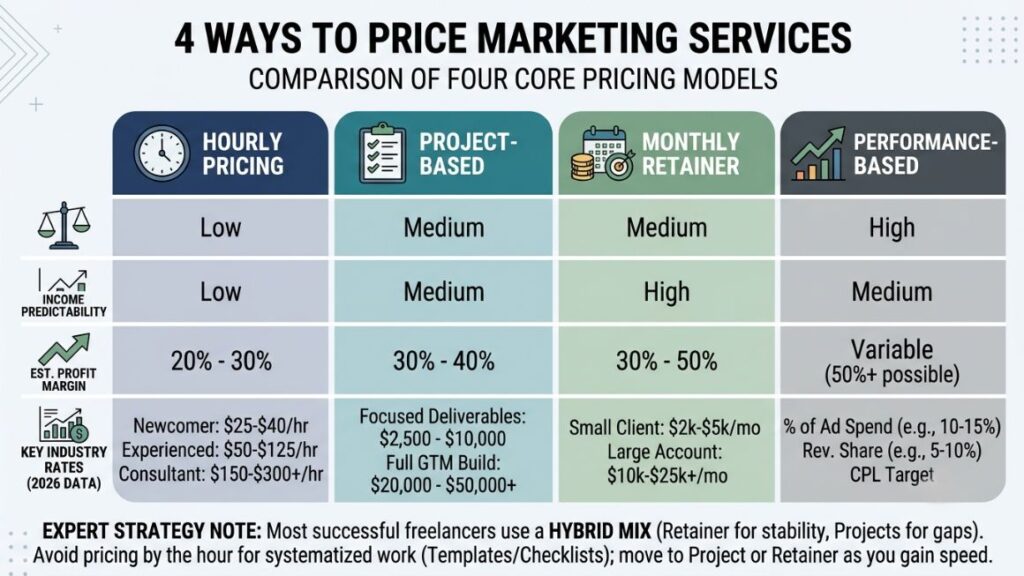
2026 industry rate data shows a clear progression by experience level: newcomers to freelance digital marketing typically charge $25 to $40 an hour, mid-level specialists charge $50 to $125, and expert consultants charge $150 to $300 or more. Retainer-based pricing is associated with 30% to 50% higher profit margins than project-based work, largely because retainer relationships last significantly longer on average.
How to Package Your Services So Clients Actually Buy?
“I do marketing” does not sell. It is too vague for a client to know whether you solve their specific problem, and vague offers get ignored in favor of specialists.
Compare that to “I run Meta ads for D2C skincare and wellness brands doing $50K to $500K a month in revenue.” That single sentence tells a prospective client exactly who you serve, exactly what you do, and gives them enough context to self-select in or out within seconds.
Build two or three clear packages instead of custom-quoting every single inquiry. A simple structure that works across most of the services above: a starter package (a single audit or a narrow scope, lower price, fast delivery), a core package (your main recurring offer, likely a monthly retainer), and a premium package (a broader scope or added strategic involvement, priced higher). Clear packages speed up sales conversations dramatically, since prospects are choosing between options instead of negotiating from scratch every time.
The audit or diagnostic offer deserves special mention, because it works as a low-friction way in almost regardless of which service you specialize in. A paid marketing audit, a paid SEO audit, a paid ad account review, gives a hesitant prospect a small, low-risk way to work with you before committing to a bigger retainer. Many freelancers convert a meaningful share of audit clients into ongoing retainer clients once the audit proves the value.
Read More: Making a Digital Marketing Proposal – Step-by-Step Guide
How to Get Your First Paying Client?
The first client is the hardest one, and it rarely comes from a portfolio website nobody has found yet.
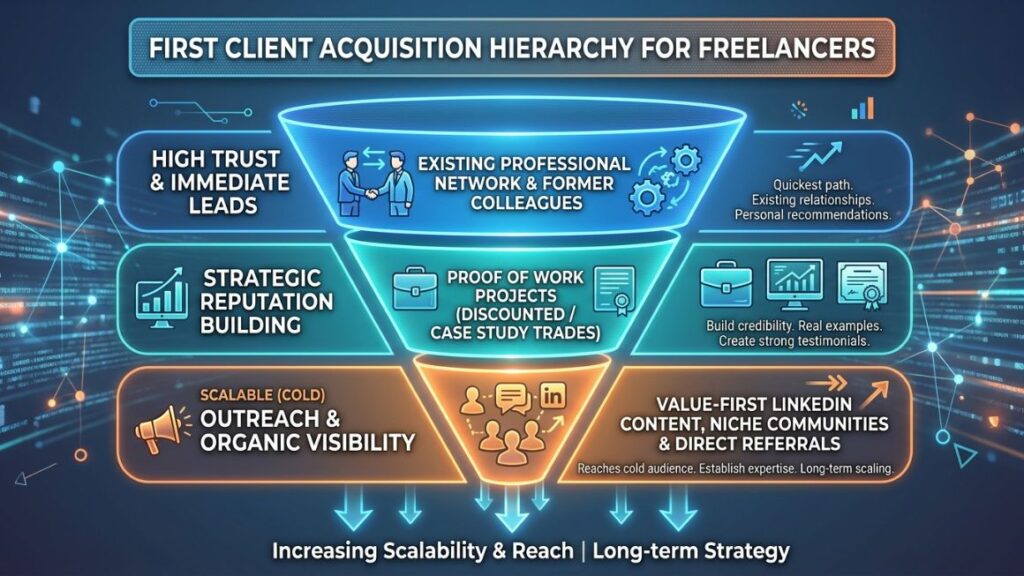
Start inside your existing network before you do any cold outreach. Former colleagues, people in your industry WhatsApp or Slack groups, and small business owners you already know personally are far more likely to hire you, or refer someone who will, than a stranger who found your LinkedIn profile. Most freelancers underuse this channel because it feels like “not real business development,” when it is usually the fastest path to a first client.
Solve the portfolio-before-permission problem by building proof of work before you have a paying client. Offer to run one campaign for a friend’s small business at a discounted rate, or in exchange for a case study and testimonial. Rework your own personal brand’s content as a live example of the skill you are selling. Clients rarely expect a perfect portfolio from a new freelancer. They expect evidence you can actually do the thing.
Once your network is exhausted, three channels produce the most consistent results: LinkedIn content that demonstrates real expertise rather than generic tips, direct referrals asked for explicitly from past or current clients, and niche communities, industry Slack or Discord groups, local business associations, where your specific ideal client already spends time. Marketplaces like Upwork and Fiverr can work, particularly for narrow, well-defined services like local SEO or paid media audits, but expect to compete heavily on price there until you have enough reviews and case studies to charge closer to your real rate.
Two things speed up how fast a first client turns into a second and third. Ask for the referral directly rather than hoping it happens. Most satisfied clients are willing to introduce you to someone else, but few do it unprompted, so build a simple habit of asking once a project wraps well. And ask for a written testimonial immediately after a good result lands, while the client’s enthusiasm is highest, rather than months later when the details have faded and the ask feels awkward.
Side Hustle vs. Full-Time: How to Know When to Make the Jump
There is no universal income number that tells you it is time to quit your job. A few signals matter more than any single figure.
Income replacement, with a buffer. Most people who transition safely have side hustle income covering somewhere between 50% and 75% of their salary for at least three consecutive months, not one good month that might have been luck.
Pipeline consistency, not just current income. If your side income depends entirely on one client, that is not a business yet, that is a second job with extra risk. Look for evidence that new client inquiries show up reasonably predictably, not just the clients you already have.
Sustainable hours, not burnout hours. If you are only hitting your side income numbers by working sixty-hour combined weeks for months on end, that pace will not survive the transition either. The real test is whether the business works at a pace you could sustain without a day job subsidizing your energy.
This decision deserves its own deeper look once you are close to making it, particularly around what actually changes when you go from solo freelancer to something bigger. If that stage is on your horizon, our guide on going from freelancer to agency owner covers what the next step looks like in detail.
Common Mistakes That Keep People Stuck at “Side Hustle” Forever
A few patterns show up again and again in freelancers who never break past side-hustle income.
Underpricing to win the first client, and never fixing it. Most freelancers price too low out of fear of losing the deal, then keep every subsequent client at that same low anchor because raising rates on existing clients feels uncomfortable. Price the first client low if you must, but treat it as a one-time discount, not your new floor.
Trying to serve everyone instead of picking a niche. “I help all kinds of businesses with all kinds of marketing” sounds like more opportunity. In practice, it makes referrals harder, since nobody can describe clearly what you do, and it makes every sales conversation start from zero instead of building on a reputation.
No repeatable way to find new clients. Freelancers who rely purely on whoever happens to reach out next live in a feast-or-famine cycle, busy for two months, panicked for one. A repeatable system, consistent content, a standing referral ask, a clear niche that generates inbound, is what turns unpredictable income into a real business.
Conclusion
The path from marketing skill to marketing income is rarely a straight line, and it does not require picking a permanent identity on day one. Start with one or two services you can genuinely deliver well, price them using a model that matches the work, and find your first client inside the network you already have.
If you are early in this process and unsure whether your current marketing skills are strong enough to charge for yet, that gap is worth closing before you start pitching. Young Urban Project’s digital marketing certification course is built for exactly this stage, practical, applied training across the channels covered in this article, designed to get you client-ready faster than piecing it together on your own.
FAQs on How to make money offering marketing services
What is the easiest marketing service to start selling with no experience?
Local SEO and Google Business Profile management for small businesses tends to be one of the most accessible starting points, since the deliverables are well-defined and small business owners see the value quickly. Social media management is also common, though it is the most saturated service on this list, so differentiation matters more there.
How much can you realistically make offering marketing services as a side hustle?
It depends heavily on the service and pricing model, but a newcomer running one or two retainer clients at $500 to $1,500 a month each is a realistic early-stage outcome. Reaching full-time-replacing income typically requires either several retainer clients or a mix of retainers and project work, built over several months, not weeks.
Do I need certifications to start offering marketing services?
No, though certifications can help build initial credibility, especially with your very first clients who have nothing else to judge you on. Actual results and case studies, even small ones, tend to matter far more than certifications once you have a few clients under your belt.
Should I specialize in one service or offer several?
Specializing in one or two closely related services is almost always the faster path to steady income, since it makes your positioning clearer and your referrals easier. Broader generalist offers can work later, once you have enough reputation that clients seek you out specifically.
What is the difference between freelance marketing services and a marketing side hustle?
There is no strict technical difference. “Side hustle” typically implies part-time work alongside a full-time job, while “freelance” often implies it is your primary source of income. Many people start with a side hustle and grow it into full-time freelance work using the exact same services and skills.
Which platforms are best for finding marketing clients?
LinkedIn content and direct referrals tend to produce the highest-quality, best-paying clients over time. Marketplaces like Upwork and Fiverr can generate early volume, particularly for narrowly defined services, but usually at lower rates until you build enough reviews to compete on more than price.
How do I price my services if I have no prior client work to reference?
Start by researching current market rates for your specific service and experience level, then price slightly below the low end of that range for your first one or two clients, with a clear plan to raise rates once you have results and testimonials. Avoid pricing so low that the engagement feels unsustainable or signals low quality.
Can I offer marketing services while still working a full-time job?
Yes, and most people do exactly this to start. Retainer clients with clearly defined, limited scopes, a set number of posts, a set ad budget managed, a monthly report, are generally easier to manage around a full-time job than open-ended project work with unpredictable time demands.
How do I know when to raise my prices?
The clearest signal is consistent demand outpacing your available capacity, turning down new inquiries because you are already full is the strongest possible evidence you are priced below the market. Raising rates for new clients while honoring existing agreements for a defined period is the most common, lowest-friction approach.