
Purpose-driven marketing has a trust problem right now. This is not because purpose stopped working, but because too many brands started faking it.
A few years back, it used to be enough to slap a social cause onto a product launch to earn credit for caring. That window is now closed. Consumers scroll past a purpose campaign. They check the brand’s actual track record in about ten seconds and then decide whether it’s real or theatre. Getting caught faking it now costs much more than staying quiet would have.
That’s the tension every marketer working on purpose-driven marketing has to sit with in 2026. This piece breaks down what purpose-driven marketing actually means and the data behind why it still works. Understand exactly why it backfires when brands fake it and how Indian brands like Mamaearth, boAt, Swiggy and Rasa Jaipur are handling it differently. You’ll also get a step-by-step framework for building a purpose strategy that survives scrutiny.
Table of Contents
What Is Purpose-Driven Marketing?
Purpose-driven marketing is a strategy where a brand builds its messaging, product decisions, and business practices around a specific social, environmental, or human need it’s genuinely committed to addressing, not just a message it runs during campaign season.
That’s the standalone definition. Everything else in this article explains why the second half of that sentence, the “genuinely committed” part, is where most brands trip up.
How It’s Different From Cause Marketing and CSR
People use purpose-driven marketing, cause marketing and CSR interchangeably. They aren’t the same thing. Mixing them up is usually where the trouble starts.
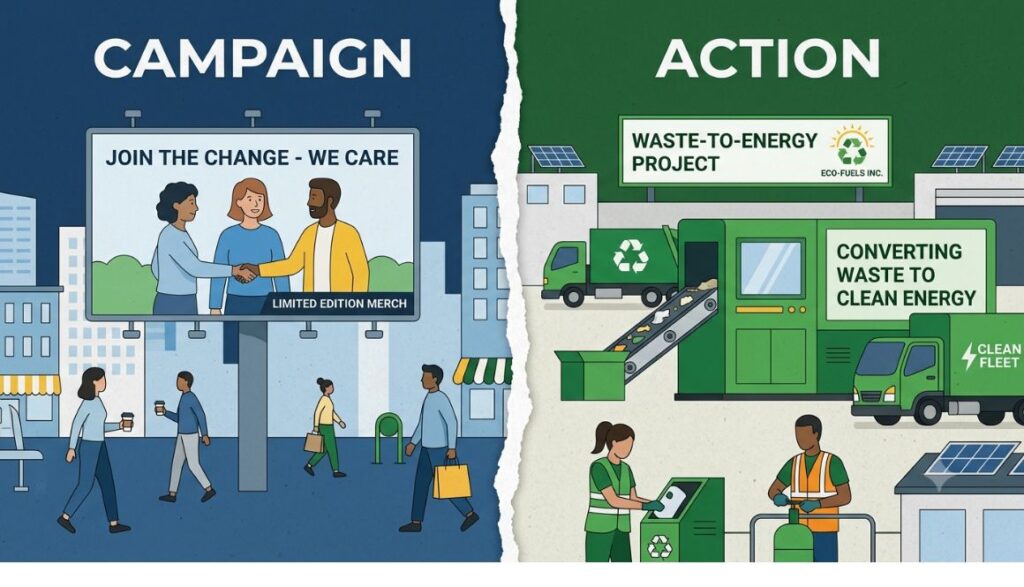
CSR or corporate social responsibility typically sits in a separate department. They run alongside the core business and show up in an annual report nobody outside the company reads. Cause marketing is narrower still. It’s a campaign-level tactic and often tied to a single product or a limited-time push. This is like a percentage of sales going to a charity for one quarter.
Purpose-driven marketing is different because the purpose is supposed to run through the product itself, not sit next to it. Patagonia’s environmental stance isn’t a campaign it runs in April. It’s baked into how the company sources materials. Repairs products instead of replacing them and structures its ownership. Things go wrong where purpose lives only in the marketing department and never touches sourcing, hiring or product design. That’s when it stops being purpose-driven marketing and becomes advertising with better intentions.
Read More: How to Create AI-Driven Marketing Campaigns
Why “Purpose” Became a Marketing Buzzword Before It Became a Strategy
Here’s the problem: purpose got popular for the wrong reason first.
Around 2018 to 2021, brand purpose became the industry’s favourite slide in every pitch deck. Agencies sold it. Consultants built frameworks around it. And a lot of companies adopted the language of purpose without doing the operational work underneath it. They wrote a purpose statement, ran a values-forward ad, and called it done.
That’s exactly why the backlash exists now. Consumers spent years watching purpose get used as decoration. They are now good at spotting the difference between a brand that changed something and a brand that just changed its tagline.
Purpose-driven marketing means building messaging and product decisions around a genuine and operationally-backed commitment to a social or environmental need. This is distinct from cause marketing, which is campaign-level and CSR. That typically sits outside the core business. The difference between the three is whether the commitment shows up in how the product is made, not just how it’s advertised.

Why Purpose-Driven Marketing Works: The Data Behind It
Brand trust in 2026 is now being redistributed away from institutions and toward brands. That shift is measurable across multiple independent sources.
According to Edelman’s data, 80% of people trust the brands they use, compared to just 54% for government and 55% for media, and for the first time, trust is now equal to price and quality as a factor in purchase decisions. That’s a structural shift, not a seasonal one. Brand purpose stops being a nice-to-have and starts affecting revenue directly when trust competes directly with price at the point of purchase.
The nuance matters here, though. Edelman’s 2025 research also found that 64% of people say they choose brands based on their beliefs, up 4 points year-over-year, and 68% say it’s very or extremely important that brands make them feel good. Purpose hasn’t declined. It’s gotten more personal and less grandiose. People aren’t asking brands to solve geopolitics. They’re asking brands to show up consistently in ways that matter to their actual daily lives.
Kantar’s BrandZ research backs this from the financial side. Brands that improved their meaning and relevance with consumers increased their brand value by an average of 129% since 2019, compared with 80% growth for brands that lost meaning over the same period. That’s a 49 percentage point gap in brand value growth, tied directly to whether consumers found the brand meaningful.
On the willingness-to-pay side, PwC’s 2024 Voice of the Consumer Survey found that consumers are willing to spend an average of 9.7% more for sustainably produced or sourced goods, even amid cost-of-living pressures, with almost nine in ten reporting they’ve felt the disruptive effects of climate change first-hand. That premium held even in a survey year dominated by inflation anxiety, which tells you the willingness to pay isn’t a luxury behaviour that disappears the moment budgets tighten.
| Source | Finding | Year |
| Edelman Trust Barometer | Brands trusted more than government or media (80% vs 54-55%) | 2025 |
| Edelman Trust Barometer | Edelman Trust Barometer | 2025 |
| Kantar BrandZ | Meaningful brands grew brand value 129% vs 80% for others since 2019 | 2026 |
| PwC Voice of the Consumer | Consumers pay 9.7% more on average for sustainable goods | 2024 |
| Forrester | 51% of Gen Z check CSR alignment before purchasing | 2021 |
Purpose-driven marketing is backed by measurable financial outcomes instead of just sentiment. Kantar’s BrandZ data shows meaningful brands grew brand value 129% since 2019 compared to 80% for brands that lost relevance. PwC found consumers pay a 9.7% average premium for sustainably sourced products even under inflationary pressure.
The Gen Z Effect: Why This Generation Forces Brands to Mean It
Ask any brand manager working in India’s D2C space why purpose suddenly has teeth, and they’ll point to the same answer. Gen Z doesn’t take a brand’s word for it.
Forrester found that 51% of Gen Z shoppers will check whether a brand’s corporate social responsibility aligns with their own values before making a purchase, and 42% of Gen Z distrust the average company, compared to 30% of millennials, 28% of Gen X, and 26% of baby boomers. This is a generation that starts from suspicion, not goodwill.
The research habit is the real shift, though. Older cohorts might glance at packaging. Gen Z runs an investigation. Qualtrics research found that 78% of Gen Z consumers said they research or check customer reviews most of the time before purchasing from a new brand. That’s not brand loyalty behaviour. That’s due diligence behaviour, applied to a bottle of shampoo.
And when a brand’s actions don’t match its claims, Gen Z doesn’t complain quietly and stick around. The same research found that 70% of Gen Zers have switched brands because the customer experience didn’t live up to the brand promise as advertised. That’s the enforcement mechanism. Purpose claims aren’t just marketing risk anymore. They’re a retention risk, checked against reality every single purchase cycle.
For Indian marketers, this shows up fastest in D2C categories where Gen Z is the primary buyer, personal care, streetwear, fitness apps, and increasingly, fintech. A values mismatch there doesn’t just lose a sale. It generates a comment thread.
This holds firmly for consumer-facing D2C brands targeting under-30 buyers. B2B purchasing follows a different and slower logic. This is where committees and long sales cycles dilute individual belief-driven decisions.
Read More: Gen Z Marketing Strategies in 2026
Purpose Washing: What It Is and Why It Backfires
Purpose washing is when a brand publicly claims a social or environmental commitment that its actual operations, supply chain, or business practices don’t support.
It’s the marketing equivalent of writing a check the company has no intention of cashing. And it almost always gets caught, because the gap between claim and reality is exactly what investigative journalists, regulators, and increasingly, random people on social media are trained to find.
Real Examples of Purpose-Driven Campaigns That Backfired
Purpose washing isn’t a fringe risk. It’s an active enforcement category now, with regulators involved.
In October 2025, a Paris court found French oil giant TotalEnergies guilty of greenwashing after ruling that the company deceived consumers by promoting carbon neutrality commitments while simultaneously expanding fossil fuel projects. The court didn’t just fine the company. It ordered TotalEnergies to remove the misleading claims and publish the decision publicly. That’s a purpose claim getting legally unwound in real time, in front of the public it was designed to reassure.
The Kendall Jenner Pepsi ad is the classic case study for a reason. Pepsi’s 2017 commercial showed Jenner joining a protest and handing a police officer a can of Pepsi, framed as a message of unity. It was pulled within 24 hours after widespread criticism that it trivialised real social movements to sell soda. Pepsi’s own statement admitted, “Clearly we missed the mark, and we apologize”. The lesson wasn’t that the topic was off-limits. It was that a brand with no operational connection to the cause it borrowed imagery from will get called out for borrowing it.
Closer to home, ASCI, India’s advertising watchdog, flagged 98% of ads it reviewed in 2024 as misleading, with real estate and online betting sectors making up a major chunk. That number should worry anyone writing purpose copy in India. Regulatory scrutiny on unsubstantiated claims isn’t a Western-market problem anymore.
The Signals Consumers Use to Spot a Fake
Consumers have gotten fast at this. A few patterns show up again and again.
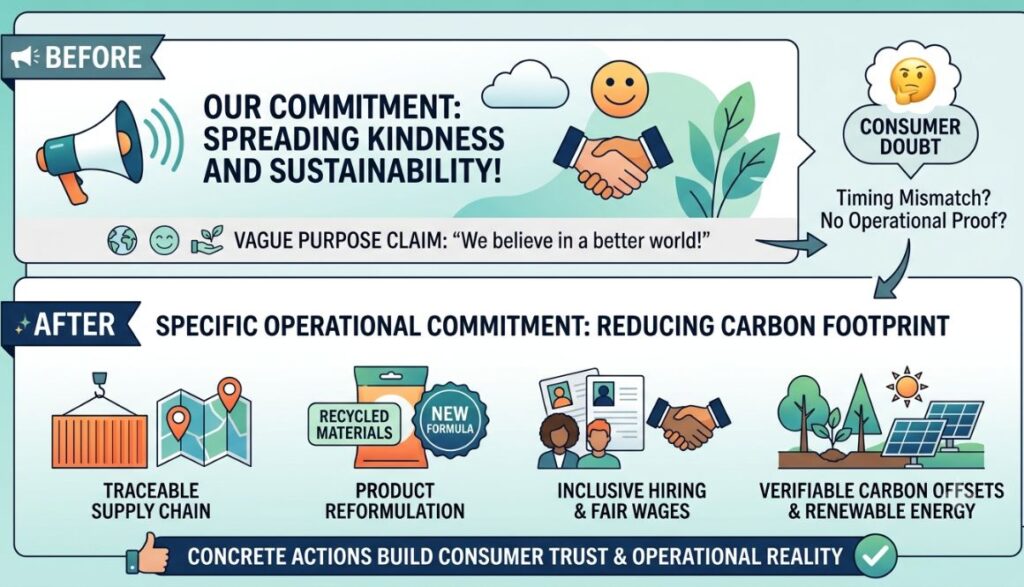
- Timing mismatches. A brand suddenly discovering a cause right when it needs a PR win looks calculated, not committed.
- No operational proof. If the purpose claim can’t be traced to a supply chain change, a hiring practice, or a product reformulation, it’s just copy.
- Silence under pressure. A brand that vanishes the moment its claim gets challenged confirms it never meant it.
- Scale mismatch. Planting a symbolic number of trees while running a resource-intensive core business reads as compensation theatre, not commitment.
Honestly, this scepticism has made marketing harder in a good way. It’s forced brands to actually do the internal work instead of outsourcing purpose to the copywriting team.
Purpose washing occurs when a brand’s public claims outpace its actual practices, and it’s increasingly an enforcement risk, not just a reputational one. France’s 2025 court ruling against TotalEnergies for greenwashing and ASCI flagging 98% of reviewed Indian ads as misleading in 2024 show that regulators are now actively testing purpose claims against operational reality.
How Purpose-Driven Marketing Is Playing Out in India Right Now
The purpose-driven marketing landscape of India looks different from the West’s. That difference is worth understanding before you copy a global playbook.
Western purpose marketing often centres on political and identity-based causes. Indian consumers respond more consistently to sustainability, women’s economic empowerment, craft and heritage preservation and accessibility. These are categories that connect to lived and tangible outcomes rather than abstract social positioning. That’s not a smaller ambition. It’s of a more grounded one and it tends to survive scrutiny better because it’s easier to verify.
Indian Brands Doing This Well: Mamaearth, boAt, Swiggy, Rasa Jaipur
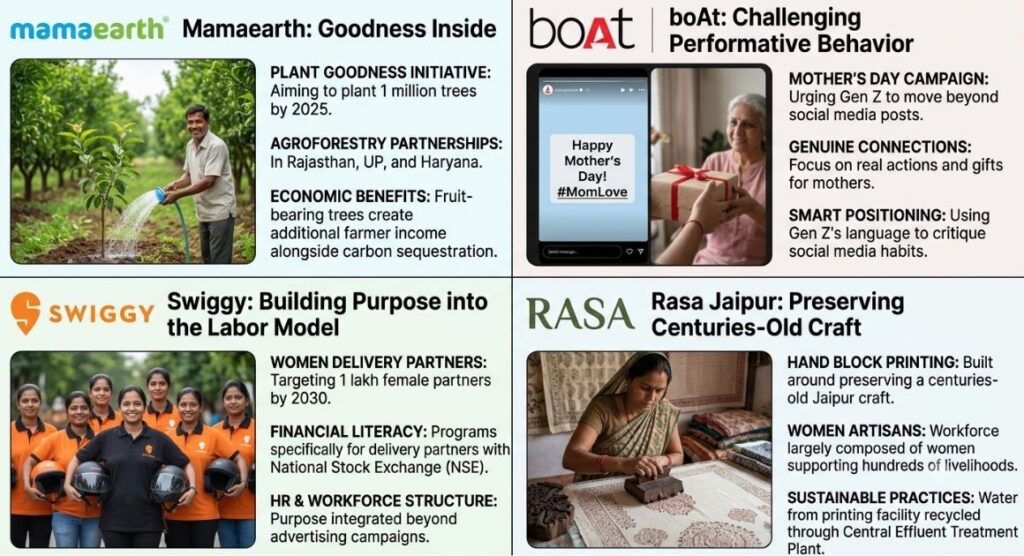
Mamaearth has built its entire brand identity around “Goodness Inside,”. It keeps extending that beyond the tagline. The Plant Goodness initiative of the brand aimed to plant one million trees by 2025. It has already planted 400,000 through agroforestry partnerships with farmers across Rajasthan, Uttar Pradesh and Haryana. This is where the trees are fruit bearing and create additional farmer income alongside carbon sequestration. That’s the detail that matters. The initiative doesn’t just plant trees; it structures the program so farmers benefit economically, which gives the “goodness” claim an operational backbone.
boAt approaches purpose less through grand statements and more through calling out performative behaviour in its own audience. Its 2025 Mother’s Day campaign with Blinkit urged Gen Z to move beyond posting an Instagram story and actually show up for their mothers with something real. It’s a small move, but it’s smart positioning: a brand built on Gen Z’s own language, poking fun at Gen Z’s own performative habits, while selling a genuine gift.
Swiggy has built purpose into its labour model rather than its advertising. The company set a target of 1 lakh female delivery partners by 2030 and partnered with the National Stock Exchange to roll out financial literacy programs specifically for its delivery partners, with special focus on women. That’s purpose showing up in HR policy and workforce structure, which is a much harder claim to fake than a campaign film.
Rasa Jaipur, a smaller but instructive example, built its entire business around preserving hand block printing, a centuries-old Jaipur craft. The brand works with a workforce that’s largely women and has influenced the livelihoods of several hundred artisans and craftsmen, recycling the water used in its printing facility through a Central Effluent Treatment Plant. It never needed a purpose campaign because the purpose is the product.
What Indian Consumers Specifically Respond To
Four themes show up consistently in Indian purpose-driven marketing that performs well. Sustainability tied to visibility. Local action like women’s economic empowerment, especially in gig and blue-collar work; craft and heritage preservation. This resonates with a strong sense of cultural pride. Accessibility or inclusion efforts that solve a concrete daily friction rather than making an abstract statement.
What doesn’t travel as well here is purpose borrowed wholesale from Western identity politics without local grounding. Indian consumers are quick to spot when a global campaign framework gets copy-pasted onto the Indian market without adaptation.
How to Build a Purpose-Driven Marketing Strategy? (Step-by-Step)
Building a purpose strategy that survives scrutiny isn’t about picking a cause. It’s about sequencing the work so the marketing comes last, not first.
Step 1: Find the purpose that’s already true about your company. Look at what your business already does, not what would look good. If your founders started the company to solve a specific problem, or your supply chain already avoids a harmful practice, that’s your starting point. Manufactured purpose is the easiest kind to expose.
Step 2: Test it against your supply chain and internal practices before you say it publicly. Pull your sourcing, hiring, and production data and check whether it actually supports the claim you want to make. If your sustainability claim doesn’t survive an audit of your own vendors, it doesn’t survive a journalist’s either.
Step 3: Build it into product and experience, not just a campaign. Purpose that lives only in an ad campaign has a shelf life measured in weeks. Purpose baked into packaging, pricing, hiring, or the product itself compounds over years, the way Mamaearth’s tree-planting model does.
Step 4: Choose the proof points you’ll show, not just claim. Specific numbers, named partnerships, and verifiable outcomes beat vague language every time. “We’ve planted 400,000 trees with named farmer partners in three states” survives scrutiny. “We care about the planet” doesn’t.
Step 5: Decide how you’ll respond when you’re challenged on it. Every purpose claim eventually gets tested publicly. Decide in advance whether you’ll double down with more transparency, correct course, or admit a gap, before you’re doing it live under pressure.
Building a purpose-driven marketing strategy that survives public scrutiny requires five sequential steps: identifying a purpose that’s already operationally true, auditing supply chain and internal practices against the claim, embedding the purpose in product rather than campaigns alone, choosing specific and verifiable proof points, and preparing a response plan for when the claim gets challenged.
Measuring Whether Purpose-Driven Marketing Is Actually Working
Reach and sentiment scores tell you almost nothing about whether purpose-driven marketing is working. They tell you whether people noticed the campaign, not whether it changed how they feel about the brand months later.
Metrics Beyond Reach and Sentiment
The metrics that actually matter sit closer to retention and behaviour than to awareness. Repeat purchase rate among consumers exposed to the purpose messaging is one. Net Promoter Score movement specifically among the segment targeted by the campaign is another. Price elasticity, whether customers hold steady when you raise prices slightly, tells you if the purpose premium PwC’s data describes is actually showing up in your own numbers.
Employee retention and applicant quality are underused signals too. A purpose that’s real usually shows up in who wants to work for the company, not just who wants to buy from it.
What to Track Over 12+ Months, Not One Campaign Cycle
This is the part most brands skip. A single campaign cycle, six to eight weeks, tells you almost nothing about whether purpose marketing built durable trust. Track cohort retention across a full year. Track whether the customers who engaged with your purpose messaging are still buying from you a year later at a higher rate than customers who didn’t. Track whether media coverage of your brand shifts from campaign-focused to practice-focused over time, which is a strong signal that the market has started believing the claim rather than just noticing it.
It depends on your category and margins, but generally, if your purpose metrics look great after one campaign and flat a year later, the purpose wasn’t real. It was a spike.
Common Mistakes Brands Make With Purpose-Driven Marketing
Most purpose marketing failures trace back to a handful of repeatable mistakes.
- Jumping on a cause with no operational backing. Picking a trending social issue because it’s culturally relevant, without any internal practice change to support it.
- One-off campaigns with no follow-through. Running a purpose-driven ad once and never mentioning the cause again, which reads as opportunism in hindsight.
- Tone-deaf timing. Launching purpose messaging during a moment when it clashes badly with current events or the brand’s own recent behaviour.
- Treating purpose as a PR layer instead of a business decision. Handing purpose entirely to the communications team instead of involving product, operations, and leadership.
Conclusion
Purpose-driven marketing isn’t dying. It’s getting harder to fake, which is a good thing for anyone actually doing the work.
The brands winning right now, Mamaearth, boAt, Swiggy, Rasa Jaipur, share one trait: their purpose claims are traceable to something real in the business, not just in the copy. That’s the entire game now. Before you write another purpose-driven campaign brief, pull your own supply chain and hiring data first, and see if it actually backs up what you’re about to say.
If you’re building out a full content and brand strategy around this, our Crystal Clear Newsletter breaks down real Indian brand case studies like these every week, the wins and the misfires, so you can see what’s actually moving the needle before you commit budget to it.
Frequently Asked Questions
What is purpose-driven marketing?
Purpose-driven marketing is a strategy where a brand’s messaging and business practices are built around a genuine social, environmental, or human need, rather than treating that cause as a standalone campaign. The purpose has to be traceable to actual product or operational decisions, not just advertising copy.
Is purpose-driven marketing the same as CSR?
No. CSR usually operates as a separate function alongside the core business, often reported annually and disconnected from day-to-day marketing. Purpose-driven marketing runs through the product and brand experience itself, which makes it harder to fake and, when done right, harder to ignore.
How do I know if my brand’s purpose is real or just marketing?
Test it against your own supply chain, hiring practices, and product decisions. If you can’t point to a specific operational change that supports your purpose claim, it’s marketing dressed up as purpose. A useful gut check: could a journalist verify this claim by looking at your vendor contracts or your internal policies?
Who should use purpose-driven marketing?
Any brand can, but it works best for companies where the founders or leadership genuinely started the business to solve a specific problem, and for categories where consumers actively research brand values before buying, like D2C personal care, fashion, and food. It’s harder to pull off convincingly for commodity categories with thin margins and no clear differentiation story.
Is purpose-driven marketing actually worth it, or is it just a trend?
The data suggests it’s worth it when done with real operational backing. Kantar found meaningful brands grew brand value 129% since 2019 versus 80% for others, and PwC found consumers pay a 9.7% average premium for sustainable goods. But the “worth it” calculation flips negative fast if the purpose claim gets exposed as fake, since the backlash tends to cost more than staying silent would have.
Do I need a huge budget to do purpose-driven marketing well?
No. Some of the strongest Indian examples, like Rasa Jaipur, are small businesses where the purpose is structurally embedded in a modest operation rather than funded by a large campaign budget. Scale of spend matters less than consistency between claim and practice.
Why do purpose-driven campaigns backfire?
They backfire when the public claim outruns what the company actually does. Consumers, journalists, and regulators increasingly check purpose claims against real operational evidence, and a mismatch gets treated as deception rather than an honest miss.
What’s the difference between purpose-driven marketing and cause marketing?
Cause marketing is typically a single campaign or product tie-in, often time-limited, like donating a percentage of one product’s sales to a charity for a quarter. Purpose-driven marketing is a sustained, structural commitment that shows up across the business, not just in one campaign.
How do I measure if purpose-driven marketing is working?
Look past reach and sentiment scores. Track repeat purchase rate among the audience exposed to purpose messaging, price elasticity, and cohort retention over 12 or more months rather than a single campaign cycle. If the effect disappears after a few months, it wasn’t durable trust, it was campaign novelty.
What do most brands get wrong about purpose-driven marketing?
They treat it as a communications task instead of a business decision. Purpose that lives only in the marketing department, disconnected from product, sourcing, and hiring, is the version most likely to get exposed and to damage the brand rather than build it.