
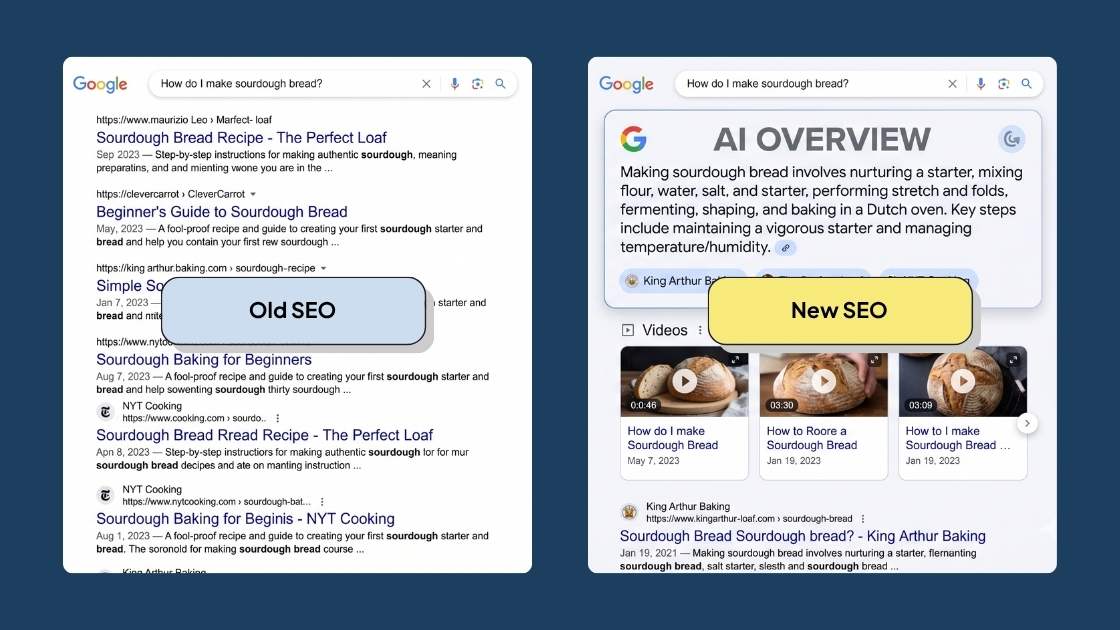
You’ve been doing SEO for years. You’ve built backlinks, written for keywords, obsessed over page one rankings. And it worked – for a while.
But if your organic traffic has been quietly declining over the past 18 months even as your rankings hold, you’re not imagining it. Something structural has changed. According to Similarweb’s 2024 Digital Market Report, over 60% of Google searches now end without a single click to any website. AI Overviews appear at the top of results and answer the question before the user even sees your listing.
At the same time, a parallel shift is happening. Millions of people aren’t using Google at all. They’re asking ChatGPT, Perplexity, and Bing Copilot their questions instead. And those tools pull answers from sources they cite – not a ranked list of ten blue links.
SEO isn’t dead. But the game has changed completely. Ranking is no longer enough. You need to be the source that AI answers quote.
This article breaks down why the old click-based SEO model is failing, what’s replacing it, and exactly how to build an SEO strategy for AI citations in 2025.
Table of Contents
Why Click-Based SEO No Longer Delivers What It Used To
The old SEO model had one job: get your page ranked at the top, drive the user to click through, and convert them on your site. It was built around the assumption that search was a traffic channel.
That assumption is now shaky.
Google’s rollout of AI Overviews (previously called Search Generative Experience) fundamentally changed the SERP. AI Overviews sit above organic results and synthesise a direct answer from multiple sources. Using the best LLM rank tracker helps businesses monitor how their brand and content are performing across AI-powered platforms like ChatGPT, Gemini, and Perplexity, ensuring they remain visible as AI-driven search continues to evolve. The sources get a tiny citation link, not a full organic listing. And for many queries, users get what they came for without clicking anywhere.
The data tells the story clearly. According to a 2024 study by SparkToro and Datos, Google sends 60% less traffic per search than it did five years ago. Informational queries, which are the bread and butter of most content marketing strategies, have been hit hardest. These are exactly the queries that used to drive the most blog traffic.
And it’s not just Google. ChatGPT crossed 100 million users faster than any consumer product in history and a large portion of that usage is informational search. Perplexity is growing rapidly as a serious alternative to Google for research-oriented queries. Bing Copilot integrates AI answers directly into its interface.
So what does this mean for your SEO investment? You can still rank on page one. You might get very little traffic for it. Unless your content is being pulled into the AI-generated answer at the top, you’re increasingly invisible.
Click-based SEO is declining as AI-generated answers replace traditional organic results on Google. According to SparkToro and Datos (2024), Google now sends 60% less traffic per search than five years ago. Informational queries have been hit hardest, as AI Overviews answer them directly on the search results page.
What is Zero-Click Search and Why is It Accelerating?
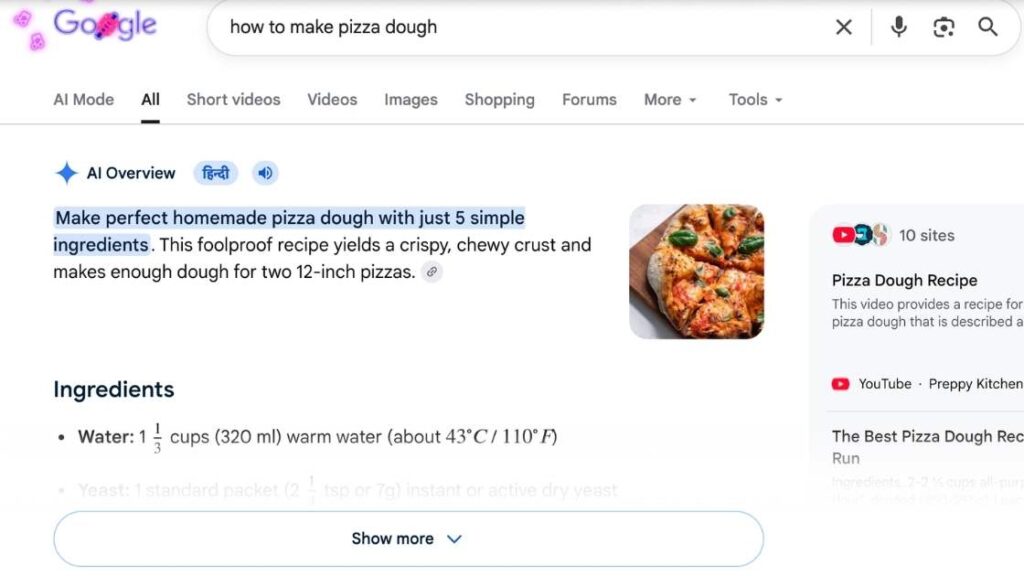
Zero-click search is a search session that ends without the user visiting any external website. The query gets answered on the search engine’s results page itself, whether by a featured snippet, a Knowledge Panel, a People Also Ask box, or now an AI Overview.
Zero-click was already a problem for SEO before AI Overviews. Featured snippets, direct answer boxes, and Google Business Profiles had been eating into organic clicks for years. AI Overviews have accelerated the trend dramatically by making zero-click the default experience for an expanding range of queries.
Here’s what makes the current shift different from past SERP updates: AI Overviews don’t just show a snippet. They synthesise. They pull content from multiple sources, rewrite it into a unified answer, and attribute it with small inline citations. The user reads a complete, coherent response – and has almost no reason to click through unless they want to go deeper.
For marketers who’ve built their organic strategy around informational content, this is the hardest hit. Listicles like “best marketing tools”, explainers like “what is a conversion funnel”, how-to guides like “how to set up Google Analytics” – all of these are exactly the query types that AI Overviews answer best. And all of them are losing click traffic.
That said, there’s a silver lining that most SEOs are not talking about enough. If your content is what the AI Overview pulls from, you’re getting something potentially more valuable than a click: you’re the source. You’re the authority that answered the question. That builds brand recall and credibility in a way a page-three organic listing never could.
The question is how you get there.
The Three New Search Surfaces You Need to Optimise For
There isn’t one new search surface. There are three, and they’re different enough that you need a distinct lens for each.
Google AI Overviews
AI Overviews appear at the top of Google results for a wide range of informational, how-to, and comparison queries. They’re generated by Google’s Gemini model, which reads and synthesises content from indexed pages. Google hasn’t published a rulebook for what gets cited in Overviews, but third-party research and testing has established fairly consistent patterns.
Pages that get cited in AI Overviews tend to have clear structure, direct answer sentences near the top of sections, and strong E-E-A-T (Experience, Expertise, Authoritativeness, Trustworthiness) signals. You still need to be indexed. You still need domain authority. But the content inside the page needs to be written differently.
ChatGPT and Bing Copilot
ChatGPT with browsing enabled and Bing Copilot both pull from live web content and cite sources inline. Bing Copilot in particular is now deeply integrated into Microsoft’s products – including Edge, Windows, and Microsoft 365. It runs on a combination of Bing’s index and OpenAI’s models.
For Bing Copilot, traditional Bing SEO signals apply, but the content structure requirements are similar to Google AI Overviews. Clear, factual, well-structured, citable.
ChatGPT without browsing (the base model) doesn’t pull from your site at all – it responds from training data. But ChatGPT with web search enabled does fetch and cite live pages, and that’s becoming more common as OpenAI integrates search deeper into its products.
Perplexity
Perplexity is the search engine most explicitly built around citations. Every answer includes a numbered list of sources. Users often check the sources, especially for research-heavy queries. Being cited on Perplexity has stronger click-through potential than being cited in a Google AI Overview, because Perplexity users are more research-oriented and more likely to read the source.
Perplexity uses a combination of its own crawl and APIs from Bing and other sources. Pages that get cited tend to have clean structure, clear factual sentences, and named entity data that aligns with the query.
What is GEO (Generative Engine Optimisation)?
Generative Engine Optimisation (GEO) is the practice of structuring content so that AI-generated answer engines cite it as a source in their responses.
GEO is different from traditional SEO in a critical way. Traditional SEO optimizes for ranking signals, which are largely about authority, relevance, and technical health. GEO optimizes for cutability, which is about content structure, factual clarity, and how well your content reads as a trustworthy primary source.
A paper published by researchers at Princeton, Georgia Tech, The Allen Institute for AI, and IIT Delhi in 2024 studied GEO systematically for the first time. They found that specific writing techniques significantly increased the probability of being cited in AI-generated answers. The highest-impact techniques were: including quotable statistics with source attribution, writing in fluent authoritative sentences rather than vague generalities, using citations from credible organisations within the content, and maintaining clear structure that maps to the query.
Most content marketers have never heard of GEO. That’s your opportunity.
Generative Engine Optimisation (GEO) is the practice of writing content so AI systems cite it in their answers. Research published by Princeton and IIT Delhi (2024) found that content with credible statistics, authoritative tone, clear structure, and named citations from reputable organisations is significantly more likely to be pulled into AI-generated responses.
What is AEO (Answer Engine Optimisation)?
Answer Engine Optimisation (AEO) is the practice of formatting content to win featured snippets, direct answers, and structured SERP features on traditional search engines like Google.
AEO isn’t new. Marketers have been chasing featured snippets since 2015. But AI Overviews have dramatically raised the stakes for AEO because the AI pulls heavily from the same content patterns that used to win snippets: direct answers, question-formatted headings, and clean structured content.
The difference between AEO and GEO is scope. AEO focuses primarily on Google’s answer surfaces (featured snippets, AI Overviews, People Also Ask). GEO extends to third-party AI engines like ChatGPT, Perplexity, and Copilot that don’t use Google’s index.
In practice, good AEO and good GEO look very similar at the content level. Both reward the same writing discipline: one direct answer per question, stated early, stated clearly.
Where they diverge is in technical signals. AEO cares about structured data markup (FAQ schema, HowTo schema, Article schema). GEO cares more about content density and factual credibility. You need both. Managing both is also why some brands bring in specialized GEO agencies to audit how ChatGPT and Perplexity describe them and close the citation gaps. Whether you outsource it or build the capability in-house, the goal stays the same: becoming a source that answer engines consistently trust and quote.
How to Write Content That AI Engines Actually Cite
This is the section most SEO guides skip. They’ll tell you to “write high-quality content” without explaining what high-quality means to an AI system scanning thousands of pages.
Here’s what actually works.
Open Every Section With a Direct Answer
Every major section of your article should begin with 1-3 sentences that directly answer the question implied by the heading. Write the answer first, then explain it.
AI Overviews and Perplexity are scanning for passage-level answers, not page-level ranking. A clear, self-contained answer at the top of a section is exactly the kind of passage they extract.
Don’t do this:
"Understanding the role of backlinks in modern SEO requires us to examine several historical and contemporary factors..."
Do this:
"Backlinks signal to Google that other sites consider your content credible. A high-authority backlink from a site like Forbes or The Economic Times has more impact than twenty links from low-traffic blogs."
The second version is citable. The first is not.
Write Standalone Definition Sentences for Every Key Term
Every key term you use should have a one-sentence definition that reads as a complete, self-contained statement. Not hedged. Not partial. Not “can be thought of as.”
This is what AI systems extract for definition queries. The more precisely you write these, the higher your citation probability.
Good: “Customer acquisition cost (CAC) is the total sales and marketing spend divided by the number of new customers acquired in the same period.”
Bad: “Customer acquisition cost, or CAC, is basically a measure of how much it costs you to get a new customer, taking into account things like ads, salaries, and tools.”
One is quotable. One is informal filler.
Add Statistics With Full Source Attribution
Cited statistics are one of the highest-impact GEO signals identified in the Princeton/IIT Delhi research. A standalone statistic with a named source and year is a ready-made citation capsule.
Every time you write a statistic, name the organization and the year inline: “According to HubSpot’s 2024 State of Marketing Report, 45% of marketers plan to increase their SEO budget.” Don’t say “studies show” or “research suggests.”
Two effects here. First, it signals to AI systems that your content is sourced, which raises trust. Second, AI systems often repeat the same statistic with attribution, and you become the first-degree source – which means you get cited even when the AI cites the original stat.
Use Question-Phrased Headings
AI systems match headings to user queries. If someone asks “what is performance marketing” and your H2 is literally “What Is Performance Marketing?”, the probability of that section being pulled into the answer is significantly higher than if your H2 is “Understanding Performance Marketing.”
Don’t force this on every heading. It reads badly when overdone. Use it for the primary definitional and how-to sections where the user’s actual query is clear.
Build FAQ Sections That Answer Real Searches
Every FAQ question should be written exactly as someone would type or speak a search query. Not formal interview questions. Real search language.
“Is performance marketing the same as digital marketing?” is a real query. “What is the distinction between performance marketing and digital marketing?” is not how people search.
FAQ sections are one of the highest-performing AEO elements. They feed People Also Ask boxes, they feed AI Overviews, and when marked up with FAQ schema, Google knows exactly what they are.
Content that wins AI citations follows a consistent pattern: direct answer sentences at the top of each section, standalone definition sentences for key terms, statistics attributed to named organisations and years, and FAQ sections written in real search language. These techniques increase the probability of being extracted and cited by Google AI Overviews, Perplexity, and ChatGPT browsing.
Technical Changes Your Site Needs Right Now
Content structure is the biggest lever. But there are technical changes that meaningfully support your GEO and AEO strategy.
Implement structured data markup. FAQ schema, HowTo schema, and Article schema all help Google understand the type of content on your page and surface it correctly in AI-driven SERP features. If you’re on WordPress, plugins like RankMath and Yoast handle this without custom code. But you need to turn them on and configure them properly.
Create or update your llms.txt file. This is new. Several AI systems, including those built on Anthropic’s Claude and some research crawlers, check for a file called llms.txt in the root of your domain. It works like robots.txt but for AI models – it signals which content you want AI systems to read and index. As of 2025, this is still an emerging standard, but setting it up early costs nothing and could be a meaningful signal as the standard matures.
Make sure your site is crawlable by AI bots. Check your robots.txt file. If you have blanket disallow rules that block all non-Google bots, you may be blocking Perplexity’s crawler (PerplexityBot), OpenAI’s crawler (GPTBot), and Anthropic’s crawler (ClaudeBot). Each of these has a specific user-agent name you can check for and explicitly allow.
Page speed and Core Web Vitals still matter. AI systems pull from indexed pages. If your pages are slow to load or have poor Core Web Vitals scores, they may not be crawled often or deeply. This is basic infrastructure, not new, but worth auditing.
Internal linking helps passage-level ranking. Google uses internal links to understand how pages and sections relate. For AI Overviews, passage-level signals matter – strong internal links to and from your most citable content help Google understand that content as authoritative.
What Still Works: The Parts of Traditional SEO You Should Keep
Not everything has changed. A few things are as important as they ever were, and some practitioners are abandoning them too early.
Backlinks still matter for domain authority. AI systems, including Google’s Gemini model behind AI Overviews, weight domain authority in deciding which sources to cite. A high-authority domain gets more citation opportunities. The strategies that build authority, including PR, guest publishing, original research, and digital PR campaigns, are still worth doing.
Keyword research is still the foundation. You need to know what people are actually searching before you can write content that answers it. The vocabulary changes slightly (more conversational, more question-based) but the process of identifying real search demand is unchanged.
Long-form, comprehensive content outperforms thin content. This was true before AI Overviews and remains true. AI systems prefer pages with enough depth to answer follow-up questions, not just the exact query. Comprehensive pillar content still wins.
Site architecture and crawlability. Your best content can’t be cited if it can’t be found. Technical SEO fundamentals, including clean sitemaps, no crawl errors, and well-structured URLs, still matter.
What doesn’t work anymore: writing content optimised purely for the same keyword ten times over, building pages designed to rank rather than to answer, and optimising only for one specific query phrase when users ask the same thing in twenty different ways.
How to Measure SEO Success When You Can’t Count Clicks
The old success metric was simple: organic sessions in Google Analytics. That number is now an incomplete picture.
If AI Overviews are citing your content but the user never clicks through, your GA data shows zero. But you still got the reach. You still built the brand impression. The metric is broken, not the outcome.
Here’s what to track instead.
Track branded search volume. If people are seeing your brand name in AI citations and then searching for you directly, branded search volume rises. Measure this in Google Search Console. It’s an indirect signal of AI citation reach.
Monitor AI citations directly. Search your most important topics on Perplexity, ChatGPT, and Google AI Overviews and note whether your content appears. This isn’t automated yet for most teams, but manual monitoring monthly for ten core topics will tell you whether your strategy is working. Tools like SE Ranking and Semrush are building AI Overview tracking features into their platforms.
Track impressions alongside clicks. In Google Search Console, a rising impression count with flat clicks is a signal that you’re appearing in AI-driven SERPs but not getting the click. That’s not a failure. It means you’re in the consideration set. Track the impressions-to-click ratio by query type and look for where you’re winning impressions without clicks, and whether that changes when you improve content for AI citation.
Brand mention tracking. Use a tool like Mention or Brand24 to track when your brand name is mentioned across the web, including in AI-generated answers that get shared on social media or embedded in newsletters.
None of these replace a full analytics setup. But they give you a more complete picture of your SEO performance in a world where the click is no longer the primary signal.
Traditional organic session tracking understates the value of AI-era SEO. When AI Overviews or Perplexity cite your content, users may recall your brand without clicking through. Measurement should now include branded search volume, AI citation monitoring, impressions-to-click ratios in Google Search Console, and brand mention tracking across the web.
FAQ
What is zero-click search?
Zero-click search is a search session that ends without the user clicking any external link. The answer is delivered directly on the search engine results page, through AI Overviews, featured snippets, Knowledge Panels, or other SERP features. According to Similarweb’s 2024 Digital Market Report, zero-click search now accounts for over 60% of Google searches.
What is GEO and how is it different from SEO?
GEO stands for Generative Engine Optimisation. It’s the practice of writing and structuring content so that AI-generated answer engines, such as ChatGPT, Perplexity, and Google AI Overviews, cite your content in their responses. Traditional SEO focuses on ranking signals like backlinks and keyword relevance. GEO focuses on citeability: clear writing, direct answers, sourced statistics, and named entities that AI systems can extract and quote.
Is traditional SEO dead?
No. Domain authority, backlinks, keyword research, and technical SEO still matter. What’s changed is that ranking on page one is no longer sufficient by itself. Content also needs to be structured for passage-level extraction and citation in AI-generated answers. Traditional SEO and GEO/AEO are not alternatives; you need both.
How do I get cited in Google AI Overviews?
Google hasn’t published a definitive guide, but third-party research consistently shows the same content signals: direct answer sentences at the top of each section, standalone definition sentences for key terms, properly attributed statistics, FAQ sections with question-phrased headings, and strong E-E-A-T signals across your domain. Implementing FAQ schema markup also helps.
How do I get my content indexed by ChatGPT and Perplexity?
ChatGPT’s browsing mode and Perplexity use web crawlers with specific user-agents. Ensure your robots.txt file doesn’t block GPTBot (OpenAI’s crawler) or PerplexityBot. Both crawlers need to be able to access your content. Beyond that, the same content quality signals that help with Google apply: clear structure, factual writing, and sourced claims.
What is AEO?
AEO stands for Answer Engine Optimisation. It’s the practice of formatting content to win Google’s direct answer features: featured snippets, AI Overviews, People Also Ask boxes, and voice search answers. AEO focuses specifically on Google’s SERP features, while GEO extends to third-party AI systems. In practice, they use very similar content techniques.
Does keyword density still matter?
Not as a raw number. What matters is natural keyword usage that reflects what users actually search. Stuffing a keyword ten times into a page no longer helps ranking and can hurt it. Write for the question behind the keyword, not the keyword itself. Semantic relevance, which means covering related concepts and subtopics, matters more than keyword frequency.
What is llms.txt and do I need it?
llms.txt is an emerging standard for telling AI models what content on your site you want them to read and index. It sits in the root of your domain, like robots.txt. As of 2025, it’s not universally adopted by AI crawlers, but setting it up is low-effort and signals that you’re optimising for AI discoverability. Some AI systems built on models by Anthropic and others check for it during crawling.
How do I measure SEO if clicks are falling?
Measure a wider set of signals: branded search volume (via Google Search Console), impressions alongside clicks, direct AI citation monitoring on Perplexity and ChatGPT, and brand mention tracking through tools like Brand24 or Mention. Falling clicks with stable or rising impressions may mean AI Overviews are surfacing your content, which still builds brand awareness. Track both.
Conclusion
The fundamentals of SEO haven’t disappeared. Domain authority, keyword research, clean site architecture – these still matter. But they’re no longer sufficient.
The search engine you rank on has changed its job description. Google used to deliver users to answers. Now it is the answer, for a growing majority of queries. And the new AI engines like Perplexity and ChatGPT have never been in the business of sending traffic. They’ve always been about answering.
If you’re still writing content optimised purely for a keyword ranking and a click, you’re playing a game that’s getting harder and paying less. The shift to writing for AI citations, writing direct answer blocks, writing standalone definitions, writing with sourced statistics, isn’t a trend to watch. It’s a practice to build now, while most of your competitors haven’t caught on.
The best time to start was when AI Overviews launched. The second best time is now.