
Doubling your ad budget rarely doubles your revenue. Plenty of advertisers learn that the hard way: spend climbs, clicks pile up, the dashboard fills with reactions and link clicks, and the bank balance barely moves. That isn’t a traffic problem. It’s a return problem.
Learning how to improve Facebook Ads ROAS starts with one uncomfortable admission. ROAS (return on ad spend, the revenue you earn for every rupee you put into ads) is only half the picture. A 4x return can still lose money once product cost, shipping and returns are counted, so Facebook Ads ROAS has to be read next to profit, every single time.
This guide covers 12 strategies, from fixing your tracking and testing creatives to smarter retargeting, cleaner campaign structure and customer lifetime value. Some take an afternoon. Others take weeks of patient testing. Start wherever it hurts most.
Table of Contents
What Is ROAS and Why Does It Matter for Facebook Advertising?
ROAS is the revenue your ads generate divided by what you spent on them. It shows how hard each rupee of ad spend is working, but it doesn’t tell you whether you made a profit. Meta Ads Manager reports it as purchase ROAS for every campaign, ad set and ad.
Understanding Return on Ad Spend
Revenue isn’t profit. Sell a ₹2,000 jacket that costs ₹1,400 to make, ship and service, and the ad behind that sale earned you ₹600 at best, whatever the dashboard claims.
Meta Ads ROAS also depends on the attribution window you’ve picked. The default is 7-day click and 1-day view, and since 12 January 2026 Meta no longer offers 7-day or 28-day view windows, according to Dataslayer’s breakdown of the change. Older reports may not line up with today’s numbers.
Also Read: Marketing Efficiency Ratio (MER): The Metric Smart Marketers Use to Scale Revenue
How to Calculate ROAS?
ROAS = revenue attributed to ads ÷ advertising spend
Spend ₹20,000, get ₹80,000 in attributed revenue, and your ROAS is 4x. Easy. Knowing whether 4x is any good is the harder bit.
That’s where Break-even ROAS comes in. It’s the return at which your ads exactly cover their own costs, and you find it by dividing 1 by your profit margin after product cost, shipping, payment fees and returns. At a 40% margin, the answer is 2.5x. Below that, every sale loses money.
What Is a Good ROAS for Facebook Ads?
There’s no universal number. Triple Whale’s 2025 benchmark report, covering nearly 35,000 ecommerce brands, put the median Meta ROAS at 1.86. Some brands do well on that. Others lose money at 4x.
Margin is the difference. Fulfilment costs, returns and repeat purchases all shift the line, which is why your own break-even number beats any industry average. Anyone who wants to improve Facebook Ads ROAS needs that number first.
ROAS is revenue divided by ad spend, but a good ROAS depends on profit margin, not an industry average. Triple Whale’s 2025 data put the median Meta ROAS for ecommerce at 1.86. The target worth chasing is 1 divided by your margin.
Why Are Your Facebook Ads Generating Low ROAS?
Facebook ads generate low ROAS when the audience, creative, tracking, landing page or offer fails to turn clicks into profitable purchases. Most accounts have more than one of these problems at once.
Here’s an illustrative case. A campaign spends ₹24,000, collects 1,800 link clicks and 9 purchases. At an average order of ₹1,800, that’s ₹16,200 in revenue, or a ROAS of about 0.7x. The clicks looked healthy. The business didn’t.
The usual causes:
- An audience that doesn’t match the message
- Creatives nobody stops scrolling for
- Conversion tracking that misses or double-counts purchases
- A landing page that loses people
- An offer that doesn’t make buying feel worthwhile
- Budget spread thinly across too many campaigns
- Acquisition costs your margins can’t carry
- Optimisation done in random bursts instead of on a schedule
Fixing any single one can improve Facebook Ads ROAS, but it’s usually two or three working together, which is why guessing rarely works.
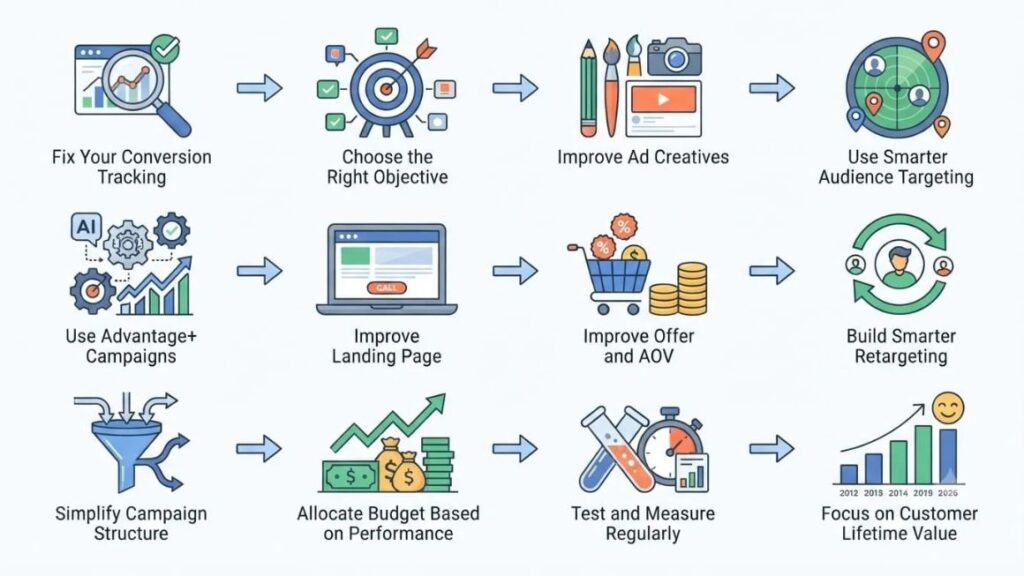
How to Improve Facebook Ads ROAS: 12 Strategies That Actually Work
To improve Facebook Ads ROAS, fix tracking first, then test creatives, then tighten the landing page and offer. Targeting, structure and scaling come afterwards, because they only work on clean data and ads people respond to.
1. Fix Your Conversion Tracking Before Optimising Campaigns
Nothing else on this list matters if the numbers are wrong. Facebook Ads tracking should run through both the Meta Pixel and the Conversions API (CAPI), which sends events from your server. Meta calls this a redundant setup and recommends it.
The catch is duplication. Send the same event name and event ID from both sources, and Meta discards the repeat if both arrive within 48 hours, per its developer documentation. Pass the right purchase value and currency every time, then test events in Events Manager. Finally, compare Meta’s purchase count with your store or CRM each week. Some gap is normal. A big one means something’s broken.
Practical tip: never make a major budget decision on conversion data you haven’t verified.
2. Choose the Right Campaign Objective and Optimisation Event
What exactly are you asking Meta to find? Pick the Sales objective for ecommerce purchases. Pick a lead objective if you generate and qualify leads, and optimise for the qualified lead where you can, not the cheapest form fill. Then choose the conversion location, such as your website, app or messaging, where the sale really happens.
When order values vary a lot, optimising for purchase value can push delivery towards bigger baskets. It suits stores with a wide price range. It’s pointless if everything costs about the same.
The rule is simple. Optimise for add-to-cart because it’s cheaper, and you’ll get add-to-carts. Match the objective to the business outcome.
Also Read: How to Create a Facebook Ads Strategy in 2026 (Step-by-Step Guide)
3. Improve Your Ad Creatives and Test Different Angles
In most accounts, creative is the biggest lever to improve Facebook Ads ROAS. Facebook ad creative testing works best when each test is a different idea, not a different font. UGC-style videos, product demonstrations, customer testimonials and problem-and-solution stories each pull different buyers. Before-and-after formats can work too, but read Meta’s advertising standards first, because health and personal-attribute claims get rejected quickly.
Test three genuinely different concepts for one product, not three near-identical ads. Compare static images against video. Test hooks, the opening three seconds, separately from the main message.
Then watch for fatigue. Frequency creeping up while click-through rate slides means people have seen enough. Refresh before performance collapses, not after.
4. Use Smarter Audience Targeting
Facebook Ads targeting has quietly changed. Broad audiences, with no interests or lookalikes layered on, often perform well because Meta’s system finds buyers from your conversion signals. Often, not always.
Custom audiences still earn their place: customer lists, site visitors, people who engaged with your page. Built from first-party data (information you collected yourself), they’re also more reliable. Lookalike audiences are worth testing where they’re available. Exclude existing customers when the goal is new buyers.
Match message to audience as well. A first-time buyer needs a different pitch from a returning one. And resist stacking restrictions, because narrow targeting shrinks delivery, pushes costs up and starves the system of data.
5. Make Better Use of Advantage+ Campaigns
Advantage+ sales campaigns are Meta’s automated campaign type for sales. They replaced Advantage+ shopping campaigns and handle audience discovery, placements, budget and creative enhancements, with product catalogue integration for stores that have one.
Meta’s own global testing claims an average 32% higher ROAS and 17% lower CPA than manual-only setups, as reported in AdLibrary’s 2026 analysis. Treat that as a vendor average, not a promise for your account.
Automation makes sense when your tracking is clean, your offer is strong and you can feed it varied creative. Weak inputs get weak results, however clever the system. Keep manual campaigns for controlled audience tests, tight placement control, or when conversion volume is too thin for the system to learn from.
6. Improve Your Landing Page and Website Experience
A great ad can still die on a bad page. Facebook Ads conversion rate depends on what happens after the click: how fast the page loads, whether it works on a phone, and whether it repeats the promise the ad made. If the ad says 20% off, that offer should be the first thing visitors see.
Then the usual suspects. Clear product benefits. Reviews and trust signals. One obvious call to action. A short checkout, with shipping and returns information shown before the final step. In many Indian categories, offering UPI and cash on delivery also removes a common reason for dropping off.
Often the cheapest way to improve Facebook Ads ROAS is sitting on your website, not in Ads Manager.
7. Improve Your Offer and Average Order Value
Raising order value lifts ROAS without spending another rupee. Take an illustrative case: 50 orders from ₹40,000 of spend. At an average order of ₹1,200, revenue is ₹60,000 and ROAS is 1.5x. Lift the average to ₹1,500 and revenue becomes ₹75,000, which makes ROAS 1.875x. Same spend. Same customers.
How do you get there? Bundles, quantity discounts, cross-sells and upsells. A free shipping threshold set slightly above your current average order nudges baskets upward. First-purchase incentives help new buyers commit, and subscription options suit products people reorder.
8. Build a Smarter Retargeting Strategy
Facebook Ads retargeting can look like magic in reports. Of course it does: the people you’re targeting already visited, so they convert more.
Split them by intent: site visitors, product viewers, add-to-cart audiences, checkout abandoners and past customers. Show each group something that fits where they stopped. Exclude recent purchasers.
The limits matter, though. Audiences can be small, overlap with each other and get hit too often, so watch frequency. Attribution can also credit retargeting for sales that would have happened anyway. Don’t assume it’s all incremental. A conversion lift test, or a simple holdout where one group sees no retargeting, shows what it truly adds.
9. Simplify Your Campaign Structure
Fewer campaigns usually means better data. Splitting a modest budget across ten ad sets leaves each one too hungry to learn. Meta’s guidance puts the exit from the learning phase at roughly 50 optimisation events within 7 days per ad set. So consolidate similar audiences, and keep campaigns separate only when business objectives differ.
Facebook Ads optimization is mostly restraint. Significant edits, such as changing targeting, creative or the optimisation event, or pausing for a week or more, restart learning. Batch your changes. Let ad sets settle. It’s an unglamorous way to improve Facebook Ads ROAS, and it works.
10. Allocate Your Budget Based on Actual Performance
Money should follow results, not mood. Look for campaigns that stay above your break-even number across several weeks, not days, and read CPA, ROAS and conversion volume together.
Here’s an illustrative example. Campaign A spends ₹30,000 a month at 1.4x against a 2.2x break-even. Campaign B spends the same at 3.1x. Move ₹10,000 from A to B, then check again.
A sensible Facebook Ads scaling strategy raises budgets gradually. Many media buyers cap increases at around 20% at a time, which is a rule of thumb, not a Meta rule. Keep a small testing budget too, or you’ll have nothing new to scale next quarter.
11. Test, Measure, and Optimise Your Ads Regularly
A/B testing only works if you change one meaningful thing at a time: a creative concept, an audience, an offer, a landing page. Change three and you’ve learned nothing. The A/B test tool in Meta Ads Manager can split audiences cleanly.
Compare comparable periods. A sale weekend against a quiet Tuesday isn’t a fair fight. And don’t call winners on a handful of purchases. Eight sales on one side and eleven on the other proves nothing. Wait for enough volume, then act.
12. Focus on Customer Lifetime Value, Not Just First Purchases
Some of the best campaigns look mediocre on day one. A 1.8x first-order ROAS against a 2.5x break-even is a loss on paper. But if customers come back and buy again, the picture flips.
Email and WhatsApp follow-ups, where customers have given consent, bring them back. Loyalty programmes, subscriptions and replenishment reminders help in repeat-purchase categories. Measure acquisition cost against what a customer is worth over time, not just the first basket. That changes how you improve Facebook Ads ROAS over months rather than weeks.
Also Read: How to Calculate Customer Lifetime Value (LTV): A Step-by-Step Setup Guide
The fastest way to improve Facebook Ads ROAS is to fix tracking, test genuinely different creatives and tighten the landing page and offer. Structure, targeting and scaling work only when those foundations are sound. Lower first-order ROAS can still be profitable when customers return.

How to Diagnose and Fix a Low-ROAS Campaign?
When you need to improve Facebook Ads ROAS quickly, start with the symptom, not the setting. Different leaks in the funnel point to different causes, and the table below maps each pattern to where you should look.
| What you observe | Possible issue | What to investigate |
| High impressions, low clicks | Weak creative or message | Hooks, visuals and relevance |
| High clicks, low purchases | Landing page or offer issue | Website experience and checkout |
| High add-to-carts, low purchases | Checkout friction | Shipping, payment and trust |
| High CPA, low ROAS | Acquisition economics | Offer, audience and conversion rate |
| Sudden ROAS decline | Tracking or performance change | Events, attribution and campaign history |
Before touching anything, work out whether it’s a tracking problem or a real fall in sales. Compare Meta’s purchases with your store or CRM orders for the same dates. If real orders held steady while Meta’s count dropped, the ads probably still work and the measurement broke. A site update that knocked out a Pixel or CAPI event can make ROAS look like it crashed overnight. A shorter attribution window does the same thing without any change in performance.
If orders really did fall, then look at creative fatigue, the offer and recent campaign edits.
A sudden ROAS drop is often a measurement problem, not a sales problem. Compare Meta-reported purchases with store or CRM orders for the same dates before changing budgets, creatives or audiences.
Facebook Ads Metrics You Should Monitor to Improve Performance
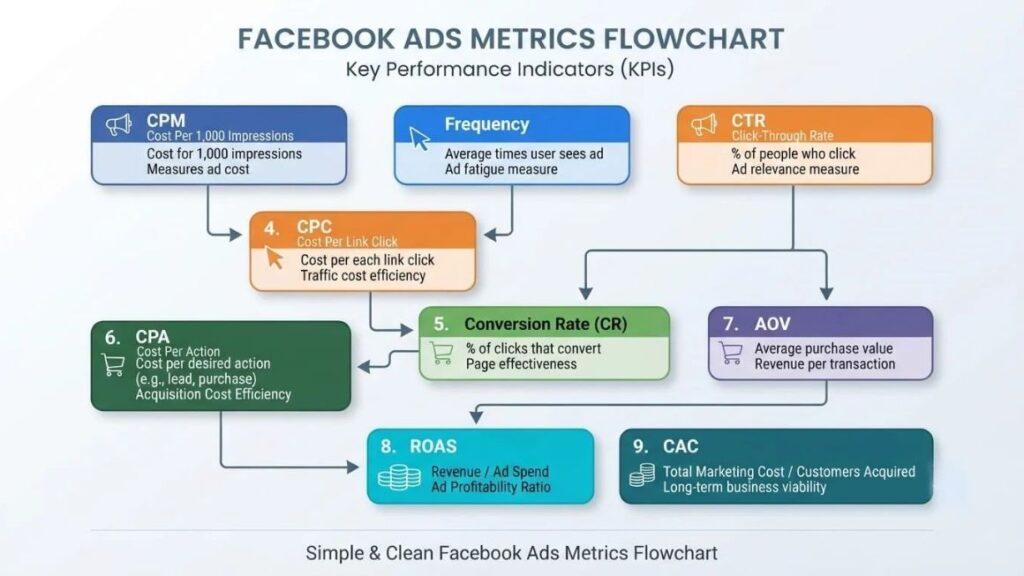
The metrics that matter most to improve Facebook Ads ROAS are ROAS itself, CPA, conversion rate and average order value. CPM, CTR, CPC and frequency help you work out why those four moved.
Essential Advertising Metrics
- ROAS: revenue per rupee spent.
- CPA (cost per acquisition): what you pay for each result. When the result is a sale, it’s your Facebook Ads cost per purchase.
- CPM: cost per 1,000 impressions.
- CTR (click-through rate): clicks as a share of impressions.
- CPC (cost per click): what each click costs.
- Conversion rate: the share of visitors who buy.
- Average order value (AOV): revenue per order.
- Frequency: how often one person has seen your ad.
- Customer acquisition cost (CAC): the full cost of winning one new customer.
Also Read: How to set up performance marketing tracking correctly
Which Metrics Matter Most?
None of them stand alone. A cheaper CPC isn’t a win if that traffic doesn’t convert. A strong CTR with a weak conversion rate points at the landing page. A rising CPM with a steady conversion rate may just mean a crowded auction.
Read them as a chain. CPM feeds CTR, CTR feeds CPC, CPC meets conversion rate, and conversion rate plus AOV decides ROAS.
Common Mistakes That Can Hurt Your Advertising Returns
Most ROAS losses come from impatience and unchecked data. These eight quietly stop you from being able to improve Facebook Ads ROAS:
- Raising budgets too quickly, which can shake delivery loose.
- Changing campaigns every day, so learning keeps restarting.
- Trusting platform-reported revenue without reconciling it against real orders.
- Testing several variables at once, so nothing is actually learned.
- Ignoring the landing page.
- Chasing industry benchmarks instead of your own profitability.
- Letting creatives run until they’re stale.
- Hitting the same retargeting audience over and over.
A Practical 7-Day Action Plan to Improve Campaign Performance
A seven-day plan can audit your tracking, structure, creatives and landing pages and set up a first round of changes. Treat it as a starting point.
| Day | Action |
| Day 1 | Audit tracking and calculate your break-even number |
| Day 2 | Review campaign structure and objectives |
| Day 3 | Analyse existing creatives and audiences |
| Day 4 | Develop new creative variations |
| Day 5 | Review landing pages and offers |
| Day 6 | Analyse results and identify improvement opportunities |
| Day 7 | Make measured adjustments and establish a monitoring schedule |
Seven days is an audit and implementation starting point. It isn’t a guarantee of statistically conclusive results, because most tests need more time and more purchases than a week provides.
Conclusion
Learning to improve Facebook Ads ROAS rarely comes down to one clever trick. It comes from tracking you trust, creatives that give people a reason to act, audiences and pages that fit the message, and a habit of testing without panicking. Keep your eye on contribution and profit, because a high ROAS that loses money is just a flattering number.
If you want to practise this on real campaigns, YUP’s Performance Marketing course goes deeper into ROAS, Meta Ads and campaign optimisation. Take the next batch, and build campaigns you can defend with numbers.
FYQs
What is a good ROAS for Facebook Ads?
Anything above your break-even point is profitable. Triple Whale’s 2025 data showed a median Meta ROAS of 1.86 for ecommerce, but margins decide what’s good. A 70% margin and a 25% margin need very different numbers.
How can I improve Facebook Ads ROAS without increasing my budget?
Fix tracking, test genuinely different creative concepts, tighten the landing page and raise average order value with bundles or free shipping thresholds. Consolidating fragmented campaigns helps too. All of these lift revenue from the same spend.
Why is my Facebook Ads ROAS suddenly dropping?
Check tracking first. Compare Meta’s purchases with real orders and look for attribution changes. If orders genuinely fell, look at creative fatigue, offers, seasonality and recent edits.
Does Advantage+ improve Facebook Ads performance?
Often, but not always. Meta’s testing claims higher ROAS than manual setups, yet that’s a global average. It works best with clean tracking, strong creative and enough conversions, so test it against your current setup.
How often should I test new Facebook ad creatives?
Continuously, in small batches. Many advertisers add new concepts every week or two and refresh sooner when frequency rises and CTR falls. Bigger budgets burn through creative faster.
How long does it take to improve ROAS?
Tracking and landing page fixes can show results within a week or two. Structured tests usually need several weeks, because purchase volume decides how quickly results become reliable.
Should I pause Facebook ads with low ROAS?
Not automatically. Check whether the ad set is still learning, whether tracking is accurate and whether the ad drives assisted or repeat sales. If it stays below break-even after enough purchases and a fix attempt, pause it and move the budget.
Is a higher ROAS always better?
No. Chasing a very high ROAS can mean spending only on people already likely to buy, which caps growth. A lower ROAS above break-even on a bigger budget can earn more profit than a high ROAS on a tiny one.