

Would you buy from a business that makes impressive promises but has a page full of unhappy reviews? Most people wouldn’t. That instinct sits at the heart of all effective brand trust building strategies.
Customers have become choosier, and understandably so. They’ve seen inflated ads, purchased five-star ratings and content nobody can trace to a real human.
So they check before committing. They read reviews, skim comments, ask friends and sometimes consult AI assistants. Price and features still matter. But they rarely close the sale on their own.
Getting attention is the easy part. Keeping promises consistently is what turns first-time buyers into long-term customers.
This guide covers what brand trust means, 12 proven ways to build it, four real-world brand examples, the metrics worth tracking, common mistakes, budget-friendly strategies and a practical 30-day action plan.
Table of Contents
What Is Brand Trust and Why Does It Matter?
Brand trust is the confidence customers have that a business will deliver on its promises, treat them fairly and fix things when something goes wrong. It develops through repeated positive experiences but can disappear after a few bad ones.
Understanding Brand Trust in Simple Terms
Think of trust as the gap between what you promise and what customers actually receive. When both match consistently, trust grows. When they don’t, no amount of clever advertising can cover the difference.
Three concepts are often confused:
- Brand awareness: Whether people know your business exists.
- Brand reputation: What people say about your business.
- Brand trust: Whether customers feel confident relying on your business with their money, data or time.
Awareness without trust is common. People may recognise a brand but never consider buying from it again. Reputation influences trust. But trust is earned through personal experiences.
Why Brand Trust Is Important for Business Growth
Trusted brands sell with less friction. Customers hesitate less at checkout, purchase more frequently and recommend businesses to others.
Customer trust and loyalty go together because people rarely remain loyal to brands they don’t believe in.
Trust also creates an advantage in competitive markets. When several businesses offer similar prices and features, customers often choose the one with a stronger track record.
It also softens occasional mistakes. A late delivery from a trusted brand may be an inconvenience. The same experience with an unfamiliar business could result in a negative review.
How Trust Influences Modern Buying Decisions
How do customers decide which brands to trust? Through research, other customers’ experiences and how businesses respond when things go wrong.
Buying journeys increasingly begin with searches, social media or AI tools. Customers compare reviews, examine complaint responses and evaluate customer service before purchasing.
Two major studies highlight the importance of trust.
NIQ’s Consumer Outlook: Guide to 2026 surveyed nearly 19,000 consumers across 27 countries between 10 June and 8 July 2025. It found that 95% consider trust critical when choosing a brand.
Edelman’s 2026 Trust Barometer Special Report: Brand Growth in an Insular World surveyed 17,688 people across 15 countries between 23 April and 11 May 2026. It found that 88% consider brand trust an important or critical purchase criterion, comparable to quality (89%) and value (88%).
These figures aren’t directly comparable because the studies use different definitions of trust. However, both show that trust now carries significant weight in purchasing decisions.
Edelman’s report also found that 41% of respondents said unpaid people’s opinions most influenced their willingness to trust a brand. Only 20% pointed to what the brand says about itself.
Your marketing isn’t the only voice shaping customer confidence. What other people say matters considerably.
Brand trust is the confidence customers place in a business to deliver on its promises, treat them fairly and fix its mistakes. NIQ’s 2026 Consumer Outlook found that 95% of consumers say trust is critical when choosing a brand. Edelman’s 2026 Special Report found that 88% consider it an important or critical purchase criterion.
12 Effective Ways to Build Customer Confidence in Your Brand
What makes a brand trustworthy? It usually comes down to honest communication, consistent quality, responsive customer service, responsible data handling and accountability.
The following 12 brand trust building strategies turn these principles into practical actions.
If you’re wondering how to build brand trust without a big budget, start with two or three strategies and implement them consistently.
1. Be Honest and Transparent in Your Communication
Honest communication means making claims you can prove, explaining prices clearly and acknowledging what your product cannot do.
Much of the damage to customer trust comes from the gap between marketing headlines and reality. Examples include misleading free trials, unclear delivery timelines and unsupported claims such as “clinically proven”.
Authentic brand communication starts with avoiding these situations.
Use this checklist before publishing landing pages, advertisements, emails or product descriptions:
- Can every claim be supported by data, testing or documentation?
- Are prices, delivery charges and additional fees visible before checkout?
- Are refund, renewal and cancellation terms easy to understand?
- Does the content explain who the product isn’t suitable for or what it cannot do?
Also apply the screenshot test: would the page still look fair if a customer shared it alongside their actual experience?
2. Deliver Consistent Product and Service Quality
Marketing may win the first purchase, but quality wins the second.
Consistency matters because customers expect their tenth order to feel as reliable as their first.
NIQ’s 2026 analysis of ingredient changes in packaged goods highlights the consequences of losing confidence. 72% of consumers say they would switch brands rather than return.
Set clear quality standards, document them and measure performance regularly.
Pay attention to recurring complaints and returns. If customers repeatedly report sizing problems or delayed deliveries, fix the underlying issue instead of apologising individually.
A consistent customer experience strategy prevents problems from becoming expensive reputation issues.
3. Build a Strong and Recognisable Brand Identity
Brand identity isn’t just a logo. It’s whether customers recognise your business across Instagram, invoices, emails and customer support conversations.
Consistent brand messaging builds trust by making a business appear reliable and professional. A brand that looks and sounds different across channels can seem disorganised.
Start with:
- A clear mission and target audience.
- Values your business genuinely follows.
- Consistent visual elements.
- A recognisable tone of voice.
- Clear guidelines for communicating with customers.
However, identity only works when behaviour supports it. If your brand sounds friendly but handles refunds poorly, customers will remember the refund experience.
Create simple brand guidelines covering communication style, preferred phrases, responses to problems and claims your business should never make.
Share these guidelines with everyone communicating with customers, not just your design team.
4. Use Genuine Customer Reviews and Testimonials
Customer reviews are among the strongest influences on brand credibility.
BrightLocal’s 2026 Local Consumer Review Survey covered 1,002 US adults. They found that 49% trust online reviews as much as personal recommendations. Although this is a US sample, the findings offer useful guidance for businesses elsewhere.
The survey also found that 47% won’t use businesses with fewer than 20 reviews, while 74% consider reviews from the last three months important.
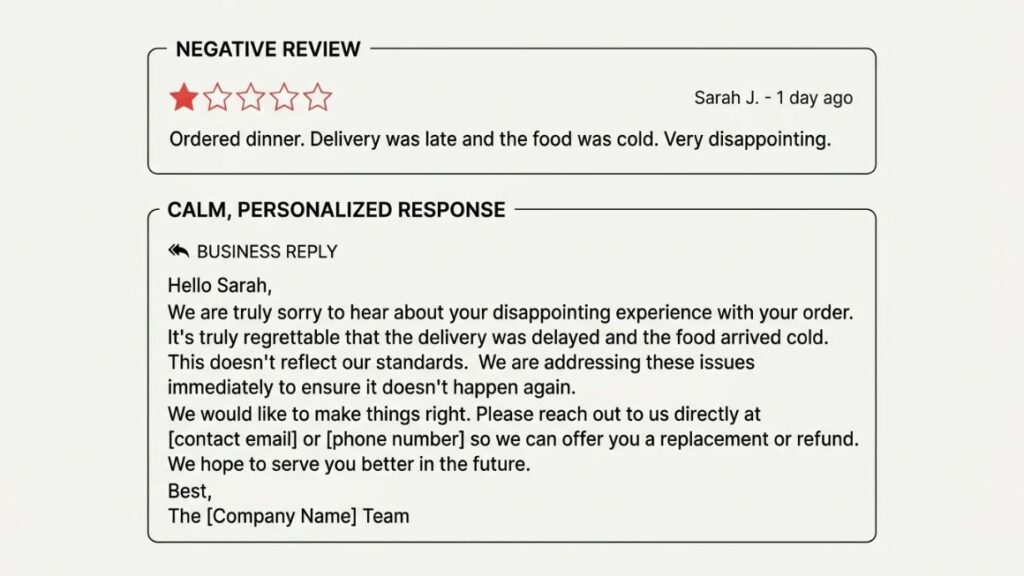
How you respond matters too. Around 80% of respondents were more likely to use businesses that reply to all reviews. 50% were discouraged by generic and copy-pasted responses.
Ask customers for reviews and respond personally. Thank satisfied customers for specific feedback and address negative experiences calmly.
For testimonials, include real names, relevant context and permission wherever possible. Vague testimonials from anonymous customers rarely persuade anyone.
Never purchase fake reviews. BrightLocal found that 97% of consumers believe businesses caught using fake reviews should face some form of punishment.
In India, IS 19000:2022, developed with the Department of Consumer Affairs, establishes principles for collecting, moderating and publishing online reviews.
Marketplaces such as Amazon use labels like “Verified Purchase” to distinguish genuine buyers. Smaller businesses can follow the same principle by publishing reviews connected to actual purchases.
BrightLocal’s 2026 Local Consumer Review Survey (1,002 US adults) found that 49% of consumers trust online reviews as much as personal recommendations, while 80% are more likely to use businesses that respond to all reviews. Generic replies discourage 50% of respondents.
5. Make Customer Service a Priority
Customer support is where brand promises are tested.
Speed matters. Sprout Social’s 2025 Index found that 73% of social media users would purchase from a competitor if a brand ignored them on social media.
BrightLocal’s 2026 survey also found that 19% of consumers expect a same-day response to reviews, compared with just 6% a year earlier.
However, responding quickly isn’t enough. Train your team to solve problems instead of simply defending company policies.
Give employees authority to approve small refunds or replacements without unnecessary approvals. Make return policies easy to find and follow up after resolving complaints to ensure the solution worked.
A basic customer relationship management (CRM) system can also help. Even a shared spreadsheet prevents customers from repeatedly explaining their problems to different representatives.
Start by defining response-time expectations for each channel and establishing a clear escalation process for unresolved complaints.

6. Maintain an Authentic Social Media Presence
How does social media influence customer trust? It allows people to observe how your business behaves publicly before making a purchase.
Sprout Social’s Q2 2025 Pulse Survey found that 76% of social media users said social media had influenced at least some of their purchases in the previous six months.
Your social profiles therefore act as a trust check. Customers examine recent posts, read comments and notice whether the brand responds.
Spotify demonstrates the value of public customer support. In a 2025 interview with LBB, Sprout Social’s Layla Revis highlighted its dedicated @SpotifyCares account as an example of customer care integrated into the brand.
You don’t need a large team to follow the same approach.
- Publish useful content alongside promotional posts.
- Respond to comments, including negative ones.
- Show the people behind your business.
- Communicate naturally rather than sounding like a press release.
A genuine and slightly imperfect post can feel more trustworthy than overly polished corporate content.
7. Work With Credible Influencers and Industry Experts
Influencer marketing builds trust when audiences believe creators genuinely use and understand the products they recommend.
Edelman’s 2026 special report found that 62% of respondents follow content creators. Among these followers, 37% tried a brand for the first time because of a creator in the previous six months, while 29% began trusting a brand because of one.
Three factors determine whether influencer partnerships build credibility:
Relevance: Choose creators whose audiences genuinely overlap with your target customers.
Authenticity: Provide accurate product information but allow creators to share honest opinions, including limitations.
Disclosure: Clearly identify paid and barter partnerships.
India’s Endorsement Know-hows, issued by the Department of Consumer Affairs in January 2023, require influencers to disclose commercial relationships using labels such as “ad”, “sponsored” or “collaboration”.
The Central Consumer Protection Authority can impose penalties of up to ₹10 lakh on endorsers and advertisers, increasing to ₹50 lakh for repeat offences.
Before choosing creators, examine their comments and audience engagement rather than focusing only on follower counts.
8. Protect Customer Data and Respect Privacy
Customers share phone numbers, addresses, payment information and browsing data with businesses. Treat this information responsibly.
Cisco’s 2024 Consumer Privacy Survey, covering more than 2,600 people across 12 countries, found that 75% wouldn’t purchase from companies they don’t trust with their data.
Privacy is therefore a business concern as much as a legal responsibility.
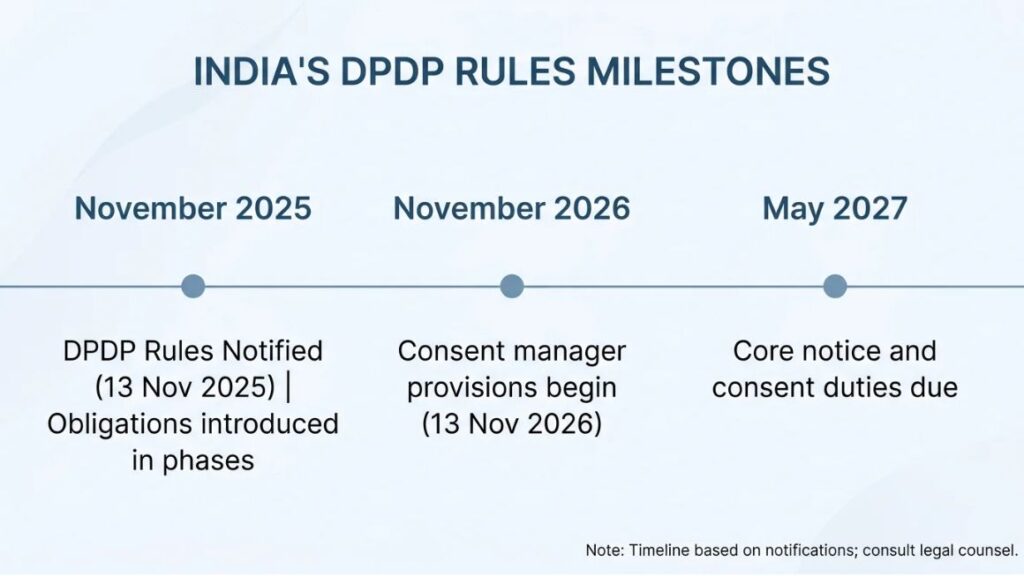
In India, the Digital Personal Data Protection Rules were notified on 13 November 2025, with obligations being introduced in phases over 18 months.
Consent manager provisions begin on 13 November 2026, while core notice and consent duties are due from May 2027. Businesses should plan accordingly and consult legal advisers about applicable requirements.
Build good privacy practices by:
- Explaining what information you collect and why.
- Requesting only the information necessary.
- Deleting data you no longer need.
- Reviewing privacy notices and consent forms regularly.
- Restricting customer data access to authorised employees.
A complicated privacy policy doesn’t build confidence. Clear communication and responsible practices do.
9. Share Real Brand Stories and Behind-the-Scenes Experiences
Dieux Skin built its brand around transparency, particularly the costs behind its products.
On the Shopify Masters podcast, co-founder Charlotte Palermino described its approach as “clinically vetted and price transparent”, according to Shopify’s brand trust guide.
Retail Dive reported that the company itemises formula, packaging, labour, payment processing and shipping costs.
Not every business needs to disclose its margins, but the principle is useful. Customers trust what they can understand and verify.
Share your genuine origin story, explain why you started and acknowledge what earlier versions got wrong.
You can also:
- Introduce employees and show their work.
- Share product development processes.
- Explain important business decisions.
- Highlight suppliers and production practices.
- Encourage employees to share authentic workplace experiences.
Employee advocacy can make a brand feel more approachable because people often connect better with real experiences than corporate messaging.
Just don’t manufacture stories. Fake founder journeys and misleading handmade claims can destroy credibility quickly.
10. Be Responsible and Transparent About AI Usage
AI has made content easier to produce, but that doesn’t automatically make it easier to trust.
Meltwater and YouGov’s April 2026 report, Trust in the Age of Generative AI, surveyed nearly 10,000 respondents across seven markets. It found that 86% believe AI-generated content should be disclosed.
The report also found that 32% would trust a brand less if they knew its content was AI-generated, compared with 15% who would trust it more.
A separate August 2026 survey of 601 US consumers by Clutch found that 64% would trust a brand or creator less if AI-generated content misrepresented a product.
The practical approach is simple: use AI responsibly, disclose relevant usage and maintain human oversight.
For businesses, this means:
- Explain where AI is used, including chatbots, recommendations and generated images.
- Have humans review AI-written content for accuracy, especially claims, prices and legal information.
- Never present synthetic testimonials, customer photographs or invented reviews as genuine.
- Make human support available for complaints, refunds and sensitive issues.
AI transparency can also become a competitive advantage. As machine-generated content increases, genuine customer experiences and identifiable human expertise become more valuable.
Meltwater and YouGov’s April 2026 report, covering nearly 10,000 respondents across seven markets, found that 86% believe AI-generated content should be disclosed. Additionally, 32% would trust a brand less if its content were AI-generated, compared with 15% who would trust it more. Responsible AI use requires disclosure, human oversight and honest representation.
11. Build a Community Around Your Brand
A brand community doesn’t need thousands of members. Even a small group of engaged customers can create meaningful relationships and strengthen loyalty.
Edelman’s 2026 research found that 59% of people who both trust brands and find them relevant engage with others on brand social channels at least monthly. Among those who do neither, the figure drops to 27%.
Start with simple initiatives:
- Create a WhatsApp or Discord group for loyal customers.
- Host monthly Q&A sessions.
- Organise educational webinars.
- Invite customers to share feedback and experiences.
Choose platforms your customers already use rather than making them download another app.
Most importantly, listen. Ask what frustrates customers, implement visible improvements and communicate what changed.
Recognise loyal members through early access, personal appreciation or small rewards.
A community should encourage conversations, not become another promotional broadcast channel.
12. Take Responsibility and Fix Mistakes Quickly
Every business makes mistakes eventually. Customers can usually accept that. What damages trust is refusing to acknowledge the problem.
When something goes wrong:
- Explain what happened in clear language.
- Identify who was affected.
- Explain what you’re doing to help.
- Share what will change to prevent repetition.
Avoid vague statements such as “we regret any inconvenience” or immediately blaming suppliers and delivery partners.
Take action, fulfil your promises and provide updates. A follow-up explaining what has changed shows customers that your apology was genuine.
This is how brands recover from a loss of customer trust: acknowledge the problem, offer a fair solution, demonstrate improvements and remain consistent.
Prepare a basic crisis communication plan before an incident occurs. Identify who speaks for the business, who approves statements and how you’ll respond to likely problems such as data incidents, product defects and service outages.
Of all the brand trust building strategies in this guide, accountability is one businesses often learn the hard way.
Real-World Examples of Brands That Have Earned Customer Trust
These four brands demonstrate different approaches to building customer confidence. None is perfect, and understanding their complications makes their examples more useful.
Apple: Building Confidence Through Product Experience
Apple’s trust strategy relies on consistent product experiences and a strong focus on privacy.
The company describes privacy as a fundamental human right. A 2020 letter to rights groups outlined four principles behind its approach: data minimisation, on-device processing, transparency and choice, and security.
Its App Tracking Transparency feature, introduced with iOS 14.5 in 2021, requires apps to request permission before tracking users across other companies’ apps and websites.
The complication: In September 2026, UK app developers launched a £2 billion collective action alleging that Apple uses App Tracking Transparency to disadvantage competitors. Apple rejects the allegations.
The lesson is that clear promises supported by visible product features give customers something concrete to evaluate.
Patagonia: Connecting Brand Values With Business Actions
Patagonia changed its stated purpose in 2018 to “we’re in business to save our home planet”.
In September 2022, the Chouinard family transferred ownership to the Patagonia Purpose Trust and Holdfast Collective. Profits not reinvested in the business are directed towards fighting the environmental crisis.
The company describes this as making Earth its only shareholder.
Its approach demonstrates how ethical business practices can become part of a company’s structure rather than remaining marketing messages.
However, Patagonia acknowledges the contradiction that manufacturing products still consumes irreplaceable resources. This willingness to recognise its limitations makes its commitments more credible.
Dove: Building Emotional Connection Through Authentic Communication
Since 2004, Dove’s Real Beauty campaigns have focused on representing real people rather than unrealistic beauty ideals.
Its Real Beauty Pledge commits to featuring real women, representing diversity and avoiding professional models or celebrities as substitutes for real women.
In April 2024, Dove also pledged not to use AI-generated imagery in place of real women in its advertisements.
According to the company, the Dove Self-Esteem Project has reached more than 100 million young people, with a target of 250 million by 2030.
The lesson for smaller businesses is consistency. Dove’s campaigns, commitments and programmes have supported the same central message for two decades.
Amazon: Using Customer Convenience and Service to Build Confidence
Amazon places customer obsession at the centre of its business values.
Its A-to-z Guarantee supports this promise by protecting purchases, including orders from third-party sellers, against problems involving delivery and product condition.
The company introduced the guarantee more than 20 years ago.
Customer reviews, Verified Purchase labels and accessible return policies further reduce uncertainty for buyers who may be unfamiliar with individual sellers.
The complication: Marketplace sellers have raised concerns about how claims are handled and the impact on their businesses.
The lesson is that convenience can build customer confidence, but fairness across the entire marketplace matters too.
How to Measure Whether Customers Trust Your Brand?
How can businesses measure customer trust? Likes and website visits aren’t enough. A post can go viral for the wrong reasons, while traffic doesn’t tell you whether customers believe your claims.
Instead, combine satisfaction, loyalty, customer feedback and purchasing behaviour.
1. Customer Satisfaction Score (CSAT)
CSAT measures satisfaction with a specific interaction, usually on a scale of 1 to 5. It’s commonly reported as the percentage of customers selecting 4 or 5.
Measure it after important interactions, such as support conversations, deliveries and onboarding.
2. Net Promoter Score (NPS)
NPS measures how likely customers are to recommend your business.
Bain & Company’s methodology uses a 0 to 10 scale and subtracts the percentage of detractors (0 to 6) from promoters (9 or 10).
The result ranges from -100 to +100.
Measure NPS quarterly, use neutral wording and pay attention to written feedback rather than focusing only on the score.
3. Customer Retention Rate
Retention rate measures the percentage of customers who continue purchasing over a specific period.
Customers who trust your business are more likely to return. Those who don’t may leave without providing feedback.
Review retention monthly or quarterly, and compare different customer segments.
4. Review Ratings and Customer Sentiment
Monitor star ratings alongside written reviews.
Recurring complaints about refunds, customer support or product quality often reveal bigger problems than isolated negative experiences.
BrightLocal’s 2026 findings also highlight the importance of review consistency.
5. Brand Mentions and Online Conversations
Monitor your brand name, product names and common misspellings.
Check social media, forums, communities and creator discussions regularly. These conversations can reveal changes in brand reputation before formal metrics do.
6. Repeat Purchases and Referral Activity
Repeat purchases and referrals provide behavioural evidence of customer loyalty.
Track how frequently customers return and whether they recommend your business to others.
Review these numbers monthly.
| Metric | What it measures | How often to review |
| CSAT | Satisfaction with specific interactions | After key interactions; review weekly |
| NPS | Likelihood to recommend | Quarterly |
| Retention rate | Share of customers who stay | Monthly or quarterly |
| Review ratings and sentiment | Public opinion and recurring themes | Weekly |
| Brand mentions | Conversations and reputation changes | Weekly, with daily alerts |
| Repeat purchases and referrals | Loyalty demonstrated through behaviour | Monthly |
Brand trust cannot be measured through likes or website traffic alone. A reliable assessment combines CSAT, Net Promoter Score, retention rate, review sentiment, brand mentions and repeat purchase or referral activity. NPS subtracts detractors (scores of 0 to 6) from promoters (9 or 10), producing a score between -100 and +100.
Common Mistakes That Damage Customer Trust
Most trust-related mistakes come from one underlying problem: the difference between what a brand promises and what customers experience.
Even effective brand trust building strategies can fail when these mistakes become common.
Making Promises the Business Cannot Deliver
Promising 24-hour delivery when it’s only possible in ideal circumstances creates unrealistic expectations.
The same applies to guaranteed results that depend on customer behaviour.
Set realistic expectations and consistently try to exceed them.
Ignoring Negative Reviews and Customer Complaints
Silence makes customers feel ignored.
BrightLocal’s 2026 survey found that 42% of consumers are unlikely to use a business that never responds to reviews.
Online reputation management isn’t about deleting negative feedback. It’s about acknowledging complaints, resolving problems and showing future customers that you care.
Using Fake Testimonials and Misleading Marketing Claims
Fake reviews, stock-photo customers and unsupported product claims damage credibility.
Once customers discover misleading information, they may question even your genuine testimonials.
In India, misleading advertising and undisclosed endorsements can also attract regulatory penalties.
Being Inconsistent Across Marketing Channels
A friendly Instagram account, an outdated website and an unhelpful support team create a confusing customer experience.
Customers see one business, not separate departments. Maintain consistent communication standards across channels.
Hiding Important Information From Customers
Unexpected checkout charges, complicated cancellations and unclear refund policies create frustration.
India’s Guidelines for Prevention and Regulation of Dark Patterns, issued by the Central Consumer Protection Authority on 30 November 2023, address deceptive practices such as drip pricing.
Beyond legal consequences, hiding important information damages customer confidence.
Overusing Automation Without Human Support
Automation can improve efficiency, but it shouldn’t prevent customers from reaching a real person.
Sprout Social’s Q4 2025 Pulse Survey found that 69% of users are comfortable with brands using AI for faster social media customer service.
Problems arise when chatbots become barriers, especially for complicated or emotional situations.
Automate routine queries, but make human support easy to access.
How Small Businesses Can Build Trust With a Limited Budget
How can small businesses establish credibility without spending heavily?
The answer is to become easy to verify. Genuine reviews, clear policies, accessible contact information and visible expertise can build considerable confidence without expensive advertising.
Improve Your Website’s Credibility
BrightLocal’s 2026 survey found that 54% of consumers visit a business’s website after reading positive reviews.
Your website should reinforce that confidence.
Include:
- Accurate business contact details.
- A clear explanation of your products or services.
- Genuine customer reviews.
- Easy-to-find refund and return policies.
- Accessible privacy information.
Focus on Organic Content and Customer Education
Answer questions customers regularly ask about choosing, purchasing and using your products.
Turn these answers into blog articles, FAQs, social media posts and product demonstrations.
Educational content builds credibility by helping customers make informed decisions rather than constantly pushing sales.
Also Read: Content Marketing Ideas That Actually Reflect How Content Works Now
Build Relationships Before Spending Heavily on Advertising
Participate in communities where your customers already spend time, including local groups, forums, WhatsApp communities and social media discussions.
Answer questions, share useful resources and act on feedback without turning every interaction into a sales pitch.
When you eventually invest in advertising, customers will already have some familiarity with your business.
Turn Existing Customers Into Brand Advocates
Happy customers can become powerful brand advocates, but sometimes they need a reminder to share their experiences.
BrightLocal’s 2026 data found that 83% of people asked to leave a review went on to do so.
Ask for feedback after positive experiences, offer thoughtful loyalty rewards and make referrals easy.
Always allow customers to share honest opinions.
A Practical 30-Day Action Plan to Improve Brand Trust
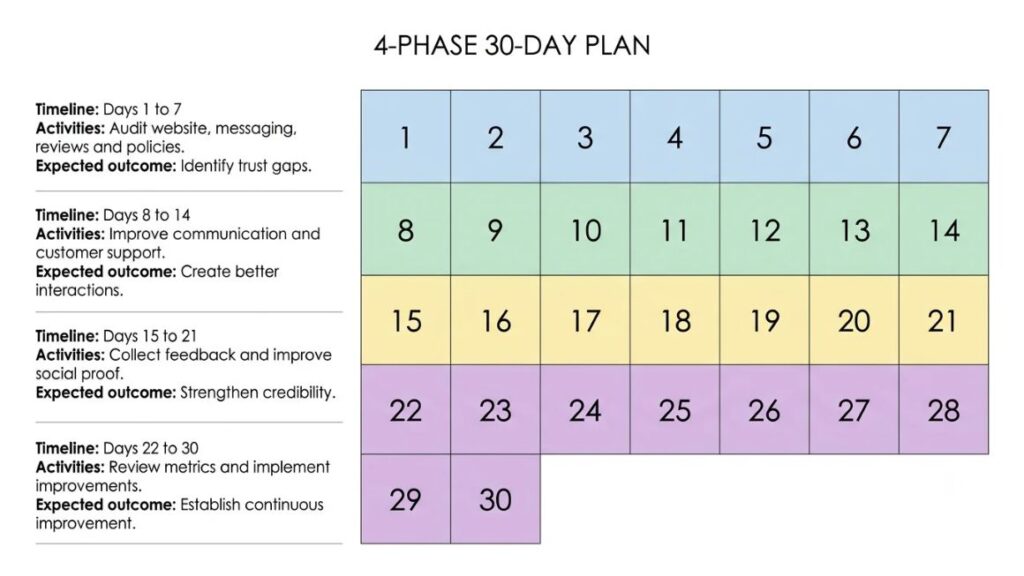
You don’t need a complete business transformation to implement these brand trust building strategies. Start with four focused weeks and assign someone responsibility for each activity.
| Timeline | Activities | Expected outcome |
| Days 1 to 7 | Audit website, messaging, reviews and policies | Identify trust gaps |
| Days 8 to 14 | Improve communication and customer support | Create better interactions |
| Days 15 to 21 | Collect feedback and improve social proof | Strengthen credibility |
| Days 22 to 30 | Review metrics and implement improvements | Establish continuous improvement |
If four weeks feels overwhelming, begin with these priorities:
What Businesses Should Prioritise First
- Fix problems directly affecting customers, including late deliveries, checkout issues and unanswered complaints.
- Remove misleading claims and clarify confusing prices or policies.
- Improve response times and establish clear customer service standards.
- Make essential business information, contact details and policies easy to find.
- Review customer feedback and performance metrics regularly.
Conclusion
Trust isn’t a marketing campaign. It’s what happens when your promises, products and behaviour consistently match customer expectations.
Three principles matter most:
- Only make claims you can support.
- Resolve problems quickly and visibly.
- Stay consistent, even when nobody is watching.
You don’t need to implement all 12 brand trust building strategies immediately. Choose two or three, perhaps improving review responses and updating your privacy notice, and get them right before moving forward.
Small improvements in how you treat customers can create lasting results.
If you’d like to develop the marketing and brand-building skills behind these strategies, Young Urban Project’s practical digital marketing workshops and courses can help you take the next step. Explore the available programmes and choose one that addresses the challenge you’re currently working on.
Frequently Asked Questions (FAQ)
What are the most effective ways to build brand trust?
Start with honest communication, transparent pricing and claims you can prove. Combine these with consistent product quality, responsive customer service, genuine reviews and responsible data handling.
The most effective brand trust building strategies are repeatable and consistent. Choose two, implement them properly for 90 days and gradually introduce more.
Why is customer trust important for a business?
Trust reduces the effort required to convert and retain customers. People hesitate less, forgive occasional mistakes, purchase more frequently and recommend trusted businesses.
NIQ’s 2026 Consumer Outlook found that 95% of consumers consider trust critical when choosing a brand, while Edelman’s 2026 report found that 88% consider it important or critical.
Without trust, businesses often end up competing primarily on price.
How long does it take to establish brand trust?
Visible improvements in reviews and response times may take around three months, while deeper customer loyalty can take a year or longer.
These are general estimates, not fixed timelines. Clear pricing and faster responses can improve first impressions within weeks, but rebuilding lost trust takes considerably longer.
How can a small business build trust with customers?
Make your business easy to verify. Add accurate contact details, a clear About page, accessible policies and genuine customer reviews to your website.
Respond to customer messages, publish useful content and encourage satisfied customers to share their experiences.
These activities require consistency more than a large advertising budget.
Do customer reviews make a brand more credible?
Yes. BrightLocal’s 2026 survey found that 49% of consumers trust online reviews as much as personal recommendations, while 85% are more likely to use a business after reading positive reviews.
Review volume, recency and business responses all influence credibility. Fake reviews are risky too: 97% of consumers believe businesses caught using them should face punishment.
How can social media help businesses build customer confidence?
Social media allows customers to observe how businesses communicate and handle problems publicly.
Respond to comments, publish useful content, introduce the people behind your brand and disclose paid partnerships.
Sprout Social’s 2025 Index found that 73% of social media users would switch to a competitor if a brand ignored them.
What should a business do after losing customer trust?
Acknowledge the problem quickly, explain what happened without making excuses and prioritise resolving issues for affected customers.
Then communicate what you’ve changed and demonstrate consistency over time.
Customers may forgive genuine mistakes, but dishonesty and attempts to cover up problems make rebuilding trust much harder.
How can businesses measure customer trust?
Track several indicators together: Customer Satisfaction Score (CSAT), Net Promoter Score (NPS), customer retention rate, review ratings & sentiment, brand mentions & online conversations, and repeat purchases & referrals.
No single metric proves trust. Review trends regularly and examine the feedback behind the numbers.
Can AI-generated content negatively affect customer trust?
Yes, particularly when AI use is hidden or produces misleading information.
Meltwater and YouGov’s April 2026 report found that 32% of consumers would trust a brand less if its content were AI-generated, compared with 15% who would trust it more.
Disclose relevant AI usage, have humans review generated content and never present synthetic material as a genuine customer experience.
What is the difference between brand reputation and brand trust?
Brand reputation refers to what people collectively think and say about a business. Brand trust is an individual’s confidence in relying on that business.
Reputation influences purchasing decisions, but trust develops through actual customer experiences.
Honest communication, consistent service and accountability help strengthen both.