

Pick any major brand you trust. Now think about the last five times you encountered it: a billboard, an Instagram ad, a packaging unboxing video, maybe a customer support email. Did it feel like the same brand every time? Almost certainly yes. That’s not an accident.
A brand consistency strategy is the operating system running quietly behind every great brand. It’s what makes Swiggy feel like Swiggy, whether you’re looking at an in-app notification or a meme they posted on Twitter. It’s what makes Apple feel premium, whether you’re reading their website or walking into one of their stores. And it’s what makes inconsistency so damaging when it does happen: customers notice the gap, even if they can’t name it.
Most teams know brand consistency matters. Far fewer have an actual strategy for maintaining it, especially as they scale, hire new people, or expand into new channels. That’s the gap this article closes.
Read More: Brand Management Strategy
What Is Brand Consistency?
Brand consistency is the practice of presenting your brand in the same clear and recognisable way across every customer touchpoint.
This includes your logo, colours, messaging, tone of voice, website, social media, advertisements, emails, packaging, and customer service. When all of these elements work together consistently, people can easily recognise your brand and understand what it stands for.
For example, when you see a post, advertisement, or product from Apple, it usually has the same clean design, simple messaging, and premium feel. That consistency helps customers instantly recognise the brand wherever they encounter it.
In simple terms, brand consistency means making sure your brand looks, sounds, and feels the same across all channels and customer interactions. This builds trust, strengthens brand recognition, and creates a more memorable customer experience.
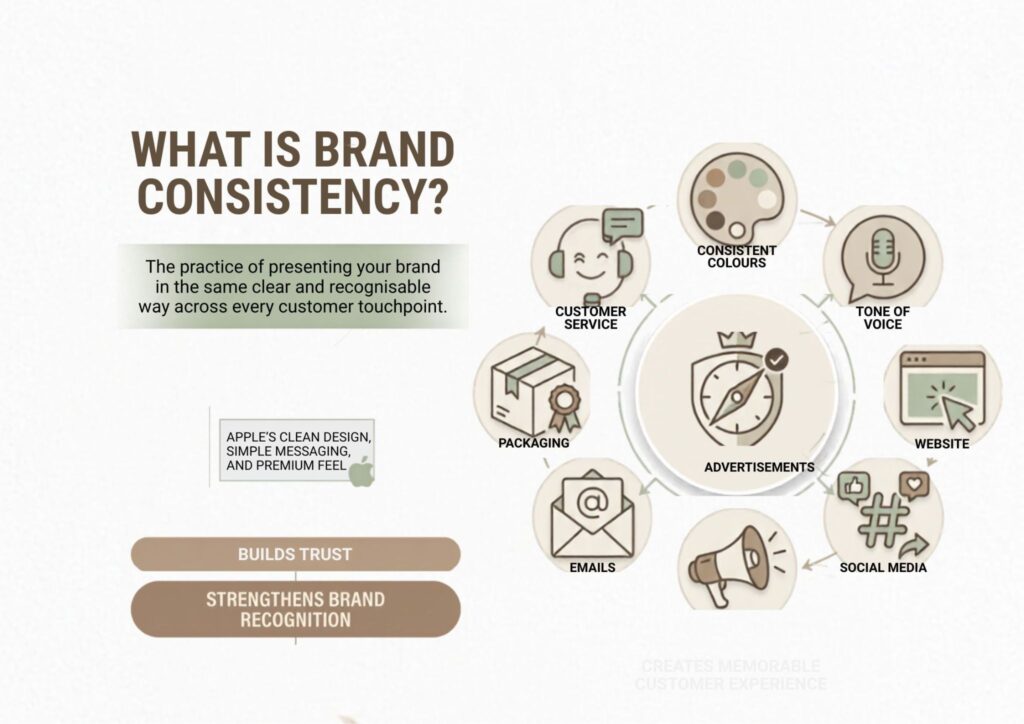
Table of Contents
Why Brand Consistency Matters (More Than Most Leaders Think)
Here’s a number worth remembering: according to Lucidpress’s Brand Consistency Report, consistent brand presentation across all channels can increase revenue between 22% and 33%. And yet most organisations treat brand consistency as a design problem, not a business problem. That misclassification is expensive.
Brand consistency builds recognition, and recognition builds trust. The more reliably your brand shows up the same way, the more cognitive effort customers save when evaluating whether to buy from you. Trust, in most categories, is built through repetition before it’s built through a single great experience.
There’s also a compounding effect that’s easy to miss. Every inconsistent touchpoint is a small withdrawal from your brand equity account. A mismatched font here. A different tone in a customer service chat there. Each one is minor in isolation. Collectively, they erode the perception that you know what you’re doing.
And then there’s the internal side. When a brand is consistent externally, it’s usually because it’s well-understood internally. Teams aren’t guessing what the brand would do or say. That clarity speeds up execution and reduces revision cycles. From what we’ve seen with YUP learners working inside marketing teams, unclear brand standards are one of the most commonly cited reasons creative work gets delayed.
Brand consistency strategy directly affects revenue. Lucidpress’s Brand Consistency Report found that consistent brand presentation can increase revenue by up to 23%. This happens because consistency builds recognition, recognition builds trust, and trust reduces the friction customers feel before buying.
How Brand Guidelines Create the Foundation for Consistency
Think of brand guidelines as the single source of truth for everyone who touches your brand: designers, writers, agency partners, sales teams, and eventually every new hire who creates so much as a slide deck.
Without brand guidelines, you’re relying on institutional memory. And institutional memory does not survive team turnover, rapid growth, or working with external partners.
Audience Elements
Your guidelines should define who you’re talking to, because voice and tone should adapt slightly to the audience, even as the core brand stays fixed. Buyer personas aren’t just for campaign targeting. They shape decisions about vocabulary level, cultural references, and what examples resonate.
Mamaearth, for instance, has built its brand around a very specific audience: new-age, health-conscious Indian parents. Every piece of communication, from product naming to social captions, reflects that. Their guidelines would need to capture that persona in a way that any new team member could apply without a briefing.
Visual Elements
This is the section most people think of when they think about brand guidelines. Colour palette (with exact hex/Pantone codes, not vague descriptions). Logo variants and when to use each. Typography hierarchy. Image style and photography direction. Whitespace rules. Icon systems.
The specificity matters. “Use blue” is not a guideline. “Use #0053A0 as the primary brand blue and never substitute with navy or cobalt” is a guideline.
Language and Communication Elements
This is where most guidelines fall short. Organisations invest in visual standards and then write one vague paragraph about “being friendly and professional.” That’s not enough.
Your language guidelines should cover: brand voice (who you are), tone variations (how voice shifts by context), words you always use, words you never use, and examples of on-brand versus off-brand copy side-by-side. If your brand has a sense of humour, show what that humour looks like in practice, not just in principle.
11 Ways to Improve Brand Consistency Across Your Organisation
1. Start With a Mission Statement That Actually Means Something
A mission statement should be specific enough that it rules things out. If every brand in your category could use the same mission statement, yours isn’t doing any work. Your mission should anchor decisions when teams are uncertain: “Would this be consistent with what we’re trying to do?”
2. Create and Maintain Brand Guidelines
Not a PDF that gets emailed once and forgotten. A living document in a format the team actually accesses: a shared Notion page, a Figma library, a dedicated brand portal. The format matters less than the accessibility.
3. Use the Same Colour Palette and Logo Across All Materials
This sounds obvious. It’s violated constantly. Someone uses a JPEG with a white background where the PNG with transparency should go. Someone “adjusts” the colours to suit a platform. Someone creates a version of the logo for a campaign, and it quietly enters circulation.
Lock the approved assets in one place and make retrieval faster than improvisation.
4. Create Content That Supports the Brand Narrative
Every piece of content should either reinforce a brand belief or demonstrate a brand value. Content that is useful but brand-neutral is a missed opportunity. Content that contradicts the brand is actively harmful.
5. Make Brand Guidelines Easy to Access
The most comprehensive guidelines in the world are worthless if nobody can find them. Put them where the work happens. If your team works in Notion, brand guidelines live in Notion. If they work in Slack, the guidelines link is pinned. Friction is the enemy of consistency.
6. Reinforce Branding Efforts Internally
Brand consistency is not a marketing department responsibility. Sales teams represent the brand in every call. Customer support represents it in every ticket. Finance represents it in every proposal and invoice. Regular training, onboarding that covers brand standards, and internal campaigns matter as much as external ones.
7. Maintain a Consistent Voice and Tone
Voice is who your brand is. Tone is how that voice adapts to the situation. A brand with a dry, witty personality doesn’t suddenly become formal in a complaint resolution email, but it might dial back the humour. Consistency means the personality stays constant even as the register shifts.
8. Work With Exemplary Brand Ambassadors
External spokespeople, creators, and influencers who work with your brand carry real reputational risk. Their associations become your associations. Choose people whose existing public identity is coherent with your brand values, not just their follower count. And brief them well. A vague brief is how inconsistency enters through external channels.
9. Keep Consistent Marketing Schedules
Inconsistent posting schedules, irregular campaign cycles, and erratic messaging frequency signal brand instability, even subconsciously. Audiences form expectations. When you show up reliably, you reinforce the sense that your brand is dependable. That association transfers.
10. Audit Your Branding Regularly
A brand audit is not a vanity exercise. It’s how you catch drift before it becomes a problem. Schedule one annually at minimum: pull a representative sample of touchpoints across channels and evaluate them against your guidelines. You’ll find inconsistencies you didn’t know existed.
11. Be Mindful When Rebranding
Rebrands are high-risk precisely because they deliberately disrupt consistency. Done wrong, they alienate existing customers while failing to attract new ones. Done right, they update the brand’s relevance while preserving the equity that’s already been built. The rule: never rebrand without a clear reason that a customer would recognise as valid.
A brand consistency strategy requires systems, not just standards. Access to brand guidelines, consistent internal training, regular brand audits, and disciplined asset management are the operational mechanisms that translate a brand identity into consistent execution across teams and channels.
Actionable Brand Consistency Strategies: A Step-by-Step Approach
Strategy #1: Determine Your Brand Architecture
Brand architecture defines the relationship between your master brand and any sub-brands, product lines, or campaigns. Without a clear architecture, teams make conflicting decisions about when to feature the parent brand and when to let a product stand alone.
boAt, the Indian consumer electronics brand, has a clear architecture where every product line from earwear to smartwatches sits visibly under the boAt identity. That decision is strategic, and it means brand equity built through one product transfers to new launches. An unclear architecture would dilute that.
Strategy #2: Perform a Brand Audit
A brand audit means systematically reviewing every customer-facing touchpoint and asking: Does this look and sound like us? Does it reflect current brand standards? Is it consistent with what’s live on every other channel?
The audit should cover: website, social profiles, email templates, ad creatives, sales decks, physical materials, and any partner or affiliate materials carrying your brand. Document the gaps and prioritise fixes by visibility.
Strategy #3: Create Buyer Personas
Personas give your brand a specific audience to be consistent with. When you know exactly who you’re talking to, it’s much easier to make judgment calls on messaging, tone, and content format that stay true to your brand.
Zepto, the quick commerce platform, has clearly defined its audience as urban millennials who prioritise speed. Everything from their in-app copy to their OOH advertising reflects that persona’s language and priorities. Buyer personas, done well, become a gut-check for every new piece of communication.
Strategy #4: Define Brand Guidelines
As covered earlier, specific, accessible, and covering audience elements, visual elements, and language elements. Don’t just document what the brand looks like. Document what it sounds like, what it believes, and what it would never do.
Strategy #5: Establish Creative Workflows
Inconsistency often enters at the process level, not the guideline level. When anyone can create and publish brand-facing assets without review, you’ll get drift. Establish who approves what, at what stage, and what the review criteria are. Keep the workflow lean enough that it doesn’t slow teams down, or they’ll work around it.
Strategy #6: Create Brand Templates
Templates are the most underrated consistency tool available. If the brief is to create a LinkedIn post, a branded template with locked elements removes most of the decisions where inconsistency can creep in. Templates for social posts, presentations, email campaigns, proposals, and report formats pay dividends fast.
Digital asset management (DAM) software such as Bynder, Brandfolder, or Canto makes templates and approved assets available to the whole organisation in one searchable place. The right DAM eliminates the “I couldn’t find the right logo so I used this one” problem entirely.
Strategy #7: Establish a Single Source of Knowledge
One brand wiki. One asset library. One place to find the right version of anything. The more places brand information lives, the more likely people are to find an outdated version and use it. Consolidation isn’t just tidiness; it’s a consistency mechanism.
Strategy #8: Repurpose Content Across Platforms
Repurposing is not laziness. It’s strategic consistency. A single core idea expressed as a blog post, a carousel, a short-form video, and an email sequence reaches different audiences across different contexts while reinforcing the same brand message repeatedly. The brand stays consistent because it’s saying the same thing in different formats, not saying different things to different channels.
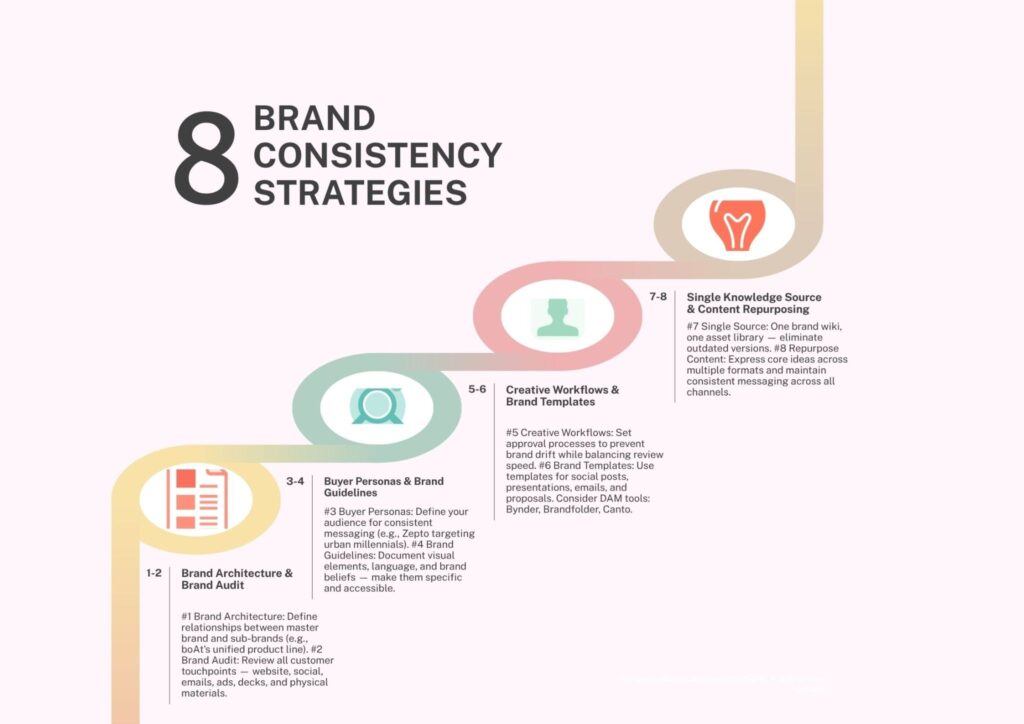
The most practical brand consistency strategies combine clear brand architecture, a defined brand audit process, accessible brand templates, and a single digital asset management system. Together, these create the infrastructure that makes consistency the default outcome rather than something teams have to remember to do.
What Effective Brand Consistency Actually Looks Like: Nike and Starbucks
Nike
Nike’s brand consistency strategy over decades demonstrates something worth understanding: you can evolve creatively and dramatically while keeping the brand completely stable.
Nike’s visual identity has modernised across eras. Their campaigns have shifted from pure performance to cultural commentary to social justice. But every campaign connects back to the same core belief: athletic achievement, the inner dialogue of pushing past limits, and the idea that sport belongs to everyone. “Just Do It,” introduced in 1988, still runs because it captures that belief in three words that haven’t aged.
Their consistency extends to internal culture. Nike invests in extensive brand training for employees, agency partners, and retail partners globally. That investment is why a Nike display in a sports store in Chennai and a Nike campaign running in New York both feel like Nike, even though entirely different teams created them.
Starbucks
Starbucks has maintained brand consistency across more than 35,000 locations globally, which is an operational challenge most brands never face at scale. Their strategy includes obsessive visual consistency (the green, the siren logo, the cup design), but the real discipline is in the experiential consistency.
The in-store environment, the barista interaction, the way drinks are named and customised, the seasonal campaign cadence: all of it is governed by guidelines precise enough that the experience in a Starbucks in Singapore matches the one in Seattle. That degree of consistency requires systems, training, and ongoing auditing at scale.
Both Nike and Starbucks also demonstrate something worth noting: brand consistency doesn’t mean brand rigidity. Both brands have evolved significantly. But they’ve done so in directions that are coherent with who they already were.
The Hidden Cost of Brand Inconsistency Most Leaders Underestimate
Every team understands that off-brand visuals are a problem. Fewer understand the costs that don’t show up in a design review.
Longer sales cycles. When a prospect encounters inconsistent materials at different stages of the funnel, their confidence in the organisation drops. They’re not thinking “the brand is inconsistent,” they’re thinking “I’m not sure these people have their act together.” That hesitation extends decisions.
Agency and freelancer rework. Every time an external partner works with unclear or inaccessible brand guidelines, you pay for rework. Either their work needs revision, or it gets approved and adds inconsistency to the system. Both outcomes have a cost.
Diluted campaign performance. Creative that doesn’t match the brand’s established visual identity suffers in ad recall. According to Nielsen’s research, brand-consistent creative generates significantly higher brand recall compared to off-brand creative, even controlling for media spend.
Employee confusion and morale. Teams that aren’t sure what the brand is can’t advocate for it. They also make more mistakes that need correcting, which creates frustration on both sides.
The costs are real. They’re just distributed across functions in ways that make them easy to misattribute.
Challenges in Maintaining Brand Consistency
Knowing the strategy is one thing. Actually keeping a brand consistent under real organisational conditions is a different problem.
Scale and team size. A five-person team can maintain brand consistency through proximity. A 200-person organisation spread across locations and functions cannot. What works at one scale breaks at another, and most teams don’t update their brand management systems as they grow.
Multiple agencies and partners. Every external partner who touches your brand is a consistency risk. Agencies have their own aesthetic instincts, freelancers have limited context, and influencer partners have their own communication style. Clear briefs and accessible guidelines help, but they don’t eliminate the risk.
Platform-specific pressures. Every platform has its own content norms. What works on LinkedIn doesn’t work on Instagram. What works on Instagram doesn’t work on TikTok. The pressure to adapt to platform conventions can pull brand voice and visual identity in inconsistent directions if teams don’t have clear guidance on what’s adaptable and what isn’t.
Speed of execution. When teams are moving fast, brand reviews get skipped. Templates don’t get updated. The approved asset is two clicks away but the close-enough version is right here. Speed is the enemy of process, and process is how consistency gets maintained. The answer isn’t to slow down; it’s to make the consistent choice the fastest choice.
Leadership changes. A new CMO with strong opinions, a rebrand driven by a new CEO’s vision, or an acquisition that brings in a different brand culture: all of these can disrupt consistency rapidly. The brand has to be documented well enough to survive personnel changes.
Conclusion
Brand consistency strategy isn’t glamorous work. It doesn’t generate the same excitement as a big campaign launch or a viral moment. But it’s what makes those campaigns land on a foundation that already has equity in it. And it’s what makes the brand survive the moments when nothing exciting is happening.
The organisations that get this right share a few things: they’ve defined their brand precisely, not vaguely; they’ve built systems that make consistent execution the path of least resistance; and they treat consistency as an ongoing operational responsibility, not a one-time brand project.
Start with what you have. If your brand guidelines are thin, make them thicker. If assets are scattered, consolidate them. If teams aren’t sure what your brand sounds like in writing, give them examples. Small improvements in brand infrastructure compound over time exactly the way inconsistency does, just in the right direction.
If you want to build the kind of marketing knowledge that makes all of this make sense at a strategic level, the Crystal Clear Newsletter covers brand strategy, marketing execution, and the thinking behind campaigns that actually work. It’s written for practitioners, not beginners.
FAQs About Brand Consistency
What is brand consistency, and why does it matter?
Brand consistency means presenting the same identity, voice, and visual style across every customer touchpoint, from social media and advertising to customer support and packaging. It matters because consistency builds recognition, and recognition builds the kind of trust that converts to purchases and loyalty. Without it, customers can’t form a stable mental model of who you are.
What’s the difference between brand voice and brand tone?
Brand voice is the fixed personality of your brand: witty, authoritative, warm, direct. It doesn’t change. Brand tone is how that voice adapts to the situation: the same brand that uses dry humour in a social post will dial back the wit in a product safety notice. Voice is constant; tone is contextual.
How often should you do a brand audit?
Once a year is the minimum for most organisations. Fast-growing brands or those operating across many channels should consider a lighter check-in every quarter, with a comprehensive audit annually. The goal is to catch drift early, before it compounds.
Do small businesses need a brand consistency strategy?
Yes, arguably more than large ones. Small businesses rarely have the budget to recover from perception damage caused by inconsistency. And smaller teams are often more dependent on individual judgment calls, which makes a clear, accessible set of guidelines even more valuable. Even a two-page brand guide covering your logo, colours, fonts, and voice is meaningfully better than nothing.
What’s the best way to maintain brand consistency when working with agencies?
Start with a thorough onboarding. Don’t assume agencies will read a brand document they’ve been handed; walk them through the most important decisions and the reasoning behind them. Make approved assets immediately accessible, not something they need to request. And include brand consistency as an explicit review criterion in every deliverable sign-off, not just an afterthought.
Is brand consistency the same as brand identity?
No. Brand identity is what you define: your logo, colours, voice, values, and positioning. Brand consistency is what you do: the operational discipline of presenting that identity reliably across every channel and touchpoint. Identity without consistency is theory. Consistency without a clear identity is empty repetition.
How do you maintain brand consistency across multiple social platforms?
Start by deciding what’s fixed and what’s adaptable. Fixed elements: logo, colour palette, core message, brand voice. Adaptable elements: content format, posting frequency, caption length, and use of platform-native features. Build platform-specific templates that lock the fixed elements and leave room for the adaptable ones. Then make sure whoever runs each platform understands the underlying reasoning, not just the rules.
What role does digital asset management play in brand consistency?
DAM software like Bynder or Brandfolder is the infrastructure layer that makes brand consistency operational at scale. It gives everyone in the organisation access to the right version of every approved asset, eliminates the “I couldn’t find it so I made my own” problem, and keeps your brand library current after rebrands or updates. Without some form of centralised asset management, brand consistency degrades proportionally with team size.
Can a brand be too consistent? Is there such a thing as being too rigid?
Yes. A brand that never adapts becomes stale. Consistency is about identity, not stagnation. The best brands update their visual and communication systems over time while keeping the underlying values and personality stable. The test is whether a change feels like growth or like a departure. Growth keeps existing customers; departures confuse them.
What’s the most common mistake brands make with brand consistency?
Treating brand guidelines as a one-time creation rather than a living system. Guidelines get built, shared once, and then ignored as the team and the market evolve. The result is a gradual drift that nobody notices until the gap between the guidelines and actual execution has become a chasm. The fix is scheduled maintenance: regular audits, regular updates, and someone accountable for the health of the brand system.