
Most small businesses show up on social media. Very few use it well.
The difference usually isn’t the budget. It’s not even posting frequency. It’s that most small business owners treat social media as a broadcasting tool and wonder why nothing grows. You post a product photo, get twelve likes from friends and family, and call it done for the week.
Social media marketing for small businesses works differently from what most people assume. You’re not buying reach with a big ad budget. You’re building a presence that compounds over time, one that earns trust before it earns sales. This guide covers everything: what social media marketing actually is for a small business, which platforms are worth your time, how to build a strategy from scratch, and what separates the businesses that grow on social media from the ones that just exist on it.
Read More: What is social media marketing
Table of Contents
What Is Social Media Marketing for Small Businesses?
Social media marketing is the use of social platforms to build brand awareness, engage with your target audience, drive traffic, and convert followers into customers.
For small businesses specifically, it means doing this without the budgets or teams that larger brands have. That sounds like a disadvantage. In practice, it’s often the opposite. Small businesses can move faster, sound more human, and build the kind of community that a corporate account rarely can.
The thing is, social media is not a sales channel. Not primarily. The businesses that treat it like one (posting discounts, products, and promotions nonstop) rarely get traction. The ones that treat it as a relationship-building channel and let sales follow naturally tend to grow much faster.
This isn’t abstract advice. A bakery in Bangalore that posts behind-the-scenes reels, shows the team at work, and responds to every comment will almost always outperform the one posting only product photos with price tags. Authenticity is a competitive advantage on social media, and it costs nothing.
Social media marketing for small businesses involves using platforms like Instagram, LinkedIn, and Facebook to build brand awareness, engage audiences, and drive conversions without large advertising budgets. Unlike enterprise brands, small businesses can compete through authenticity, community, and consistent content, which costs time rather than money. The businesses that treat social media as a relationship channel rather than a direct sales channel consistently see stronger long-term growth.
Which Social Media Platforms Are Most Effective for Small Businesses?
The right platform depends entirely on who your customers are and what kind of content you can realistically produce. Spreading yourself thin across every platform is one of the most common mistakes small businesses make. Pick two, maybe three, and do them properly.
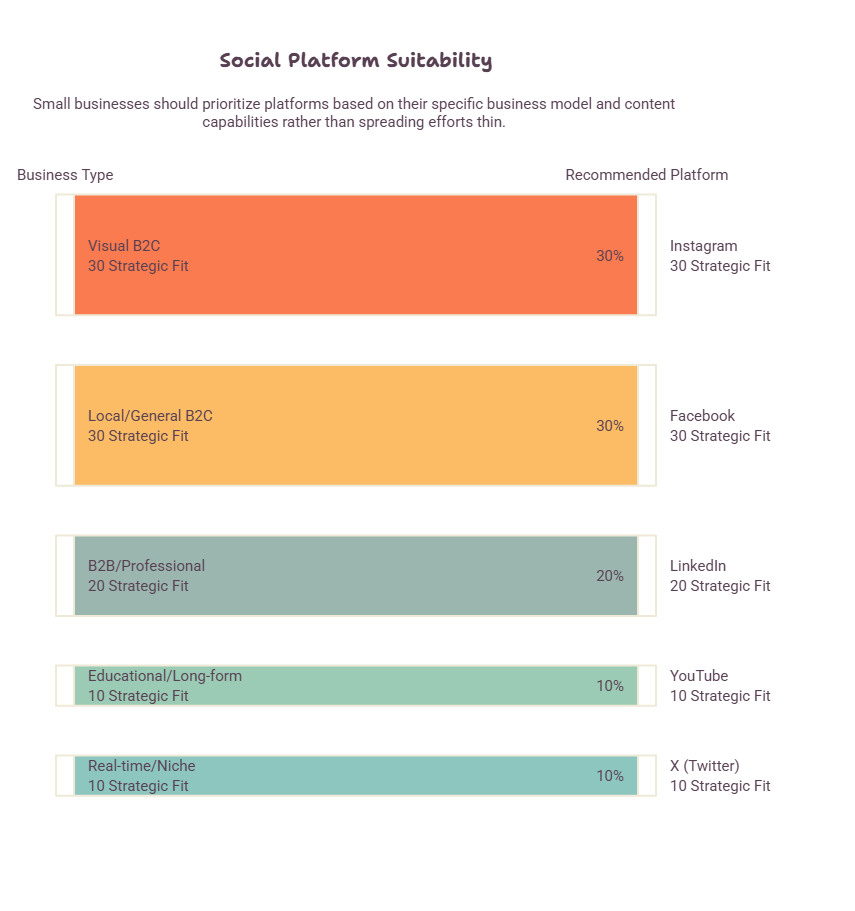
Instagram works best for businesses with a visual product or service: food, fashion, beauty, home decor, fitness, and travel. According to Meta’s 2024 Business Insights report, over 200 million businesses use Instagram, and 90% of users follow at least one business account. Reels have significantly more organic reach than static posts right now. If you can make short videos, Instagram should be your first platform.
Facebook’s organic reach has dropped significantly over the last decade, but it’s still the most used social platform globally, with over 3 billion monthly active users as of 2024 (Meta, Q3 2024 Earnings Report). For local businesses in particular, Facebook Pages and Facebook Groups remain powerful. Paid advertising on Facebook is also the most sophisticated targeting option available to small businesses on any budget.
LinkedIn is the right choice if you’re selling to other businesses, running professional services (accounting, law, consulting, recruitment), or building a personal brand in a professional field. It’s not a good fit for most B2C consumer businesses. But for B2B, it’s arguably the most valuable social platform you can invest in.
YouTube
YouTube is a long-term play, not a quick win. But it’s the second-largest search engine in the world, and content has a long shelf life compared to Instagram or Twitter posts. If you can consistently produce educational or tutorial content, a YouTube channel builds compounding traffic over the years. Zomato’s presence on YouTube, for example, goes far beyond food content and builds genuine brand affinity.
X (Twitter)
X works if you’re in tech, media, finance, or any field where real-time conversation and commentary matter. For most local or product-based small businesses, it’s hard to justify the time investment given the lower organic reach.
WhatsApp Business
This one gets overlooked in social media strategy conversations, but WhatsApp Business is extremely effective for Indian small businesses in particular. Broadcast lists, catalogs, and status updates let you stay top-of-mind with existing customers in a channel they actually check. According to a 2023 Meta report on Indian SMBs, over 15 million small businesses in India actively use WhatsApp Business.
How to Use Social Media for Small Business Marketing
This section is the practical playbook. Follow these steps in order, especially if you’re starting from scratch.
Step 1: Set Up Your Social Media Accounts Properly
Don’t rush past setup. A half-built profile loses credibility immediately.
For every platform:
- Use a clear, high-resolution profile photo (your logo or a professional headshot if you’re a personal brand)
- Write a bio that states exactly what you do and who you serve. No vague taglines.
- Add a link to your website or a link-in-bio page (Linktree or a native Instagram link tool)
- Fill in all contact and location fields completely
- Post 6-9 pieces of content before promoting the account to anyone
That last point matters more than people think. An empty profile or one with two posts tells a potential follower there’s nothing here. Give them a reason to follow before you ask them to.
Step 2: Develop Your Content Strategy
A content strategy doesn’t have to be complicated. It just needs three things: clarity on who you’re talking to, what you’re going to post, and how often.
Start with your audience. Who are your best customers? What do they care about beyond your product? What questions do they ask you repeatedly? Those questions are content.
Then decide your content mix. A workable starting split for most small businesses is:
- 50% educational or entertaining content (tips, behind-the-scenes, storytelling)
- 30% community content (user-generated content, reshares, conversations)
- 20% promotional content (offers, products, services)
If you reverse that ratio and post mostly promotions, you’ll see engagement drop fast.
Read More: content strategy for social media
Step 3: Build and Engage Your Audience
Posting content is only half the job. Engagement is the other half, and most small businesses neglect it completely.
Respond to every comment on your posts. Everyone. Especially in the first hour after posting, when platform algorithms are watching engagement rate closely to decide how widely to distribute your content. Reply to DMs. Comment on posts from accounts in your niche or neighbourhood. Follow relevant hashtags and add value in those conversations.
Mamaearth built much of its early community on Instagram, not through big campaigns but through consistent engagement with its followers, responding to reviews, reposting UGC, and making customers feel heard. That’s replicable at any scale.
Step 4: Consider Advertising on Social Media
Paid social is not a requirement, but it accelerates what organic can’t do quickly. A small budget on Meta Ads (Facebook + Instagram) can test audience segments, retarget website visitors, and drive very targeted traffic to a landing page.
The key for small businesses is not to start with broad awareness campaigns. Start with retargeting: people who’ve visited your website, engaged with your profile, or are on your customer email list. These audiences already know you. Converting warm traffic is far cheaper than cold traffic.
Read More: Meta Ads for small business
Top 8 Social Media Marketing Strategies for Small Businesses
1. Research Your Target Market
You can’t create content that resonates without understanding who you’re talking to. And “everyone” is not a target market.
Use Instagram Insights, Facebook Audience Insights, or even just look at who’s already following and engaging with your competitors. What age range? What interests? What problems are they posting about that you can solve? The more specific your picture of your ideal customer, the more relevant your content becomes.
2. Create Buyer Personas
A buyer persona is a semi-fictional profile of your ideal customer. It gives your content a specific person to talk to rather than a vague audience.
Build one by documenting: age, occupation, location, income range, what they scroll for, what they hate seeing in their feed, and what would make them follow and trust a brand like yours. BoAt, the Indian audio brand, clearly built content around a specific persona: young, urban, aspirational, music and sports-oriented. Everything they post feels like it’s made for one specific type of person.
3. Understand the Strengths of Each Social Media Platform
Don’t repurpose the same content identically across platforms. A LinkedIn post that performs well is not the same as an Instagram caption that performs well. The audience expectation, the algorithm, and the format are all different.
Vertical video for Instagram Reels. Conversational text posts for LinkedIn. Short entertaining clips for YouTube Shorts. Horizontal long-form videos for YouTube. Adapt the core idea to the native format of each platform.
4. Use Visual Content to Capture Attention
Humans process images 60,000 times faster than text, according to research from MIT’s Brain and Cognitive Sciences department. On a social feed where content moves at scroll speed, your visual is the only thing stopping someone from moving on.
You don’t need professional photography. But you do need consistency: a recognisable color palette, a consistent style of image or video, and basic composition. Nykaa’s Instagram is a masterclass in visual consistency for a small-to-mid-sized brand. Every post looks like it belongs together.
5. Engage With Your Followers
Say it louder for the people in the back: engagement is not optional.
Businesses that post content but don’t respond to comments or DMs are leaving their most valuable social media activity on the table. Engagement signals platform algorithms, builds trust with potential customers, and turns casual followers into loyal ones. Set aside 15-20 minutes a day to respond, react, and interact.
6. Leverage User-Generated Content (UGC)
User-generated content, meaning posts, reviews, and videos created by your actual customers, is the most credible content you can share. A real customer showing their real experience with your product converts better than any ad you’ll create yourself.
Ask for it. After a purchase, message customers and ask if they’d share a photo. Repost tagged content with credit. Run a simple hashtag challenge. Swiggy’s UGC approach, consistently reposting customer food photos, has been a major part of how they maintain social engagement without constantly producing original content.
User-generated content (UGC) is among the most effective social media tools for small businesses because it combines social proof with free content creation. Businesses that actively encourage and repost UGC from customers build credibility faster than those relying solely on brand-produced content. A simple request after purchase, combined with a branded hashtag, can generate a steady stream of authentic content.
7. Collaborate With Influencers
Influencer marketing doesn’t require a celebrity budget. Micro-influencers, accounts with 5,000 to 50,000 followers in a specific niche, often have higher engagement rates and more genuine audience trust than large accounts.
For a small business, a local food blogger, a niche fitness creator, or a regional lifestyle account can drive meaningful results at a fraction of the cost of macro-influencer campaigns. The key is relevance over reach. A skincare brand getting coverage from a 15,000-follower beauty creator whose audience is the right demographic will almost always outperform a generic post from a 500,000-follower celebrity.
8. Explore Paid Advertising
Start small. A budget of Rs. 500-1,000 per day on Meta Ads is enough to test audiences and creatives before scaling what works. For Google-indexed businesses, retargeting ads on Facebook to website visitors can be highly cost-effective.
Don’t run ads to a cold audience without a landing page that matches the ad promise exactly. The ad gets the click. The landing page closes the conversion.
Read More: social media advertising guide
How Can a Small Business Measure the Success of Its Social Media Marketing?
Track what you can act on. Not every vanity metric deserves your attention.
Metrics that actually matter for small businesses:
- Engagement rate: (Likes + Comments + Shares) / Reach. Aim for above 3% on Instagram and above 1% on Facebook. Below that, your content isn’t resonating.
- Follower growth rate: Month-over-month percentage growth. Absolute numbers are less useful than trends.
- Click-through rate (CTR): What percentage of people who see your post click your link? Useful only if you’re tracking traffic-driving content.
- Website traffic from social: Set up UTM parameters on your links so Google Analytics (or any analytics tool) shows which social platform is actually driving visitors.
- Conversion rate from social traffic: Of the visitors who come from social media, what percentage take the action you want (sign up, purchase, enquiry)?
Follower count is the least useful metric for a small business. 2,000 genuinely engaged followers who know your brand will do more for your business than 20,000 passive ones.
Small businesses should measure social media success through engagement rate, website traffic from social channels, and conversion rate rather than follower count. A small, highly engaged audience consistently outperforms a large, passive one. Setting up UTM parameters on all social links gives accurate data on which platforms are actually driving business outcomes.
Common Mistakes to Avoid in Social Media Marketing for Small Businesses
Most of these are fixable. The problem is that most small businesses don’t realise they’re making them.
Not having a social media plan. Posting when you feel like it, about whatever seems relevant that day, produces inconsistent results. A simple content calendar covering even two weeks ahead changes this entirely.
Ignoring audience insights and analytics. Every platform gives you free data on what’s working. Instagram Insights, Facebook Page Insights, and LinkedIn Analytics all show you which posts drove the most engagement, what time your audience is most active, and what content formats perform best. Most small businesses never look at this data.
Over-promotion without engagement. If more than 30% of your posts are promotional, you’ll see reach and engagement drop. The algorithm de-prioritises accounts that users don’t engage with, and users don’t engage with pure advertising.
Not adapting content to each platform. Copying the same caption and image across Instagram, Facebook, and LinkedIn looks lazy and performs worse than native content on each platform.
Failing to experiment with different formats. If you’ve only ever posted static images on Instagram, you have no idea whether Reels or carousels would perform better for you. Most platforms currently reward the adoption of new formats with extra reach. Test.
Not setting clear goals or KPIs. “Get more followers” is not a goal. “Increase website traffic from Instagram by 20% in 90 days” is a goal. Without specific targets, you have no way to know if what you’re doing is working.
Poor crisis management. A negative review, a controversial post, or a customer complaint that goes viral can disproportionately hurt a small business. Have a simple policy: respond publicly and calmly, take the conversation offline quickly, and never argue in comments.
Practical Small Business Social Media Tips
Quick things you can act on immediately:
- Batch your content creation. Spend two to three hours once a week creating and scheduling all your content rather than scrambling daily. Tools like Buffer, Later, or Meta Business Suite let you schedule in advance.
- Use native scheduling tools. Scheduled posts through Meta Business Suite don’t take an algorithmic hit, despite the persistent myth that they do.
- Repurpose content across formats. A blog post becomes a LinkedIn article, an Instagram carousel, and three Twitter/X posts. A customer testimonial becomes a Story, a post caption, and a quote graphic.
- Use polls and question stickers on Stories. These are among the highest-engagement formats available and take five minutes to create.
- Respond to comments within the first hour. This is the window where your response will be seen by people who are already engaged with the post, and it signals to the algorithm that your post is generating an active conversation.
- Pin your best-performing post to the top of your profile. New visitors see it first.
- Go live occasionally. Live video still gets priority reach on Instagram and Facebook. Even a 10-minute Q&A or a behind-the-scenes live can outperform your normal posts.
Conclusion: Start Growing Today
Social media marketing for small businesses isn’t about going viral. It’s about showing up consistently, talking to the right people, and building the kind of trust that makes someone choose your business over a competitor they found through a Google ad.
The businesses that win on social media long-term do three things: they pick platforms where their customers actually are, they create content worth engaging with rather than content designed to sell, and they treat the engagement as part of the job, not an afterthought.
You don’t need a big budget or a professional content team. You need a clear understanding of your audience, a realistic posting plan you can stick to, and the discipline to show up week after week.
If you want to go deeper on building social media strategies that actually convert, YUP’s Social Media Marketing course covers everything from content frameworks to paid social, with real-world examples built for Indian businesses and D2C brands. [CTA: YUP Social Media Marketing Course]
Frequently Asked Questions
What is social media marketing for small businesses?
Social media marketing for small businesses is the use of platforms like Instagram, Facebook, LinkedIn, and YouTube to build brand awareness, engage with potential customers, and drive sales. It typically relies more on organic content and community-building than on large advertising budgets, making authenticity and consistency the main competitive advantages.
Which social media platform is best for a small business
It depends on your product and customer. Instagram and Facebook work well for B2C businesses with visual products. LinkedIn is best for B2B and professional services. YouTube suits businesses that can produce educational content consistently. WhatsApp Business is highly effective for customer retention, especially in India. Start with one or two platforms where your customers already spend time, rather than trying to be everywhere.
How often should a small business post on social media?
Consistency matters more than frequency. Posting three to four times a week on Instagram or Facebook and showing up reliably is more effective than posting daily for two weeks and then going quiet for a month. For LinkedIn, two to three posts per week is enough if the content is high-quality.
How do I grow my social media following as a small business?
Focus on engagement before follower count. Post content that’s genuinely useful or interesting to your target audience, respond to every comment, engage with other accounts in your niche, and use relevant hashtags. Collaborating with micro-influencers and running occasional giveaways can accelerate growth, but organic community-building produces better long-term results than follower purchases or aggressive follow-unfollow tactics.
Do small businesses need to spend money on social media ads?
No, but it helps. Organic social media alone can build a strong presence over time. Paid advertising, even a small daily budget on Meta Ads, lets you reach new audiences faster, retarget website visitors, and test what content converts. If the budget is tight, focus on organic first and add paid when you have a proven message and a landing page that converts.
How do I measure if social media is working for my business?
Track engagement rate, website traffic from social channels, and conversion rate rather than raw follower count. Set up Google Analytics (or any analytics tool) with UTM parameters on your social links to accurately track which platforms drive visits and sales. Revisit these numbers monthly and adjust your content based on what’s actually performing.
What type of content works best for small businesses on social media?
Behind-the-scenes content, educational tips, customer stories, and user-generated content consistently outperform pure promotional posts. Short-form video (Instagram Reels, YouTube Shorts) currently gets the most organic reach across platforms. The most effective content answers a real question your customer has or shows your product or service solving a real problem.
How do I handle a negative comment or review on social media?
Respond publicly, promptly, and calmly. Acknowledge the issue without being defensive. Invite them to continue the conversation via DM or email. Never delete negative comments unless they violate community guidelines. A well-handled public complaint can actually improve trust with potential customers who see how your brand responds under pressure.
Is influencer marketing worth it for small businesses?
Yes, if you choose the right influencers. Micro-influencers with 5,000 to 50,000 followers in your specific niche often deliver better ROI than large celebrity accounts because their audiences are more targeted and engaged. Focus on relevance over reach, and make sure the influencer’s audience matches your customer profile before agreeing to a collaboration.
What’s the biggest mistake small businesses make on social media?
Over-promoting without engaging. Most small businesses use social media as a one-way broadcast channel: posting products, offers, and announcements, and then wondering why engagement is low. Social media works when you treat it as a two-way conversation. Respond to comments, ask questions, share content that genuinely serves your audience, and let selling be the natural outcome of trust, not the lead.