

Open your favourite D2C brand’s website, then its Instagram page, then the ad that followed you around last week. Chances are the three sound like three different companies. The website is polished and a little formal. Instagram is all memes and slang. The ad promises a discount and nothing else.
Customers feel that mismatch even when they can’t name it. They hesitate. They scroll on. They trust a bit less. A brand messaging framework fixes this by putting what you say, who you say it to and why anyone should care into one shared document that every channel works from.
This guide covers: What a brand messaging framework actually contains? How to build one in eight steps? How Apple, Nike, Dove and Patagonia handle their messaging? You’ll also get a fill-in template, the mistakes that quietly wreck messaging, and a few ways to tell whether yours is working.
Table of Contents
What Is a Brand Messaging Framework?
A brand messaging framework is a document that sets out what your brand says, who it says it to and why that audience should care. It holds your core message, supporting points, proof and tone in one place. So everyone who writes or speaks for the brand starts from the same page.
Not a tagline. Not a logo guide either. It sits underneath both.
Your brand messaging strategy is the thinking: who you’re for, what you promise, how you’re different from the other options. The framework is where that thinking gets written down in a form a copywriter, a salesperson or a freelancer can pick up on Monday and use by Tuesday.
For marketing, that means fewer arguments over wording and faster briefs. For growth, it means a customer who meets you on Instagram, then on your pricing page, then in a sales call, and hears the same promise each time. That kind of repetition feels slow and a bit boring from the inside. From the outside it looks like a brand that knows what it is.
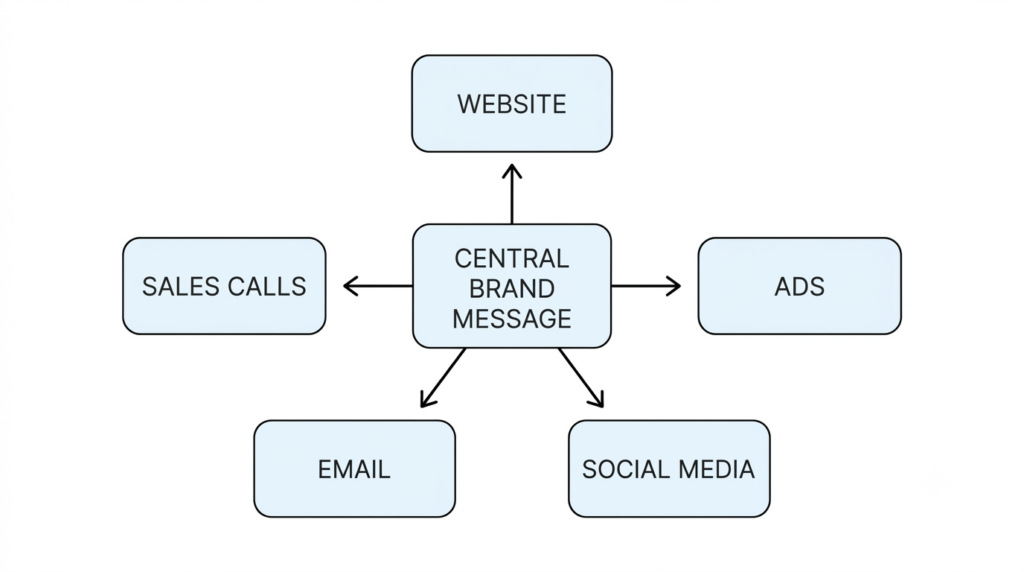
How Does It Work in Practice?
Take a made-up skincare brand called Dewmark. It’s fictional, invented only for this example. Its central promise is simple: skincare for sensitive skin that’s honest about what it can and can’t do.
On the website, that promise becomes the homepage headline. That comes with a plain-language ingredient list right under it. In paid ads, the same promise shrinks to one benefit, say “fragrance-free”, and the ad lands on a page that talks about exactly that. On Instagram, it turns into short videos where the team explains one ingredient at a time, with no miracle claims anywhere.
Three channels. Three formats. One promise. Nobody at Dewmark has to reinvent the message every time they open a new tab. They only change its size.
Why Does Every Business Need One?
Because without it, every person on the team fills the gaps differently.
Consistency is the obvious payoff of having a brand messaging framework. Customers also understand you faster, since they keep hearing the same thing in the same words. Marketing gets sharper because every campaign has to answer to one central idea. That kills a lot of random “let’s try this” posts. Teams write with more confidence. The repeated message turns into recognition over months.
There’s some data behind this, with a caveat. In its 2019 State of Brand Consistency report, Lucidpress (now Marq) found that companies attributed revenue increases of up to 33% to consistent brand presentation. 81% said they regularly deal with off-brand content. The survey covered more than 400 brand professionals. It was self-reported. It came from a brand-management software vendor. Treat it as a direction, not a promise. It also measures brand presentation broadly, not messaging alone.
A brand messaging framework is a written document that defines what a brand says, who it says it to and why customers should care. It combines a central message, supporting pillars, proof points and a defined voice so every channel and team member communicates the same promise. Lucidpress’s 2019 research linked consistent brand presentation with revenue increases of up to 33%, though the figures were self-reported.
What Are the Core Elements of Effective Brand Messaging?
A good brand messaging framework has eight parts: purpose, audience, value proposition, positioning, pillars, voice, proof and a brand promise. They stack on each other. Thin audience research makes the value proposition vague. A vague value proposition gives your pillars nothing to stand on.
The first four are about thinking. The last four turn that thinking into language.
1. Brand Mission and Purpose
What does the business stand for? Why does it exist, and what change does it want to make in the customer’s world? Those questions sound like workshop fluff until you try answering each in one sentence. Most teams can’t, at first.
A purpose doesn’t have to be grand. “We help small shops get found in their own city” is a perfectly good one. It only has to be true, and specific enough that it rules something out.
2. Understanding Your Target Customers
Demographics are the easy bit: age, city, income, job. Behaviour is where it gets interesting. What do people do before they buy? Who do they ask? What makes them hesitate at checkout?
Motivations and expectations matter even more. Two 28-year-olds in Pune can want completely different things from the same product. One wants it cheap and quick. The other wants it to last and doesn’t mind paying for that. Same demographic, but different message.
3. Your Unique Value Proposition
What do you offer. What does the customer get out of it. Why pick you over the other option? Your brand value proposition answers all three in a line or two. If it takes a paragraph, it isn’t finished.
Here’s a quick test. Could a competitor paste it on their website without changing a word? If yes, it’s too generic to be yours.
4. Brand Positioning
Positioning is the spot you claim in the customer’s mind. Three things feed it: the category you compete in, the alternatives people compare you with (doing nothing counts as one), and whatever you do that they don’t.
Plenty of teams squeeze this into a brand positioning statement, one sentence built like this: for [audience], [brand] is the [category] that [main benefit], because [reason to believe]. Rough, yes. It still forces decisions that a long strategy deck lets you dodge.
5. Core Messaging Pillars
Pillars are the three to five themes that hold up your main promise. Most brands do well with three or four messaging pillars. Five starts to feel crowded. Six usually means nobody made a choice.
Each pillar needs four things: the central message, why customers should care, the supporting benefits, and the evidence that makes it believable. Back to Dewmark. One pillar could be “gentle by design”. The message says the formulas are built for reactive skin. Customers care because they’ve been stung, literally, by other products. The benefits are fewer ingredients and no added fragrance. The evidence is a full ingredient list and properly documented testing, if that claim is made at all.
And if a pillar could sit on any other brand in your category without anyone noticing, rewrite it.
6. Brand Voice and Personality
Voice is who you sound like. Tone is how that voice shifts with the moment. Good brand voice and tone guidelines cover both: three to five personality traits, the words you like, the words you avoid, and how the tone changes between, say, a launch announcement and an apology for a delayed order.
A cheerful brand can still go quiet and serious when a customer is upset. Nobody wants a joke in the middle of a refund request.
7. Supporting Evidence and Proof Points
Claims are cheap. Proof is what makes them stick. The usual sources are customer testimonials, case studies, product demonstrations, certifications, verified business results and, where it exists, independent research.
Pick the ones you can defend. A testimonial with a real name and a real result beats “customers love us” every time. If you can’t prove something yet, don’t say it yet.
8. Brand Promise and Emotional Connection
What can a customer count on every single time? That’s the promise. Trust gets built in small, dull moments, like a delivery arriving on the day you said it would.
Emotion comes in through expectations. Someone applying for a loan wants a quick yes. They also want to avoid feeling stupid while they apply. Your messaging should show you understood both.

How to Build a Strong Brand Messaging Framework Step by Step?
You can build a brand messaging framework in eight steps: understand your business, research your audience, study competitors, write one main message, create your pillars, set your style, test everything, then document and roll it out. Do them in order. Jumping straight to the writing is the classic mistake.
Step 1: Understand Your Business and Its Purpose
Start with what the brand messaging framework needs to help you achieve. Growing revenue? Entering a new city? Moving from small shops to chains? Goals shape the message. That’s because a brand chasing volume talks differently from one chasing premium prices.
Then pin down the main offering in plain words, the problem it solves and the value you want customers to walk away with. One sentence each. If your co-founder writes a different sentence for the same question, good. You’ve just found your first problem.
Step 2: Research Your Target Audience
Interview customers. Five to eight real conversations will teach you more than a week of guessing in a meeting room. Then read your reviews, support tickets, sales call notes and the questions people send in DMs. Look for patterns, and for the exact words people use.
Those words matter more than anything a brainstorm will produce. boAt is a useful Indian example. According to Outlook Business’s 2019 profile, the founders built their early communication around a problem buyers already felt. The brand’s first Facebook ad showed a frayed Apple cable and asked whether people were tired of replacing chargers. It spoke straight to one of the everyday customer pain points the founders had spotted. That kind of target audience messaging starts with listening, not with a clever line.
Questions to Ask During Audience Research
- What problem are customers trying to solve?
- What makes them trust a business?
- What stops them from buying?
- What words do they use when they describe the problem?
Step 3: Analyse Your Competitors
Open competitor websites, ads and social feeds side by side. Note what everyone says, because that’s where the market is crowded. Note what nobody says, because that’s where your opening might be. Compare promises and the proof behind them. The aim is competitive differentiation you can back up, not a slogan that merely sounds different.
What to Include in a Competitor Messaging Analysis
| Element | What to examine |
| Audience | Who are they targeting? |
| Main message | What promise do they communicate? |
| Benefits | What customer outcomes do they highlight? |
| Differentiation | What makes them stand out? |
| Proof | What evidence supports their claims? |
| Tone | How do they communicate? |
Fill it in for three to five competitors. Patterns show up quickly, usually by the third row.
Step 4: Define Your Main Brand Message
Write one statement. It names the customer’s problem, the outcome they want and something you can really deliver. That’s the whole job.
Skip phrases like “innovative solutions” and “world-class service”. They tell nobody anything. A workable first draft sounds more like this: “We help [who] get [outcome] without [the thing they dread].” Then check it against Step 1. Can the business honestly deliver it? If the answer is “mostly”, soften the promise now, not after a customer complains.
Step 5: Create Your Messaging Pillars
Choose three to five supporting themes. Tie each one to a real customer need from your research. Then add the supporting message and the proof. Then test the set as a whole: do these pillars, read together, make your central promise easier to believe?
Cut any that don’t. A pillar you like but can’t prove is decoration.
Step 6: Establish Your Communication Style
Choose three to five personality traits. Define each with a pair of examples. Take “approachable”. It might mean writing “we’ll sort this out today” instead of “your query has been escalated”. Spell out words and phrases you’ll use, and the ones you won’t.
Examples of what’s on-brand and what isn’t do more work than any adjective list. Show a good email and a bad one. People copy what they can see.
Step 7: Validate and Test Your Messages
Show the draft to customers and listen for confusion. Try different headlines on your website, compare ad variations and run a simple clarity check. Show someone your homepage for five seconds, hide it and ask what the company does.
Then watch engagement and conversions. Be honest about sample size, though. A test on a few hundred visits can point in a direction, but it rarely settles an argument.
Step 8: Document and Implement the Framework
Put the finished brand messaging framework in one reference document. Keep it short enough that people will open it. Share it with marketing and sales, and with whoever writes your support replies. A framework buried in a shared drive is just a nice file.
Fold it into your wider brand communication strategy: briefs, onboarding, ad review checklists, email templates. Then set a review date. Twice a year works for most teams.
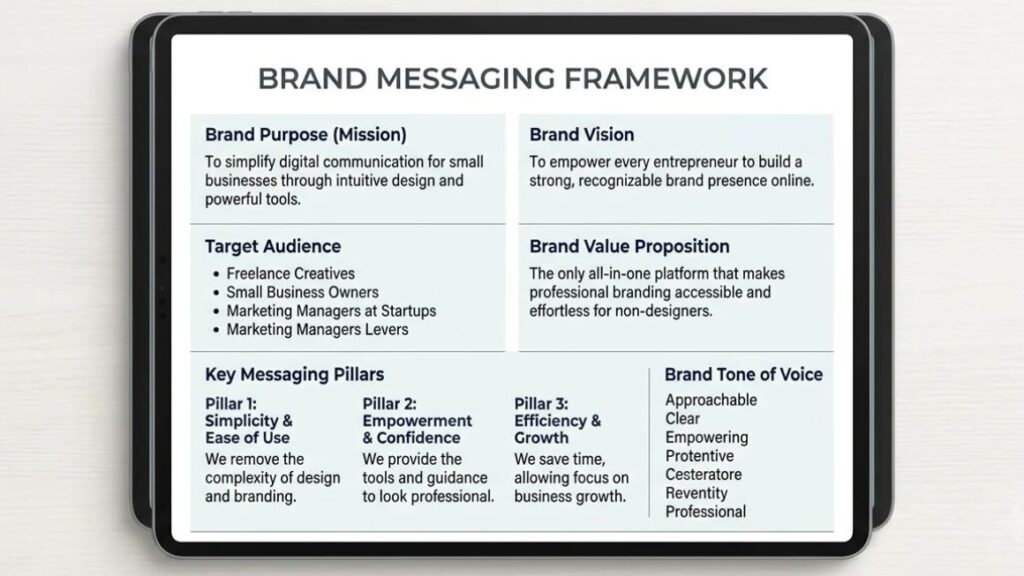
Building a brand messaging framework starts with customer research, not copywriting. Teams interview customers, study competitor messaging, write one central message backed by three to five pillars, define voice, test the language and document it in a single reference file reviewed twice a year.
Real-World Brand Messaging Examples Worth Learning From
The brand messaging examples below come from official company announcements and public campaigns. You rarely get to see a brand messaging framework itself, only its effects, so these show what each brand communicates from the outside, not what happens behind closed doors.
Apple: Making Simplicity Part of the Experience
Apple’s story leans hard on technology that feels easy. Its June 2025 announcement of the Liquid Glass software design is a tidy illustration. Apple described one design language across iOS 26, iPadOS 26, macOS Tahoe 26, watchOS 26 and tvOS 26, and kept stressing that the result stays “instantly familiar” while bringing more focus to content.
Read a few Apple pages in a row and count how often ease and familiarity show up. The company seldom sells a feature without tying it to how the experience feels. That’s a messaging choice, and a disciplined one.
Nike: Connecting Products With Human Motivation
Nike’s stated mission is to bring inspiration and innovation to every athlete in the world, with an asterisk that reads “If you have a body, you are an athlete.” That small footnote widens the audience from competitive sportspeople to nearly anyone.
“Just Do It” launched in 1988, and Nike’s newsroom says it opened with an ad of 80-year-old runner Walt Stack crossing the Golden Gate Bridge. In September 2025 the company relaunched the line for a younger generation under a campaign called “Why Do It?”, framing greatness as a choice rather than an outcome. Nearly four decades on, the same emotional idea is still doing the work.
Dove: Building Communication Around Real Beauty
Dove’s Campaign for Real Beauty began in 2004, after a global study the brand commissioned found that only 2% of women would describe themselves as beautiful, according to Unilever. Instead of talking about soap, Dove picked a social theme and stuck to it.
The theme later became a set of public commitments, including a pledge to always feature women, never models. In 2024 Dove added a promise to never use AI to represent real women in its advertising. A clear social stance gives campaigns a spine, but it also invites scrutiny, so the actions have to keep pace with the words.
Patagonia: Communicating Environmental Responsibility
Patagonia has pledged 1% of sales to environmental causes since 1985, per Fast Company. In September 2022 it went further. The company announced “Earth is now our only shareholder”, moving ownership to the Patagonia Purpose Trust and the Holdfast Collective, with profits not reinvested in the business going to fight climate change. Patagonia projected that dividend at roughly $100 million a year.
What makes the message land is that it’s attached to something the company did, with legal paperwork behind it. A claim is easy to make. An ownership change is hard to fake.
Brand Messaging Framework Template: A Practical Example
A brand messaging framework only becomes useful once it’s filled in. Here’s a brand messaging template you can copy into a doc and complete over an afternoon. Answer in plain sentences. Don’t polish yet.
A Fill-in-the-Blank Template
| Framework component | Questions to answer |
| Business purpose | Why does your business exist? |
| Target customer | Who are you serving? |
| Customer problem | What problem are you solving? |
| Main promise | What outcome do you deliver? |
| Differentiation | Why should customers choose you? |
| Main message | What should customers remember? |
| Supporting pillars | What three to five themes support the message? |
| Proof points | What evidence supports your claims? |
| Brand personality | How should your brand sound? |
| Customer action | What should customers do next? |
Completed Example for a Fictional Business
This is a hypothetical example, not a real client case study. “Brightpath Digital” is an invented digital marketing agency, and nothing below describes real results.
| Framework component | Brightpath Digital (hypothetical) |
| Business purpose | To make marketing spend understandable for owners who don’t have a marketing team |
| Target customer | Small business owners |
| Customer problem | Difficulty generating consistent leads |
| Main promise | Helping businesses attract qualified customers through measurable digital marketing |
| Differentiation | Reports an owner can read without a glossary |
| Main message | Marketing you can understand, with leads you can count |
| Supporting pillars | Transparency, performance, practical expertise |
| Proof points | Verified client results, case studies, a clear reporting process |
| Brand personality | Approachable, knowledgeable, honest |
| Customer action | Book a free review of your current lead sources |
Look at how each row feeds the next one. The problem shapes the promise, the promise shapes the message, and the proof keeps the whole thing from floating off into puffery.
How to Apply Your Messaging Across Different Marketing Channels?
The message stays put while the packaging changes. Pair the framework with your brand identity guidelines, the document covering logo, colours and typography, so words and visuals travel together. Then adapt channel by channel.
Website and Landing Pages
Put the main promise above the fold, where people see it before scrolling. Spell out the customer benefits, add proof close by, and give one clear call to action. A visitor should be able to say what you do within a few seconds.
Also Read: AI Landing Page Optimization: In-depth Guide for Marketers
Social Media Marketing
Keep your voice recognisable even when the format changes. Build content around your pillars and lean on stories and customer-focused posts rather than announcements. Social is also where a loose voice shows up fastest, usually when three people post with three personalities.
Facebook and Instagram Advertising
Match each ad to a customer motivation you found in research. One benefit per creative. Make sure the ad, the landing page and the offer all say the same thing, because a mismatch there burns budget quietly. [INTERNAL LINK: Meta ads → article on Facebook and Instagram advertising]
Google Search Advertising
Search ads work when they answer the query. Pick one clear benefit, write for the intent behind the keyword, and make sure the landing page delivers what the ad promised. Someone searching for “fragrance-free moisturiser for eczema-prone skin” is not looking for your brand story.
Email Marketing
Keep the same voice as everywhere else, and adapt the content to what each segment cares about. Subject lines should be relevant and useful. Clever ones can wait.
SEO and Content Marketing
Build content around real customer questions and connect each article to one of your central themes. Educational pieces should help first and sell second. Readers can smell a sales pitch dressed up as a guide.
Common Brand Messaging Mistakes to Avoid
Most messaging problems are boring and fixable, and most disappear once a brand messaging framework is in place. Here are the six that show up most often.
Trying to Speak to Everyone
A message aimed at everyone is relevant to nobody. When your copy could apply to any customer, no customer feels spoken to. Choosing a primary audience feels like losing sales. It usually does the opposite.
Using Generic Marketing Statements
“Best quality.” “Customer-first service.” You’ve read them on a hundred websites, and that’s the issue. Without evidence, such phrases are noise. Say what the quality is, or what “customer-first” looks like on a Tuesday afternoon, like replying to every query within a set time.
Focusing on Features Instead of Benefits
A feature says what a product does: a 20-hour battery. A benefit says why anyone should care: you can leave the charger at home all week. Features back up the story. Benefits are the story.
Changing the Brand Message Too Frequently
Adapting is healthy. Abandoning is not. Rewording your headline for a festive sale is adapting. Swapping your whole promise every quarter because someone read a LinkedIn post is how customers lose track of who you are.
Making Claims Without Evidence
Every claim that goes unsupported costs a little trust, and trust is slow to rebuild. If you say you’re the fastest, show the measurement. If you say you’re sustainable, show what you changed.
Ignoring Customer Feedback
Customers tell you which words work, usually without being asked. When reviews keep describing your product as “simple”, and your copy says “powerful”, one of you is wrong. It’s rarely the customer.
How to Measure the Effectiveness of Your Brand Messaging?
You measure messaging by watching whether people recognise you, engage with you, convert and understand you. No single number gives the answer, so look at all four together and read them against your goals, campaign context and everything else that moved in the same period.
Brand Awareness and Recognition
Direct traffic and branded search growth are the usual signals. Google Search Console shows how many people search for your brand name over time. Brand recall surveys go further, since they ask people directly what they remember about you.
Customer Engagement
Look at social engagement, how people behave on your site and how they interact with content. Time on page and scroll depth are noisy on their own. A rise across several of them, after a message change, is more convincing.
Conversion Performance
Landing page conversion rates, lead volume and ad conversion rates tell you whether the message moves people to act. They’re also the easiest to over-interpret. A price change, a festival season or a new ad channel can swing them without any help from your wording.
Customer Understanding and Trust
Numbers can’t tell you whether people understood you. Interviews, feedback surveys and message comprehension checks can. Ask your sales team too. They hear which phrases land and which ones make customers frown.
One last point. No single metric proves your messaging works. Treat each as one piece of evidence.
Brand Messaging Trends Businesses Should Pay Attention to in 2026
Some of what’s written about 2026 is guesswork dressed as fact. The four developments below are grounded in published research and official guidance instead.
Personalization Without Losing Brand Consistency
Personalization lets you speak differently to different groups without changing the promise underneath. McKinsey’s Next in Personalization 2021 survey of about 1,000 US consumers found that 71% expect companies to deliver personalized interactions and 76% get frustrated when they don’t. The data is a few years old, but the pressure it describes hasn’t gone away.
The trap is letting each segment get its own brand. Your brand messaging framework should hold the central message fixed. Adjust the example, the offer and the order in which you say things.
AI-Assisted Content and Communication
AI can help with organising research, drafting variations and trying out phrasing. It can’t tell you what your brand believes. Google’s own guidance says generative AI can be useful for researching a topic and adding structure to original content, and warns that generating many pages without adding value may violate its spam policy on scaled content abuse.
So use it as an assistant. Have a person check every fact and every claim, and make sure the output still sounds like your framework.
Authenticity and Evidence-Based Communication
Specific, checkable claims are replacing big adjectives. Dove tying its message to a public pledge and Patagonia tying its message to an ownership change are the sort of proof customers can actually look up. Be transparent where you can, and let the evidence do the persuading.
Consistent Messaging Across Search and AI Discovery
People now find brands through traditional search results and AI answers. Google’s May 2025 guidance on AI features recommends that structured data match what’s visible on the page. Clear business descriptions, useful answers and consistent facts across your site and profiles make it easier for people and search systems to understand you.
Don’t chase markup tricks, though. Google ended FAQ rich results on May 7, 2026, according to its documentation, even though the markup remains valid. Clear content outlasts a format change.
Conclusion
Clear communication is a decision before it’s a skill. Decide who you’re for, what you promise and how you’ll prove it. Then write it down as a brand messaging framework.
Audience research and differentiation do most of the heavy lifting. Without them, even good writing drifts. With them, a modest team can sound sharper than a bigger competitor that never bothered.
So don’t leave your strategy as an idea in someone’s head. Open a blank doc today, paste in the template from this article, and fill in the first three rows. It’ll take twenty minutes and it’ll expose every gap.
If you want more practical marketing breakdowns like this one, subscribe to YUP’s Crystal Clear Newsletter. It’s a good way to keep learning without having to hunt for what matters.
FAQs
What is a brand messaging framework?
A brand messaging framework is a written guide that defines what your brand says, who it speaks to and why they should care. It usually includes a core message, supporting pillars, proof points and voice guidelines. Teams use it to keep marketing, sales and support saying the same thing.
What are the five key elements of brand messaging?
Most teams treat these five as the core: target audience, value proposition, positioning, supporting pillars and brand voice. Proof points and a brand promise then make them believable. This article splits the idea into eight parts, but those five carry the most weight.
How do you create a messaging framework from scratch?
Research your audience, study competitors, write one central message, back it with three to five pillars, set a voice, test it and document everything. Start with customer interviews rather than a blank page. The step-by-step section above walks through each stage.
What is the difference between brand messaging and brand positioning?
Positioning is the place you want to own in the customer’s mind. Messaging is the language you use to claim it. A brand positioned as the affordable premium option, for instance, would message around value and quality proof. Positioning comes first, and messaging expresses it.
How many messaging pillars should a business have?
Three to five, and three or four is easier to remember and prove. Go beyond five and teams start dropping some in practice, so the message blurs. If you have six, you probably have two that overlap.
Why is consistent messaging important?
People recognise and trust what repeats. When messages conflict, customers have to guess which version is true, and many won’t bother. Marq’s 2019 research linked consistent brand presentation with revenue gains of up to 33%, although those figures were self-reported.
Can small businesses benefit from a messaging framework?
Yes, often more than large ones, because the message usually lives only in the founder’s head. A one-page framework is enough. It helps the first freelancer, the first hire and the first agency understand the brand quickly.
How often should a business update its messaging?
Review it once or twice a year, and revisit sooner if your audience, product or market changes. Adapt wording often. Change the core promise rarely, since constant rewrites erase the recognition you’ve built.
What is the difference between a brand message and a tagline?
A brand message is the central idea you want customers to remember. A tagline is a short line that expresses it. Nike’s “Just Do It”, launched in 1988, is a tagline, while its mission about serving every athlete is closer to the message behind it.
Can AI help businesses develop their messaging?
Yes, for organising research, drafting variations and testing phrasing. It shouldn’t decide who your brand is. Google’s guidance says generative AI can help with researching and structuring original content, but mass-producing pages without added value may break its spam policy. Human review keeps facts and voice in check.