

Somewhere between the 3rd bid tweak of the morning and the 40th audience test of the quarter, manual media buying ceases to be strategy and becomes admin.That’s precisely the gap that agentic AI media buying tools were designed to close. Buyers know it. The IAB’s 2026 Outlook Study found that 96% of ad buyers are aware of agentic AI for ad buying. And 66% are putting more focus on it this year.
The trouble is that “AI” has become a lazy label. Meta’s Advantage+ and a rules engine like Birch both get called AI media buying tools. But the catch? They do completely different jobs. Some are sitting in the platforms themselves. Some are sitting on top of the platforms. Some are buying open web inventory and a couple of them just write your ads or do your reporting.
So this guide sorts 15 tools into four groups. You’ll see what each one does, what it costs where prices are public and where it falls short. After that come a way to choose, a rollout plan and the mistakes that quietly eat budgets.
Table of Contents
What Is AI-Powered Media Buying?
AI-powered media buying is the use of machine learning to decide where your ads run, who sees them, what each impression is worth and which creative shows up, with very little manual input. You set the goal, whether that’s purchases, leads or app installs. The software makes the thousands of small decisions behind it.
How AI Is Transforming Traditional Media Buying
A manual buyer picks audiences, sets bids, checks results over breakfast and tweaks things by the afternoon. An AI-assisted setup runs that loop all day. Automated bid management reprices every auction in milliseconds. Audience discovery finds people you’d never have thought to target. Real-time optimisation pushes budget toward whatever is converting right now.
Your job shifts from pulling levers to setting goals and checking the machine’s work.
How AI Media Buying Works
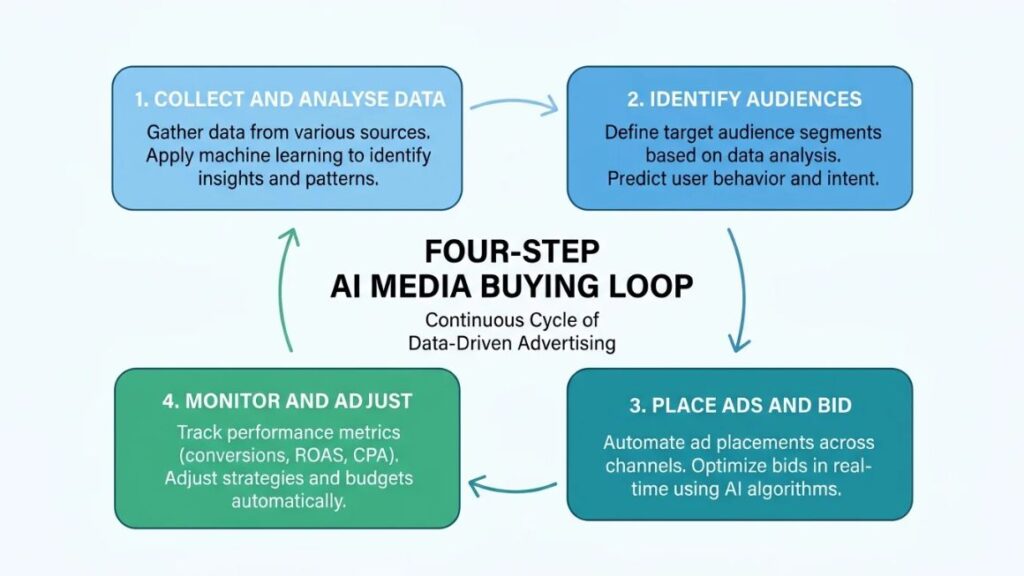
The loop is the same on almost every platform, whether it’s Meta, Google or a programmatic exchange.
- Collect and analyse data. Pixels, conversion APIs, product feeds and customer lists tell the model who bought what, and when.
- Identify audiences. The model scores people by how likely they are to act, including people outside your targeting inputs.
- Place ads and bid. Every auction gets a bid based on that predicted value.
- Monitor and adjust. Results flow back in, and the model reshuffles budget, bids and creative.
Notice where it all starts. Bad data in step one means a very confident machine optimising for the wrong thing.
AI Media Buying vs Traditional Media Buying
Speed is the obvious difference. It isn’t the only one.
| Factor | Traditional media buying | AI media buying |
| Speed | Changes made daily or weekly | Continuous, often per auction |
| Targeting | Manual audiences and interest lists | Predicted intent from many signals |
| Optimisation | Periodic reviews | Always on |
| Scalability | Limited by team hours | Grows with budget and data |
| Human involvement | Hands-on, setting by setting | Strategy, creative and guardrails |
| Cost | Mostly staff time | Platform or tool fees, less labour |
Now for a question that trips up plenty of buyers. Isn’t this just programmatic advertising? Not quite. Programmatic is the automated trading of ad inventory. Programmatic advertising platforms such as The Trade Desk are the pipes it runs through. AI is the decision layer on top. The two overlap on a demand-side platform (DSP). The software advertisers use to buy inventory. But AI also runs inside closed platforms like Meta, where no open exchange is involved.
AI media buying uses machine learning to choose audiences, bids, placements and creative toward a goal you set, such as purchases or leads. It runs inside ad platforms like Meta and Google as well as on programmatic platforms like The Trade Desk. Results depend heavily on the quality of your conversion data.
15 Best AI Media Buying Tools in 2026
The best AI media buying tools in 2026 fall into four groups: automation built into the ad platforms themselves, third-party optimisation layers, enterprise and programmatic buying platforms, and creative or analytics support. They solve different problems. So the right pick depends on where your money goes.
Tools 1 to 5 are the native AI-powered advertising platforms. Tools 6 to 9 sit on top of them to add rules, reporting or creative production. Tools 10 to 13 buy across the open web and retail media. Tools 14 and 15 help with creative and measurement. Prices come from vendor pages and 2026 reviews. Plenty are tiered by ad spend. So check the current plan before you commit.
1. Meta Advantage+
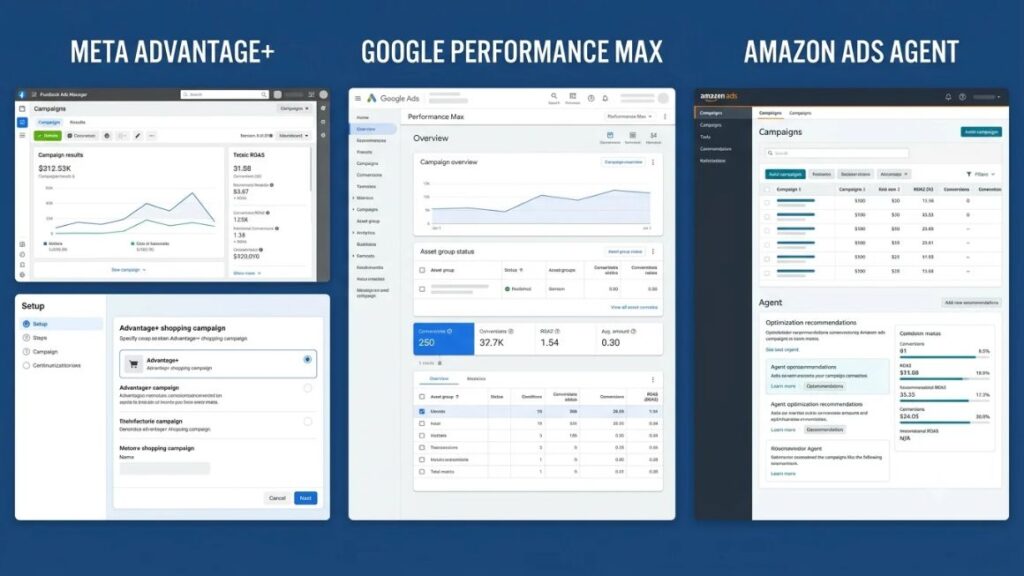
Advantage+ is Meta’s bundle of automation across Facebook and Instagram. Its flagship, Advantage+ sales campaigns, is the renamed Advantage+ shopping campaign. Meta’s machine learning picks the audience, placements, budget split and creative mix. In new campaigns, most Advantage+ settings now arrive switched on by default. It suits ecommerce and lead generation accounts with steady conversion data.
Meta’s own tests, repeated in 2026 guides, point to an average 32% lift in return on ad spend (ROAS). 17% lower cost per acquisition (CPA) against manual-only campaigns. Treat that as a vendor benchmark, not a forecast for your account. The trade-off is visibility: you see results, not reasons, so creative becomes your main lever.
2. Google Performance Max
Performance Max (PMax) is a goal-based Google Ads campaign that reaches Search, YouTube, Display, Discover, Gmail and Maps from a single setup. It runs on Smart Bidding, which sets each bid at auction time using signals like device, location, audience and predicted value. You supply assets and audience signals. Google treats those as guidance, not hard targeting.
It works best for ecommerce and lead generation with solid conversion tracking. PMax used to be a black box. But channel reporting and first-party audience exclusions (added in 2026) make it easier to steer. Easier, though, isn’t precise.
3. Google AI Max for Search
AI Max isn’t a new campaign type. It’s a set of add-ons for Search campaigns. Search term matching that stretches past your keyword list, text customisation that writes headlines and descriptions from your landing page. Final URL expansion that sends people to the most relevant page on your site. You can switch each piece on or off.
Reporting is decent, with an AI Max match type in search term reports and a landing pages report that flags the URLs it chose. Tira, the Indian beauty retailer, reported 35% purchase growth from an AI Max pilot, according to Google. Watch for broader matching pulling in DIY or out-of-area searches, and know that pinned headlines may stop being respected.
4. TikTok Smart+
Smart+ is TikTok’s automation suite for web, app and lead generation campaigns, plus Smart+ Catalog Ads for product feeds. The 2026 upgrade lets you turn automation on or off module by module (targeting, budget, catalog ads, placements) instead of going all in. Symphony Automation adds TikTok’s generative AI tools for creative.
TikTok says Smart+ Catalog Ads improved CPA by 29% against manual campaigns in its own testing. That makes it a natural fit for ecommerce brands with a clean catalogue and decent video. One limit: web campaigns can’t mix Spark and non-Spark ads. And a big one for readers here. TikTok remains banned in India. So this entry is for brands selling to other markets.
5. Amazon Ads
Amazon rebuilt its ad stack in September 2026. The new Amazon Ads Agent platform merges the old Ads Console and Amazon DSP, offers three campaign types (sponsored ads; display, video and audio; and Full-Funnel Campaigns), and adds a chat assistant that recommends targeting, bids and budgets for Sponsored Products.
You can run campaigns manually, hand them to Amazon’s AI or mix both, and Amazon says you review proposed changes before they apply. The edge is Amazon’s own shopper and purchase data. That makes this the obvious home for sellers whose customers shop there. EMARKETER’s advice is sound: check the AI’s results against independent measurement before scaling.
6. Madgicx
Madgicx is built around Meta. Its AI Marketer audits your ad account daily and hands back a prioritised list of actions you can approve. And an AI ads generator and launch tool push new creative into Ads Manager. Creative analytics and ad fatigue detection sit alongside.
It suits ecommerce brands and agencies running several Meta accounts. Pricing is tiered by monthly ad spend. 2026 reviews list entry prices from about $44 to $99 a month. So confirm the current plan. The limit is focus: a Google-heavy budget gets much less out of it.
7. Birch (formerly Revealbot)
Revealbot is now Birch (renamed in October 2024, same team and platform), and at heart it’s still a rules engine. You write conditions, such as pause an ad when cost per acquisition passes a threshold or raise budget while ROAS holds. It carries them out around the clock across Meta, Google, TikTok and Snapchat. A newer Birch AI layer drafts rules for you to approve.
Its pricing page lists plans from about $99 a month, rising with ad spend. The upside is predictability. The downside is that you’re still the strategist. Birch won’t help you make better ads.
8. Optmyzr
Optmyzr is for people who live in Google Ads. It adds a Rule Engine, one-click optimisations, pay-per-click (PPC) audits, reporting and an AI assistant on top of your accounts, with Meta and LinkedIn tools included on every plan. Agencies like it for running dozens of accounts with standard checks.
Plans start at roughly $209 a month and scale with managed ad spend. Be clear about what you’re buying, though. Optmyzr speeds up a skilled PPC manager. It doesn’t replace one, and its depth leans toward Google.
9. Smartly.io
Enterprise social teams with huge creative libraries are who Smartly.io is built for. It splits into three suites: Creative, for templates and automated ad variations. Media, for AI-driven spend optimisation. Intelligence, for insights across campaigns. In June 2026 it announced AI agents on top. Its AI Studio generates finished creative at scale.
Smartly handles cross-channel advertising across Meta, TikTok, Pinterest, Snapchat and more. It integrates with Amazon DSP for connected TV (CTV). Pricing is custom. The platform makes most sense for large budgets with dedicated ops teams. Smaller teams will find it heavy.
10. Skai
Retail media is fragmented, and Skai’s whole pitch is pulling it into one place. The platform connects planning, buying and measurement across more than 300 publishers and retail media networks. It runs an AI agent called Celeste AI, and since April 2026 offers a Model Context Protocol (MCP) connection so brands can plug in their own AI agents.
One vendor-reported example: Haleon linked Google paid search to Amazon through Skai’s Amazon Attribution integration across 26 brands. It reported a 26% ROAS lift with 52% lower CPA. Pricing isn’t public. Skai is built for enterprise brands juggling many retail media networks. That makes it overkill for a single-channel store.
11. The Trade Desk
Programmatic buyers know The Trade Desk, the largest independent DSP. Its Kokai platform runs on Koa, the AI that handles bidding, forecasting and, increasingly, campaign tasks. The August 2026 Zuma release added agentic features, and the company claims a 32% CPA improvement across 62 campaigns, though some Koa capabilities were still in closed beta at launch.
Strengths include open-web reach, connected TV and Deal Desk, its tool for managing private marketplace deals. Limits? There’s no public rate card, and the buying experience is sales-led, so it favours larger advertisers with trading expertise.
12. Google Display & Video 360
Google’s own enterprise DSP is Display & Video 360 (DV360), which covers programmatic display, video and CTV, and Gemini sits deeper in it now. The Marketplace proactively curates media packages, and since October 2026 it offers Gemini-curated bundles with single-click activation for live sports and tentpole events. LinkedIn CTV inventory has also been brought in for unified buying and measurement.
DV360 is strongest for teams already inside the Google Marketing Platform, since YouTube, Analytics and exchange inventory connect in one place. No pricing is published, so expect a sales conversation and a trading team.
13. StackAdapt
StackAdapt is the self-serve alternative to the enterprise DSPs, covering display, video, CTV, audio, native and digital out-of-home in one interface. A 2026 comparison by Rework notes that Forrester named it a Strong Performer in its Q1 2026 Omnichannel Advertising Platforms Wave, with top marks for self-serve capability and onboarding.
It suits mid-market teams and performance agencies that want programmatic reach without a trading desk. There’s no published rate card, and third-party minimum-spend figures conflict, so confirm terms with sales. Some reviewers find it less suited than The Trade Desk to complex multi-region campaigns.
14. AdCreative.ai
AdCreative.ai generates ad banners, product shots and copy from a website scan, then scores each creative on predicted performance before you spend a rupee on media. The scoring is its best idea and its weakest claim: a score is a hypothesis, not a guarantee.
Credits are used when you download a creative, not when you generate one. Starter costs $39 a month for 10 downloads, and reviews say features like creative scoring and batch creatives sit on higher plans. It suits small teams short on design hours. Read the trial and refund terms before you start.
15. Triple Whale
Shopify brands usually meet Triple Whale as an attribution tool. Its Triple Pixel collects first-party data, its Total Impact model spreads credit across touchpoints, and its Moby AI assistant answers questions and, in the newer Moby Agents, can take actions in your ad accounts.
There’s a free plan. Paid plans scale with revenue, with one 2026 guide putting the entry tier around $219 a month. It’s most useful for direct-to-consumer (D2C) brands with real paid spend across several channels. Some reviewers say Total Impact isn’t fully transparent about its method. So compare its numbers against Shopify’s own.
Comparison of the Best AI Media Buying Tools
Here are all 15 side by side. Native tools cost nothing beyond media spend. Everything else varies, so treat the pricing column as a starting point and check each vendor’s page.
| Tool | Primary purpose | Channels | Main AI capabilities | Best suited for | Pricing model |
| Meta Advantage+ | Native campaign automation | Facebook, Instagram, Messenger, WhatsApp | Audience, placement, budget and creative automation | Ecommerce, lead generation | Media spend only |
| Google Performance Max | Cross-channel campaigns from one setup | Search, YouTube, Display, Discover, Gmail, Maps | Smart Bidding, audience signals, asset assembly | Ecommerce, lead generation | Media spend only |
| Google AI Max for Search | Search expansion | Google Search | Search term matching, text customisation, URL expansion | Search advertisers with a healthy keyword base | Media spend only |
| TikTok Smart+ | Native campaign automation | TikTok | Targeting, budget, catalog and creative automation | Ecommerce, app, lead generation (not available in India) | Media spend only |
| Amazon Ads | Retail media | Amazon, streaming TV, DSP inventory | AI guidance, Full-Funnel Campaigns, creative generation | Sellers and brands on Amazon | Media spend; managed DSP terms vary |
| Madgicx | Meta optimisation | Meta | Daily AI audits, creative generation, fatigue detection | D2C brands, agencies | Tiered by ad spend |
| Birch | Rules automation | Meta, Google, TikTok, Snapchat | AI-drafted rules, automated actions | Buyers who want control | From about $99/month |
| Optmyzr | PPC optimisation | Google, Microsoft, Amazon, Meta, LinkedIn | Rule Engine, audits, one-click fixes | PPC teams, agencies | From about $209/month |
| Smartly.io | Creative and media automation | Meta, TikTok, Pinterest, Snapchat, CTV | Creative templates, AI Studio, budget optimisation | Enterprise social advertisers | Custom |
| Skai | Omnichannel commerce media | Search, social, retail media networks | Celeste AI, MCP agent connection | Enterprise brands, agencies | Custom |
| The Trade Desk | Programmatic DSP | Open web, CTV, audio, display | Koa bidding, forecasting, agentic tools | Large advertisers | No public rate card |
| Google Display & Video 360 | Programmatic DSP | Display, video, CTV, YouTube | Gemini-curated bundles, planning | Google stack enterprises | Contact sales |
| StackAdapt | Self-serve programmatic | Display, video, CTV, audio, native, DOOH | AI bidding and targeting | Mid-market teams, agencies | No published rate card |
| AdCreative.ai | Creative generation | Meta, Google, LinkedIn exports | Creative generation and scoring | Small teams | From $39/month |
| Triple Whale | Analytics and attribution | Shopify plus ad platforms | Total Impact, Moby AI | D2C brands on Shopify | Free plan; paid scales with revenue |
So how much do AI advertising platforms actually cost? The native ones, nothing beyond media spend. Third-party optimisation layers tend to start somewhere between $40 and $220 a month and climb with spend. Enterprise and programmatic platforms almost never publish prices.
Key Benefits of Using AI for Media Buying
The benefits of digital advertising automation are real. They also show up unevenly, and mostly where your data is clean.
Faster Campaign Optimisation
AI campaign optimization reacts to a dip in conversion rate in hours, not at the next Monday review. The Trade Desk says Koa analyses more than 20 million ad impressions every second, which no human team will ever match.
Better Audience Targeting
AI ad targeting finds buyers from behaviour, not from the interest lists you guessed at. Myntra paired Performance Max with video action campaigns and Firebase signals and reported a 37% increase in return on ad spend, according to Google’s Think with Google case study.
Reduced Manual Work
Rules, audits and weekly reports eat hours. Tools like Optmyzr and Birch take the repetitive checks. Advertising performance analytics dashboards stop you from rebuilding the same report every Friday.
Improved Budget Allocation
Spend drifts toward what converts without waiting for a human. Advantage+ sales campaigns split budget across ad sets automatically, and Smart Bidding reprices each Google auction on its own.
Easier Campaign Scaling
More products, more markets, more placements. Automation covers them without more headcount. The catch is scaling too fast, which comes up again below.
Better Creative Testing
Generative tools turn out dozens of variants, and scoring tools rank them before launch. Treat the ranking as a starting guess. Real results pick the winner.
Also Read: AI Creative Testing Tools: How to Pick and Use the Right Platform in 2026
AI media buying tools speed up optimisation, widen audience discovery and shift budget toward converting campaigns. Vendors report gains such as Meta’s 32% average ROAS lift and TikTok’s 29% CPA improvement, but each figure comes from the vendor’s own testing. Your gains depend on tracking quality, creative and margins.
How to Choose the Right AI Media Buying Tool?
Match the tool to where your budget already goes. If most of your spend sits on Meta or Google, start with their native automation. Before you pay for media buying software, find a specific gap the native tools can’t close, such as rule control, reporting or creative volume.
Identify Your Advertising Goals
Sales, leads, app installs or reach? Native platform automation handles the first three well. Reach and awareness across the open web push you toward programmatic tools.
Consider Your Advertising Budget
A $200-a-month tool isn’t cheap when you spend $3,000 on ads. Spend-tiered pricing also means the bill rises as you scale, so do the maths at your target spend, not today’s.
Check Platform Compatibility
Madgicx is Meta-first, Optmyzr leans Google and Triple Whale assumes Shopify. A Meta-first tool does very little for a Google-heavy budget.
Evaluate Automation Capabilities
Ask three things. What does it automate, what does it only suggest, and what can you override? A rules engine like Birch does exactly what you tell it. Agentic tools act on their own judgement. Know which one you’re buying.
Review Reporting and Analytics
Can you see why the tool changed something? Look for search term reports, placement data and a change log you can undo. Google’s AI Max reporting is a fair standard, with match type labels and a landing pages report.
Consider Ease of Use and Customer Support
Run the free trial on one real campaign. Check how fast support replies, and read the cancellation terms. Enterprise tools often want annual contracts, and those are hard to leave.
Choose an AI media buying tool by matching it to your channels, goals and budget, in that order. Start with the native automation inside Meta, Google, TikTok or Amazon, and add third-party software only when it fixes a specific gap such as rules, reporting or creative volume. Price every tool at your target spend, not your current spend.
How to Use AI Media Buying Tools Effectively?
Switching a tool on takes a minute. Getting good results from it takes a process.
Step 1: Set Clear Campaign Objectives
Pick one primary goal per campaign, whether purchases, qualified leads or installs, plus a target cost or ROAS. Vague goals give the model nothing to chase.
Step 2: Prepare Accurate Tracking and Conversion Data
Check your pixel, conversions API and event setup before launch. The model optimises toward whatever you measure, so duplicate or wrong conversions mean wrong decisions. Feed in CRM or offline sales data if you can, which is standard practice in any AI marketing automation setup.
Step 3: Select the Right Advertising Platform
Start where your customers already are and where you have conversion history. For most Indian D2C brands that means Meta and Google first. Add a third-party layer later, once you know what the native tools can’t do.
Step 4: Create and Test Multiple Ad Creatives
Upload several images, videos and headlines. Automation needs variety to learn from, and one lonely creative gives it nothing to compare.
Step 5: Monitor Campaign Performance
Check daily at first, but judge on weekly trends. Early swings during the learning phase are normal, and reacting to them is how good campaigns get wrecked.
Step 6: Review AI Recommendations Before Scaling
Accept the suggestions that fit your goals and reject the rest. When you do raise budgets, go in steps of around 20%, a common rule of thumb, rather than doubling overnight.
Common Mistakes to Avoid When Using AI Media Buying Tools
Most of these come down to trusting the machine a little too much.
Relying Completely on Automation
AI optimises the goal you gave it. It doesn’t know your margins or your brand. EMARKETER’s advice on Amazon’s agentic tools applies everywhere: set guardrails and validate results independently.
Ignoring Conversion Tracking
Broken tracking is the fastest way to teach a model the wrong lesson. Fix events first, then spend.
Scaling Campaigns Too Quickly
Big budget jumps reset learning and can wreck efficiency overnight. Raise spend gradually.
Using Poor-Quality Creative Assets
Blurry images and a single-angle video starve the algorithm. With targeting automated, creative is the lever you still hold.
Focusing Only on ROAS
ROAS ignores margins, repeat purchase and lifetime value. A campaign can show a strong ROAS and still lose money once costs are counted. Look at profit too.
Also Read: Marketing Efficiency Ratio (MER): The Metric Smart Marketers Use to Scale Revenue
Latest AI Media Buying Trends to Watch in 2026
Four things changed this year. The fifth, transparency, is what buyers keep asking for.
The Growth of Autonomous Advertising Agents
Agents moved from demo to product in 2026. The Trade Desk shipped Koa Agents in April, Skai opened an MCP connection for brands’ own agents, and Amazon renamed its whole platform Amazon Ads Agent in September. Automated media buying is shifting from rules you write to goals you set.
Generative AI for Ad Creatives
IAB’s 2026 Digital Video Ad Spend & Strategy Report found that six in 10 buyers use generative AI to build or enhance digital video ads, up from 51% the year before.
First-Party Data and Privacy-Focused Advertising
Tools keep asking for your own data. Google added first-party audience exclusions to Performance Max in 2026, and Triple Whale builds on its own first-party pixel. If your customer data is a mess, the smartest tool in the world won’t help.
Cross-Channel Campaign Optimisation
Amazon’s Full-Funnel Campaigns combine sponsored ads, display, video and streaming TV in one campaign. Smartly added a Reach Planner in September 2026 for deduplicated reach forecasts across channels. Budgets are being steered across channels now, not inside each one.
Greater Transparency and AI Reporting Controls
Platforms are answering the black-box complaint. Google added AI Max reports and PMax channel reporting, TikTok added per-module toggles, and Amazon adds an approval step. Meanwhile, IAB’s September 2026 update shows buyers’ focus on generative AI in media campaigns slipping to 69% from 78% in January. Honestly, that looks like a market asking for proof.
Conclusion
The best AI media buying tools are the ones that fit your channels, your budget and your tolerance for hands-off automation, not the ones with the loudest launch event. Start with the native automation in Meta, Google or Amazon. It costs nothing beyond media spend, and it’ll show you quickly whether you need anything more. Only then pay for AI advertising tools that fix a specific gap, like rules, reporting or creative volume.
And keep a human in the loop. These models chase whatever you point them at, and they can’t see your margins or your brand. Check what they change before you scale it.
If you want the skills to run these tools properly instead of just switching them on, YUP’s Performance Marketing course is a solid next step.
Frequently Asked Questions About AI Media Buying Tools
What are AI media buying tools?
AI media buying tools are software and platform features that use machine learning to choose audiences, set bids, place ads and shift budgets toward a goal. They range from native options like Meta Advantage+ and Google Performance Max to optimisation layers like Madgicx and enterprise platforms like The Trade Desk.
Which AI media buying tool is best for beginners?
Start with native automation in the platform you already use, usually Meta Advantage+ or Google Performance Max. It costs nothing beyond ad spend. If you want a layer on top later, Madgicx for Meta or a rules tool like Birch is a gentler step than an enterprise platform.
Can AI automate Facebook and Google Ads?
Largely, yes. Meta’s Advantage+ and Google’s Performance Max and AI Max handle audiences, bids, placements and parts of the creative on their own. You still set objectives, budgets, tracking and brand guardrails, and you still review what the system chooses.
Are AI media buying tools free?
The native ones are free to switch on, and you pay only for media. Third-party tools usually charge monthly, often tiered by ad spend, from roughly $39 to $219 a month at entry level among the tools here. Enterprise platforms quote custom prices.
Can small businesses use AI for media buying?
Yes, and it’s probably where they should start. Native automation works on modest budgets as long as conversion tracking is clean and there’s enough data to learn from. Skip enterprise software until your spend and team size justify it.
Will AI replace human media buyers?
Not the good ones. AI handles execution, while people still set strategy, judge creative, read margins and question the numbers. Even Amazon says advertisers review and approve changes proposed by its agent.
How can AI improve advertising ROI?
Faster optimisation, wider audience discovery and smarter budget shifts can all lift results. Meta reports an average 32% ROAS gain for Advantage+ sales campaigns, but that’s a vendor figure from its own tests. Your gain depends on tracking quality, creative and margins.