

You’ve put real money behind a Facebook or Google campaign, and the numbers still come back flat. Click-through rate stalls. Cost per lead creeps up. The room blames targeting, or the budget. Sometimes that’s fair. More often the problem is the creative: a headline that doesn’t convince, a video that loses people in the first three seconds, a visual that never connects with whoever’s looking at it.
That’s the gap AI creative testing tools are built to close. They score, tag, compare and sometimes predict how ads will perform, either before launch or while the spend is running.
It matters more than most marketers think. Nielsen Catalina Solutions studied nearly 500 consumer packaged goods campaigns running from 2016 to early 2017. It credited creative with 47% of sales contribution, ahead of reach at 22% and targeting at 9%. Yet plenty of teams still pick winners by gut feel.
This guide covers ten platforms, what each one is genuinely good at, where each falls short, and how to run a test that tells you something real.
Table of Contents
What Is AI Creative Testing?
AI creative testing is the use of machine learning to evaluate ad creatives, meaning images, video, headlines and copy, and estimate or measure how they’ll perform. Some tools predict audience response before launch. Others read live campaign data and show which creative elements are doing the heavy lifting.
The label stretches across a lot of ground. A heatmap showing where eyes land on a banner counts. So does a dashboard that tags every video in your Meta account by hook type. Both sit under the umbrella of AI ad testing tools, though they answer very different questions.
How AI Creative Testing Works
Most platforms start by pulling an ad apart. Computer vision reads the images and video frames, language models read the headline and copy, and every asset gets tagged: face in frame, logo in the first two seconds, discount in the headline. What happens next depends on the tool.
Attention models, like the one inside Neurons, predict where people will look. Predictive scorers compare your ad with patterns learned from earlier campaigns, such as the $1bn-plus of spend data Pencil says it draws on. Analytics tools like Motion skip prediction and read your own live results instead. That last route is AI-powered ad analysis at its most practical: tagged creative elements lined up against click-through rate (CTR), cost per acquisition (CPA) and return on ad spend (ROAS), so patterns surface that a spreadsheet would bury.
Then comes comparison. Variations get ranked against each other, against your history, or against industry benchmarks.
AI Creative Testing vs Traditional Creative Testing
The differences are mostly about speed and where the signal comes from.
| Traditional testing | AI-assisted testing |
| Often depends on manual analysis | Automates parts of analysis |
| May require more time to evaluate concepts | Can provide faster initial feedback |
| Usually relies on live audience experiments or research panels | Can include predictive models and live campaign data |
| Manual creative comparisons | Automated tagging and comparisons |
| Human interpretation of results | AI-assisted pattern recognition |
One caution the table can’t carry: a prediction isn’t behaviour. A model estimates how people will probably react, based on patterns from earlier ads. Real customers still decide with real money, which is why every sensible workflow ends in a live test.
AI creative testing uses machine learning to evaluate ad images, video and copy, then estimate or measure performance. Predictive tools estimate audience response before launch, while analytics tools read live campaign data. Predictions help decide which ideas to test first. They don’t replace real customer behaviour.
Why Are Marketers Using AI for Ad Creative Testing?
Because creative is the biggest lever in an ad and the hardest one to judge by instinct. AI shortens the time it takes to review ideas, puts data behind opinions, and flags weak spots before the budget goes out. Here’s where that shows up day to day.
Faster Creative Evaluation
A traditional panel test can take days and cost real money per ad. Predictive tools compress that. Neurons returns attention heatmaps in seconds, and Kantar says LINK AI delivers individual predictions in minutes. So you can review a dozen versions on Monday morning instead of picking two and hoping.
Better Understanding of Audience Preferences
Ads work on feeling before they work on logic. Some tools measure that directly: System1 asks real viewers about their emotional response and turns it into a Star Rating. Others infer it from visual and messaging signals, like whether a face appears early or the offer is stated plainly. Neither is a mind reader. They do show which signals tend to travel with attention and response, which is more than opinion can offer.
More Creative Variations to Test
Generative tools have made variations cheap. The Interactive Advertising Bureau’s (IAB) 2026 Digital Video Ad Spend & Strategy Report, released in July, says nearly two in three video ad buyers now use generative AI for video creative, up from about half in 2025. More variations means more headlines, hooks, images, video formats and CTAs worth testing. It also means more noise, unless you’ve got a way to sort the good from the merely different.
Also Read: How to write Facebook ad copy that drives clicks
Improved Advertising Decisions
Data settles arguments that taste can’t. “I like the blue one” loses to “the blue one cut our cost per lead.” Done properly, this is ad creative optimisation based on evidence rather than seniority. One fair warning, though: a FreeWheel survey cited in Comcast’s 2026 Advertising Report found 61% of advertisers hadn’t yet seen meaningful results from AI. The tools help when somebody actually acts on what they show.
Identifying Creative Fatigue
Every ad wears out. Frequency climbs, click-through rate slides, cost per acquisition drifts up, and the same people keep seeing the same thing. Tools that chart performance by creative over time make that slide visible days earlier than an account-level report would. Catching it early is the difference between a quick refresh and a week of wasted spend.
10 Best AI Creative Testing Tools in 2026
These ten fall into rough groups. AdCreative.ai and Pencil generate and score. Marpipe, Motion and Vidmob analyse or test live performance. Neurons, System1 and Kantar LINK AI predict before launch. CreativeX and Smartly handle quality control and automation at scale. Pricing appears only where an official page could confirm it, and otherwise the entry says quote-based or tells you to check with the vendor. None of this ad creative testing software does the same job, so read the “best for” line before the feature list.
1. AdCreative.ai
AdCreative.ai generates banners, copy, product shots and short videos, then gives every creative a score. That score is the testing angle. It’s worth being clear about what it is: a model’s estimate based on patterns in past ads, not a measurement of how your audience behaves. A high score doesn’t promise results. It ranks a batch so you know what to launch first. Your live data should overrule it whenever the two disagree.
Other features include competitor insights, a compliance checker and publishing to Meta, Google and LinkedIn. Entry plans were listed from about $39 a month in October 2026 pricing checks, with scoring and video on higher tiers, so confirm on the vendor’s site. Best for small businesses and agencies that need volume quickly. The catch is credits: you spend one per creative download.
2. Pencil
Pencil is a generative AI platform for ad production, part of The Brandtech Group since 2023. It produces image and video ads, and once you connect your media accounts it uses spend data (Pencil cites more than $1bn) to predict performance before launch. Live results then feed the next round. For performance marketers, that loop is the draw: generate, predict, launch, learn, repeat.
Pencil says it gives specific suggestions rather than a bare score, which is the right instinct. The limits are the usual ones for any predictor, plus pricing, which is quote-based because Pencil’s site sends you to sales. Best for e-commerce and paid social teams shipping many variants every week.
3. Marpipe
Marpipe is built for catalogue ads. Connect a product feed, design on-brand templates, and it produces variations for every SKU, then runs multivariate ad testing on live campaigns across Meta, Google, TikTok and Pinterest catalogues. Instead of A against B, it measures combinations of images, headlines, colours and calls to action, so you see which element moved the result.
When does catalogue-level testing make sense? When you’ve got hundreds of products and enough spend per variant to produce a readable result. With ten products and a thin budget, you’re mostly splitting noise. Latico, an e-commerce brand, tested enriched catalogue templates against plain ads, and a “20% Off Strikethrough” design won, according to a Marpipe case study. Marpipe says you can start free, though paid pricing wasn’t publicly confirmed at the time of writing. Best for e-commerce brands running Meta Dynamic Product Ads.
4. Motion
Motion tags every ad in your account by hook, format, angle and creator, then groups results so winning patterns are visible at a glance. That’s creative performance analysis done visually instead of in a spreadsheet. It supports Meta, TikTok, YouTube and LinkedIn, although Motion’s own FAQ says AI tagging is currently Meta-only. The published Starter plan costs $250 a month for brands spending up to $50,000 monthly on ads. Pro and Growth are custom.
Where it earns its keep is the next brief. Take the winning hooks and angles, then build the next batch around them instead of around whatever felt clever in the meeting. The limit: Motion explains creative that already ran. It doesn’t make ads and it doesn’t predict. Best for DTC brands and agencies on paid social.
5. Vidmob
Vidmob is enterprise creative intelligence. It breaks assets into attributes (logo timing, text, colours, people), links them to media performance, and scores creative before launch, in flight and afterwards against brand rules and platform best practices. In June 2026 it launched Vidmob360, which pipes that data into other AI tools and workflows through an API and a Model Context Protocol (MCP) server.
That scale is the point, and also the problem. Vidmob suits enterprise marketing teams juggling many brands, markets and agencies, where creative inconsistency gets expensive. For one ad account run by a team of three, it’s too much machine. Pricing is demo-led and custom.
6. Neurons
Neurons predicts attention. Upload an image or video and its AI draws a heatmap of where viewers are likely to look, plus scores such as clarity and cognitive demand. The model is trained on Neurons’ own eye-tracking database, and the company says its predictions match real eye-tracking with over 95% accuracy.
Read that claim carefully. It compares predicted heatmaps with measured heatmaps. It doesn’t say the ad will convert, because attention is a precondition for a sale, not a sale. Predicted attention and measured conversion performance are different things. Neurons works best for catching problems early, like a headline nobody looks at or a logo buried in a corner, before the shoot is locked. Creative teams get the most from it, and it’s a sensible option for video since it scores frame by frame. Pricing is demo-led.
7. System1 Test Your Ad
System1 tests ads on real people. Viewers describe how an ad makes them feel, and System1 converts that into a Star Rating from 1.0 to 5.9 (predicting long-term brand growth), a Spike Rating (short-term sales potential) and a Fluency Rating (how easily viewers identify the brand). It says the Star Rating has been validated more than 250 times, including with the Institute of Practitioners in Advertising (IPA).
Here’s the distinction worth holding on to. The panel test measures real consumers. System1’s newer AI tool, Test Your Ad Screen, predicts their reactions using its 100,000-ad dataset. Use the panel when the budget is big and the brand matters, and AI screening to thin a long list. Best for brand advertisers pre-testing video. It’s less useful for click-level performance, and pricing is quote-based.
8. Kantar LINK AI
LINK AI predicts ad effectiveness without a consumer sample. It splits a video into frames, extracts up to 20,000 features (imagery, audio, speech, on-screen text) and feeds them into models trained on Kantar’s LINK database: more than 300,000 ad tests and 35 million human interactions. Scores include a predicted eye-tracking attention measure and come back in minutes.
How good is it? Kantar’s own validation says that, on average, more than 7 in 10 digital video and TV ads get comparable ratings to survey testing. That’s strong. It’s also not 10 in 10, and the gap matters for any single ad you’re about to back with serious money. Established brands and large teams get the most from it, especially when screening hundreds of assets, creator content included. It’s sold self-serve or serviced through Kantar Marketplace, pay-as-you-go or by subscription.
9. CreativeX
CreativeX doesn’t predict performance. It audits quality. Its Creative Quality Score counts how many of the best practices required for a platform, such as logo timing or text density, show up in each ad, then rolls that into a single number. Unilever reported that adherence to its digital mandatories rose 200% within six months, according to CreativeX’s own write-up.
Why does that matter for multi-market campaigns? Because “does this feel on-brand?” turns into an argument across every market and agency, and one scorecard ends it. The limits: it measures adherence to rules, not whether an ad works, it can’t generate creative, and pricing isn’t published. Best for global marketing teams and the agencies serving them.
10. Smartly
Smartly is an enterprise advertising platform that puts creative production, media buying and measurement in one place. Template tools build ad variants from product feeds, AI Studio generates and enhances images and video, and automation handles trafficking and optimisation across Meta, TikTok, Pinterest, Snap, Google and YouTube. Smartly says it supports more than 800 brands.
The case for joining creative and campaign management is speed. A new variant goes live and gets measured in the same system, so the test-and-learn loop shortens. Deliveroo reports cutting its CPA by 38% with Smartly Creative’s automation, a figure from Smartly’s own customer page. Among AI advertising tools, this is one of the heavier ones: onboarding takes effort, and pricing is quote-based and aimed at large budgets. Best for big advertising teams.
Comparison: Which Tool Should You Choose?
| Tool | Primary use | Best suited for |
| AdCreative.ai | Creative generation and scoring | Small businesses and agencies |
| Pencil | Creative production and insights | Performance marketers |
| Marpipe | Structured creative testing | E-commerce brands |
| Motion | Performance analytics | Paid social teams |
| Vidmob | Creative intelligence | Enterprise teams |
| Neurons | Predictive attention analysis | Creative teams |
| System1 | Advertising effectiveness testing | Brand advertisers |
| Kantar LINK AI | Predictive ad evaluation | Large brands |
| CreativeX | Creative quality analytics | Global marketing teams |
| Smartly | Creative and campaign automation | Large advertising teams |
The ten best AI creative testing tools in 2026 split into four jobs: generating and scoring (AdCreative.ai, Pencil), live analysis and testing (Marpipe, Motion, Vidmob), pre-launch prediction (Neurons, System1, Kantar LINK AI) and governance or automation at scale (CreativeX, Smartly). Predicted scores estimate response, while live tests measure it.
How to Choose the Right AI Creative Testing Tool for Your Business?
The right tool depends on the job: generating and scoring ideas, predicting before launch, testing live, or policing quality across a large team. Most disappointments come from buying a predictor when the team needed live testing, or the reverse.
Consider Your Marketing Goals
Brand awareness points towards attention and emotion tools: Neurons, System1, Kantar LINK AI. Lead generation and e-commerce sales lean on tools tied to live results, like Motion and Marpipe, with Pencil or AdCreative.ai feeding them fresh variants. Website traffic is the easy one, since click-through rate answers quickly. App installs are the awkward case. Check whether a tool reads install and in-app event data before you pay, because several of these lean towards e-commerce and brand work. And if you’re after the best AI tools for testing Facebook ads, Motion, Marpipe and Pencil all connect to Meta accounts.
Check Advertising Platform Integrations
List what you actually run on, then check each vendor against it. Motion covers Meta, TikTok, YouTube and LinkedIn, but its AI tagging is Meta-only. Marpipe works with Meta, Google, TikTok and Pinterest catalogues. Smartly spans more again. A tool that can’t read your channel’s data won’t tell you much about your channel.
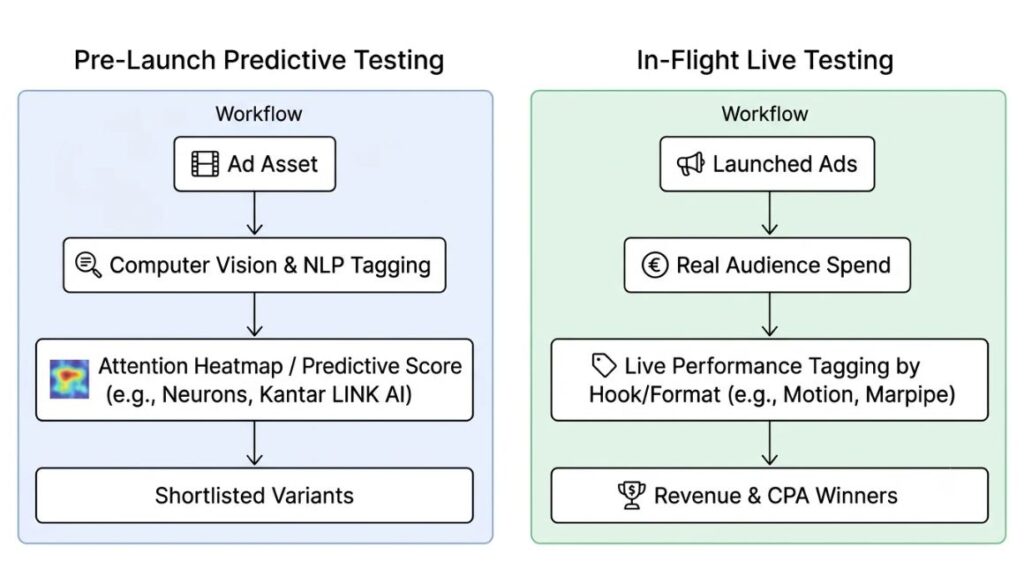
Understand the Difference Between Predictive and Live Testing
This is the question to settle before you buy anything. Predictive tools, such as Neurons, Kantar LINK AI and Pencil’s prediction layer, estimate response before launch. Live tools, such as Marpipe and Motion, measure what happened with real spend. Predictive creative analytics tells you where to place your bets, and live testing tells you which bet paid. Good teams use both, in that order. When you compare creative testing platforms, ask which of the two you’re really being sold.
Compare Pricing and Scalability
Models vary a lot. AdCreative.ai charges by credit, Motion’s tiers follow your ad spend, Kantar offers pay-as-you-go, and Vidmob, CreativeX and Smartly negotiate. Check usage limits, how many brands or ad accounts a plan covers, and what happens when you outgrow it. Motion’s Starter plan, for example, tops out at $50,000 in monthly ad spend.
Look for Actionable Reporting
A score without a reason is trivia. The better tools say what to change: move the logo earlier, shorten the headline, lead with the offer. Ask any vendor to show a report from a real account, then check whether you’d know what to do on Monday.
Also Read: How to Do Audience Research for Facebook Advertising (Step-by-Step Guide)
Choose by job, not by feature list. Predictive tools such as Neurons and Kantar LINK AI estimate response before launch, while live tools such as Motion and Marpipe measure real results. Most teams need one of each, used in that order, and a tool is only useful if its report says what to change.
How to Use AI Creative Testing Tools: A Step-by-Step Process
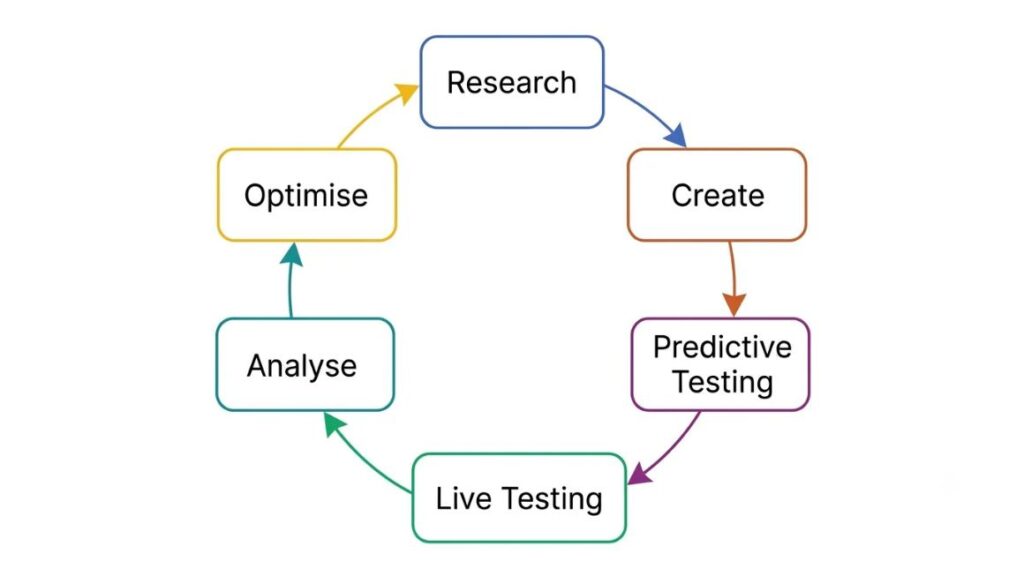
To test ad creatives using AI, set one objective, build genuinely different concepts, screen them before launch, run a controlled live test, read the metrics closest to revenue, and repeat with what you learned. Here’s the full loop.
Step 1: Define Your Campaign Objective
Decide what a win looks like before you open a tool. More clicks, leads, purchases and brand awareness are different goals with different metrics, and a creative that wins one can lose another. Write the primary metric down.
Step 2: Create Multiple Creative Variations
Build variations that differ in ways a customer would actually notice: different headlines, different opening hooks, a static image against a video, different offers, different calls to action (CTAs). Don’t just recolour a button. Three to five really different concepts beat twenty cosmetic tweaks.
Step 3: Evaluate Creatives Before Launch
This is pre-launch ad creative testing. Run your variations through a predictive tool and look for weaknesses: a headline that attracts no attention, a cluttered first frame, a CTA nobody sees. Cut the weakest. Keep at least one surprising idea in the mix, since a model can only recognise what resembles past winners.
Step 4: Launch Controlled Advertising Experiments
Use Meta’s A/B test tool in Ads Manager, or the equivalent experiments feature on your other platforms. Meta’s Business Help Center says each version is shown to a separate segment so nobody sees both, and it advises against informal testing, like switching ad sets on and off by hand. Change one major variable at a time. Change the image, the headline and the audience together, and a win tells you nothing about why.
Step 5: Analyse the Results
Look at the numbers that tie back to your objective from Step 1:
- Click-through rate (CTR): clicks divided by impressions, a read on attention and relevance.
- Cost per click (CPC): what each visit costs.
- Conversion rate: the share of visitors who take the action you wanted.
- Cost per acquisition (CPA): what each lead or sale costs.
- Return on ad spend (ROAS): revenue earned per unit of ad spend.
- Video retention and engagement: how long people watch, and what they do next.
To identify winning ad creatives, favour the metric closest to money. A high CTR with weak conversions is a curiosity, not a winner.
Step 6: Improve and Repeat
Take what won and ask why. Was it the hook, the offer, the face? Brief the next round around that answer, test again, and keep a simple log so the learning doesn’t live in one person’s head.
Real-World Examples of AI Creative Testing in Digital Marketing
The three scenarios below are illustrative, not case studies, and none carries invented results. For documented examples, look back at Latico’s catalogue test under Marpipe and the Deliveroo figure under Smartly, both reported by the vendors themselves.
Example 1: E-commerce Advertising
Picture an online clothing store testing four concepts: a clean product shot, a lifestyle photograph, a customer testimonial and a discount-led ad. Before launch, an attention tool checks whether the product and the price are visible. Live, the team watches attention first, then clicks, then purchases. The discount ad might win on clicks and still lose on profit if it attracts bargain-hunters who never return, which is why purchases get the final say. That’s AI creative testing for e-commerce brands at its simplest.
Example 2: Lead Generation Campaigns
An education business wants more sign-ups for a free webinar. It tests three hooks (a career-switch story, a skills gap, a salary outcome) and then course benefits shown up front against a free-trial offer. The cheapest lead isn’t automatically the best one, so the team tracks cost per qualified lead rather than raw form fills.
Example 3: Video Advertising
A brand compares three video openings: a product close-up, a person speaking to camera, and a problem statement. Tools that analyse video frame by frame, like Neurons or Kantar LINK AI, are common choices for screening the best of them before launch. Then the live test compares product demonstrations and CTAs, with retention and cost per acquisition deciding which version gets more budget.
Also Read: 5 Tips to make Perfect Youtube Video Ads
Best Practices for Getting Better Results from AI Creative Testing
Treat the AI as a filter, not a judge. Test sensibly, give experiments time, and keep a human in charge of the final call.
Test One Major Variable at a Time
Controlled experiments only work when you know what changed. Swap the hook and hold everything else steady, and any difference belongs to the hook. Multivariate testing can compare many combinations at once, but it needs far more traffic than most accounts have, so start simple.
Avoid Relying Only on AI Scores
Neurons predicts attention. Kantar says more than 7 in 10 of its predictions line up with survey results. Those are respectable numbers for a tool and poor reasons to skip a live test. Validate every prediction against your own campaign data.
Give Experiments Enough Data
Small samples lie. A variant that leads after two days and a handful of conversions can fall straight back. Many practitioners run tests for at least a week so weekdays and weekends both show up, then wait for the platform’s confidence reading before calling a winner. Thin budget? Test fewer things for longer.
Test Different Creative Concepts
Recolouring a button isn’t a test. Try different angles: a problem, a benefit, a story, a price. Different messaging, not different wallpaper.
Monitor Creative Fatigue
Review performance by creative every week. When frequency rises and CTR falls, refresh before the cost per acquisition does the talking.
Combine AI Insights with Human Judgement
A model doesn’t know your positioning, a sensitive news cycle, or that the lifestyle shot features a competitor’s logo. People do. Use AI to shortlist, then let someone who understands the brand decide.
Also Read: Meta Ads Optimization Checklist: The Complete Guide for Andromeda-Era Campaigns (2026)
AI Creative Testing Trends to Watch in 2026
Five shifts stand out: prediction before launch, cheaper variation, analytics that follow ads across platforms, measurement down to individual creative elements, and a clearer split of work between people and models.
Predictive Creative Analysis
Pre-launch scoring is moving into planning workflows. Vidmob’s pre-flight predictive scoring has been built into Horizon Media’s buying workflows, and Kantar and Neurons are pushing the same idea. The question is no longer whether to pre-screen. It’s how much to trust the screen.
Automated Creative Variations
Pencil, AdCreative.ai and Smartly’s AI Studio can turn out dozens of AI-generated ad creatives from a single brief. The bottleneck has moved from making ads to deciding which ones deserve budget.
Cross-Platform Creative Analytics
People switch between Meta, Google, TikTok and YouTube in the same hour, so creative results need reading the same way. Vidmob360 exposes creative data to other tools through an API and MCP server, and Smartly spans multiple channels. Expect more vendors to promise a single view. Check what they actually support.
Creative-Level Performance Insights
Campaign-level numbers hide the story. Tagging tools like Motion break results down by hook, format and angle, so you learn that testimonial openings beat product shots, not just that one campaign beat another.
Human and AI Collaboration
System1’s analysis of the 2026 Super Bowl found AI accounted for 18% of ads, and AI-led spots averaged 2.1 Stars. Google Gemini’s “New Home,” a human story about a mother and her son moving house, earned 3.3. The takeaway isn’t that AI ads fail. Story and feeling still decide a lot, and strategy stays with people.
Also Read: AI Agent for Paid Advertising: How to Set Up, Control and Measure One in 2026
Common Mistakes to Avoid When Using AI for Creative Testing
Most failures are boring ones. Fixing even three of these puts you ahead of most ad accounts.
- Assuming AI predictions guarantee advertising success. They don’t.
- Testing too many variables at once, so nobody can explain the result.
- Ignoring audience and campaign context. A score built on general patterns knows nothing about your offer.
- Choosing a tool on price alone.
- Calling winners on thin data.
- Forgetting creative fatigue until the cost per acquisition spikes.
- Celebrating clicks while conversions sit flat.
- Publishing generated content without checking brand accuracy and the platform’s advertising policies.
Conclusion
Short answer: yes, as long as you treat them as a filter rather than a verdict. They save time, widen the number of ideas you can afford to try, and put evidence behind creative debates. Small agencies and D2C brands get quick screening and tagging, while large brands get governance and scale. Neither should skip live testing, because predicted performance and real customer behaviour are different things. And the right tool depends on your objective: generate, predict, test or govern.
So start small. Pick one campaign, test two or three genuinely different variations, measure what happens, and write down what you learned. Repeat that a few times and you’ve got a testing process, which is worth more than any single tool.
If you’d like help building that habit with guidance, YUP’s Performance Marketing course is a good next step.
Frequently Asked Questions (FAQs)
What are AI creative testing tools?
AI creative testing tools are platforms that evaluate ad images, videos and copy using machine learning. Some predict performance before launch, some pull insights from live campaign data, and some do both. They help marketers decide which creatives deserve budget.
Which is the best AI tool for testing ad creatives?
It depends on the job. Motion suits live analytics for paid social, Marpipe suits structured catalogue tests, Neurons and Kantar LINK AI suit pre-launch prediction, and AdCreative.ai suits generation with scoring. Pick by objective first, then budget.
Can AI predict whether an ad will perform well?
Partly. Predictive models estimate attention, emotion or likely effectiveness from patterns in past ads. They can’t promise clicks, conversions or revenue, because audiences, offers and timing differ. Kantar’s own validation puts agreement with survey results at roughly 7 in 10 ads.
Can I use AI to test Facebook and Instagram ads?
Yes. Use an analysis or scoring tool to shortlist creatives, then run them through Meta’s A/B test tool in Ads Manager. Motion reads your Meta account data, and Marpipe tests catalogue ads.
Are there free AI creative testing tools?
Sort of. AdCreative.ai offers a 7-day trial and Marpipe says you can start free, but free access is usually limited. Free generation also isn’t testing. Meta’s A/B test tool carries no separate fee, though the test still spends your ad budget.
What metrics should I track when testing ad creatives?
Track CTR, CPC, conversion rate, CPA and ROAS, plus retention for video ads. Prioritise the metric closest to revenue. Clicks are a signal, not the goal.
Is AI creative testing suitable for small businesses?
Yes, with realistic scope. AdCreative.ai and Meta’s built-in A/B tests need no research budget. Enterprise platforms like Vidmob, CreativeX and Smartly are probably overkill. Test one variable at a time on a small budget.
What is the difference between AI creative generation and AI creative testing?
Generation creates ad assets: images, copy, videos. Testing evaluates them, either by predicting performance or by measuring live results. Several tools, including Pencil and AdCreative.ai, do both, but the jobs are separate.