

Six months ago, an AI agent for programmatic advertising was mostly a slide in someone’s pitch deck. Now it is moving real budgets. PubMatic’s AgenticOS is live with WPP Media and MiQ. Adform has opened its infrastructure to Claude and ChatGPT through a Model Context Protocol server. IAB Tech Lab has an entire standards body, AAMP, dedicated to how these agents talk to each other. If your team is still logging into a DSP every morning to eyeball bids by hand, you’re running on last year’s operating model.
This isn’t a story about AI writing better ad copy. It’s about software that can plan a media buy, adjust spend mid-flight, and negotiate with a publisher’s own agent, all without someone clicking through a dashboard first. That shift changes what a trader’s job looks like, what a media plan looks like, and what “optimisation” even means.
This guide walks through what an AI agent for programmatic advertising actually does, how the underlying infrastructure works, which platforms are ahead right now. Learn what this looks like in India specifically, and how to roll one into your stack without losing control of your budget.
Table of Contents
What Is an AI Agent for Programmatic Advertising?
An AI agent for programmatic advertising is a software system that can plan, execute and adjust digital ad buying decisions on its own, within limits a human sets, instead of just recommending changes for someone to click through. That’s the line that matters. A dashboard that flags “this campaign is underpacing” is an alert. A system that reallocates the budget itself, logs the reason, and reports back is an agent.
What Programmatic Advertising Already Automates
Programmatic advertising has been automated in one sense since real-time bidding existed. A demand-side platform evaluates an impression, checks it against your targeting rules and submits a bid, all in under 100 milliseconds. None of that required a human in the loop for each auction.
But the layer above the auction stayed manual. Someone still decided the daily budget caps, wrote the audience rules, picked which creative to rotate in, and checked performance once a day or once a week to adjust course. That’s the part agentic systems are now taking over.
What Makes an AI Agent Different
An AI agent reasons across signals it wasn’t explicitly told to check, and then it acts. A rule-based system does exactly what it was configured to do and nothing more. If you told it to cap CPA at ₹500, it caps CPA at ₹500. An agent might notice that a specific placement is driving cheap but low-quality traffic, pull in a brand-safety signal you never wired into the original rule, and pause that placement before you’d have caught it in a weekly review.
That reasoning-and-acting loop, not just automation, is what separates an agent from a script. Honestly, this distinction gets blurred by marketing copy more than almost any other term in ad tech right now. Plenty of tools calling themselves “AI-powered” are still recommendation engines wearing an agent’s name.
AI Agent vs Automation vs AI Assistant vs Generative AI
It helps to separate four things that get lumped together constantly:
- Rule-based automation follows fixed if-then logic. It doesn’t reason. It executes exactly what was configured.
- An AI assistant recommends actions and waits for a human to approve them, like a co-pilot suggesting a bid change.
- Generative AI advertising is the layer that writes headlines and produces image variants; it doesn’t decide where those variants run.
- An AI agent reasons, decides and executes actions autonomously, within guardrails a human defines up front.
Most platforms today sit somewhere between the second and fourth category. Full autonomy, where an agent acts with zero human checkpoint, is still rare in production. That’s changing fast, but it hasn’t arrived everywhere yet.
Read More: Agentic AI vs AI Agents: Key Differences
Programmatic Advertising vs Agentic Advertising: What’s the Difference?
Programmatic advertising is the automated buying and selling of ad inventory through real-time auctions. Agentic advertising is a layer on top of that, where AI agents make and execute the buying decisions themselves, including negotiating directly with a publisher’s own agent.
Industry commentary sometimes uses agentic AI advertising and “agentic programmatic” interchangeably, though the more precise term describes the decision-making layer, not the media itself. Programmatic answers the question “how does the auction happen.” Agentic answers “who, or what, decides what to bid and why.”
| Aspect | Programmatic Advertising | Agentic Advertising |
| Who decides | A human sets rules; the DSP runs the auction | An AI agent decides and acts within guardrails |
| Speed of adjustment | Batch or periodic (daily, hourly checks) | Continuous, in-flight |
| Negotiation | Fixed auction mechanics | Agent-to-agent negotiation is possible |
| Example in practice | Manual bid caps set in DV360 | PubMatic’s AgenticOS executing a live buy |
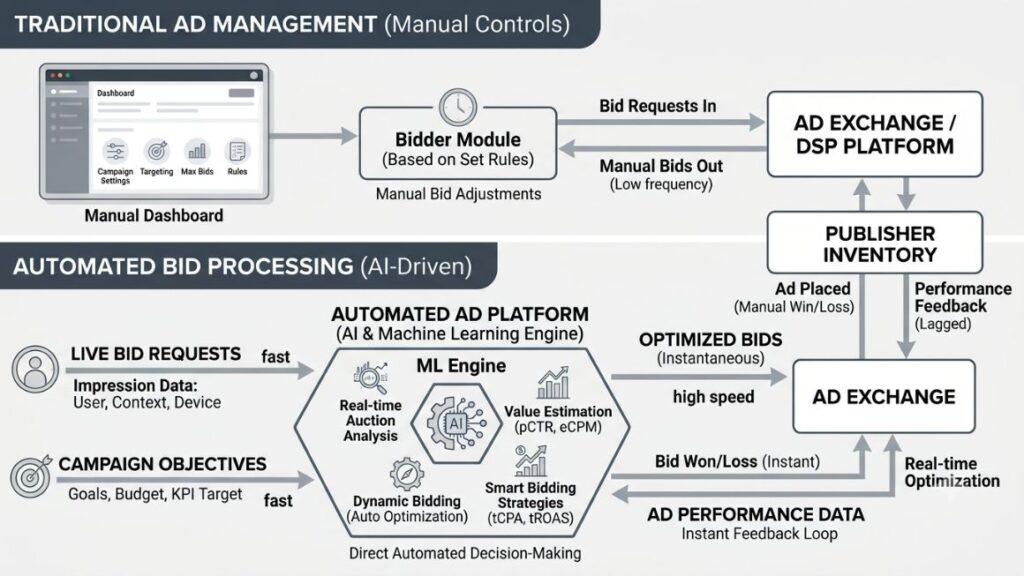
Programmatic advertising automates the auction itself, while agentic advertising automates the decisions around the auction, such as what to bid, which audience to target, and when to shift budget. The distinction matters because agentic systems can act continuously and negotiate directly with other agents, something rule-based programmatic setups were never built to do.
How an AI Agent Executes a Programmatic Campaign
An AI agent for programmatic advertising runs a continuous loop: it reads live performance and market signals, decides on an action, executes that action through a connected platform and learns from the result to refine the next decision.
- Signal: The agent pulls in live data: bid landscape, pacing, conversion events, brand-safety flags, sometimes even weather or commerce signals.
- Decide: It weighs that data against the objective and guardrails you’ve set (target CPA, budget ceiling and approved inventory).
- Act: It executes the decision directly through an API or agent protocol, whether that’s shifting spend, pausing a line item, or building a new audience.
- Learn: It logs the outcome and feeds it back into the next decision cycle, so the model gets sharper over time rather than repeating the same call.
The Tools and Data It Can Access
What an agent can actually touch depends entirely on what it’s connected to. A well-configured agent might have API access to your DSP, your measurement platform, first-party CRM signals, and a brand-safety vendor, all at once. A poorly configured one might only see bid data, which is exactly why “garbage in, garbage out” applies here as much as it does to any model.
Where Humans Stay in the Loop
This may not apply to every setup, but in most production deployments right now, a human still approves budget reallocations above a certain threshold. Adform’s MCP integration, for instance, is explicitly built so the agent proposes a change and a trader reviews the evidence before approving or rejecting it. Full autonomy exists in pockets, not everywhere.
What Can AI Agents Automate in Programmatic Advertising?
The honest answer is: more than most teams are currently using, and less than the marketing decks suggest. Here’s where an AI agent for programmatic advertising is genuinely doing the work today.
Campaign Planning and Setup
Feed an agent a brief in plain language, and platforms like Synter or Trade Desk’s Koa Assistant can translate that into a structured media plan, complete with channel splits and initial targeting parameters, in minutes instead of the hours a planner would normally spend.
Audience Discovery
Instead of relying on predefined segments, agents can analyse contextual and behavioural signals to build audiences dynamically, then keep refining them as new performance data comes in. Static audience lists are becoming the exception rather than the default.
Bid and Budget Optimisation
This is where agents have the longest track record. The Trade Desk reported an average 32% improvement in cost-per-acquisition performance from its Kokai Zuma release, driven by upgraded AI forecasting and modelling behind Koa’s agentic functions.
Inventory Discovery and Curation
Agents can scan supply sources in real time, flagging premium private marketplace deals or filtering out low-viewability inventory before a human would have manually reviewed the deal sheet.
Creative Optimisation
Dynamic creative optimization used to mean swapping a product image based on a rule. Agents extend that by testing creative combinations against live performance and reallocating impressions toward whichever variant is actually converting, without a human setting up each test manually.
Cross-Channel Analysis
A single prompt can now pull joined ROAS across Google, Meta, LinkedIn, and TikTok. It can flag audience overlap between platforms and recommend where to dedupe spend, work that used to mean exporting four separate reports into a spreadsheet.
Deal Discovery and Negotiation
Through frameworks like the Ad Context Protocol, a buyer’s agent can discover a publisher’s available inventory, compare pricing, and in some cases negotiate terms directly with the publisher’s sell-side agent.
Brand Safety and Suitability
Agents can enforce brand-standard rules across every impression in real time. They don’t rely on a static keyword blocklist that gets stale within weeks.
Troubleshooting and Anomaly Detection
When a campaign suddenly underperforms, an agent can trace the drop to a specific line item, supply source, or targeting change and surface that root cause before a trader has to dig through logs manually.
Also Read: AI Agents for Content Marketing: How Autonomous Workflows Are Replacing Manual Content Ops in 2026
What AI Agents Still Can’t Do Reliably
They still struggle with genuinely novel situations that don’t resemble their training data, and they don’t set strategy. An agent can execute a budget shift beautifully; it can’t decide your brand should reposition against a competitor. That’s a business judgement, and it stays human for the foreseeable future.
The Infrastructure Behind Agentic Programmatic Advertising
None of this works without a common language for agents to talk to platforms and to each other. That infrastructure has moved fast in 2026, and it’s worth understanding even if you never touch it directly when you’re evaluating an AI agent for programmatic advertising.
Model Context Protocol
This is Model Context Protocol advertising in practice: Adform opened its full-stack infrastructure through an MCP server in May 2026, giving direct access to planning and forecasting, in-flight optimisation and cross-channel reporting through external tools such as Claude, ChatGPT or Microsoft Copilot. Instead of building a custom integration for every AI tool, the platform exposes one standard interface any compatible agent can call.
Agent-to-Agent Communication
The Ad Context Protocol, launched in October 2025 by founding members including Scope3, Yahoo, and PubMatic, gives buyer agents and seller agents a shared language to discover inventory, compare pricing, and activate campaigns across platforms without bespoke integration work for each new connection.
IAB Tech Lab’s AAMP
IAB Tech Lab formally named its umbrella framework the Agentic Advertising Management Protocols, or AAMP, on 26 February 2026. AAMP extends established standards like OpenRTB, AdCOM, and OpenDirect into the agentic execution layer, and its Agent Registry, launched 1 March 2026, gives companies a way to register and verify their agents so a buyer knows it’s transacting with a legitimate seller. The most recent update, AAMP 2.3, released in July 2026, added enterprise deployment support including OAuth-based authentication and MCP transport enhancements.
Platform-Specific Agent Infrastructure
Not every platform is waiting on shared standards. PubMatic built AgenticOS as its own operating system for agent-to-agent execution, claiming up to 5x faster decisions and 87% less setup time in early tests with partners including WPP Media and MiQ.
Why Interoperability Matters
If AAMP or something like it, becomes the common layer every platform speaks, agentic buying scales across your whole stack instead of working in isolated pockets. If the standards splinter into competing versions, the efficiency gains stall and you end up managing five different agent dialects instead of one. That’s a real risk worth watching, not a settled outcome.
Agentic programmatic advertising runs on shared protocols, not just individual AI models. The Ad Context Protocol and IAB Tech Lab’s AAMP framework let buyer agents and seller agents discover inventory, negotiate terms, and transact directly, reducing the custom integration work each new AI tool would otherwise require.
AI Agents, First-Party Data and Cookieless Programmatic Targeting
An agent is only as good as the signal it’s fed. This is the part of the conversation that gets skipped in most “AI will fix programmatic” pitches. It’s the part that decides whether your agent actually performs.
First-Party Data
Your CRM, your loyalty programme and your on-site behaviour data. This is the highest-quality signal an agent can work with, because it reflects real customer intent rather than a modelled guess.
Contextual Signals
With third-party cookies fading, contextual data, what the page is actually about is regaining relevance. Agents can process contextual signals at a scale no human trader could match manually.
Commerce Signals
Retail media data, what people are actually buying right now, is becoming one of the sharpest signals available. That is closing the loop between ad exposure and purchase in a way open-web impressions never could.
Privacy-Safe Identity
Clean rooms and hashed identity solutions let an agent target and measure without exposing raw personal data, which matters as privacy regulation tightens across markets.
The Limits of AI Without Good Signals
Cookieless targeting doesn’t magically improve just because an agent is running the show. Feed it thin, low-quality data and you get fast, confident, wrong decisions instead of slow, uncertain ones. That’s arguably worse.
AI Agent and AI-Powered Programmatic Platforms to Know in 2026
Here’s where the market for autonomous media buying actually stands, not where the roadmaps say it will be.
PubMatic AgenticOS. Launched 5 January 2026, this is an operating system built specifically for agent-to-agent execution across premium environments, orchestrating planning, transacting and optimisation with NVIDIA-accelerated infrastructure.
The Trade Desk, powered by Koa. Koa now supports a growing set of specialised agents inside Kokai, including a conversational Koa Assistant that handles campaign creation, audience building, and troubleshooting. The Kokai Zuma release in August 2026 reported a 32% average CPA improvement from its updated forecasting engine.
StackAdapt, powered by Ivy. Ivy handles cross-channel audience activation across native, display, video and CTV inventory. It uses predictive modelling to surface the highest-value impressions across StackAdapt’s network. It’s a strong fit for mid-market teams that don’t need enterprise-scale complexity.
Amazon DSP. Particularly strong where retail and streaming signals matter, given Amazon’s direct line to commerce data most other platforms have to buy or infer.
Adform. Its MCP server opens direct API access to planning, forecasting, and reporting through Claude, ChatGPT, and other external AI tools, positioning it as infrastructure other agents plug into rather than a closed agent of its own.
Synter. Positioned as an AI Agent Operator that directs agents across roughly a dozen ad platforms from one interface, with direct API connections into DV360, The Trade Desk, Amazon DSP, and Meta’s ad network.
Scope3. Originally built for carbon measurement, Scope3 has pivoted hard into agentic infrastructure with its Interchange platform, where buyer agents and seller storefronts transact on the open Ad Context Protocol. It participated in the first real-money agent-to-agent media transaction using LG Ads inventory in October 2025.
Google DV360. The best fit if your stack already lives deep in the Google stack, with AI increasingly embedded into Performance Max-style automation.
Adobe Advertising DSP. The natural pick for organisations already running on Adobe Experience Cloud, where the DSP shares data and workflows with the rest of the Adobe stack.
This is an AI-powered DSP landscape moving quarter over quarter, not year over year, so treat any list like this as a snapshot, not a permanent ranking. Every one of these is, at some level, demand-side platform AI: the differences come down to how much of the decision loop each one actually executes versus recommends.
| Platform | Agent Name | Autonomy Today | Best For |
| PubMatic | AgenticOS | Agent-to-agent execution | Publishers and enterprise buyers |
| The Trade Desk | Koa | Recommendation plus one-click execution | Independent DSP trading desks |
| StackAdapt | Ivy | Recommendation plus automated activation | Mid-market and lean teams |
| Adform | MCP server | Human-approved execution via external AI | Agencies using Claude, ChatGPT, Copilot |
| Synter | AI Agent Operator | Cross-platform execution on approval | Teams managing 5+ ad platforms |
| Scope3 | Interchange | Agent-to-agent transacting | Sustainability and brand-suitability focus |
Also Read: Programmatic Advertising Platforms: A Complete Guide to Modern Digital Media Buying
How Autonomous Are AI Advertising Platforms?
Not all “AI-powered” claims mean the same thing. This is where a lot of vendor pitches blur together things that shouldn’t be. It helps to think of autonomy as a spectrum rather than a yes-or-no label.
| Level | What It Does | Human Role |
| Level 1 | Surfaces recommendations only | Surfaces recommendations only |
| Level 2 | Recommends with one-click execution | Approves each action individually |
| Level 3 | Executes within pre-approved guardrails | Sets rules upfront, reviews periodically |
| Level 4 | Negotiates and transacts agent-to-agent | Sets objectives and brand standards only |
Most of the market today sits at Level 2 or Level 3. This spectrum is what separates a genuine AI agent for programmatic advertising from AI-flavoured automation panels that just repackage old rule-based bidding with a chat interface bolted on. Ask any vendor which level their product actually operates at before you believe the “autonomous” label on the tin.
Programmatic Advertising in India: Why AI Agents Matter
Zoom into programmatic advertising India trends and the acceleration is sharper than the global picture, not just a smaller version of it.
India’s Programmatic Market
By the end of 2025, programmatic buying accounted for 42% of India’s total digital media spend, roughly ₹30,081 crore, growing 19% over 2024, according to the dentsu-e4m Digital Advertising Report 2026. The same report projects programmatic ad spend reaching ₹42,435 crore by 2027, with an 18.77% CAGR. Its share of digital ad spend is climbing to 43%.
First-Party Data and Privacy
India’s growth is being driven partly by advertisers leaning harder on first-party data and audience insights tied to the country’s Digital Public Infrastructure. This lets targeting stay both precise and more privacy-aligned than the old cookie-based model ever was.
CTV and Video
Connected TV inventory is expanding fast, with platforms like Disney+ Hotstar enabling tailored ad delivery based on viewing habits during events like a cricket match. That is something traditional linear TV spots could never do.
Retail Media
Retail media networks are one of the fastest-growing programmatic categories in India right now, feeding commerce signals straight into agent decision-making the same way Amazon’s data does in the US.
Programmatic DOOH
Digital out-of-home is entering the programmatic fold too. Smartags expanded its DOOH network to over 1,000 high-traffic locations across India in 2025, projecting a monthly reach of 40 million consumers, and that inventory is increasingly buyable the same way display and video are.
India’s Ad-Tech Market
Redseer estimates 80 to 85% of India’s digital advertising transactions are already conducted programmatically, and its analysts point to India’s engineering talent base as a reason the country is positioned to build next-generation agentic advertising infrastructure, not just consume it.
What Indian Advertisers Should Prepare For
From what we’ve seen with YUP course learners working in performance and programmatic roles, the teams furthest ahead are the ones auditing their first-party data pipelines now, before agentic tools become table stakes rather than a differentiator. Cashify’s early adoption of Google’s AI-driven advertising tools in India reportedly drove a 15% increase in conversions, a real, named example of what’s possible when the data foundation is solid going in.
Programmatic advertising already makes up 42% of India’s digital ad spend, roughly ₹30,081 crore as of 2025, and is projected to reach ₹42,435 crore by 2027 according to dentsu-e4m. With 80 to 85% of digital ad transactions already programmatic per Redseer, India is one of the clearest live testbeds for agentic advertising tools anywhere in the world.
How to Roll Out an AI Agent in Your Programmatic Stack?
Skip the guardrails step and you’ll regret it within a month. Here’s the sequence that actually works when you’re bringing an AI agent for programmatic advertising into a live stack.
- Define the campaign objective. Be specific: a target CPA, a ROAS floor, a reach number. An agent optimising toward a vague goal will optimise toward the wrong thing.
- Audit data and signal quality. Check that your conversion tracking, CRM feed, and brand-safety data are actually clean before connecting anything. Agents amplify bad data just as fast as good data.
- Choose one workflow to start. Don’t hand an agent your whole account on day one. Pick one channel or one campaign type, like bid optimisation on a single DSP.
- Start in recommendation mode. Let the agent suggest changes for a few weeks before letting it execute anything itself, so you can see how its logic holds up against your judgement.
- Define guardrails. Set budget ceilings, approved inventory lists, and thresholds above which a human has to approve the change before it goes live.
- Connect APIs and MCP. This is the technical wiring step, giving the agent access to the platforms and data sources it needs through your DSP’s API or an MCP-style connection.
- Run a controlled test. Compare the agent-managed segment against a manually managed control group over a defined window, not an open-ended “let’s see how it goes.”
- Measure incrementality. Confirm the gains are real lift, not just budget the agent would have spent well anyway. This step gets skipped constantly, and it shouldn’t be.
- Expand autonomy gradually. Only widen the agent’s scope, more budget, more channels, higher approval thresholds, after it’s earned trust with hard performance data behind it.
How to Measure an AI Agent’s Impact?
Vanity metrics will lie to you here faster than almost anywhere else in marketing, because an AI agent for programmatic advertising can look brilliant while just spending budget on demand that was already going to convert.
Media Efficiency
CPA, CPM, and viewability are still the baseline. If these don’t move, nothing else the agent claims to be doing matters much.
Delivery and Quality
Check pacing accuracy and inventory quality scores. An agent that hits budget targets but degrades quality is trading one problem for another.
Business Outcomes
Tie performance back to actual revenue or leads, not just platform-reported conversions, which can be inflated by attribution windows that favour the platform doing the reporting.
Incrementality
This is the metric that separates real AI campaign optimization from expensive automation theatre. Run holdout tests periodically, even after the agent has been live for months, because agent behaviour drifts as it learns.
Agent Performance
Track the agent itself: how often its recommendations get overridden, how fast it responds to anomalies and whether its confidence in a decision correlates with actual accuracy. This data should also inform how quickly you expand its real-time bidding automation scope going forward.
Also Read: Meta Ads Optimization Checklist: The Complete Guide for Andromeda-Era Campaigns (2026)
Risks, Governance, and What Can Go Wrong
This is the section most vendor content skips, and it’s the one that actually protects your budget once an AI agent for programmatic advertising has real spend behind it.
- Overspending. An agent optimising aggressively toward a goal can burn through a monthly budget in days if a guardrail isn’t set correctly. Always cap total spend, not just pace.
- Bad data. Agents are only as good as the signals they’re fed. Feed one stale conversion data or broken pixel tracking, and it will confidently make the wrong call, fast.
- Brand safety. Full autonomy without a brand-standards layer is how a campaign ends up next to content it should never have touched.
- Hallucinations. Generative components inside an agent’s reasoning can produce plausible-sounding but incorrect justifications for a decision. Don’t take an agent’s explanation at face value without spot-checking the underlying data.
- Permissions and API access. Every connection an agent has is a potential exposure point. Scope API keys narrowly and rotate them like you would any other credential.
- Explainability. If you can’t get a clear answer for why an agent made a specific call, you can’t defend that decision to a client or a CFO. Prioritise platforms that log reasoning, not just outcomes.
- Vendor lock-in. Proprietary agent infrastructure that doesn’t speak an open protocol like AAMP or AdCP can trap you inside one platform’s stack of tools. That makes it expensive to switch later.
- Accountability. When an agent makes a bad call, someone still has to own the outcome. Decide upfront, in writing, who that is on your team before the agent goes live, not after something breaks.
This works well for performance-driven D2C and retail campaigns, but it may not apply cleanly to long, multi-stakeholder B2B sales cycles where “conversion” isn’t a clean, fast signal an agent can optimise against in the first place.
The Future of Agentic Programmatic Advertising
From Optimisation to End-to-End Execution
The trajectory is clear even where the current reality is still catching up: an AI agent for programmatic advertising moves from suggesting bid tweaks to running entire campaign workflows, planning through reporting, with humans setting objectives rather than clicking through execution steps.
Buyer Agents and Seller Agents
Expect more transactions like Scope3’s October 2025 agent-to-agent deal on LG Ads inventory to become routine rather than headline-worthy, as both sides of programmatic ad buying get their own dedicated agents that negotiate directly.
Interoperable Advertising Protocols
Whether AAMP, AdCP, or some consolidation of both wins out, the direction is toward one shared language agents can use across platforms instead of a dozen incompatible dialects.
More Direct Media Transactions
As agents get better at discovering and negotiating inventory directly, expect more deals to bypass the traditional layers of manual trading desk negotiation entirely.
The Changing Role of Media Buyers
The value shifts to whoever designs and orchestrates the system best, not whoever clicks the most buttons. Data readiness becomes the real differentiator, because agents are only as good as the signals feeding them.
What Remains Human
Strategy, brand judgement, and client relationships aren’t going anywhere. Agents execute well-defined decisions at speed; they don’t set the goals worth pursuing in the first place, and that’s unlikely to change soon.
Conclusion
Three things matter more than the rest of this guide on an AI agent for programmatic advertising combined. Agentic is not the same as generative, and mixing the two up will lead you to buy the wrong tool. Guardrails come before autonomy, every time, no exceptions. And India isn’t a lagging market here; it’s one of the most active live testbeds for this shift anywhere in the world right now.
If your team is still deciding whether this is worth the setup time, it probably is, but only once your data foundation can support it. Start small, in recommendation mode, on one channel.
Want to actually get hands-on with the tools and workflows covered here? YUP’s AI Marketing course walks through building and managing agentic campaigns step by step, and the Hotskill app gives you a sandbox to practise the prompts and workflows before you touch a live budget.
FAQ
What is an AI agent in programmatic advertising?
An AI agent in programmatic advertising is software that can plan, execute and adjust ad buying decisions on its own, within guardrails a human sets, rather than only recommending changes for someone to approve. It reads live performance signals, decides on an action and executes it directly through a connected platform.
Is an AI agent the same as programmatic automation?
No. Traditional programmatic automation follows fixed rules a human configured in advance, like a bid cap or a scheduled budget split. An AI agent reasons across signals it wasn’t explicitly told to check and can take actions the original rules never anticipated, which is a meaningfully different level of decision-making.
Which platforms currently offer AI agents for ad buying?
PubMatic’s AgenticOS, The Trade Desk’s Koa within Kokai, StackAdapt’s Ivy, Adform’s MCP-connected infrastructure, Synter, and Scope3’s Interchange are among the most active platforms shipping agentic capabilities in 2026. Coverage and autonomy levels vary significantly between them. So it’s worth checking each vendor’s actual execution scope rather than assuming “AI-powered” means the same thing everywhere.
How is agentic AI different from generative AI in advertising?
Generative AI creates content, like ad copy or image variants. Agentic AI makes and executes decisions, like where that content runs and how much budget it gets. They often work together inside the same platform, but they solve different problems.
Is AI agent-led buying actually worth it for a mid-size brand?
For most performance-driven brands running D2C, retail, or app campaigns, yes, particularly for bid optimisation and cross-channel reporting, where the time savings are immediate. It depends on your data quality and margins, though; a brand without clean conversion tracking will get unreliable results no matter how good the agent is.
What’s the biggest risk of letting an AI agent manage a budget?
Overspending without a hard cap is the most common failure mode, closely followed by acting on bad or stale data with full confidence. Both are solvable with clear guardrails set before the agent goes live, not after a problem shows up in the monthly report.
How is programmatic advertising in India adopting AI agents?
India’s programmatic share of digital ad spend reached 42% in 2025 per dentsu-e4m, and Redseer estimates 80 to 85% of digital ad transactions are already programmatic, giving AI agents an unusually large, fast-growing base to operate on. Adoption is currently concentrated in bid optimisation, CTV, and retail media, with DOOH expanding quickly.
What should a team check before switching to agent-led buying?
Start with data quality, not the vendor’s feature list. Confirm your conversion tracking, CRM feed, and brand-safety rules are accurate, then run the agent in recommendation mode before granting it execution rights, and only expand its scope once it has proven itself against a manual control group.