

Your brand could be ranking on page one of Google and still be completely invisible where a growing number of your buyers are actually looking.
That’s not a hypothetical anymore. ChatGPT now handles over 1 billion queries per week (according to OpenAI’s 2024 usage disclosures). Google’s AI Overviews appear in roughly 47% of search results pages, according to a 2025 study by SE Ranking. Perplexity is adding millions of users every quarter. And in all of these AI-powered experiences, the tools that decide which brands, sources, and products get mentioned are not the same tools that decide who ranks on page one.
AI search visibility tools are the category that’s filling this gap. They track whether your brand is being cited, recommended, or mentioned when people ask AI engines questions in your space. And in 2026, for any brand serious about search, this is no longer optional monitoring. It’s core infrastructure.
This article covers what these tools are, how they work, which features actually matter, and which platforms are worth your time.
Table of Contents
What Are AI Search Visibility Tools?
AI search visibility tools are software platforms that track how your brand, products, or content appear in responses generated by AI-powered search engines and chatbots.
They answer a question that Google Search Console simply cannot: “When someone asks ChatGPT or Perplexity about products in my category, does my brand come up?”
How They Differ from Traditional SEO Tools
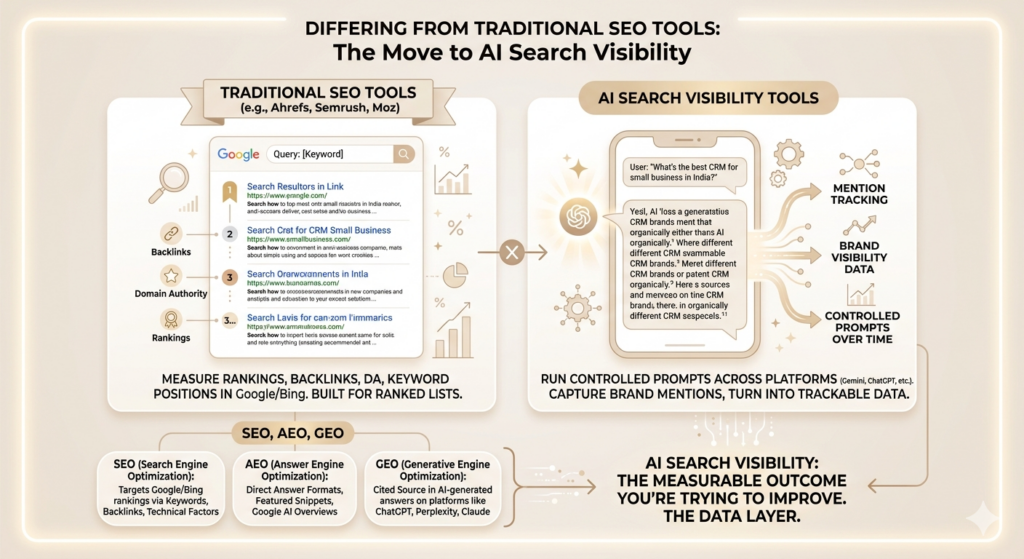
Traditional SEO tools like Ahrefs, Semrush, and Moz measure rankings, backlinks, domain authority, and keyword positions in search engines like Google and Bing. They were built for a world where you could directly inspect a ranked list of ten blue links.
AI search doesn’t work that way. When a user asks Gemini “What’s the best CRM for a small business in India?”, Gemini generates a paragraph response that may or may not mention your brand. There are no keyword positions to track. There are no rankings in the traditional sense. The response is unique, contextual, and changes based on how the question is phrased.
AI search visibility tools are built to handle exactly this. They run controlled prompts across AI platforms, capture which brands get mentioned in responses, and turn that into trackable data over time.
AI Search Visibility vs SEO vs AEO vs GEO
These terms get used interchangeably, and they shouldn’t be.
SEO (Search Engine Optimization) targets traditional Google/Bing rankings through keywords, backlinks, and technical factors.
AEO (Answer Engine Optimization) focuses on getting your content surfaced in direct answer formats like featured snippets and Google AI Overviews.
GEO (Generative Engine Optimization) is about being cited as a source in AI-generated answers across platforms like ChatGPT, Perplexity, and Claude.
AI search visibility is the measurable outcome that all three are trying to improve. It’s the data layer that tells you whether your SEO, AEO, and GEO efforts are actually getting your brand mentioned in AI responses.
Why AI Search Visibility Matters in 2026
Traditional organic traffic is getting squeezed from two directions at once.
On one side, Google’s own AI Overviews are answering queries directly on the results page, reducing the click-through rate for even first-position organic results. According to a 2025 BrightEdge study, AI Overviews reduced organic CTR for informational queries by up to 30% in categories where they appeared frequently.
On the other side, a portion of your audience has simply switched to asking ChatGPT, Perplexity, or Gemini instead of searching Google at all. Similarweb data from late 2024 showed AI chat platforms accounting for a rapidly growing share of referral traffic for informational and research-heavy categories.
The brands showing up in these AI answers are getting something valuable: citation-based visibility. When ChatGPT recommends a tool, or Perplexity cites a source in a buying-intent query, that carries implicit third-party authority that a paid ad simply cannot replicate.
And here’s the thing, most marketing teams haven’t caught up to yet: the brands being cited are often not the ones with the biggest budgets. They’re the ones with the most authoritative, well-structured, consistently updated content. Which means the playing field is more level than it looks, but only for brands paying attention.
AI Overviews and chatbot-based search are reducing organic click-through rates for informational queries by 20-30%, according to 2025 BrightEdge data. Brands not tracking their visibility in AI-generated responses are flying blind in an increasingly significant part of the search landscape. AI search visibility tools provide the monitoring layer that fills this gap.
How AI Search Visibility Tools Work
Prompt Tracking
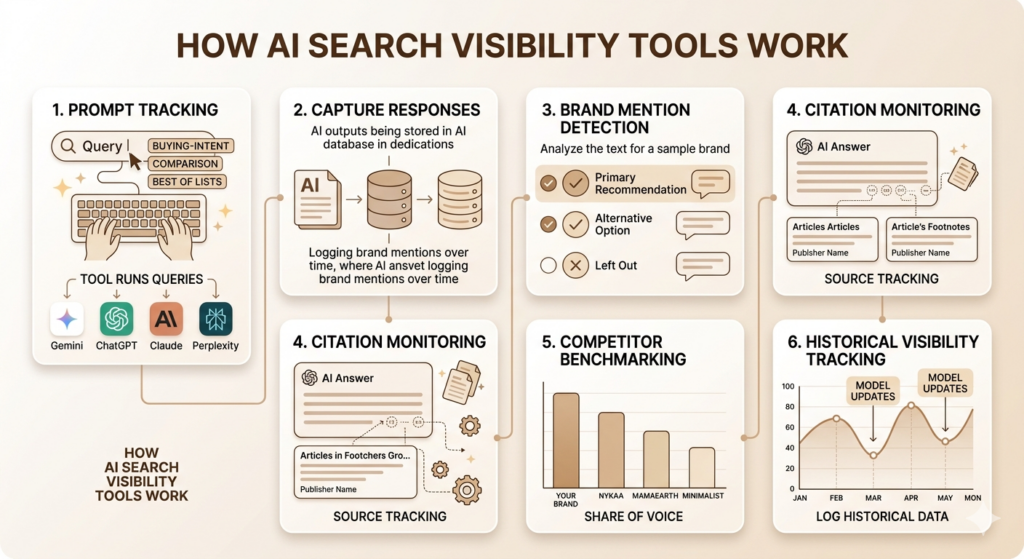
The core mechanic: the tool runs a library of queries relevant to your category across AI platforms like ChatGPT, Gemini, Claude, and Perplexity. These prompts are structured to reflect real user search behavior -buying-intent questions, comparison queries, “best of” lists, and how-to questions.
The tool captures what the AI engine says in response, identifies brand mentions, and logs them over time.
Brand Mention Detection
Once responses are captured, the tool parses them to identify where your brand appears and in what context. Was it the primary recommendation? Mentioned as an alternative? Left out entirely? The context matters as much as the mention.
Citation Monitoring
Some platforms go a step further and track which sources AI engines are pulling from when they generate answers. This is particularly relevant for publishers and content marketers who want to know if their articles are being used as references by AI systems.
Competitor Benchmarking
Most tools let you track competitor brands alongside your own. This gives you share of voice data: not just “is my brand mentioned?” but “compared to Nykaa, Mamaearth, and Minimalist, how often does my brand appear in AI responses about skincare?”
AI Engine Coverage
The better tools run prompts across multiple AI platforms simultaneously. What ChatGPT says about your brand may be completely different from what Perplexity says, because they use different training data and different retrieval methods.
Historical Visibility Tracking
Visibility in AI responses isn’t static. Model updates, content changes, and shifts in how your competitors are described all affect your position. Tools that log historical data let you spot trends: Was there a drop in mentions after a model update? Did a competitor gain ground?
Key Features to Look for in AI Search Visibility Tools
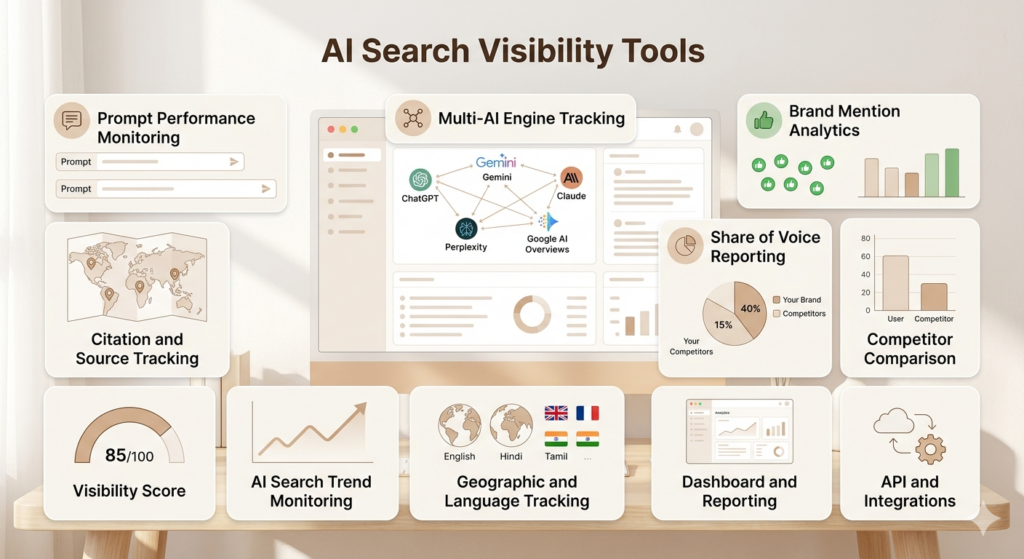
Not every tool in this category is equally capable. Here are the features that separate useful platforms from ones that give you a number without context.
Multi-AI Engine Tracking
The most important filter. A tool that only tracks ChatGPT is telling you half the story, because Gemini, Claude, Perplexity, and Google AI Overviews each have different knowledge sources and behavior patterns. Your brand could be well-represented on one and completely absent on another.
Look for tools that cover at minimum: ChatGPT (OpenAI), Gemini (Google), Claude (Anthropic), Perplexity, and Google AI Overviews. Bing Copilot coverage is a bonus.
Prompt Performance Monitoring
The quality of the prompts the tool uses matters enormously. Generic prompts like “best marketing tools” give you broad data that may not reflect how your actual buyers search. Good platforms let you customize or expand the prompt library to match your specific product category, use case, and audience.
Brand Mention Analytics
Beyond raw mention counts, you want context. Was your brand mentioned positively or neutrally? Was it the top recommendation or buried at the bottom? Was it mentioned alongside strong competitors or in a weaker cluster? These nuances tell you whether your AI visibility is actually driving perception or just appearing as noise.
Citation and Source Tracking
If you’re a publisher or content-heavy brand, knowing which of your URLs are being cited by AI engines is gold. This tells you which content is functioning as a trusted reference and which articles are invisible to AI systems despite potentially ranking well on Google.
Share of Voice Reporting
Share of voice in AI search is the percentage of relevant AI-generated responses where your brand appears, relative to competitors. A brand with 40% share of voice in ChatGPT responses about project management software is significantly more visible than a competitor with 15%. This metric is rapidly becoming as important as organic ranking position.
Competitor Comparison
You can’t optimize in a vacuum. The best tools show you not just your own visibility data but a side-by-side view of how competitors are performing across the same prompts and the same AI engines.
Visibility Score
A consolidated score that aggregates your performance across prompts, platforms, and time periods. Useful for executive reporting, trend tracking, and setting benchmarks. The methodology behind the score varies by tool, so understand what goes into it before anchoring your reporting to it.
AI Search Trend Monitoring
AI models update constantly, and those updates can shift which brands get mentioned in responses almost overnight. Tools that track trends over time help you catch these shifts early, before they show up as revenue impact.
Geographic and Language Tracking
If you’re operating in multiple markets, a tool tracking only English-language responses is missing a significant portion of your actual exposure. For Indian brands operating across Hindi, Tamil, Telugu, and English, geographic and language segmentation is a real requirement, not a nice-to-have.
Dashboard and Reporting
The data is only useful if your team can act on it. Clean dashboards, scheduled report exports, and team access controls matter more than most buyers think when evaluating these tools. A tool with rich data but a confusing interface will get ignored within a few weeks.
API and Integrations
For enterprise teams, the ability to pull AI visibility data into existing analytics stacks -Google Looker Studio, Tableau, HubSpot, or custom dashboards -is often essential. Ask about API availability and data export options before committing.
Benefits of Using AI Search Visibility Tools
Better AI Discoverability
The most obvious benefit: you can’t improve what you don’t measure. If you don’t know whether your brand is appearing in AI-generated responses, you have no baseline to optimize from. These tools give you that baseline.
Higher Brand Authority
Brands that consistently appear in AI answers for relevant queries build a perception of authority that compounds over time. Users who see your brand recommended by ChatGPT or Perplexity repeatedly start associating it with credibility, even if they never consciously notice. It’s similar to how PR mentions work, but on a far greater scale.
Earlier Detection of Visibility Issues
AI model updates can remove a brand from responses it previously appeared in, sometimes overnight. Without monitoring, you’d discover this drop through revenue impact weeks or months later. With an AI search visibility tool, you see the change in the data before it becomes a business problem.
Competitive Intelligence
These tools often reveal what your competitors are doing right in AI search before it shows up in any traditional metric. If a competitor’s brand suddenly starts appearing in twice as many AI responses, that’s a signal worth investigating: what content are they publishing? What sources are AI engines pulling from? What can you learn from it?
Content Optimization Opportunities
When you can see which prompts and queries produce AI responses that don’t mention your brand, you have a direct roadmap for content gaps. Build content that answers those exact queries with authority, and you’re targeting AI citation directly.
Better Marketing ROI
If your brand is being cited in AI-generated answers, that’s earned visibility with no cost-per-click attached. Tracking this helps you quantify the value of your content investments in a way that most marketing teams currently can’t, because they’re not measuring it.
Stronger AI-First SEO Strategy
AI search visibility data feeds back into your overall SEO strategy. You learn which topics generate AI citations, which content formats AI engines prefer to quote, and which authority signals seem to drive inclusion. This creates a feedback loop that makes your broader content strategy sharper over time.
AI search visibility tools offer brands real-time data on how often and how prominently they appear in AI-generated responses across platforms like ChatGPT, Gemini, and Perplexity. The primary benefit is not just awareness monitoring but a concrete feedback loop for content strategy: teams can identify citation gaps, benchmark against competitors, and measure the ROI of GEO-focused content investments.
Who Should Use AI Search Visibility Tools?
Honestly, any brand where search traffic matters. But some use cases are more urgent than others.
SEO teams at growth-stage companies need this data to expand their performance metrics beyond traditional keyword rankings. Without it, they’re missing a significant portion of the search landscape.
Content marketers can use AI visibility data to prioritize topics: which content themes are generating AI citations, and which aren’t? This directly improves content ROI.
SaaS companies are particularly exposed. When a buyer asks ChatGPT, “What’s the best email marketing tool for a startup?”, the brands that appear in that response have a massive advantage. SaaS buyers heavily research through AI chat.
Enterprise brands need this for brand protection as much as growth. A large brand not appearing in AI responses about its own category is a reputational signal worth taking seriously.
Agencies running SEO or content programs for clients need AI visibility reporting to show a complete picture of search performance, not just traditional rank tracking.
E-commerce businesses selling in competitive categories where buyers ask AI platforms for product recommendations are directly impacted by AI search citations.
B2B companies with long sales cycles especially benefit, because B2B buyers rely heavily on research phases where AI chat is increasingly central.
Publishers whose revenue depends on traffic need to know which of their content is being cited as a source by AI engines and which is being bypassed.
Best AI Search Visibility Tools in 2026
The market is still maturing. A handful of dedicated platforms have established early leads, and several traditional SEO tools have added AI visibility features to their existing products. Neither approach is automatically better -it depends on your needs.
| Tool | Best For | AI Platforms Supported | Standout Feature |
| Profound | Enterprise brands | ChatGPT, Gemini, Perplexity, Claude | Deep prompt library, SOV reporting |
| Otterly.ai | Agencies, SMBs | ChatGPT, Perplexity, Gemini | Fast setup, clean UI |
| Semrush AI Toolkit | Existing Semrush users | Google AI Overviews, Gemini | Integration with existing SEO data |
| SE Ranking | Multi-feature SEO teams | Google AI Overviews | Strong traditional SEO + AI combo |
| Ahrefs Brand Radar | Backlink-focused teams | Limited AI engines | Brand mention tracking alongside links |
| AthenaHQ | Content teams | ChatGPT, Gemini, Perplexity | Citation source identification |
| Peec AI | SMBs and startups | ChatGPT, Perplexity | Affordable, fast prompt testing |
| Promptwatch | Prompt-focused monitoring | ChatGPT, Perplexity | Granular per-prompt visibility tracking |
| LLM Pulse | Developer/API users | Multiple LLMs | API-first, customizable |
| HubSpot AEO | HubSpot ecosystem users | Google AI Overviews | Tied to HubSpot content tools |
Profound
Profound is one of the most established dedicated platforms in this space. It was built specifically for enterprise brand teams who need to track AI search presence across multiple platforms and markets.
Key features: Comprehensive prompt libraries across categories, share of voice reporting, multi-platform coverage (ChatGPT, Gemini, Perplexity, Claude), competitor benchmarking, and scheduled reporting.
Pros: Deep data, strong multi-engine coverage, enterprise-grade reporting. Cons: Pricing is enterprise-level, which puts it out of reach for smaller teams.
Best for: Mid-market to enterprise brand and SEO teams. Pricing: Custom enterprise pricing.
Otterly.ai
Otterly positions itself as the approachable option in the category. The interface is clean, setup is faster than most competitors, and it’s specifically designed for agencies running visibility tracking for multiple clients.
Key features: Multi-platform tracking, brand mention detection, competitor comparison, and client-friendly reporting.
Pros: Easy to use, good for agencies managing multiple brands. Cons: Less depth on citation source tracking compared to Profound or AthenaHQ.
Best for: Agencies, SMBs. Pricing: Tiered subscription pricing starting at an accessible monthly fee.
Semrush AI Toolkit
Semrush has built AI visibility features into its existing platform rather than launching a standalone product. If you’re already using Semrush for keyword tracking and backlink analysis, the AI Toolkit layers onto your existing workflow.
Key features: Google AI Overview tracking, Gemini visibility, integration with Semrush’s keyword and content tools.
Pros: No new platform to learn, AI data alongside traditional SEO metrics. Cons: Coverage is more Google-centric; less depth on ChatGPT or Perplexity.
Best for: Existing Semrush users who want to add AI visibility to their current reporting. Pricing: Add-on to existing Semrush plans.
SE Ranking
SE Ranking has added AI Overview tracking to its already-solid traditional SEO platform. The combination gives teams a single place to monitor both traditional keyword rankings and Google AI Overview presence.
Key features: Google AI Overview, visibility, keyword rank tracking, site audit, and backlink analysis.
Pros: Well-rounded traditional SEO features with AI coverage included. Cons: AI platform coverage is currently more limited than dedicated tools.
Best for: SEO teams wanting one platform for both traditional and AI search. Pricing: Affordable tiered plans.
Ahrefs Brand Radar
Ahrefs Brand Radar extends Ahrefs’ existing brand mention monitoring to cover AI-generated responses. For teams already deep in the Ahrefs ecosystem, it’s a natural extension.
Key features: Brand mention tracking across the web and AI, backlink data correlation with AI citations.
Pros: Strong integration with backlink data; useful for understanding the link between earned links and AI citation. Cons: AI engine coverage is narrower than dedicated platforms.
Best for: Content and SEO teams already using Ahrefs. Pricing: Available as part of Ahrefs plans.
AthenaHQ
AthenaHQ focuses specifically on citation tracking: not just whether your brand is mentioned, but which of your actual URLs are being cited by AI engines as sources. This makes it particularly valuable for publishers and content-heavy brands.
Key features: URL-level citation tracking, content performance in AI responses, and source identification.
Pros: Best-in-class citation source data. Cons: Narrower scope compared to full-platform competitors.
Best for: Publishers, content marketing teams. Pricing: Tiered subscription.
Peec AI
Peec AI is a lighter-weight tool designed for startups and smaller brands that want to get started with AI visibility tracking without enterprise pricing.
Key features: Prompt-based monitoring, brand mention alerts, competitor comparison.
Pros: Low barrier to entry, fast time-to-data. Cons: Less depth than enterprise tools; limited historical data.
Best for: Startups, small teams. Pricing: Affordable monthly plans.
Promptwatch
Promptwatch takes a granular approach, letting you set up and monitor specific prompts individually. This is useful for brands that have identified specific high-value queries they want to track closely.
Key features: Per-prompt visibility tracking, an alert system when mentions drop or appear, and trend monitoring.
Pros: High granularity, good for teams with a focused prompt strategy. Cons: Requires more manual setup than automated platforms.
Best for: SEO-focused teams with a defined prompt tracking strategy. Pricing: Tiered subscription.
LLM Pulse
LLM Pulse is more developer-oriented, offering API access to AI visibility data for teams who want to build custom monitoring into their own dashboards or internal tools.
Key features: API-first architecture, multiple LLM coverage, customizable query library.
Pros: Maximum flexibility. Cons: Requires technical setup; not plug-and-play.
Best for: Developer teams and data-driven enterprises. Pricing: Usage-based API pricing.
HubSpot AEO
HubSpot’s Answer Engine Optimization tools are built directly into the HubSpot content and marketing platform, making them most relevant for teams already running their content through HubSpot.
Key features: Google AI Overview monitoring, content recommendations tied to HubSpot blog data, and SEO integration.
Pros: Seamless for HubSpot users; recommendations are directly actionable in the platform. Cons: Limited outside of HubSpot’s owned channels; less multi-engine coverage.
Best for: HubSpot-native marketing teams. Pricing: Available on HubSpot’s higher-tier plans.
AI Search Visibility Tools vs Traditional SEO Platforms
These are not competing categories. They’re measuring different things, and you need both.
| Feature | AI Visibility Tools | Traditional SEO Tools |
| AI mention tracking | Yes | No |
| Prompt-based monitoring | Yes | No |
| Citation source analysis | Yes | Limited |
| Keyword rankings | Limited | Yes |
| Backlink analysis | Limited | Yes |
| Technical SEO audit | No | Yes |
| Google AI Overview tracking | Some | Some |
| Historical ranking data | Yes (newer) | Yes (extensive) |
| Share of voice (AI) | Yes | No |
| Share of voice (organic) | Limited | Yes |
The practical takeaway: if you drop your traditional SEO tools for AI visibility tools, you’ll lose your view of organic rankings, backlinks, and technical performance. If you run traditional SEO tools only, you’re blind to a growing portion of search behavior.
The brands building durable search strategies in 2026 are running both.
How to Choose the Right AI Search Visibility Tool
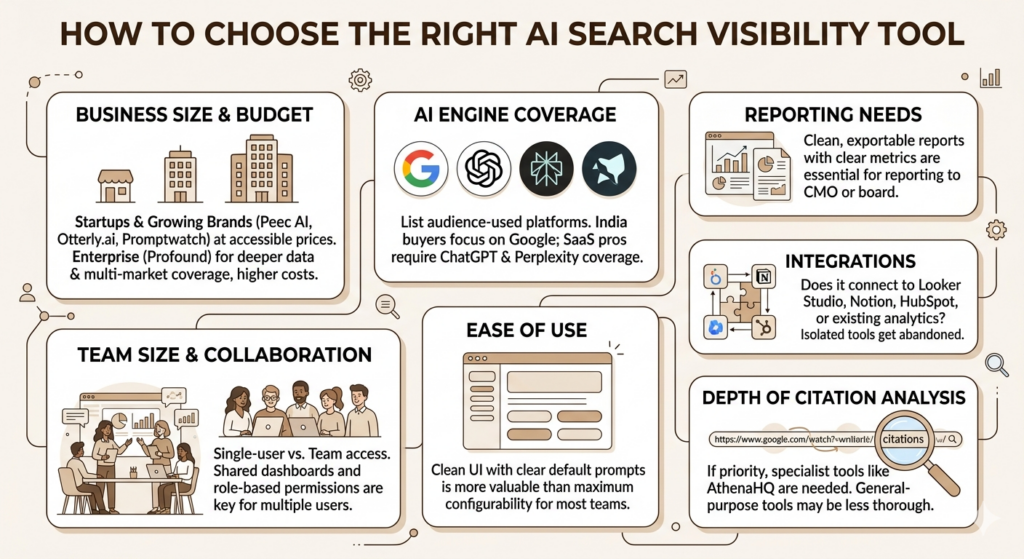
There are enough options now that choosing without clear criteria leads to either overspending on features you don’t use or under-buying and hitting a ceiling quickly.
Business size and budget: Enterprise tools like Profound offer deeper data and multi-market coverage, but at prices that don’t make sense for a 10-person team. Startups and growing brands are better served by Peec AI, Otterly.ai, or Promptwatch at more accessible price points.
AI engine coverage: List the platforms your audience actually uses. If your buyers are in India and predominantly using Google for research, AI Overview tracking matters more than heavy Perplexity coverage. If your buyers are SaaS professionals doing research, ChatGPT and Perplexity coverage becomes critical.
Reporting needs: If you’re reporting AI visibility to a CMO or board, you need a tool that produces clean, exportable reports with clear metrics. Not all tools do this equally well.
Integrations: Does the tool connect to your existing analytics stack? Can you pull data into Looker Studio, Notion, or HubSpot? The more isolated the tool, the less likely it is to get used consistently.
Team size and collaboration: Some tools are single-user focused; others are built for team access with shared dashboards and role-based permissions. If multiple people need to access the data, verify collaboration features before buying.
Ease of use: A tool that takes two weeks of setup and a dedicated analyst to interpret is a tool that gets abandoned. For most teams, a clean UI with clear default prompts is worth more than maximum configurability.
Depth of citation analysis: If citation tracking (knowing which URLs are cited by AI engines) is a priority for your content strategy, AthenaHQ is the specialist. General-purpose tools do this less thoroughly.
Best Practices to Improve AI Search Visibility
The tools tell you where you stand. These practices move the needle.
Publish authoritative, well-structured content. AI engines pull from content they can trust. That means clear structure (H1 through H4 headings), specific claims with named sources, and depth that signals expertise rather than surface-level coverage.
Build topical authority. A brand with 40 strong articles covering a topic from multiple angles is far more likely to be cited than a brand with one excellent article and nothing else. Consistency of coverage signals domain expertise to AI engines.
Add structured data (schema markup). FAQ schema, Article schema, and HowTo schema all help AI engines extract and use your content more reliably. This is a technical implementation, but a high-leverage one.
Improve your E-E-A-T signals. Experience, Expertise, Authoritativeness, and Trustworthiness (E-E-A-T) are Google’s quality framework, but they’re also a reasonable proxy for what AI engines value. Named authors with credentials, linked expert sources, and factual accuracy all contribute.
Earn citations from trusted sources. AI engines learn which brands to recommend partly from which other trusted sources mention. Press coverage, industry reports, and backlinks from authoritative publications all contribute to AI citation likelihood.
Update content regularly. AI engines deprioritize outdated content. Articles with recent updates, current statistics, and current examples are more likely to be cited than evergreen content that hasn’t been touched in three years.
Optimize your FAQ sections. Question-answer pairs are among the most extractable content formats for AI engines. Every major article should have a well-constructed FAQ that covers the questions your audience actually asks.
Create entity-rich content. Name the specific brands, tools, frameworks, and people you’re discussing. AI systems build knowledge graphs from named entities. Vague references to “a leading e-commerce platform” are less useful than “Flipkart” or “Meesho.”
Improve internal linking. Strong internal link structures help AI crawlers understand the relationship between your content pieces. A well-linked content cluster signals topical depth.
Monitor AI search prompts continuously. AI visibility is not a set-and-forget metric. Run regular prompt audits to see how your presence changes over time, especially after major AI model updates.
Improving AI search visibility requires a combination of technical optimization and content strategy. Brands that publish authoritative, entity-rich content with clear structure, strong E-E-A-T signals, and consistent topical coverage are significantly more likely to appear in AI-generated responses than those relying on traditional SEO tactics alone. Structured data, regular content updates, and strong internal linking all contribute to AI citation frequency.
Common Challenges in AI Search Visibility
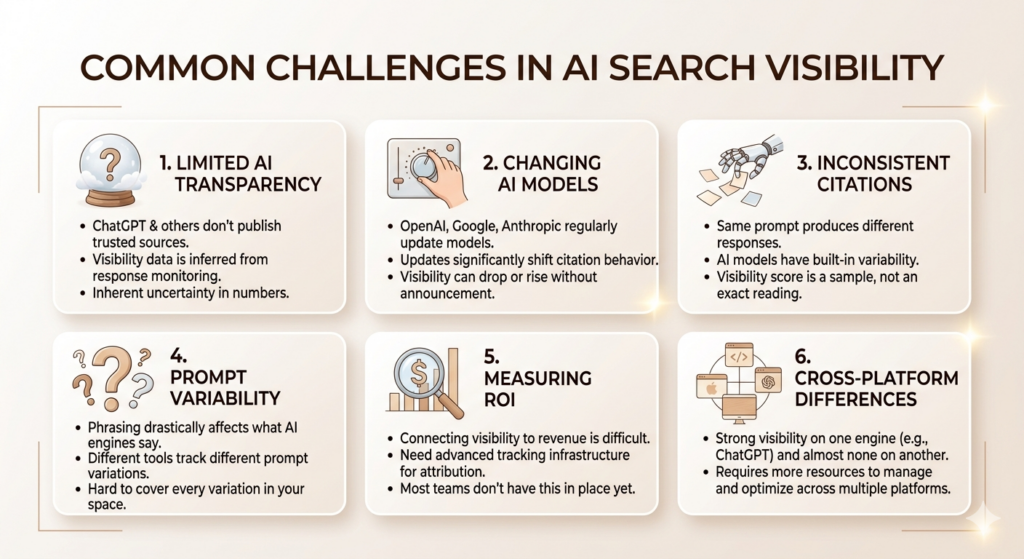
This category is not without its frustrations. Going in with eyes open saves time.
Limited AI transparency. ChatGPT doesn’t publish a list of sources it trusts or a ranking of brands it mentions. The data AI visibility tools surface is inferred from response monitoring, not from direct API access to the model’s preference data. This means there’s inherent uncertainty in the numbers.
Changing AI models. OpenAI, Google, and Anthropic update their models regularly. A model update can shift citation behavior significantly without any announcement. Brands can see visibility drop (or rise) for reasons that have nothing to do with their own content changes.
Inconsistent citations. The same prompt can produce different responses on different days, or even in different sessions on the same day. AI models have variability built in. This means your visibility score at any given moment is a sample, not an exact reading.
Prompt variability. How you phrase a question dramatically affects what AI engines say. A tool tracking “best CRM for startups” and one tracking “top CRM tools for small businesses” may produce completely different brand mentions. No tool can cover every variation of every prompt in your space.
Measuring ROI. Connecting AI search visibility to revenue is still genuinely difficult. You can see that your brand is mentioned more; attributing that to conversions requires tracking infrastructure that most teams don’t yet have in place.
Cross-platform differences. Your brand might have strong visibility on ChatGPT and almost none on Perplexity, or vice versa. Managing and optimizing across multiple AI engines simultaneously requires more resources than optimizing for a single platform.
Future Trends in AI Search Visibility
AI-First SEO Becomes Standard Practice
Right now, AI search visibility monitoring is still early-adopter territory. Within 12 to 24 months, this will likely be as standard as rank tracking. The brands building this capability now will have a meaningful head start in both data and institutional knowledge.
Generative Engine Optimization Matures
GEO is still a relatively new discipline, but the practices are solidifying quickly. Expect clearer playbooks around content formats, entity optimization, and citation-building strategies that specifically target AI-generated responses.
Answer Engine Optimization Becomes a Core SEO Metric
AEO is already being tracked by teams doing serious content work, but it will become a default reporting metric rather than an advanced add-on. AI Overview, appearance rates, featured snippet capture, and voice search visibility will be standard dashboard items.
AI Agents Change the Game
AI agents that autonomously research, compare, and recommend products are moving from prototype to production. When an AI agent is making a purchase recommendation on behalf of a user, being present in the agent’s knowledge base becomes a sales channel. This is still emerging, but it’s worth watching.
Brand Entity Optimization
Optimizing how AI engines understand your brand as an entity (what it is, what category it belongs to, what makes it credible) will become a distinct practice. This goes beyond keyword optimization into territory that’s more like PR and knowledge graph management.
Predictive Visibility Analytics
Tools will move from telling you where you are to predicting where you’re going. As platforms accumulate historical data, they’ll be able to forecast visibility trajectory based on content activity, competitor changes, and model update patterns.
AI Search Analytics as a Core SEO Metric
The split between “traditional SEO metrics” and “AI visibility metrics” will narrow. Expect unified dashboards and reporting systems that treat both as equal components of overall search performance rather than separate workstreams.
Conclusion
The shift to AI-powered search is not a future risk. It’s a current reality affecting traffic, brand perception, and buyer behavior right now. AI search visibility tools are the measurement layer that lets you understand where your brand stands in this new environment and what to do about it.
These tools don’t replace traditional SEO platforms. They complement them. A brand running both has a complete picture of its search presence across both traditional rankings and AI-generated responses. A brand running only traditional SEO tools is missing an increasingly significant portion of how people actually find and evaluate options.
Start with a clear goal. Pick a tool matched to your team’s size, budget, and AI engine priorities. Set a monitoring cadence. And use the data to feed back into your content strategy, your E-E-A-T signals, and your structured data implementation.
The brands that figure out AI search visibility in 2026 are the ones that will have an outsized advantage when AI-first search becomes the default. That’s not a distant outcome. It’s already in progress.
FAQs
What is an AI search visibility tool?
An AI search visibility tool is a platform that tracks how often and how prominently your brand appears in responses generated by AI-powered search engines like ChatGPT, Google Gemini, Perplexity, and Claude. Unlike traditional SEO tools, these platforms run controlled prompts across AI engines and measure brand mentions, citations, and share of voice in the results.
How is AI search visibility different from traditional SEO?
Traditional SEO measures your position in ranked search results on platforms like Google and Bing. AI search visibility measures your presence in conversational AI-generated responses where there are no ranked positions, only mentions, citations, and recommendations. You need both to understand the full picture of your search presence in 2026.
Which AI search engines do these tools support?
Coverage varies by platform. The most commonly supported engines are ChatGPT (OpenAI), Google Gemini, Perplexity, Claude (Anthropic), and Google AI Overviews. More comprehensive tools cover all five; budget platforms may focus on two or three. Always check engine coverage before subscribing.
Can AI search visibility tools actually improve my rankings?
Not directly, because there are no “rankings” in AI search the way there are in Google. What these tools do is show you where you’re missing presence, so you can publish the right content to earn citations. The improvement comes from acting on the data, not from the tool itself.
Are AI search visibility tools worth it for small businesses?
It depends on how much your business relies on search traffic and how competitive your category is. For most small businesses, starting with a more affordable platform like Peec AI or Otterly.ai makes sense. Even basic monitoring gives you data you simply can’t get from Google Analytics or Search Console.
What metrics should I track in AI search?
The core metrics are: brand mention frequency (how often you appear across tracked prompts), share of voice (your mentions relative to competitors), platform distribution (which AI engines mention you most), and citation source data (which specific URLs are being cited). As your program matures, you can add trend tracking and prompt-level granularity.
How often should I monitor AI search visibility?
At a minimum, monthly. But if you’re actively publishing content with the goal of improving AI citation, a weekly or bi-weekly cadence gives you faster feedback loops. After major AI model updates from OpenAI, Google, or Anthropic, run a spot check regardless of your regular schedule.
Which AI search visibility tool is best for enterprises?
Profound is currently the most established dedicated enterprise platform, offering deep multi-engine coverage, robust share of voice reporting, and the prompt library depth that enterprise programs need. Semrush’s AI Toolkit is a strong option for enterprises already embedded in the Semrush platform who want AI visibility without adopting a new tool.
Does content quality actually affect AI search visibility?
Yes, significantly. AI engines prioritize content that is authoritative, well-structured, factually specific, and regularly updated. Thin content with generic claims is far less likely to be cited than an article with named sources, clear entity references, and a thorough FAQ section. This is one of the clearest signals from monitoring how citation frequency varies across content types.
What’s the connection between backlinks and AI search visibility?
The relationship isn’t fully understood yet, but there’s evidence that sites with stronger backlink profiles and domain authority are cited more frequently by AI engines. This makes sense: AI models are trained on web data, and highly-linked content is more likely to have been included in training sets or retrieval databases.