

Plenty of people applying for product marketing jobs can write a decent launch email. Far fewer can explain why a feature matters to the person paying for it, and that gap is where hiring decisions tend to get made.
Product marketing manager skills have shifted, too. According to the Product Marketing Alliance’s State of Product Marketing Report 2026, the metrics leadership cares about have moved towards revenue and commercial impact. AI now sits inside most people’s daily workflow. The job asks you to be part researcher, part storyteller, part analyst.
This guide covers 15 product marketing manager skills, from customer research to commercial thinking, with a real-world use for each and one way to practise it. None needs a particular degree, and most can be practised long before you have the job title. Which ones deserve your attention first depends on your product, your industry and how senior you are. A PMM selling B2B software won’t weight them the same way as one at a D2C beauty brand.
Table of Contents
What Does a Product Marketing Manager Do?
A product marketing manager (PMM) connects what a product does with what customers need, then makes sure sales, marketing and the product team all tell the same story about it.
Understanding the role and its business impact
Read any product marketing manager job description and the verbs repeat: research, position, launch, enable. The Product Marketing Alliance frames the function as owning a product’s route to market and its success afterwards, from the spot where product, sales and marketing meet. That middle seat is why PMMs keep getting pulled into revenue conversations.
How the role differs from product management and general marketing
A product manager decides what gets built. A PMM decides how it’s explained, to whom, and why anyone should care. General marketing, meanwhile, usually chases leads for the whole company, while you’re chasing understanding and adoption for one product.
Responsibilities before, during, and after a product launch
Say a software company is adding a reporting dashboard to its invoicing app. (It’s a made-up case, but the pattern is real.) Before launch, you interview customers and settle the message. During it, you brief sales and publish the launch pages. Afterwards, you track adoption and fix whatever confused people.
Those are the everyday product marketing manager responsibilities, and a sound product launch strategy covers all three phases, not just launch week.
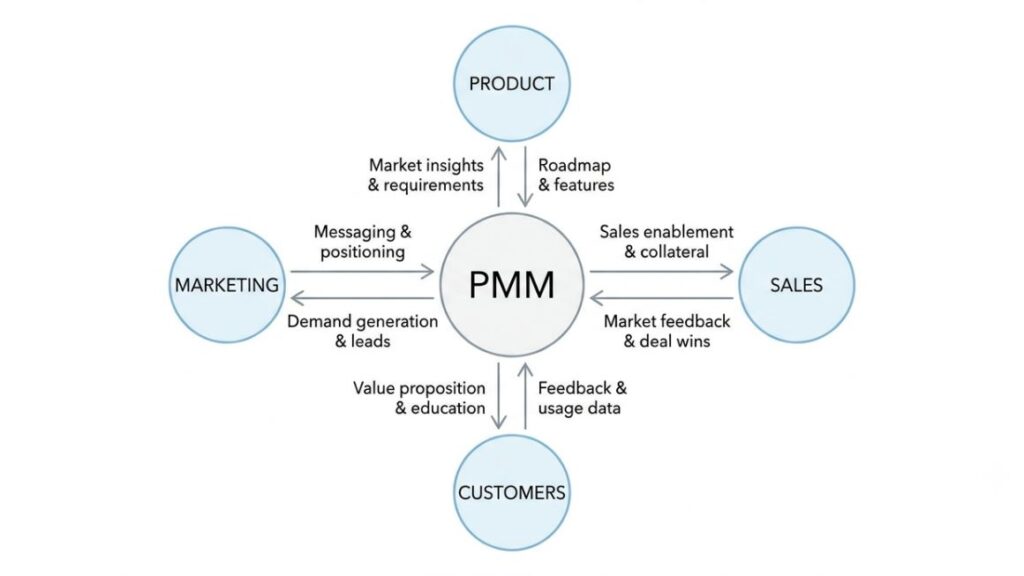
A product marketing manager connects customer needs, product capabilities, sales and marketing, and owns how the market understands a product from research through launch and adoption. A product manager decides what gets built; a PMM decides how it is positioned, explained and measured.
15 Essential Product Marketing Manager Skills
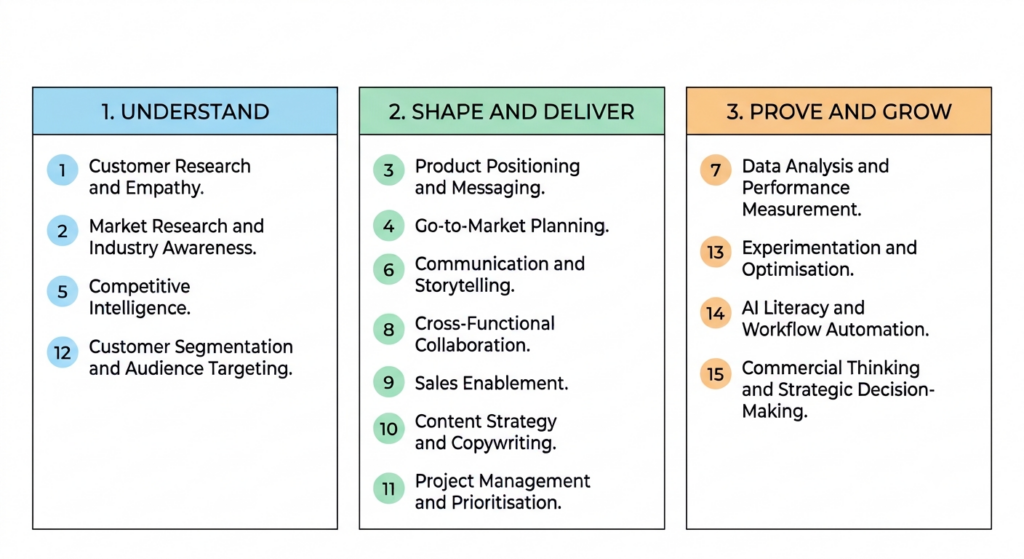
Product marketing skills fall into three loose groups: understanding customers and markets, shaping and delivering the message, and proving the work paid off. The 15 product marketing manager skills below cut across all three. Each one comes with a place you’d use it and one thing you can do this month to get better.
1. Customer Research and Empathy
Of the product marketing manager skills on this list, this is the one everything else leans on. Customer research means talking to buyers and users until you can describe their problem better than they can, workarounds and all. Interviews, surveys and a habit of reading support tickets are the raw material behind your market research skills, and they stop launches from being built on guesses.
Before that dashboard launch, you’d ask five recent customers how they chase unpaid invoices today. To build the habit, book two customer calls a month and write down their exact words before you interpret a single one.
2. Market Research and Industry Awareness
Customer calls tell you about five people.
Market research tells you whether five hundred thousand more feel the same. You’re sizing demand, splitting the market into segments, and watching what buyers now expect that they didn’t two years ago.
Picture a PMM at a fintech app checking whether a new feature suits first-time investors or experienced traders, since the two groups buy for different reasons. To practise, pick one industry newsletter and one analyst report, then write a half-page note on what changed this quarter.
3. Product Positioning and Messaging
Positioning is a short answer to three questions: who is this for, what problem does it solve, and why should they pick it over the alternatives? Messaging is how you say that answer to different audiences. According to Enrich Labs’ 2026 summary of the Product Marketing Alliance’s 2025 report, positioning and messaging appear in 91% of PMM roles.
Look at India’s quick-commerce race. Blinkit, Zepto and Swiggy Instamart all push roughly ten-minute delivery, so speed alone stopped telling them apart. A January 2026 YourStory analysis called the three “same same but different”: Swiggy leaning on megapods, Blinkit on variety, Zepto on price. Strong product positioning and messaging make that kind of choice visible to a buyer.
To practise, take a product you use and fill in this sentence: for [who], is the [category] that [main benefit], unlike [alternative]. Then rewrite it for a second audience.
4. Go-to-Market Planning
A go-to-market plan answers who you’re selling to, what you’re offering, when it ships, where you’ll reach people and how you’ll know it worked. Miss one piece and the rest wobble. A go-to-market strategy that lists channels but no success measure is a to-do list with ambition.
For the dashboard, that could mean existing customers first, a two-week email and in-app sequence, and one number to watch: the share of active accounts that open a report within 30 days. Practise by writing a one-page plan for a launch you’ve followed, then compare it with what the company actually did.
5. Competitive Intelligence
Competitive intelligence is tracking what rivals say, charge and ship, then deciding what it means for you. It isn’t copying them. A proper competitive analysis compares real alternatives, including the spreadsheet or the do-nothing option, and sticks to claims you can back up. Honestly, a comparison that only flatters your own product fools nobody, least of all your sales team. Unsupported statements about a competitor get you a very awkward call from legal.
Start with a simple table: three rivals, their pricing page, their top three claims, and where each one is weakest. Update it monthly.
6. Communication and Storytelling
“Real-time analytics engine” means nothing to a busy buyer. “See who hasn’t paid without opening a spreadsheet” does. That gap is the whole skill: turning a feature list into something a person can repeat to a colleague, using short words and, ideally, a story with an actual human in it.
Complex products lose people in the first sentence, so practise on one you find confusing. Take its headline and rewrite it until a friend outside your industry can explain it back to you.
7. Data Analysis and Performance Measurement
What happened after launch, and how do you know? Data analysis is one of those product marketing manager skills people assume they can skip, and then regret it. Conversion, activation (the share of new users who reach a first useful moment), adoption and revenue-linked numbers are how a PMM answers that. You don’t need to code. You do need to read a funnel without flinching.
Say sign-ups were healthy but few accounts ever opened the dashboard. That’s an activation problem, not a demand problem, and the fix is different. Build the skill by taking a free analytics demo or a public dataset and writing three findings and one recommendation.
8. Cross-Functional Collaboration
You’ll rarely own the people you depend on. Product controls the roadmap, sales controls the conversations, design controls how it looks, customer success hears what’s breaking, and leadership signs off on budget. Getting all of them behind one story takes patience more than process, and it’s one of the product marketing manager skills you mostly learn on live projects.
In practice, that’s a launch kickoff where each team states one thing it needs from you and one thing you need from it. To build the skill, run a small cross-team project, even a volunteer one, and keep a log of who needed what and when.
9. Sales Enablement
Sales enablement means giving sales teams the content, training and talking points they need to explain a product’s value and handle objections the same way every time. It’s also where a lot of product marketing work quietly dies. The same Enrich Labs breakdown has enablement in 78.7% of PMM roles, up from 64% in 2024.
Think about a rep who hears “we already use a spreadsheet” on every call. A one-page objection guide written from real call notes often does more than a fresh slide deck. Practise by sitting in on three sales calls and drafting answers to the most common objections.
10. Content Strategy and Copywriting
Landing pages, launch emails, explainer videos, comparison pages: PMMs either write these or brief the people who do. The test is simple. Can a stranger land on the page and understand what the product does within a few seconds?
For the dashboard, that could be a launch page, a three-email onboarding series and a short help-centre guide. Get better by rewriting one real landing page you don’t love, then asking two people which version they’d click.
11. Project Management and Prioritisation
Launches have dependencies, and dependencies slip.
The design file arrives late, legal wants another review, and sales asks for a feature-specific deck three days before go-live. You’ll spend a surprising amount of time deciding what not to do.
A simple tracker with owners, dates and a column for “what breaks if this slips” beats a clever tool nobody opens. Practise by planning something with real deadlines, like a college fest or a family function, using exactly that tracker.
12. Customer Segmentation and Audience Targeting
The same product gets bought for different reasons by different people. A finance head wants control, an ops manager wants fewer errors, and an end user wants it to be easy. Segmentation means grouping buyers by needs, use cases and decision-making roles, then adjusting what you say to each.
With the invoicing app, a freelancer cares about getting paid on time, while an agency owner cares about seeing every client’s balance. Take your product’s last ten customers, sort them by why they bought, and write one message per group.
13. Experimentation and Optimisation
You won’t know which headline works until you test it. Experimentation means changing one thing at a time (a message, an offer, an onboarding step) and measuring the result, instead of debating it in a meeting. It also means accepting that some of your favourite ideas will lose.
Try two subject lines on a small slice of a launch email list, then send the winner to everyone else. To learn the basics, read one A/B testing guide and run a tiny test on your own LinkedIn posts.
14. AI Literacy and Workflow Automation
AI is part of the job now, and it’s the newest of the product marketing manager skills on this list. Using it well means checking its claims, keeping customer and company data out of tools your employer hasn’t approved, and treating its drafts as drafts, never as positioning.
Good uses include summarising twenty interview transcripts into themes or building a first-pass competitor table, both of which you then verify. Build the skill by running the same task with and without AI, and noting where it saved time and where it made things up.
15. Commercial Thinking and Strategic Decision-Making
Plenty of people stop at execution. At senior level, product marketing manager skills add one more layer: linking customer value and marketing activity to adoption, retention, profitability and growth. You ask what the launch is worth, not just whether it went out on time.
A PMM with this habit might argue against a flashy launch event because the same budget could fund onboarding emails that lift retention. Practise by reading a company’s public results or pricing page and writing down how it makes money, who its best customers probably are, and what you’d prioritise first.
Which Skills Matter Most in 2026?
Positioning, launches, enablement and research anchor most PMM jobs, and 2026 adds AI fluency and revenue accountability on top. Hiring, meanwhile, favours people who’ve done it before.
Skills employers are asking for
According to Enrich Labs’ summary of the Product Marketing Alliance’s 2025 report, positioning appears in 91% of PMM roles, launches in 80.9%, enablement in 78.7% and research in 69.7%. As of 28 October 2026, Growth.Talent listed 136 open product marketing roles, 64 posted in the previous 30 days. Manager-level openings led with 57, then 30 senior and 22 mid-level. Proof of work beats a long skills list.
How AI is changing everyday product marketing work
The Product Marketing Alliance’s State of Product Marketing Report 2026 found that about 80% of PMMs use AI regularly for specific tasks. Its public summary describes widespread adoption alongside real caution, and a wide gap between individual use and company readiness. Checking output and protecting data are skills now, not extras.
Why business outcomes matter more than marketing output alone
The same summary says PMM reporting lines have moved closer to executive leadership, and that the metrics leadership watches now centre on revenue and commercial impact. Shipping more assets isn’t the goal. Moving adoption is.
Treat the numbers with care. The job data comes from one board that leans towards US and French listings and says little about hiring in India, and its counts change by the hour. PMA’s survey reflects the people who answer PMA. Neither dataset speaks for every market, so check a few current listings in your own city before choosing what to learn first.
Employers hiring product marketers in late 2026 mostly want proven, mid-to-senior operators who combine customer research, positioning and measurement with AI fluency. According to the Product Marketing Alliance’s 2026 report, about 80% of PMMs already use AI regularly, and leadership now judges the function on revenue and commercial impact.
How to Develop These Skills Step by Step?
You build these product marketing manager skills the way you’d build any other: learn the basics, apply them to a real product, measure something, and show your work. One sensible product marketing career path starts with research and positioning, then adds analytics as your responsibilities grow.
Build a foundation in customer research and positioning
Start here because every other skill depends on it. Read a couple of strong positioning guides, then run five real customer or user conversations, even informal ones. Write a one-page summary of the patterns, including the exact phrases people used, and test your positioning on someone outside your industry.
Practise with a real or hypothetical product
You don’t need a job title to practise. Pick something you’ve used and have opinions about, like a food delivery app or a budgeting tool, and pretend a new feature ships next month. Work through research, messaging, a launch plan and a measurement plan, and label it clearly as a practice project.
Learn analytics and experiment design
Get comfortable with a funnel (visit, sign-up, activation), a cohort (a group of users who joined in the same period) and a basic A/B test. Change one thing, pick one success metric, and skip the advanced statistics until you need them. A free analytics tier and a small test on your own content are plenty to begin with.
Build a portfolio that demonstrates your thinking
Turn each exercise into a short case study: the problem, what you researched, what you decided and why. Two or three solid ones beat ten thin ones, and a simple Notion page or a short PDF is a fine place to host them.
Here’s a sample exercise to try:
- Choose a product you know well and use regularly.
- Identify its main audience and the job they’re hiring it to do.
- Analyse three alternatives, including doing nothing, on price, features and promise.
- Write a one-sentence positioning statement.
- Design a launch plan with measurable goals, such as sign-ups or activation within 30 days.
Tools Every Product Marketer Should Know
Tools should follow the task, not the other way round. Pick the job first, then the product marketing tools that do it.
Research and customer feedback tools
Dovetail stores and tags interview notes so patterns show up across calls, and a shared spreadsheet is still a perfectly good starting point. For tracking rivals, Klue and Crayon collect competitor changes and turn them into battlecards, the one-page cheat sheets sales reps use on calls.
Analytics and experimentation tools
Amplitude covers product analytics: how people move through a product and where they drop off. For website and app tests, VWO and Optimizely are common choices.
Collaboration, content, and AI tools
HubSpot handles marketing workflows such as email and landing pages, while Notion and Slack keep launches coordinated. AI assistants like ChatGPT, Claude and Perplexity help with research synthesis, as long as you check what they tell you. Learn the ones your target job lists, not all of them. Never paste confidential customer data into a tool your company hasn’t approved.
How to Demonstrate Your Skills in a Portfolio or Interview?
Show the problem, the research, your reasoning, the deliverables and the outcome. Anyone testing your product marketing manager skills wants to see how you think, not only what you made.
What to include in a product marketing case study
Open with the customer problem and the business goal. Then show your research, the positioning you chose and the alternatives you rejected, followed by the actual deliverables: a messaging doc, a launch plan, a sample email or page. Finish with outcomes, kept to a page or two in total. If the project was a practice exercise, say so plainly and describe how you’d measure success instead of inventing numbers.
How to explain decisions and results in interviews
Interviewers dig into the why. Be ready to say what you knew when you decided, what you’d change now, and what you got wrong. Expect product marketing interview questions such as how you’d position against a bigger rival, launch with a small budget, or win over a sales team that ignores your messaging. Rehearse stories out loud with a friend rather than memorising scripts.
How to demonstrate transferable skills without direct experience
Maybe you ran campaigns, handled customer calls or taught something. Map each one to a PMM skill: customer calls become research, campaign reports become measurement. Then back each claim with a practice project and a short write-up.
A strong product marketing portfolio shows the customer problem, the research, the reasoning, the deliverables and the outcome. Practice projects should be labelled as such, with planned success measures instead of invented results.
Common Mistakes to Avoid
Five mistakes keep dragging down otherwise strong product marketing manager skills, and most are fixable inside a quarter.
- Selling features. Buyers care what changes for them, such as fewer hours spent chasing payments, so lead with that and let the spec sheet follow.
- Skipping customer research. If you haven’t spoken to buyers recently, your messaging is a guess with good formatting.
- Trusting AI drafts. They read smoothly and can still be wrong or generic, so verify the facts and rewrite in your own voice.
- Measuring too little. A launch with no success metric can’t be judged, learned from or defended in a budget meeting.
- Working apart from sales and product. Messaging that sales never uses and product never hears about helps nobody.
Conclusion
The product marketing manager skills that carry the most weight sit closest to the customer and the revenue line: research, positioning, measurement and the judgement to connect them. Tools and templates can be picked up along the way. Skills like these compound, so a small habit every week beats a big push the night before an interview.
So don’t try to fix all 15 at once. Choose two this week, run the one-product exercise, and write down what you got wrong.
If you’d like mentors and live feedback while you do it, YUP’s 8-Week Product Marketing Course is a live, weekend cohort programme covering positioning, messaging, persona research and pricing.
Frequently Asked Questions
What are the most important skills for a product marketing manager?
The most important product marketing manager skills are customer research, positioning, go-to-market planning, communication, data analysis and cross-functional collaboration. The exact mix shifts by company. A B2B software team may lean harder on competitor work and sales support, while a consumer brand may lean on audience insight and storytelling.
Do product marketing managers need technical skills?
You need enough technical understanding to explain what the product does accurately and hold your own with engineers. Coding isn’t a requirement. Analytics, AI literacy and technical fluency matter more in some roles, especially developer and data products, where you may need to read a basic dashboard or understand how an API fits together at a high level.
Can a beginner become a product marketing manager without experience?
Yes, though some employers prefer prior marketing or product experience, and current openings lean mid-to-senior. Beginners can build product marketing manager skills through customer interviews, competitor write-ups, positioning exercises and launch plans, all labelled as practice work.
What tools should a product marketing manager learn first?
Start with whatever supports customer research, analytics, collaboration and content for the job you want. Read the listing, check the company’s existing workflow, and learn that. Collecting platforms you never use won’t help.
How is AI changing product marketing skills in 2026?
AI speeds up research synthesis, first drafts and competitor monitoring. You still have to check its output, protect sensitive data, understand customers and make the strategic calls. The Product Marketing Alliance’s 2026 report found that about 80% of PMMs already use it regularly for specific tasks.
How can I demonstrate product marketing skills in an interview?
Bring one case study that walks through the customer problem, your research, your positioning, the launch plan and how you’d measure success. Use real results if you have them. If the project was a simulation, label it that way and talk about what you’d measure, not what you’d claim happened.